

Date: 2011-11-27, 1:43 am. E.S.T.
To the Guy Who Tried to Mug Me in Downtown Savannah night before last.
I was the guy wearing the black Burberry jacket that you demanded that I hand over, shortly after you pulled the knife on me and my girlfriend, threatening our lives. You also asked for my girlfriend’s purse and earrings.
I can only hope that you somehow come across this rather important message.
First, I’d like to apologize for your embarrassment; I didn’t expect you to actually crap in your pants when I drew my pistol after you took my jacket..
The evening was not that cold, and I was wearing the jacket for a reason.. my girlfriend was happy that I just returned safely from my 2nd tour as a Combat Marine in Afghanistan .. She had just bought me that Kimber Custom Model 1911 .45 ACP pistol for my birthday, and we had picked up a shoulder holster for it that very evening.
Obviously you agree that it is a very intimidating weapon when pointed at your head … isn’t it?!
I know it probably wasn’t fun walking back to wherever you’d come from with crap in your pants.
I’m sure it was even worse walking bare-footed since I made you leave your shoes, cell phone, and wallet with me. (That prevented you from calling or running to your buddies to come help mug us again).
After I called your mother or “Momma” as you had her listed in your cell, I explained the entire episode of what you’d done. Then I went and filled up my gas tank as well as those of four other people in the gas station, — on your credit card. The guy with the big motor home took 153 gallons and was extremely grateful!
I gave your shoes to a homeless guy outside Vinnie Van Go Go’s, along with all the cash in your wallet. [That made his day!]
I then threw your wallet into the big pink “pimp mobile” that was parked at the curb ….. after I broke the windshield and side window and keyed the entire driver’s side of the car.
Earlier, I managed to get in two threatening phone calls to the DA’s office and one to the FBI, while mentioning President Obama as my possible target. The FBI guy seemed really intense and we had a nice long chat (I guess while he traced your number etc.).
In a way, perhaps I should apologize for not killing you … but I feel this type of retribution is a far more appropriate punishment for your threatened crime.
I wish you well as you try to sort through some of these rather immediate pressing issues, and can only hope that you have the opportunity to reflect upon, and perhaps reconsider, the career path you’ve chosen to pursue in life..
Remember, next time you might not be so lucky. Have a good day!
Thoughtfully yours, Semper fi,
Alex
Until it was restored, it kind of looked like a chicken finger.
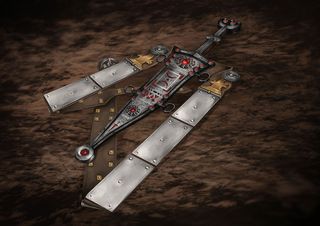
An illustration of the Roman dagger, sheath and belt. (Image credit: Elif Siebenpfeiffer)
Archaeologists in Germany were “lost for words” after the discovery of a 2,000-year-old silver dagger. The weapon was found in its sheath in the grave of a Roman soldier who once fought against the Germanic tribes.
The dagger was so corroded, it took nine months of sandblasting and grinding before the sharp, 13-inch-long (35 centimeters) weapon was restored, at which point researchers were easily able to remove it from its richly decorated sheath.
The find is unusual, given that “it was not the normal practice for Roman soldiers to be buried with their military equipment,” said Bettina Tremmel, an archaeologist at the Westphalie Department for the Preservation and Care of Field Monuments in Germany, who specializes in the Roman Empire and took part in the excavation with the University of Trier.
An intern with the Westphalie department, 19-year-old Nico Calman, discovered the dagger and sheath, as well as the remains of the decorated leather belt, during an archaeological dig at Haltern am See (Haltern at the Lake), a town in the German state of North Rhine-Westphalia, in April 2019.
During the Augustan period, from 27 B.C. to A.D. 14, Haltern was home to a Roman military base, known as “Hauptlager,” or “main camp.” Archaeologists have known about the site since 1900, making the newfound discovery of the dagger all the more surprising, Tremmel said.
The Roman soldiers stationed at the base weren’t terribly successful. Three Roman legions (large military units of about 5,000 men each) were wiped out during the defeat of the Roman general and politician Varus by the Germanic tribes in A.D. 9. Not too far from the base is a cemetery, where Roman soldiers and their families were buried.
It was there, in this cemetery, that Calman discovered the corroded dagger.
“The discovery of the dagger was emotional. We were lost for words,” Tremmel told Live Science. “Imagine: Though thousands of Roman soldiers were stationed in Haltern over almost 15 years or more, there are only a few finds of weapons, especially complete and intact ones.”

The “chicken finger”

Excavation block

Dagger and sheath X-ray

Belt X-ray

Amazing design

Sharp weapon

Teenage discoverer

Dagger restored

The team

Dagger, sheath and belt
Tremmel immediately got in touch with restorers in Münster, who came to Haltern and excavated the “rusty lump” of a dagger from an earthen block, she said.
After the dagger was X-rayed, CT scanned and restored, archaeologists marveled at the dagger; its handle is inlaid with silver and decorated with rivets, and the iron blade has “deep grooves on either side of the midrib, a pronounced waist and a long tapering point,” Tremmel said.
The iron sheath is lined with linden wood and decorated with red glass, silver, niello (a black mixture, often of sulphur, copper, silver and lead) and red shiny enamel. Rings on the sheath were used to hang the dagger from a belt, which was also found in the grave.
The dagger was likely wielded by a legionary infantryman, an auxiliary infantryman or an officer known as a centurion, Tremmel said. However, daggers weren’t the main weapons used by the military.
“The dagger was a formidable weapon to have as a backup should the sword be lost or damaged,” she said. “The penalties for loss of equipment were so severe, there was every incentive for a soldier to keep a tight grip on his helmet, sword and dagger.”
It’s a mystery why this individual was buried with a dagger. Perhaps the owner was a Celtic or German native. Unlike the Romans, members of those tribes were often buried with their weapons. Or maybe the person was Roman, but wanted the dagger to be included in the burial, Tremmel said.
The only other known Roman military belt, dagger and sheath discovery was in a small Roman military camp in Velsen, in the Netherlands. In that case, a Roman soldier was thrown into a pit during a military conflict with the Germans in 28 B.C.
- Photos: Major Roman settlement discovered in North Yorkshire
- In Photos: Ancient Roman fort discovered
- In Photos: 1,800-year-old Roman battle site
Originally published on Live Science.
Categories
Smith & Wesson M&P9 Pro 1st shots

“Major John Pitcairn at the head of the Regular Grenadiers,” detail from The Battle of Lexington, April 19th. 1775. Plate I, by Amos Doolittle, 1775.
Twenty-three-year-old Sylvanus Wood was one of the Lexington militia who answered the call that spring morning. Several years after the event he committed his recollection to paper in an affidavit sworn before a Justice of the Peace which was first published in 1858:
When I arrived there, I inquired of Captain Parker, the commander of the Lexington company, what was the news. Parker told me he did not know what to believe, for a man had come up about half an hour before and informed him that the British troops were not on the road. But while we were talking, a messenger came up and told the captain that the British troops were within half a mile. Parker immediately turned to his drummer, William Diman, and ordered him to beat to arms, which was done. Captain Parker then asked me if I would parade with his company. I told him I would. Parker then asked me if the young man with me would parade. I spoke to Douglass, and he said he would follow the captain and me.”I, Sylvanus Wood, of Woburn, in the county of Middlesex, and commonwealth of Massachusetts, aged seventy-four years, do testify and say that on the morning of the 19th of April, 1775, I was an inhabitant of Woburn, living with Deacon Obadiah Kendall; that about an hour before the break of day on said morning, I heard the Lexington bell ring, and fearing there was difficulty there, I immediately arose, took my gun and, with Robert Douglass, went in haste to Lexington, which was about three miles distant.
By this time many of the company had gathered around the captain at the hearing of the drum, where we stood, which was about half way between the meetinghouse and Buckman’s tavern. Parker says to his men, ‘Every man of you, who is equipped, follow me; and those of you who are not equipped, go into the meeting-house and furnish yourselves from the magazine, and immediately join the company.’ Parker led those of us who were equipped to the north end of Lexington Common, near the Bedford Road, and formed us in single file. I was stationed about in the centre of the company. While we were standing, I left my place and went from one end of the company to the other and counted every man who was paraded, and the whole number was thirty-eight, and no more.
Just as I had finished and got back to my place, I perceived the British troops had arrived on the spot between the meeting-house and Bucknian’s, near where Captain Parker stood when he first led off his men. The British troops immediately wheeled so as to cut off those who had gone into the meeting-house. The British troops approached us rapidly in platoons, with a general officer on horseback at their head. The officer came up to within about two rods of the centre of the company, where I stood, the first platoon being about three rods distant. They there halted. The officer then swung his sword, and said, ‘Lay down your arms, you damned rebels, or you are all dead men. Fire!’ Some guns were fired by the British at us from the first platoon, but no person was killed or hurt, being probably charged only with powder.
Just at this time, Captain Parker ordered every man to take care of himself. The company immediately dispersed; and while the company was dispersing and leaping over the wall, the second platoon of the British fired and killed some of our men. There was not a gun fired by anv of Captain Parker’s company, within my knowledge. I was so situated that I must have known it, had any thing of the kind taken place before a total dispersion of our company. I have been intimately acquainted with the inhabitants of Lexington, and particularly with those of Captain Parker’s company, and, with one exception, I have never heard any of them say or pretend that there was any firing at the British from Parker’s company, or any individual in it until within a year or two. One member of the company told me, many years since, that, after Parker’s company had dispersed, and he was at some distance, he gave them ‘the guts of his gun.’”
And the first rounds were fired…

Now that will probably leave a mark! Grumpy
Categories