


In 1912 the respected British firm Holland & Holland established the future of the belted rifle case with the .375 H&H Magnum. It was not the first belted case, but it was the one that set the dimensions for a century of cartridges to come. H&H’s head and belt design have been used almost unchanged in a staggering number of standard, proprietary, and wildcat cartridges.
In about 1920, H&H applied those head dimensions to a then-new .30-caliber cartridge, first called the “Holland’s Super 30.” The same length as the .375 H&H case, the newcomer had a long, tapered shoulder. Soon its standardized name became the .300 H&H Magnum, and there was a sound reason for that funny-looking shoulder.
I’ve previously written about how handloaders can deal with belted rifle cases, but not so much on why they had to exist. First, let’s reconsider “Magnum” and “belted” for the benefit of our younger or newer readers.
To many shooters, “belted” and “magnum” are conjoined twins, but that cannot be further from the truth. “Magnum” is a non-technical, marketing term. It may imply a performance improvement, but that improvement does not have to be real.
Conversely, the belt has a compelling technical reason to exist. It is a raised ring at the head end of a cartridge case lying where the extraction cannelure meets the case body. The magazine bolt-action rifle and the British love affair with Cordite propellant drove H&H to develop this case.
Magazine rifles function best with rimless cartridges, but those cartridges need a rim substitute for headspacing. Typically, that is a pronounced case shoulder or the cartridge’s case mouth. However, if the bullet will be crimped as with most factory ammo, the case mouth can’t be used. So why not simply use enough shoulder?
That is where the Cordite connection entered. Cordite was an early, high-nitroglycerin-content smokeless propellant. It came in long sticks roughly the diameter of a pencil lead that is cut to a length that fits between the inside of the case head and the base of the bullet or sometimes an over-powder wad. You didn’t pour this stuff into a case; you inserted a bundle of sticks.
The need to insert Cordite bundles resulted in many British-developed cartridges having cases with shoulders that are either a narrow width—like the
.375 H&H—or a shallow angle like the .300 H&H. The latter’s shoulder angle is only 8.5 degrees. Compare that to the .30-06 shoulder at 17.5 degrees.
People think the belt adds case strength at a critical point. I don’t. The critical point is ahead of the belt. I’ve seen belted cases just as mangled as non-belted ones when suffering an 80,000-psi overload.
The .300 H&H was first loaded in the United States in about 1925, but shooters had to wait another decade for a domestic rifle chambered for it: the Winchester Model 70 Super Grade. The .300 H&H supplanted the .30-06 as the most powerful commercially loaded U.S. .30-caliber cartridge. Original H&H specs were close to 3,000 fps.
The .300 H&H ruled the .30-caliber world until the .300 Weatherby came out in about 1944 and held its own for another 20 years until the .300 Winchester Magnum edged it out. Today, the H&H’s published nominal velocity with 180-grain bullets has been downgraded to about 2,900 fps. With safe handloads and current propellants in 24-inch barrels, it can still drive a 180-grain bullet to just over 3,000 fps.
There are not a lot of tricks to handloading the .300 H&H. The complicating factor is cartridge overall length (COL) in custom rifles. COL is a function of both action length and how the chamber’s throat and the bullet’s profile marry up. Custom rifles don’t have to follow industry guidelines. The standard chamber throat drawing shows no freebore and a 2-degree leade that is 0.114 inch long. The industry COL is 3.600 inches; the sample cartridge pictured has a match bullet seated to max COL. It chambered easily in one custom rifle but contacted the rifling in another.
Custom .300 H&H rifles have been built on an array of bolt-action lengths. Some may not eject a live round that is within COL values and chambers normally. With so many custom rifles for this cartridge, the saying, “COLs are guidelines, not gospel,” is important to remember. Determining proper COL for your rifle is your job.
The .300 H&H’s 3,000 fps velocity and more than 3,500 ft-lbs of energy with safe handloads is impressive performance, even considering the handful of newer .30-caliber cartridges that exceed those marks. Not bad for a century-old hunting buddy.

I served as a Marine infantryman for five years. I worked with weapons and line companies, I worked with LAR, Recon, Scout Snipers, and more. It wasn’t until years later I that I became aware of the Boat Marines. By Boat Marine, I mean 0312 Riverine Assault Craft Marine. The Corps dumped the MOS in 2020, but I was on active duty between 2008 and 2013 and never heard of these guys.

RELATED: SDV: THE SECRET WEAPON OF THE NAVY SEAL TEAMS
USMC Boat Marines also include the defunct 0314 and the still-active 0316 MOS. 0316 is an additional MOS and supplements a traditional infantry MOS, and utilizes rubberized small crafts. The 0312 and 0314 Boat Marines operated Riverine Assault Crafts. These ruggedized patrol crafts were used in Iraq to patrol rivers and control these areas.
Boat Marines were a combined effort between the Navy and the Marine Corps and shouldn’t be a surprise. Marines are water-borne infantry by their very nature, so boats have to be a factor eventually.
Have you ever looked at the Marine dress uniform and thought, “Man, it’d look a lot better with a cape?” Of course, it would. Dress blues, a sword, and a cape sound sick. Well, boys, the USMC offers you the Boat Cloak. As far as USMC facts go, this is the most fashionable. Male Marine officers and SNCOs are allowed to wear the Boat Cloak with the Dress A or B blues uniform.

The Boat cloak features a black exterior and red interior with a soft wool-like collar and a button-down design. It’s a special order item and costs about 750 bucks to make and order. Please allow eight weeks for delivery! The Boat Cloak is rarely seen, but come blues season, at least one SNCO will pop up wearing this bad boy.
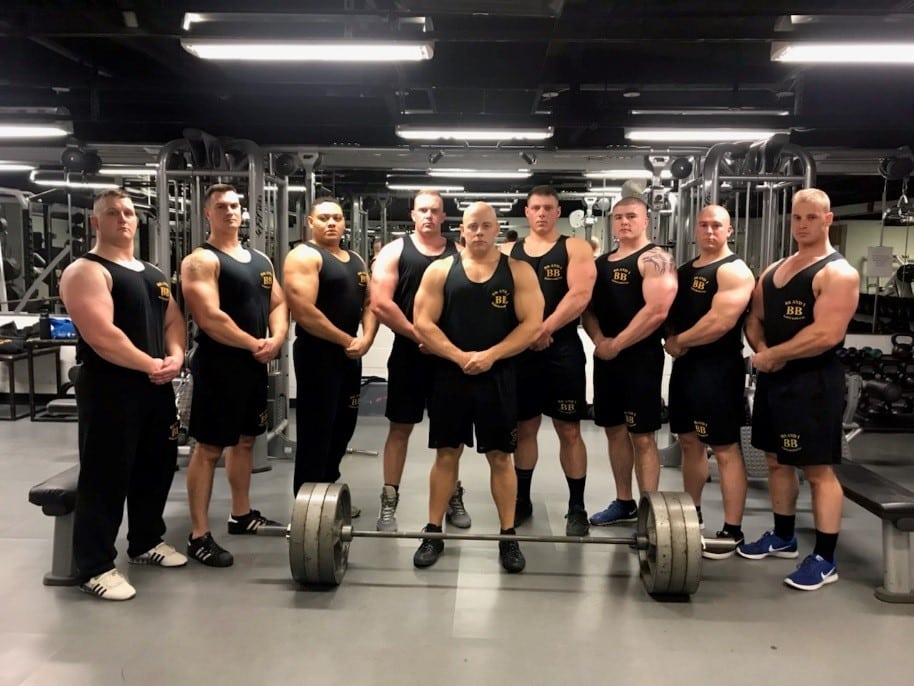
Marine Corps Body Bearers have both the honorable and sad job of carrying Marines to their final resting place. These Marines are subject to strict requirements, including: having a first-class PFT and CFT, being between 70 and 76 inches tall, being within regular Marine Corps height and weight standards, and being a Sergeant or above.
Additionally, they have to pass a Body Bearer fitness test and maintain these weight lifting standards. Body Bearer Marines must be capable of completing ten reps of the following exercises:
RELATED: PT-R WEIGHT KIT – DEPLOYMENT READY FITNESS
Currently, this is the only fitness test the Marine Corps utilizes weight lifting techniques for. This has led to USMC Body Bearers being labeled the strongest Marines in the Corps. These USMC facts help me set my own goals even as a gross civilian.
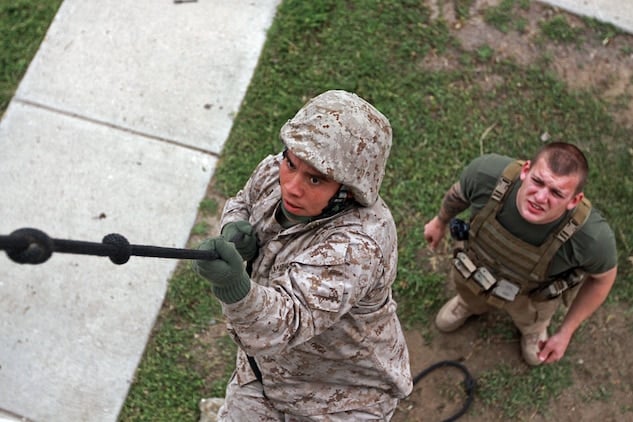
It’s true, of all the USMC facts we have, at least one makes us look like Batman. We use grappling hooks! Marines wield grappling hooks for a variety of reasons. This includes searching for improvised explosive devices (IEDs) and mines. Marines can tuck behind cover, throw and drag a grappling hook through a suspected IED area. It’s like a version of the claw game you see with teddy bears in supermarkets, but it’s for things that explode.

Grappling hooks make an appearance in urban operations and give a means for Marines to climb over walls and into windows. While it sounds like Batman, the grappling hook often gives a holding point and a little boost to the climbing Marine. You aren’t scaling up the sides of buildings like Batman and climbing multiple stories. However, an 8-foot wall or second-story window is easier to get over while wearing full gear with the assistance of a grappling hook.
Finally, we get to the story of the Yucca Man. This is likely the most widespread of the USMC facts on this list. Anyone who was stationed in Twentynine Palms knows the story of the Mojave bigfoot. According to legend, any Marine unlucky enough to find himself on watch in the endless desert of the Twentynine Palms training area may have an encounter with the Yucca Man.
The natives of the area have long told stories about these desert bigfoots and their spread to the Marine Corps. I think it’s due to two main reasons. First, these stories are fun to tell new Marines and work them up a bit before sending them out for some night guard duty or road guard position.

RELATED: THE ‘YUCCA MAN’ IS A BEAST THAT STALKS MARINES AT 29 PALMS?
Second, training at Twentynine Palms for a battalion level combined arms exercise (CAX)/Mojave Viper training event will exhaust the Marines. It’s made to simulate a month at war, and Marines are constantly training and dealing with the desert heat, endless training operations, and sleep deprivation. Sleep deprivation and exhaustion can cause hallucinations, and I’m willing to bet some exhausted Marines have had some visual and auditory hallucinations.
On my first deployment, I remember many nights on post after a 24-36 hour operation guarding the base and having a healthy amount of hallucinations.
America needs an Army, an Air Force, and a Navy, but America wants a Marine Corps. The Marines have long held the heart of the American civilian. A mixture of glory and capability mixed with a perception of a plucky underdog gives the Marine Corps a completely different cultural impact. Part of that impact is the unique culture, roles, and capabilities the Marine Corps has. These small USMC facts are only part of a much richer culture, so sound off below on your favorite USMC facts that we might not know.
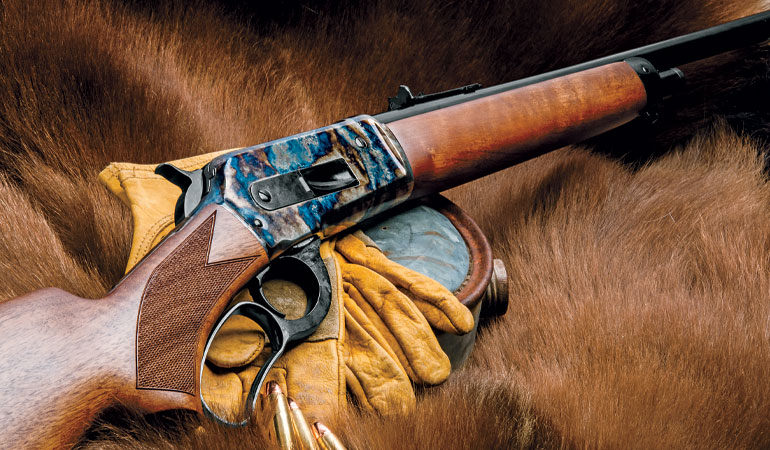
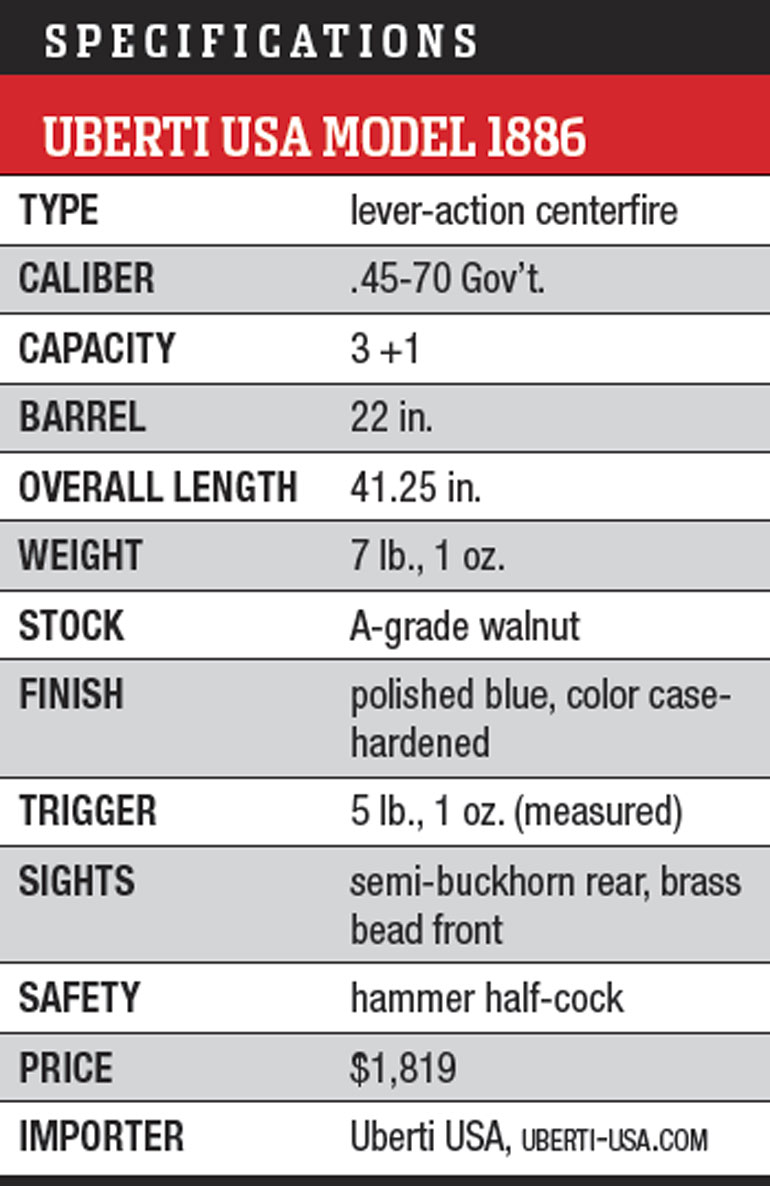
Offering just the right assortment of features, the slick Model 1886 from Uberti provides big-bore lever-gun enthusiasts a new opportunity to own and use an Italian replica of Winchester’s historic hunting rifle.
If you’re not familiar with this gun, Winchester’s lever-action model of 1886 was the first successful rifle to bridge the gap between firepower and authority, effectively pairing high magazine capacity and fast function with authoritative cartridges adequate for potentially dangerous big game. Previously, the great lever guns were limited, for the most part, to revolver-size cartridges, and big-bore cartridges were limited to single-shot rifles. While the 1886 had significantly more recoil than a revolver-caliber lever gun and somewhat less accuracy than a fine single-shot rifle, it did offer unprecedented effectiveness on elk and moose—and even just deer and pronghorns.
As for negotiating dinner plans with a savage, tooth-and-claw-equipped critter with uncivilized intentions, it had no equal. For the first time, North American hunters of big bears had a capable charge-stopping tool.

It was also the earliest lever-action design to effectively make the transition to the smokeless-powder era, courtesy of its strong twin vertical locking blocks. All that was required to withstand the greater pressures of smokeless propellant was a shift to a slightly different steel for the barrel.
Original Model ’86 rifles were chambered in cartridges ranging from .33 W.C.F. to the massive .50-110 Express, but the only round that lives on today is the .45-70 Gov’t. It’s a fantastic all-around rimmed big-bore cartridge, proven for well over a century on all North American big game.
Designed by John Browning, the ’86 features a slightly heavy but sleek action with lovely contours. It’s fed by a tubular magazine affixed below the barrel. A massive, exposed bolt runs fore and aft in the top of the action, and its stout ejector launches empty cartridge cases straight up—so it’s never been a good candidate for a traditional riflescope.
Loading is accomplished via a generous gate in the right side of the action, through which cartridges are thumbed into the magazine. To function the rifle, briskly sweep the lever loop down and forward, then return it to its closed position. This allows a cartridge to slide rearward onto the lifter, and the lifter then pops up like a ramp and presents the cartridge.
The bolt face catches the cartridge rim and pushes it forward into the chamber. Twin locking blocks cam up vertically into their slots, securing the breech.
Although there were a few standardized versions of the 1886, a wide variety of configurations were available by custom order from Winchester. One of the most popular custom combinations paired a shotgun-style buttstock—which transfers recoil much less violently than the more common crescent-type buttplate—with a tapered round barrel and a half-magazine.
The latter resulted in a significantly lighter hunting tool than the standard rifle, and that’s the approach Uberti took with its 1886 Hunter Lite, which features a tapered, round 22-inch barrel and half-magazine, as well as a shotgun-like pistol grip stock. This stock is also found on the Hunter Lite’s bigger brother, a traditional-style 1886 with a 25.5-inch octagon barrel and full-length magazine.
The Hunter Lite version I borrowed for evaluation is nicely blued with a just-past-satin polish on the barrel and hardware. A color case-hardened finish complements the action, and while the vividness and distribution of the color isn’t quite what original Winchester firearms sported, it’s quite attractive.
Two small threaded holes at the left rear side of the action provide a place to mount a receiver-style aperture sight if desired, and the tang is drilled and tapped for a traditional wrist-mounted tang sight. Two extended-length screws for mounting such a sight are included with the rifle.
Being a quite-accurate reproduction, no safety is present on the tang, nor is there a cross-bolt hammer block safety on the rifle.
The barrel is drilled and tapped for a forward-mounted scope base as well. Uberti product manager Tom Leoni said the distance between the holes is 21.8mm, making it compatible with several commercially available bases.
The rear sight is a traditional buckhorn type dovetailed into the barrel, and the front sight features a nice, crisp brass bead on a ramp, which is fixed to the barrel via two screws. Each side of the ramp is grooved for a sight hood, but none came with this test rifle.
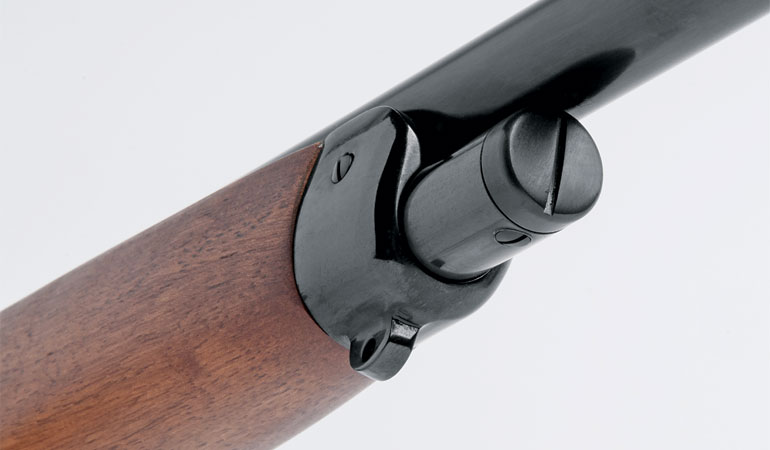
A nicely finished and fit steel cap graces the fore-end tip and features a sling stud machined integral to the cap. The forward end of the magazine tube protrudes about an inch. Leaning toward handiness rather than capacity, the mag tube limits capacity to three rounds of ammo plus one in the chamber.
As for the fore-end itself, it’s fairly well profiled, although it has a slight belly that doesn’t follow the leading lines of either the action or the fore-end tip. It’s made of good, dense walnut, with pores well filled and a nice natural-wood satin finish.
The first beef I found with the rifle is where the fore-end joins the bottom front of the action. The wood-to-metal fit at that particular point is poor, with the metal proud of the wood. Everywhere else the wood is only slightly proud of the metal, which—if they can’t make the two flush—is how it should be.
A simple panel of laser-cut checkering is found on each side of the pistol grip, adding a bit of texture for shooting with wet or sweaty hands. An interesting, attractive reverse-radius contour is cut into the bottom of the pistol grip, and the sling stud is a proper two-screw steel affair inlaid into the toe of the stock rather than just a screwed-in stud.
Like the fore-end, the toe of the stock has a slight belly, but aside from that, the buttstock has attractive lines. It’s also fitted with a good rubber recoil pad, which takes the bite out of the .45-70’s substantial recoil.
Balance is lively and nicely centered between the hands. As a result, the Hunter Lite is particularly responsive even for a lever action, pointing and swinging beautifully. Being brand new, the action is tight but not sluggish, and it didn’t display any undesirable play or looseness. The trigger is a bit stout—right at five pounds by my Lyman digital trigger scale—but breaks cleanly.
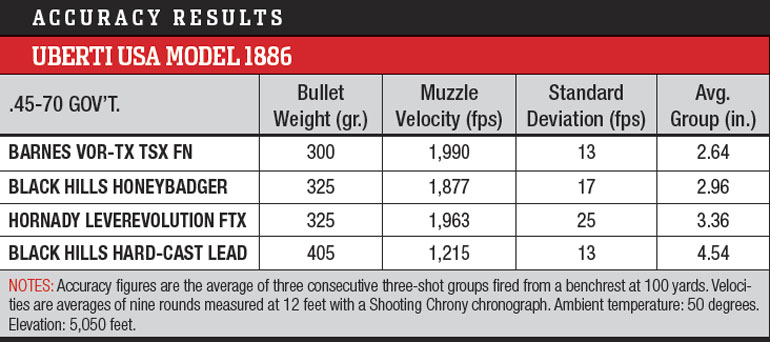
Because the Model 1886 is a reproduction of a classic and might be used in cowboy action competition or similar shooting, I rousted out some of Black Hills Ammunition’s traditional 405-grain hard-cast lead ammo that’s loaded to historic (read slow) muzzle velocities of around 1,200 fps.
And because it’s beautifully configured to serve as a close-range brush-busting big game thumper, I added two of my favorite modern .45-70 hunting loads: Hornady’s 325-grain LeverEvolution ammo with the FlexTip bullet that permits pointed bullets to be used in a tubular magazine and Barnes’s VOR-TX ammo loaded with the 300-grain TSX flatpoint. Both loads offer enough velocity to be 200-yard capable, with a tough, controlled-expansion bullet massive enough to offer decent penetration.
Finally, I included an intriguing brand-new load from Black Hills that features a 325-grain HoneyBadger bullet. It’s a solid copper projectile with an X-shaped tip and deeply scalloped flutes in the ogive.
The flutes act hydraulically on impact, creating massive temporary and permanent wound cavities without any bullet expansion at all. While I haven’t yet used the bullet on game, the HoneyBadger promises to produce massive internal trauma coupled with deep, bone-breaking straight-line penetration.
With appropriate hunting ammunition loaded to stout pressures (the Model 1886 is a strong action), the .45-70 cartridge is comfortably adequate for all North American big game, including the big bears, bison and so forth. However, it’s a low-velocity proposition, and use in the field is best kept to 200 yards or less.
Initially, I wondered if the Uberti 1886 would be a tooth-rattler because of its relatively light weight. I needn’t have worried. Recoil, even with the stouter hunting loads, was almost pleasant.
I rested the Model 1886 over my Sinclair benchrest setup and proceeded to shoot a series of three-shot groups at 100 yards. The mid-March sun was warm on my back and helped make for a crisp sight picture on the eight-inch black bullseyes I’d stapled up.
With the buckhorn rear placed in the second notch in the sight elevator, point of impact was on the money with the hunting loads, striking just at the top of the bead front at 100 yards. The slower cast-bullet load required the sight elevator to be placed in the top notch.
While some of Winchester’s Model 1886 rifles displayed excellent accuracy and pretty much all provided accuracy entirely adequate for the hunting ranges of the day, many weren’t exactly write-home accurate. This test rifle fits among the latter, averaging 100-yard three-shot groups of 3.37 inches.
No doubt that average would have been a bit tighter if it were scoped, I was achieving a really crisp, consistent sight picture, and I don’t think the rifle will do significantly better.
That said, it provided usable hunting-grade accuracy for iron-sight use out to a couple hundred yards, averaging between 2.5- and three-inch groups with Barnes 300-grain TSX FN and Hornady 325-grain FTX.
Feeding was just a bit sticky for the first 20 or 30 rounds, but it smoothed up considerably as the action began to break in. By the end of the day, the Uberti ’86 was running slick and clean like it should.
One small issue plagued me. I used the rear sight elevator to shoot different groups on one target face, raising it a notch after firing each in a series of three groups. The sight body—the part that’s supposed to act like a leaf spring and provide the flex needed to raise and lower it on the elevator—was so stiff I couldn’t adjust the sight by hand, even though I strained until blue in the face attempting to prove I could do it.
Finally, I had to tape up the nose of a flat-face screwdriver and use it to cam up the sight while raising or lowering the elevator. This is not a massive issue, but it’s something you should be aware of. Other Uberti rifles may have more flexible sights, but this particular one would be difficult to adjust in the field.
With accuracy testing accomplished, I moved away from the bench and shot casually, running the 1886 through rapid-fire and various target acquisition exercises and getting a better feel for the rifle. As the old saying goes, pumps and lever actions prefer to be run like you mean it. The Uberti functioned flawlessly when levered with speed.
As mentioned earlier, recoil is smooth and almost comfortable. Putting in a good deal of time practicing with the rifle would be pleasurable, particularly from field-type positions that roll easily with the .45-70’s big, slow kick.
After examining the Uberti Model 1886 minutely, photographing it—which tends to bring out small aesthetic issues—and shooting it fairly extensively, I have only one real gripe with it: the price.
At $1,819 it is about half the price of an original in decent, usable condition, which is fair enough. However, Winchester Repeating Arms offers newly made Model 1886 rifles for as little as $1,340 and high-grade Deluxe versions—with nicer walnut, checkering at wrist and fore-end, and extensive color case-hardening on action, lever, grip cap, fore-end tip, and buttplate—for $1,740.
That’s $80 less than the Italian-made version, and it’s rollmarked with the Winchester name. It is worth pointing out, though, that Winchester’s 1886 rifles are not actually made in the U.S. They’re manufactured in Miroku, Japan, where Browning firearms are made.
That said, you’re likely to find the real-world price of a Uberti Model 1886 to be significantly less than the suggested retail price. If you prefer Italian to Japanese, the Uberti is your ticket to big-bore lever-action happiness.
It’s a well-built, well-configured rifle of historic significance and will serve you well at the range and in the field. Reliable, authoritative and chockful of panache, it’s a reproduction Model 1886 any hunter or shooter would be glad to carry.


A Ruger Super Blackhawk from the early ’70s counts as an oldie, but goody.
Interesting things start happening after completing our 50th ride around the sun, especially among hardcore gunmen and women. Rather than pursuing the newer, latest greatest releases, we tend to gravitate toward the used gun racks of our local shops, where the older guns reside. Golden treasures of times past, freed from the confines of safes, closets, attics, or under the beds of their previous owners, are here for the taking.
Everywhere across America long-forgotten relics are stumbled upon by surviving family members, while cleaning up the possessions of a departed family member. “Wow, I never knew dad had so many guns,” are words commonly heard in these situations.
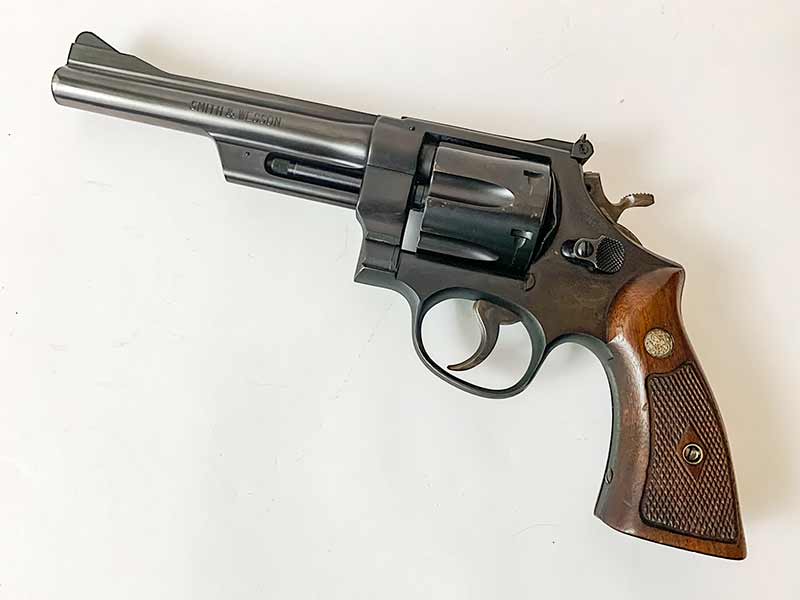
An S&W model 28 made the year Tank was born certainly counts as old.
Why are these older guns more enticing to us, as we get older ourselves? I can’t speak for everyone, but I do have my own reasons why I appreciate these older relics. Older guns from a certain time provide the perfect median for time travel. Holding, feeling, aiming, and in some instances, shooting these guns let us experience what our heroes, or beloved family members experienced long ago.
How cool is it to be able to hunt with great grandpa’s old deer rifle, or beloved side-by-side shotgun with Damascus barrels? How about shooting an elk, or wildebeest with a Winchester 1895 like Teddy Roosevelt did over a hundred years ago? These are the magical moments we strive to repeat when we are seasoned enough to appreciate these special experiences. Not to be wasted on youth, these fine moments are for those wise enough to savor each instance spent afield with such arms.
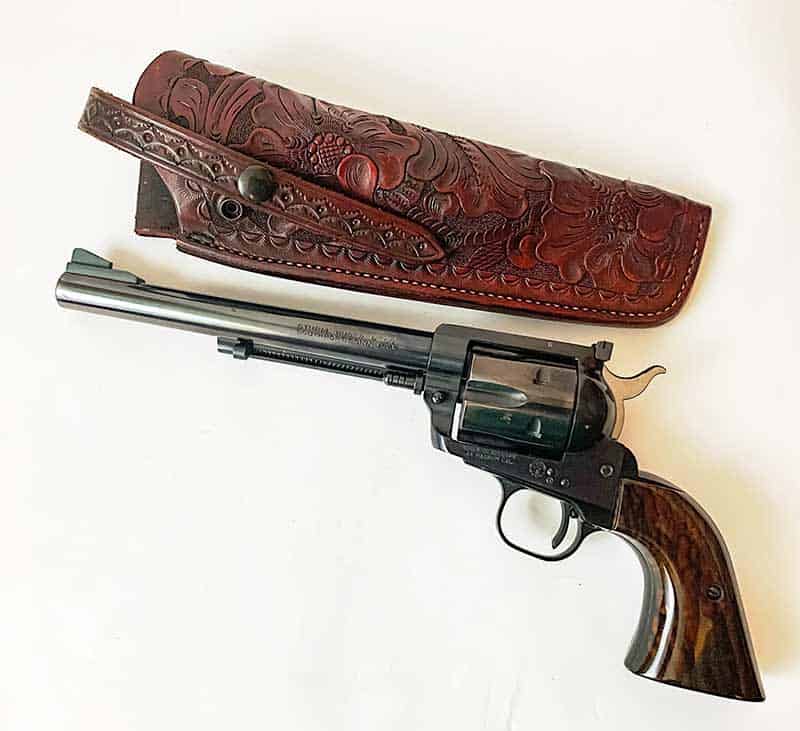
A Ruger flat top Blackhawk in .44 magnum from the ’60s is a cherished shooter.
Pick up an early 19th Century firearm and it’s obvious. The fit and finish are perfect! During the time these guns were made, skill and elbow grease were the recipe for the quality of these guns — and it showed! When perfectly polished, bluing is deeper, darker and more beautiful than someone using a buffing wheel to “good enough” status. Workers took pride in their trade back then, and it showed. Compare the factory finishes of today, to yesteryear, there’s no comparison.

A gun once belonging to the late Terry Murbach, a ’50s era
model 14, is extremely special to Tank.
These older relics are free from warning labels and silly safeties. People were responsible for their actions during the good ol’ days. There were no frivolous lawsuits. The only markings on firearms were the brand name, model and caliber. There was no billboard warning stating the obvious. Oh, how I cherish those days and these fine old guns remind us of the times when things were more right with the world.
Owning vintage guns has a coolness factor that doesn’t need explaining. Whenever unzipping that vintage shooter, you see the envy in the eyes of your friends. By explaining pertinent historical events and finishing it with, “and he did it with a gun just like this one….” is mesmerizing to your audience. Hearing history is one thing, but seeing, feeling, holding, or perhaps shooting a part of history is unforgettable.
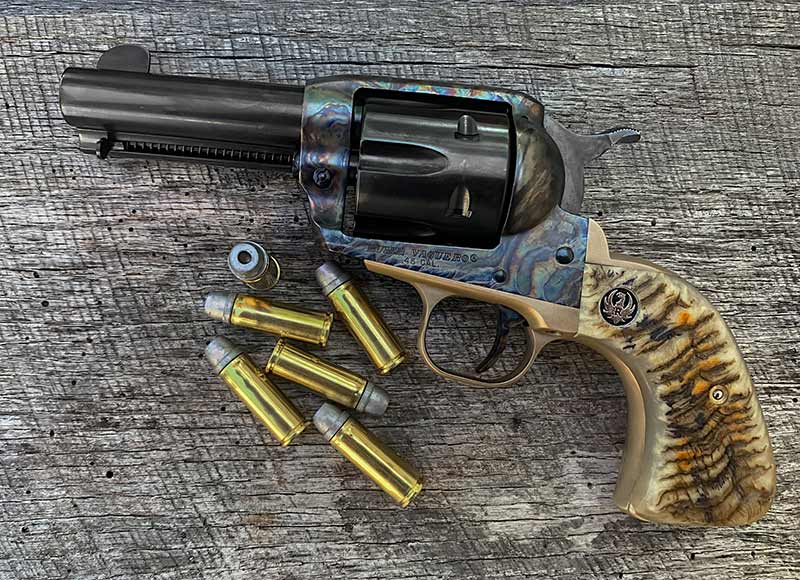
Here’s a gun Bobby Tyler worked over that belonged to a friend of Tank’s.
While not necessarily that old, it is a special gun indeed.
This last category is perhaps the most bittersweet of reasons we have for owning a cool, old gun. The gun is either passed down to you, or you’ve bought it from the estate, or it was simply given to you, because someone close has died. You’d do anything to bring the loved one back, but we can’t. When we end up with a gun in this situation, it obviously means more to us.
We feel a real connection to the person through the gun. It’s the last real thing of theirs we can hold, something that still has their DNA ingrained in it. It may sound silly, but gun people know this feeling all too well. Like a double-edged sword, it cuts both ways.
Owning an old gun lets us partake in history. We get to experience what common men felt by shooting, hunting, or just holding the arms they used. The older we get, the wiser we become, hopefully. We’re mature enough to understand just how special these older guns really are. While I’ll never turn my nose up at a new gun, the older ones sure are a lot more interesting to me …