Categories
All About Guns Allies Anti Civil Rights ideas & "Friends"

Do Studies Show Gun Control Works? No. Out of 27,900 research publications on gun laws, only 123 tested their effects rigorously. by AARON BROWN AND JUSTIN MONTICELLO

Categories
A Victory! All About Guns

Governor Kemp Makes Georgia 25th Member of Constitutional Carry Club by Dean Weingarten

New Right-to-Carry Case Filed; Second Amendment Advocates Seek Injunction Against Georgia Governor Brian Kemp, Public Safety Commissioner Gary Vowell, Cherokee County, and Probate Judge Keith Wood

Governer Kemp Makes Georgia 25th Member of Constitutional Carry Club

U.S.A. –-(AmmoLand.com)-– On Tuesday, April 12, Governor Brian Kemp of Georgia signed SB319, the Constitutional Carry (permitless carry) bill. The bill became effective when the Governor signed the bill.

Second Amendment supporters have been attempting to pass Constitutional Carry through the Georgia legislature for years. Governor Kemp pledged support for the measure in 2018. From fox5 atlanta.com:

Kemp said the bill is a public safety measure.

“SB 319 makes sure that  law-abiding Georgians — law-abiding Georgians, including out daughters and your family too — can protect themselves without having the permission of the state government. The constitution of the United States gives us that right, not the government,” Kemp said Tuesday. “HB 218 ensures that individuals who are licensed to carry in another state are also authorized to do so here in Georgia.”

The governor initially promised the measure when he first ran for governor in 2018, but little was done to advance it. It’s been revived now that Kemp faces opposition in this year’s primary from former U.S. Republican Sen. David Perdue and others. Longtime proponents of gun rights have credited Kemp’s advocacy for moving the issue forward.

In 2022 Governor Kemp is in a tight primary race, in part because of his lack of performance during the 2020 elections. More and more evidence is accumulating of significant irregularities during the election in Georgia, which was a pivotal state in the presidential election.

Governor Kemp vigorously championed Constitutional Carry in Georgia during his primary campaign. The large signing ceremony for the bill was carried out in front of Gable Sporting Goods. Gable Sporting Goods is a long-established sporting goods store in Douglas, Georgia, which is in the Atlanta metropolitan area.

With Governor Kemp’s signature, Georgia becomes the fourth state to pass Constitutional Carry (permitless carry) in 2022, and the 25th member of the Constitutional Carry club in the United States. Half of all states have now restored their legal system to the situation where no permits to carry were required, as was the case in all the United States in 1791 when the Second Amendment, as part of the Bill of Rights, was ratified. The 25 states who have restored the right to carry handguns in most public places, openly or concealed are:

Alabama, Alaska, Arizona, Arkansas, Georgia, Idaho, Indiana, Iowa, Kansas, Kentucky, Maine, Mississippi, Missouri, Montana, New Hampshire, North Dakota, Ohio, Oklahoma, South Dakota, Tennessee, Texas, Utah, Vermont, West Virginia, and Wyoming.

With the addition of Georgia, states, where no permit to carry, is required cover about 2,343,089 square miles or 61.6% of the land area of the United States.

Constitutional Carry has become a strong movement as people seek a return to a Constitutionally limited government in the United States. In 2002, only Vermont had Constitutional Carry. It had always maintained the right to carry without a permit, openly or concealed. In 2003 Alaska enacted a Constitutional Carry law. Arizona followed in 2010, Wyoming in 2011, and Arkansas in 2014. From 2015 to 2022, 20 more states joined the club.

Nebraska narrowly failed to join the club, by two votes in its unicameral legislature, the day before Governor Kemp signed Constitutional Carry in Georgia. Pennsylvania and Louisiana both passed bills with strong majorities, only to have Democrat governors veto them.


About Dean Weingarten:

Dean Weingarten has been a peace officer, a military officer, was on the University of Wisconsin Pistol Team for four years, and was first certified to teach firearms safety in 1973. He taught the Arizona concealed carry course for fifteen years until the goal of Constitutional Carry was attained. He has degrees in meteorology and mining engineering, and retired from the Department of Defense after a 30 year career in Army Research, Development, Testing, and Evaluation.

Dean Weingarten

Categories
All About Guns

Colt Police Positive Special: Al Capone’s Favorite Handgun

Categories
Uncategorized

It really is sad when Cousins Marry and decide to have Children. Here is Exhibit A below

Why the Hell did he post this? All I can say is that the Darwin Award Committee is just waiting for this Childs Nomination! Grumpy

Categories
All About Guns

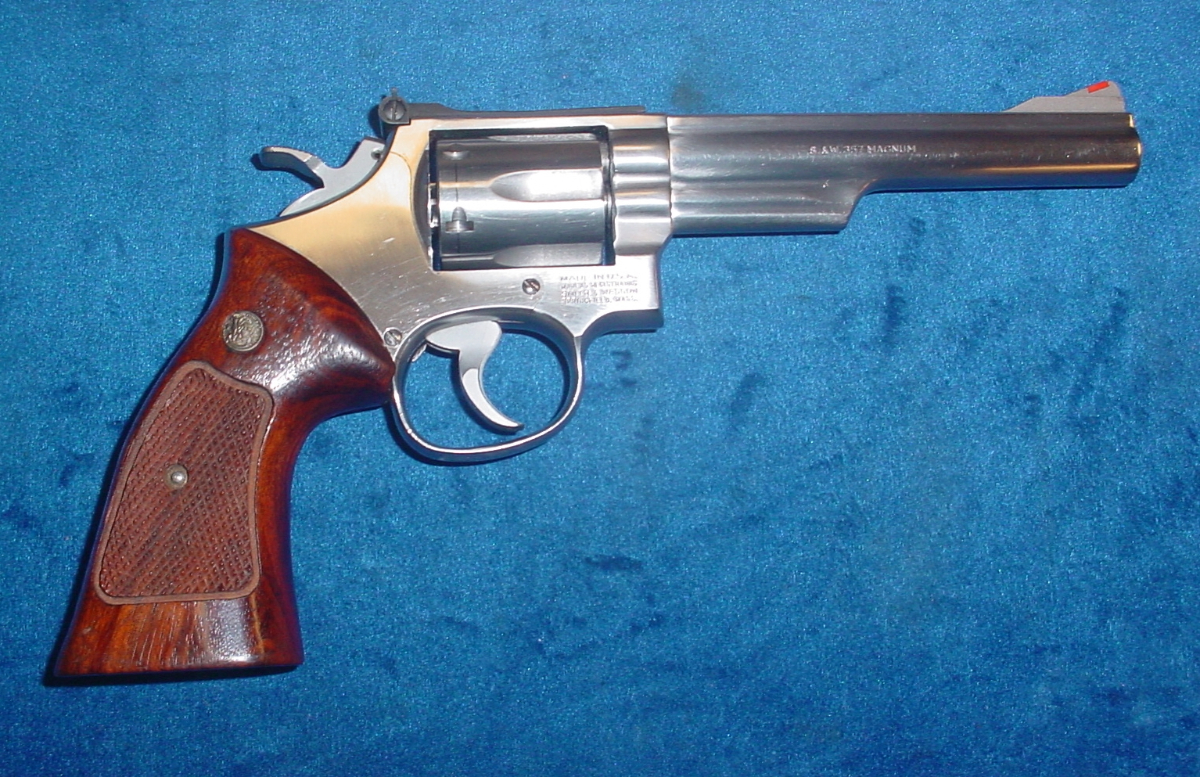
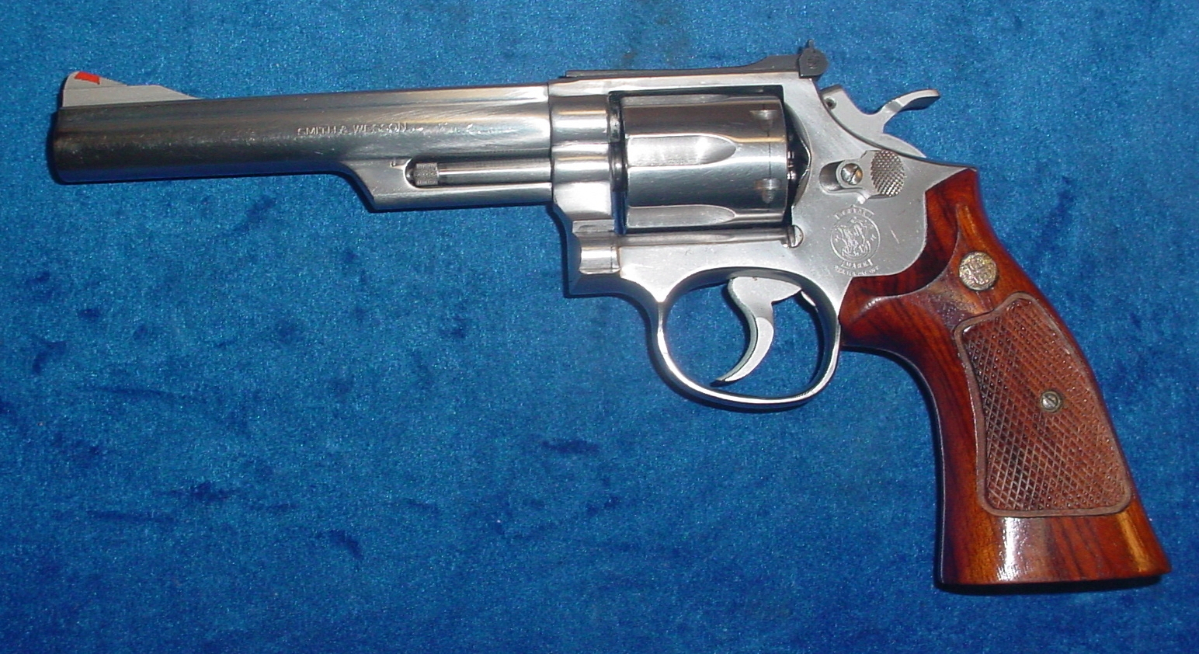
Early Smith & Wesson Model 66 Differences

Smith & Wesson Model 19

From Wikipedia, the free encyclopedia
Smith & Wesson Model 19
Smith Model 19 .357 Magnum.jpg

S&W Model 19, polished nickel, 6″ barrel
Type Revolver
Place of origin United States
Production history
Designer Smith & Wesson
Manufacturer Smith & Wesson
Produced 1957–1999
2018—present
Variants
Specifications
Cartridge .357 Magnum
Action Double action
Feed system 6-round cylinder
Sights Adjustable

The Smith & Wesson Model 19 is a revolver produced by Smith & Wesson that was introduced in 1957 on its K-frame. The Model 19 is chambered for .357 Magnum. The K-frame is somewhat smaller and lighter than the original N-frame .357, usually known as the Smith & Wesson Model 27. A stainless steel variant of the Model 19, the Smith & Wesson Model 66, was introduced in 1971.

History[edit]

The .357 Magnum is the oldest “magnum” handgun cartridge. Smith & Wesson played a major part in the development and success of the cartridge and revolver that went with it. Firearms writer and experimenter Philip Sharpe is credited for its development during the 1930s when police agencies were asking for a more powerful round. S&W’s Douglas B. Wesson agreed to produce a new revolver that would handle “high-intensity” .38 Special loads,[1] but only if Winchester would develop a new cartridge. Elmer Keith, a well known author and wildcatter at the time, was experimenting with hand loading .38 Special ammunition beyond their original specifications, taking advantage of the newer and better designed firearm frames and metallurgy, and also played a major role in the development of the .357 Magnum. Winchester introduced the .357 Magnum, which was dimensionally identical to the .38 Special except for a .125 inch longer case, and the first revolvers (referred to as “.357 Magnum Models”) were completed by S&W on April 8, 1935.[2]

Retired Assistant Chief Patrol Inspector of the U.S. Border Patrol, famous gunfighter, and noted firearms and shooting skills writer Bill Jordan consulted with Smith & Wesson on the design and characteristics of the Model 19. Jordan’s idea for a “peace officer’s dream”[3] sidearm was a heavy-barreled four-inch K-Frame .357 Magnum with a shrouded barrel like the big N-frame .357 and adjustable sights. After a year of experimentation with improved-strength steels and special heat-treating processes, the result was the .357 Combat Magnum (later designated Model 19), with the first serial-number gun (K260,000) presented to Jordan on November 15, 1955.[2][4]

The .357 Magnum, four-inch barreled model was standard issue to uniformed officers of the former U.S. Immigration and Naturalization Service[5] as well as Patrol Agents of the U.S. Border Patrol until both agencies adopted .40 caliber semi-automatic pistols.[6]

A rare S&W M19-3 was built for the French GIGN. In 1972 they ordered 500 of these revolvers that have serial numbers in the M&P range from D639300 to 639800. With only 500 guns produced, this is the rarest M19 version.

This specific model 19-3 has a fixed sight and is pinned & recessed. It has a three inch barrel.

Styles[edit]

The Model 19 was produced in blued carbon steel or nickel-plated steel with wood or rubber combat grips, an adjustable rear sight, full-target or semi-target hammer, serrated wide target trigger or combat-type trigger, and was available in 2.5″ (3″: Model 66—rare), 4″, or 6-inch barrel lengths. The weights are 30.5 ounces, 36 ounces, and 39 ounces, respectively. The 2.5- and 3-inch barrel versions had round butts, while the others had square butts.[2]

The Model 19 was produced from 1957 (first model number stampings) to November 1999. The Model 66 was produced from 1970 until 2005. The Model 66 differed by its use of stainless steel and its smooth target-type trigger. The Model 68 was a limited-production version of the Model 66 made for the California Highway Patrol and Los Angeles Police Department chambered in .38 Special with a 6″ barrel. The Model 19 and the Model 66 had the same trigger options.[2] One of the last variations of the Model 19 ordered for police use was the 2.5″ Model 19-5, special ordered under SKU #100701 as the standard issue sidearm for Special Agents of the US Department of State’s Diplomatic Security Service. This model featured a .400″ wide, smooth “combat” trigger, Pachmayr Professional Compac rubber grips, and most notably a matte black finish instead of the common high-polished blue.[2]The 2.5″ barrelled Model 66 was carried by I&NS Special Agents until the mid 1990’s when the agency adopted a .40 caliber semi-automatic pistol as its standard issue sidearm.[5]

Engineering changes were designated with a “dash-” number after the model number. The engineering changes are as follows:[2]

Model 19 variants[edit]

4″ Model 19-5, polished nickel plated with woodgrain square grips

2.5″ Model 19-5 of the US Diplomatic Security Service, featuring unusual matte black finish

Model Year Modifications
19 1957 Introduction.
19-1 1959 Change extractor rod, right to left-hand thread.
19-2 1961 Cylinder stop changed, deleted trigger guard screw.
19-2 1963 Introduce 6″ barrel.
19-2 1963 50 manufactured with 2.5″ barrel, serial range K544672–K544721.
19-2 1966 Introduce 2.5″ barrel as standard.
19-3 1967 Relocation of rear sight leaf screw.
19-3 1968 Delete diamond-insert grip.
19-4 1977 Change gas ring from yoke to cylinder.
19-5 1982 Eliminate cylinder counter bore and pinned barrel; small change in cylinder length to 1.62″.
19-6 1988 New yoke retention system; radius stud package; floating hand; hammer nose bushing.
19-6 1992 Blue finish only is cataloged.
19-7 1994 Add Uncle Mike’s Combat synthetic grips; drill and tap frame; change extractor; change rear sight leaf.
19-7 1995 Delete square butt.
19-7 1996 Discontinue 6″ barrel production; begin shipments in blue foam-filled plastic cases.
19-7 1997 Change to MIM thumbpiece and trigger, ship with trigger locks.
19-8 1998 Change frame design, eliminate cylinder stop stud, serrated tangs.
19-8 1998 Add internal lock, add MIM hammer w/ floating firing pin.
19-8 1999 Discontinue 2.5” barrel.
19-9 2018 Reintroduced with 4.25” barrel and Performance Center Carry Comp with 3” barrel.

Model 66[edit]

A model 66-2, displayed with two speedloaders

Model Year Modifications
66 1971 Stamping of each model.
66-1 1977 Changed the gas ring from the yoke to the cylinder.
66-2 1982 Eliminated pinned and recessed, slightly lengthened cylinder.
66-3 1986 New yoke retention system/radius stud package/hammer nose bushing/floating hand.
66-4 1994 Change rear sight leaf, drill and tap frame, introduce Uncle Mike’s grips, change extractor.
66-5 1998 Change in frame design: eliminate cylinder stop stud/eliminate serrated tangs/change to MIM hammer with floating firing pin/change internal lockwork.
66-6 2002 Introduced internal lock.
66-7 2003 Two piece barrel and internal lock.
66-7 2005 Discontinued.
66-8 2014 Reintroduced with 4.25″ barrel; 2.75″ barrel offering added in 2017.

Model 68[edit]

Model Year Modifications
68 1977 Introduction

Criminal use[edit]

Two Model 19s, along with two Browning Hi-Power pistols, were used in the 1996 Dunblane massacre.[7] This led to the enactment of Firearms (Amendment) Act 1997 and Firearms (Amendment) (No. 2) Act 1997, effectively banning handguns in the UK.[8]

References[edit]

  1. ^ Wood, Keith (May 13, 2015). “10 Things You Didn’t Know About Smith & Wesson”americanhunter.org. Retrieved September 20, 2019Daniel Wesson’s grandson, Colonel Douglas B. Wesson
  2. Jump up to:a b c d e f Supica, Jim; Nahas, Richard (3 January 2007). Standard Catalog of Smith & Wesson. Iola, Wisconsin: F+W Media, Inc. pp. 136, 186–188. ISBN 0-89689-293-X.
  3. ^ Taffin, John (2006). “The combat magnum: good gun gone”Guns Magazine. Retrieved 2009-08-02.
  4. ^ Sweeney, Patrick (2004). The Gun Digest Book of Smith & Wesson. Iola, Wisconsin: Gun Digest Books. pp. 40–41. ISBN 0-87349-792-9.
  5. Jump up to:a b Former I&NS Special Agent
  6. ^ Former Border Patrol Agent
  7. ^ Cullen, Douglas W (30 September 1996). “The Public Inquiry into the Shootings at Dunblane Primary School on 13 March 1996” (PDF)ISBN 0 10 133862 7. Retrieved 7 April 2018.
  8. ^ “Britain’s changing firearms laws”BBC News. 12 November 2007. Retrieved 30 November 2018.
Categories
All About Guns

FN MAG: Best of the Western GPMGs

Categories
All About Guns

The sound of Hitler’s Buzz Saw

Categories
All About Guns

Heym SR30 in 8x68S

Categories
Uncategorized

Winchester 1892 * * * It’s Here ! ! !

Categories
War Well I thought it was funny!

Hehe!