I myself could not even imagine fighting in many of these outfits or being in oh say India with such gear. But I guess that I am a wimp at heart. Grumpy
Categories
Works for me!
.JPG)
.png)

1. “He had delusions of adequacy ” Walter Kerr
2. “He has all the virtues I dislike and none of the vices I admire.”- Winston Churchill
3. “I have never killed a man, but I have read many obituaries with great pleasure. – Clarence Darrow
4. “He has never been known to use a word that might send a reader to the dictionary.”-William Faulkner (about Ernest Hemingway)
5. “Poor Faulkner. Does he really think big emotions come from big words?”- Ernest Hemingway (about William Faulkner)
6. “Thank you for sending me a copy of your book; I’ll waste no time reading it.” – Moses Hadas
7. “I didn’t attend the funeral, but I sent a nice letter saying I approved of it.” – Mark Twain
8. “He has no enemies, but is intensely disliked by his friends.” – Oscar Wilde
9. “I am enclosing two tickets to the first night of my new play; bring a friend, if you have one.” -George Bernard Shaw to Winston Churchill
10. “Cannot possibly attend first night, will attend second… if there is one.” – Winston Churchill, in response
11. “I feel so miserable without you; it’s almost like having you here” – Stephen Bishop
12. “He is a self-made man and worships his creator.” – John Bright
13. “I’ve just learned about his illness. Let’s hope it’s nothing trivial.” – Irvin S. Cobb
14. “He is not only dull himself; he is the cause of dullness in others.” – Samuel Johnson
15. “He is simply a shiver looking for a spine to run up. – Paul Keating
16. “He loves nature in spite of what it did to him.” – Forrest Tucker
17. “Why do you sit there looking like an envelope without any address on it?” – Mark Twain
18. “His mother should have thrown him away and kept the stork.” – Mae West
19. “Some cause happiness wherever they go; others, whenever they go.” – Oscar Wilde
20. “He uses statistics as a drunken man uses lamp-posts… for support rather than illumination.” – Andrew Lang (1844-1912)
21. “He has Van Gogh’s ear for music.” – Billy Wilder
22. “I’ve had a perfectly wonderful evening. But I’m afraid this wasn’t it.” – Groucho Marx
23. The exchange between Winston Churchill & Lady Astor: She said, “If you were my husband I’d give you poison.” He said, “If you were my wife, I’d drink it.”
24. “He can compress the most words into the smallest idea of any man I know.” – Abraham Lincoln
25. “There’s nothing wrong with you that reincarnation won’t cure.” — Jack E. Leonard
26. “They never open their mouths without subtracting from the sum of human knowledge.” — Thomas Brackett Reed
27. “He inherited some good instincts from his Quaker forebears, but by diligent hard work, he overcame them.” — James Reston (about Richard Nixon) —Robert L Truesdell


On June 23, the U.S. Supreme Court struck down New York’s discretionary carry licensing regime as a violation of the Second Amendment right to bear arms in the NRA-backed case NYSRPA v. Bruen. The law at issue was the modern version New York’s Sullivan Law, which was enacted in 1911.
Named for notorious Tammany Hall political boss “Big” Tim Sullivan, the law imbued bribery and favoritism into the licensing process and empowered those with racial, ethnic, or other prejudice to prevent those they disfavor from exercising their Second Amendment rights.
Gun owners should understand that this victory was the culmination of more than a century of opposition to the Sullivan Law. In that spirit, NRA-ILA would like to share materials from its archive chronicling some of the early gun owner resistance to the measure.
As evidenced by the pages of American Rifleman precursor Arms and the Man magazine, gun owners were skeptical of the New York pistol licensing regime from the start. In 1911, Arms and the Man operated as the unofficial journal of the NRA. The magazine would be purchased by NRA in 1916 for one dollar and was renamed the American Rifleman in 1923.
The publication took New York’s politicians to task in the June 8, 1911 edition of the magazine with an article titled “An Obnoxious Arms Law.” Describing the Sullivan Law, the publication explained,
Ostensibly directed towards the use of concealed weapons by unworthy persons, it actually will accomplish an infringement of the guarantees of liberty contained in the Constitution of the United States.
The Constitution says in the Second Amendment: “A well regulated militia, being necessary to the security of a free state, the right of the people to keep and bear arms, shall not be infringed.”
In the meaning of those who wrote the Constitution the word “militia” embraced every able-bodied citizen.
The piece went on to note,
The law may be expected to operate in a prohibitive manner against good citizens, who, if they had weapons, would do no harm with them, and to be inoperative against bad men whose disregard for the laws relative to killing may be expected to extend to other laws.
This was followed by an article in the September 28, 1911 Arms and the Man titled, “The New York Pistol Problem.” The item stated,
Considerable agitation and much uncertainty exists in New York and vicinity at the present time with regard to the so-called “Sullivan Pistol Law.” As far as can be ascertained the only “good” the law, which went into effect September 1, has done, has been to… cause a great deal of inconvenience to numerous members of the rifle and revolver associations of New York and vicinity, and make the Attorney General and the District Attorney, judges and police officials sit up nights and try to place an interpretation on this law…
[W]hat has really been accomplished has been to take away from peaceful and law-abiding citizens the opportunity to shoot.
NRA members and other gun owners didn’t warm up to the law once they saw it in practice. In 1931 and 1932, a serious effort was made to amend the law to make it easier for law-abiding New Yorkers to exercise their rights.
In May 1932, the American Rifleman published a piece titled, “Governor Roosevelt Upholds Sullivan Law.” The piece explained how then-New York Governor Franklin D. Roosevelt rejected legislation passed by the New York State Assembly to repeal and replace the Sullivan Law and challenged a Roosevelt statement that accompanied the veto. Describing the legislation, the magazine noted,
[the bill] would have repealed the Sullivan Law in New York State, and would have substituted a sensible law, which, the Governor of New York State admits, a great many sportsmen had urged him to approve.
The piece went on to excoriate Roosevelt for defending the Sullivan Law, stating that,
[NRA] is grinding no political axe when it takes exception to the shallow, fallacious and uninformed views of the present Governor of New York in regard to the needs of the public welfare in matters pertaining to firearms.
In his veto message, Roosevelt specifically downplayed the use of handguns for self-defense, to which the American Rifleman responded,
Readers of THE AMERICAN RIFLEMAN who have been following the monthly listing of cases called to our attention in which private citizens armed with the pistol have successfully protected their lives and property and assisted in the apprehension of criminals, and who have probably been making mental notes of many additional cases of a similar type published in their local newspapers, will have small patience with the theoretical self-protection argument used by Governor Roosevelt in his veto message. These readers of THE AMERICAN RIFLEMAN may seriously question just how much alive to important public-welfare problems involving the citizens of his own state Governor Roosevelt has been, in failing to investigate how much theory there is in the self-protection afforded by a good gun in the hands of a man who knows how to use it.
Taking up the fight for target shooters, the piece expressed disgust that law-abiding New Yorkers were,
subjected to the inconvenience of a czarist-type police supervision, discrimination and political byplay in order to enjoy a sport which provides not only recreation, but meets an obligation of good sportsmanship both in preservation of local order and the protection of national rights.
Alongside the re-publication of a news article about the U.S. Senate examining the efficacy of the Sullivan Law, in May 1936 the American Rifleman published a letter from an NRA member in Brooklyn, New York in the magazine’s Guns vs. Bandits section (precursor to the Armed Citizen). Titled, “How the Sullivan Law Works,” the member explained,
I put in an application with the Police Department for a pistol permit and I have been refused. It took them two months to make up their minds to disapprove my application…
Gentlemen, I am calling for your aid. I am a legitimate business man in the finance business, I am a sportsman and have an inherent love for guns, I have won medals, been a member of the C.M.T.C. for two years, and I can handle a gun. I am treasurer of this company and it is my duty to handle large sums of money and deposit them at the end of the day. I have never been arrested in my life. I can submit an unlimited number of character witnesses as well as business references. My bank will vouch for my responsibility and personal and business integrity.
It is a ridiculous system of society which allows thieves to get all the pistols, gas bombs, machine guns, etc., with very little difficulty but stops an honest citizen from getting a pistol to protect himself and his interests from our modern highly organized crime.
You would almost think that criminal lords have such powers that they have issued instructions to the New York Police Department to refuse permits for pistols to all legitimate citizens, so that robbing will not be such a hazardous occupation.
A quarter-century later, the American Rifleman revisited the history of the Sullivan Law in an April 1962 article titled, “The Sullivan Law: The origin and complexity of New York State’s concealable weapons law.” As the title implied, the author surveyed the then-half-century history of the Sullivan Law using a variety of sources.
Despite his scholarly effort, the author did not come away with a complete understanding the unconstitutional measure. The item noted,
After considerable study, I find that there isn’t really one Sullivan Law, nor does it relate to pistols alone, nor is it forthright, nor was it understood by most of the legislators who passed it. The law itself, together with its more than 50 amendments, is so complicated that judges, prosecutors, police chiefs, and defense attorneys have widely divergent opinions as to what it all means.
Identifying the chief constitutional defect in the law, the piece explained,
The license-issuing authority (police commissioner in New York City and Nassau County; elsewhere, judge or justice of a court of record in the county of residence) has almost unlimited discretionary power in passing upon a licensing application. Thus, he may, and frequently does, deny an applicant fully qualified in every respect on the arbitrary ground that he does not choose to issue a license. Moreover, the licensing official may and does issue rules and regulations which not only spell out procedural requirements but also impose, in effect, additional substantive restrictions having little or no support in the law.
Another portion of article laments, “Once a bad law is on the books, it’s terribly difficult to get it off.” Well, it took another 60 years, the tireless efforts of NRA members and other gun rights supporters, and three U.S. Supreme Court cases affirming the Second Amendment right to keep and bear arms, but gun owners can finally celebrate that this century-old bad law is officially off the books.
March 4, 2022, marks the debut of Springfield Armory’s Hellcat Pro. Think duty-size pistol performance, but smaller. Thinner. This pistol, like the original Hellcat, is just 1” thick. You can get all three fingers around the grip frame of the 15-round 9mm pistol to stabilize the pistol as that other, almost all-important finger works the trigger. And the all-steel magazine contributes to the pistol’s overall slimness.

My test sample Hellcat Pro came fitted with the HEX Wasp red dot optic that is sold separately. Nominally “1X,” it appeared to us that the image through the glass was a tiny bit smaller than actual target size, but that went unnoticed in actual shooting. As expected with a Hellcat, the desirable large U-notch rear iron sight was coupled with a bright yellow circle on the front post, in the center of which sat a bright Tritium night sight dot. Also, the self-adjusting red dot was an appreciated feature.

Like the original Hellcat, the Hellcat Pro has simple and easy-to-use controls. While the slide stop of the Hellcat Pro is not ambidextrous, the magazine button is reversible. This isn’t just for southpaws, who can do very fast reloads by pressing the mag release with their trigger finger instead of their thumb; it’s also useful for right-handed shooters who want to do the same thing. This right-handed tester has a thumb twisted by arthritis and has switched several of his pistols to right-hand buttons, but didn’t have to do so with this one: the compact dimensions of the Hellcat Pro allowed even that arthritic right thumb to hit the standard left-side release just fine.
The Hellcat Pro also has an accessory rail on the dust cover and functional grasping grooves both fore and aft on the slide. I don’t care for a forward grasp of a slide, but lots of people do, and this feature gives the shooter the option.

Essentially the original, super-popular Hellcat enlarged, the Pro has an excellent grip shape that locked into the hollow of this tester’s palm, with “just right” stippling around the entire grip frame. Trigger reach was such that an average-size adult male hand found the natural trigger contact point to be the “power crease” at the distal joint of the index finger.

“Power crease” is a term coined by double-action revolver shooters for the sweet spot where the index finger has maximum leverage on the trigger. As a result, the trigger pull requires less shooter effort and thus “feels lighter” than it actually weighs out. This short reach dimension means that even shooters with very short fingers should be able to get the oft-recommended “pad” of the index finger centered right on the face of the Hellcat Pro’s flat-ish trigger.
Trigger Control
I paid particularly close attention to the trigger on the Hellcat Pro, as a good one can make all the difference. Once the intended shot was begun, our pre-introduction sample (serial number BB113097) had a relatively short, light take-up before the finger met what shooters call “the wall,” the first firm resistance to the press. Then followed a short “roll” and finally, a clean break with no “backlash” or post-release trigger movement that I could feel. Reset was very palpable.
Trigger pull was measured at the toe (bottom tip) of the pivoting trigger, where the measuring device has the most leverage, and again from the center of the trigger where the human finger is typically positioned during firing. The Lyman digital trigger pull gauge revealed an average pressure of 5.19 pounds at the toe, and 7.19 pounds at the center. In hand, it felt lighter than that to virtually everyone on the test team. The reason, I suspect, is that nicely short Hellcat trigger reach: it allows the shooter to get the finger deeper into the trigger guard, thus giving the shooter more leverage and creating the felt sensation of an easier, lighter pull.

On the Firing Line
Our editor thought readers would like to know what 9mm velocities were from the newest Hellcat’s 3.7” barrel, so my colleague Steve Denney set up his Chrony F-1 on my range, 15’ from the shooting bench. We ran the three most popular bullet weights in 9mm.
Speer Gold Dot 124 grain +P bonded JHP averaged 1166.6 feet per second, with a standard deviation of 32.

The most popular 9mm training load is 115-gr. FMJ, and MagTech’s well-reputed version of that load averaged 1133.6 foot-seconds, with a standard deviation of 15, supportive of that product’s reputation for consistency.
147 grain subsonic carry loads are very popular in the US and Canada, and Federal’s HST has earned an excellent reputation. We used the +P version, which averaged 1006.2 feet per second, with the lowest standard deviation: 12, with a low of exactly 1000 fps and a high of 1012.
| Ammunition | Group Size | Velocity |
| Federal HST 147 gr JHP +P | 0.45″ | 1,006 fps |
| MagTech 115 gr FMJ | 1.75″ | 1,134 fps |
| Speer Gold Dot 124 gr JHP | 1.05″ | 1,167 fps |
We used the same three loads for accuracy testing, from a Caldwell Matrix rest on a concrete bench 25 yards from the target. Each five-shot group was measured once overall (to give an idea what an experienced shooter can expect under ideal conditions) and then again for the best three hits (to weed out enough unnoticed human error for a good approximation of mechanical accuracy capability).
The 124 grain Gold Dot +P 9mm load, proven on the street by ICE, NYPD, and Las Vegas Metro played well with the Hellcat Pro, delivered a five-shot group that measured 2.40” center to center, with the best three more than twice as tight at 1.05”.

Relatively inexpensive MagTech full metal jacket ball gave us a 3.15” measurement for all five 25-yard shots. The best three were in an inch and three quarters. All measurements were center to center between the farthest bullet holes being measured, and to the nearest 0.05”.
147 grain HST +P, a popular and highly rated duty hollow point, had the largest five-shot group but the tightest “best three,” which I think validates the dual measurement concept. The whole group was 3.50”, but the best three hits were in a tight cloverleaf measuring less than half an inch center to center, 0.45” to be exact. That’s right: all three shots would have hit a single .45 bullet facing point of aim.
For perspective, the commonly quoted figure is “five shots in four inches at 25 yards is acceptable accuracy for a full-size service pistol.” Though technically a “compact” and not “full-size service pistol” in size, the 3.7”-barreled Hellcat Pro easily met and exceeded the “service pistol” accuracy standard.
Initially, the gun wasn’t sighted for my eyes and hit a bit to the right, though it was “on” for elevation. Fortunately, the HEX Wasp carry optic sight is adjustable. Easy fix by users.
Hellcat Pro Specifications
Here are the specs on the new Springfield Hellcat Pro pistol:
| Chambering | 9mm |
| Barrel | 3.7″ |
| Overall Length | 6.6″ |
| Weight | 21.0 oz |
| Sights | U-Dot |
| Grips | Integral, polymer |
| Action | Striker-fired |
| Magazine Capacity | 15+1 |
| MSRP | $634 |
Important Features
Like some other Springfield Armory pistols, the Hellcat Pro has a potentially life-saving feature I think its manufacturers should advertise more than they do. If the muzzle has to be pressed directly against firm resistance for a self-defense shot, it will not go out of battery and fail to fire as most semi-automatic pistols will. This is because the design of its particular full-length recoil spring guide rod creates a “stand-off effect” for a press contact shot, whether it’s a bear or a bear-hugging attacker that’s on top of the shooter.

Another safety feature in my opinion is the little depressed, stippled “touch pad” on either side of the frame’s dust cover, which gives the shooter a felt index for placing their trigger finger when in a “ready” position. It turns out also that for those shooters who prefer a two-hand firing grasp involving straight thumbs, this is also an excellent resting point for the thumb of the support hand. It keeps that thumb from wandering upward and pressing against the slide, which could interfere with the firing cycle and jam one’s own self-defense pistol.
Bottom Line
Due to the pre-introduction non-disclosure agreement, I could only put the test gun into seven testers’ hands, and as respective schedules turned out only three of them got to shoot it with live ammo. About the only complaint was that it took strong thumbs to get the last couple of rounds into the magazines (it comes with two), but I suppose that’s why Springfield Armory includes a magazine loading tool. However, insertion of full magazines was positive even with the slide forward.
We put several hundred rounds through it – one hand only with either hand, various two-hand stances, and even intentionally limp-wristing – with shooters ranging from five-foot-tall female to six-foot-plus male with proportional hands. There were no malfunctions. Those who shot the Hellcat Pro gave it a unanimous thumbs-up.
Your broad range of choices in striker-fired compact 9mm self-defense pistols just got broader. This particular choice has a lot going for it.
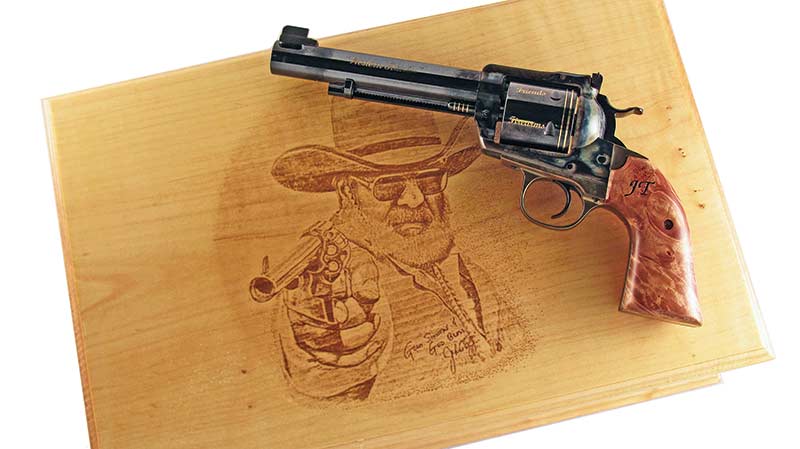
Milt Morrison’s custom crafted .45 Western Hunter The Shootists presented to John in 2014.
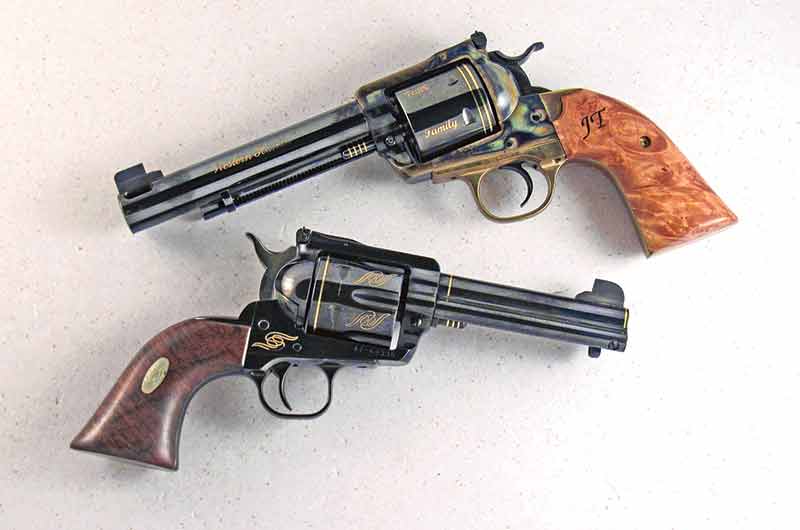
The Shootists commissioned Milt Morrison to build these custom .45 Rugers for John
in 1995 and 2014 celebrating John’s involvement with the group.
Back in the 1990s, Milt and Karen Morrison were visiting us and after supper I pulled out a few sixguns. I had the idea of coming up with a different kind of custom gun. I also had a few copies of old articles from the 1920s through the 1950s concerning customizing Colt Bisley Models. As a result, a Cimarron Bisley .44-40 was turned over to Milt for conversion to a real hideaway sixgun — single-action style. I wanted a true 19th-century-style belly gun, a term once used for short-barrelled, easy-to-conceal sixguns. Turned loose to use his artistic freedom, Morrison came up with the perfect single action for concealment and defensive use.
The result was a real single-action defensive sixgun. Milt removed the ejector rod housing and the ejector rod mounting slot on the right side of the frame, welding and re-contouring the frame in the process. The standard Bisley grip frame was removed and replaced by a brass Bird’s Head grip frame adapted to a Colt-style mainframe. At the same time, the original Bisley hammer was changed from its link system to a roller system to work with the new mainspring.
The action was tuned, all end-shake was removed, and a 2″ long heavy barrel fitted. For easier sighting when deliberate shots were called for, the rear sight notch was changed from its V-shape to give a square picture, and a new front sight was fitted. The trigger was also contoured to match the inside of the trigger guard.
To finish the project the mainframe was re-color cased, and the rest of the gun was finished in Milt’s high luster Black Diamond blue. To top it off an 18K gold band was inlaid around the cylinder. The result is one of the most beautiful and efficient single-action belly guns as ever existed. Chambered in .44-40, it’s potent but easy to shoot and control with the heavy barrel.

Whether using .357s or .38s, the stainless steel Smolt Morrison built for his wife
more than 30 years ago can shoot!
A Retro-Classic
We have many modern guns available, however the number one spot in my sixgunnin’ soul still belongs to the old classics. Alan Teague commissioned Milt to do a very special sixgun:
“It would be my take on the Colt Target Bisley. The frame would be a Flat-Top, barrel would be an octagon 6.5″ to 7.5″, rear sight would be dovetailed, adjustable for windage only.
And the front sight would be, somehow, adjustable for elevation. The cylinder would be unfluted, grip frame would be a Ruger Bisley style, the frame would be color case hardened and the barrel, cylinder and grip frame would be done in Milton’s Black Diamond finish. The grips would be ivory, and finally a grip cap would be steel, either Black Diamond or color case, with a silver medallion insert.”
Milt has taken one of our modern single action sixguns and turned it into a true classic. Starting with a Ruger Bisley Model the top strap is welded up and then recut to accept a rear sight patterned after that found on the Colt Flat-Top Target sixguns of the 1890s. In fact this model is called the Ruger Flat-Top Target. The front sight is in a dovetail and the rear sight — patterned after that found on the old Colt Target — is adjustable for elevation. The heavy 7.5″ barrel is hexagonal. The grip frame, hammer and trigger are reminiscent of the Colt Bisley Model Flat-Top Target from 1896.
The left side of the barrel is marked “Bisley Target” while the right side above the ejector rod housing is inscribed with the caliber, .41 SPECIAL. The frame is case hardened while the balance of this classic rendition, including the hammer, is finished in the deep Black Diamond bluing Milt is well known for.
Two gold bands encircling the rear of the cylinder add a classy touch. The grips are ivory micarta, and the butt is fitted with a special silver ring cap. The underside of the butt itself is scrimshawed with a head of a wolf. The combination of Bisley grip frame and heavy barrel makes this big sixgun very pleasant to shoot whether you choose the .44 Special or .41 Special chambering. All in all this is one of the most beautiful custom single action revolvers I’ve ever encountered.

Milt Morrison rescued this .44 Special Colt New Service from the boneyard and turned
it into a very special Special.
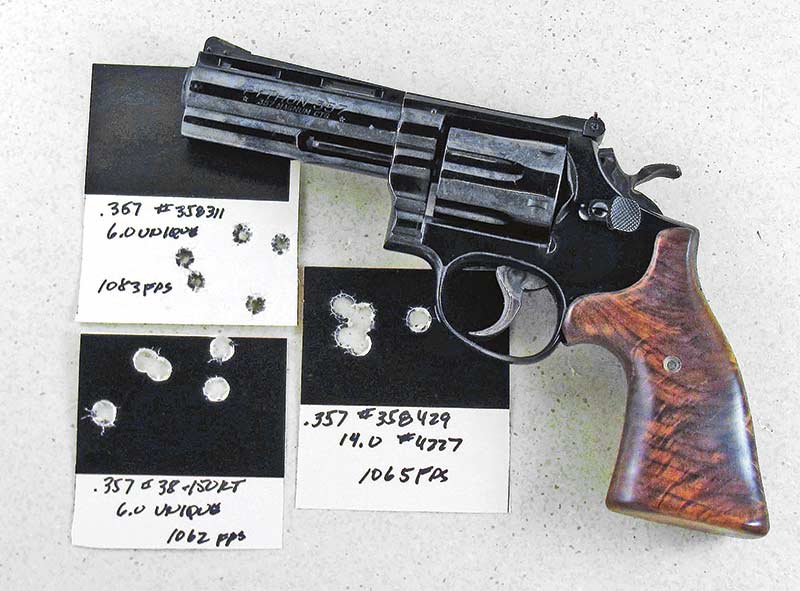
Milt Morrison’s “Smolt” conversions all shoot splendidly.
A Special .44 Special
Years ago Milt rescued a Colt New Service .44 Special and in the process fitted it with new sights, totally tuned it, and turned it into a 4.5″ Target Model. I had found a .44 Special someone had started to convert to a Target Model by installing an adjustable rear sight. It was not in the best of shape mechanically and the original front sight, which was too low for the rear sight, was still in place. This 4.5″ New Service was turned over to Milt Morrison for total rebuilding and the installation of a proper front sight. It’s not an original New Service Target but it will certainly do.
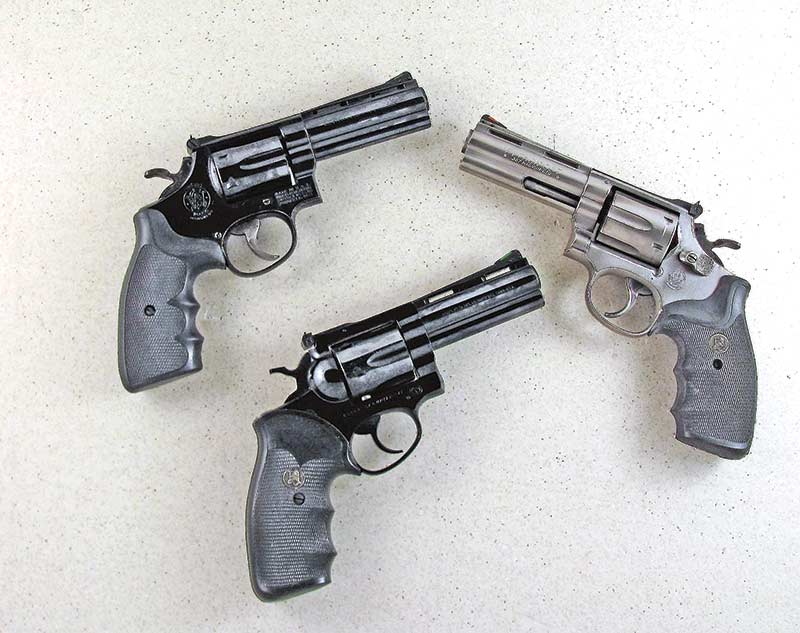
Whether Rugers or Colts, the Python conversions prove to be accurate and feel very good in the hand.
Shootists
In 1986 I invited a dozen sixgunners to gather with me in Wyoming for a week of shooting and sharing. We had such a good time we decided to make this an annual event and “The Shootists” was officially formed. Since that time The Shootists have met annually and they have twice honored me with special sixguns.
In 1995 Milt Morrison was commissioned to build a special sixgun for me as “Shootist of the Decade.” Starting with a Ruger New Model Blackhawk .45, Milt totally tuned the action, fitted a new front sight, finished this special sixgun in his Black Diamond finish with gold embellishments, and our mutual friend Dave Wayland made the custom grips. The top strap is engraved: “In Memory of Deacon Deason” who was the founder of BearHug Grips and a very special friend and Shootist.
Then in 2014 friends in the industry honored me with a banquet and I was again presented with a special sixgun from The Shootists, also built by Milt Morrison. This is also a Ruger New Model Blackhawk .45 albeit this time it’s a Bisley Model patterned after Milt’s Western Hunter package. It is of course totally tuned, fitted with a new front sight, finished in Black Diamond bluing with a case hardened frame and gold embellishments.
The gold lettering is a very special touch that includes my “4Fs” — Faith, Family, Friends and Firearms — engraved on the cylinder. The whole package is topped off with custom grips with my initials. Both of these .45s are cherished sixguns and the only problem will be figuring out which grandkids they will go to.
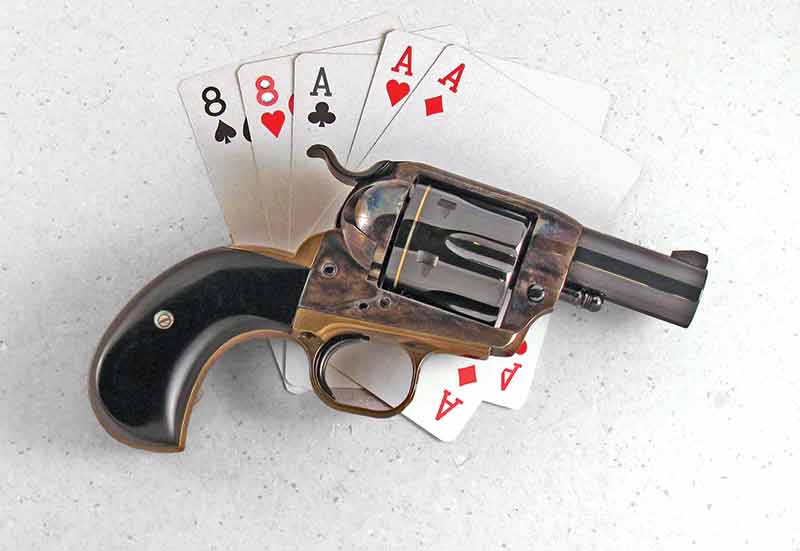
Milt Morrison converted this Bisley Model .44-40 into a very effective 19th Century-style “belly gun.”
Smolts
About 30 years ago Milt set about to build a special sixgun for his wife Karen. Starting with a stainless steel .357 Magnum S&W Model 66, Milt expertly fitted a 4″ stainless steel Python barrel to the K-Frame S&W. The resulting “Smolt” has a totally new balance, heavy in the front, and well-suited to DA shooting.
For many decades sixgunners argued the merits of Colt versus S&W DA sixguns. The majority of aficionados felt the DA mechanism of the Smith could not be topped, while the Colt was better suited to single action firing. Even Fitz, John Henry FitzGerald, who was Mr. Colt during the two world wars, privately said the S&W had the better action for DA shooting. The .357 Python not only had a heavy barrel but was also tighter as to bore diameter than most .357 sixgun barrels and seems to shoot a shade better. Combining the two, as Milt did way back then, resulted in the best attributes of both.
Milt did much gunsmithing as the S&W armorer for the California Highway Patrol and then moved to Colorado and opened his own shop, Qualité Pistol & Revolver. Now, he’s back in my neighborhood. Since he’s arrived here we have talked about many possible projects, one of which was building my own personal Smolt.
I had a 4″ blued Python barrel on-hand resulting from re-barreling my Python to 8″. I have been holding onto this barrel for just the right project for several years. Then a while ago, Jerry Moran, the well-known Python ’smith visited me along with his family and dropped off another 4″ Python barrel. Now it was time to get off the dime and get these projects going. And the combination of Jerry’s contributing another barrel and Milt arriving here told me it was time to do this.
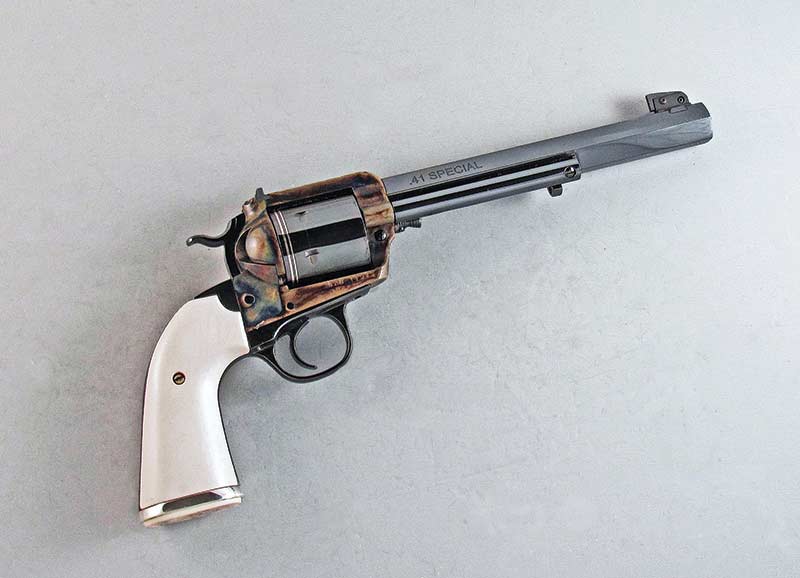
Milt Morrison resurrected the Colt Flat-Top Target of the 1890s with this special custom Ruger .41 Special.
Smolt Vs. Couger
Starting with a 2.5″ S&W Model 19 .357 Magnum, we began the project. Milt prefers the shorter barrel version as a base gun as it’s easier to match up the top of the Python barrel with the top of the frame of the S&W. Now, what was I to do with the other barrel? One of the old Classic Sixguns we rarely see, or at least I rarely see in my area, is the Ruger Security-Six. More than 1 million of these were made, however they are not readily found on the used gun market. Then it happened — I found not one but two used Ruger Security-Six .357 sixguns, one a 4″ stainless while the other was a 6″ blue. Since the Python barrel was blue, the latter was the only choice.
There’s no question about my liking the conversion on the S&W Model 19. With the barrel change it becomes a totally different sixgun as to balance and shooting DA. I knew without question I would like this “Smolt.” However, I did not realize how much I would really like the “Couger.”
The Security-Six is an excellent sixgun, however it becomes especially special with the addition of the 4″ Python barrel. The transformation as to balance and shootability is even more pronounced with the Security-Six Couger than with the Model 19 transformation. When Ruger stopped production of the Security-Six to bring out the GP100, a heavily under-lugged barrel was added. Now, I know what the Security-Six gains with the same style barrel.
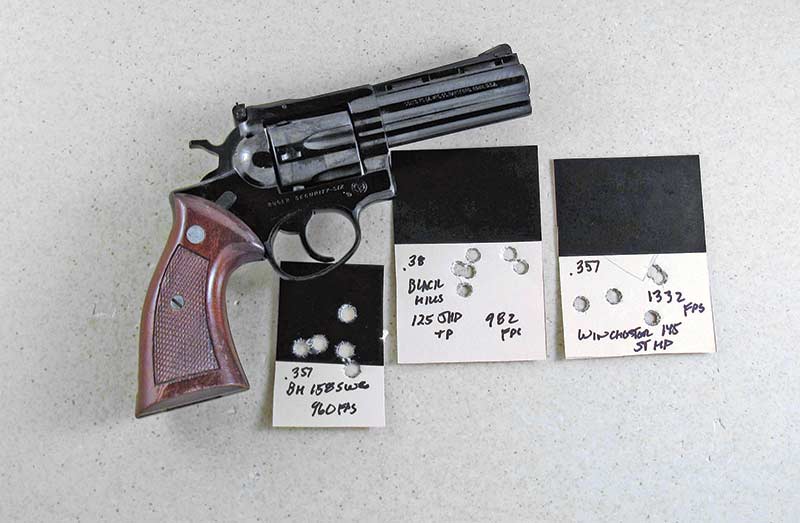
The “Couger” is a Ruger Security Six with a Python barrel. The combo works just fine.
Shooting Fun
I especially enjoy shooting these custom conversions with .38 Special loads, as they are so pleasant shooting. Switching to some of my favorite .357 Magnum loads, the Smolt performs especially well with the Lyman #358429 Keith bullet over 14.0 grains of #4227 for 1,065 fps and five shots into 1″ at 20 yards. With the Couger, my .357 Magnum loads assembled with 6.0 grains of Unique performed well with Lyman cast bullets. The Lyman #358429 Keith load resulted in 1,081 fps and a 5-shot group at 20 yards of 13/8″. Lyman’s #358477 SWC clocked out at 1,022 fps and 11/4″, while the Lyman #358311 RN has a muzzle velocity of 1,074 fps and a 11/8″ group. With factory .357 Magnum Loads I found the Winchester 145-gr. Silver-Tip performed well, with muzzle velocities in both sixguns right at 1,325 fps.
Converting to a Smolt or Couger is not simply a matter of unscrewing the old barrel and screwing in the new. The threads are different and the frames require some special machining. The conversion is certainly not inexpensive, plus you need a Python barrel and a base sixgun to start with.
Is it worth it? With these two special Python-ized .357 Magnums by Milt Morrison now in my possession — I would say definitely so.
For more info: www.qualitygunsmithing.com, Ph: (208) 465-0071