They say every gun has a story. A reader submission series from American Handgunner, Wheelgun Diaries seeks to tell some of those stories through the words of revolver owners.
The following stories were shared by email with permission to publish.
Problem-Solving, Kentucky-Style
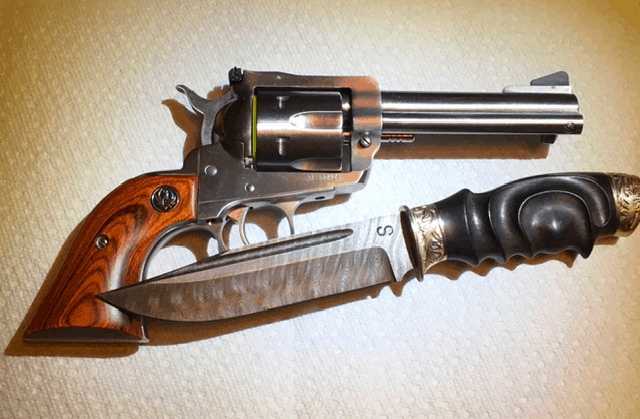
In April 1963, I bought a used flattop Ruger Blackhawk in .357 Magnum for $50. That May, I flew to Anchorage, Alaska — just 30 days after the earthquake and tsunami that pretty much wrecked the state — where I worked for four months as a biologist aide. For two weeks that summer, I ran the Salcha Creek fish hatchery, located halfway between Fairbanks and Big Delta.
One day, while returning from the supply store located 50 miles away, I ran into a game warden in a one-ton truck with a Derrick mounted in the bed. He had just pulled a world class bull moose out of a bog that had been shot by some villain just for sport. It was 80 degrees and the moose had been dead for days. The question was, would the moose blow up or break in half when wrenched onto the truck?
While we were pondering the dilemma, a state trooper showed up. Then a geologist. Then another biologist. I figured half the state’s employees within 500 miles were there. Much pondering ensued with no solution. Since I was from Kentucky, I had been taught any problem that could not be solved by a bigger hammer could be solved by a big gun, and well, I had a big short-barreled .357 in a cross draw holster just begging “use me, use me!” Three shots later, the moose collapsed with much flatulence and problem was solved, Kentucky-style. I spun the Ruger around my finger several times and popped it in my holster as good as any Hollywood cowboy.
Now with the warden’s truck serving as a hearse, the whole gaggle set off for the nearby mighty Tanana River for a watery burial. A huge, nasty drainage, the Tanana runs about 20 miles an hour and took the dumped moose quickly. We all stood in reverent silence, drinking from the now warm case of beer I had in my vehicle.
When I finished my first beverage, I thought I would engage in an old Kentucky sport — throw the bottle upstream and shoot at it as it floats by. So, I did — piece of cake! The accompanying trooper bet $5 I couldn’t do it again. Bang! Thinking I had to miss some time, this repeated until I had all of their money. With empty wallets, they drove off, but not before taking the rest of my beer. It was 50 miles back to the store for more drinks and ammo, but now, with a reputation to uphold.
The Kentuckian
A Spanish Snubbie
I live in a country (Spain) where firearm ownership is rigorously restricted. However, it hasn’t always been that way. Under General Francisco Franco’s regimen, handgun permits were easier to obtain than nowadays as violence was extremely uncommon at the time, but that changed when he died in late-1975 and democracy brought the unexpected phenomenon of rising street crime. Gun laws also became more restrictive.
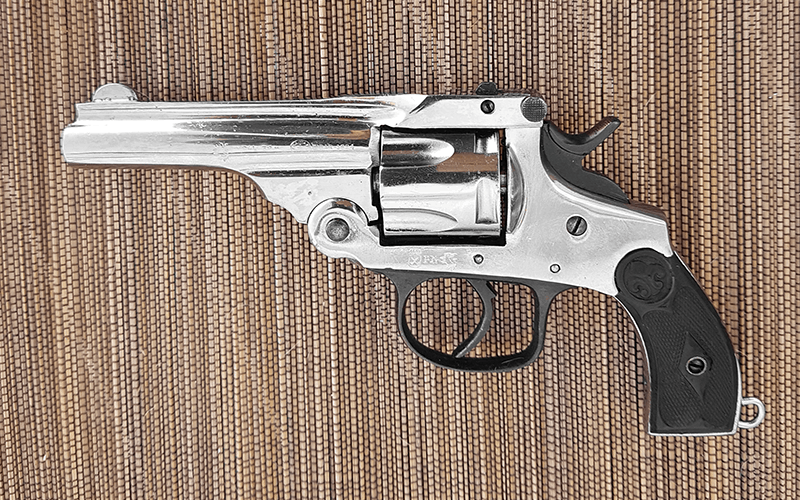
During this time, my Dad asked a friend for a favor, and a small, nickel, top-break snubbie revolver chambered in .38 S&W (known as “38 Corto” in Spain) found its way into our home. A Spanish Eibar replica of a Smith & Wesson revolver, it wasn’t a great gun, but it was all that was available to him. Dad allowed us to handle the unloaded gun under his close supervision, which was the very first handgun I had seen and handled.
As a kid, I was fascinated with it, and when I was 18, I obtained my sporting handgun license and came to own better handguns — but I always liked to clean and handle that old revolver. One day, a few years ago, I was visiting my dad, who was ill, and presented me the handgun. He died just a few months ago. Today, I cherish that old revolver more than ever as it brings back memories of a great and loved man.
Álvaro Vicena
Spain
.gif)


Some folks are simply charmed. Their trajectory through life just flies a bit higher than that of the rest of us. Winston Churchill was just such a man. An accomplished writer, painter, soldier, and politician, Old Winston was the archetypal Renaissance Man. Over on our side of the pond, “Wild Bill” Donovan was a similar archetype.

Joseph Donovan was born in 1883, the son of Irish-American immigrants. The family name was originally O’Donovan but got anglicized when Joe’s dad settled in Buffalo, New York. Early on Donovan aspired to the Catholic priesthood before deciding “he wasn’t good enough to be a priest.” Instead, he attended Columbia University where he was voted both “Most Modest” and “Handsomest” out of his graduating class of 1905.

Donovan later attended Columbia Law School. He was a classmate of a young Franklin D. Roosevelt. His friendship with FDR would shape the rest of his professional career.

Joseph Donovan joined a respected Buffalo law firm and was commissioned into the New York National Guard as a Cavalry officer. In 1914 he married a New York heiress whose family connections immediately transformed him into American aristocracy. Donovan took acting classes under the esteemed stage star Eleanor Robson and went to war against Pancho Villa in 1916. Upon his return from the Punitive Expedition, Donovan was posted to the 42d Rainbow Division alongside Douglas MacArthur.

While fighting the Germans in France during World War 1, Joseph Donovan caught a load of shrapnel in one leg and was nearly blinded by mustard gas. He subsequently led an assault during the Aisne-Marne Campaign that ultimately cost hundreds of his comrades. Among the fallen was his acting adjutant, the esteemed poet Joyce Kilmer.

In combat, Donovan developed a reputation for being unstoppable, a man of limitless endurance. This led the troops under his command to refer to him as “Wild Bill.” While he publicly professed annoyance at the nickname, his wife later said that she “knew deep down that he loved it.”

As commander of the 165th Infantry Regiment Joseph Donovan led from the front, his rank insignia and medals plainly displayed. In encouraging his troops prior to a critical assault he said, “They can’t hit me and they won’t hit you.” He was nonetheless subsequently shot through the knee yet refused evacuation until all American forces including friendly tanks had been forced back by concentrated German fire.

For his remarkable combat performance, Donovan ultimately earned the Medal of Honor. He initially refused the award, stating that it belonged “to the boys who are not here, the boys who are resting under the white crosses in France or in the cemeteries of New York, also to the boys who were lucky enough to come through.” Before his military service was complete Donovan also took home the Distinguished Service Cross, the Distinguished Service Medal, the Silver Star, the Purple Heart with two Oak Leaf Clusters, the National Security Medal, and some two dozen other combat awards.

Donovan spent the interwar years in private law practice as well as working for the US Justice Department. Along the way, he traveled the world gathering critical intelligence on world powers in Europe and Asia. He met Mussolini, Winston Churchill, and King George VI. Hitler despised him. During the speech in which Hitler declared war on the United States the German dictator castigated Donovan by name, declaring him “utterly unworthy.” That was high praise considering the source.

With the outbreak of WW2 President Roosevelt appointed “Wild Bill” Donovan the Coordinator of Information. While the United States had no formal spy agency back then, Donovan began laying the groundwork for a centralized intelligence apparatus based upon the British MI6. In 1942 Donovan’s organization was rechristened the Office of Strategic Services. The United States was in the spy business.

Nowadays intelligence officers and special operators are the product of an extensive selection process and grueling training program. Back then unconventional thinkers just came together and got the job done. Over in the UK the future James Bond novelist Ian Fleming was a good example of a neophyte who took to the world of espionage as a natural outlet of his peculiar personal proclivities.


Donovan sought out unconventional warriors for his burgeoning team of misfits. He recruited the film director John Ford and the Hollywood actor Sterling Hayden. The poet Archibald MacLeish, the influential banker Paul Mellon, and the author Stephen Vincent Benet joined the team. The famed psychologist Carl Jung, the chef Julia Child, the industrialist Alfred DuPont, and the author Walter Lord as well as several influential members of the Vanderbilt family hung their hats at OSS headquarters. The extensive density of upper-crust aristocrats drove many in government to claim that OSS actually stood for “Oh So Social.”

Building an intelligence and covert action organization from scratch is an overwhelming task. Donovan had access to money and resources, but this was uncharted territory. There were no manuals he could read or deep well of institutional insight he could mine. Wild Bill Donovan just figured it out as he went along. Among myriad other things, that meant brand new specialized covert guns and gear. Principle among them was the High Standard sound-suppressed H-DM/S pistol.

Raw lead bullets were prohibited by the Hague Convention, so Donovan had to contract for special lots of jacketed .22 rimfire rounds. Once the gun was perfected Donovan wanted to show it off. He once slipped into the Oval Office while his friend FDR was dictating a note to his secretary. Dropping a sandbag onto the floor he proceeded to fire ten rounds as fast as he could squeeze the trigger. Donovan then dropped the smoking pistol onto the desk before President Roosevelt. FDR was so smitten with the quiet little gun that he refused to give it back.
The Weapon

The H-DM/S was an integrally-suppressed version of the High Standard H-DM target pistol. H-DM/S stood for H-D Military/Silenced. As the program was classified the original examples were spuriously described as “Impact Testing Machines.”

Chambered for .22LR, the H-DM/S was a straight blowback design that fed on a ten-round single-stack box magazine. The gun sported fixed iron sights, a five-inch ported barrel, and a heel-mounted magazine release. The H-DM/S came equipped with a slide lock that prevented the action from cycling. In this configuration, the weapon was indeed exceptionally quiet. Development began in 1942 with the first operational fielding in 1944.

The first variants featured a blued finish on the pistol and a Parkerized suppressor. Later versions were completely Parkerized. The H-DM/S saw a fairly widespread issue among early special operations forces. Gary Powers had a suppressed H-DM/S on his person when his U2 was shot down in Soviet airspace in 1960.

The H-D/MS suppressor was developed during the war by Bell Labs and featured an initial chamber filled with a cylinder of zinc-plated bronze mesh that acted as a heat sink. The barrel was ported with four rows of eight holes that dropped standard velocity rounds into the subsonic range. Later guns featured four rows of eleven holes. A second distal chamber was filled with bronze mesh screens. This repackable design was typically good for 200 to 250 rounds.

For applications requiring extreme stealth the distal chamber could be charged with water, oil, or shaving cream. The muzzle was then sealed with a piece of tape. Thusly configured with the action locked the gun made no more noise than a human whisper.
The Rest of the Story

Much to Donovan’s consternation, FDR displayed his top-secret pistol at his home in Hyde Park, occasionally showing it to visiting guests during the war. Donovan also gave a copy to Admiral Chester Nimitz. He was known to shoot the classified weapon with neighborhood children. A photograph of such an outing actually made it into a local newspaper in 1944.

Wild Bill Donovan was, by all accounts, a genuinely good guy in possession of some remarkable insights. He opposed the internment of Japanese Americans during the war, rightfully predicting that this was an unnecessary solution to a non-existent problem. In his roles as America’s espionage chief, he also took part in many of the major combat actions of the war.

Donovan and his commander for covert ops in Europe, Colonel David Bruce, went ashore early during the Normandy invasion. Pinned down by German machinegun fire, Donovan said, “David, we mustn’t be captured. We know too much…I must shoot first,” Donovan said.

Bruce replied, “Yes, sir, but can we do much against machine guns with our pistols?” Donovan explained: “Oh, you don’t understand. I mean, if we are about to be captured, I’ll shoot you first. After all, I am your commanding officer.”

Donovan ended WW2 as a Major General but fell afoul of post-war politics. President Truman sidelined him with a task to produce a study of the nation’s fire departments. Under Eisenhower, he was made ambassador to Thailand. Throughout the early bits of the Cold War, Donovan helped influence the formation of the CIA from the shadows.

Wild Bill Donovan died in 1959 from complications arising from vascular dementia. His statue graces the lobby of the CIA headquarters in Langley, Virginia, today. In 2011 Vanity Fair writer Evan Douglas described Donovan’s exploits as “a brave, noble, headlong, gleeful, sometimes outrageous pursuit of action and skullduggery.” Wild Bill Donovan was the real freaking deal.

Categories
Yep
.png)

State Representative Wendell Gilliard (D-111) announced that he will pre-file legislation to ban many commonly-owned rifles, shotguns, and handguns that law-abiding citizens use for self-defense and sport, and require current owners to surrender them. While the text of the legislation is not yet available, it will likely be similar to other so-called “assault weapons” bans that demonize these firearms based on arbitrary features that do not alter how they function.
We are confident that the pro-Second Amendment majority in the South Carolina legislature will be ready to fight any such scheme, but this highlights how our rights are at stake during every election cycle. Law-abiding gun owners must be ready to turn-out to the polls to ensure they elect officials who will work to protect their rights. Please stay tuned to www.nraila.org and your email inbox for further updates.