Categories
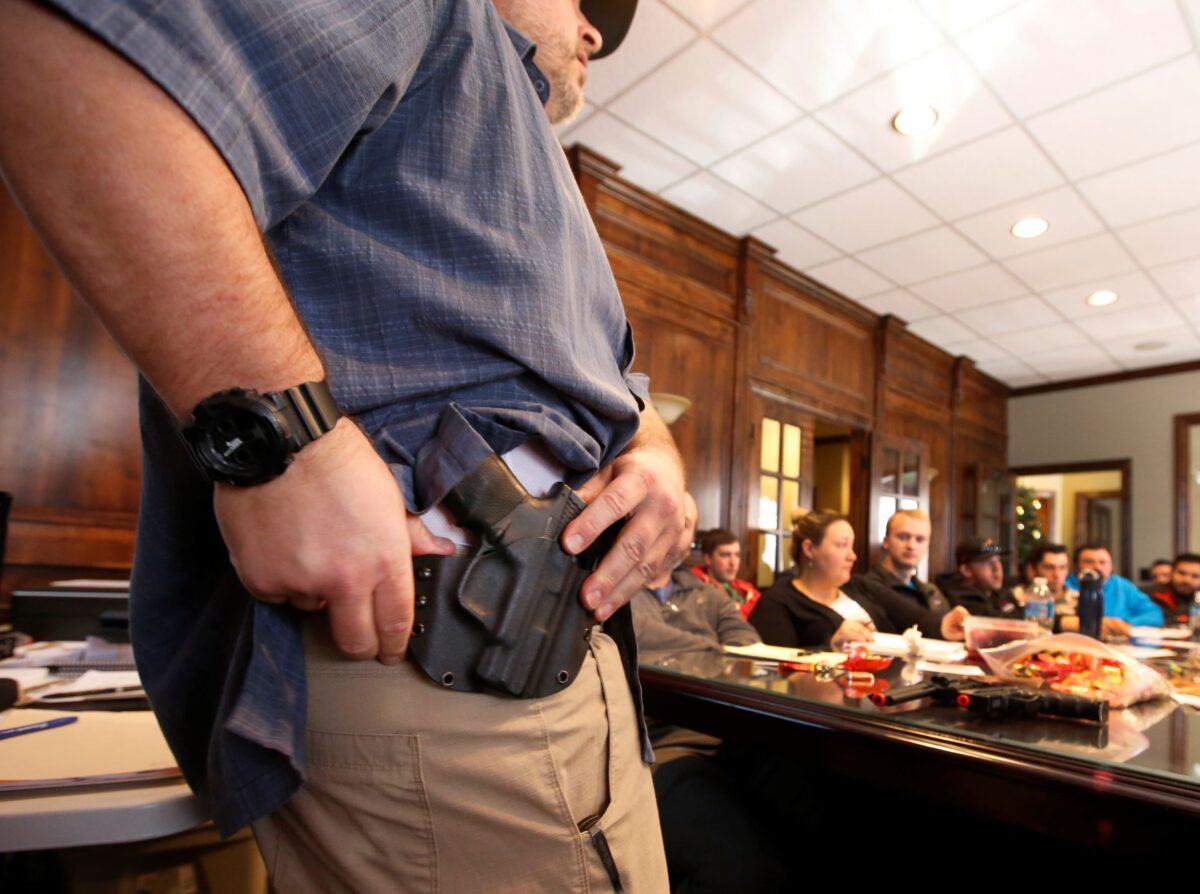
Missouri sheriffs say they would be breaking the law by allowing an FBI audit on concealed carry details. The file image is from a “USA Firearms Training” on December 19, 2015 in Provo, Utah. (George Frey/Getty Images)
The Federal Bureau of Investigation (FBI) has so far randomly audited 24 sheriff’s offices in Missouri in search of concealed carry weapon (CCW) details, but they all refused to comply, according to law enforcement authorities.
“None released anything pertaining to CCWs themselves, but some did partially comply by answering procedural questions on issuing CCWs,” said Moniteau County’s Sheriff Tony Wheatley.
“They answered two of those standard questions but nothing, as far as I know, was given from any sheriff pertaining to any CCW files.”
As previously reported in The Epoch Times, the FBI informed several Missouri County sheriffs that they would be showing up during August for onsite reviews of CCW permits.
In a statement to The Epoch Times, the FBI said the the auditing program is routine and has been in place for years.
“As part of the planned Missouri audit, a small sampling of system transactions is to be inspected for compliance and to ensure there is no misuse of CJIS systems,” the bureau said.
“At no point would auditors require access to lists such as state approved concealed carry holders, nor would the CJIS Division retain information beyond what is necessary to address a specific compliance concern. Missouri has been through this routine audit multiple times, most recently in 2018.”
Wheatley is among the sheriffs who received an email from Missouri’s Attorney General Eric Schmitt’s office on Aug. 9 in which he reminded law enforcement officers not to comply.
“We’re the highest ranking freely elected law enforcement of the state and it’s up to us to stand up for the rights of Missouri citizens,” Wheatley told the Epoch Times.
“The federal government, they overstep some, and it’s our job to put them in check and stand up for what we know is right.”
Scotland County’s Sheriff Brian Whitney is also vowing to follow Schmitt’s direction in not complying with the FBI.
“We received a letter by email on Aug. 8 from general counsel in the attorney general’s office that advised us to not comply with any audit,” Whitney said. “I would be committing a crime if I complied.”
So far, neither the Scotland County Sheriff’s Office nor the Moniteau County Sheriff’s Office have been approached by the FBI about an audit.
“The audits are ongoing,” Wheatley added. “They could still knock on my door, but it won’t do them a whole lot of good.”
Schmitt’s email this week was a follow up to a July 13 letter in which he told FBI director Christopher Wray that obtaining information about CCW permit holders is illegal statewide.
Under the Revised Statues of Missouri Law 571.101.9(2), sharing protected information retained in the concealed carry permit system with the federal government is prohibited.
“Any person who violates the provisions of this subdivision by disclosing protected information shall be guilty of a class A misdemeanor,” the subsection states.
Schmitt was a state Senator when the law was approved.
“I proudly voted for it,” he wrote to Wray. “In the Heartland, we elect our county sheriffs who are members of our communities. The same cannot be said for your out-of-touch FBI.
“You may wonder why there is such strong suspicion of federal agents here in the Show Me state. Simply put Missourians are hardworking, law-abiding citizens who don’t need a national nanny state keeping tabs on us.
“But more than that, over the last couple of years, we’ve seen story after story of incompetence and corruption at the highest levels of the FBI.
“Our trust in your agency is at an all-time low.”
But not all Missourians are in agreement with Schmitt’s position to directly oppose the FBI.
“It’s unfortunate that we, as a country, have become so divided that we can’t even get cooperation between local law enforcement and the FBI,” said John Wood, a former attorney for the congressional committee investigating the Jan. 6, 2021, pro-Trump rally at the U.S. Capitol.
“It’s also unfortunate that law enforcement issues have become politicized when they really shouldn’t, and we need to rise above politics and work together.”
Both Wood and Schmitt are gunning to replace U.S. Sen. Roy Blunt in the November mid-term elections. Wood is running as an Independent while Schmitt secured the Republican primary on Aug. 2.
“Federal law enforcement are rogue entities now,” said attorney Mark McCloskey, who was among the Republican Senate candidates that Schmitt defeated in the GOP primary.
“They are no different than the KGB or STASI. They’re just the political enforcement arm of the Democrat party and the powers that be.”
Schmitt’s email to sheriffs statewide was sent a day after the unprecedented search of former president Donald Trump’s Florida residence in Mar-a-Lago by FBI agents.
“What the federal government is attempting to do in Missouri with CCW audits is completely inappropriate, particularly in light of what the FBI and the DOJ did down in Mar-a-Lago this week,” McCloskey told The Epoch Times.
McCloskey and his wife, Patricia, were charged two years ago in the wake of the 2020 George Floyd protests for brandishing guns in front of their St. Louis home while Black Lives Matter demonstrators marched towards former Mayor Lyda Krewson’s home nearby.
The McCloskeys have been waiting since May 4 for 22nd Judicial Circuit Court Judge Joan Moriarty to rule on a motion to return their assault rifle and semi-automatic pistol.
“I think his [Schmitt] letter to the sheriffs is entirely appropriate,” McCloskey added.
In an Aug. 8 tweet, Schmitt said that if elected he would take a wrecking ball to ‘this overtly political DOJ and the administrative state.’
In response, Wood—who is a former United States attorney for the Western District of Missouri serving as the chief federal law enforcement official in Kansas City, St. Joseph, Columbia, Jefferson City, Springfield, and Joplin—accused Schmitt of political posturing.
“Schmitt claims to support law enforcement, but apparently his loyalty to Donald Trump is stronger than his commitment to law and order,” Wood said.

Juliette Fairley is a graduate of Columbia University’s Graduate School of Journalism. Born in Chateauroux, France, and raised outside of Lackland Air Force Base in Texas, Juliette is a well-adjusted military brat who now lives in Manhattan. She has written for The New York Times, The Wall Street Journal, TheStreet, Time magazine, Newsmax, and many other publications across the country. Send Juliette story ideas at JulietteFairley@gmail.com


So, what does a company do after winning the US military handgun contract with the M17/ M18, and garnering top spot for the #1 selling pistol in the country – SIG P365? Well, they endeavor to figure out how to give the handgun consumers “even more.” I own both the SIG P365 and the 365 XL, and I believe both are excellent pistols that changed the Micro Compact market. The P365 X-Macro Comp is just as groundbreaking as its predecessors.
SIG CEO, Ron Cohen tasked the 365 Product Team to give the shooters more, and they absolutely crushed their mission. The new X-Macro gives more in so many ways and redefines the market space that the P365 will compete in. The X-Macro’s upgrades should allow the 365 line to expand from the Micro Compact market into the sporting, medium framed handgun, and duty handgun markets.

To compete outside of the Micro Compact concealed handgun market, the 365 needed more capacity, so SIG developed a new magazine and slightly extended the grip of the Macro so that it now has a capacity of 17 + 1. The longer grip provides space for a full-handed grip while still retaining the 365’s comfort and ergonomics.
The good news for all 365 owners is that the new 17-round magazines will fit all previous 365 models. The new longer grip of the Macro increases the overall height of the pistol to 5.2,” which is less than a half inch taller than the 365 XL with its 12 +1 capacity. The amazing thing is the Macro remains a small pistol and is still a slim 1 inch thick.

The new grip fits naturally in the hand and adds more surface area and leverage to increase control while shooting. For shooters with larger hands the original 365 grip was probably a bit too small. To make the P365 X-Macro Comp more comfortable for those with larger hands SIG added a replaceable backstrap that comes in 3 sizes. The backstrap system is so seamless you can hardly tell where it mates to the grip .

The Macro’s slide still has the removable plate to support mounting a red dot optic while the iron sights remain installed, and the excellent SIG front and rear cocking serrations. However, the big change to the slide is the integrated 2 port compensator machined just in front of a 3.1-inch barrel. The overall length of the slide is the same as the standard 365 XL making it a fast handling yet still concealable pistol.

The obvious question is how much does a small 2 port compensator help on a 9mm with a 3.1” barrel? In my opinion, enough. SIG says that the reduction in muzzle flip is 20 – 25%. I don’t have a scientific way to put a concrete number to it, but the reduction in muzzle flip and recoil is definitely noticeable and significant enough to warrant having the compensator.

I’ve shot plenty of pistols with compensators over the years in USPSA competition, and many would blow a portion of the exiting gases back toward the shooter and/or the optic. The SIG Macro’s compensator didn’t exhibit these issues. The gases tended to move forward away from the shooter minimizing distraction while still being very effective at increasing control.

One of the concerns about compensated carry pistols is that from a retention position the comp may vent gases up into the shooters face. I shot over 50 rounds from close retention and never had any issues with the vented gas.

I slow-motion videoed the close-range shooting strings and it was clearly evident that the gases were venting out in front of me towards the target. The Macro proved to be very controllable while shooting one-handed from the retention position. The compensator allowed for some very fast close-range strings.
Specifications
Caliber 9mm
Capacity 17 + 1 rounds
Height 5.2 inches
Width 1 inch
Length 6.6 inches
Weight 21 3/8 ounces
Sights Sig XRay or Sig Romeo 0
Rail Picatinny 1913
Cost Should be available for ~ $799.99

Accuracy Testing
For a pistol that’s small enough to be a concealed carry gun and holds enough ammunition to be a duty gun, the SIG 365 X-Macro Comp demonstrated fantastic accuracy. The 3.1” barrel printed really well from the table at 15 yards. Most of the groups were shot with the red dot installed, but I did shoot a few with the iron sights and I was equally impressed.

I think the pictures speak for themselves, the Macro did great with everything I shot. Even the military ball ammunition grouped right at 2 inches, and the Speer Law Enforcement frangible was under 1.75. The best group was 5 shots with Hornady Custom 147 XTP.

The Macro comes with the usual 365 X straight trigger, this one broke at 5 lbs 4 oz on my trigger scale. Not a match trigger but certainly more than adequate for defensive shooting or shooting some great groups.
I knew that the Macro Comp was capable of shooting well from greater distances, so I backed out to 50 yards for a try. I had already removed the red dot, so I shot it with the iron sights. I figured if it could do 1 – 2” at 15 yards it should easily shoot 6 – 8” at 50 yards, perhaps better if I did my part.

I went prone and shot from the ground at 50 yards. I really like the SIG XRay sights for up close shooting, but the short sight radius and front sight width would require some focus to shoot the longer distance. However, the Macro did better than I had expected.
Four of the five shots grouped just under 2,” the other one was obviously my fault getting a little rushed on the trigger. The 5 shot group ended up measuring 6.25,” still excellent for such a compact pistol.

Speed Work
I was lucky enough to shoot several hundred rounds through the P365 X-Macro Comp at the SIG Academy and then over 500 more at my home range. It only took a few magazines to get the feel for the compensated Macro. The new grip fits so well that it feels like I’ve shot this pistol my whole life.
My first impression was that this gun cycles fast and the compensator really works. So, unless you are very focused on shooting fast and getting on the trigger, the Macro will definitely be waiting on the shooter to break the next shot. Even after you get a feel for the timing it’s all you can do to keep up.
Another upgrade on the Macro is that the accessory rail is now standard 1913 Picatinny instead of a SIG proprietary design. So now there are hundreds of lights and lasers that will fit the pistol. Unfortunately, this means that 365 XL holsters won’t fit the Macro; and this kept me from shooting it from the draw.

I did my range work from a variety of low-ready positions engaging my plate rack, dueling tree, and assorted steel silhouettes. I was very impressed at the speed I could run the dueling tree, and though I didn’t have a previous baseline time, I am certain I was hitting some new personal bests. Faster is better, right?
During all the media shooting at SIG, and the hundreds of rounds I fired at the house I never had or saw anyone have a single malfunction with the Macro. I know SIG does extensive reliability testing but with that much ammunition ranging from Hornady Critical Defense Light (100 grain reduced recoil) to 124 +P, and 147 grain full power it is impressive to have a firearm run 100%.

Summary
I am very impressed with the P365 X-Macro Comp, SIG did an amazing job on the new model. It’s still a relatively small pistol, much smaller than most 18-round duty guns, but extremely shootable. In addition, it’s very accurate, and stone-cold reliable.
With the same slide length as my XL and only .4 difference in grip length I often had to look twice to see which handgun I was picking up. A pistol this size is not expected to hold 18 rounds and shoot this well. The size and design of the 365’s grip and interchangeable backstraps is awesome and will undoubtedly be a great fit for many in law enforcement as well as civilians.
In my opinion, the greatest endorsement I can give a firearm is to carry it as my daily defensive pistol. I’ve carried the P365 XL since it came out, but as soon as the right holsters become available I will be transitioning to the P365 X-Macro Comp for its added capacity, ease in shooting, and accuracy.

Most heinous crimes are crimes of passion. Penitentiaries are brimming with folks who suffer from poor impulse control. Whether it is spontaneous road rage or a husband spurned, it is the heat of the moment that drives so many people to do so many things they might later regret. Little is more emotionally heated than modern combat.

The most effective soldiers are, with few exceptions, young and impressionable. Lord knows I was. Old guys with a little mileage wouldn’t be willing to do the job. If nothing else we have come to better appreciate the reality of our own mortality. The toxic combination of youth, patriotic fervor, and the very real prospect of imminent violent gory death can be an explosive milieu indeed.

In June of 1944, the entire world was changing. The Allies had a foothold in Normandy, and the Germans were appreciating for the first time what a self-inflicted catastrophe they had created for themselves. Realizing the stakes, Hitler and his general staff mobilized a number of first-rate combat divisions on the Western front to oppose the British, Canadians, and Americans during their breakout from Normandy. Among them was the 12th SS Panzer Division Hitlerjugend.

Adolf Hitler had a great many repugnant things for which to answer when he finally faced divine judgment in 1945. Right after the cold-blooded murder of six million Jews during the Holocaust, primary among them was the Hitler Youth. The Hitler Youth dates back to 1922. Its formal title was “Hitler-Jugend, Bund deutscher Arbeiterjugend.” That mouthful of kraut-speak translates to “Hitler Youth, League of German Worker Youth.” This paramilitary organization indoctrinated German boys age 14 to 18 to prepare them to become good little Nazis.

Your typical fourteen-year-old lacks the sense to pick out his own clothes, much less intelligently assimilate political ideology. As a result, the Hitler Youth did a simply fantastic job of creating fanatical Hitler acolytes. When Hitler’s total war finally caught up with Germany, the 12th SS Panzer was formed from the ranks of the Hitlerjugend. Senior NCOs and officers were typically drawn from other experienced SS divisions, but the rank and file junior enlisted men were products of the Hitler Youth.

The 12th SS Panzer was a well-equipped and well-trained combat unit that first saw action on June 7, 1944. During defensive operations around Caen they suffered heavy casualities. The stage was set for Something Truly Horrible.
The Setting

Waffen-SS Standartenfuhrer Kurt Meyer commanded the 12th SS Panzer Division during this critical time following the Allied landings in Normandy. He was revered by his men. Behind his back they called him “Panzermeyer.”

Meyer’s command post was established in a Premonstratensian monastery in Saint-Germain-la-Blanche-Herb near Caen. The towers of the Abbaye d’Ardenne offered a commanding view of the battlefield. These relatively unbloodied SS troopers were arrayed against Canadian forces moving inland from Juno Beach. Canada was a critical partner with the Allies during the D-Day invasion, providing some 14,000 combat troops to the effort.

By the evening of June 7, the Norman countryside was a battlefield. Battlefields exemplify chaos. Now some 36 hours into the close fight there were eleven Canadian prisoners being held at the Abbey. Five were assigned to the North Nova Scotia Highlanders, while the remaining six hailed from the 27thArmoured Regiment (The Sherbrooke Fusiliers). The 12th SS Panzer was being pressed mightily, and Kurt Meyer felt cornered.

A Polish-born SS trooper named Jan Jesionek was present for what came next and testified for the prosecution at the war crimes tribunal after the end of hostilities. Jesionek reported that a pair of SS soldiers arrived at the command post with seven Canadian prisoners on June 8. One of the guards queried Jesionek regarding the location of Standartenfuhrer Meyer. Meanwhile the Canadians were remanded to a stall adjacent the Abbey for safekeeping. When informed of the seven prisoners, Meyer reportedly said, “What should we do with these prisoners? They only eat up our rations.”

Meyer then purportedly had a quiet discussion with one of his officers out of earshot of the troops working nearby. He supposedly said, “In the future, no more prisoners are to be taken.”

The officer with whom Meyer had been speaking then questioned each prisoner individually. As each prisoner’s name was called he was led into the garden of the Abbey where this officer subsequently waited. As each Canadian turned into the garden the officer shot him in the back of the head with his machine pistol. All seven prisoners were brutally executed in this manner.

Once the officer and guards departed, Jesionek and three fellow drivers examined the bodies lying in the garden. Jesionek reported that the Canadians realized what was happening, and that each prisoner shook hands with his comrades before walking to the garden to be shot. Jesionek admitted that he never heard Meyer give the order to kill the Canadians, but the calculus of the event was fairly self-evident.
The Gun

The German MP40 was the seminal submachine gun used by German forces during the war. Like the American Thompson and the Russian PPSh, the MP40 became a national icon. Roughly one million copies were produced before the gun was supplanted by the MP44 assault rifle.

The MP40 was a streamlined development of the MP38 that was itself an evolutionary successor to the MP36. The MP36 was developed by Berthold Geipel working at Erma Werke with funding from the German Army. The MP36 never made it past prototype stage but laid the foundation for the profoundly successful guns to come.

The MP38 featured the same familiar layout as the subsequent MP40 but was built around a milled receiver formed from a piece of drawn tubular steel. The MP38 can be identified at a glance by the longitudinal grooves milled into the receiver as well as the dime-sized holes cut in the sides of the magazine well.

The definitive MP40 employed a pressed steel receiver and synthetic Bakelite furniture. As a result, the MP40 was the first general issue infantry weapon in the world to eschew wood in its manufacture. The underfolding steel stock was copied almost exactly onto the AKMS folding stocked Kalashnikov rifle.

The MP40 runs from the open bolt and feeds from a double-column, single-feed 32-round magazine. The rear sight is flip adjustable between 100 and 200 meters. The gun fires full-auto only at a sedate rate of around 550 rounds per minute. While fairly heavy at 8.75 pounds empty, the front-heavy nature of the design makes the MP40 exceptionally controllable in action.
The Rest of the Story

All totaled, as many as 156 Canadian POWs were executed by members of the 12th SS Panzer during the Normandy Campaign. A few bodies were discovered by members of the Regina Rifle Regiment a month later on July 8 when they liberated the Abbey. The first eleven victims were not discovered until spring of the following year when locals accidentally stumbled across the remains. The forensic analysis demonstrated that, while many had been shot in the head as described by Trooper Jesionek, others had been bludgeoned to death with either rifle butts or entrenching tools.

In December of 1945, Kurt Meyer was formally charged with murder by the Allied War Crimes Tribunal. Trooper Jesionek along with SS Private Alfred Helzel testified for the prosecution, with Helzel reporting that Meyer had commanded that no prisoners be taken. SGT Stanley Dudka, a Canadian survivor, offered first-person damning testimony as well.

For his part, Kurt Meyer denied all knowledge of the killings. He later claimed that he was aware of the presence of the bodies, but that he had not seen them until two days after the murders. Throughout his trial Meyer denied having issued the order not to take prisoners.

Meyer was convicted of incitement to commit murder for his role as Division Commander at the time of the atrocities. He was sentenced to death on December 28, 1945, though his sentence was commuted to life imprisonment on January 14, 1946. He served nine years of his sentence before being released on September 7, 1954.


After his release from prison Meyer became an active member of HIAG, a lobbying group formed from high-ranking Waffen SS troops. HIAG stands for “Hilfsgemeinschaft auf Gegenseitigkeit der Angehörigen der ehemaligen Waffen-SS,” which literally translates to “Mutual Aid Association of Former Waffen-SS Members.”

Throughout the rest of his life Meyer remained a vocal SS apologist, painting SS troops as non-politically affiliated, profoundly brave fighters who had little to nothing to do with the crimes of the Nazi regime. Historians have since reliably debunked these claims.

In 1957 Meyer published Grenadiere, the memoirs of his time with the Waffen SS. In this book, Meyer condemned the “inhuman suffering” to which Waffen-SS personnel had been subjected”for crimes which they neither committed nor were able to prevent”. Historian Charles W. Sydnor subsequently described Grenadiere as “perhaps the boldest and most truculent of the apologist works” of the post-Nazi era.

Later in life, Kurt Meyer’s health declined precipitously. He suffered from kidney failure and heart disease and required a cane to walk. Meyer died two days before Christmas in 1961 at age 51. 15,000 people attended his funeral.


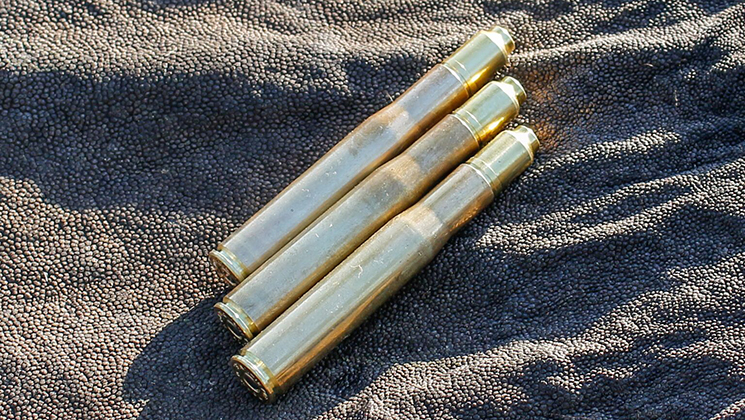
The first two decades of the 20th century saw huge advances in cartridge technology, giving us the .30-06 Sprg., the .375 H&H, the .250-3000 Savage, the .416 Rigby and the .45 ACP. While all those went on to become a star on one stage or another, Jeffery’s .404 Rimless Nitro Express was somehow always overshadowed. It was a smart design, matching the ballistics of the rimmed .450/400 3” Nitro Express—already the darling of the single shot and double rifle crowd—in a repeating bolt-action rifle. Unlike the .450/400, which uses a 400-grain bullet of .411” diameter, the original .404 load used .423”-diameter bullets, maintaining the same muzzle velocity of 2,150 fps, for just over 4,000 ft.-lbs of muzzle energy. Should the hunter want to use his .404 on lighter game, a 300-grain load was developed, with a muzzle velocity of 2600 fps.
Being able to be housed in a Mauser standard-length action, the .404 made an economical, effective and sensible choice as an all-around rifle for sportsmen visiting Africa and India a century ago, and though the production numbers—in comparison to the number of .416 Rigby rifles produced prior to World War II—show that it sold very well, the Jeffery never received the accolades that the Rigby did. It certainly wasn’t due to the fact that the Jeffery was in any way ineffective or unreliable as a dangerous game cartridge; in fact many of the Eastern and Southern African countries chose the Jeffery as the cartridge for their Game Rangers, doing the dangerous animal control work. Yet, history is what it is, and by the 1960’s the .404 Jeffery had all but faded into obscurity.
It has all the necessary ingredients to make a perfect all-around rifle cartridge: it is only slightly longer than our revered .375 H&H Magnum, it uses a shoulder angle of roughly 8˚-20’, so it feeds like a dream, it is easier on the shoulder than most cartridges in its class, and with modern bullets the .404 Jeffery is undeniably capable of taking any and all game animals on earth, including the African elephant. And, thankfully, it seems to be making a strong comeback.
It isn’t as flexible as the African industry-standard .375 H&H—which can do just about anything you’d ask of it—but it is undoubtedly a better choice for the truly large game animals. Modern .404 Jeffery loads have an increased muzzle velocity compared to the ammunition of a century ago; 400-grain bullets at 2350 fps put this old girl in the .416 Rigby and Remington class. Even at that higher speed, the Jeffery still makes an easy-shooting rifle.
There are many premium softpoint bullets designed for the Jeffery; The Swift A-Frame, Woodleigh Weldcore, Hornady DGX, Peregrine BushMaster and Cutting Edge Safari Raptor are all available in .423”-diameter, in many different bullet weights from 325 grains to 450 grains, extending the flexibility of Jeffery. The choice of solid (non-expanding) bullets is equally superb, with Nosler, Woodleigh, Cutting Edge and Hornady all making excellent projectiles. Factory ammunition is once again (thankfully!) plentiful, and the prospect of handloading your .404 ammunition is no difficult task.
The .404 also has a respectable group of offspring, being the basis for the Remington Ultra Magnum series, as well as the line of Dakota and Nosler cartridges; all took full advantage of the large case capacity and beltless design of the Jeffery.
I own two rifles chambered to this lovely old cartridge: my favorite rifle of all time, a Heym Express by Martini, and a Legendary Arms Works Big Five. Both are sweet shooting, both are wonderfully accurate, and I wouldn’t hesitate to take either on a hunt anywhere in the world that warranted a cartridge of this performance level. I’ve used the .404 Jeffery to take game animals from warthog, reedbuck and impala, to the tenacious blue wildebeest (often known as the poor-man’s buffalo) to a huge-bodied elephant; all were taken cleanly and effectively. I’ve handed that Heym to a buddy, while we were out on the Zambezi Delta flood-plains, and watched him take a Cape buffalo at just over 200 yards when we absolutely ran out of cover. I’ve also carried that same rifle into the mopane to take my elephant at a mere 16 yards, with no worries whatsoever.
My own pet handload revolves around a good 400-grain bullet—usually a Peregrine BushMaster or Woodleigh Hydrostatically Stabilized Solid—and a healthy amount of Alliant’s Reloder 15, giving me a muzzle velocity of 2280 fps, with groups hanging right around MOA out to 250 yards. If I feel I want a bit more weight, my Heym Express absolutely loves the Norma African PH ammunition, driving a heavy 450-grain Woodleigh Weldcore at 2150 fps. The Legendary Arms Works rifle also loves the lighter 325-grain Cutting Edge Safari Raptor at 2550 fps, and I plan on taking that weatherproof rifle to Alaska one day for a grizzly.
So, why would one choose a .404 Jeffery over one of the .416s or a .375 H&H? Well, because it’s really cool. There’s something about the look of that cartridge that I like a whole lot. It does, in fact, pair well with a .375H&H while on safari, letting the .375 handle the long shots and acting as a backup gun to the Jeffery for the truly large game. In comparison to the .416s, I feel the modern Jeffery loads are the absolute equal, and having used the .416 Remington extensively throughout Africa, I saw no visible difference in killing power between the two cartridges. It comes in a lighter rifle than does the Rigby version, but in the end it’s really going to come down to a matter of personal preference, and I’d happily use any one of the three .40s for any African hunt.
The ,404 Jeffery received its due in John ‘Pondoro’ Taylor’s famous African Rifles and Cartridges, in which he states “The Game Warden of Tanganyika (now Tanzania) who started his hunting career shooting buffalo for their hides in Portuguese East (now Mozambique) with a rifle of this caliber, found it so entirely satisfactory that he has armed all of his native game scouts in the Elephant Control Department with Vickers’ .404 magazine rifles.” If that doesn’t prove the worthiness of the .404 Jeffery, I don’t know what would.