Categories
California Gov. Gavin Newsom signed a controversial gun control bill modeled after Texas’ vigilante abortion law on Friday, teeing up a legal battle with a U.S. Supreme Court friendly to 2nd Amendment groups and firearm owners.
Newsom started a game of legal chess in December when he called for gun control legislation in California modeled after a Texas law that authorizes private citizens to sue anyone who aids and abets in an abortion, which the high court declined to block.
State Sen. Bob Hertzberg (D-Van Nuys) and a coalition of Democratic lawmakers introduced Senate Bill 1327 in response to Newsom’s request as a way to test the Supreme Court’s legal logic while setting up a political rivalry with states that have used a conservative majority of justices to expand gun ownership and curb abortion rights.
“If they are going to use this framework to put women’s lives at risk, we are going to use it to save people’s lives here in the state of California. That’s the spirit, the principle, behind this law,” Newsom said during a news conference to sign the bill.
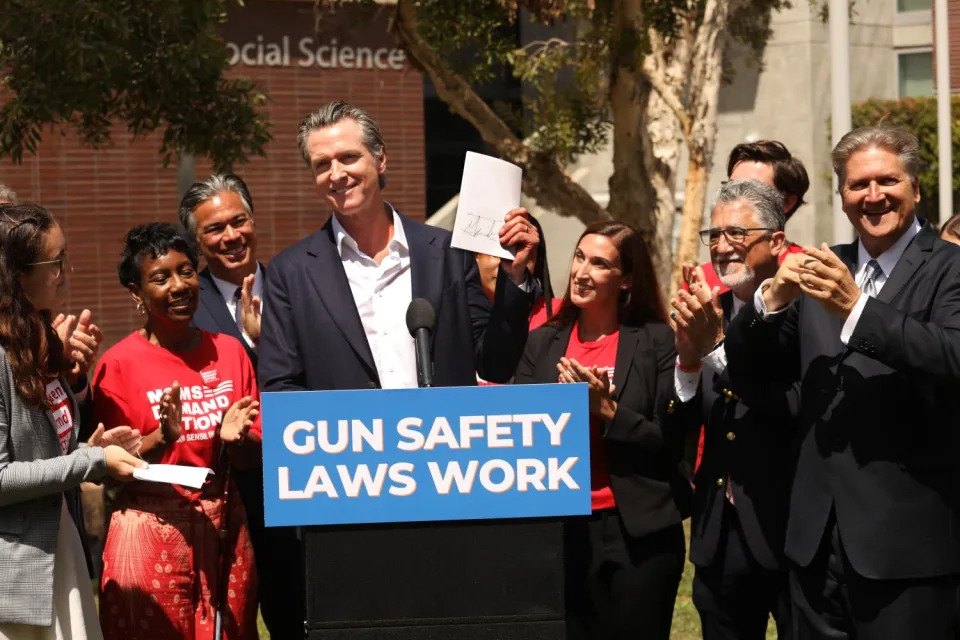
Newsom on Friday morning also announced that he was running a full-page ad in Texas newspapers targeting Gov. Greg Abbott “for refusing to protect human life and take action against gun violence.”
“If Texas can ban abortion and endanger lives, California can ban deadly weapons of war and save lives,” Newsom wrote in a tweet.
Earlier this month, Newsom ran another campaign ad in Florida, which claimed that freedom is “under attack” in the Sunshine State and urged residents to “join us in California.”
Abbott Press Secretary Renae Eze said Newsom should instead “focus on all the jobs and businesses that are leaving California and coming to Texas.”
The new gun law, set to go into effect in January, will allow private people to sue anyone who imports, distributes, manufactures or sells illegal firearms in California, such as assault weapons, .50 BMG rifles and so-called ghost guns. The law requires a court to order $10,000 in damages for each weapon used in an alleged violation, along with attorneys fees. The bill was written so that if Texas’ law is nulled, California’s would similarly be invalidated.

Newsom placed SB 1327 at the top of a list of more than a dozen bills he prioritized this year to help address a national crisis of mass shootings and to further limit the gun industry’s already restricted influence in California. Newsom signed another measure this month to establish a “firearm industry standard of conduct” and to allow local governments, the state Department of Justice and gun violence survivors to sue for violations of state law. Other bills he signed limit firearm advertising to minors, crack down on ghost guns and require school officials to investigate credible threats of mass casualty incidents on campus.
Proponents billed SB 1327 as a way to curtail gun violence by enlisting the legal help of private residents in stopping the spread of prohibited firearms in the Golden State.
The Texas statute that inspired California’s law allows citizens to sue abortion providers and anyone who helps a person to obtain an abortion after five or six weeks of pregnancy.
“You’ve gotta do everything possible to reduce gun violence,” Hertzberg said. “If Texas is going to use this legal framework to essentially outlaw abortion for women, California is going to use this legislation to save lives.”
Lawsuits against many, if not all, of the bills are expected, with several gun ownership groups citing the policies as an infringement on 2nd Amendment rights.
“It is obvious that this is a retaliation against lawful gun owners and the court because of the Texas decision,” said Sam Paredes, executive director of Gun Owners of California. “There’s a full expectation that the firearms industry will have a very strong reaction towards the signing of this bill.”

“They are really, really trying to be nothing but vindictive against lawful people in the firearms industry,” Paredes added. “All of our attorneys are in the process of evaluating what we are going to do on this thing.”
When the Supreme Court upheld the Texas law, some 2nd Amendment advocates voiced fears it could be used against them by gun control advocates, with Erik Jaffe, a lawyer for the Firearms Policy Coalition, calling the decision a vehicle for “deterring the exercise of any and all rights.”
But other legal experts question whether California’s strategy to mimic the Texas abortion ban will render the same outcome if it is brought before the Supreme Court’s conservative majority.
“One big difference between this law and Texas’ [abortion ban] is the likely opinion of the Supreme Court,” said Adam Winkler, a UCLA law professor with expertise in 2nd Amendment issues.
Winkler pointed to the Supreme Court’s recent decisions that struck down abortion rights guaranteed in Roe vs. Wade and a New York law that restricted concealed carry as evidence against its likelihood in upholding California’s new private right to action.

“The Supreme Court is much more likely to strike down California’s law than the Texas law. We now know one of the reasons the Texas law was not struck down is the court, within a matter of months, would overturn Roe vs. Wade,” Winkler said. “The same court is expanding 2nd Amendment rights and is now likely to take a ban on assault weapons as unconstitutional.”
The American Civil Liberties Union also raised serious concerns with the new law’s enforcement tactics.
Shilpi Agarwal, legal director at the ACLU of Northern California, said the group doesn’t object to what the bill aims to accomplish in limiting access to illegal firearms. Instead, Agarwal said the ACLU disagrees with circumventing the courts by allowing a private right to action as a way to enforce those restrictions, which could essentially establish a “constitutional arms race” with other states.
“The federal Constitution creates the floor on our rights that states can’t go below. That is what ensures that all citizens, no matter what state they live in, enjoy a baseline level of rights, which courts then enforce,” Agarwal said. Texas’ abortion ban “is meant to create a trap door in that floor. And now other states are creating their own trap doors. California is creating one as well. And with all of these trap doors, the floor becomes meaningless.”
A legislative analysis of the bill cautioned that replicating a Texas-style private enforcement strategy “may be flawed and dangerous” and noted that California already “tightly controls, regulates, and criminalizes activities related to restricted firearms.”
Hertzberg said the strategy is still worth trying.
“We don’t like the framework, but if we can take advantage of it and save lives, why is that wrong?” he said.
Newsom said that California has to assert itself after the Supreme Court “opened the door.”
“It was a terrible decision, but these are the rules that they have established.”
This story originally appeared in Los Angeles Times.
—————————————————————————————-Care to guess is planning to run for President? Grumpy
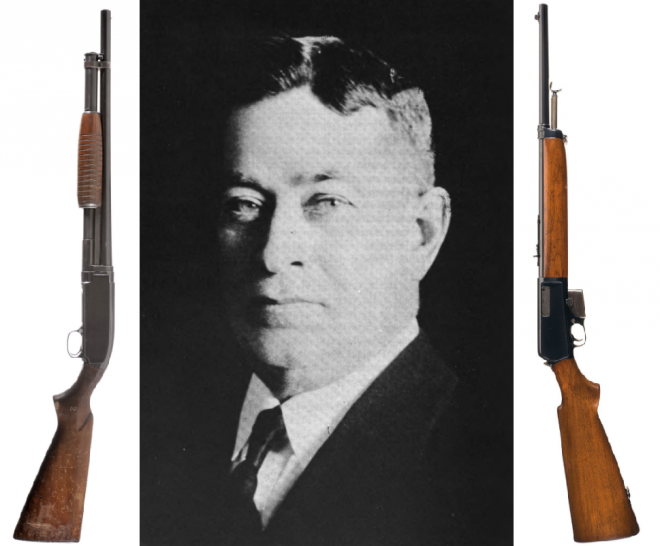
The late 1800s and early 1900s are undoubtedly a period of American firearms design dominated by one man, John Moses Browning. But many of Browning’s contemporaries were no less able and men like Andrew Burgess, William Mason, John Pedersen, Frank Burton and T.C. Johnson were all responsible for ingenious and important designs.

A mountain goat hunter poses with his Model 1907 (reddit)
Thomas Crossley Johnson is perhaps one of the lesser known alumni of that generation of gun designers. Johnson was responsible for Winchester’s line of successful semi-automatic rifles, a series of shotgun designs and the Model 54 bolt-action hunting rifle.
Johnson was born in Connecticut in May 1862, the son of Samuel C. Johnson, president of the Yale Safe and Iron Company. Highly educated, he graduated from Yale’s Shefield Scientific School in 1884, he joined the Winchester Repeating Arms company a year later.
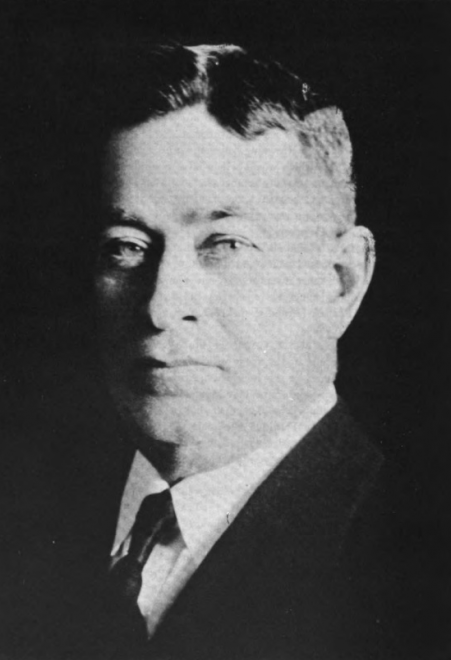
T.C. Johnson (Winchester: The Gun That Won the West – H.F. Williamson)
During his fifty years at Winchester, Johnson emerged as a talented inventor, working initially as a draftsman before being assigned to work under William Mason developing new designs. During this time he also worked on improving many of John Browning’s designs, getting them ready for production and drawing up patent specifications to protect them from infringement.
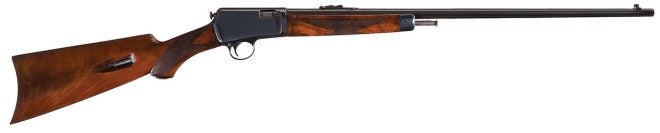
Winchester Deluxe Stocked Model 63 Semi-Automatic Rifle (Rock Island Auctions)
Johnson’s first success came in 1903, with the introduction of the Model 1903 .22 semi-automatic rifle. The 1903 was the first semi-automatic rifle designed and offered commercial sale in North America. The new rifle came at an important time for Winchester in the wake of the break up of the lucrative Winchester-Browning partnership which for almost twenty years had seen Winchester purchase every major design and invention the Browning brothers offered them.
So important was Johnson’s new .22 rifle to Winchester that the company wrote to its dealers and sales agents stating that “any suggestion of their [the Brownings] claiming that they are the ‘whole thing’ and there is nothing left, the .22 Automatic gun is our answer…”

Johnson’s 1901 patent for his semi-automatic .22 (US Patent Office)
Johnson patented his new semi-automatic takedown rifle in April 1901 (US #681,481), the Model 1903 retained the classic Winchester receiver shape reminiscent of the company’s lever action rifles but used a blowback action and fed from a 10-round tube magazine in the butt. By the early 1930s Winchester had built 126,000 Model 1903s. In 1933, Winchester re-introduced the M1903 as the Model 63, chambered in the popular .22LR cartridge. Approximately 175,000 Model 63s were made before production finally ended in the late 1950s.
From 1903 into the late 1920s Johnson was responsible for many of Winchester’s new guns, becoming the company’s chief designer in 1907. The company steadily introduced a series of self loading rifles including the Model 1905, Model 1907, and Model 1910. Johnson filed a patent protecting the design of what would become the Model 1905 in June 1902 (US #720698).

Winchester Model 1905 (RIA)
The Model 1905 has the distinction of being the first centrefire semi-automatic rifle to be sold commercially in the US. It used the same blowback action as the earlier .22 calibre but was chambered in .32 and .35 Winchester Self-Loading. Instead of a tube magazine the 1905 fed from either 5 or 10 round box magazines. Like the 1903, the 1905 lacked a conventional charging handle – instead having an operating sleeve beneath the barrel, projecting from the fore-end.

Johnson’s 1902 patent for what would become Model 1905 (US Patent Office)
In 1907 Winchester released a version of the rifle chambered in the more powerful .351 Winchester Self-loading suitable for hunting medium sized game. It also proved popular with police departments and saw limited military use during World War One with France, Britain, Russia and the US. Both the 1907 and the later 1910 had noticeably thicker fore-ends to prevent cracking.
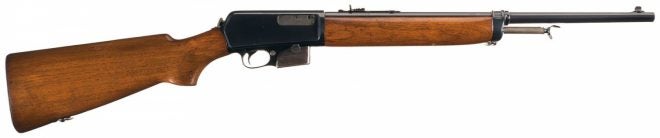
Winchester Model 1907 (RIA)
The final rifle in Johnson’s blowback self-loading series was the Model 1910, chambered in .401 Winchester Self-Loading, designed to take large game such as deer. Again the 1910 saw some military purchases from France and Russia during the Great War. The 1910 remained in production for nearly 30 years and over 20,000 were manufactured.
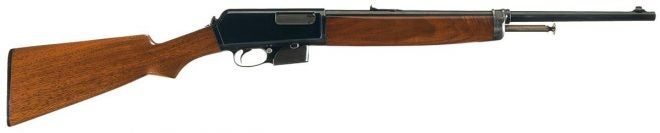
Winchester Model 1910 (RIA)
During the early 1900s, Johnson, a prolific designer patented numerous innovations including sights (US #1220637), stock pieces, take-down systems, locking methods, scope mounting systems (US #852119 & #870295), hollow-point projectiles (US #1077607 & #1084342) and an ‘impact illuminating bullet’ (US #1088027).
With the break from Browning still fresh, T.G. Bennett, Winchester’s managing director, asked Johnson to develop a semi-automatic shotgun to rival Browning’s Auto-5/Remington Model 11 – the gun that Winchester had declined to buy from Browning. Designing a gun that avoiding infringing Browning’s patents proved no easy feat. Johnson spent over 5 years developing his shotgun – the Model 1911 (US #768665). The Model 1911 used the same long-recoil principle as Browning’s design but Browning’s patent protected the Auto-5’s cocking handle, so the Model 1911 had to be cocked by grasping the barrel itself and pulling it backwards. This led to a somewhat dangerous and questionable manual of arms where some users placed the gun on the ground and used their weight to pressed down on the barrel, this led to a number of injuries and fatalities during loading and unloading.
Despite Winchesters efforts the Model 1911 was only a moderate success and failed to beat Browning’s design in the marketplace. Not only was the 1911 expensive, at $38, it also had problems with its fibre recoil washers breaking down which meant the shotgun’s recoil could become painfully strong. While the Auto-5 remained in continuous production for almost a century, Winchester discontinued the Model 1911 in 1925.

12 gauge Model 1911 (RIA)
Johnson was responsible for another safer and more successful shotgun, the slide action Model 12, introduced in 1912. The Model 12 had an internal hammer and a six round magazine tube. The Model 12 owed some of its design to Browning’s 1893/97 pump action but improved the earlier weapon’s ergonomics. The Model 12 was adopted by the US military and saw action during both world wars, Korea and Vietnam. Production ended in 1964 when manufacturing costs meant it couldn’t compete, in terms of price, with more modern shotguns.
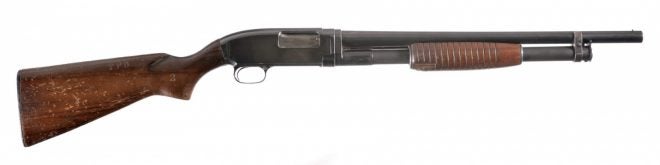
Winchester Model 1912 (RIA)
From 1914 Johnson turned his attention to developing a bolt action rifle suitable for military adoption. The Model A used a modified Mauser action and had a stock profile similar to the M1903 Springfield. Between 1914 and 1919 the rifle evolved steadily through a series of prototypes.
During the war Winchester manufactured both the British Pattern 1914 and the US Model of 1917, which evolved from it. But according to historian Herbert Houze the Model A was also considered as an option if the P14 proved too difficult to manufacture. The various prototype models of Johnson’s bolt action are currently held by the Cody Firearms Museum, a photo of some of them is available here.
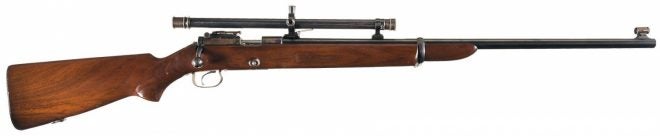
Model 52 target rifle with Winchester scope (RIA)
After the war Johnson and Frank Burton set about designing a new .22 calibre target rifle, the Model 52. The Model 52 proved to be extremely popular with target shooters with over 100,000 made and production continuing into the 1980s. Initially, designed to be similar to the service rifles returning soldiers were familiar with it was also hoped that the military would also purchase it as a training rifle.

Winchester Model 54 (RIA)
In 1925, Winchester introduced the short-lived bolt action Model 54, a development of one of Johnson’s prototype military rifles. The Model 54 was Winchester’s first rifle designed to handle high velocity ammunition and chambered a number of calibres including .30-06 and .270 Winchester. The 54 was discontinued in 1936, but influenced the famous Model 70 which replaced it. Some 50,000 Model 54s were made before production ceased.

Winchester’s first double barrel shotgun – the Model 21 (RIA)
The final Winchester firearm to draw on Johnson’s work was the Model 21, introduced in 1930. It was Winchester’s first traditional double barrel shotgun. While the project was led by Frank Burton, Johnson’s safety mechanism from a patent filed almost twenty years earlier (US #995790) was used. Available with one or two triggers it proved a popular skeet shooting gun with everyone from farmers to film stars with Charlie Chaplin, Gary Cooper and Errol Flynn all owning Model 21s.
Thomas Crossley Johnson lead Winchester’s design department for nearly three decades, he was responsible for bringing many of John Browning’s rough toolroom prototypes to production and guided the company through some of its most difficult times. He was undoubtedly a talented designer and skilled engineer who deserves more recognition than he, and many of his contemporaries, receive today. Johnson died in June 1934, aged 72.
Sources:
Winchester Repeating Arms Company 1865-1981, H.A. Houze, (2004)
The History of Winchester Firearms 1866-1992, T. Henshaw, (1993)
Winchester: The Gun That Won the West, H. F. Williamson. (1952)

Matt is a British historian specialising in small arms development and military history. He has written several books and for a variety of publications in both the US and UK. He also runs Historical Firearms, a blog that explores the history, development and use of firearms. Matt is also co-founder of The Armourer’s Bench, a video series on historically significant small arms.

I sat overlooking a beaver swamp, with a bait barrel full of fish heads and moose bones, waging war on the black flies. The temperature had risen to nearly 70 degrees that afternoon, and I was being eaten alive. I’d packed a couple of sandwiches and a can of soda for the evening vigil, and though I’d just gotten to my stand, I was hungry already. I had just unwrapped one of the dainties when I saw—for it did not make a sound on approach—a decent boar come into the bait site. Flies be damned, this was exactly what I was waiting for.
I raised the handy .308 Winchester and put one 180-grain bullet into his boiler room, turning the black bear into an infuriated beast, but a second bullet ended the affair. It was my first bear, and I was immediately hooked. I’ve spent much more time hunting for bears than actually shooting bears, but it’s a hobby I enjoy very much. That spring, among the beautiful lakes that make up the Quebec landscape, was the first I’d hunted big game here in the States, and it was something that would become part of my life. Let examine the reasons to book a spring bear hunt.
1. It’ll take to you to a different part of the world.
Much of the spring bear hunting is done in Canada, with our U.S. opportunities being in Alaska and a few Western States. A change of scenery represents an adventure—at least in my book—and for many of us, a trip to those areas that allow spring bear hunting can be a great time. I know that you need not ask me twice to begin planning a trip to a different destination, and more than likely, the country you’ll see will become a very fond memory.
2. It’s halfway to deer season.
It’s been quite a while since deer season closed—in most areas anyway—and if you’re like me, you’re starting to feel that itch. Yes, turkeys offer great sport and will always be a part of my spring ritual, but bears offer a reason to grab a rifle and experience a whole new type of big-game hunting. Whether it’s black bears over bait or glassing for brown bears, a spring bear hunt will help ward off the irritability and shortness of breath that is usually experienced when one realizes how far off deer season actually is.
3. It’s not just about the bears.
Many of the areas in which spring bear hunts are conducted also offer great fishing. Where I hunted in Quebec, the early morning was usually spent checking the bait stations, and a good part of the day—up until about 3:00 p.m.—was spent fishing the numerous lakes. Fresh fish, neatly fried up, was a delicious treat in bear camp, and with a minimal amount of fishing gear, we had a great time. Depending on the area you’re hunting, deep sea fishing may be involved, or perhaps fly-fishing for trout in a Western stream, but no matter, you’ll be outdoors all day long.
4. Bear hunting is an amazing experience.
Be careful, you may end up with a new favorite hobby. Bear hunting can be addictive, as they are after all dangerous game. Even a black bear can turn the tides on a hunter, especially if hit wrong, so hunting them requires a bit of a different level of attention than other animals. They’re smart, wary and silent. They can be brazen—I’m sure you’ve seen videos of a bear climbing the very tree that a hunter occupies—and they can be as witty as they come, circling the bait station, just out of range, until they feel comfortable coming in. Sometimes they’ll wait until well after dark, especially the big boars that have been educated, and though you’ll find tracks, you’ll never get a glimpse of him. Only when you’ve seen a bear will you get an idea of exactly how quietly they walk on those large pads, adding to the mystique. If it’s a brown bear you’re after, well, that alone is an amazing experience, and one I’m keen to have. It’s beautiful, rugged country and just being there is worth the price of admission.
5. It just might be an excuse to buy a new rifle.
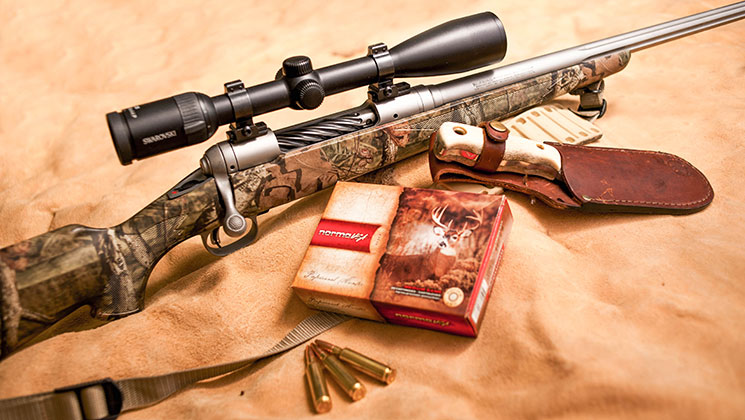
Well, not that any of us really need an excuse to buy a new rifle—I’m a firm believer in ‘the-more-the-merrier’—but this is as good a justification as any. Been wanting that .35 Whelen? Perhaps that sweet .300 Magnum you’ve been eyeing is just an excuse away from joining the team. No matter, so long as it’s a bear-worthy caliber—usually .270 and up for the black bears, and .300 on up to around .375 for the browns—I say go ahead and set up your own bear rifle. Maybe a rugged, all-weather affair makes sense for the locale you plan to hunt, or it may just be a familiar design in a different caliber. You could also experiment with a different projectile in a rifle you already have, something good and strong that can easily break those large shoulder bones. At any rate, the planning and purchasing of gear can be an awful lot of fun, and booking a bear hunt is a good impetus for just that.
I wish more states would open up a spring season for bears. Populations are most definitely on the rise, and the additional license money would help keep our public lands well-funded. There are some very affordable bear hunts available. I know I’ve seen some good deals for black bear in Idaho, Quebec and Alberta, and some very expensive ones as well—an Alaskan Kodiak bear hunt is no small financial investment—so there should be something for almost everyone’s budget. Get on the computer, make some phone calls and start planning your great adventure.
Delaware — A small business owner with no criminal record was shocked this month when he watched a disturbing scene unfold on his Ring doorbell camera. When he checked the notification on his phone he noticed three armed men wearing tactical vests, dressed in t-shirts and blue jeans. Two of the armed men were agents with the Bureau of Alcohol Tobacco and Firearms (ATF) and the third was a Delaware state trooper.
Knowing he had committed no crime, the business owner who wishes to remain anonymous, had no idea why these men were there so he walked out to confront them before they ever knocked. The entire interaction was recorded on his camera system.
“Can I help you?” he asks.
The homeowner had recently made a firearm purchase and the ATF agent told him they were there to verify it. Making sure this wasn’t a scam or a setup, the homeowner verified their identification before proceeding.
The ATF agent then pulled out a list of recent firearms purchased by the man and demanded to see them. The ATF claimed they were investigating straw purchases. A straw purchase is when someone buys a gun for a third party who is not legally authorized to buy a gun themselves.
The following creepy dialogue then unfolded as the ATF showed the homeowner a list of all of his guns — which the ATF claims not to have.
Agent 1 – “All I’m doing is verifying that you have it, you got two different purchases. If you have them, I’m out of here. That’s how quick it is. Yeah. Do you have them with you by any chance?”
Homeowner – “They’re in my safe.”
Agent 1 – “If you can unload them and bring them out. We can go out to your foyer here, check them out, write the serial numbers and we’re out of here.”
Homeowner – “That’s it?”
Agent 1 – “Yep.”
Agent 2 – “That’s it. It will take five seconds.”
Trooper – “The reason we’re out here is obviously gun violence is at an uptick. We want to make sure – we’ve been having a lot of issues with straw purchases. One of the things, indicators we get is someone making a large gun purchase, and then a lot of times we’ve been there and ‘Oh, those guns got taken.’”
Agent 1 – “The idea is that when you purchase more than two guns at a time it generates a multiple sales report and it comes to us and we have to check them out. That’s all that is. You did nothing wrong – absolutely zero. I noticed you were stopped in Philly though with one of your guns?”
Trooper – “We’ll wait if you feel more comfortable.”
Homeowner – “I’m okay. I just – I didn’t expect…”
Agent 1 – “Oh no. It just came up. We came here, look, I’m telling you. There’s an email from the federal side saying can you make sure this guy’s got his guns. If you recently purchased a whole bunch of guns, if we can look at them and just scratch them off…”
Homeowner – “I have them all.”
Agent 2 – “We can look at them and write which ones you just bought, so we can save a trip from coming back. We’ll confirm that you have them.”
When the homeowner went back inside to retrieve his guns, the cops had a telling conversation outside, not knowing they were being recorded.
Trooper – “He doesn’t believe we’re cops.”
Agent 1 – “I don’t blame him.”
After showing the agents his firearm, they left. The homeowner had been coerced into a warrantless search of his property despite the fact that he was not suspected of committing a crime, nor was he the subject of any law enforcement action.
In fact, because the ATF agents did not have a warrant, it means they lacked any probable cause to obtain one. Their entire warrantless search relied on the compliance of the homeowner — who in hindsight says he wishes he wouldn’t have consented to the search.
A reporter with Ammoland spoke to the homeowner who told them this situation was embarrassing as it was disturbing.
“I was embarrassed,” the homeowner said. “My neighbors saw the whole thing – guys in these police vests standing in my yard. I was really uncomfortable. I felt really confused, like I was in some way being accused of something even though I didn’t commit a crime. It was quite embarrassing. I knew they couldn’t come in, but I didn’t know what to do. I didn’t want to get put on some watch list. We just got new gun laws here. I didn’t want them coming back again. I felt like they were invading my privacy.”
Unfortunately, it appears that this is going to become the new norm. In July of last year, US attorneys offices and the ATF announced that they will be investigating straw purchases more aggressively, “focusing not only on major cities, but also the neighboring towns and states.”
All the ATF needs to do is claim they suspect you of making a straw purchase and now they can come to your door and demand to see your guns. If that does happen, and they have no warrant, you do not have to show them your guns and can simply tell them this.
When federal agents are going door to door to verify gun purchases it means we are that much closer to a national gun registry which will not end well. How long until this disturbing scene unfolds on your doorstep?
Article posted with permission from Matt Agorist
FPC Statement to Concealed Carry Issuing Authorities: Obstructing the People’s Fundamental Right to an Effective Self-defense is not an Option.

Sacramento, CA –-(AmmoLand.com)- Firearms Policy Coalition issued the following statement in response to reports of multiple carry permit issuing authorities across the country refusing to comply with the Supreme Court’s opinion in NYSRPA v. Bruen, which held that the Second and Fourteenth Amendments protect the right to carry firearms in public:
Quoting the plurality opinion from McDonald v. Chicago, the Supreme Court held in Bruen that “[t]he constitutional right to bear arms in public for self-defense is not ‘a second-class right, subject to an entirely different body of rules than the other Bill of Rights guarantees.’”
To those authorities that process or issue permits to carry concealed weapons that are abrogating the People’s right to carry: Obstructing the People’s fundamental right to effective self-defense is not an option.
It doesn’t matter if you disagree with the recent United States Supreme Court opinion. It doesn’t matter if there are a lot of applicants. It doesn’t matter if you don’t feel like spending time processing them. You are required to objectively process a carry permit application submitted to you without burdensome fees, delays, flaming hoops, and other games. The deluge of applications you’re now experiencing could have been avoided if you simply respected the People’s right to bear arms from the start and not treated it as a second-class right.
FPC refuses to stand idly by while the issuing authorities—who are often law enforcement agencies—delay and deny the People’s right to the peaceable conduct they are entitled to. Your agencies must know that FPC will utilize every available instrument to remedy this ongoing and historical wrong.
Individuals who want to Join the FPC Grassroots Army and support important pro-rights lawsuits and programs can sign up at JoinFPC.org. Individuals and organizations wanting to support charitable efforts to restore the Second Amendment and other natural rights can also make a tax-deductible donation to the FPC Action Foundation. For more on FPC’s lawsuits and other pro-Second Amendment initiatives, visit FPCLegal.org and follow FPC on Instagram, Twitter, Facebook, YouTube.