Categories
CZ Scorpion EVO 3 S1 Pistol


Here’s Elmer sitting behind his desk. When you pushed a button,
he’d turn around and start talking to you, telling stories.

The famous #5 of which “The Last Word” was written in
Rifleman, April 1929 issue.
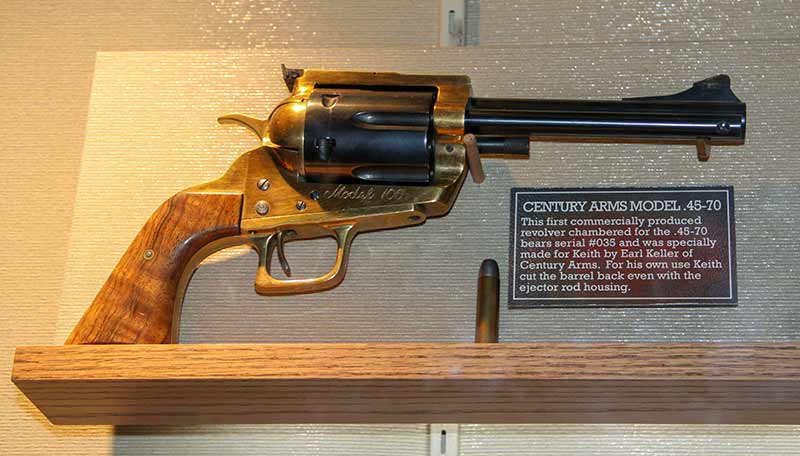
Elmer tested and wrote about all guns. Here’s his Century Arms .45-70 revolver.
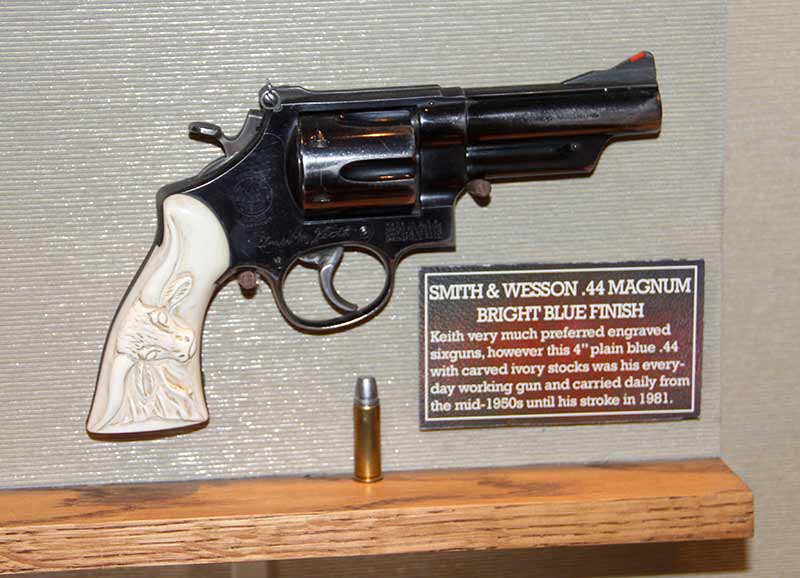
One of many 4″ Model 29s Elmer owned with his trademark steer-head ivory stocks.
Lately, I’ve been getting my Elmer on. Yup! Been reading up and researching the Grand Old Man of Handgunning. Up until seven years ago, there was a place that paid homage to Elmer Keith. For you youngsters never hearing of him, I don’t fault you. You’ve been neglected by your elders, or school system, so I’ll step up and tell you a little about Elmer.
Afterwards, I suggest you hunt up any book, magazine, or computer writing by him and get yourself intimately acquainted with his works, thoughts and readings.
It’s been said Elmer spoke the original thoughts and all others have simply regurgitated his words in one form or another. Thinking about it, it’s not too far from the truth. Elmer had his hand in, or made mention of, just about everything pertaining to the gun world.
With no formal education, Elmer had great instincts and understanding. He didn’t just concentrate on one discipline either, he knew how to shoot, load or discuss anything pertaining to sixguns, autoloaders, black powder rifles, revolvers, shotguns and paper-patched lead bullets for Sharps single-shots rifles. If it went bang, Elmer knew how to shoot and handload for it.
He was a great outdoorsman, outfitter and packer. He guided hunters for years, up until age 50, and knew the life cycle, food habitat and environment of every critter living in his area. He’s responsible, or planted the seed, for such things as the .357, .44 and .41 Magnums, the S&W model 29 and 57, Ruger Flat Top and Super Blackhawk .44 Magnums, the Winchester model 70 rifle, and the .338 Winchester Magnum, to name just a few things.
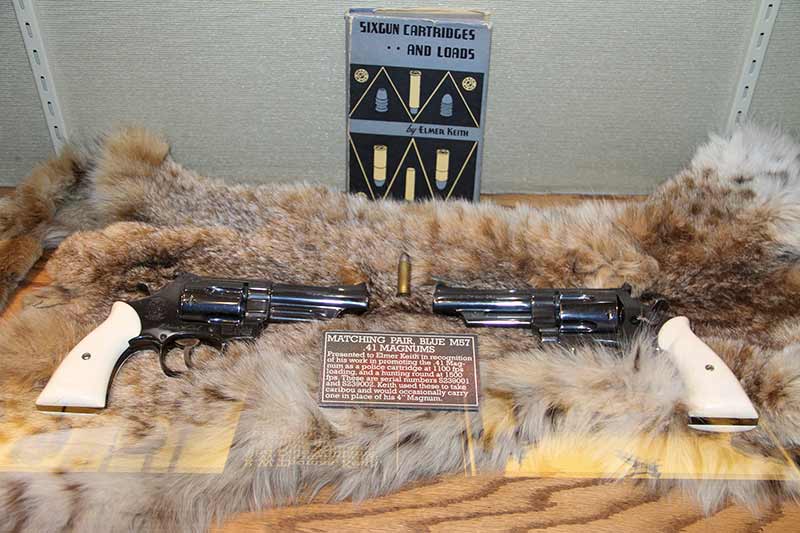
Elmer’s matching pair of S&W Model 57 4″ revolvers.

Here’s Elmer packing out a ram in the rugged country of Idaho. Notice his simple pack-board.
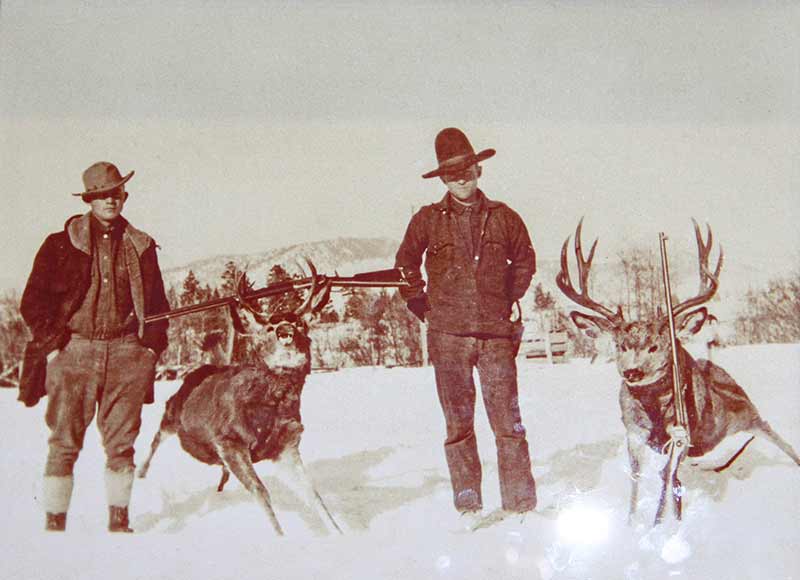
Elmer and his brother Silas with two mule deer. Elmer took his with a Sharps rifle.

The Museum
With much help from our own John Taffin, Cabelas in Boise, Idaho carved a niche in their store to house the Elmer Keith Museum. I knew about it and wanted to go for years. I finally got the opportunity when I went out to visit my buddies Dick Thompson and Steve Call. I was fortunate to make the journey on two occasions.
For those knowing who Elmer was, it was a breathtaking experience to see his pictures, game heads and yes, firearms, of the famous gun writer. As time went on, the family wanted to liquidate the assets, and had everything auctioned off. Sadly, this forced the closure of the museum.
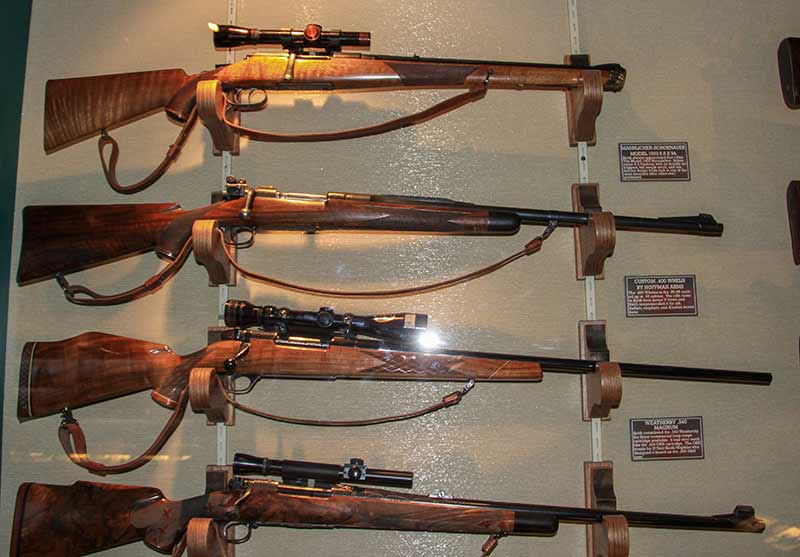
A rack of Elmer’s rifles. Second from top is his famous .400 Whelen, a gift from Jim Howe’ of Griffin & Howe.
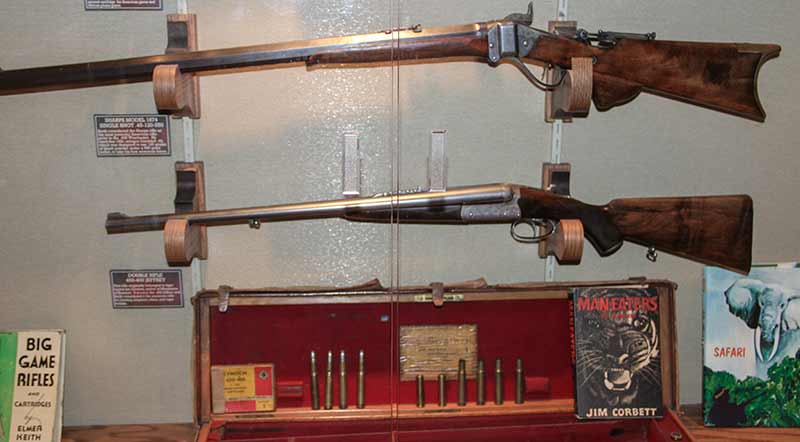
Another rack of rifles. The bottom rifle was Jim Corbett’s .450-400 double rifle,
a major-league cool factor! Below it is the leather case it came with
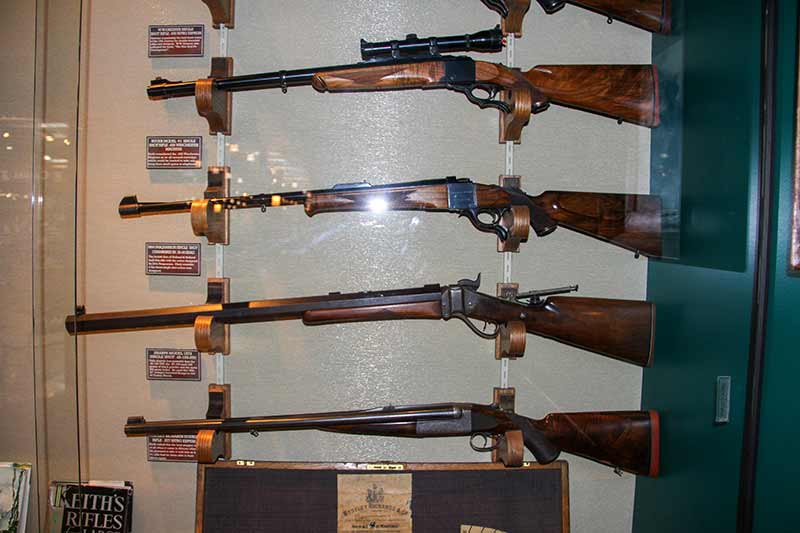
Above the Corbett rifle is Elmer’s Sharps .45-100-550 rifle. Need I say more?

Some of Elmer’s trophies.
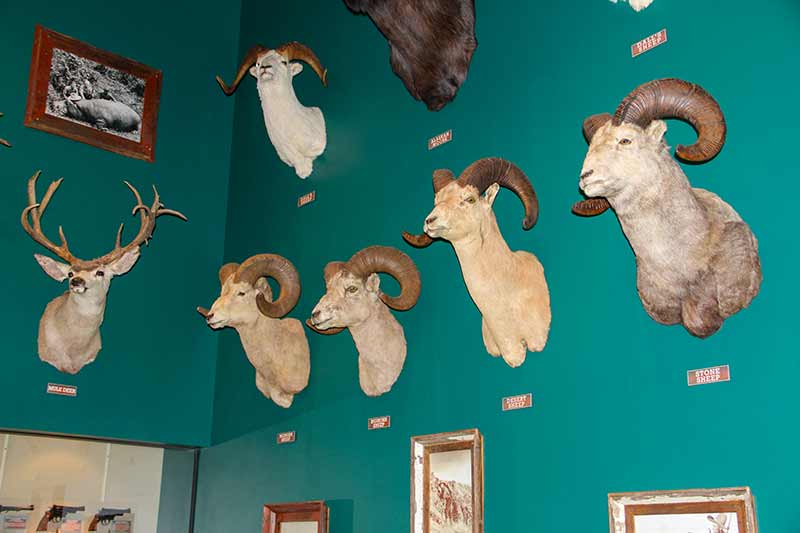
Some fine sheep he took!
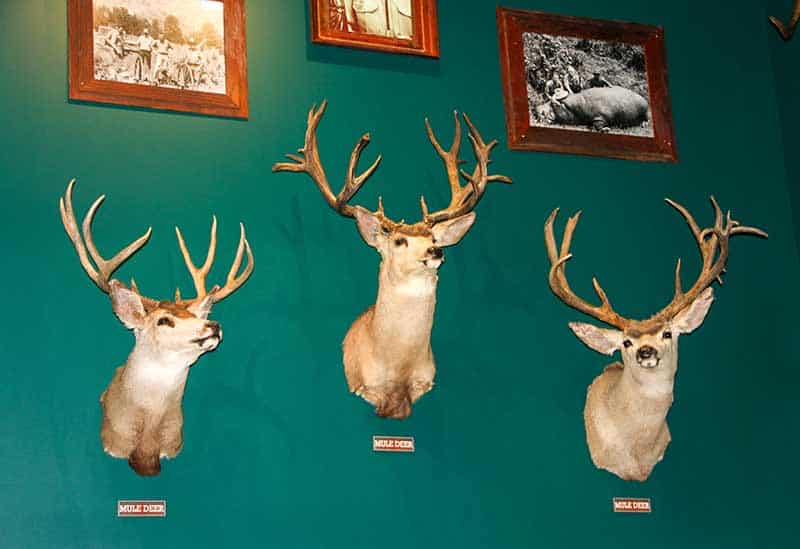
A trio of mulies the master took.
Second Chance
So, for those of you who never had the opportunity, I figured I’d share my pictures with you, to get some insight into one of the pioneers of shooting, hunting and the development of handguns, rifles and cartridges. I hope you enjoy visiting with Elmer. It was something to see in person.
More importantly, I hope I’ve lit a spark for you to continue reading, researching and replicating some of the loads, guns, holsters or hunts Elmer experienced.
It’s fun walking alongside the footprints of our founders, and who knows, you just may learn something along the way.
Categories
At The Range: Valmet M-62/S
Twice a year gun writer Dick Williams organizes a three-day theme shoot.
DRILLS
Instructors Lew Gosnell and Aimee Grant did a great job putting a spin on routine drills while keeping them fun. For example, on a man-against-man contest, rather than face the target and wait for the “fire” command, the shooters looked at each other and movement, by either contestant, was the signal to draw and fire. The first shooter to make a hit on the steel target won the “gunfight.”
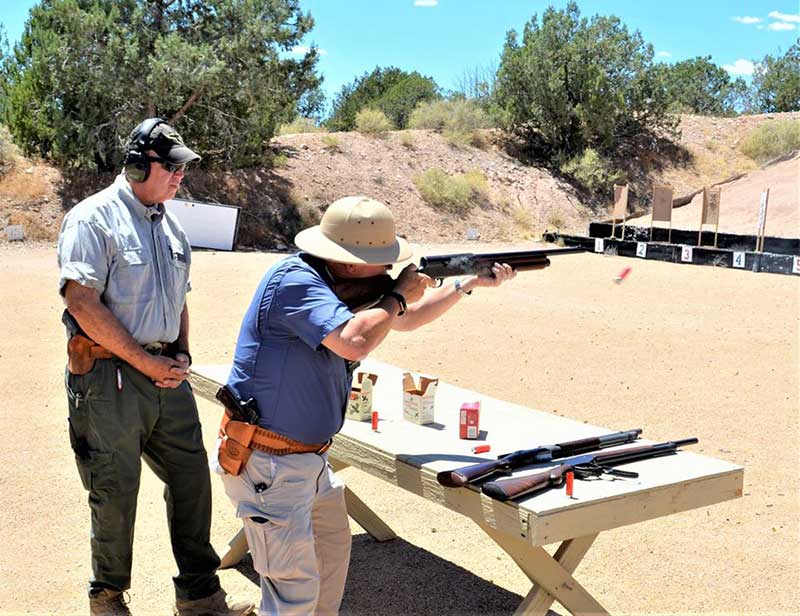
Gunsmith David Fink chambers a round from the lever-action 1887 while empty shell is still in the air. Photo: Mike Detty

Gunsite Chief Executive Officer Ken Campbell, cutting loose with the Remington 11. Photo: Mike Detty
Revolvers are obviously slower to reload than the semi-autos, so just like shotguns we spent a lot of time loading what we shot—one-shot drill, load one round; two-round drill, load two rounds; failure drill, load three rounds, etc.
We shot a school drill where the possible score is 50 points. The twist here was that if a shooter did not shoot a perfect score, his final score was zero.
On the third day we shot one-handed from a saddle.
OLD WARHORSE
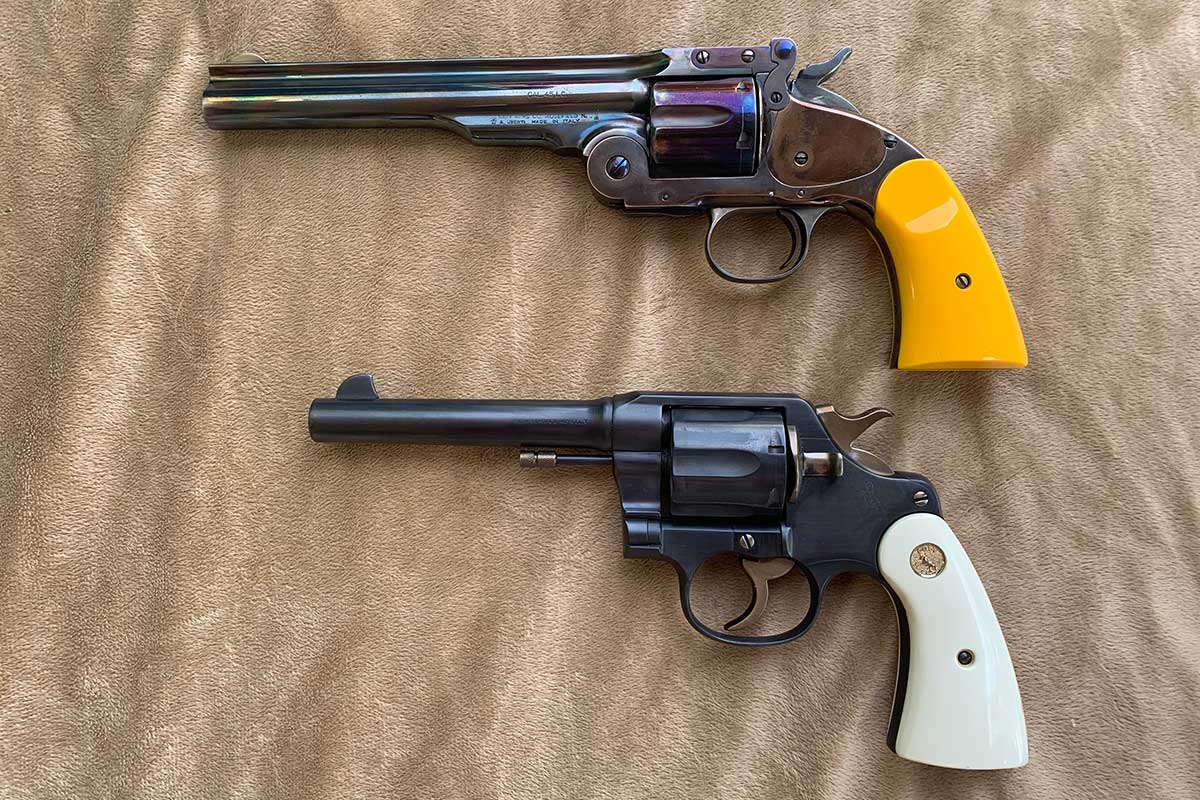
For the double-action day I used my Colt New Service, chambered in .45 Colt, made in 1907. Two years after this one was made, the U.S. Army adopted this large frame revolver as the Model 1909—two years before the iconic 1911 became the standard issue sidearm. A while back I had it expertly refinished for many more years of shooting, for both recreational use and self-defense (see New Life For a New Service https://gunsmagazine.com/gear/new-life-for-a-new-service/).
Although not as light and easy to conceal as almost any modern pistol, there is something comforting about a big heavy revolver that will launch a 250-gr. semi-wadcutter at 900 feet-per-second. For the event at Gunsite I used Black Hills Ammunition .45 Colt 250-gr. RNFP loads.
LOAD WHAT YOU SHOOT
In the movie the Shootist with John Wayne, when giving a shooting lesson, J.B. Books tells Gillum to leave the hammer down on an empty chamber for safety. When asked what if you’re expecting trouble, he says, “load six if your insides tell you to.”
Trying to keep the event as true to the period as possible, this became more difficult with the single-actions as they were to be reloaded, but with the hammer down on an empty chamber. Easier said than done. Remember Ruger did not come out with the transfer bar, which made carrying six rounds safely, until 1974.
A revolver I have taken to Gunsite for several events is my Uberti reproduction S&W Model 3 Schofield and the unique top-break revolver is always sure to attract interest and curiosity and due to the top-break action is easy to load and unload.

Retired Border Patrol officer Ed Head back in his element protecting the border from banditos. Photo: Mike Detty
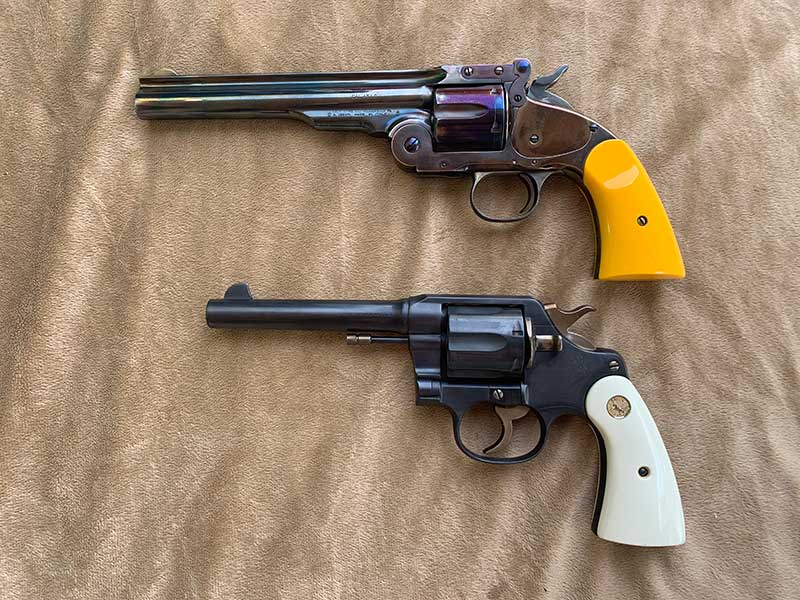
Denny’s Model 3 Schofield and Colt New Service. Two proven performers.
Major George Schofield, serving with the 10th Cavalry in Kansas, learned of the No. 3 and became S&W’s sales agent for Colorado and Kansas. He later made some design changes and was granted patents that included a different latch and an improved extraction system. Hence the name Schofield was forever associated with the Smith & Wesson revolver.
The No. 3 has four hammer positions. After pulling the trigger, the hammer is all the way forward at rest with the integral firing pin protruding from the breech face.
Cocking the hammer to the first click retracts the firing pin, and the cylinder remains locked. This actually allows the Schofield to be carried fully loaded, although I’ve always been a bit wary about any “half-cocked” position—there is a good reason for the old saying, “Don’t go off half-cocked.”
Another click back unlocks the cylinder so that it rotates freely. In either one of these partially cocked positions, the latch can be activated and the barrel and cylinder rotated down to simultaneously eject the shells.
The fully cocked hammer position is all the way back ready to make a loud noise.
While the Uberti reproduction will also chamber .45 Colt, I used authentic .45 Schofield ammo from Black Hills Ammunition.
COMING TO AMERICA
For the semi-auto I took another reproduction—a 1911A1 imported by SDS Imports. Made in Turkey by TISAS, it is the closest reproduction of the gun used by the U.S. Army I have found. About the only thing different from the original is a magazine well that is slightly beveled and a polished feed ramp and barrel lip.
I didn’t just want to compete with the 1911A1, I wanted to give it as much of an evaluation during the short time I had with it as possible. Over the day I fired in excess of 200 rounds of mixed ammunition including 230-gr. full metal jacket, 228-gr. cast round nose lead and 200-gr. cast semi-wadcutters and did not experience a single malfunction.
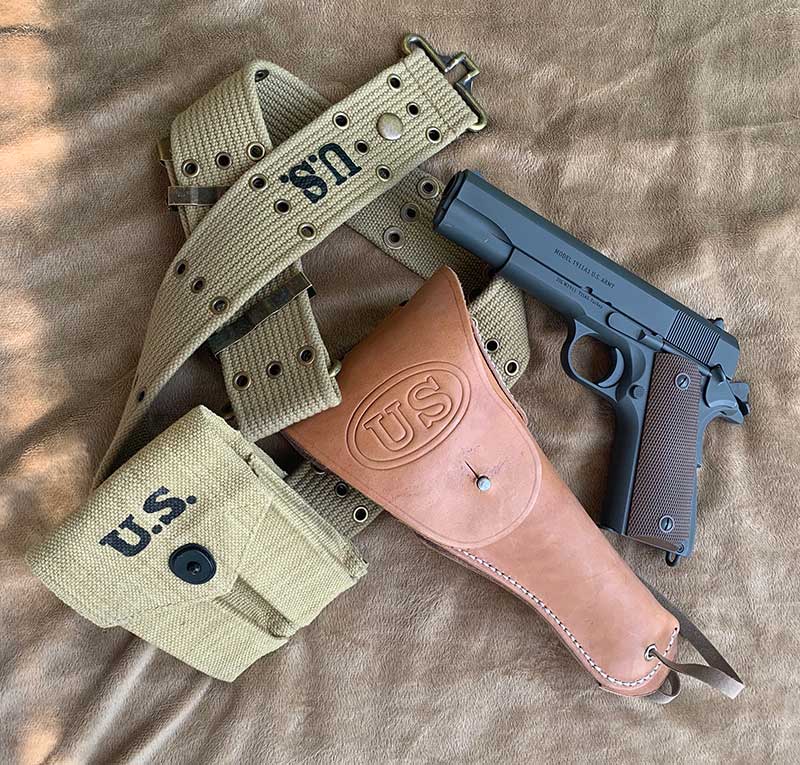
At the Gunsite event Denny used a M1911A1 with a period correct GI flap holster and web gear.
Since I wanted to remain pure to the “period correct” theme, I used a GI flap holster on a web belt and web magazine pouches. I knew full well this would leave me out of the running in any man-against-man contests, but I did manage a respectable third place. Considering the flap was secured by the stud/hole arrangement on the holster I was quite content with my placing.
One of the differences between the 1911 and 1911A1 is the longer spur on the grip safety to avoid hammer bite. And although I was not bitten by the hammer, the narrow hammer spur caused enough discomfort to the web of my hand to make me appreciate the wide beavertail on modern 1911s.
One thing all three handguns had in common were the small and narrow front sight with matching small rear sights. As expected as distance increased, accuracy decreased even more than usual.
LAWDOG FOWLING PIECES
For a break from the late July Arizona sun, we had a show-and-tell session planned. When my turn came I brought out three shotguns that saw use by lawmen (and outlaws) in the early 1900s, and all three were John M. Browning designs. I have covered these extensively in my GUNS Magazine shotgun columns.
The first was a reproduction Winchester 1887 lever-action. This was a gun Browning really didn’t want do design, but Winchester insisted on it for brand identity.
Up next was an original Model 1897 made in 1907. This pump gun is probably the most identified shotgun used by U.S. troops in the trenches of World War I.
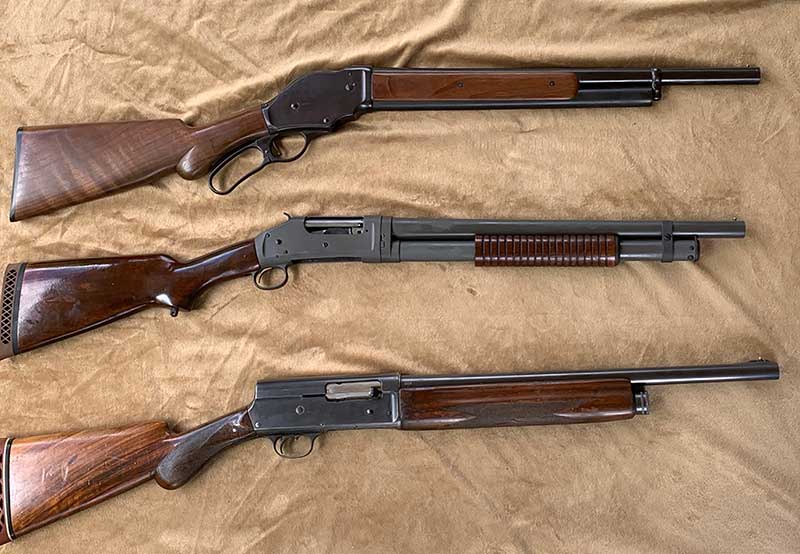
Class enjoyed hearing about and shooting historic shotguns. Top to bottom: Winchester Model 1887, Winchester Model 1897 and 1905 vintage Remington Model 11.
Finally I presented the Remington Model 11. Introduced initially as the Browning Auto-5, Remington purchased the rights to produce it starting in 1905. My Rem 11 is part of the first production run by Remington in 1905.
An interesting side note on the Remington 11 is that by rearranging friction rings on the magazine tube and recoil spring it can be set for either light or heavy loads and I demonstrated to the class how to accomplish this.
All attendees were given the chance to shoot each shotgun.
All shooting does not need to be tactical, or even practical for that matter. An event like this gives us the chance to kick back, reflect on our heritage and just have fun.
GUNSITE
(928) 636-4565
www.gunsite.com
BLACK HILLS AMMUNITION
(605) 348-5150
www.black-hills.com