



Categories
How the 1873 Cimarron action works
Every single thing has its purpose.
One of the great powers in humanity is its ability to imbue what it creates with as much of a purpose as we can. No matter how mundane that creation may be, anything from breakfast to a sculpture, there’s a droplet of a purpose in it all. As benign as it can be, as unintentional as it may be, it is still there.
I know that’s a lot of Baby’s First Philosophical Optimism right there, waxing way too poetic for something as asinine as a 70 year old military surplus rifle, but the M1 Carbine is that to an extent. It’s a rifle built for one purpose, but it’s done that purpose so well that it’s gone into another one. It was supposed to be a lightweight carbine rifle for giving to rear line soldiers, and yet it ballooned out into one of the first widespread and common semi-automatic rifles out there. The prototype for everything from the PDW concept to the modern assault rifle, although calling it either of those things is stretching it a bit. It is still a carbine, just a weird middle-ground one.

Plus it’s one that’s a divisive one to talk about. For decades, this gun was the butt of boomer jokes and jabs about it’s lack of power and reliability, and now ironically it’s a rifle who’s market is dominated by those same boomers artificially inflating the prices to a point where the fun semi-automatic plinker is now a bit of a pain to get into. That being said, we’re delving into all of it here. History, a review AND a few nuggets of information you should know. I’ve owned three of these frickin’ things, and it’s good to know what you’re getting into because the 59 year old former bricklayer turned VFW attendee who lives off of a diet of Middleswarth potato chips, ham and beans and cases of Bud Light will not tell you that his rifle’s a piece of garbage. It’ll be a sea of “I know what I got”.
With that said, let’s go.
Well This Machine Kills Commies
1936, in the wake of the rising tensions in the world, the US Army begins engaging in a variety of upgrade programs to a flabby armed forces. Two decades in the wake of WWI, your average soldier looked less like a modern fighting man and more like he was heading off to fight in Belleau Wood. And following the annexation of Austria and rising tensions in China, it was more apt to get going on proper new equipment now than later. One of the biggest things for the US Military at the time was a new rifle. In 1936, the M1903 Springfield was still the mainline service weapon. While the A1 model had come in following WWI, it was still a tad elderly and the M1917 rifle laid some interesting concepts down for the Ordnance Department to look into. However, they didn’t want another bolt action. Like every other power, they wanted a semi automatic rifle. They weren’t the first, technically. Rifles like the Mondragon M1907, the General Liu, the RSC 1917 and even the wonky Russian Fedorov were all mainline issued rifles prior to the 1936 Rifle Trial. The fundamental difference however was that. “Mainline”. All of the previous rifles were either prototypes that sadly never got past the limited trials stage or specialist weapons used in small roles. Even the new AVS-36 wouldn’t break that trend. The concept of a semi-auto for every soldier was a tad of a ballsy jump.

This trial ran two mainline frontrunners against each other, both designs that had been simmering in other trials prior for the past decade. The one was from John Pedersen, the prodigy designer of Remington Arms and the man behind everything from the Model 10 and 17 shotgun to the original Remington 51 pocket pistol. His design was a rather unique en-bloc loaded toggle locked action firing a lubricated .276 cartridge. An interesting design for certain, but it wasn’t the only front runner.

Its competition would be a gas operated rotating bolt rifle from Springfield Armory, developed by Canadian-American immigrant John Garand. Also an en-bloc loader but using a long stroke gas piston. It also used that same .276 cartridge just to be fair. As time went on, the 1936 Trial became one of minor details winning out. The Pedersen’s much more open action and its tendency to detonate primers on closing the bolt, alongside the risk of losing funds for the trials made the Ordnance Board go for the Garand models, initially just a .276 with minor interest in a prototype .30 caliber model. With pushback from Army figures such as General Douglas MacArthur over the concept of adopting a new caliber, the prototype .30 caliber Garand would be refined into a new rifle, the M1 Garand.

With a new adoption came its further troop trials, where other issues came up. Beyond mechanical faults such as modifying away from the gas trap gas system as well as a slow start to production, there was one fundamental problem. The thing was big. Very obvious I know, it’s a full sized battle rifle from the 1930’s, it weighs 10 pounds loaded. But the issue wasn’t for normal GI’s, rather for the burgeoning specialist roles in the US Army. When the initial trial was written up, there wasn’t much of a concept for things such as radiomen, combat engineers or even rear line roles like military police.
With the adoption of the M1, it meant these roles that were normally reserved by handguns were now filled with heavy, long semi-automatic rifles. Complaints abounded, and with intentions for the implementation of even more specialists, they needed to make a solution to this problem. They needed something in a medium role, and with awareness that not every soldier could reliably use a M1911A1.
So the basic outline was drawn up in 1938 for a new carbine rifle. A 5 pound rifle, semi-automatic with an effective range of 300 yards, and the option to be given a folding stock. They’d get a basic concept from the cartridge from Winchester, a modified rimless version of the vintage .32 WSL cartridge from the old 1907 rifle. At the time, Winchester was caught up with their own rifle project, the Winchester M2.
And that rifle was a bit of a problem.
Making A Dollar Out Of 15 Cents
Following the adoption of the M1 Garand, the Ordnance Department would have private companies assess the design and look for improvements. Especially as the production of it was lagging behind schedules, a Springfield Armory tradition at this point. One of the biggest would be Winchester, who’d had a minor stake in this game. Years prior, they had picked up Ed Browning. Brother to John Moses, and in some weird attempt to make up for the mess they had started with JMB decades ago, he brought them his semi-automatic rifle patents that he had worked with for Colt in 1929. Refining them slowly, he’d develop the Winchester G30M. Hopeful it would go well, they would send it off to the Marine Corps rifle trial of 1940.

And it came in dead last behind the Garand and prototypes of the M1941 Johnson.
That was a problem, but the issue was that Browning had passed away the year prior. So they needed someone to fix it. And so they turned to a man by the name of David Marshall Williams.

David Marshall Williams was the eldest son of James Claude Williams, a wealthy North Carolina landowner and farmer. While he initially worked at one of the family’s farms, he’d be expelled from school in eighth grade and continue a weird career in his mid teens. He’d try to enlist in the US Navy, lying and saying he was 17 when he was only 15 but they denied him once the real age was found out. Not that it helped him, three years later he’d join a military school and be expelled before the end of the first semester for stealing a load of rifles and ammunition.
He continued odd jobs until Prohibition when he was arrested for shooting a deputy who was part of a raid on an illegal still. His still. He’d get 30 years and be sent to Caledonia State Prison Farm as a result. With mechanical aptitude probably gained from working on all of the stolen rifles, Williams would end up operating in the machine shop of the prison and over time developed a reputation as a solid firearms designer and self-taught gunsmith.
His family would work to try and have his sentence commuted, which was granted in 1927 to just ten years. For murder, mind you. At the same time, he developed the floating chamber system and began selling it to companies like Colt for their .22 conversions of guns like the M1911. Remington would also contact him for a .22 rifle, although they sat on the patent for it for a while until the Remington Model 550 was released later on.
But Winchester would bite the proverbial bullet. Under recommendation from General Julian Hatcher, they’d hire him to help reform the G30M into the M2. While it was a better rifle, it still wouldn’t cut the mustard, especially now that the Garand had four years of service. Still, a Major by the name of Rene Studler would say that the rifle showed promise in the Light Rifle project. Williams would even make a 7.5~ pound scaled down version of the G30, so the possibility was there.
And so the concept of this rifle would coalesce from a myriad of men, sources and inspirations. The lower receiver and fire control group from the earlier Model 1905 rifle, the overall action and lockwork from Williams’s revised M2 rifle, segments from the M1 Garand and in 13 days, had their first prototype.
This was a hit, and so another team was created with men like William Roemer and Edwin Pugsley to make a production model. Williams was the project lead, but his constant decisions to go it alone in the project harmed its ability to continue. This led to him being taken off the project, and having him debate over patents involved with the design for the next two years. While he was granted those royalties and later brought back to Winchester to refine other Ed Browning designs, he wouldn’t interact more in what would become the M1 Carbine. Despite what the movies would tell you.

Still, it would go on to trials in September of 1941, beating the other designs and being adopted the month after. The new “M1 Carbine” would be formally adopted on October 22, 1941.
Just in time for war two months later.
War Were Declared
Broadly speaking, the M1 Carbine was not supposed to see real combat use. As stated prior, it was supposed to be a lightweight rifle for reserve role troops or ones that were operating in roles that weren’t intended for direct combat. Cooks, clerks, truck drivers and so on. And to that end, the M1 Carbine would serve in that role. However over time it would expand outwards given the rifle’s interesting middle ground role. While it wasn’t as powerful as a Garand, it was still arguably more powerful and controllable than a M1 Thompson. And it was also much more cheaper to make than a Thompson, costing around ⅕ of the price.

Over time, the M1 Carbine would creep into other roles and became a de-facto arm of NCO’s and the burgeoning anti-tank crews, both anti-tank guns and the new Bazooka anti-tank rocket launchers. The small size and decent firepower made it popular in places like the Pacific Island hopping campaigns, although small issues would crop up as it got into wider and wider service moving into 1943 and 1944. It was also modified for the airborne with the M1A1 Carbine, fitted with a special side folding stock. These would begin to form a mixture of upgrade packages that would shape the M1 Carbine during the war, yielding a small mixture of variants.

Issues with handguards popping off would result in two separate modified barrel bands, leading to one featuring a bayonet lug to mount the new M4 bayonet. Issues with the fire control group, namely how both the safety and mag release were two round buttons lead to a new fire control group. Issues with trying to zero the fixed two-position sight lead to a stamped rear sight assembly similar to the M1903A3.
These various modifications would be done initially on a field armorer level before becoming full refit projects for M1 Carbines. These are colloquially called the “Late War” or “Korean War” M1’s in comparison to the WWII models without these features. In response to the rise of automatic weapons like the STG-44 in German hands, the Ordinance Department would restart working on the concept of making the rifle select fire, developing the “M2” Carbine from that, as well as the final upgrade of a thicker stock as well as new 30 round magazines. While it would be too late for major use in Europe, the M2 would see service in Okinawa and the late-stage Pacific Theatre. Alongside the other version, the M3 Carbine.

Developed in response to Japanese penchants for night raids during early battles like Guadalcanal and Tarawa, the T3 Carbine would be a heavily modified M1 Carbine fitted with a “Generation 1” night vision optic, alongside a foregrip, battery pack and an overall weight of around 34~ pounds. Primarily issued on sentries, it did see limited use during the battle of Okinawa, although rain and other inclement weather soured the gun’s already miserable 75 yard range. Still, it did prove effective and was the pioneer of night vision scopes in both the US military and the world, improved and later adopted as the M3 Carbine and used sparingly in Korea, with a new “125” yard range. Improvements!
Another thing to touch on here is manufacturers. While Winchester had designed the rifle and won the contract, they were not in a position to dedicate 100% of their production floor to this rifle. As WWII kicked off, they were assigned a contract to manufacture M1 Garands as well and couldn’t keep up with the demand for Carbines.
Plus, the less higher pressures for .30 Carbine meant more companies could make them, not requiring the same strict high quality firearms steel and equipment. And so Winchester would draw up a technical package and the War Department would have several contractors set up to manufacture M1 Carbines in their stead.


Winchester would still make M1 Carbines during the war, but they were joined by Inland Manufacturing Division and Saginaw Steering Gear Division of General Motors, Underwood Elliott Fisher Company, manufacturers of typewriters and not trying to be outdone by Smith-Corona’s contract of M1903A3’s, Quality Hardware and Machine, who would manufacture receivers and subcontract out other parts for assembly, National Postal Meter, Standard Products of Port Clinton, Ohio, Rock-Ola, manufacturers of jukeboxes, International Business Machines would initially split their project with Auto-Ordinance but the deal fell through and they became one of the few companies to make their rifles entirely in-house. And the rarest would be none other than Irwin-Pedersen, a company formed between the Irwin family of Grand Rapids, Michigan and John Pedersen.
Yes, that Pedersen, the one from earlier. Pedersen had gotten a contract for the new company to make 100,000 M1 Carbines. However, constant production issues and faulty floor management meant the deal fell through, and Saginaw would buy out the failing company to finish the contract. All in all, during WWII alone there were 10 seperate companies making the M1 Carbine for US and Allied use. Suffice to say, even as the war ended, the Carbine was here to stay.
Atom Bomb Baby, Loaded With Power
By the end of WWII, the M1 Carbine had topped out at a clean 6,121,309 total units produced. Quite a bit for a military that was already looking for a new design. So starting in 1946, the M1 Carbine would join the Garand as a popular weapon to send as foreign aid to nations needing a bolster to their defense. Popular options were the French Republic, the reformed Japan, Italy, and of course the American backed states of the Republic of South Korea and Vietnam. Others would proliferate across the world, popping up almost everywhere where Yankee influence was at least moderately common and known.

Over this time, the carbines would go into retrofit for all of the upgrades that I have mentioned, although quite a few escaped being reworked. For the most part though, by 1950 with the Korean War, most M1 Carbines in service were the later pattern. Korea would prove to be the divisive war in the history of the M1 Carbine, earning it ire that has lingered with the rifle to this day.
Issues such as the oil seizing together in the cold, weak return springs tending to cause jams and the aforementioned “low power” of the rifle against “thick jackets” of both North Korean and Chinese soldiers. A US Army report in 1951 would prove that no, the rifle was still lethal beyond 50 yards, but the lore has stuck to the rifle like glue. Still, the M1 and M2 Carbines were still liked for the same reasons as WWII, lightweight and capable combat firepower in a package smaller and more controllable than a rifle or submachine gun.
In fact this weird middle ground role would keep the M1 Carbine in service far longer than either M1A1 Thompson or the M1 Garand, with the rifle seeing continued use by both American and other militaries long into the late 50’s and early 60’s. French foreign aid ones would see service in the various colonial conflicts such as the First Indochina War, the Algerian War and the Suez Crisis. M1 Carbines were still on the roster during the Malayan Emergency for the British, and of course the Americans used it in the up and coming Vietnam War.

Initially the primary armament of both the Army of the Republic of Vietnam as well as American advisors to the ARVN, the M1 and M2 Carbine would still see ready use by both rear line soldiers such as USAF Security Police, but also in roles such as aforementioned combat engineers and bazooka troops. Even as the M14 was replaced by the M16 starting in 1964, the M1’s and M2’s would persist onwards in use all the way through the 1970’s. While officially pulled from service in 1970, there were still cited uses of them straight to the pullout in 1975. It was popular as well with the burgeoning American Special Forces and groups like MAC-V/SOG given, and say it with me now “the light weight and relative power of the cartridge”.
Millions were fed into the ARVN and by the powers of guerilla warfare, they’d also trickle into the hands of the National Liberation Front of South Vietnam, better known as the Viet Cong. As funding for the VC was low in the early to mid stages of the conflict, with newer arms like Type 56’s AK’s and SKS’s going to the PAVN, they were reliant on former French and ARVN stockpiles which meant that, for the first time in the M1 Carbine’s history, it was fighting itself.
Over time, the M1’s would be replaced by more modern arms, and supposedly around a million and a half of both M1 and M2 Carbines were left to the ARVN and in Vietnam as a whole. While it is a tad of a sad note to end this segment on, knowing how the Vietnamese still maintain stockpiles of former ARVN equipment, it wouldn’t be surprising to see if those Carbines are still maintained in some armory in Da Nang. Here’s hoping.
Still, we’re not done yet. Because while the official use of the M1 Carbine had begun to slack, it became very popular somewhere else. The civilian market.
Freedom Is Something You Have To Do For Yourself
Now, I know it seems obvious off-the-bat that a rifle produced as heavily as the M1 Carbine would see some decent civilian sales, as the CMP maintained stocks of these things from the 50’s until recently drying up. However what isn’t is the sheer extent that the M1 Carbine had. Because of one simple thing. You remember how I talked about the 10 or so companies that were making M1’s?
Well, given most of them weren’t in the firearms business, they would elect to sell off the tooling rather than keep it or melt it. And enterprising Americans would do what we do, buy the tooling. And then, remember how I said there were subcontractors on top of that? Yeah, so there was quite a bit of tooling, parts and stock left over to make more rifles. And with the American market interested in whatever old war glory they could get, the M1 Carbine became a very popular rifle very fast.

Starting in 1953, companies began to spring up who had bought tooling from the mainline and side contractors to the WWII era M1 Carbines, and I do mean companies with a plural “s”. When the patents for the M1 Carbine from both Winchester as well as Williams expired in 1960, the market blew up with around 12 separate manufacturers making various versions of the M1 Carbine.
The names are extensive, but the most profitable and common are from companies like Universal Firearms, Plainfield, National Ordinance, Sante Fe Division and later on Iver Johnson. These companies would initially begin using mostly USGI parts leftover from the war, but gradually these would be eaten up and soon they’d get into the business of making them wholesale. This combined with actual surplus meant that the M1 Carbine became one of the most common semi-auto civilian rifles in the United States at the time.
Buoyed also by a large supply of surplus .30 Carbine ammunition and the ballistics making it a decent large varmint rifle, the M1 Carbine became borderline omnipotent for decades, not simply because there were a baker’s dozen civilian manufacturers of it. For the same reasons as it survived so long in military service, it would remain popular with civilians and police agencies. Many riot police and prison guards were issued M1 Carbines, surplus or civilian, through the 1960’s and early 1970’s. A few even trickled out into the 1980’s, although by then the M16 and AR platform had begun their rise to dominance and a 40 year old surplus rifle was not exactly ideal. Still, the carbine kept showing up on the news for good and bad reasons.


Famous gangster Bugsy Siegel was killed in California in 1947, as the famous man sat in his girlfriend’s Beverly Hills home. Siegel, famous for his work with fellow Jewish gangster Meyer Lansky and leader of the “Murder Inc” syndicate had moved over into operating in the LA Area during the 1930’s as his reputation in New York City became more and more likely to get him killed. Operating a series of gambling syndicates and employing men like Mickey Cohen, Siegel made his own new empire in the West Coast like he had done with Murder Inc. in the east.
However, his interest in going legitimate would take him to Las Vegas, and his buyout and subsequent projects for the Flamingo Hotel and Casino had him wracking up serious debts to both legitimate collectors and the Commission itself alongside constantly grating against the Commission by refusing to report his income. And so on June 20, 1947, he would be killed by fire from an M1 Carbine. 21 shots were fired, most hitting him including two lethal headshots. Most assume this was a sanctioned hit due to his reckless spending in Vegas, as well as the tanking of the Flamingo in the same year. The casino would be taken over by new management in 1947, but it would become a lynchpin in creating the modern Las Vegas identity. Siegel’s legacy remains as one of the founders of modern Vegas.


Malcolm X, civil rights leader and former spokesperson for the Nation of Islam would come under fire from his own organization in 1964, after he had taken the Hajj to Mecca and connected with a wide variety of new people ranging from Kwame Nkrumah to Martin Luther King Jr. The iconic radical of the civil rights movement began to mellow, and collaborate with more groups. All except one.
The Nation of Islam itself. His open critiques of Elijah Muhammad had a target painted on the man’s back, and throughout the year both him and his family would be constantly threatened by the NOI. This included everything from an attempted car bombing, the burning down of his home, and constant threats written in the NOI’s personal newsletter “Muhammad Speaks”.
When Malcolm X was interviewed by Ebony magazine, he would have a photo taken of him looking out the window holding an M1 Carbine with clamped 30 round magazines. Not even a year later from this photo’s taking, he would be assassinated by members of the Nation of Islam at the Audubon Ballroom in Manhattan. He was declared dead at 3:30 AM on February 19, 1965, hit with 21 gunshot wounds from the three members. Those members would later be convicted of murder, although their convictions would be overturned in 2021 due to withheld evidence from both the NYPD and FBI. Little late for that.


Nine years later, the youngest member of the Hearst family fortune would be kidnapped from her Berkeley, California apartment. Granddaughter to William Randolph Hearst, the creator of Hearst Communications, the young Patricia Hearst was part of a branch of the family not inheriting any part of the fortune. But, the name “Hearst” meant a lot to the Symbionese Liberation Army, a left-wing urban guerilla group operating in LA. That and living VERY close to the SLA’s base.
While they negotiated with her father, negotiations fell apart and subsequently Patty would “join” the group under the name Tania. And on April 15, 1974, she would join other members of the SLA during a bank robbery on the Sunset Drive branch of the Hibernia Bank. Armed with a sawn off M1 Carbine. She used this rifle repeatedly while with the SLA, all the way until she was arrested on September 18, 1975.
Her trial would be a mess, Hearst herself was coming out of years of mental programming by the SLA, and her defense would fail to really capitalize on that and allowed the prosecution to run laps around her. On March 20, 1976 she would be convicted of bank robbery and using a firearm during the commission of a felony and sentenced to the legal maximum of 35 years. A later judge would bump this down to 7. She would later be commuted by Jimmy Carter, and then fully by Bill Clinton.
Through the 70’s, over competition and failing quality control would begin to doom the various M1 Carbine manufacturers. Increasing scarcity of ammo didn’t help the issue, and the rising commonality of the M16 platform as well as fresh imports began to dislodge the M1 Carbine’s place on the totem pole. Ironically, those imports included Type 56 AK’s, just like in Vietnam.
The 1980s would see the end of most civilian M1 Carbine manufacturers, although a few would live on making parts here and there. Recently interest from companies like Auto-Ordnance, owned by Kahr Arms, Inland Manufacturing and Fulton Armory has begun to rekindle interest in the rifles. Ammo production, once borderline unobtanium beyond surplus, has begun, albeit it is still pricey. Still, it’s better than before, and has allowed the M1 Carbine to come back around in popularity.
The Rifle In Profile

The M1 Carbine is a lightweight semi-automatic rifle, firing .30 Carbine ammunition. It uses a modified version of the G30/M2 action with a Tappitt gas system courtesy of David Williams. It has a rotating bolt operated by the operating rod, similar in concept to a Garand but with a large weight on the end instead of a straight gas piston. It has a 18” barrel, an overall length of 35.6” and weighs in at 5.2 pounds empty and almost 6 loaded and that’s with a full 30 round mag. So it still weighs less than an M16A1. Unless you go full Brother Malcolm with two fully loaded 30 round mags. I’m not saying you should but it is cool to do.
Overall it is a slim and weirdly svelte little carbine with minimal recoil and muzzle blast. Given it’s a strange intermediate cartridge, this isn’t much of a surprise. Firing the M1 Carbine is akin to a spicier .22LR or a .357 lever gun, albeit with more of a chance to eat shit and stovepipe. The memes about M1 Carbines jamming aren’t entirely untrue. Just a little harder to parse.
This rifle specifically is a 1943 production Saginaw rifle, USGI parts and rebuilt in 1945~ with all of the post-war modifications intact. It is the cream of the M1 Carbine crop, which means it is the absolutely most common version and therefore the sanest priced. You do not want to know how absurd WWII spec M1’s can go. All I can say is that, if you think the Inland or AO’s are expensive, you ain’t seen nothing yet.

The stock profile is an M1 Garand-let with a slot in the stock for the oiler bottle/rear sling swivel. Which is a bit of a pain in my opinion, very rattly and always finicky to try and get out. Yes I get it, that’s by design. On my model we also have the issued stock mounted magazine pouch, which holds 2 15 rounders.
In case you need more, and in a package that means you can’t really shoulder this thing left handed if there’s mags in it and will slide around a smidge. A semi-pistol grip is nice and leads you to the trigger group. Now, back in WWII this was originally a simple button magazine release with a cross bolt safety. Due to the minor issue of two very similar in profile but not in use buttons next to each other, the group was modified to this. The magazine release is a very large button, nice and easy to hit. The safety is…

Weird. It’s a small rotary tab that’s supposed to be based on the M1 Garand. As you can see from the tab extending into the trigger guard like the big safety on the M1. However, unlike the Garand, it operates in reverse. Having it pointed straight down…is safe. Having it in the trigger guard is on fire. This does arguably make it easy to put on safe, but I think we lost an intention a bit in re-translation here.
The magazine release is now just a massive big push button, and mags can drop free although a few tend to stick so don’t gamble your life on it. The trigger is a fairly simple single-stage, think of a mushy but still decent M1 Garand and you’re about there. It breaks at some point. When it feels like it.

The action itself is fairly simple, with a large chunky reciprocating charging handle like Pop-Pop Garand albeit with a spring detent so you can manually lock the bolt back to clear out whatever has gone wrong with this mag. The bolt is again, like a tiny Garand that makes an adorable little clunk when it goes home. You also have the in-general markings on the front of the receiver that specify that this is a “Carbine, M1” and that it uses “.30 Carbine”.
The production information is on the rear of the receiver with manufacturer and serial number. Although only the serial number is really visible due to the rear sight being in the way. And yes, it’s time to talk about the sights. Originally the M1 Carbine had a two position flip sight, with a hole for 75 yards and 125 yards. Fair given the rifle’s intended role as a short ranged rear reserve rifle but larger usage of it meant that was scrapped. In favor of…

This. It’s a large stamped sheet metal, or in my case milled steel assembly that is windage adjustable in 1 MOA clicks as is standard on old American surplus. The sight is elevation adjustable by shoving the aperture up the ramp, from 100 yards to a mildly optimistic 300 yards.
It’s serviceable, albeit very chunky. That being said while the two position flip is better for an in-general “PDW” style use of the M1, the adjustable sight is better for overall use as it lets you dial your rifle in better than just a fixed two position leaf that leaves you having to file down the front sight to fix your elevation. The large sides of the housing are a bit of a view eater, and the slider can lose tension if you beat on it too hard, but it is at least better than a two position flip. Because I can adjust for windage like a normal person.
Moving forward, we have the handguard.
And explanations.

The front end of the M1 Carbine is fairly simple, at first. You have the upper handguard that’s kept in place by the combination handguard retainer/sling swivel/bayonet lug. As a sling swivel, it’s fine, a simple bent piece of rod that sorta moves when you sling the rifle. Most of your adjustment of the sling is at the other end.
As a bayonet lug, it’s a fine ad-hoc arrangement, certainly able to stab watermelons on the Fourth of July after one too many bourbons. But as a retainer, it’s weird. The primary issue is down to how it’s kept in place. Beyond the inlet in the stock, it’s kept in check by a screw that you see down below near the sling, as well as an off-screen inletted spring that has a small notch that interfaces with a hole on the opposite side of the retainer.
Which in a just world, would hold it in place.
We do not live in a just world.
By the power of recoil, Newton’s Laws and the concept of shrinking wood, this retainer can and will find a way to slide out and allow the handguard to liberate itself from the stock. How do you fix it? Well you can try to bend the spring up so it interfaces more, but it doesn’t really want to. You can try and pinch the edges of the retainer down so it impinges on the upper handguard more, but then you’re marring up the finish with plier marks. Or. You use duct tape or whatever shimming material you want and walk the handguard back up to spec. Which I did.
Shame is for cowards.
The end of the barrel has the front sight, which you saw above. Very typically American as well as the markings for the US Armed Forces adoption should yours be USGI. If not, run. Flee. Evacuate the boomer selling you an overpriced Plainfield.
Actually Using The Carbine For Normal Things
It’s freaky how light weight the M1 Carbine is once you get one, and that weird light weight feeling doesn’t ever go away. The gun feels like an above average airsoft gun even when it’s legit, although it’s far more sturdy.
Overall, if you can get a decent enough carbine they are solid little shooters for the bargain, although that bargain comes with caveats. Reliability has been relatively decent in comparison to other carbines I’ve owned, although not idyllic by any measure. .30 Carbine ammo is a mix of both decent or mediocre civilian loadings and old South Korean surplus, and neither are exactly cheap or perfect.
The M1 Carbine has a tendency to either fail to fully extract or fail to feed, not super common to be a huge problem but enough to be a concern. It’s definitely something you can work on by oiling the action and piston, but it’s not like you can dial in what’s effectively a blowback gas piston. Keep an eye out because there’s never been a 100% reliable M1 Carbine.
The mags don’t help much.

Magazines are the demon to the M1 Carbine, primarily due to the genius decision to once again make them “disposable”. Because yes, again some genius decided to make a cheap magazine because it was supposed to be “ditched” and then another person went “but these are expensive” and so they kept them in service for longer than they should’ve. M1 Carbine mags come in crispy 15 round and spicy crispy 30 round magazine versions, as well as weird 5 and 10 rounders for ban states. They are usually aluminum or some kind of stamped sheet metal, rattle very loudly if you shake them and make a wonderful boomerang. Load a 30 rounder up and throw it at people!
These mags are problem children, although that is mostly due to USGI originals. Not only are they expensive, they run worse. And are filled with rust. Do yourself a favor and buy repops from GG&G and KCI. They might be shit, but they’re LESS shit than originals.

The mags also have two different types of followers, another upgrade asked for during WWII. Initially cut without a bolt hold open, it meant exactly what you think. Last round would go home on an empty chamber without telling you. In the wake of that, with the creation of the M2 and the 30 rounder came a new follower with an extra hump that holds the bolt open. But like a Yugo AK mag, only to the extent that the magazine is still in the gun. So the second you yank it out, the bolt drops. And now you have the force of the bolt weighing on the mag as you yank it out, to keep you on your toes.
The Tappitt gas system itself is also its own bundle of issues. The first issue is that it’s staked in place and will require either a proper wrench or a pair of pliers, torque and the knowledge you’re about to crunch up some threads, it won’t come out. And when it does, you must be careful.
It’s very easy to ruin the internal threads of the gas port and piston area, and if they ever get wobbly you run a risk of your piston electing to leave the threads and give you a locked open Carbine.
Congratulations, you now have a very expensive straight pull. Pray to higher powers and always check the thread and gas piston retaining nut on whatever Carbine you intend to buy and shoot to make sure it’s staked and not loose. And check the interior threads of the piston housing.
Are there advantages? Yeah. The gun is fairly accurate for a light weight little rifle, reasonably getting good groupings at 100 yards if you try hard enough, and the low recoil of the .30 Carbine means it’s possible to easily keep the gun on target for repeat shots. The cartridge itself is a warmed over equivalent of .357 Magnum, 110 grains moving at almost 2,000 FPS, around 1,990 is nothing to sneeze at. As stated earlier, a good cartridge for large varmints, and can theoretically kill a white tail. Don’t quote me on that and check local hunting laws prior, there are a few states with bans on either the M1 Carbine directly or banning semi-autos for hunting.
Plus there is just the in-general advantage of the rifle. It is incredibly lightweight with ammo that is equally easy to store. A standard 3 mag ALICE pouch can stuff around 6-9 30 round M1 Carbine magazines if you’re careful and diligent in putting them in. That means around 12-18 magazines in just two pouches. Good info if you’re an LRRP team in 1967 who has magically seen into the future internet. Buy stock in IBM, past dwellers.
Mind you, there is a hell to get into should you want a M1 Carbine. The aforementioned explosion of civilian carbines means there’s a large amount of manufacturers to sort through and go on.
My rule of thumb is minorly simple. USGI’s or civilian rifles made on USGI parts are what you want, skim past later civilian production rifles, the hell of making them work properly will cost you as much as it’d take to just get a good USGI. Mind you, that cost is still hyperinflated thanks to the constant investor hubbub around WWII collectable firearms, but this is one of those guns you just check a box on.
You buy one, say you have it and enjoy it, not trying to fight with 49 other jaded old men thinking their portfolio will be saved by having around two dozen M1 Carbines in a safe filled with silver certificates and anti-rusting tins.

Still, the M1 Carbine is a fun little gun to have, both for the history of it and how it’s still finding use decades prior. Now that we’ve peeled away the misgivings that were placed on these things as part of misheard history from Korea, we have begun to appreciate these plinkers for laying the groundwork for a lot of concepts in the modern firearms world.
You don’t get the idea of more intermediate calibers, mid length rifles and short carbines without a bit of the M1 Carbine being involved. Many steps take us from M1 to M4, but there’s still steps and this is still involved. Is it a good rifle? God no, it’s a janky little bastard which will find a new way to choke up on it’s own brass.
But, at the same time, it’s still fun. And the real reason most people like milsurp is for that. Fun. We like to have fun with weird old guns that no one has heard of, and how those old guns work and how they came around is how you continue to have fun. And for some people, figuring out that history is what gets them more and more into guns. Small iterative steps that lead to bigger ones.
Plus coming from someone who grew up as the kid who liked WWII and played all of the original Call of Duty games, the M1 Carbine has a special little place in my heart.
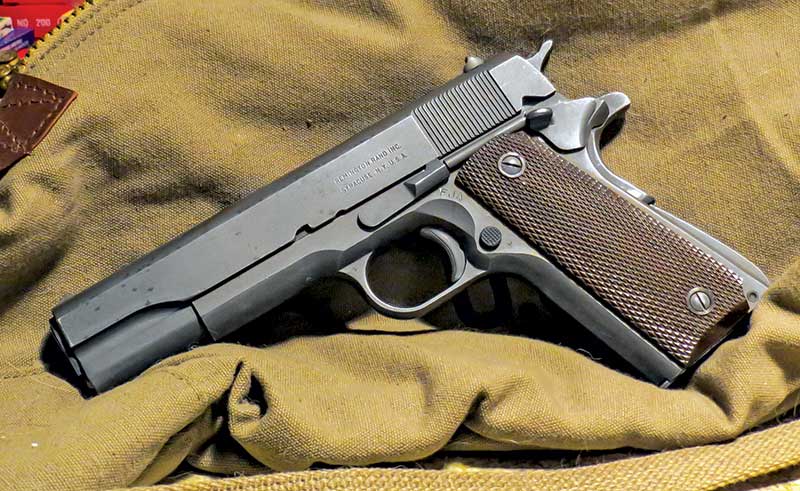
Situation: Famous as a leader in combat, Chesty Puller was a skillful pistol fighter as well.
Lesson: Training, skill and the best equipment are enormously helpful. Perhaps most important, though, is the fighting spirit that made General Puller a legend. And … a pre-war start in guns and hunting can shape a more survivable combatant.
Lewis “Chesty” Puller. In his time, his name was a household word, and if asked “Who was the most famous U.S. Marine?” — many people today would answer, “Chesty Puller.” He first made his mark in “police actions” in places like Haiti, rose to fame in the South Pacific campaign during World War II, and became solidified in legend by leading the Breakout in the Korean conflict.
There are many books about Puller. Most focus on his leadership and courage. One book is even devoted to his famous quotes. But most give short shrift to the general’s formidable pistol fighting skills.
Burke Davis (1913-2006) was the author of many historical non-fiction books, specializing in war and warriors. One of his trademarks was a personal touch, with deep insights into the heroes about whom he wrote. One of Davis’ classics is Marine! The Life of Chesty Puller, subtitled The Only Marine in History to Win Five Navy Crosses.
It is to Burke Davis we are primarily indebted for the following accounts of General Puller’s pistol fights, his training and background with guns and his general attitude toward related matters.
Puller In Combat
Puller’s first deployments were in Haiti and Nicaragua, supporting friendly governments who were fighting anti-American insurgents. In the latter country in 1929, he found himself traveling with a Thompson submachine gun, cased with ample spare ammunition.
Two years later, he found himself fighting for his life with his .45 pistol in Nicaragua. Davis tells us, “They were more than a hundred miles from Jinotega, Company M marching over open country on high ground beside the swift Cua River. Puller and (Col. William) Lee were not far apart when they saw, almost at the same instant, a native dugout canoe speed around a bend to their rear, bearing two men. One of these men fired, wildly. There was also a burst of rifle fire from across the river — another attempt at ambush.
“Puller reacted as usual. He ran at top speed toward the riverbank, straight for the canoe, pulling his pistol as he went. He fired in motion, and one of the canoeists fell across the gunwale. The patrol killed the other Indian, and when men splashed across the river, they found the band had fled.
“Lee thought Puller’s action a climax of the fighting in Nicaragua: ‘It was the greatest field shot I ever saw. He shot that bird from 15 to 25 yards away from that canoe, going at full speed, and the canoe moving, too. He drilled him right in the ear, so perfectly that we looked over the body for several minutes before finding the wound. He had shot him precisely in the opening of the ear. I don’t think such shooting was accidental.’” (1)
Some of the accounts of Puller’s personal engagement in combat are sketchy and short on details. Here is one, from when he was a Colonel on Guadalcanal: “A grenade fell near the Old Man — no more than eight yards away, Captain Zach Cox estimated, but Puller turned when he saw A Company scatter and yelled: ‘Oh, that damned thing ain’t going off.’ It helped steady the men. The grenade was a dud. Cockrell’s B Company was being cut up in the woods by snipers in trees with light machine guns, and fire from Puller’s front became spotty. The fight was now at close quarters: The Colonel had killed three men with his .45 — one of them a Japanese major.” (2)
There were many men in combat along with Puller who were glad they, too, were carrying pistols. One was Captain Regan Fuller, who spoke of an experience he had on Guadalcanal. “It was rough country, up and down everywhere, with plenty of cover. I sent one of my boys, Corporal Turner, up a grassy hill to our right, where we were trying to persuade the Old Man to stop for the night. I walked behind Turner — and we almost stepped on two Japs who were eating rice by a hidden fire at the base of a big tree. They were as astonished as we were, and we all scrambled. I fired three clips from my .45 and killed one of them, but the other ran down the trail toward our main body. Turner’s squad had deployed into line behind us. There was a little shooting, and then quiet …” (3)
The Guns Of Chesty Puller
Most of the time when an enemy was killed by Puller’s own hand, it appears to have been with his service pistol.
While there exists a photo of Puller shooting offhand with a very long barreled, non-issue DA revolver, virtually all the photos of him in the South Pacific and Korea depict him wearing a standard .45 auto. Burke Davis’ anecdotes all refer to him using a .45. I’ve been unable to find if or where Puller’s sidearm still exists today. Most photos of him wearing it are taken from the front, so we can’t see whether it wore a flat (1911) or arched (1911A1) mainspring housing.
There actually exists a chest holster named the Chesty Puller, but it appears to be a modern play on the great Marine’s nickname. In every photo I’ve seen of him in combat theaters, his .45 is in a standard issue flap holster on his right hip, backed up with a web double magazine pouch at the left front of his web belt. While many military officers did carry their .45s in the tanker-style chest holster during WWII, I’ve seen no indication Puller was one of them. He became a Marine early enough he was presumably issued a 1911, since the A1 dates to relatively late in the 1920s. Of course, if he preferred the 1911A1’s features (slightly better sights, longer grip tang to minimize hand bite, shorter trigger, arched housing), he had the “pull” to requisition one once they became available.
In any case, whenever Puller personally fought with a pistol in hand, it was the government-issue pistol known colloquially in his time as simply “the .45 automatic.”
Puller had specific opinions on other small arms. Pictures of him in the field almost invariably show him wearing a pistol and two spare magazines, and he expected fighting men to be constantly armed when in danger zones. Davis writes of one day when Col. Puller was selecting staff members: “When he was choosing his intelligence officers, his exec pointed out a major sent in for the purpose by headquarters. Puller scoffed loudly, ‘Hell, that man hasn’t even got on a weapon. Find me another one.’” (4)
Only The Best For His Men
He also worked hard to make sure his troops had ample ammunition. Again, from Burke Davis: “As the time for a new campaign drew near, Puller drove his staff to complete the last detail in preparation. He warned the regimental supply officer, an Army Quartermaster general, was to check their requisitions. ‘Notify me at once when he arrives,’ Puller said. ‘I want to explain things in person.’
“The Army general arrived when Puller was out, and the lieutenant took the inspector to the supply dump. Puller found them there and overheard their conversation:
“‘Lieutenant, your requisitions are excessive.’
“‘I’m sure Colonel Puller would never have signed for more than we need, sir.’
“‘But he’s asked for 10,000 brass buckshot shells. What the devil does he want with those?’
“‘To kill Japs with, sir.’
“‘Doesn’t Colonel Puller know buckshot is prohibited by the Geneva Convention?’
“‘Sir, Colonel Puller doesn’t give a damn about the Geneva Convention — any more than the Japs did at Pearl Harbor.’” (5)
It should be noted short barrel pump shotguns were indeed used in the Pacific Theater. My late mentor, Bill Jordan, a veteran of that campaign, told me he used a Winchester slide-action trench gun and an S&W 1917 .45 revolver when clearing enemy pillboxes in the island campaign. The brass buckshot shells had been requisitioned because paper shells swelled up in the heat and humidity there, getting stuck in the magazines and chambers.
Puller’s demands for the best equipment for his Marines weren’t limited to guns and ammo. Wrote Davis, “(Puller) spoke to War Production Board officials in Washington: ‘I want to ask you why American troops shouldn’t have the world’s best fighting equipment. On Guadalcanal we saw our trenching shovels break at the first use. All of our men now have Jap shovels because they’re better and more dependable. Jap field glasses are better, too. I have good ones myself, German glasses I’ve carried for 20 years. Why should American glasses be so poor? Not worth a damn in the tropics. They fog up because they are improperly sealed, and once they get damp, they’re done for. I’ve seen hundreds of pairs tossed away in the jungle or the sea, because men know they can see as well with the naked eye. What kind of American ingenuity — or patriotism — produced those?’”
Yet, curiously, Puller wasn’t a fan of the M-1 Garand that George S. Patton had called “the best battle implement ever devised.” Davis reports the following:
“There was a squabble between A Company and some of the 164th Army men, for Regan Fuller’s men had bartered for, or stolen, some new M-1 rifles during the big night’s fighting, and Army officers wanted them returned. The Colonel was amused by the affair. For himself, he favored the old rifle they brought to Guadalcanal: ‘For sheer accuracy, if you want to kill men in battle, there has never been a rifle to equal the Springfield 1903. Others may give us more firepower, but in ability to hit a target, nothing touches the old ’03. In my opinion, nothing ever will. A perfect weapon, if ever there was one.’” (6)
The following seems contradictory to the above, but Davis noted, “… Puller was asked by Marine Corps Headquarters for a full report on his experiences with the Thompson submachine gun under field conditions and sent in an enthusiastic report on the weapon’s value on patrol.” (7)
Puller’s Training & Quals
While based in Hawaii, having shot Expert Rifleman five years running, Puller was affronted when a grizzled sergeant offered to teach him to shoot. When the sarge promised to bring his rifle score up 20 points in two weeks, Puller accepted the challenge. Davis reported, “Puller became the sergeant’s pupil, shooting when targets became vacant during the training, and shot an average of two bandoleers daily. He improved rapidly, and brought his record score from 306 to 326, of a possible 350. During all these years he qualified as expert with both rifle and pistol, and when a rifle team was sent from Pearl Harbor to a competition in San Diego in 1928, Puller was a member.” (8)
Davis adds, “… in the first report period, Puller posted an average score in bayonet drill; a fellow Marine, Lieutenant Gerald Thomas, finished 10 places ahead of him. But in marksmanship, with the automatic pistol, he ranked as expert, with a score of 91.13 out of 100 points. As a rifleman, he fired 335 of a possible 350, and stood 16th in the class of officers. He also ranked as expert with the machine gun, in which he stood high in the top third of the class, with a score of 340.” (9)
The quality of marksmanship training in the United States Marine Corps is, of course, legendary. That said, Puller famously credited his survival and many of his accomplishments in battle to having been a young armed citizen before he enlisted in the Marine Corps.
Born in Virginia, he learned guns and hunting early. He was about 10 years old when cancer took his father, and he supplemented the larder by shooting small game and wild turkeys. He became a trapper, selling muskrat pelts to pay for his ammunition. “Lewis learned both accuracy and frugality, for he bought his own ammunition,” biographer Davis wrote. (10)
Another writer, Michael Martin, wrote, “After his military fighting career was over many years later, Chesty noted he learned more about the art of war by hunting and trapping than he learned from any school. He insisted the skills he learned as a kid, living off the land, saved his life many times in combat.” (11)
Lessons
The constant presence of his sidearm saved Chesty Puller’s life more than once. It is no surprise you see his holstered .45 in almost every photograph taken of him in a combat environment, from his early days in the banana republics to the Pacific Theater to Korea. Note he insisted all his men be within reach of their guns in combat environments, at all times. It saved his life multiple times over … and, doubtless, the lives of many of his troops, including Captain Regan Fuller, as noted above.
Puller was a contemporary and friend of Herman Hanneken in his early combat days. Hanneken was the man who had killed the revolutionary leader Charlemagne Peralte in Haiti in 1919, with a single .45 slug to the heart from Hanneken’s USMC-issue Colt 1911. Puller had doubtless incorporated this knowledge into his trust in the same weapon, which he learned to keep constantly close.
His critics felt too many USMC casualties had accrued from Puller’s aggressive tactics, while his defenders argued those aggressive tactics were what won his major victories. Both sides need to remember Puller was a casualty himself, blown up on Guadalcanal with shrapnel savaging his legs, yet he returned to lead from the front sooner than his doctors wanted. Many who served under him were heard to say they’d follow him into Hell … and that he actually led them there and did his damnedest to get them back out after they’d won.
It is vital to remember this legendary Marine gave credit to his survival and victories to the hunting and shooting skills he learned in boyhood and adolescence. This sort of “pre-service preparation” has served American fighting men since the beginning of our nation. Woods-wise citizen soldiers with their own rifles and muskets won the Revolutionary War. The National Rifle Association was founded in 1871 by Yankee officers who had noted the superior fighting ability of individual Confederate soldiers who had grown up hunting and shooting. Sergeant Alvin York in WWI, WWII’s most decorated soldier Audie Murphy, Carlos Hathcock in Vietnam and Chris Kyle in the most recent conflict all fit the same mold: super-soldiers whose skill at arms had been developed before they joined up. This heritage is one reason why we at the Second Amendment Foundation where I currently serve as interim president have brought lawsuits to allow young Americans ages 18 to 20 to buy their own AR15s and prepare for a career defending their nation with firearms similar to the faster-shooting true assault rifles they’ll be issued when asked to die for their country.
There is much, much more to the history and legacy of Lewis “Chesty” Puller than can be presented in this short space. We conclude with thanks to the late biographer Burke Davis, who gave us so many valuable details from this particular side of the Puller legend. He is the one to thank for what you’ve just read; hell, I merely “wrote the book report.”
For more info: SAF.org. References: 1) Davis, Burke, Marine! The Life of Chesty Puller, P. 56. 2) Ibid., P. 118. 3) Ibid., P. 118. 4) Ibid., P. 181. 5) Ibid., Pp. 169–170. 6) Ibid., P. 148. 7) Ibid., P. 61. 8) Ibid., P. 46. 9) Ibid., P. 61. 10) Ibid., P. 9. 11) Martin, Michael. “Chesty” Puller and the Southern Military Tradition, Abbeville Institute Press, 2018.
Categories
Thursday NSFW Why not?

Russia took delivery on a handful of advanced Su-34M fighter bombers late last month, and one has already been shot down over Ukraine. It wasn’t Ukrainian forces who managed to down the twin-seat jet, however… It was Russia’s own air defenses.
Over the weekend, video emerged of Russian forces downing a jet operating over Eastern Ukraine, though at the time, it was unclear exactly what type of aircraft they had intercepted. The footage was uploaded to Telegram by a Russian war correspondent with a history of being sanctioned by foreign nations for spreading disinformation and propaganda on behalf of Moscow.
“Last night, the air-defense crew of the allied forces destroyed a target in the sky over Alchevsk,” Yevgeny Poddubny, a Russian war correspondent and known propagandist, wrote with the video he uploaded.
“The nature of the target is not clear. The burning ball fell to the ground for more than a minute.”
Related: That time a Russian fighter shot down one of its own in a mock dogfight
The one-minute video shared on July 17 shows a bright light emanating from above the clouds, accompanied by a thundering crash. Shortly thereafter, a fireball can be seen falling from the sky.
It wasn’t long before the wreckage of the aircraft was located, and upon inspection, it soon became apparent that it was actually one of just ten or fewer Su-34Ms in existence, with a registration number of RF-95890.
These jets, which Russian media refers to as 4++ generation fighters-bombers, were just delivered to the Russian air force late last month, fulfilling the beginning of an order placed in May of 2020.
The only nation that operates these fighter-bombers, of course, is Russia themselves.
Related: Zapad 2017: When a Russian helicopter opened fire on the press
Russia received its first Su-34Ms only weeks ago and has fewer than 10 total
</figcaption></figure>
</div>
<p>In June of 2021, Russian media outlet <a href=) Tass reported that the nation would receive eight updated Su-34M fighter bombers by the end of the year. It wasn’t until July 8 of this year that Russia inducted the first operational Su-34Ms into service.
Tass reported that the nation would receive eight updated Su-34M fighter bombers by the end of the year. It wasn’t until July 8 of this year that Russia inducted the first operational Su-34Ms into service.
To date, it appears Russian Aerospace Forces have received no more than ten total aircraft.
The Sukhoi Su-34, NATO reporting name Fullback, has been under development for literally decades, with the design concept first floated as a replacement for the Su-24 Fencer as far back as 1977. Like many modern Russian fighters, the Su-34 was based on the Su-27 Flanker—an air superiority fighter designed to compete with the likes of America’s 4th-generation dogfighters like the F-14 Tomcat and F-15 Eagle. It first flew 32 years ago, in April of 1990, but didn’t enter service until as late as March of 2014.
The Su-34 may have air superiority roots, but its design was changed dramatically to better suit an attack role. It can carry up to 17,630 pounds of ordnance across 12 hardpoints located underwing and beneath the fuselage, alongside a 30mm GSh-30-1 internal cannon. A pair of Russian AL-31FM1 engines provide 30,000 pounds of thrust each under afterburner, giving the aircraft a top speed of Mach 1.8 and a service ceiling of around 56,000 feet. The Su-34M is said to improve upon these figures while integrating a synthetic aperture radar, camera pod, and UKR-RT electronic intelligence (ELINT) pod for improved situational awareness.
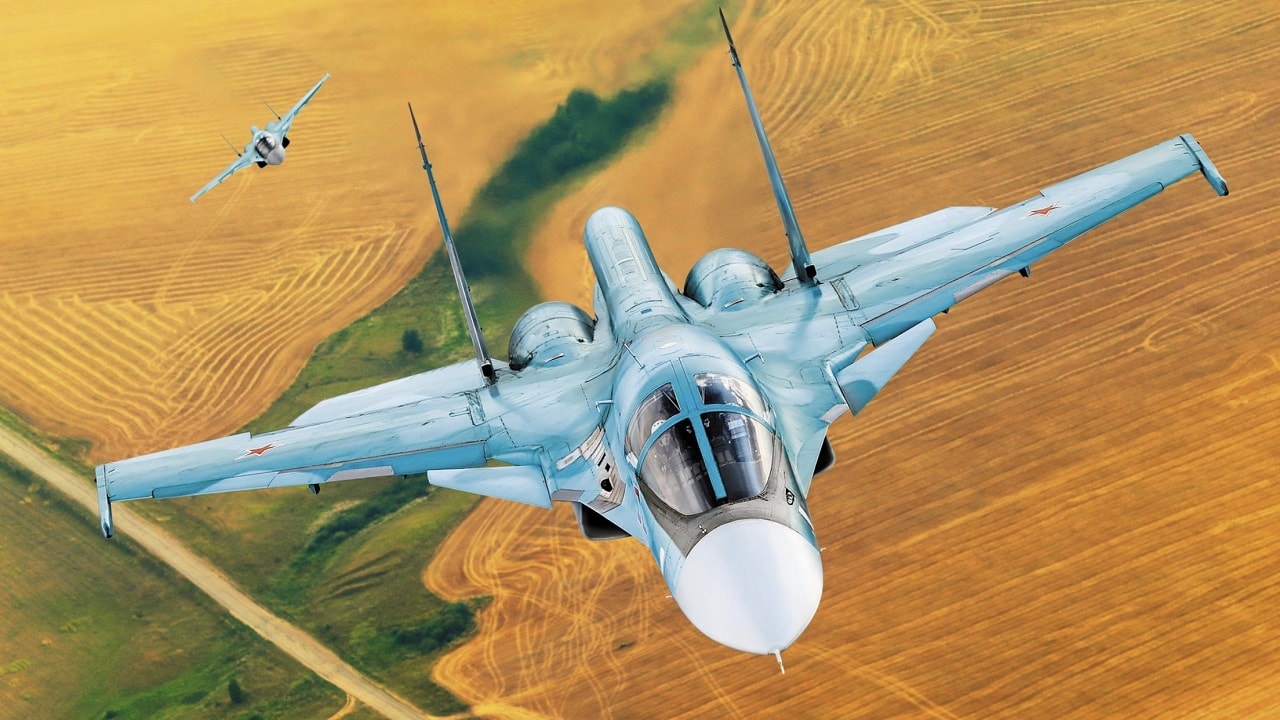
In some ways, the Su-34 could be compared to America’s F-15E Strike Eagle, as an air-superiority fighter turned fighter-bomber, though in practice, its design takes a different approach.
The Su-34 diverged most dramatically from its Su-27 predecessor in the nose, with a new forward fuselage designed to allow the aircraft’s two-person crew to sit side-by-side, rather than one in front of the other. The resulting design was so unique it earned the aircraft nicknames like “Hellduck” and the “Platypus.” A pair of canards sourced from the Su-30 mounted toward the rear of the cockpit further adds to the Hellduck’s unusual aesthetic.
In 2020, the Russian Aerospace Forces placed an order for 76 updated Su-34Ms at a rate of 14 aircraft per year through 2027. Each of these modernized fighter-bombers sets Moscow back about $50 million, thanks in no small part to upgraded avionics, radar, and communications systems and electronic warfare capabilities. Considering the Russian Defense budget is less than a tenth the size of America’s, losing such an expensive aircraft to friendly fire is a serious setback.
Related: How Russia’s warfare doctrine is failing in Ukraine
Russia has lost at least 35 fixed-wing aircraft over Ukraine, but likely more than 200

Conservative estimates of Russian losses of fixed-wing aircraft throughout their invasion of Ukraine are as low as 35, with sites like Oryx tallying confirmed photographic losses of identifiable platforms to determine that figure. Ukrainian officials, however, offer a significantly higher count, soon to exceed 220. While this may sound like a wide disparity, Oryx themselves highlight the fact that actual losses are almost certainly significantly higher than they report, due to their strict requirements for photographic evidence.
“This list only includes destroyed vehicles and equipment of which photo or videographic evidence is available. Therefore, the amount of equipment destroyed is significantly higher than recorded here,” Stign Mitzer explained for Oryx.
Among the confirmed losses are at least 11 other Su-34s, though none of the previous losses were of advanced Su-34Ms. Earlier iteration Su-34s are often valued at between $35 and $40 million, making their losses similarly difficult to swallow for the increasingly cash-strapped Kremlin.
To date, Russia has failed to secure air supremacy over the embattled Eastern Ukrainian front, which may be largely attributed to Russian military doctrine placing little emphasis on air superiority. Russian forces have long based their doctrine on a potential conflict with NATO, and because Russia felt securing air dominance in such a conflict would be unlikely, they’ve shifted their approach to combat to simply attempting to control the airspace immediately around their forces and objectives and nothing more.
However, despite Russia’s setbacks, Ukraine still has a grueling fight ahead with no clear path to victory yet to materialize.
Categories
Old School & $$$$$$$$$$$ to boot!
