Categories
All About Guns

The CSX: Smith & Wesson’s New… Single Action? Smith & Wesson’s train just keeps a-rollin’ with its new CSX pistol for concealed carry. by JAY GRAZIO

Smith & Wesson CSX

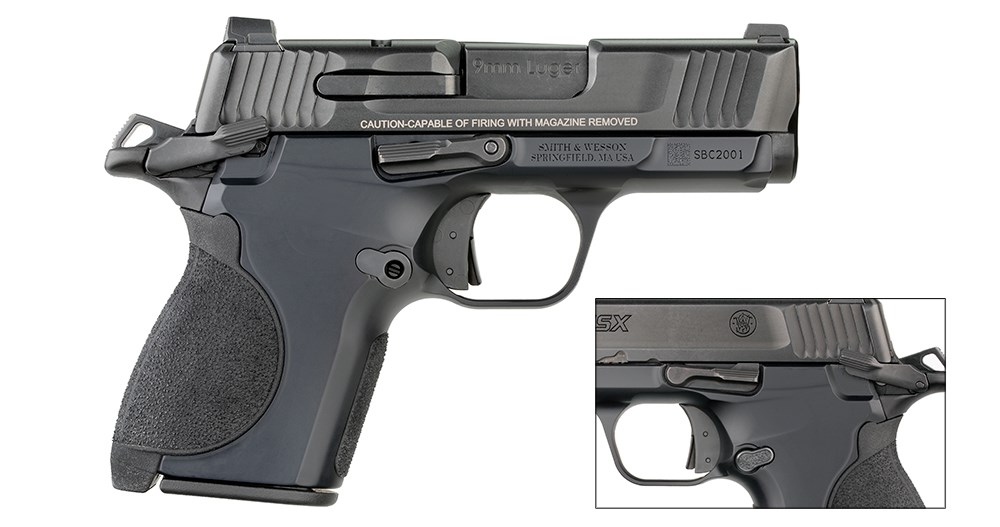
I’m not going to lie; when I saw the press release from Smith & Wesson about its new CSX pistol, I was skeptical. At a time when the polymer-frame, striker-fired, micro-9 mm double-stack pistol was conquering the landscape, Smith & Wesson launched the CSX, a metal-frame, single-action-only handgun. Heck, even trying to describe the CSX is on the complicated side. It’s kinda, sorta like a 1911; kinda, sorta similar to the Hi Power, and, then again, neither of those. 

Closer inspection, though, and the CSX isn’t as much of an oddball as it first might seem. In fact, it’s rather ingenious. There’s a market for vaguely-1911-ish, concealable handguns that started with the Colt Mustang/Government 380 in the 1980s. This trend continued with the SIG Sauer P238 (.380 ACP) and P938 (9 mm), the 911 in both .380 ACP and 9 mm from Springfield Armory and Kimber’s Micro (.380 ACP) and Micro9. All of a sudden, the CSX isn’t looking as much the odd gun out as before, is it? 

Then you realize, wait a minute … The CSX starts with a 10-round magazine, and has a 12-round, slightly extended variant available. Hold the phone. It’s now competitive, capacity-wise, with the P365, Hellcat, et al, while maintaining a single-action-operating system, which is one of the most prominent features mentioned in support of the 1911. Smith & Wesson has, with its CSX, carefully blended the worlds of the 1911/Hi Power with the micro-9 mm double-stack handgun. That’s basically sorcery. Well, at least very clever engineering.

There’s no sorcery in the name, though. It’s clear Smith & Wesson was reaching back in its long history for the “CS” part of “CSX,” a nod to the “Chiefs Special” line of five-shot, small-frame revolvers launched in the 1950s as a backup gun to the larger K- and N-frame pistols of the day. The “CS” designation would be added to a short-lived line of double-action, semi-automatic pistols in the late 1990s, again aimed squarely at the growing concealed-carry market. With the advent of the M&P line of polymer-frame, striker-fired handguns in the mid-2000s, the CS line made way for subcompact M&Ps. Until now, that is. The “X” in “CSX?” Smith & Wesson tells us it stands for the intersection of the company’s past and future. I like that.
Smith & Wesson CSX features

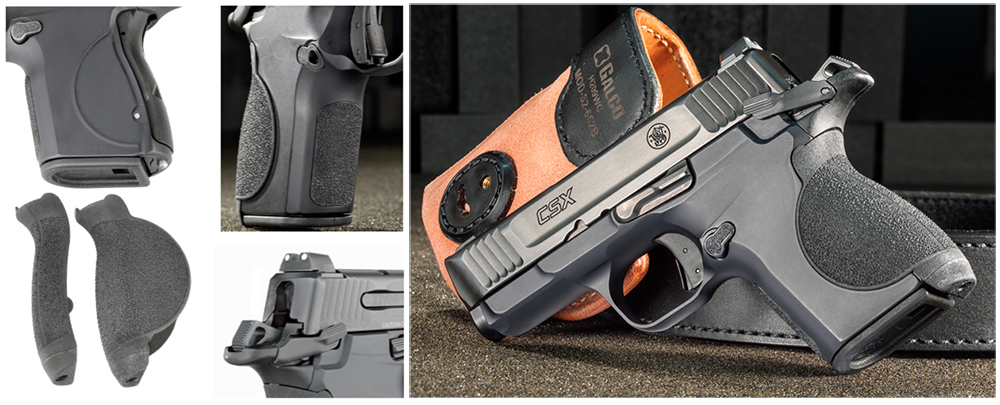
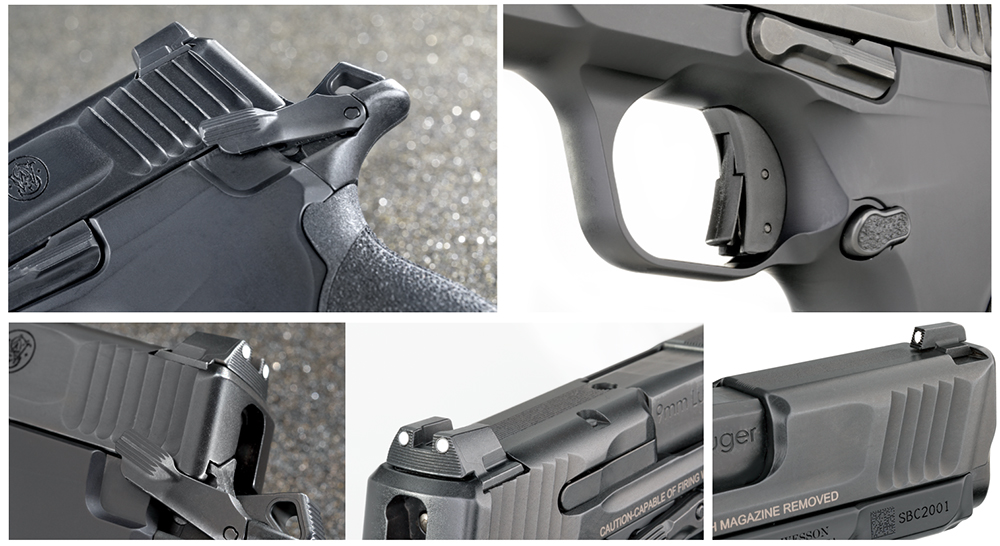
Identical in size to the Shield Plus (which itself is only a fraction of an inch wider than the original Shield), the CSX is perfectly suited for concealed carry, especially in inside-the-waistband applications • With engineering clearly integrated from Smith & Wesson’s M&P line of handguns, two interchangeable backstraps allow the CSX to be better fit to each shooter’s hand • Mildly aggressive texturing on the frontstrap serves to anchor the CSX in the hand, helping the shooter control the pint-size 9 mm in all shooting conditions, without being painful under recoil • While the hammer should only be manipulated once the pistol has been completely cleared of ammunition and double- (or triple-) checked, Smith & Wesson added fine knurling on the top of the hammer for assistance. Blending it into the beavertail is a nice aesthetic touch.

Dave O’Connor, Smith & Wesson’s media-partnership relations manager, explained it simply: “CSX is 100 percent a nod to our ‘Chiefs Special’ heritage. Smith & Wesson has such a robust history with metal-frame handguns, and because of that we wanted to pay homage to our past. The CSX was built on some of our history, but we really tried to incorporate modern features that the consumer of today is looking for—higher capacity, caliber choice, interchangeable palmswells, etc.”

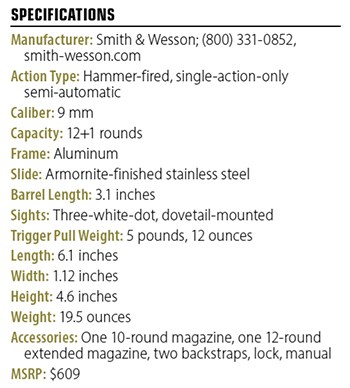
Still not convinced about the CSX, though? Let’s run the numbers. Compare the CSX to its sibling, the Shield Plus. Overall length? Identical. Height? Identical. Barrel length? Identical. Capacity? Identical. The CSX is wider than the Shield Plus—by a whopping .02 inch. I don’t know about anyone else, but I can’t tell the difference between a pistol that’s 1.1 inches wide and one that’s 1.12 inches wide. The only significant difference between the CSX and the Shield Plus is the weight, and here’s where things get interesting: The metal-frame CSX is .7 ounce lighter. Basically, the CSX and the Shield Plus are indistinguishable in all dimensions. Since the Shield Plus is pretty middle-of-the-pack, size-wise, in the micro-9 mm double-stack world, it’s the same for the CSX.

It’s the similarity in size and capacity to the Shield Plus that leads to a natural question: Why? Why would Smith & Wesson devote time, research and development and effort into producing a micro-9 mm, double-stack, concealed-carry pistol immediately on the heels of introducing the Shield Plus? Pro- duct Manager Corey Beaudreau stated it simply: “Smith & Wesson launched the CSX to provide today’s firearm enthusiast with more options to answer the question of concealed carry. Not everyone prefers striker-fired, polymer [-frame] micro-9 mm [pistols], so we wanted to still deliver the higher capacity in a small, metal frame, but with some improvements from a micro 1911.”

There is one unfortunate difference between the Shield Plus and the CSX, though: the magazines. While both pistols have a flush-fit, 10-round magazine and a slightly extended, 12-round magazine available, the two are not interchangeable. Per Smith & Wesson, the quest to provide the smallest, most concealable hammer-fired pistol required a completely new magazine geometry that would not allow cross-compatibility. It’s not a deal-breaker by any stretch of the imagination, but it something about which to be aware.
Smith & Wesson CSX FEATURES

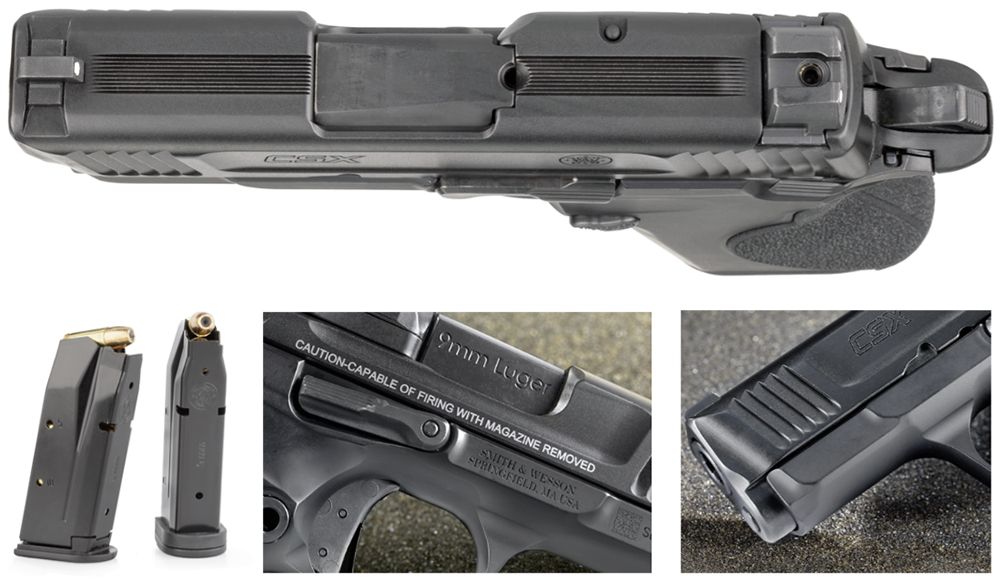
Slim, svelte and with serrations to reduce glare, the top of the CSX’s slide is useful and elegant • Two magazines ship with the CSX, a flush-fit 10-round mag and an extended 12-round variant that adds a little extra real estate for the pinkie finger of the strong hand • Also ambidextrous is the slide-stop lever, allowing southpaws to actuate the lever as easily as right-handed shooters • More M&P M2.0-related touches include front cocking serrations, useful in administrative handling.

In its quest for that diminutive, hammer-fired pistol, Smith & Wesson crammed an absolute ton of clever engineering into the CSX. Intended to be carried “cocked and locked” like a 1911 or Hi Power, it has a thumb safety like both pistols. It also has a trigger-based safety like most striker-fired guns to guard against discharging if dropped or struck—something other, similarly designed pistols often lack. Oh, and did I mention the interchangeable backstraps? Two sizes are available to better fit the CSX to the shooter’s hand. And talk about ambidextrous: The thumb safety and slide-stop lever are both completely ambidextrous, while both left- and right-side magazine releases are included to make the CSX as friendly as possible for all shooters.

Other smart design features include the textured frontstrap of the pistol. While recoil isn’t terribly significant, it’s nice to have the moderately aggressive texturing of the M2.0 M&P design incorporated into the CSX frontstrap and interchangeable backstraps. The trigger has a flat-face with an integrated safety mechanism, consistent with the latest round of M2.0 upgrades on the M&P line as well. It’s easy to see where the modern aspect of the CSX comes in, here. Up on top, the CSX has dovetail-mounted front- and rear sights, with the familiar three-white-dot arrangement. The top of the slide is serrated to reduce glare, a nice touch; as are the cocking serrations, front and rear, with a pronounced edge at the rear to assist in charging the pistol.

In its takedown, the CSX is more like a standard, striker-fired pistol than a 1911. Standard caveats apply, of course: Make sure no ammunition is present, remove the magazine, check the chamber manually and visually, etc. Lock the slide to the rear with the thumb safety engaged, then drift a small pin out in the slide-stop lever, right-to-left, after aligning the lever with the takedown notch. The pin falls out, attached to the left-side slide-stop lever, and then the slide can be taken off the frame. Remove the guide rod with captured recoil spring, then tilt the barrel up and out of the slide. To reassemble, complete the steps in reverse. There’s no need to pull the trigger as part of the disassembly process, which some find reassuring.
Smith & Wesson CSX features

Dovetail-mounted and containing white dots, both the front and rear sights can easily be replaced if desired • Ambidextrous in operation, the thumb safety proved easy to manipulate with either hand • To help prevent hammer bite, the CSX has an extended beavertail • Unlike many other single-action pistols, the CSX has a bladed-trigger safety.

I had the opportunity to shoot the CSX at a pre-SHOT Show event sponsored by Smith & Wesson in Las Vegas. Whether it was a paper target at 10 yards or a rack of hanging (polymer) plates, the CSX performed spectacularly. Working the pistol from plate to plate, the trigger’s short reset made even my mediocre shooting look good. Some reviews mentioned problems with the reset, but I’ve tested three separate CSX pistols and haven’t had any issues with the trigger. I’ve never been a fan of the bladed-safety lever on triggers in general as a tactile thing, and I’m still not 100-percent sold on this version of Smith & Wesson’s trigger on the M&P line as it is, but the trigger on the CSX has been one of the better versions I’ve tried.

When it comes to carrying the CSX, well, if you’re comfortable carrying the Shield, you’ll be fine with the CSX. Since the CSX is the same size as the Shield Plus, which is only a tiny bit wider in the slide than the original Shield, it shouldn’t present any unusual difficulties for inside-the-waistband carry. While in certain pants with larger pockets it’s possible to pocket-carry the CSX, the advisability of carrying a single-action pistol in this manner varies from person to person. It certainly can be done, and there’s nothing inherently unsafe as long as a quality holster is used and nothing other than pistol and holster are in the pocket.

On the range, absolutely no surprises were to be had with the CSX, although there was something of which to take note. I tend to keep a high (very high) grip on a pistol, and with only medium-size hands found the bottom left edge of the slide to graze the top of the bottom knuckle on my thumb. I’ve had this happen before, mostly on similar-size pistols, and with the CSX it wasn’t bad. After I’d fired approximately 300 rounds, I had a slight blister. On other pistols, it has been so bad that it hindered operation of the slide. Not a deal-breaker, but something to watch for, especially if you’re planning on taking a high-round-count training class. Might be a good idea to bring some gloves.

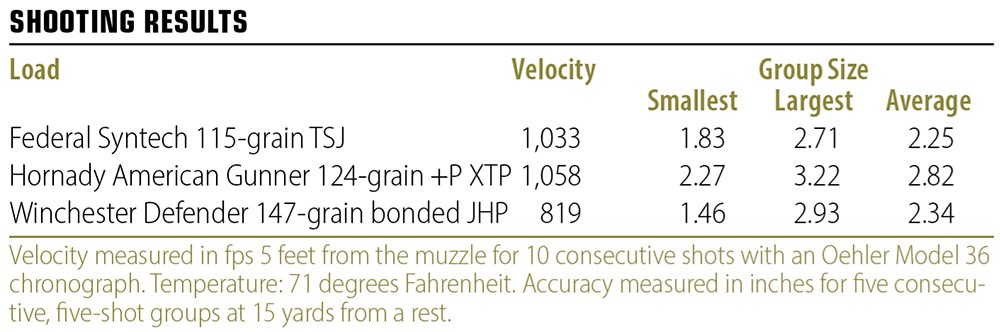
The accuracy surprised me, although I guess I really should have expected it given the single-action trigger. The CSX has exactly the same length barrel as the Shield Plus I reviewed in August, 2022, and is chambered in 9 mm rather than the lighter-recoiling 30 Super Carry of the Shield Plus; however, I shot more accurately with the CSX. Again, it’s a very pleasant surprise, and it’s not entirely unpredictable given the trigger, but it was quite interesting to note.
Smith & Wesson CSX shooting results

Our Handgun Editor, also in the August 2022, issue, pointed out that defining a trigger is difficult, and often results in the trigger-pull weight being given as a be-all, end-all number. For the CSX, that’s especially true: While the 5 pound, 12 ounce weight of the trigger is right in line with that of many striker-fired pistols, there’s far less travel and zero mush, resulting in a supremely clean break. For a small gun, it shoots well. Heck, even were it a large gun, it shoots well.
Smith & Wesson CSX specsOver the course of testing the CSX, I put somewhere between 450 and 500 rounds through three different pistols, between the initial launch, featuring the CSX in an episode of our “I Carry” online video series and the standard testing we do for each firearm we review (accuracy, velocity and function testing). No malfunctions of any type were experienced over a wide variety of both defensive and practice ammunition. There comes a point where you realize that there’s not much more to say other than it works. Period. Full stop.

Smith & Wesson considers the CSX to be a completely new product line, so the future almost certainly will see line expansions and upgrades. It wouldn’t be the least bit surprising to see an optics-ready version, or perhaps one chambered in 30 Super Carry in the near future, although there are no concrete plans at the moment. Six months from now, though? There are all kinds of directions the CSX line could take, and as I’m fond of saying in our “I Carry” videos, more options are a good thing. Personally, I’m hoping for an optics-ready version. In any case, the CSX has respectable capacity, eminent shootability and Smith & Wesson’s legendary reliability in its corner.

With all this, what’s the bottom line on Smith & Wesson’s new CSX pistol? Well, it’s good to see a company thinking beyond mere line extensions. Smith & Wesson certainly took a chance with the CSX, offering an all-metal pistol with a single-action-only operating system at a time when everyone and their brother seems to be launching polymer-frame, striker-fired micro-9 mm, double-stack, optics-ready pistols. The CSX still checks all the right boxes in capacity, weight and size, so it’s an excellent choice for concealed carry, particularly for those who prefer other-than-striker-fired pistols. It works well, it shoots well and it carries well. I think it’s a no-brainer to say that Smith & Wesson is on the right track with the CSX.
Smith & Wesson CSX

Categories
All About Guns

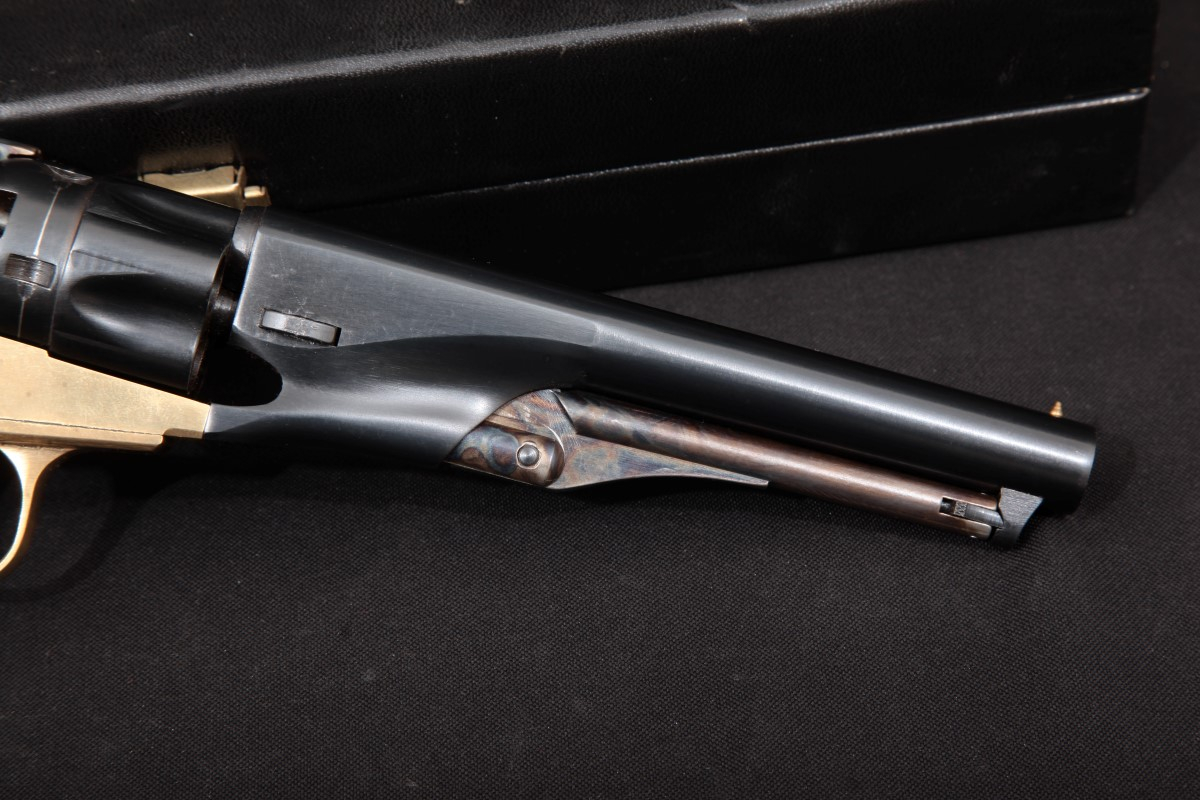
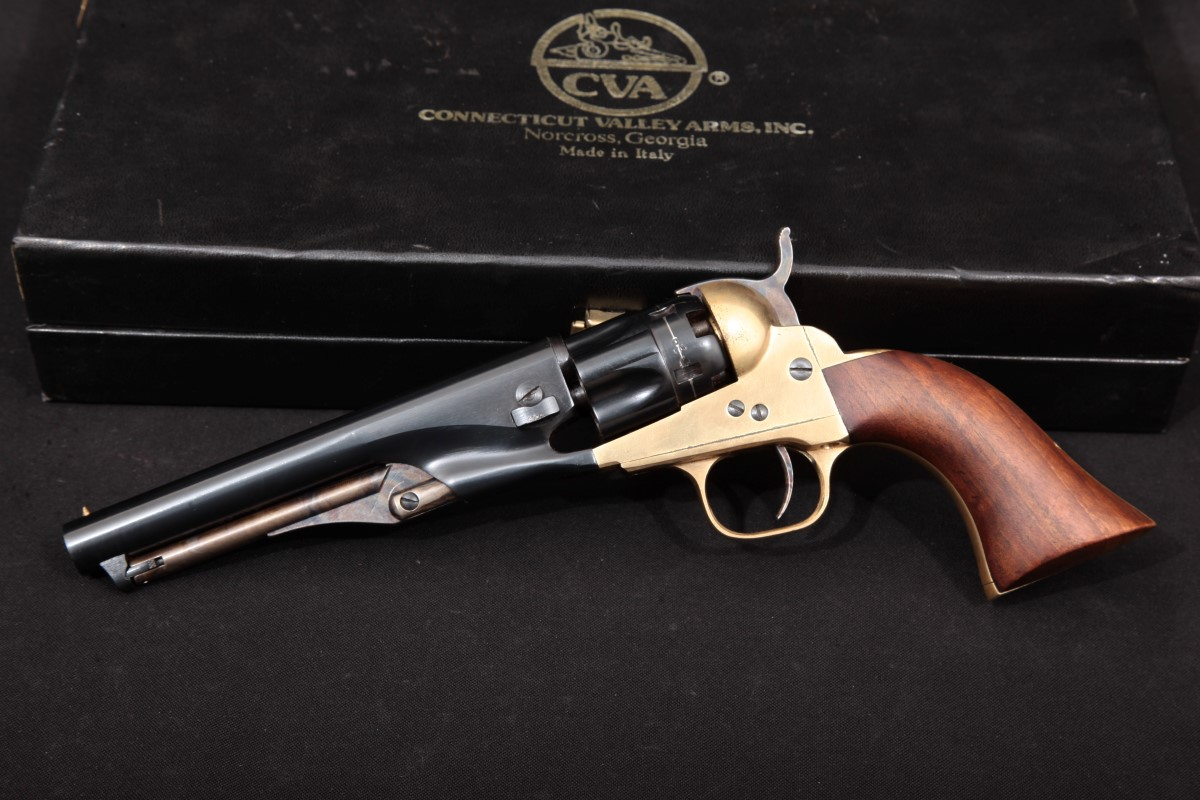
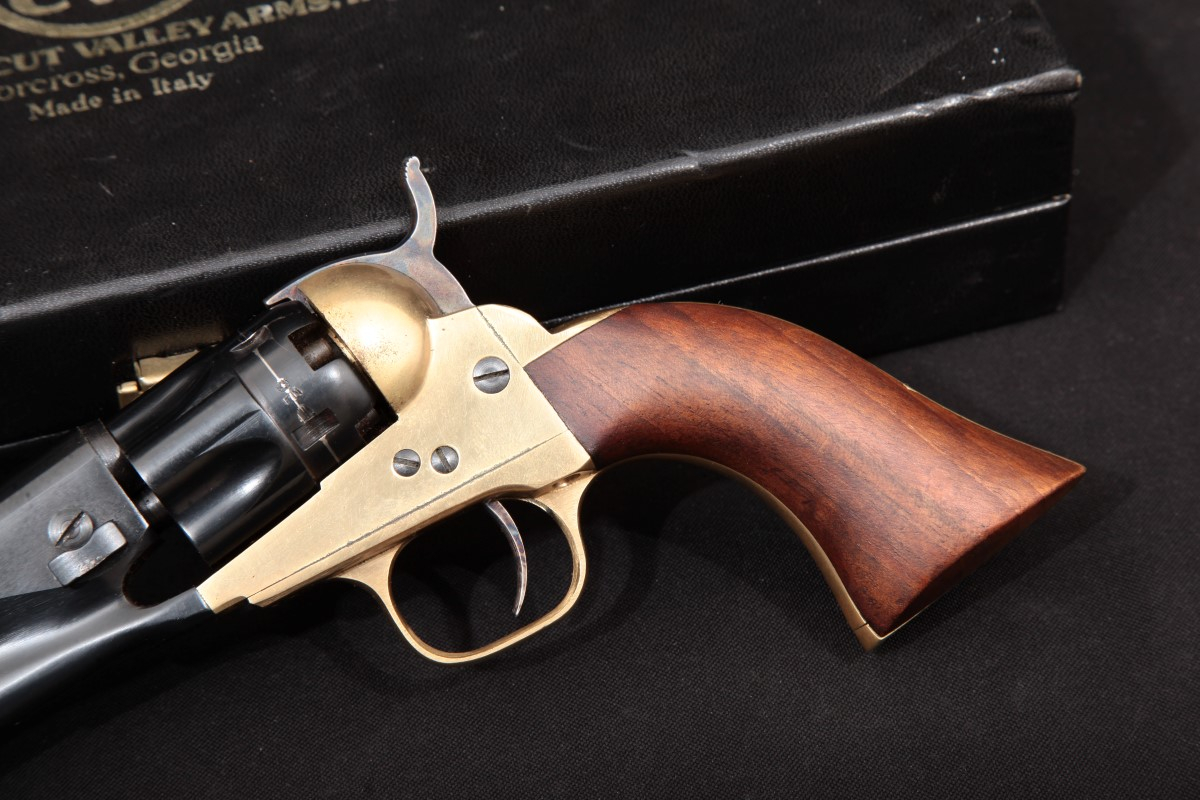
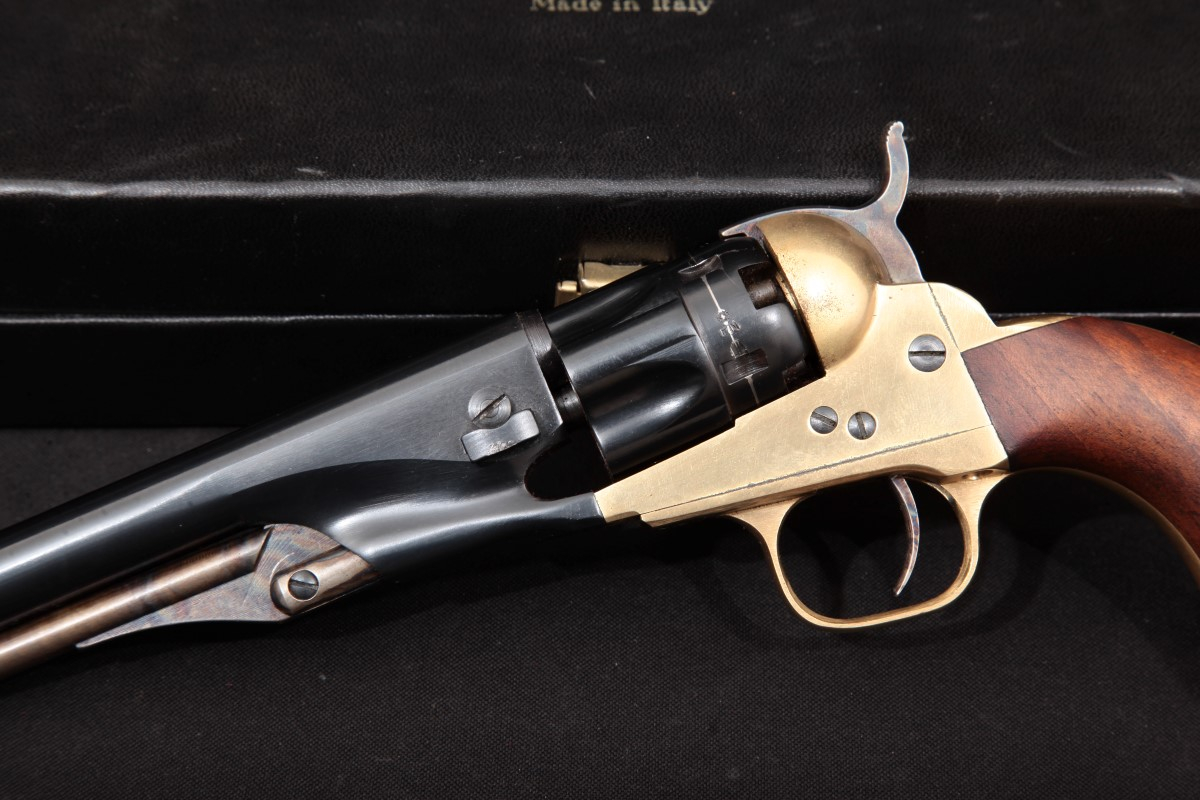
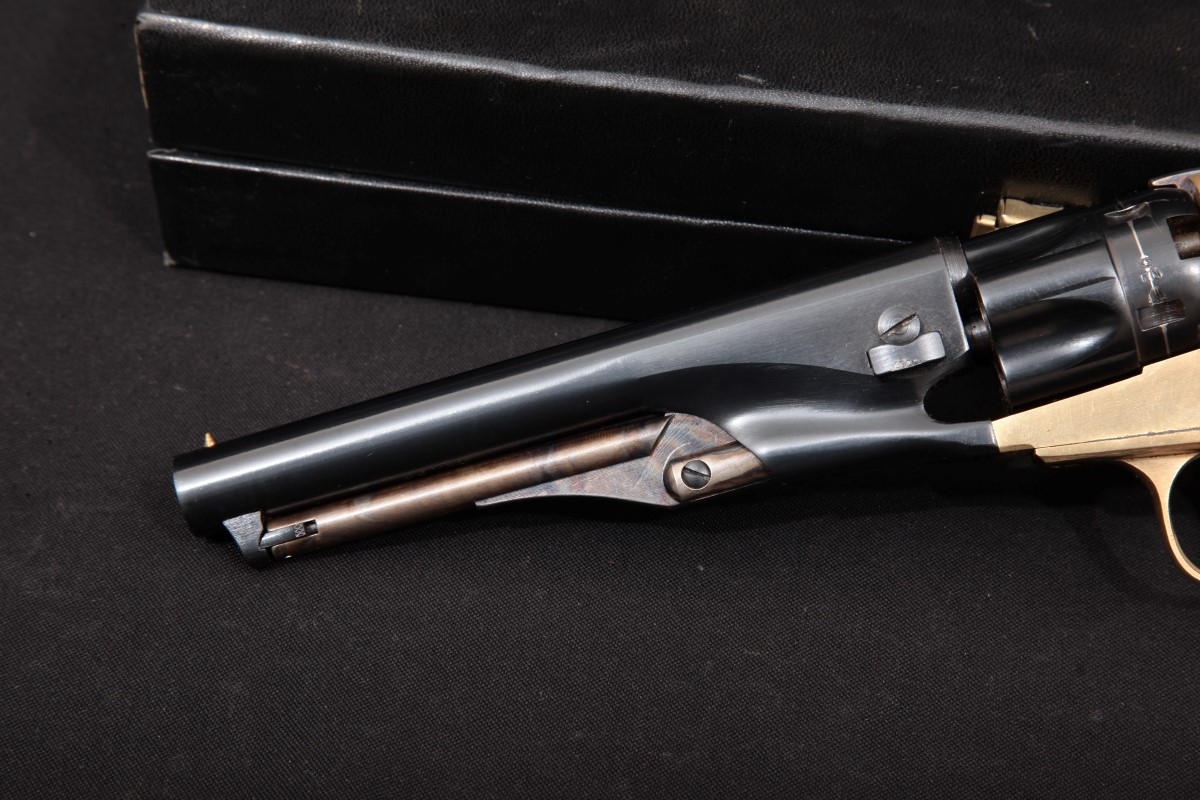
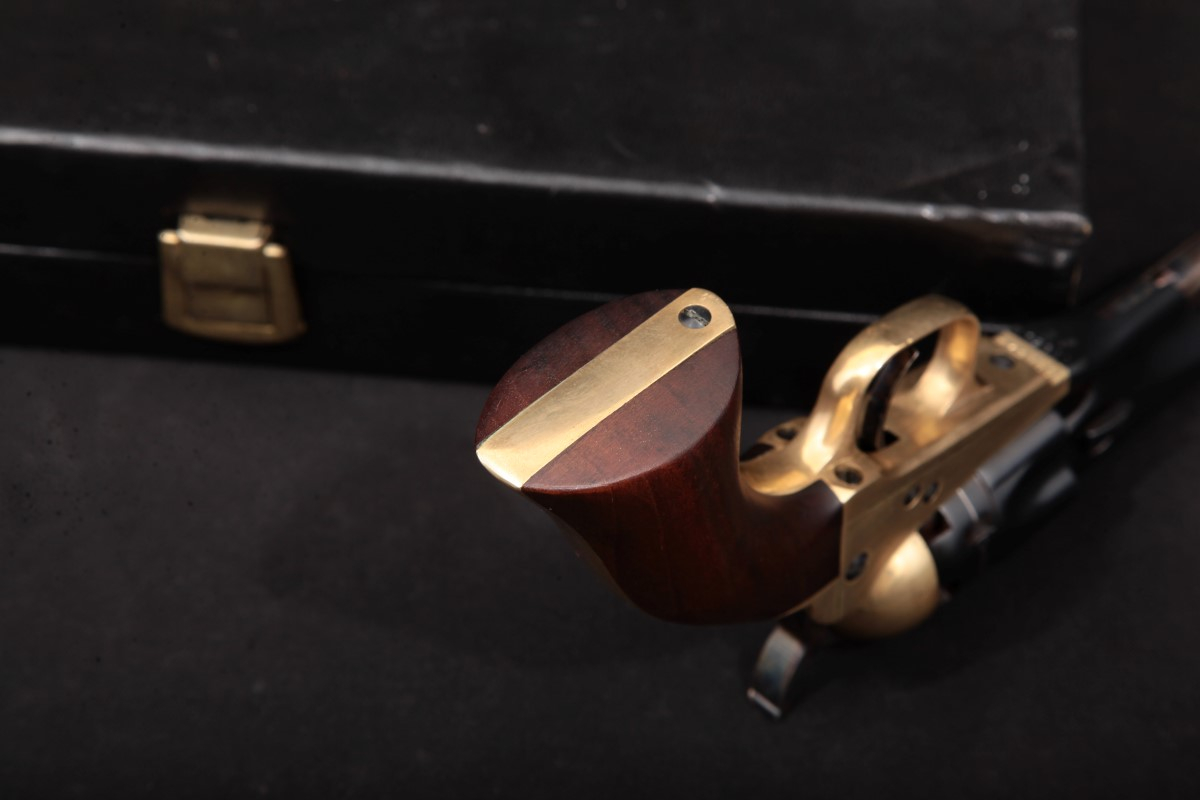
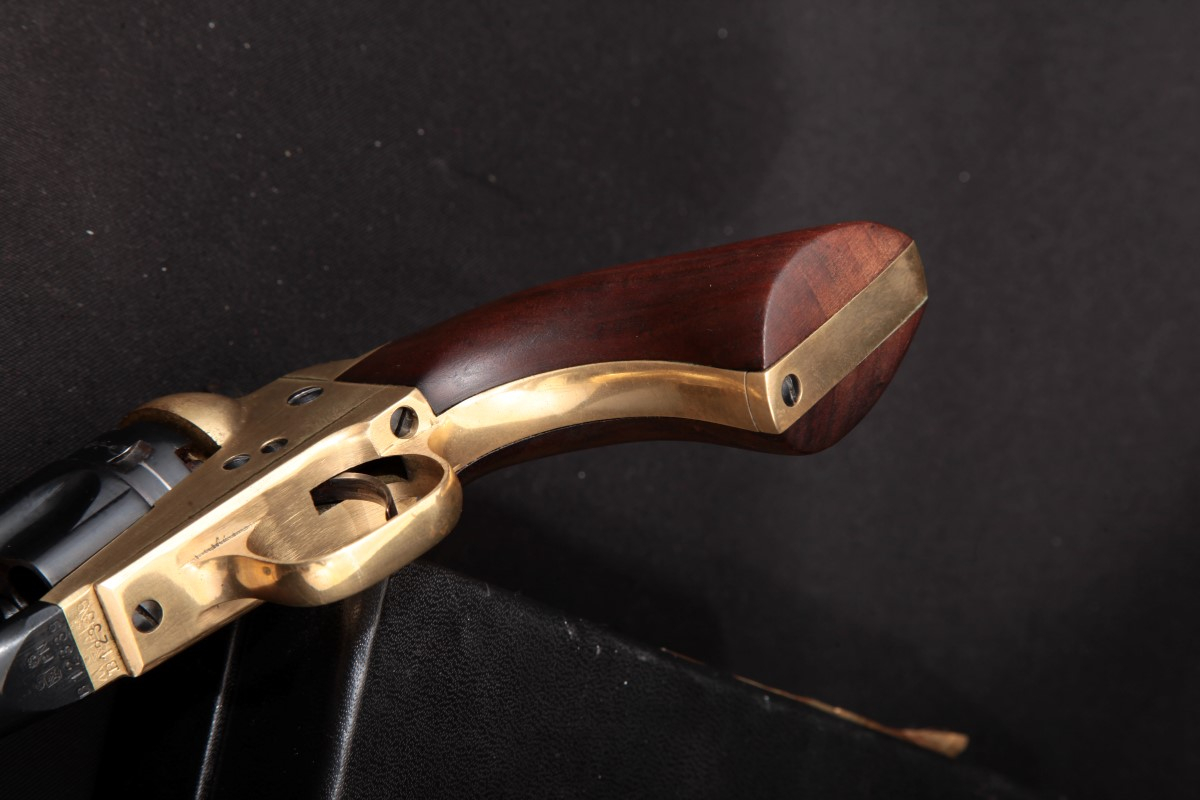
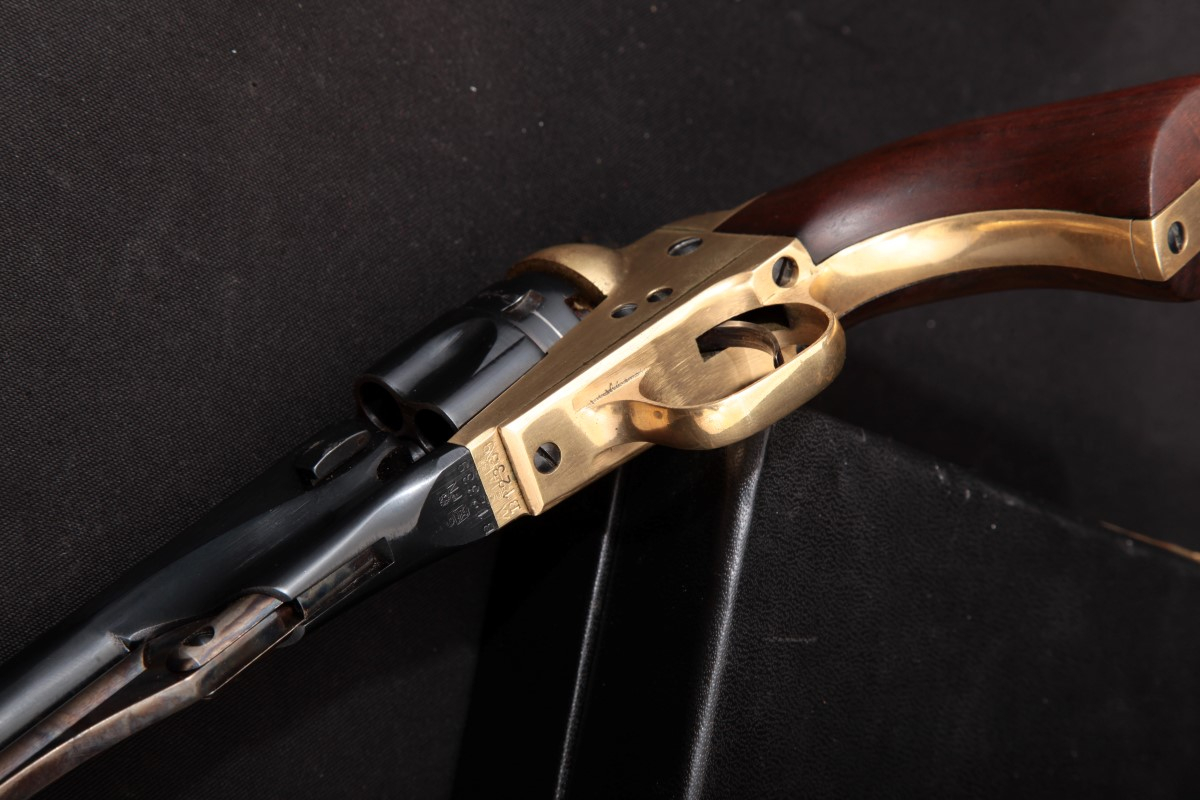
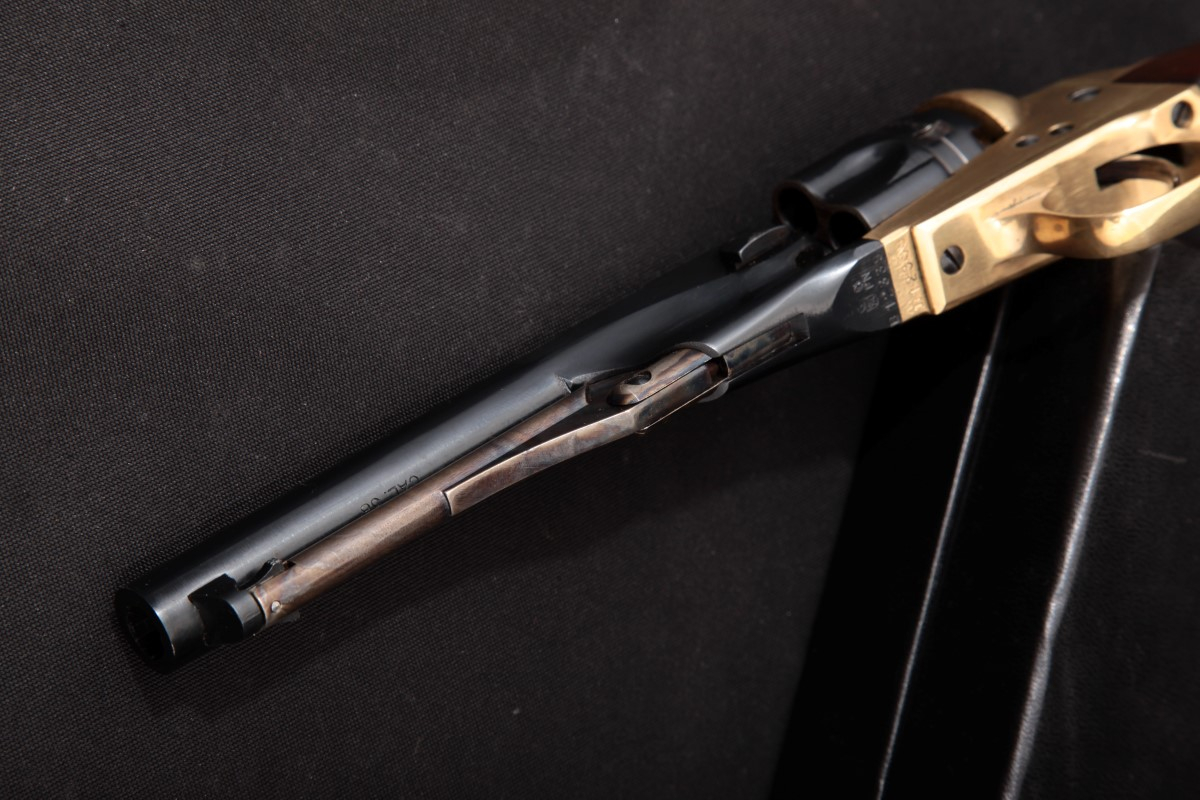
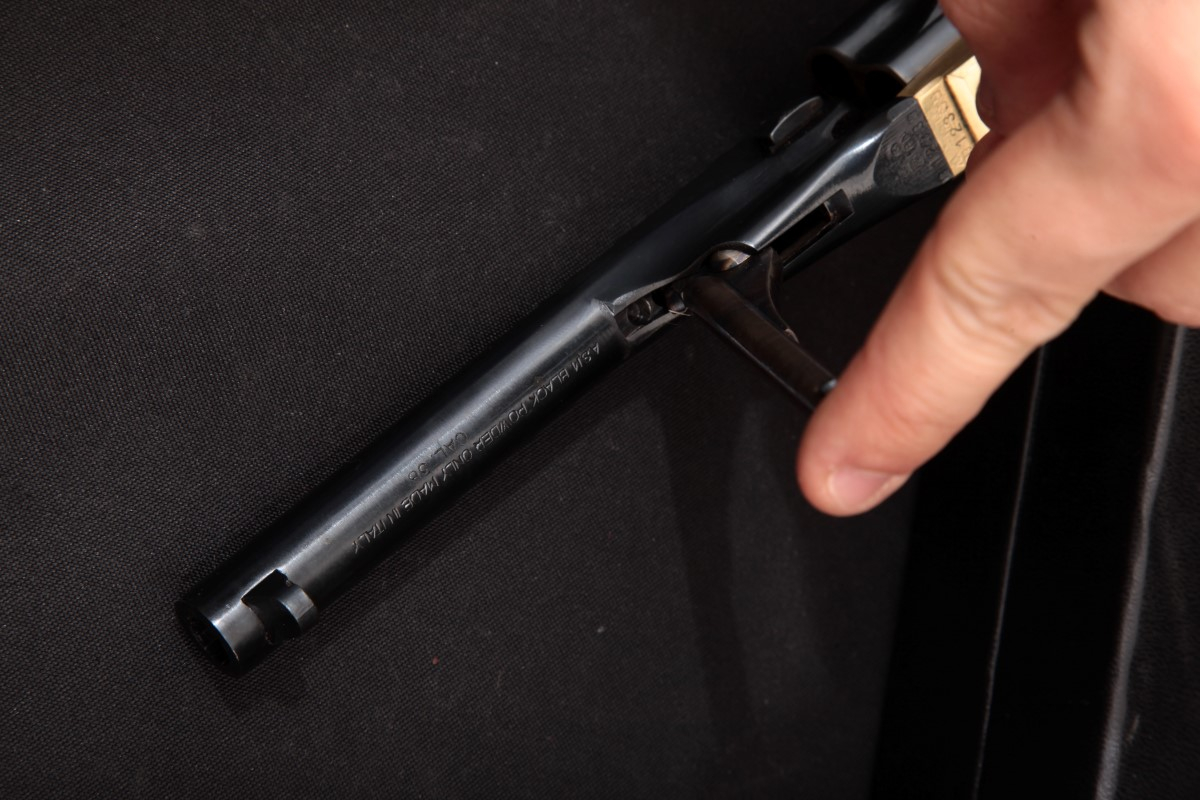
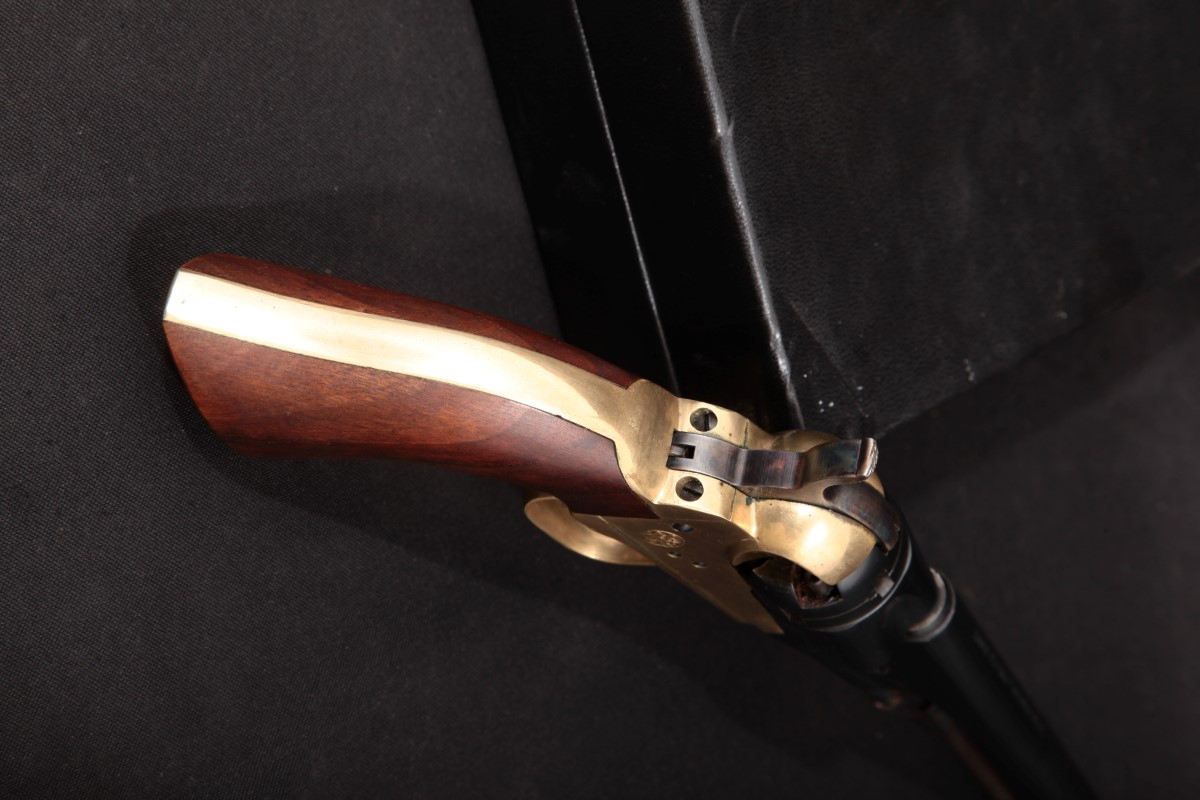
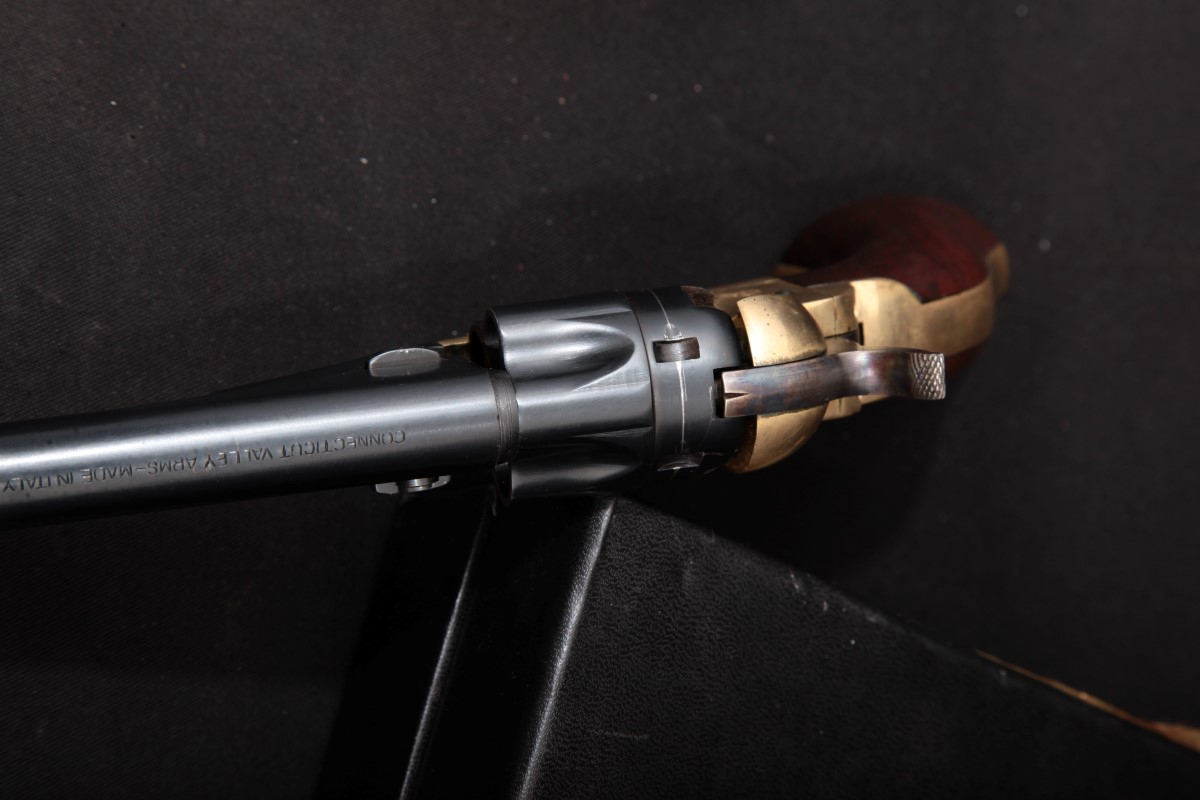
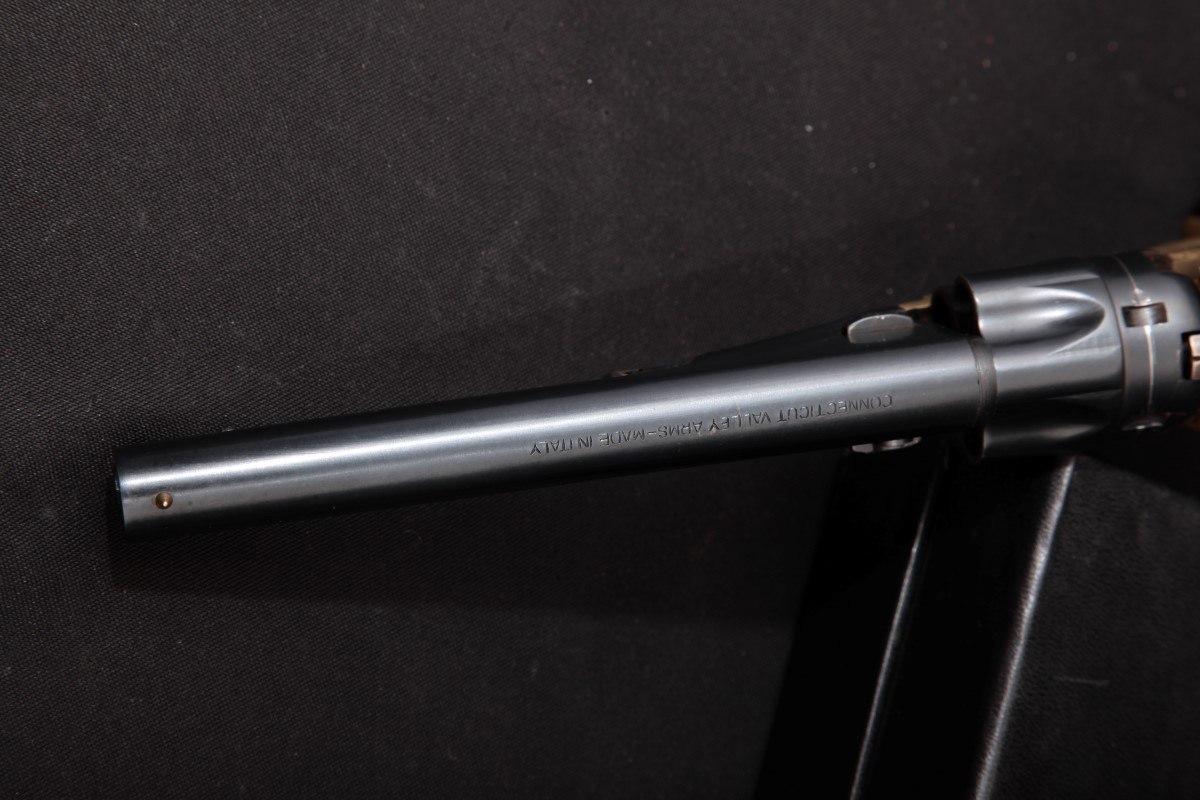
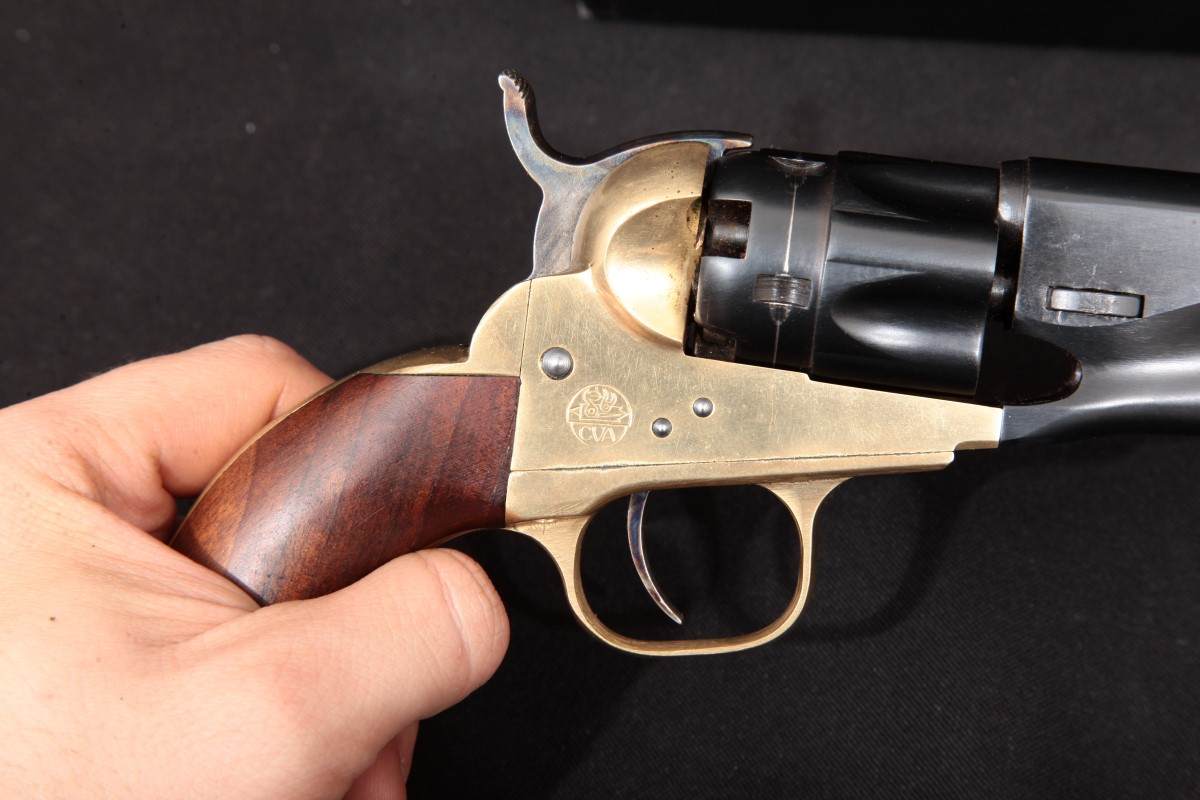
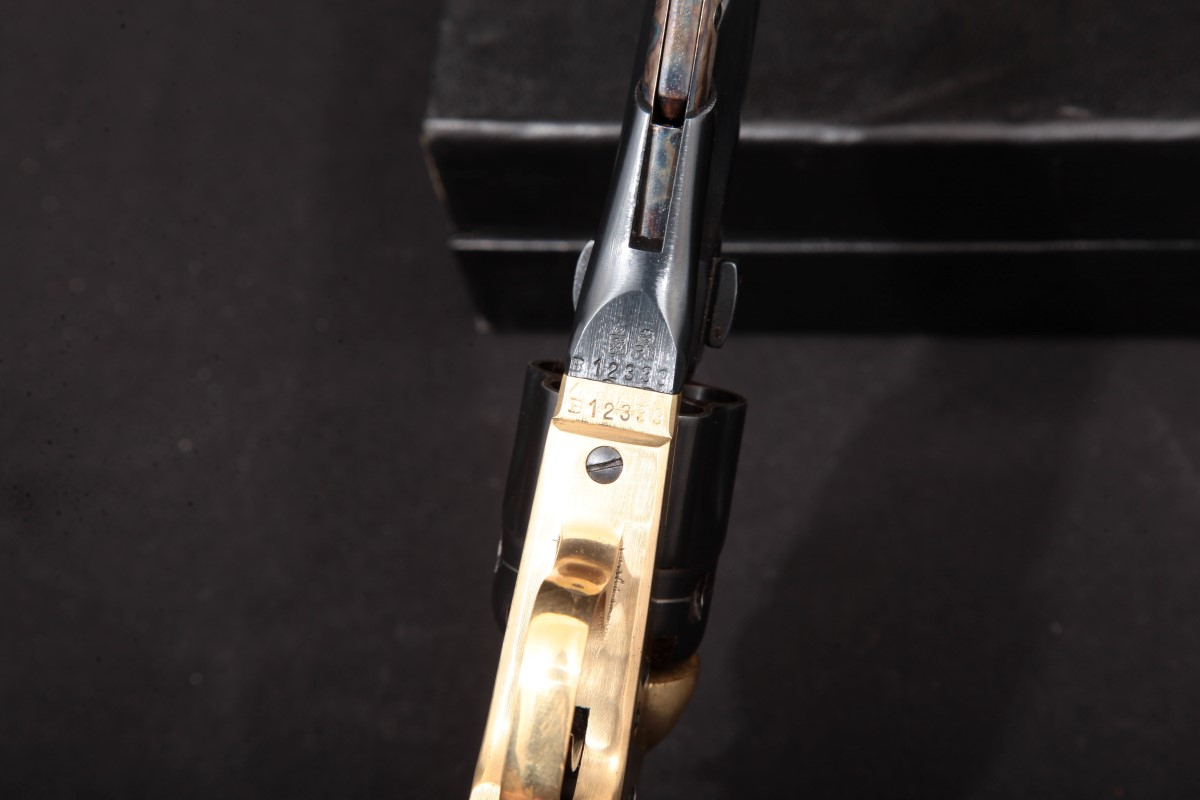
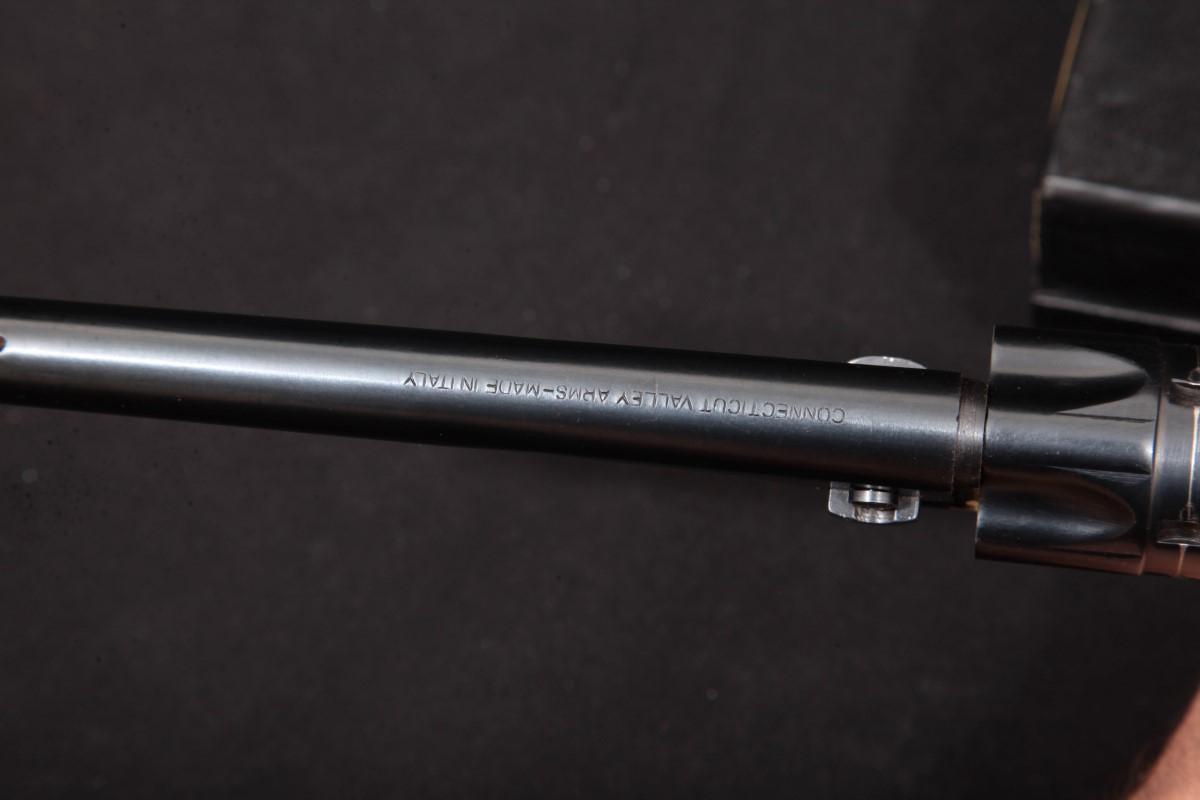
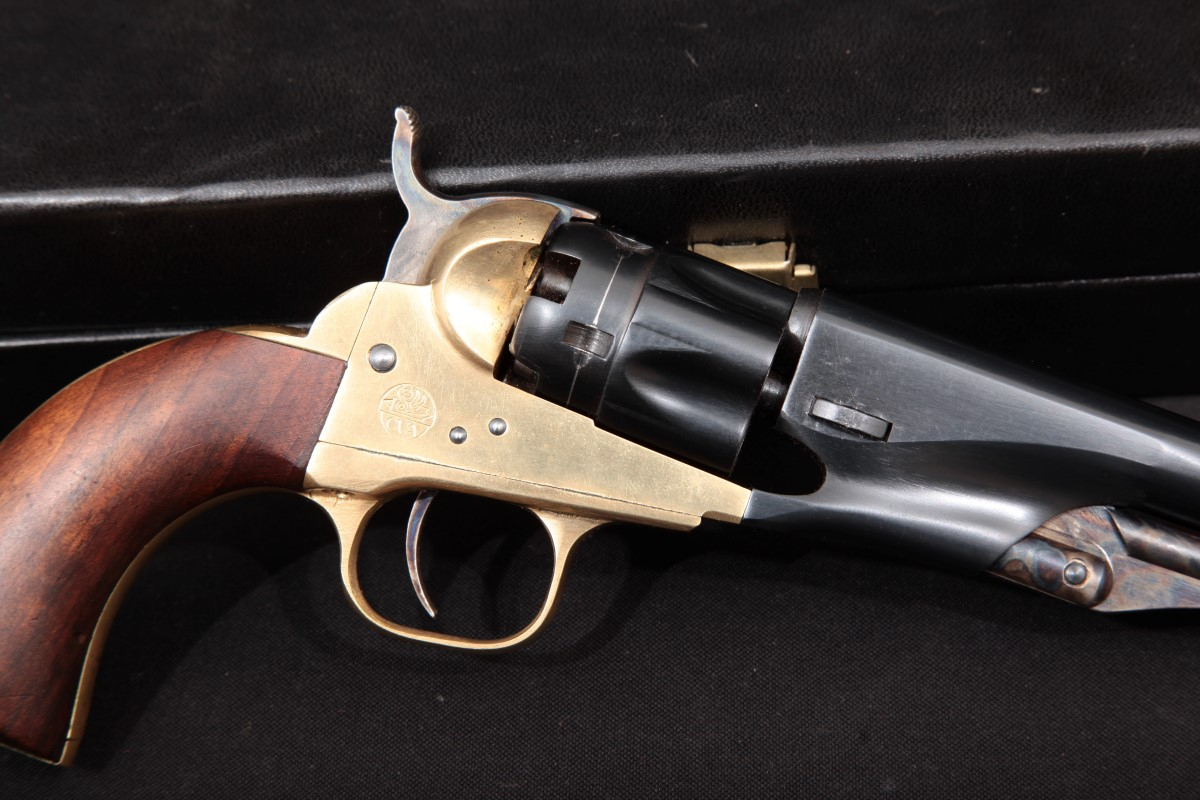
Connecticut Valley Arms Asm Model 1862 Pocket Police, Blue & Brass 5 1/2" Single-Action Percussion Cap & Ball Revolver & Box, Made in 1988 in .36 Caliber Ball

Over the years, I have found this Italian Copies to be well built and a lot of fun to shoot! Grumpy

Connecticut Valley Arms - ASM Model 1862 Pocket Police, Blue & Brass 5 1/2


Categories
All About Guns Well I thought it was funny!

Pumpkin Carving with an Uzi

Categories
All About Guns Allies

Sir Maurice Mickelwhite CBE by WILL DABBS

Michael Caine is a modern day cinematic icon. He rose from remarkably humble beginnings.

Maurice Joseph Mickelwhite was born in March of 1933 at St. Olave’s Hospital in London. His father was a fish market porter, while his mom worked as a charwoman cleaning houses. The elder Mickelwhite was conscripted into the British Army during World War 2. Maurice, his mom, and two brothers were evacuated from London during the Blitz.

Maurice Mickelwhite’s first taste of the stage came at age ten.

At age ten young Maurice had a small part in a school production of Cinderella. In his enthusiasm to mount the stage, he left his fly undone to the delight of the audience. This bit of inadvertent comic relief was the highlight of the play.

After World War 2 thousands of displaced Britons were housed in prefabricated housing like this.

After the war, the family was reunited in a small prefabricated home built in Canada. “Prefabs” as they were called were intended to serve as a temporary shelter until London’s housing districts could be rebuilt. The Mickelwhite family lived in theirs for another eighteen years.

Though eventually supplanted by the Sterling, the British Sten gun served well into the 1950’s.

In 1952 the younger Mickelwhite was called up for his national service. He trained on a WW2-era No 4 Lee-Enfield rifle and the Sten submachine gun as one of the British Army’s Royal Fusiliers. Once while training with his mates on the Sten a fellow squaddie had a runaway gun. This is a condition wherein these crude SMGs would continue firing even after the trigger was released. Maurice reported in later years that the hapless recruit turned toward his sergeant for guidance and inadvertently sprayed the entire firing line as a result. Miraculously no one was hurt. After a brief stint on the continent with the British Army of the Rhine (BAOR) PVT Mickelwhite was assigned to Korea.

Like most young soldiers, Maurice Mickelwhite was not well versed in the geopolitical nuance of the war he was called upon to fight. He is shown here in the back row, second from the left.

Mickelwhite admitted later to being utterly bewildered when he arrived to fight the Korean War. He knew nothing of Asian politics and even less of the situation on the ground. On his first night on the line, he was assigned to an American-made Browning M1919 light machinegun.

Mickelwhite’s first night on the line was both chaotic and horrible.

He said later that his first night facing the Chinese near what is now the border between North and South Korea was surreal. He heard the sound of trumpets in the darkness and hadn’t time to ask his foxhole mate what they meant before flares exploded overhead. By the dancing shadows, he saw countless hundreds of fanatical Chinese troops charging his position. He was later to state that he would never forget the horrifying sound of those, “demonic trumpet players.”

Chinese troops were fanatical in their enthusiasm.

The Commonwealth forces responded with searchlights and massed artillery fire. Mickelwhite’s Fusiliers had emplaced barbed wire and a dense antipersonnel minefield in the killing zones ahead of their positions. The Chicom troops never slowed down, throwing themselves over the wire and pushing through the mines to make way for follow-on echelons. Mickelwhite later described them as “insanely brave.”

PVT Mickelwhite’s Browning M1919 extracted a prodigious butcher’s bill during his first night in combat.

PVT Mickelwhite burned belt after belt through his Browning, mowing down the attacking Chinese by the rank. Eventually, the weight of artillery and small arms fire broke the back of the assault. However, it was a rude awakening to life as an infantryman in the frozen wastes of Korea.

Death Lurks in the Dark

PVT Mickelwhite found himself deep in the suck one night late in Korea.

Later Mickelwhite, his commander, and a signals operator blacked out their faces, bathed in insect repellent, and moved forward into the marshy space between the opposing lines on a recce. Lying there in the dark all three men suddenly realized how pointless their mission was. The patrol commander then offered the two other men five pounds each to help him capture a Chinese prisoner. The younger two soldiers demurred but suddenly caught the strong odor of garlic.

There is an inimitable fellowship borne of suffering. Men in combat develop a bond unlike any other.

Mickelwhite said the Chinese chewed garlic like gum. The three men realized to their horror that there was a Chinese patrol hunting them. The enemy troops were close enough to smell. By now they could hear movement all around and realized they were cut off, surrounded, and alone. Knowing they were done for, the three men hatched a crazy plan.

Their grand plan, such as it was, involved jumping to their feet, screaming like maniacs, and firing everything they had.

They decided to leap up and fire everything they had, assaulting in the direction of the Chinese lines while screaming like banshees. They intended to simulate a large-scale assault on the Chicom positions. Thinking they were facing certain death they were unanimous in their desire to take as many enemy soldiers as possible with them.

The three men fully expected to die together, so they shared one final moment of fellowship.

The signals operator agreed to the plan but announced softly that he had a desperate need to pee. The other two Brits concurred that this would be a good idea. The three men then got on their knees, loosened their trousers, and urinated together, believing this to be their last act of fellowship before their collective gory demise.

Due largely to the audacity of their assault, the three young English soldiers miraculously survived having been surrounded and cut off by a much larger Chinese force.

The three young Britons indeed leapt to their feet and charged the Chinese lines guns a-blazing. The Chicom soldiers were so unsettled by the ferocity of their attack that they let the small British patrol escape. Once the three men were outside the reach of the searching Chinese they changed course and evaded back to friendly lines amazed that they had survived. Of these remarkable events, he later said, “The rest of my life I have lived every bloody moment from the moment I wake up until the time I go to sleep.”

The Guns

The Sten was a wonderful horrible gun. Crude, simple, and available, it was the right tool for the right time.

In the immediate aftermath of the miraculous evacuation at Dunkirk, the British Army retained a proper army bereft of small arms. The industrial behemoth of the United States was just awakening, but the Battle of the Atlantic threatened to keep the copious war materiel from the US from reaching the UK where it was needed. In response, Reginald Shepherd and Harold Turpin working at Enfield designed the Sten gun. Sten is a portmanteau combining the first letters of their last names with “En” from Enfield.

Its ghastly magazine notwithstanding, the Sten was actually quite the capable close-combat tool.

In its simplest form, the Sten had a mere 47 parts. The design was left intentionally rough with loose tolerances such that parts could be crafted in small decentralized shops and assembled remotely. This 9mm SMG was selective fire and cycled at a sedate 500 rpm.

The Sten saw service throughout occupied Europe with partisan forces.

The Sten is itself a solid enough gun, but its magazine was simply abysmal. A double-column, single-feed design, the Sten magazine creates quite a lot of internal friction and is subsequently exceptionally susceptible to fouling. The double-column, double-feed magazine of the improved Sterling SMG rectified these problems nicely.

The Sten Mk IIS was the world’s first production sound suppressed submachine gun.

The Sten was produced in a variety of Marks. The Mk II included a rotating magazine well that could be positioned downward to seal off the ejection port against dirt and fouling. The Mk IIS was the first mass-produced SMG with an integral sound suppressor. The Mk III was the simplest of the lot, featuring a fixed magwell welded in place. The Mk V included a wooden stock and the front sight and bayonet from a No 4 Lee-Enfield rifle.

The Browning M1919A4 was really obsolete by the onset of WW2, but it was nonetheless reliable, effective, and everywhere.

The Browning M1919A4 belt-fed light machinegun was an evolutionary development of the WW1-era water-cooled M1917. The M1919 fired from the closed bolt and was recoil operated. The same basic action drove the entire family of M2 and M3 .50-caliber machineguns as well.

There really is no easy or comfortable way to carry or fire the M1919A4 while on the move.

At 31 pounds and 40 inches long the M1919A4 was really designed to be used from fixed positions. Given the gun’s boxy utilitarian architecture there is simply no comfortable way to carry it, particularly across rough terrain. However, the receiver is formed from heavy steel plates riveted together. This makes for a weapon that is fairly easy to produce in quantity while remaining just incredibly rugged.

The M1919A6 was an awkward effort at transforming the M1919A4 into something a bit more portable.

The M1919A6 was introduced in 1943 as an attempt to make the M1919 into a true General Purpose Machinegun (GPMG) in the vein of the German MG34 or MG42. The A6 included a shortened, lightened barrel as well as a detachable buttstock. However, the final package still weighed a pound more than the M1919A4 and 6.5 pounds more than the MG42.

The Rest of the Story

Maurice Mickelwhite’s first real theater job was as an assistant stage manager.

As a newly-minted 20-year-old combat veteran Mickelwhite answered an advertisement in The Stage, an English theater periodical, for an assistant stage manager position with a theater troupe. This job also entailed his performing a number of walk-on parts as needed. As Mickelwhite seemed a mouthful the young man adopted the stage name of “Michael White.” However, his agent informed him that there was already a Michael White performing as an actor in London and that he needed to find a new name post haste.

Caine later jokingly claimed he might have been named for the beloved Disney animated movie “101 Dalmations” had it not been for the strategic location of a few trees.

This conversation took place from a phone booth in Leicester Square, London. Mickelwhite looked around and noted that The Caine Mutiny was playing at the nearby Odeon Theater. He decided on the spot to change his name to Michael Caine. He later joked that had the intervening trees been arrayed slightly differently he might have become “Michael Mutiny” or “Michael One Hundred and One Dalmatians.”

Michael Caine has remained married to his second wife for nearly half a century.

Michael Caine went on to become one of the most beloved and successful actors in the world, appearing in some sixty major films. He has been nominated for an Academy Award six times and has won twice. He and Jack Nicholson are the only two actors to have been nominated each decade from the 1960s to the 2000s. He carries the title Commander of the British Empire and was knighted by the Queen as Sir Maurice Mickelwhite CBE in 2000. He has remained married to his second wife, Shakira Baksh, for 48 years. By all accounts, Michael Caine is and always has been quite the good bloke.

Dashing, handsome, and successful, Michael Caine is the archetypal movie star. When younger, however, he was also apparently quite the competent soldier as well.
Categories
All About Guns Ammo

9mm vs 45 ACP–A Different Kind of Comparison by RICHARD MANN

Yes, we went there. But, this is a different take on the most common and irritating debate among gun enthusiasts, and you will learn something new regardless of which side you end up on.

9mm vs. 45 ACP

The 9mm vs 45 ACP argument has been going on for more than a century. Many believed the two World Wars answered this question after Americans used their .45s to beat the Germans and their 9mms— twice. But in 1967, the Illinois State Police adopted the Smith & Wesson Model 39 pistol in 9mm, and in 1985 the U.S. Military transitioned from their war-winner to the Beretta M9. A year later, the supposed failure of a 9mm during the FBI’s notorious Miami shootout had all the .45 lovers screaming, “We told you so!” and we ended up with the .40 S&W. But today, the 9 mm is our most prevalent self-defense cartridge.

Why? Basically, for the following three reasons:

The best 9mm loads deliver terminal performance similar to many 45 ACP loads.

Pistols in 9mm hold between 20 and 30 percent more ammo than .45 pistols.

Felt recoil of 9mm handguns is about half as much as pistols chambered in 45 ACP.

This is why the FBI and many other law enforcement agencies have transitioned back to the 9mm. Few will argue these three facts, but are the advantages offered by the nine substantial enough to make it the better choice?

It’s true that the best 9mm loads are equal in performance to many 45 ACP loads. However, if recovered-bullet diameter and penetration mean what we think they do, the best 9mm loads are not the equal of the best 45 ACP loads. Regarding capacity, a first-grader can see a 9mm pistol holds more ammo, but most civilian self-defense shootings are resolved with between one and eight shots. So, capacity might not be all that important after all. But what about shootability? Are 9mm pistols that much easier to shoot more accurately and faster? To find that out, I conducted a test to get to the bottom of the 9mm vs 45 ACP debate.

Testing 9mm vs 45 ACP

I selected three drills I thought represented varied self-defense shooting situations. To eliminate as much human error as possible, there was no drawing from the holster or reloads; all the drills were started at the low ready and required less than seven shots. The first drill was my standard defensive-handgun-test drill, which I call the Forty-Five Drill. It requires placing five shots inside a 5-inch circle at 5 yards in less than 5 seconds. It would specifically highlight recoil control during rapid, sustained fire at a relatively small target.

The next drill was a modified version of Jeff Cooper’s famous El Presidente Drill. In this variation, you engage three steel, torso-size targets at 10 yards, spaced 10 feet apart. All that’s required are two hits anywhere on each target. This drill highlights recoil control and target transition, with minimal emphasis on shot placement.

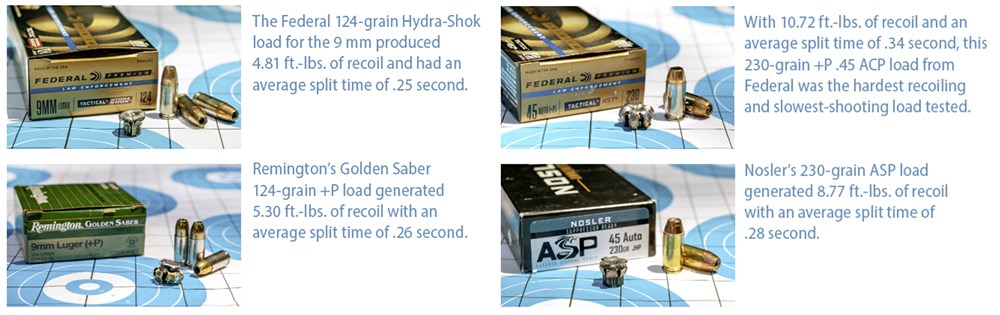
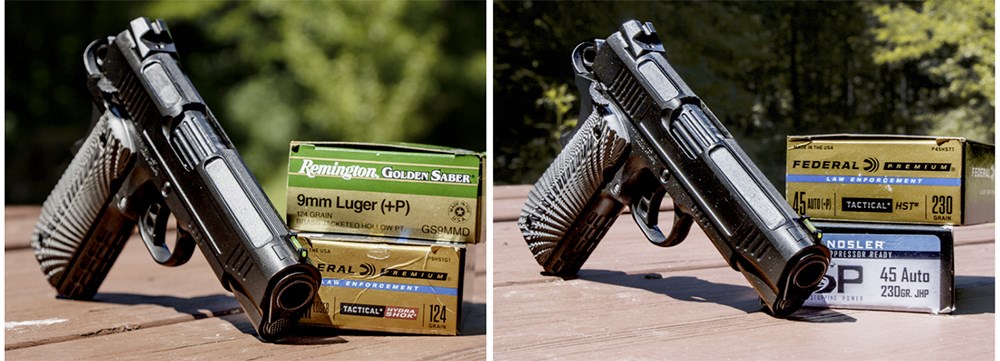
ammo tested

The final drill was a variation of another Cooper drill known as the Mozambique or Failure Drill. It would be performed at 5 yards, without taking the time to evaluate the effects of the first two shots before firing the head shot. Using an Action Target PT Hostage Target, two shots are fired center mass and then a shot on the swinging head plate is attempted as fast as possible. With this drill, we could evaluate recoil control during fast application on a close-in target, with a transition to a single, precision shot.

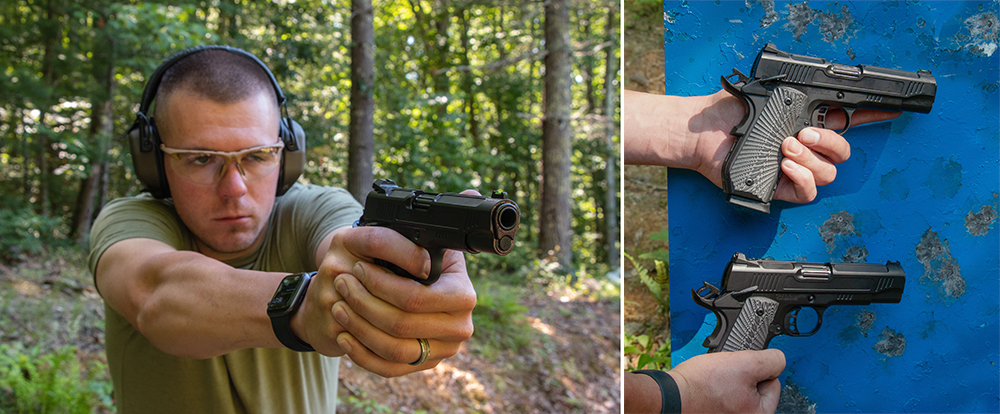
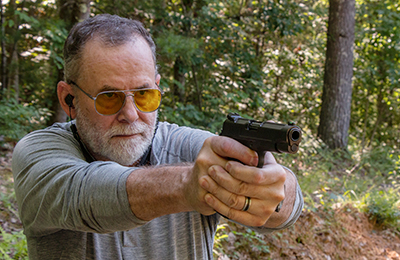
I recruited a SWAT officer to help me with this test, and each drill was conducted three times by each shooter, with each handgun and with each test load. The guns used for the test were two identical, lightweight Tisas 1911 Bantam Carry handguns—one in 9mm and one in 45 ACP. Also, standard-pressure and +P loads for both cartridges were used during the test.

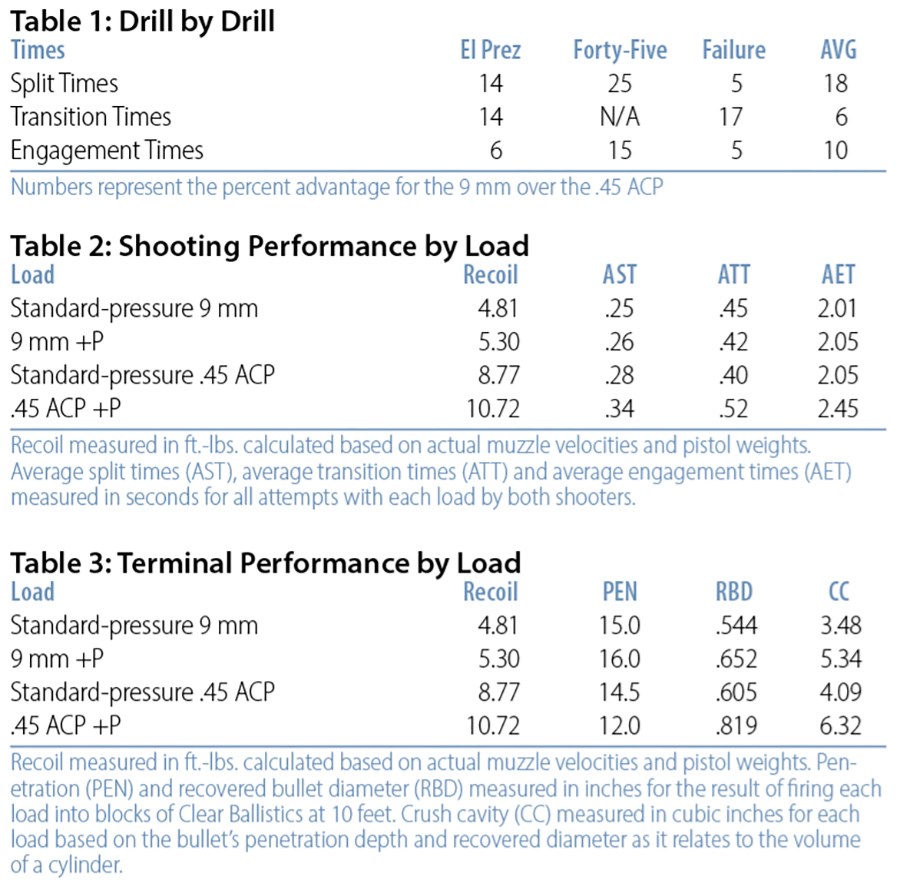
drill tables

The Results

We did not score this like a shooting match, and we only counted attempts at each drill that were miss free; three clean runs were required with each pistol, with each load, on each drill. The goal was not to see how fast we could miss, it was to see how quickly we could get hits with. Using a shot timer, we recorded the total time it took to complete each drill and the split times between every shot fired. Splits, with a transition between targets, were recorded as “transition” times.

Given the identical pistols, aside from capacity and terminal performance, recoil is the only real difference between 9mm vs 45 ACP. What the results give us is a look at how recoil limits a shooter’s ability to fire multiple shots fast and accurately. There are several practical ways to look at the data.

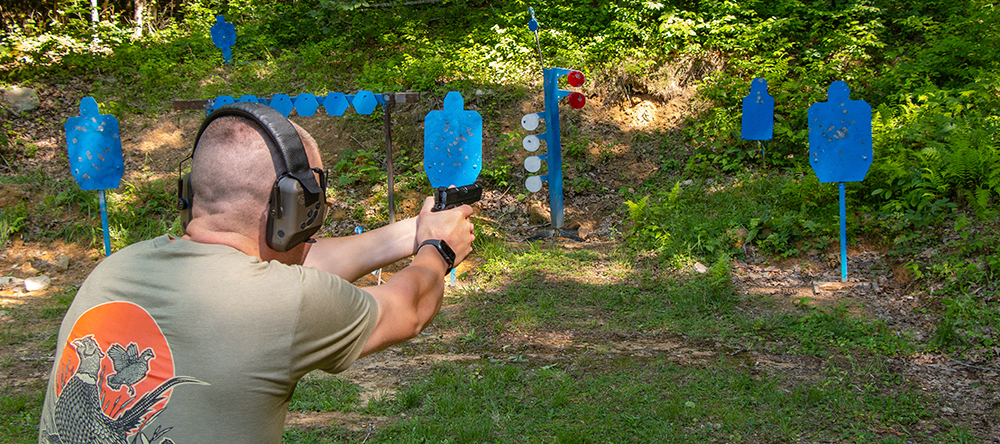
shooting at the range

Both the 9 mm and .45 ACP pistols were put through several drills with various loads in order to evaluate shooting speed and accuracy.


Overall

With all the data averaged, split times were 18 percent faster with the 9mm. This essentially means we could accurately fire five to six 9mm rounds as fast as we could accurately fire four 45 ACP rounds. Transition times—the time it took to switch targets—were very close, but the 9mm did have a six-percent advantage. Regarding the time it took to complete each engagement, the 9mm was faster by 10 percent. Keep in mind, these numbers represent the results obtained by both shooters and all four test loads.

testing 9 mm vs. .45 ACP

By using identical (apart from the chambering) pistols, the author was able to remove much of the “gun variable” from testing 9 mm vs. .45 ACP.

Drill by Drill

Another way to look at the results of that 9mm vs 45 ACP test is by the individual drills. Two things stand out here. The first is that when precision was required, such as repeatedly hitting a 5-inch target in the Forty-Five Drill, the 9mm had a substantial advantage. In the El Prez Drill, where precision shot placement was not as critical, the nine’s advantage was less obvious. And finally, with the Failure Drill, you can see that when hammering a target up close, the difference was not that much. However, when slowing down to make the precision shot, it took longer to transition/recover from recoil with the 45 ACP.

By Load

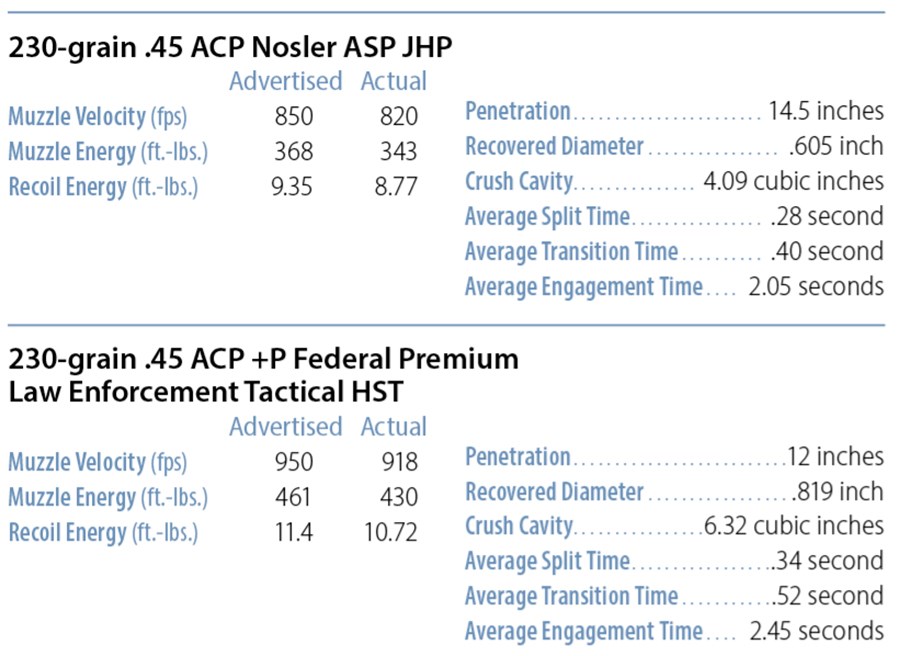
What we’re learning in this 9mm vs 45 ACP test is not earth-shattering; pistols with more recoil are harder to shoot fast and accurately. It’s not like we didn’t know that. However, I think the most interesting thing this data shows is how different 9mm and 45 ACP loads performed. As you can see, the standard-pressure 45 ACP load with 8.77 ft.-lbs. of recoil performed very similarly to the +P 9 mm load with only 5.3 ft.-lbs. of recoil. You may be able to perform just as well with a little more recoil, but at some point, the recoil of the .45 will begin to negatively impact on-target performance.

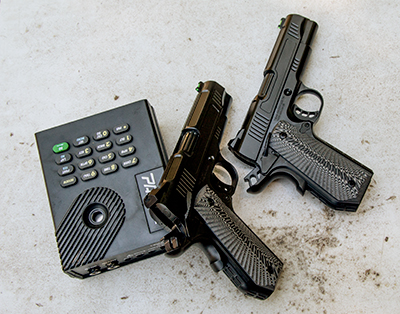
Tisas Bantam Carry 1911

(l.) The Tisas Bantam Carry 1911 served as the test platform, since it can be had in 9 mm or .45 ACP. (r.) Weight difference between the .45 ACP and 9 mm Tisas 1911s was only .7 ounce (empty), and each pistol functioned with the utmost reliability throughout testing.

For us, this was painfully obvious with the 10.72 ft.-lbs of recoil delivered by the 230-grain +P 45 ACP load. Compared with the 124-grain +P 9mm load, our times increased across-the-board by about 20 percent. What this data fails to effectively convey is how hard 10.72 ft.-lbs. of recoil is out of a 27-ounce handgun—it is not enjoyable.

testing 9 mm and .45 ACP ammunition

To collect the test data, over the course of several days hundreds of rounds of 9 mm and .45 ACP ammunition were fired, and the shot times for every round fired were recorded.

Terminally Speaking
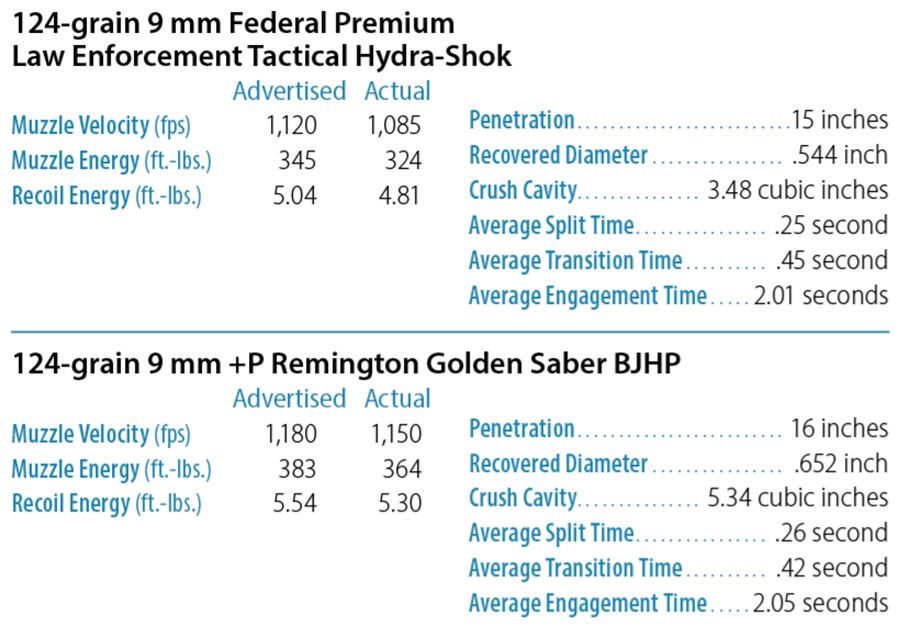
This was a lot of shooting to prove a known fact, but it does provide an idea of exactly how much recoil can negatively impact shooting performance. What you might be wondering is exactly what you’re paying for with more recoil? If we’re going to reduce our ability to shoot fast, what type of terminal performance will we get in return? To enhance the shooting data, we also fired each of the four test loads into Clear Ballistics gelatin.

The 6.32-cubic-inch crush cavity delivered by the Federal 230-grain +P HST load is impressive, but it comes with a cost, and that cost is an uncomfortable shooting experience and an increase in the time it takes to fire multiple shots. Measuring recoil can be subjective, but more never helps you shoot better. Everyone will have different limits, but at some point, you must decide if the terminal performance you gain is worth the reduction in shootability that comes with it.

What the information from this test—and the massive spreadsheet created to digest it—might do best is to explain why most law enforcement agencies have gone back to the 9mm. With the best 9mm loads, you get terminal performance similar to standard 45 ACP loads out of a gun that holds more ammunition and is easier to shoot fast and accurately. But, what this also shows is that with a 45 ACP, you can select a lesser-recoiling load and shoot nearly as fast and accurately as you can with a 9mm pistol, while delivering similar terminal performance. If you do that, the only thing you’re giving up with the .45 is capacity.

No one ever said the choice is easy, and the right answer will not be the same for everyone. Above all, the most important takeaway might be that, while picking the right cartridge is important, it may not be as important as selecting the right load for it.


9mm vs 45 ACP Cartridge/Ammunition Synopsis

Comparing the 9mm vs 45 ACP cartridges by themselves is simply not enough; ammunition must be taken into consideration. The following information offers a comprehensive look at the ammunition used in the test. There are better and worse loads for both cartridges out there, but here you can look at two loads that deliver average performance, and two loads that represent the best performance available from each cartridge.

.45 and 9mm pistols

table
table

Categories
All About Guns

A S&W Model 631

Engraved Smith & Wesson Model 631 Kit Gun Revolver by John Adams

Categories
All About Guns

Just another hint on what I want for Christmas!

Categories
Uncategorized

The War – (This may or may not be true) RUSSIANS PREPARE TO ABANDON WESTERN KHERSON OBLAST! UKRAINIAN ADVANCES IN NORTHEAST STALLED.

Russian guns in action in eastern Ukraine.

Latest Millitary News from the Russian Front – Institute for the Study of War (ISW) Russian Offensive Campaign Analysis for October 19

Institute for the Study of War
Katherine Lawlor, Karolina Hird, Grace Mappes, Riley Bailey, George Barros, and Frederick W. Kagan October 19, 8:00 pm ET Click here to see ISW’s interactive map of the Russian invasion of Ukraine. This map is updated daily alongside the static maps present in this report. Russian authorities are likely setting information conditions to justify planned Russian retreats and significant territorial losses in Kherson Oblast. Commander of Russian Armed Forces in Ukraine Army General Sergey Surovikin reported during an appearance on Russian television that the Russian military leadership has to make “difficult decisions” regarding Kherson Oblast and accused Ukraine of planning to strike civilian and residential infrastructure in Kherson Oblast.[1] Kherson Occupation Head Vladimir Saldo relatedly noted that his administration is evacuating the west bank of the Dnipro River in anticipation of a “large-scale” Ukrainian offensive.[2] Surovikin‘s and Saldo’s statements are likely attempts to set information conditions for a full Russian retreat across the Dnipro River, which would cede Kherson City and other significant territory in Kherson Oblast to advancing Ukrainian troops. Russian military leaders have evidently learned from previous informational and operational failures during the recent Ukrainian counteroffensive in Kharkiv Oblast and are therefore likely attempting to mitigate the informational and operational consequences of failing to defend against another successful Ukrainian advance. Russian forces are also setting information conditions to conduct a false-flag attack on the Kakhovka Hydroelectric Power Plant (HPP). The Russian military may believe that breaching the dam could cover their retreat from the right bank of the Dnipro River and prevent or delay Ukrainian advances across the river. Surovikin claimed on October 18 that he has received information that Kyiv intends to strike the dam at the Kakhovka Hydroelectric Power Plant (HPP), which he alleged would cause destructive flooding in Kherson Oblast.[3] Saldo echoed this claim and warned that Ukrainian forces intend to strike dams upstream of Kherson City.[4] Russian authorities likely intend these warnings about a purported Ukrainian strike on the Kakhovka HPP to set information conditions for Russian forces to damage the dam and blame Ukraine for the subsequent damage and loss of life, all while using the resulting floods to cover their own retreat further south into Kherson Oblast. The Kremlin could attempt to leverage such a false-flag attack to overshadow the news of a third humiliating retreat for Russian forces, this time from western Kherson. Such an attack would also further the false Russian information operation portraying Ukraine as a terrorist state that deliberately targets civilians. Russia continues to use the guise of civilian “evacuations” as a cover for the mass forced removal of civilians from Russian-occupied areas of Ukraine. Saldo’s announcement of a mass withdra

There is a lot of news today, both military and political. So I am going to have to divide the Posts again. This one will cover military news and, assuming I can manage it, a later post will cover political issues.

SOUTHERN UKRAINE

The Kherson Counter Offensive

“Russian authorities are likely setting information conditions to justify planned Russian retreats and significant territorial losses in Kherson Oblast. Commander of Russian Forces Surovikin reported during an appearance on Russian television that the Russian military leadership has to make “difficult decisions” regarding Kherson Oblast and accused Ukraine of planning to strike civilian and residential infrastructure in Kherson Oblast. Kherson Occupation Head Saldo relatedly noted that his administration is evacuating the west bank of the Dnipro River in anticipation of a “large-scale” Ukrainian offensive. Surovikin‘s and Saldo’s statements are likely attempts to set information conditions for a full Russian retreat across the Dnipro River, which would cede Kherson City and other significant territory in Kherson Oblast to advancing Ukrainian troops. Russian military leaders have evidently learned from previous informational and operational failures during the recent Ukrainian counter offensive in Kharkiv Oblast and are therefore likely attempting to mitigate the informational and operational consequences of failing to defend against another successful Ukrainian advance.”

This paragraph shows that the Russians are less tone deaf to Ukrainian advances and are “setting conditions” (e.g., preparing Russians) for another upcoming defeat and withdrawal. The main questions appear to be how orderly such a retreat will be and what opportunities it will afford advancing Ukrainian troops.

“Russian forces are also setting information conditions to conduct a false-flag attack on the Kakhovka Hydroelectric Power Plant (KHPP). The Russian military may believe that breaching the dam could cover their retreat from the right bank of the Dnipro River and prevent or delay Ukrainian advances across the river. Surovikin claimed on October 18 that he has received information that Kyiv intends to strike the dam, which he alleged would cause destructive flooding in Kherson Oblast. Saldo echoed this claim and warned that Ukrainian forces intend to strike dams upstream of Kherson City. Russian authorities likely intend these warnings about a purported Ukrainian strike on the KHPP to set information conditions for Russian forces to damage the dam and blame Ukraine for the subsequent damage and loss of life, all while using the resulting floods to cover their own retreat further south into Kherson Oblast. The Kremlin could attempt to leverage such a false-flag attack to overshadow the news of a third humiliating retreat for Russian forces, this time from western Kherson. Such an attack would also further the false Russian information operation portraying Ukraine as a terrorist state that deliberately targets civilians.”

What possible reason Kyiv could have for taking such an action against its own civilians is not explained and makes no sense. This is just another example of Russia making inherently unbelievable claims and expecting them to be accepted. Of course, actually carrying the threat out would make things even worse.

“Russian sources widely claimed that Ukrainian troops conducted another general counter offensive in northwestern Kherson Oblast on October 19. A Russian occupation deputy claimed that Ukrainian troops went on the offensive around noon on October 19 and attacked from northern Kherson Oblast about 30km south of the Kherson Dnipropetrovsk Oblast border toward Beryslav. Other Russian sources similarly claimed that Ukrainian troops launched an offensive south of the Nova Kamianka-Dudchany area and attacked toward Sukhanove and Piatykhatky, both near the current frontline in northwestern Kherson Oblast and about 35km north of Beryslav. ISW is unable to verify these claims. Russian milbloggers (RMBs) reported that elements of the 126th Coastal Defense Brigade, 11th, 80th, and 83rd Air Assault Brigades, and 76th Guards Air Assault Division are holding the line of defense in this area and prevented significant Ukrainian advances. These elements, especially the 126th Coastal Defense Brigade, are severely degraded and understrength, and some have likely been active in Kherson Oblast without rest or rotation for most of the war.”

These elements were once among Russia’s most capable units, but have now been reduced to mere shadows of their former selves. Unless augmented by substantial numbers of additional troops, it is highly unlikely that they can hold the line in northern and northwestern Kherson. These units were probably chosen for the defense of this sector as they are more likely to be able to withdraw in better order than less experienced troops.

Beryslav is the major Russian supply and logistics point on the west bank of the Kokhovka Reservoir and presumably the Russians will abandon the northwestern part of the Oblast before Ukrainian troops can seriously threaten it.

“Ukraine’s Southern Operational Command (USOC) noted that Ukrainian forces are continuing “active combat operations” and focusing on “creating favorable conditions for the development of further offensives.” Ukrainian forces additionally continued their interdiction campaign against Russian concentration areas in Kherson Oblast as part of the ongoing counteroffensive. USOC and other Ukrainian military sources reported that Ukrainian strikes destroyed three ammunition warehouses around Beryslav, Nova Kakhkovka, and Kherson City on October 18. Ukrainian strikes likely also hit a Russian ferry crossing 3km north of Nova Kakhovka on the opposing bank of the Dnipro River. Satellite imagery from October 18 shows that Russian troops have completed the creation of a barge bridge near Kherson City as part of an effort to reconstitute river crossings as Ukrainian troops continue to target Russian transportation capabilities across the Dnipro River.”

Both the Russian statements and their construction of a barge bridge (a bridge generally constructed of steel planking aid across barges and not terribly sturdy) is evidence that Russia is preparing to abandon Kherson west of the Dnipro, as their forces there are overstressed.

Nothing of substance new to report in Zaporizhzhya Oblast – Russia statements indicate likely false shelling by Ukrainian of the Zaporizhzhya Nuclear Power Plant and a supposed amphibious assault to take it.

EASTERN UKRAINE

The Luhansk Counter Offensive

“Russian forces continued to conduct limited assaults to recapture lost territory in northeastern Kharkiv Oblast on October 19. The UGS reported that Ukrainian forces repelled Russian assaults on Dvorichna, 17km northeast of Kupyansk in Kharkiv Oblast. The Luhansk People’s Republic Deputy Internal Minister reiterated claims that Russian forces captured Horobivka, also 17km northeast of Kupyansk on October 18, although ISW cannot independently verify that Russian forces have captured the settlement. The Russian Ministry of Defense (RMoD) claimed that Russian forces struck Ukrainian control points and concentrations of manpower and equipment throughout Kharkiv Oblast”.

“Russian and Ukrainian forces reportedly continued fighting along the Kreminna to Svatove line on October 19. A Russian source claimed that Russian forces repelled a Ukrainian assault on the Kyslivk in the direction of Svatove. The RMoD claimed that Russian forces repelled Ukrainian formations that attempted to cross the Zherebets River 16km northwest of Svatove, 15km west of Svatove, 11km west of Svatove) in Luhansk Oblast. The Ukrainian General Staff reported that Ukrainian forces repelled a Russian ground assault near Bilohorivka (12km south of Kreminna). A RMB claimed that Russian and Ukrainian forces are continuing to fight west of Kreminna in the vicinity of Terny, 18km northwest of Kreminna, and Torski, 16km west of Kreminna, although ISW cannot independently verify his claims.”

It appears that, for now, Ukrainian forces are largely defending against Russian attacks in northeastern Ukraine. Given that the Russians claim the capture of only one small village (which is not confirmed), it indicates that the Ukrainians are not overextended and are able to repel what appear to be largely limited and local counter attacks.

Fighting in Donetsk

“The UGS reported that Ukrainian forces repelled Russian ground attacks south of Bakhmut near four villages. Russian sources claimed that fighting is ongoing in Optyne and on Bakhmut’s eastern outskirts. Russian sources also claimed that fighting is ongoing in Soledar’s industrial zone and near Spirne, 18km northeast of Soledar. The UGS also reported that Ukrainian forces repelled Russian ground attacks northeast of Avdiivka, west of Donetsk City, and in western Donetsk Oblast. A Russian source claimed that Russian forces are continuing to fight southwest of Avdiivka. A Russian source also claimed that Russian forces attacked fortified Ukrainian positions in Marinka, and geolocated footage confirmed that Russian forces have advanced further down the highway north of Marinka. A Russian source claimed that positional battles are ongoing in the Vuhledar area in western Donetsk Oblast, and a different Russian source expressed continued concern that Ukrainian forces may launch a counter offensive in the Vuhledar area.”

Another day without even Russian claims of having captured a village – it appears that even their limited and local counter attacks are failing now. On the other hand, the rumors of another Ukrainian offensive – either in western Donetsk or northeastern Zaporizhzhya continue as a subject of great concern for the RMB community.

And finally…

Ukrainian attacks in Kherson appear to have cracked the Russian lines and forced them to prepare for withdrawal from the Oblast west of the Dnipro. However, announcing in advance that a retreat may occur is not necessarily good news for the Ukrainians, as it could indicate that the withdrawal will be less disordered than previous Russian retreats. Also, the apparent intention to blow the Kakhovka Dam is worrisome, although how much damage that would cause is unknown. The period of easy advances for the Ukrainians has at least temporarily ended in the northeast and seems to have come to a pause. To make sure that Ukrainian advances don’t halt altogether, the Western allies need to provide the Ukrainians additional support at this critical juncture.

Categories
A Victory! All About Guns California

California Judge Blocks Law Mandating Release of Gun Owners’ Personal Information by Jake Fogleman

California must stop sharing the personal identifying information of the state’s gun owners with academic researchers, a state judge has ruled.

San Diego Superior Court Judge Katherine Bacal issued a preliminary injunction against California’s Assembly Bill 173 on Friday. Judge Bacal noted that allowing the law to remain in effect while the case continued sufficiently threatened the privacy rights of California gun owners.

“Accordingly, plaintiffs have shown that the balance of harms weighs in favor of issuing the injunction,” she noted in her order.

The injunction represents a win for gun-rights advocates in their fight against the state’s attempts to share gun owners’ identifying information for outside research. The state already collects extensive data on gun and ammunition purchases–including an ammo registry. California’s practices make it an outlier, but one with the potential to be copied by other blue states seeking tighter gun laws. The successful injunction suggests advocates may be successful in permanently stopping the state from sharing that data with non-law enforcement entities and quash the potential for other states to follow California’s lead.

Assembly Bill 173, signed by Governor Gavin Newsom (D.) last September, directed the Attorney General to disclose personal information on gun purchasers to the California Firearm Violence Research Center at UC Davis. The information includes details such as the buyer’s name, address, date of birth, what they purchased, when and where they bought it, and more. It also authorized the center to share the information with any other “bona fide research institution.”

The now-blocked law is not the only time California officials have garnered controversy over how they handle gun owners’ private data. Earlier this June, The Reload broke news that the California Department of Justice had inadvertently leaked the names, racial identifications, home addresses, dates of birth, and permit classifications of the state’s concealed carry permit holders during a botched rollout of its 2022 Firearms Dashboard Portal. That information was made publicly available for download for several hours before eventually being scrubbed from the website. The state has since offered credit monitoring to all those it believes were affected by the leak.

Judge Bacal cited this incident as an example of the potential harm faced by gun owners if AB 173 were allowed to stay in effect.

“Defendant responds plaintiffs cannot establish irreparable harm because the personal identifying information has already been shared with researchers as recently as November of 2021,” she said. “Yet this does not account for the potential ongoing and future harms that could occur by continuous use of the information. Furthermore, and while this motion has been pending, a massive data breach reportedly occurred that leaked personal identifying information from the firearm databases for concealed carry applicants in or about June of 2022.”

A coalition of gun-rights groups, including the Firearms Policy Coalition (FPC), filed suit against the law in state court in January. The groups celebrated the injunction.

“The California government has proven time and time again that it can’t be trusted with the private personal information of its residents,” Bill Sack, FPC Director of Legal Operations, said in a press release. “Today’s ruling reinforces what FPC has been arguing all along; that you needn’t be forced to open your front door to immoral government intrusion in order to exercise your fundamental rights.”

California Attorney General Rob Bonta (D.) told The Reload that despite the ruling, he planned to continue defending the law in court.

“We are disappointed in this decision,” he said. “Research and collaboration would help protect our communities from gun violence and save lives. We will continue this fight in court.”

UPDATE 12:58 AM EASTERN 10-18-2022: This piece has been updated to include comment from Attorney General Bonta’s office.

Categories
All About Guns

The Minigun – M134 7.62×51mm Six-barrel Rotary Machine Gun