
Categories
Real OLD SCHOOL!
.jpg)

When you’ve been living like a farm animal and haven’t removed
your clothes in a month this is what heaven looks like.
Human beings are waterproof, and personal comfort is a state of mind. I actually used to believe tripe like that. Among the big three survival requirements of food, water and shelter, I always kind of felt that shelter was more a desirable luxury than an absolute necessity. That was then. Nowadays, were I to sleep on the ground I wouldn’t be able to walk upright for a week afterwards.
The winter is the primary training time in the arctic reaches of Alaska. Our mission was cold weather combat operations, so that was naturally the best time to train. That unfortunate mantra acquainted me with some of the most ghastly weather.
I’m a skinny guy from Mississippi. A really cold day down where I live was maybe 30 degrees Fahrenheit. Then, Uncle Sam sent me to Alaska just to give me a little perspective.
Our first winter in Fairbanks it snowed 144 inches. New math tells us that is 12 feet. The coldest it got while I was stationed there was 62 degrees below zero, and we were in the field. If I never see another snowflake, it will be too soon.
Our field training exercises typically lasted three or four weeks. We would load up all of our killer gear and deploy to some remote wasteland to stage our tactical missions day or night. Not that this mattered a whole lot. It’s always dark up there in the wintertime, anyway. I’ve flown night vision goggles above the arctic circle at noon.
It’s tough to get worked up about much more than basic survival at fifty below zero. Aircraft and vehicles become instantly cold-soaked once you shut them down. In a survival situation you have to dig a big hole in the snow for a shelter because crawling into the snow is actually markedly WARMER than being outside.
Each arctic tent nominally housed ten guys and included a Yukon stove that would run on most anything flammable. We most typically used jet fuel. Once you got that stove cooking it made the most mesmerizing sound. We called it “Yuking.” As each drop of fuel hit the burner plate, atomized, and burned it made a pleasant little pop. Just thinking about that sound right now brings a smile.
Even wide open that stove still had a hopeless task. The tents were canvas, after all, and the outside air temperature was fifty below. As a result I would go an entire month without being warm. Under such sordid circumstances I’m living proof that you can indeed survive, but you’ll never be comfortable.
Once we finally got back to garrison we still had to clean and stow absolutely everything. You never knew when you might be called upon to go to war. Before anybody went home it was staged and ready to rock again. I’d come dragging into the house after a month in the field in the arctic as filthy as a feral pig and utterly exhausted. When finally the magical time arrived my precious bride was ready.
If you’ve read this column for long you should have a decent idea as to my personality and comportment. I describe myself as a high-effort, high-payoff sort of guy. However, living with me has got to be a chore most onerous. My wife does so with grace and poise.
We had a routine. I’d dump my filthy killer gear inside the door and strip down to my skivvies for hugs from my wife and kids. As that was the first time I had come out of those clothes in a month I cannot imagine how they could stand it. I then retreated to the shower.
We lived on post at Fort Wainwright. All the inhabited buildings were heated by a central heating facility that pumped hot ethylene glycol through underground pipes to keep the dwellings and facilities habitable. Our house had the neatest heat exchanger in the basement that provided hot water from this central boiler. We literally never ran short of hot water. You could run the hot tap for a week, and it would never cool off. That first shower back in the World typically lasted about an hour and a half. By the time I wrapped up, I was too weak to stand.
I would then dry off as best I was able and wriggle into a bathrobe before slithering downstairs to the dining room. There, my precious bride had a massive pot of her signature steaming hot chili and some ice-cold Coke waiting. I would eat that stuff until I literally thought I might explode. Now swollen up like a toad, I would crawl into bed and sleep the sleep of the dead.
I have no idea what heaven will be like. While details are scant, I have it on reliable information that the company will be great and everything else will be comparably awesome. However, I fear I might be just a wee bit disappointed if off in a corner someplace there’s not an immortal shower and some of my wife’s signature holy chili. That mystical combination sure seemed heavenly to me.
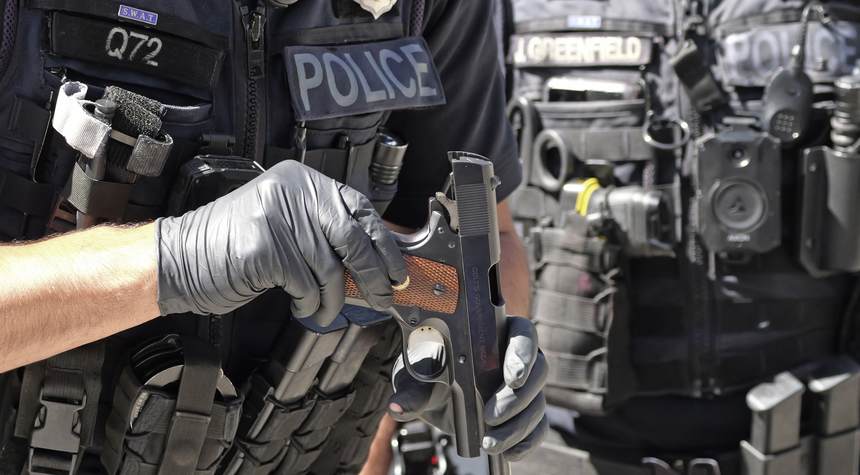
As per usual, particularly in the Golden State, when there’s a problem with violent crime, someone is going to blame the guns.
And for Santa Rosa, that means hosting its very first gun buyback event.
In the North Bay, a gun buyback event in Santa Rosa saw a big turnout Saturday, as hundreds of people swapped their firearms for cash.
Santa Rosa’s first ever gun buyback event drew more than a crowd; it was a traffic jam.
Cars stretched more than a mile down Fulton Road.
“I think it’s amazing. It surprises me so many are getting rid of guns,” said Sandy Sewell.
…
Despite the obvious popularity here, some research studies have questioned how effective buybacks are at stopping crime.
The National Bureau of Economic Research said, “Using data from the National Incident based reporting system, we find no evidence that GBP’S reduce gun crime.”
“At the end of the day, we’re not saying it’s going to reduce all the crime in Santa Rosa, but we do say the program may make that one difference for that one act of violence. For me, that’s a big win,” [Santa Rosa Police Chief John] Cregan said.
Now, they pulled in 423 guns before they started turning people away. They paid $200 for handguns and rifles while “automatics” and “ghost guns” got $300.
If no one got $300 for a gun, they still paid out more than $84,000 for guns in a program that studies have shown simply doesn’t work, and Cregan is pulling the “if it saves one life” nonsense?
That’s a cop-out and everyone knows it.
There’s no evidence it’ll make a difference in any act of violence. There’s no hint that it will. After all, in this report, they talk to people selling guns and they’re exactly the kind of people you expect to sell them at a buyback. They’re non-gun people who just want to get rid of some family heirlooms because the media told them guns were bad.
Sure, some of the others might be criminals looking to dump weapons or something of that sort, but for the most part, the bad guys keep their guns. Even if one sells a weapon, you better believe they’re still going to have a way to get a gun.
In other words, Santa Rosa spent more than $84,000 on the vague hope that maybe, some single act of violence might be averted somehow.
And then Cregan has the cajones to sit there and call this a big win?
The only “win” here is that he gets to look like he’s doing something about violent crime without having to, you know, actually do anything about violent crime. The big win is probably just him protecting his paycheck.
Look, the study mentioned in the above-linked quote is legit. It’s also not the only study showing buybacks don’t work. In fact, it’s hilarious watching people try to defend them. While I take issue with how Cregan is framing this, he’s hardly the most egregious in their nonsense defense of buybacks.
That doesn’t give him a pass for justifying such an expenditure with little more than a vague hope that it will do something.
That money could well have been put to better use in a number of ways, ways that might actually make a difference.
But those aren’t as flashy as buybacks, so they’re never even discussed.


Over that time we’ve learned a lot, and little of it has been good news for the 30 Rock star. For example, we learned that no, there’s no way that particular pistol “just went off.”
He got some more bad news earlier this week, too. It seems investigators are wrapping up their investigation.
The Santa Fe Sheriff’s Office completed its investigation Thursday into the fatal “Rust” shooting that left cinematographer Halyna Hutchins dead — and criminal charges against those involved, including Alec Baldwin, may be imminent.
“Today, District Attorney Mary Carmack-Altwies received the Santa Fe County Sheriff’s investigative report on the Rust movie set incident,” Heather Brewer, the spokesperson for Santa Fe’s top prosecutor, said in an email.
“The District Attorney and her team of investigators and prosecutors will now begin a thorough review of the information and evidence to make a thoughtful, timely decision about whether to bring charges.”
Brewer said the prosecutor’s focus will be “on upholding the integrity of the process, enforcing the laws of the state of New Mexico, and pursuing justice.”
Brewer could not provide a timeline on when Carmack-Altwies will have her decision ready but said there are no statutory deadlines in New Mexico that dictate how much time she has to press charges, beyond statutes of limitation.
While the announcement is short of details, Carmack-Altwies has been gearing up for a prosecution against someone with deep pockets. If it’s not Baldwin, it’s a mystery who that could be.
However, it also seems that Carmack-Altwies isn’t just focused on the high-profile A-lister. She also looks to potentially charge three others.
Yet no matter who else gets charged, Baldwin is going to be the headliner.
And frankly, it seems unlikely that he won’t be charged. No one disputes that the firearm was in his hands when the shot occurred. Even Baldwin has admitted publicly that it was.
What he’s claimed, though, is that the gun just fired, it went off suddenly and without any action on his part to cause it to do so. Yet an FBI team looking at the firearm in question said that simply couldn’t happen with that particular pistol. It wasn’t faulty or in some other state where it would just “go off” as Baldwin alleges.
So the idea that Baldwin won’t face charges while others do seems a little farfetched.
Yet the question now becomes who else faces charges. While armorer Hannah Guiterrez-Reed is a potential candidate, there’s also evidence that she simply wasn’t allowed to do her job in the first place. The state’s version of OSHA found evidence of that, which one would imagine might well impact any decision at prosecution.
However, as noted above, there’s no timeline for when charges will be formally filed. It seems clear someone’s getting prosecuted, though, which means we’ll get yet another high-profile trial to tear apart soon enough.
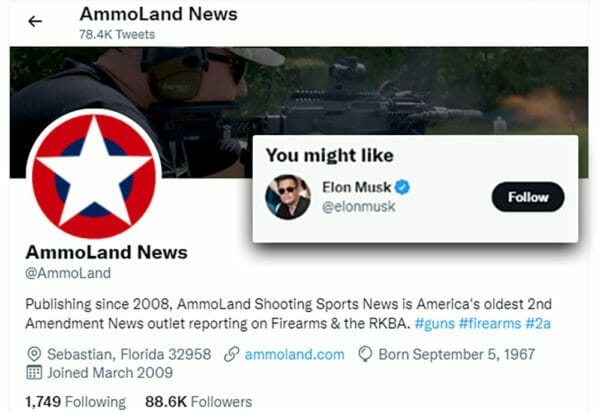
United States – -(AmmoLand.com)- Elon Musk completing the purchase of Twitter is a massive boon for Second Amendment supporters in our efforts to protect our freedoms – and our enemies know it.
Musk’s purchase of Twitter deals Silicon Valley censorship a very serious blow, one that is going to be difficult for it to recover from outside some very drastic intervention. We’ll get to that later, but for now, Second Amendment supporters now have a reasonably fair playing field thanks to the Tesla/SpaceX CEO.
In one sense, Second Amendment supporters now have the chance to show up and reach out on this site without interference from a cubicle somewhere in Silicon Valley. In another sense, they have to be careful – because Musk isn’t going to save us from our own mistakes or if we botch the fundamentals.
We’ve seen what just showing up does in some other contexts – Fox News gets better ratings than CNN and MSNBC simply by giving us a reasonably fair shake. We also can look at the lessons from the successful campaign of Glenn Youngkin in Virginia for a similar lesson.
Show up and reach out, but remember what I’ve said before and will say again: How we come across to our fellow Americans matters. The approach we take when we are making our case matters. Making sure we have our facts straight will matter because it goes to credibility. In anything, Second Amendment supporters must emphasize the fundamentals even more.
Elon Musk may be ridding Twitter of censorship, but a lot of media double standards will still be around. Those who fail in these, even if it’s an honest mistake, will make things harder, not easier, for those trying to defend the Second Amendment and could do far more damage than if they had just sat out.
That said, there is an elephant in the room – well, more accurately, Brussels – that Second Amendment supporters may have to deal with. The European Union could very well make Musk’s effort to restore Twitter to free speech a lot more difficult, to say the least, with fines for so-called “hate speech” and “misinformation” – and we have no real control over who in the EU will make those calls. Similarly, we do have the worry of companies who are told that advertising on Musk’s version of Twitter could impact so-called ESG scores.
Despite the potential threats from the EU and corporations, Second Amendment supporters have a lot to celebrate about Elon Musk’s purchase of Twitter. A fair fight on Twitter will, on balance, help Second Amendment supporters defeat anti-Second Amendment extremists via the ballot box at the federal, state, and local levels.
About Harold Hutchison
Writer Harold Hutchison has more than a dozen years of experience covering military affairs, international events, U.S. politics and Second Amendment issues. Harold was consulting senior editor at Soldier of Fortune magazine and is the author of the novel Strike Group Reagan. He has also written for the Daily Caller, National Review, Patriot Post, Strategypage.com, and other national websites.
California’s attempt to stop people from building their own firearms can move forward.
That’s the decision federal district judge George H. Wu, a George W. Bush appointee, delivered late last week. Wu determined the Second Amendment’s text does not cover the building of firearms, ruling against gun-mill maker Defense Distributed (DD) in its challenge of AB 1621. The judge argued California’s law banning the possession of unserialized firearms, as well as parts or specific tools used to make them, does not run afoul of gun-rights protections under the Supreme Court’s Bruen decision.
“Though it leads with a recognition of the primacy of Bruen’s ‘plain text’ point, DD seeks in its opening brief to jump ahead in the analysis to a historical/tradition assessment (and to jump ahead in Bruen to that decision’s discussion of how to conduct such an assessment),” Judge Wu wrote in his ruling rejecting a request for a preliminary injunction against the law. “But it has effectively attempted to avoid the necessary threshold consideration – does the ‘Second Amendment’s plain text’ cover the issue here? No, it plainly does not. AB 1621 has nothing to do with ‘keep[ing]’ or ‘bear[ing]’ arms.”
The decision presents a novel interpretation of the standard for reviewing gun laws set in New York State Rifle and Pistol Association v. Bruen, which requires judges to strike down laws that implicate Second Amendment rights unless they match a historical analogue from the founding era. Wu is among the first federal judges to grapple with the new test and possibly the first to determine the text of the amendment only covers owning and carrying guns, not making or selling them. If his approach to reading the scope of what activities are protected by the Second Amendment as relatively limited becomes influential among other judges, it could result in them upholding many modern restrictions.
Judge Wu argued Defense Distributed skipped passed the textual analysis of what the Second Amendment protects and, ultimately, undermined its case.
“Under DD’s own characterization of the Penal Code provisions introduced via AB 1621, what is at issue here is a ban on ‘self-manufacture of firearms’ and a prohibition on ‘the sale of the tools and parts necessary to complete the self-manufacturing process,’” he wrote. “Try as you might, you will not find a discussion of those concerns (or any such ‘right(s)’) in the ‘plain text’ of the Second Amendment.”
However, Defense Distributed disputed Judge Wu’s contention. Cody Wilson, the company’s founder, described the judge’s conduct in the case as “unprofessional” and “cynical.” He noted California’s law does directly implicate owning guns, not just building them.
“What’s crazy is AB 1621 in California is about keeping and bearing arms,” Wilson told The Reload. “Literally, it defines a number of things as firearms under California Penal Code, and it restricts if you can possess and transfer them.”
He said there might be more to argue about when it comes to how far Second Amendment protections extend to gun making. But he accused Judge Wu of side-stepping the core issues at play in the company’s case against California, which he said were identical to those in Bruen.
“We’ve challenged a number of sections 1621 that defined things as firearms,” Wilson said. “I didn’t choose to do it that way; the California legislature decided to say everything which can become a gun in California is a firearm that you can’t have unless it has a serial number. Well, I don’t know what else to say. There’s clearly a second amendment application to be made here and a historical inquiry to make. Maybe the secondary questions about CNC machines and the right to manufacture are more interesting at the outer bounds of Bruen or something. But a lot of what we challenge is obviously firearm regulation of the same type in Bruen.”
Judge Wu is among the only federal court judges to uphold a 21st Century gun regulation in the wake of Bruen. His ruling is in stark contrast with U.S. District Court Judge Maryellen Noreika, who blocked Delaware’s “ghost gun” ban earlier this year. Judge Wu appeared to acknowledge that his approach to Bruen differs from how other federal judges have approached the issue. However, he accused his piers of cherry-picking from Bruen to reach preferred outcomes.
“DD – and apparently certain other courts – would like to treat the Supreme Court’s Bruen opinion as a ‘word salad,’ choosing an ingredient from one side of the ‘plate’ and an entirely-separate ingredient from the other, until there is nothing left whatsoever other than an entirely-bulletproof and unrestrained Second Amendment,” Wu wrote. “That is not how precedent works; it is not even how language works (let alone salad, in most instances).”
Defense Distributed’s attempt to block SB 1327, a law that allows California to seek legal fees from plaintiffs in gun cases even when those plaintiffs prevail on some of their claims, was denied by Judge Wu. He did not examine the merits of the law, though, instead relying on California’s word they would not pursue legal fees in the DD case.
“Defendants have made clear that they ‘have informed [DD] that they will not seek attorneys’ fees or costs from [DD] or its attorneys pursuant to [Section 2 of SB 1327] in connection with this action,’” Judge Wu said. “Given Defendants’ statements in documents filed with the Court, it is almost certain that any later court considering a contrary plan would hold Defendants to their word under principles of judicial estoppel.”
Wilson believes the way California wrote the bill opens it up to broad legal scrutiny. He said he’s just concerned about finding a judge in the Ninth Circuit who will, in his view, abide by the standard set down by the Supreme Court.
“California has multiplied the number of things that are firearms that they regulate the possession and transfer of,” he said. “So, they’ve actually expanded the scope of the Second Amendment themselves. Historical analysis can now be applied to components of firearms because of California. I just can’t find, you know, an actual judge to actually apply the law right.”
Wilson said Defense Distributed is exploring an appeal against the decision.
Categories
REMEMBER

Categories