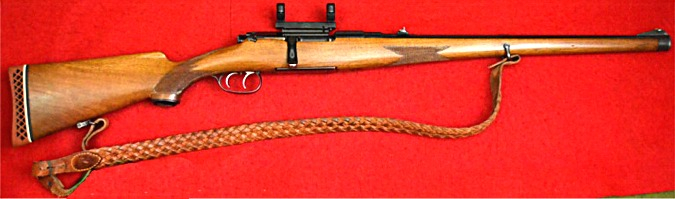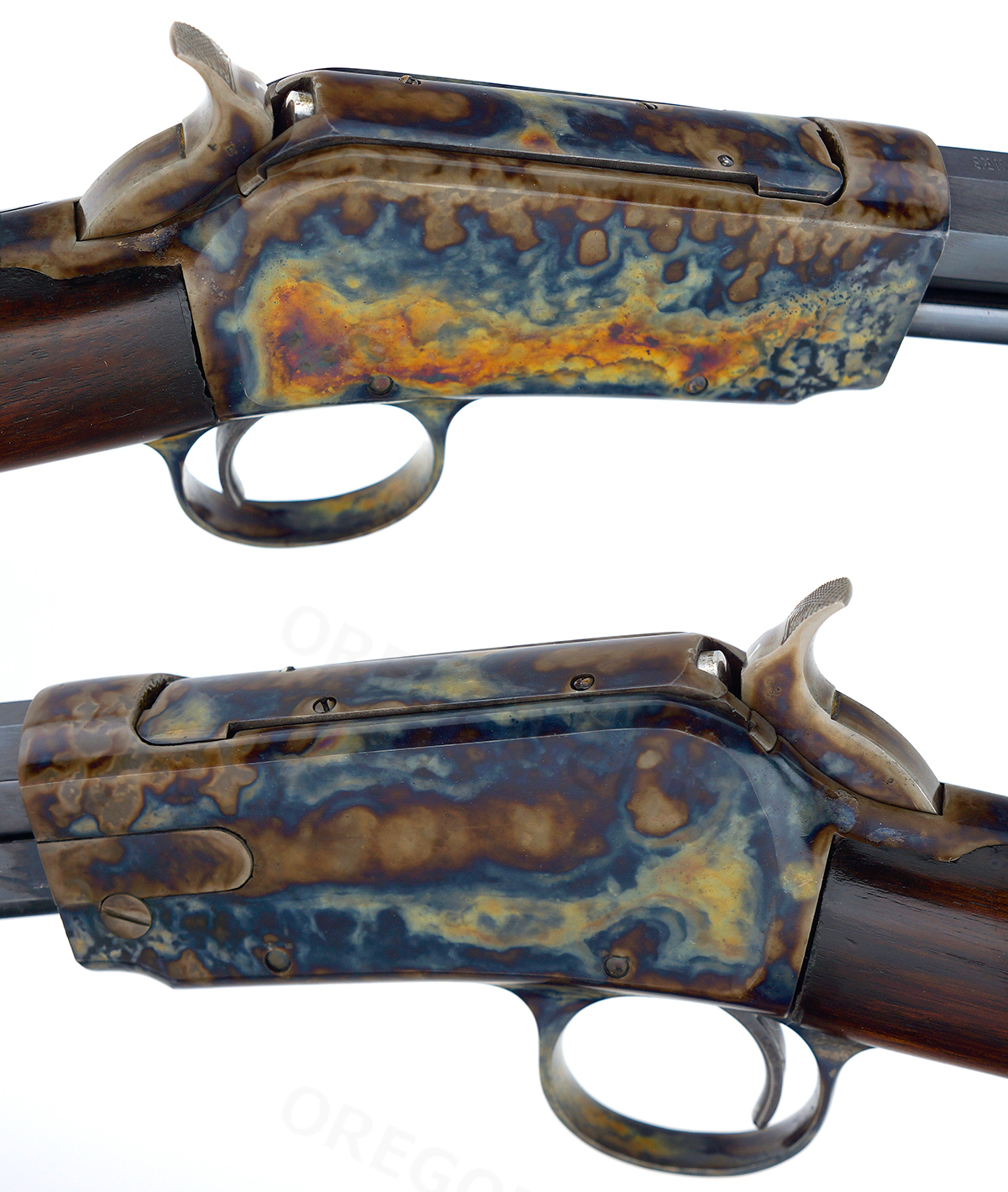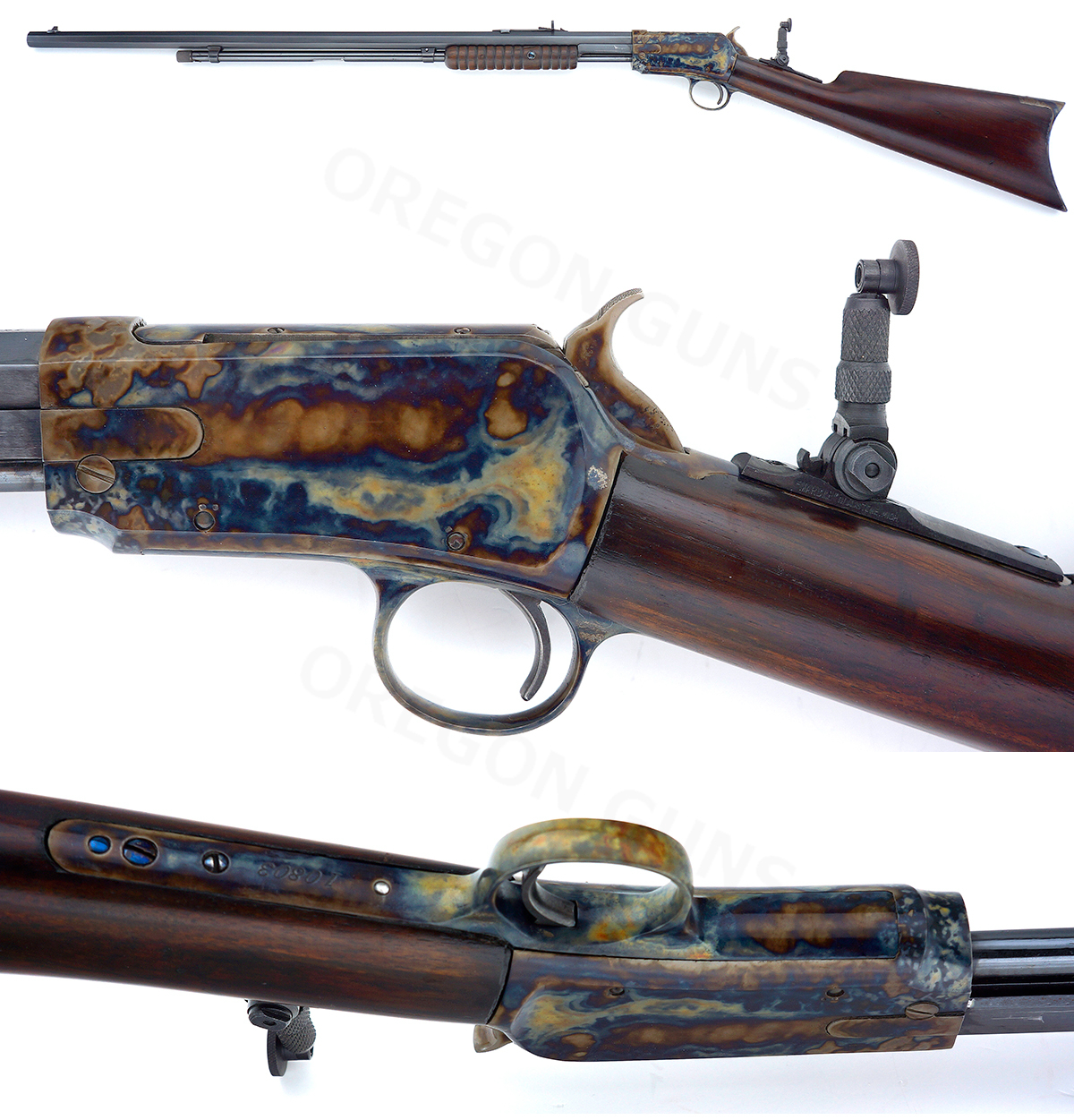
Stevens 1915 Favorite
In 1955, Bill Ruger went from his .22 Single-Six single-action revolver to a full-sized single-action with his .357 Blackhawk. Basically the same size as a Colt Single Action, the Blackhawk utilized the coil spring action of the Single-Six along with a flat-topped frame with a fully-adjustable Micro rear sight matched up with a ramp front sight on a 4-5/8″ barrel. A longer 6-1/2″ barrel was soon offered and then, very rarely, a 10″ version. They never did offer the standard Colt SAA 5-1/2″ and 7-1/2″ so I had to make my own, which I did several times over the years. The .357 Blackhawk immediately became popular with outdoorsmen and Elmer Keith reported Ruger planned to soon offer it not only in .44 Special but .45 Colt as well. As often happens, something occurred to derail “soon.” That something was the .44 Magnum’s arrival in late December 1955.
A New Revolution
At the NRA Show in 1956, Ruger displayed three .44 Magnum Blackhawks in barrel lengths of 4-5/8″, 5-1/2″ and 7-1/2″. At least in the beginning of the .44 Magnum, Bill Ruger’s prototypes were in the three standard Colt SAA barrel lengths. However, when he went to production, the standard barrel length was 6-1/2″ and very rarely were 7-1/2″ and 10″ versions offered. No 5-1/2″ versions were ever cataloged. Keith looked at the prototypes and told them the cylinder was too short to accept his loads and the frame was too small for the pressure of the .44 Magnum. He did tell Bill Ruger he would like the short-barrel version to use as a .44 Special. Bill told him to pick it up at the end of the show; however, it got packed up too quickly for this to happen and subsequently Keith was proved correct as Ruger decided to do more testing. One of those first .44 Magnum Blackhawks blew up with a proof load.
Ruger went back to the drawing board and, as Keith had suggested, increased the size of the frame and cylinder. In the process, the idea of a .44 Special on the original .357 Magnum Blackhawk died and when Ruger brought out a .45 Colt Blackhawk in 1970, the .44 Magnum-sized frame was used. It would be over a half-century before a .44 Special Ruger Blackhawk arrived.
In 2005 Ruger brought out the 50th Anniversary Model of the .357 Blackhawk. Since the .357 has been on the larger frame since 1972, it would have been quite easy for Ruger simply to use this for the special occasion. I’m certainly glad they did not. Instead, Ruger went retro and the Anniversary Model, although it is built with the New Model transfer-bar action, is otherwise a dead ringer for the original .357 Blackhawk.
It is not only the same size as the 1955 Blackhawk, it also went back to the original Colt Single Action grip frame, known as the XR3 frame, which had been lost with the “improved” XR3-RED grip frame. This frame arrived with the change to the Old Model Blackhawk in 1962. Now finally, the stage was set for a Colt SAA-sized Ruger .44 Special. I talked to the then-president of Ruger about this and he didn’t say yes but he also did not say no.
Take The Long Way
It finally did happen but in a slightly roundabout way, thanks to Lipsey’s. Ruger actually began doing what they had intended to do more than 50 years earlier. The .44 Special Flat-Top New Model Blackhawk was first offered in an all-blued steel sixgun with the choice of 4-5/8″ or 5-1/2″ barrel lengths. Just before the 2009 SHOT Show, Jason Cloessner of Lipsey’s called to inform me they would be offering a special run of Rugers. In itself this is not unusual as Lipsey’s is a distributor that has offered many special editions of several firearms manufacturers over the years.
But this one was special; make that really special. Jason had called to thank me for doing everything I could to keep the .44 Special alive and more importantly, to let me know one of my very special “Special” dreams have come true. Ruger through Lipsey’s would be producing and offering 2,000 .44 Special Flat-Top Blackhawks in 2009. The .44 Special has been a sixgun connoisseur’s cartridge for well over a century and even today some sixgunners still say, “Why a .44 Special when the .44 Magnum is available?” Only those whose heart is in tune really understand.
In the 1950s and 1960s, Ruger offered not only the .357 and .44 Magnum Blackhawks, they also offered .41 Magnum and then later in the early 1970s, the .45 Colt. None of these were ever cataloged with a 5-1/2″ barrel and the latter was the only one offered routinely with a 7-1/2″ barrel length. The original .45 Colt Blackhawk Old Model was only in production from 1970 to 1973 with a total output of just over 23,000 units.
In 1973 all Ruger Blackhawks were changed to the New Model. The New Model replaced the three screws on the side of the frame with two pins and a transfer bar safety was added to the action. There was now a piece of steel between the hammer and the firing pin preventing any negligent discharge. The advent of the New Model action was a great step forward for single-action safety. There are several gunsmiths who can tune a New Model Ruger Blackhawk to absolute perfection.
Handy, Hands Down
It has been more than 65 years since I purchased my first Ruger Single Action and many more have been added over these all too quickly passing years. A few years back, I set about the task of coming up with 5-1/2″ Compromise Ruger Single Actions. All four of the original chamberings, .357 and .44 Magnum, .41 Magnum and .45 Colt, were used to build this handiest of single actions.
To come up with the .44 Special, I went in two directions. Custom Gunsmith Ben Forkin built several for me using both Ruger .44 Magnum and Colt .44 Special New Frontier barrels on the original-sized crane. All of these were finished with case colored frames and hammers. Ruger liked the idea of a .44 Special New Model Flat-Top so well they became a catalog offering. I also have .44 Specials in both blue and stainless steel finishes.
Lipsey’s and Ruger did not stop there and we soon had a Convertible New Model Flat-Top Blackhawk. Not only is the 5-1/2″ offered in both blue and stainless versions, but with two cylinders, one in .45 Colt and the other in .45 ACP. It could easily be argued that this is the most versatile of Ruger Perfect Packin’ Pistols.
When we try to shoot shorter cartridges in the longer cylinders such as .38 Special and .357 Magnum, we never know how good the results will be until we try. The old .44 Magnum Flat-Top Blackhawk I had cut back to 5-1/2″ also handles .44 Special superbly. Add in the abovementioned 45 Colt/.45 ACP and I have 10 cartridge options in 5-1/2″ sixguns. There is nothing that cannot be handled with one of the choices.

NASHVILLE, Tenn. (AP) — Public housing agencies in Tennessee can no longer include provisions in their leases that bar tenants from having guns in their homes, a state appeals panel has ruled.
A three-judge panel of the Tennessee Court of Appeals made the unanimous decision Thursday, saying that the prohibitions in public housing violate the 2nd Amendment rights of its residents.
In the ruling, the judges cited a prominent U.S. Supreme Court decision from June that expanded gun rights, while striking down a New York law requiring people to demonstrate a particular need for carrying a gun in order to get a license to carry a gun in a concealed way in public.
The Tennessee decision could set up an appeal to the state Supreme Court, which has a majority appointed by Republican governors.
The case centers on a lawsuit by Kinsley Braden, who signed a lease agreement with Columbia Housing & Redevelopment Corporation in April 2018 that barred him from having a gun on the premises.
In November 2020, housing officials sought to evict Braden when they found out he had been keeping a handgun in his residence at the Creekside Acres low-income housing complex. Lower court judges ruled in favor of Columbia Housing in the initial case and an appeal, then Braden sought another review, the ruling states.
In the latest decision, Judge Frank Clement wrote that “a total ban on the ability of law-abiding residents — like Mr. Braden — to possess a handgun within their public housing unit for the purpose of self-defense is unconstitutional under the Second Amendment.”
The ruling reasoned that public housing is not similar to other types of “sensitive” government buildings where guns can be banned, including statehouses, polling places and courthouses.
Clement also acknowledged that it is “largely unsettled whether public housing developments could constitutionally prohibit firearm possession under both the Second Amendment to the United States Constitution and nearly identical provisions of certain state constitutions.” He wrote that states have come to different conclusions on whether such bans are allowed.
New York City’s first-of-its-kind gun crime unit at the Office of the Chief Medical Examiner will begin work Monday and focus on testing an analysis of evidence from gun crimes, in order to speed up those cases.
NEW YORK – Beginning Monday, the New York City Medical Examiner’s Office is launching its new DNA Gun Crimes Unit.
Meant to help speed up both testing and the criminal justice process, the forensic lab is the first of its kind in the country dedicated exclusively to processing gun crimes.
“As far as gun cases, we handle over six thousand cases,” said Senior Forensic Scientist Gabrielle McKenzie.
That’s six thousand gun cases a year in New York City. Now, the city Medical Examiner’s Office has a gun crime unit that will be staffed with 24 forensic scientists.
Although overall index crime in New York City was up, murders and shooters were down in September 2022 compared to September 2021. But the top brass said a few people are committing the vast majority of the crimes, which they say highlights the problem of recidivism.
What makes the lab new is that scientists working there are strictly devoted to processing and analyzing DNA found on guns, rather than fingerprints.
The team will get faster results for the NYPD, prosecutors as well as defense lawyers who represent accused shooters.
“We, in building this unit, are going to reduce our turnaround time in gun crimes cases from 60 days to less than 30 days and that’s revolutionary,” said Dr. Jason Graham, the city’s Chief Medical Examiner.
The unit has been created to help deal with the city’s gun crisis and is independently run by scientists.
Providing the criminal justice system with DNA results more quickly helps both the guilty and the innocent.
“That would lead to either a faster more efficient exoneration of someone who’s innocent and a speedier conviction of someone who’s guilty and maybe a threat to New Yorkers on the street,” Dr. Graham said.
“We will help to resolve a lot of crimes, and we will help get justice to people who need it,” said Vanessa Sutherland, one of the new forensic scientists on the team.
The new gun unit will officially begin its work on Monday, October 17.
If you were forced to defend yourself, would you want a .45 in your hand? How about one with 11 or more rounds in a concealable, yet utterly reliable, package? I know a lot of people, including myself, would feel very comfortable with a gun like that.

Springfield Armory offers just such a gun. Called the XD 4” Compact, the handgun is chambered in .45 ACP and will feed from 10- and 13-round magazines. It’s downsized from a full-size for ease of concealment and affordably priced. Interested? I was and recently got one to check out for myself.
The bonus for my friends in California is that this potent pistol is available to you as well.
Overview of the XD-45 Compact
For a lot of shooters, the .45 is as American as mom and apple pie. It’s not hard to figure out why – the cartridge carried the country through two World Wars, fought off Pancho Villa’s criminals along the Southern Border, loaded the Tommy guns of G-Men and protected tunnel rats in Vietnam. For us regular folk, the same cartridge proved to be an effective self-defense round when defending the homestead or the family.

While the .45 and Springfield Armory are both associated with the 1911 platform, both the cartridge and the company offer an alternative in the XD line. It’s an alternative with some real benefits, also.
The XD-45 4” Compact is a smaller version of the Service Model. While both guns share the same length slide and barrel, the Compact pistol chops the grip by 0.75” to dramatically improve concealability. If you think about how you carry a concealed pistol, the overall height can impact printing much more than the length of the gun. Slicing off almost an inch from the grip dramatically reduces problems from printing.

Even with the shorter grip, I’m able to get a solid two-handed grip on the pistol without any problem. My hands are medium-sized, and I had plenty of gripping space. I imagine that better than 99% of people will have plenty of frame to achieve a solid firing grip on the gun.
XD-45 Compact Features
In addition to the chambering and reduced footprint, what other features does the XD-45 4” Compact sport?
To start with, this XD-45 is tough. In addition to the proven ruggedness of the high-strength polymer frame, both the slide and barrel are made of forged steel. Moreover, Springfield Armory finished the barrel and slide using the Melonite process for extreme corrosion and wear resistance. I own several pistols with a Melonite finish and all of them look great after years of service.

Springfield installs three-dot sights on this pistol. The sights are steel and the rear sight has a flat edge for emergency slide manipulation. Many shooters prefer this sight configuration. I find three-dot sights functional, but I much prefer the U-Dot sights like those found on the Hellcat. Fortunately, the sights on the XD 4” Compact are dovetailed into place. If you want to swap them out, replacement is simple work.
Springfield backs the XD-45 Compact .45 with a warranty that covers the original purchaser from any defects in workmanship or material. I’m not a legal scholar, but it seems to me that Springfield intends to take care of you should the gun give you problems – short of user abuse, of course. Sam Weitzner did a great review of the Springfield Armory warranty. I recommend giving it a look.
Low Cap or Just California Friendly?
If you take a look at the Springfield Armory website, you will see this pistol described as “Low Capacity.” What does that mean? Put simply, it means the company did not abandon the citizens of California and other states that limit how many rounds can be carried in a magazine.

The XD 4” Compact .45 ACP handgun ships with two 10-round magazines that fit flush with the end of the magazine well. Frankly, this is the magazine I choose to carry in the pistol even though I can purchase the extended 13-round magazines here in Florida. I simply prefer the improved concealability.
Nevertheless, California residents can purchase this gun as Springfield Armory was able to get the pistol on the dubious Roster of Certified Handguns. While many consider the California list to be unconstitutional, it is what California’s residents are currently saddled with. And the Springfield XD-45 4” Compact in .45 ACP is listed on it so citizens can buy the gun – something many guns from other companies cannot claim.

I appreciate Springfield’s continued support of firearms owners in California – especially since the gun is both potent and remains available to the rest of us around the U.S. without any problems.
Specifications
Here are the factory specs on the Springfield XD-45 4” Compact .45 ACP pistol:
| Chambering | .45 ACP |
| Barrel | 4” |
| Weight | 29 oz. |
| Overall Length | 7.3” |
| Sights | Dovetailed three-dot |
| Grips | Integral polymer |
| Action | Striker-fired |
| Finish | Black: Melonite slide, polymer frame |
| Capacity | 10+1 (13-round magazines available) |
| MSRP | $573 |
Range Testing
One of the hurdles I have to overcome as a writer is devising engaging ways to describe the total, if not downright boring, reliability of the XD pistols. Every XD pistol I own or have tested has been completely reliable.

I shoot my guns a lot – and polymer-framed, striker-fired pistols tend to be reliable. They are certainly a major improvement over prior generations of guns from all manufacturers. The XD line is a perfect example of how reliable modern pistols can be.
Nevertheless, all guns can fail and should be thoroughly tested on the range prior to carry. That’s exactly what I did with the XD-45 4” Compact .45. With more than 500 rounds of ammo, I headed to the range to give the gun a workout.

As expected, the XD-45 Compact .45 ACP delivered wholly reliable performance. With full metal jacket (FMJ) and jacketed hollowpoint (JHP) loads, the ammo fed, shot and ejected as expected. Neither standard nor high-pressure rounds caused any issues.
Scary Moment
While testing the gun, I had a brief scare that seemed to prove the strength of this XD pistol. I loaded a magazine of JHP ammo from an overseas manufacturer. When I shot the first round, I felt recoil that was substantially greater than any other .45 ACP round I’ve fired. Additionally, the muzzle blast and visible fire ring were incredibly intense.
My chronograph measured the 185-gr. JHP round at more than 4,000 fps. If that seems impossible, I agree. I suspect that the device mismeasured due to unburned powder, the flash or some other interference.

Given the fact that a federal judge has already said that many portions of New York’s ironically named Concealed Carry Improvement Act are likely unconstitutional, are California lawmakers really ready to double down and approve similar restrictions in the Golden State? Unfortunately, the answer is “yes,” though California Attorney General Rob Bonta suggested in an interview this week that the California legislation could be tweaked in response to the New York case. One thing is clear, however: Bonta and other anti-gun Democrats are still intent on restricting the right to carry as much as they possibly can.
Bonta said his sense of urgency remains as acute as ever.
“There will be, and there have been huge spikes in the number of applicants,” he said. “We believe that it’s important to have a constitutional regime that allows for those who should constitutionally have a concealed carry weapon to have (one), but to take the steps to make sure that we are doing everything constitutionally permissible to keep people safe.”
“Keep people safe,” in Bonta’s view, means prohibiting concealed carry holders from actually carrying in most circumstances and ensuring stiff sentences and severe consequences for those concealed carry holders who may stray into one of the many “gun-free zones” Bonta and his anti-gun allies want to put in place. And even if the courts don’t look kindly on New York’s newest infringements on the Second Amendment, California’s AG is intent on putting new laws on the books.
Bonta echoed comments made by the bill’s author, state Sen. Anthony Portantino, a Glendale Democrat, who said that he would like to see the bill, or some version of it, introduced as soon as the next session begins in December.
That plan hit a possible speed bump late last month. Where California’s bill failed, a similar proposal in New York was signed into law, only for a federal judge to rule this month that its long list of “sensitive places” is unconstitutional.
“So we need to look at that, and maybe it is over-broad,” Bonta said, “and we should take that to heart…and respond appropriately with any new (similar) bill.”
Bonta was also asked about California’s new law that, in part, forces plaintiffs challenging any state-level gun control law to pay attorneys fees if they lose any portion of their lawsuit; a law enacted as a response to a Texas law allowing private citizens to sue abortion providers in the state. The California AG seemed to realize just how stupid this culture war fight really is, calling the move a “dangerous game” but claiming that somehow it’s okay when California does it.
Bonta insisted that the law is an earnest effort to “save lives,” but also acknowledged that it was meant to call the high court’s bluff.
“We’re using it in the best way that it can be used, in a way that advances California values,” he said. “But it’s dangerous. It’s a dangerous game. We’re using it responsibly. Now others can use it like Texas, and maybe the Supreme Court will look at the landscape of how this approach is being used and try to correct it. If that happens, that’s fine, too.”
Not exactly a stirring defense of the California law in question, is it? I’m sure the Second Amendment groups that are challenging the law in court will find Bonta’s comments very interesting, especially since it seems like Bonta’s basically asking the Supreme Court to step in and invalidate both the Texas and California statutes.
While Bonta might not be too eager to defend this particular law in court, he’s very much a willing participant in California Democrats’ attempt to chill the Second Amendment rights of Californians. Bonta can chalk that up to “advancing California values,” but to those trying to exercise their right to keep and bear arms Bonta’s efforts look a lot more like treading all over a fundamental right of we the people.