 She was & is one of my all time favorite Actresses. From The Avengers to her final performance in Game of Thrones. She was smart, classy and tough as nails. I will miss her! Grumpy

Hands down, the .45 Colt is my favorite handgun cartridge. You know this! Sure, I love other cartridges too, fickle as I am, but .45 caliber cartridges just grab my attention, mainly because of the way they grab the attention of anything shot with them. The “grand” father of .45 caliber metallic cartridges, the .45 Colt, started many love affairs with sixgunners, including me. We’re going to discuss how to make your .45 shooters more versatile, by shooting .45 ACP and/or .45 Auto Rim. Pretty nifty in a .45 caliber kind of way, eh?

Here’s Tank’s Ruger Redhawk. You can see the slight machining on his cylinder,
allowing the use of moon clipped .45 ACPs from TC Custom. Other feeding utensils
include a speed strip and speed loader with .45 Colt ammo.
Ruger’s Redhawk
I love my Ruger Redhawks almost as much as my Ruger single actions (SA) but love them I do. Double-Action (DA) advantages? They allow the use of speed loaders during hot tactical reloads, and of course double-action shooting, which is simply pressing the trigger as smooth and fast as possible. For precision work, you can cock your hammer and shoot SA, if it works for you. Pretty handy, I’d say.
I have a 4″ Redhawk originally chambered in .45 Colt. Wanting to make it more versatile, I had TC Customs alter the cylinder so I can shoot moon clipped .45 ACPs in my gun. I love the added ability of shooting more efficient .45 ACPs, while still being able to shoot heavy .45 Colt handloads. TC Custom simply mills the breech side of your cylinder a few thousandths to allow your moon clipped .45 ACPs to chamber in your cylinder.
Better yet, you only need to send your cylinder for the alteration, not your whole gun. TC even has videos on their website showing how easy removing your cylinder is. You can alter your S&W .45 Colt too, making it more versatile with moon clip .45 ACPs.
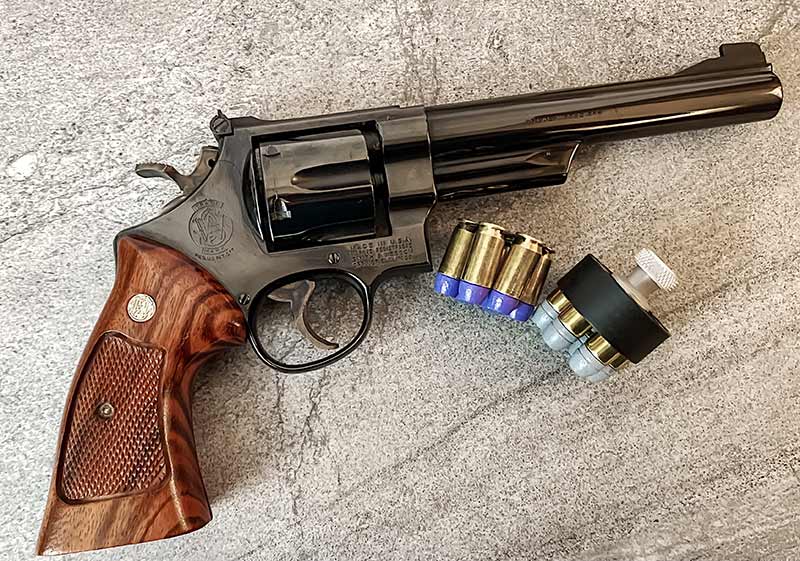
The S&W Model 25 shoots both moon clipped .45 ACPs and .45 AR splendidly!
S&W Model 25
You have two options for feeding your .45ACP wheelgun. Obviously, .45 ACP is the first, utilizing moon clips, or you can skip the “moonies” and use .45 Auto Rim (AR) brass, which is simply .45 ACP brass with a rim, so cases will extract when you pound your ejector rod. Moon clipped .45 ACPs will drop right in your cylinder, and you can use either a speed strip, or speed loader, with the .45 AR.

Comparison of moon clip and speed loader for size. Both work wonderfully.
Ruger Blackhawk .45 Colt/ACP Dual
Single actions chambered in .45 Colt sometimes come with auxiliary cylinders in .45 ACP, allowing you to swap cylinders, depending on what caliber you feel like shooting that particular day. But you need to swap cylinders to do it. You’d think our friend, the .45 AR, would be perfect for the .45 Colt cylinder, but you’d be WRONG. The .45AR will not fit in a .45 Colt single action cylinder! The rim is too thick! It’s too thick for the .45 ACP cylinder also.
If you wanted, you could have your .45 ACP cylinder milled, allowing the .45 AR, and it would also be able to shoot .45 ACP, since it headspaces on the rim. I just might do this alteration to allow full versatility with my .45 Colt/ACP dual’s one day.
When using your .45 ACP cylinder, a convenient way of carrying and loading your SA is to borrow your 1911’s magazine and feed your gun straight from the magazine. You and your gun will love it!

Hard to beat a dual cylindered sixgun for versatility. Chambered for both .45 Colt
and .45 ACP, you can handle many of your shooting needs confidently.
Loadin’ Moon Clips
TC Custom makes the slickest nutcracker type tool for loading your moon clips. You can load while watching TV or enjoying a beautiful day on your deck. Some hate those clips, but being a tinkering kind of guy, I like ’em! I even like removing spent brass from those thumb-cuttin’ SOBs, as long as I have the right tool. Yup, TC Custom makes those too and they’re a joy to use. I give them two “cut-free” thumbs up!
Keeping The .45 Alive
To keep anything alive, it needs to be fed. I hope I showed you a few different ways of feeding your .45 wheelguns, whichever one you have. After all, everyone enjoys a varied diet, and guns are no different.
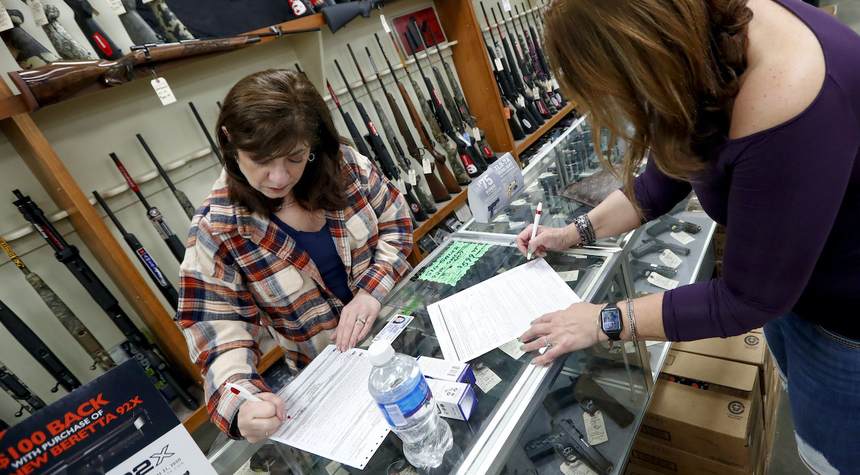
The NSSF estimates based on numbers from the National Instant Check System that 1,265,311 firearms were sold at retail last month. That’s a decline of 11.3% compared to October 2021, but it’s also the third highest number ever reported for October sales, trailing only 2020 and last year. A closer look at the data going back to the year 2000 shows that while sales are off of their two-year highs they’re still far above the levels we saw between 2000 and 2012.

NSSF director of public affairs Mark Oliva says the NICS figures “continue to reflect a steady interest by law-abiding Americans to exercise their God-given Second Amendment rights,” adding that “despite the claims of some elected officials that crime is not a national concern, these figures reflect the true sentiment of America. These gun owners are choosing to protect themselves.”
Despite the best efforts of anti-gun activists, I might add. On Tuesday, voters in Oregon will have the chance to weigh in on a ballot measure that would create a “permit-to-purchase” system for all handguns; one that would allow law enforcement to deny someone the ability to buy or possess a pistol even if they’re able to pass a federal background check. San Jose, California’s city council wants all gun owners to pay a fee to own a gun as well as shell out the money for an insurance policy before they can legally possess a gun inside the city limits. And in towns across the country anti-gun activists are trying to block gun stores from opening, explicitly trying to interfere with an individual’s ability to exercise a fundamental constitutional right.
Those are just a few examples of a much broader attempt to curtail our Second Amendment rights through legislation, regulation, and even cultural indoctrination, and yet month after month we’re seeing hundreds of thousands of Americans embrace those rights; many for the first time in their lives. Michelle McGhee is one of those folks. The Arkansas teacher bought her first gun two years ago, and recently spoke to NPR’s Scott Simon about her decision.
MCGHEE: I originally bought a gun – I was recently divorced and a single mom to a 17-year-old. And I wanted it for peace of mind and protection for my family. And also, I live in the rural area of Arkansas, and I travel quite a bit where there is not always phone service or cell towers. That was the main reason why I purchased my first one.
…
SIMON: Michelle McGhee, would you rely on the police if something – God forbid, some kind of terrible shooting broke out into your school?
MCGHEE: I think I would want to be proactive. I would also support doing anything that we needed to do to keep our kids safe and our colleagues and our faculty safe until police can arrive. If there is a – you know, a well-trained staff member who volunteers and would want to carry and our board supported that, then I would be I would be for that.
SIMON: Do you – and if you don’t want to answer, I am prepared. Do you bring your gun to school?
MCGHEE: I actually do not. I live in town. I’m about four minutes from my house to the school building. So it’s a straight shot. So I do not carry mine. But if the board approved and I decided that that’s a responsibility that I wanted to take on and if I went through proper training, I don’t think I would hesitate.
Personally, I’m glad that someone like McGhee is a gun owner, but I know that gun control activists don’t feel the same way. According to them we have too many guns and too many gun owners, and the only way to protect the public from violent criminals is to prevent people like Michelle from being able to protect herself.
Americans have been voting with their wallets, and on Tuesday I have a feeling we’re going to see that same energy directed at the ballot box. Gun control activists are already trying to provide a pre-election spin on what could be a disastrous evening for their movement, proclaiming that it’s now “safe” for Democrats to tout their support for gun control because public polling shows Americans want more gun laws. That argument flies in the face of the latest poll out of Oregon, however, which shows majority opposition to the magazine ban and permit-to-purchase system that’s on the ballot. As it turns out, the more voters get to know the devil in the gun control details, the less likely they are to back supposedly innocuous “gun safety” proposals. And of course, the more gun owners there are, the more likely they are to care about these issues. A million guns sold every month doesn’t translate into a million new Second Amendment advocates every four weeks, of course, but there’s a sizable number of voters who’ve become personally invested in protecting the right to keep and bear arms and I think their presence will be felt in the midterms.

Petty Officer Michael Thornton was a highly decorated career Navy SEAL who distinguished himself in combat in Vietnam.
Michael Thornton was born in 1949 in South Carolina. He graduated from high school in 1966 and immediately enlisted in the US Navy.

SEAL training is legendarily grueling.
In 1968 Thornton was one of sixteen BUD/S (Basic Underwater Demolition/SEAL) graduates out of a starting class of 129.

The fictional war hero John Rambo had nothing on real-world Navy SEAL Mike Thornton.
Four years later on a bullet-swept beach in North Vietnam, Petty Officer Thornton made John Rambo look like a Sunday School teacher.

Naval Special Warfare soldiers were still pulling covert missions at the very end of the war in Vietnam. Mike Thornton is in the center. Note the blue jeans.
The war in Vietnam was winding down, and Michael Thornton was one of only a dozen Navy SEALs remaining in the country. On October 31, 1972, Thornton formed a team along with a SEAL officer named Thomas Norris and three South Vietnamese Special Forces operators.

Vietnam-era Navy SEALs were masters of unconventional warfare.
Their mission was to gather intelligence and capture prisoners for interrogation from the Cua Viet Naval Base north of Quang Tri. Thornton had worked with his three South Vietnamese counterparts before and trusted them as brothers.

SEAL stands for Sea/Air/Land. Waterborne insertions are their specialty.
The plan was to insert via rubber boat launched from a South Vietnamese junk. At dusk, they launched their small boat and then swam the last mile to reach their objective. In the darkness, they found that they had made a navigation error and landed well within North Vietnam. Advancing inland past numerous enemy positions they simply continued the mission.

Though the mission was a quiet reconnaissance and prisoner snatch, Thornton’s SEAL detachment was loaded for bear.
Their intelligence gathering complete, the small Naval Special Warfare team encountered a pair of North Vietnamese soldiers patrolling on the beach and attempted to capture them. When this operation went awry one of the NVA troops escaped and ran toward the jungle to alert his comrades. Thornton gave chase and was forced to shoot the man with a handgun, drawing the attention of some fifty NVA regulars located nearby. The result was a simply epic firefight.

Aggressive fire and maneuver kept the enemy confused concerning the size of Thornton’s small unit. The effective use of LAW (Light Antitank Weapon) rockets by the South Vietnamese SEALs helped slow down the attacking NVA troops.
Thornton picked up a load of shrapnel in his back from an NVA grenade early on but kept on fighting. The five allied warriors fired and moved constantly to keep the attacking NVA troops confused about the modest size of their small detachment.
Thornton attempted to call in friendly naval gunfire from American destroyers offshore but return fire from NVA shore batteries pushed the warships out of range. Over the next four hours, the five frogmen kept around 150 enemy troops at bay. With the coming dawn, however, things began to look bleak.

Only courage and implacable force of will got Mike Thornton and his team off that hostile beach.
The five sailors charged toward the water’s edge with Thornton in the lead and Norris taking up the rear. In the process, the unit commander took a round to the head and was presumed dead. When one of the South Vietnamese operators informed Thornton he ran back through blistering NVA fire to recover the body of his fallen friend. He arrived to find four NVA soldiers gathered around Norris’ inert form and killed them all.
As he lifted the limp man to his shoulders he observed that the whole side of his head seemed to be missing. Norris was, however, still breathing.

Thornton killed several of the pursuing NVA soldiers by firing his CAR15 assault rifle one-handed while carrying his severely injured commander to the water’s edge.
Running four hundred yards under fire carrying Norris on his shoulders, Thornton still managed to effectively engage the attacking NVA soldiers by firing his CAR15 assault rifle one-handed.

Mike Thornton’s extraordinary feat of heroism is memorialized in bronze outside the Navy UDT/SEAL Museum in Fort Pierce, Florida. Mike Thornton is on the left. Tommy Norris is on the right.
Tom Norris had previously called naval gunfire in on his position from a nearby heavy cruiser requesting a five-minute delay on the fire mission. When he was struck in the head and immobilized the timeline for the extraction fell apart. The supporting cruiser ultimately fired 104 five-inch high explosive rounds onto the beach.
When Naval gunfire support finally impacted, the two SEALs were blown fully twenty feet into the air. Petty Officer Thornton regained his senses, again hefted his buddy, and charged for the ocean. Once at the water’s edge Thornton found that one of his South Vietnamese comrades had been shot through the buttocks and was unable to swim.

Mike Thornton was not the sort of man to quit just because he was peppered with shrapnel and abandoned on a hostile Vietnamese beach.
Shoving both the severely wounded Norris and the South Vietnamese soldier into the surf, Thornton dragged them both out into open water. Once out of small arms range, Thornton bandaged Norris’ head wound as best he could. He subsequently trod water, keeping himself and his two injured comrades afloat for another three hours. The supporting vessels had presumed the patrol lost and retreated to safety.

Tommy Norris had an AK47 strapped to his body as Mike Thornton carried him into the surf. Thornton used this weapon to alert friendly troops in a South Vietnamese junk.
One of the South Vietnamese frogmen was eventually picked up by a friendly junk and reported both Americans killed. In desperation, Thornton fired Norris’ AK47 into the air and got the attention of an American SEAL onboard. Once taken aboard the South Vietnamese junk, the team was transported to the USS Newport News, the heavy cruiser that had recently fired in support of their extraction.

The heavy cruiser USS Newport News provided fire support to the beleaguered SEAL detachment. Surgeons onboard the vessel were the first to treat injured SEAL Thomas Norris.
Mike Thornton personally carried his friend Tom Norris into the big warship’s operating room only to be told that the severely injured man was beyond saving. Thornton insisted that the surgeon try his best regardless.

Mike Thornton was awarded the Medal of Honor roughly one year after his actions that saved his fellow operators.
A year later Michael Thornton was presented with the Medal of Honor by President Richard Nixon.

Thornton went on to a long and distinguished career in US Navy Special Operations.
Mike Thornton eventually served as an instructor at the BUD/S course in Coronado. He also did an exchange program with the elite British Special Boat Squadron and became a founding member of SEAL Team Six. Thornton was eventually commissioned and left the Navy as a Lieutenant in 1992.

Mike Thornton saved Tommy Norris’ life in 1972 on a beach in North Vietnam.
Tom Norris’ story did not end in the operating room of the Newport News in 1972. He survived his ordeal after a nineteen-hour emergency surgery. Multiple surgical procedures and many months of hospitalization later he was medically discharged from the Navy.

Tom Norris went on to complete training at the FBI academy despite the grievous nature of his injuries.
Not satisfied with medical retirement Norris applied for and received a waiver to attend the FBI academy at Quantico, Virginia. He went on to serve twenty years as a special agent in the FBI.

Tom Norris was eventually awarded the Medal of Honor for his actions on a previous mission. The details of his exploits were memorialized in the movie BAT21.
Tom Norris was himself awarded the Medal of Honor for an extraordinary mission to rescue downed American pilots some six months prior to his wounding on that North Vietnamese beach. His exploits were immortalized in the book and movie BAT21. Thornton and Norris were two of only three Navy SEALs to be awarded the Medal of Honor during the Vietnam War. Norris’s MOH mission was incredible in its own right and will likely be the focus of our efforts at some point in the future.
The Guns

Vietnam-era Navy SEALs carried a variety of unconventional weapons. Note the Stoner Light Machine Guns and AK 47 rifles in this team photo.
Vietnam-era Navy SEALs had great latitude in selecting their personal weapons.

Navy SEALs in Vietnam occasionally obtained their weapons from some unconventional sources.
A good friend who served as a SEAL in Vietnam in 1970 carried an M14, a Colt 1911A1, and a Browning pump 12-gauge shotgun stoked with buckshot whenever he went downrange. The shotgun carried a total of nine rounds onboard and was the product of a particularly successful night of poker soon after he arrived in the country. He cut the wooden buttstock down into a pistol grip and slung the gun over his shoulder on a makeshift single point sling.

The SEAL on the right is packing a Stoner 63 LMG. The one on the left has a highly modified M60 machine gun.
While the Stoner 63 light machinegun was a SEAL favorite, Michael Thornton carried a COLT CAR15 during his MOH mission.

The technical designation for the CAR15 was the XM177E2 Colt Commando. Issued with two slightly different barrel lengths, this stubby little carbine eventually evolved into today’s M4.
This compact carbine was a shortened version of the standard M16A1 that armed most of the conventional troops deployed during the war.

The CAR15 was popular for its modest weight and fast handling characteristics.
Sporting either a 10 or 11.5-inch barrel, a telescoping aluminum stock, and a sound moderator, the 5.56mm CAR15 was popular among aircrews, dog handlers, and Special Forces troops. By the end of the war, there were only about one thousand 30-round magazines available for these weapons in Vietnam. Special operators like Navy SEALs typically got first dibs.

The AK47 saw its first widespread use against American forces during the Vietnam War. American soldiers developed a healthy respect for the gun’s extraordinary reliability and exceptional firepower.
Tom Norris carried a captured AK47 during this mission. Special Forces troops frequently employed enemy weapons on clandestine operations. This practice would minimize the possibility of hostile troops distinguishing them by the sound of their gunfire. The AK47 was a rugged and effective assault rifle that was readily available in the latter stages of the war.

Mikhail Kalashnikov developed the most widely distributed combat rifle in human history as he recovered from wounds incurred fighting the Germans on the Eastern Front during World War 2.
Mikhail Timofeyevich Kalashnikov developed the gun that would become the AK47 during the waning months of the Second World War. Firing a true intermediate 7.62x39mm cartridge via an unnaturally reliable long-stroke gas-operated system, the AK47 found its way into the hands of communist soldiers and insurgents around the globe. With more than 100 million of these tough guns in service, these weapons will be found anyplace men kill each other for untold generations to come.
Denouement

Mike Thornton’s dedication to country, mission, and teammates was awe-inspiring. He is shown here along with Tommy Norris, the SEAL whose life he saved during his MOH operation. If that picture doesn’t move you then something about you is broken.
Michael Thornton’s superhuman display of courage and stamina eclipses anything depicted in a Hollywood epic. That the man he rescued did himself earn the Medal of Honor on an unrelated mission simply speaks to the caliber of the warriors that served with the US Navy SEALs during the protracted war in Southeast Asia.

Mike Thornton is a legendary American hero.
While the causes and prosecution of the war in Vietnam are certainly open for debate, none could dispute that Michael Thornton’s actions on that dark Vietnamese beach were the stuff of legend. Mike Thornton was and is a true American hero.

Navy SEALs in Vietnam pioneered unconventional warfare in an asymmetric battlefield.
Categories
This could really mess up your day for sure!
Categories
Trench Battle WW2
Categories