Categories
Winchester model 42
.JPG)

Dawn broke crisply over the high elevation desert, chasing night’s shadow across sagebrush draws and sandstone outcroppings. A small brushy flat wrapped over the rim of a nearby canyon, fingers of sunshine just beginning to feel their way between sage and scrub oak. Sweeping the flat with my field glasses, I spotted a big buck, antlers towering above the sage. I ranged the distance, dialed my turret and settled in behind the scope. This was the moment I’d planned and prepared for months to meet.

A mature mule deer buck is considered one of the hardest animals in North America to harvest. To successfully find and kill a big buck you’ll need skill, the determination of a pit bull and good equipment. Shots in the wide-open arid country mule deer call home are commonly long, so you’ll need to hunt with something that can “reach out and touch ‘em.” Translated, you should hunt with a cartridge that’s accurate and maintains downrange energy well beyond “average” shot distances.
Mule deer are not hard to kill, but they are prone to soak up punishment from small(ish) calibers, acting undisturbed until they suddenly fall over dead. For that reason, I’ve left cartridges like the .243 Winchester off this list in favor of rounds that impact with more authority. Similarly, I’ve left away bigger calibers that deliver more recoil but don’t offer the ability to make a mule deer any more dead. Choose any of the cartridges featured below and you’ll be set to hunt mule deer anywhere they reside.

1. 6.5 PRC
For a dedicated deer-hunting cartridge, in my opinion, it’s pretty hard to top the 6.5 Precision Rifle Cartridge (PRC). Recoil is mild, accuracy is generally superb and retained downrange energy is outstanding. I have killed a handful of big muley bucks with the 6.5 PRC (including the one featured in the beginning of this article) and experienced impressive results every time. Shooting a .264-inch diameter bullet weighing in the 125- to 150-grain range and starting out around 2960 fps, the cartridge isn’t built to take out Sherman tanks, but rather to kill with accurate finesse.

2. .280 Ackley Improved
Were I to choose the ideal all-around cartridge for hunting Western big game it would be the .280 Ackley Improved. Why? Because it hits hard enough for moose but not too hard for deer and pronghorn, is very aerodynamic, sports a slender case that enables good magazine capacity, and owns the panache of James Bond. Recoil is firmer than the 6.5 cartridges but less than the 7mm Rem. Mag.
The .280 Ackley sends a .284-inch diameter 140- to 175-grain projectile downrange at velocities ranging from 2850 to 3150 fps. While it used to be a wildcat cartridge, Nosler, Hornady and Federal now build factory .280 Ackley Improved ammo. My personal widest mule deer fell to a rifle chambered in .280 AI; a beautiful buck sporting double cheater points that stretch his spread to just north of 34 inches.

3. 6.8 Western
The .270 Winchester should have been on this list, you say? You’ve got a point; the venerable .270 is an awesome mule deer cartridge. However, barrel twist rate is generally slow, necessitating light-for-caliber projectiles that smoke downrange at first, but lose steam later. Not to worry; the 6.8 Western will tag into the fray in its behalf. The “Western” shoots the exact same diameter bullet (.277-inch) as the .270 Win., but is designed to stabilize long, heavy-for-caliber projectiles that offer superb long-range performance.
Brand-new on the hunting cartridge scene, the 6.8 Western is rapidly gaining popularity in the hunting field. It’s new enough that I personally have not killed a muley buck with it, though I have harvested a great bull elk and watched a buddy harvest a beautiful Coues deer buck, both at extended distances. I am comfortable in opining that the 6.8 Western will build a reputation as a fantastic mule deer and all-around Western hunting cartridge. Bullet weights will average 165 to 175 grains, with velocities ranging from 2800 fps and up.

4. 7mm Remington Magnum
The “Seven Mag” has maintained a reputation as a great mule deer cartridge for half a century, and the modern long-range shooting movement has enabled the 7mm Remington Magnum to become a headline cartridge. It seamlessly transitioned from shooting light, fast projectiles to shooting heavy-for-caliber, aerodynamic bullets, and is now considered to be one of the finest long-range hunting cartridges available. One of my favorite big muley bucks fell to my 7mm Rem. Mag.; a massive old warrior with huge, bladed brow tines and 13 inches of forked drop tine. I still feel giddy when I think about that buck.

5. 6.5 Creedmoor
This list would be incomplete without a mule deer cartridge dedicated to our ladies and youth. While many of them can shoot the above-listed cartridges with ease, some are recoil sensitive and benefit from a hunting round that is a bit more friendly on the shoulder. In my opinion, the 6.5 Creedmoor is an awesome mule deer round, and while it lacks a little of the punch offered by the afore-mentioned cartridges, it still possess deadly oomph out to ranges beyond the distance most hunters have any business shooting. My wife and oldest daughter have shot handfuls of mule deer with the Creedmoor—many of them great bucks—with awesome results. It shoots the same projectiles as the 6.5 PRC, but starts them out about 200 to 250 fps slower. It’s supremely accurate, boasts excellent aerodynamics and is beautifully comfortable to shoot.

Conclusion
Dozens of cartridges that didn’t make this list are great mule deer killers. I had a particularly hard time leaving the legendary .30-06 Springfield off, but this article is about the best mule deer hunting cartridges. The ones listed here are, in my opinion, the best of the best when climbing sage slopes and stalking rocky crags in search of mule deer. Choose a premium bullet, settle your crosshairs and squeeze the trigger well. If you’re shooting one of these cartridges, it won’t let you down.
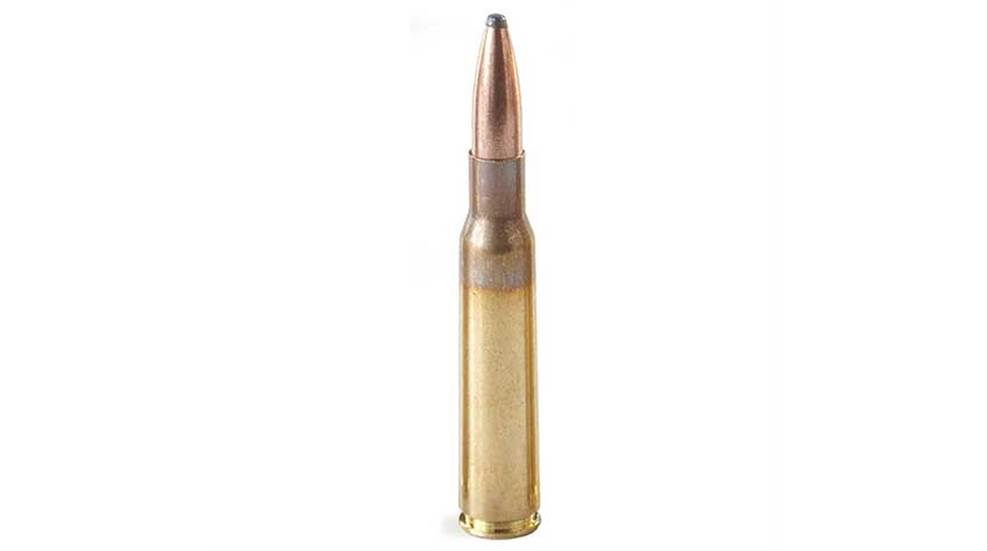
Many shooters and reloaders are surprised when they learn than the first attempts at so-called smokeless powder—more correctly called nitrocellulose—is nearly two centuries old. A French chemist and pharmacist, Henri Braconnot, determined in 1832 that soaking wood fibers in nitric acid produced a highly flammable—even explosive—compound. These first attempts yielded products that were quite unstable and rather dangerous, hence their usability was nil. A number of other chemists and scientists experimented with nitrocellulose production and stabilization during the following decades.
These early experiments led to some high-energy explosives. They were wholly unsuitable as propellants until another French chemist, Paul Vieille, toned down the energy enough to produce what was known as gun cotton—because of its visual similarity to cotton—and was deployed as a propellant for artillery munitions in 1884.
With further development, nitrocellulose or Poudre V, in recognition of its inventor was first loaded into the 8 mm Lebel case in 1886. Results were impressive. Nitrocellulose produced some six times the volume of gas from an equal pre-combustion weight of black powder, thus it imparted a much higher velocity in a given projectile with as much as three times the energy.
In 1891, Paul Mauser went to Spain after delivering some Model 1889 trial rifles, chambered in 7.65×53 mm Mauser. He brought with him a new cartridge with a slightly smaller diameter bullet and a case that was .134″ longer with 5 percent greater case capacity, and a bullet 18 percent less in weight at a 23 percent faster muzzle velocity.
That cartridge was the 7×57 mm Mauser, and it was the high-speed, low-drag cartridge of its day. Mauser also had a transitional Model 1892 rifle with an external, single-column box magazine holding five rounds. The Model 1892 morphed quickly into the Model 1893 Mauser by employing an internal, staggered-cartridge, five-round magazine. To say that the Spanish military was impressed would be an understatement. It immediately ordered rifles and ammunition.
Meanwhile, the U.S. was strolling along with what it thought was a decent improvement over the latest iteration of the Trapdoor Springfield—Model 1888—the Model 1892 Krag-Jørgensen chambered in .30 Government or as it became popularly known, the .30-40 Krag. Then we got into a little dust-up with Spain called the Spanish-American War.
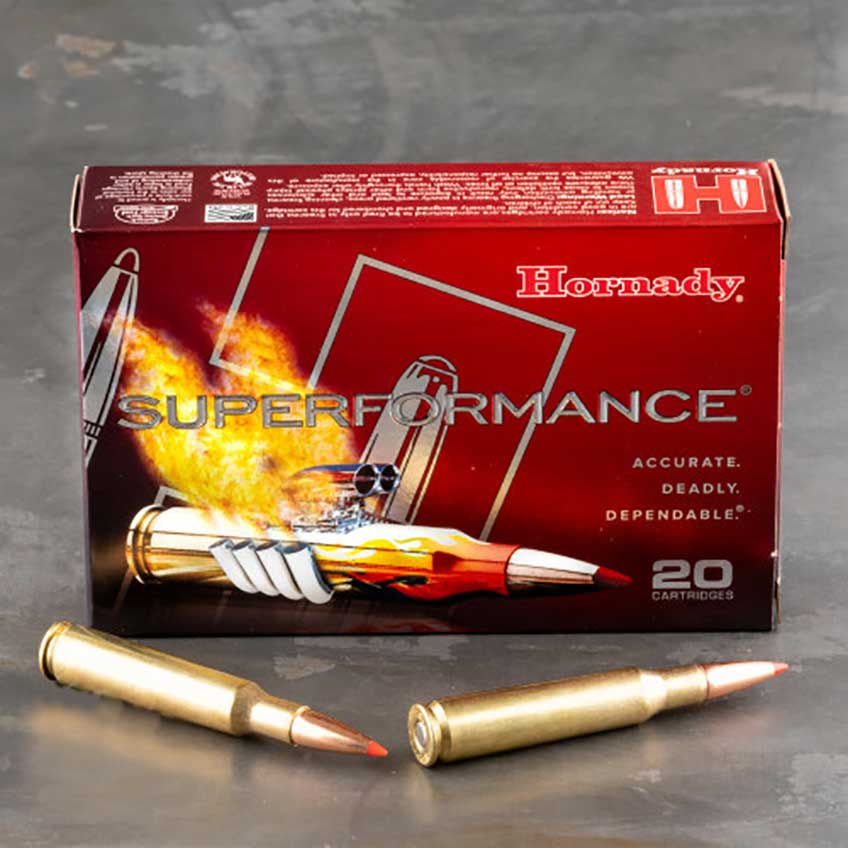
Our guys got their fannies shot to pieces from the 7×57 mm Mauser with its 173-gr. bullet at 2,746 fps while trying to defend themselves with rifles firing a 220-gr. bullet at 1,960 to 2,000 fps, depending on whether the soldier had a rifle or carbine. To be fair, the Mauser’s staggered-cartridge box magazine played nearly as much a role in this, since the 1892 Krag-Jørgensen had a side-fed magazine that did not have the ability to be charged with stripper clips.
The Brits also got a taste of 7 mm Mauser during the Second Boer War in South Africa. Boer snipers using ammunition loaded with ballistite-type smokeless powder—an early double-based powder made from nitrocellulose and nitro glycerin—easily outshot the Brits at long range with their .303 British ammo loaded with cordite and fired from Lee-Enfield rifles.
After that altercation, the 7×57 mm Mauser drew attention from European and a few American sportsmen. As a first-generation transition from black powder to smokeless powder, the 7×57 mm Mauser still held to some black-powder design parameters. The case tapers some .043″ from .473″ at the base to .430″ at the shoulder. Black powder left a lot of residue, ergo most cases needed to have a good taper in order to facilitate reliable extraction.
Too, the shoulder has an angle of just 20 degrees to ensure reliability in extraction. Later on, wildcatters and experimenters like P.O. Ackley would blow out both measurements to increase case capacity and efficiency, thereby getting more velocity from the cartridge. Such wildcats—or non-standard cases—are often referred to as “Ackley Improved” or AI. With the 150-gr. Noslers (BT, AB or CT) the AI will add about 200 fps to the muzzle velocity.
Another caution for reloaders: European-made 7×57 mm rifles have a groove diameter of 0.285″ (7.24 mm) whereas American rifles chambered in 7×57 mm have a groove diameter of 0.284″ (7.21 mm). It’s not end-of-the-world stuff, but shooters who reload should ensure they know the real source and diameter of their bullets.
The 7×57 mm Mauser has a good reputation on plains game the size of deer or pronghorn. My own experience with this cartridge is admittedly thin. However, I shot a couple of feral pigs with the cartridge some 30-plus years ago with Remington factory loads in a friend’s rifle. Not surprisingly, if you put the bullet in the right spot, the critter will tip over nicely.
In typical European fashion, there is a rimmed version of the 7×57 mm Mauser called, appropriately, the 7 x 57R. External dimensions are almost identical, save the rim, but there are internal anomalies. As far as performance, both cartridges are virtually alike in every way. The rimmed version is for single-shot, double rifles and drillings; it allows for more reliable and easier extractions in those rifles. British gunmakers are fond of the 7×57 mm Mauser cartridge, giving it British nomenclature, .275 Rigby.
The cartridge has seen extensive use in Africa, again as a plains-game cartridge. A rather famous departure from this norm was W.D.M. Bell, the Scottish adventurer and ivory hunter of the early 20th century, who used a Mauser ’93 rifle built by Rigby in 7×57 mm Mauser to kill some 800 elephants, as well as countless other animals in Africa, including many Cape buffalo.
On this side of the pond, the 7×57 mm Mauser has enjoyed a subtle but steady popularity. It seems that about every 30 to 40 years, after the wildcatters and experimenters have tried to come up with the ultimate death ray, some guys rediscover this 128-year-old cartridge. The rifles for it are light, recoil is manageable, and the accuracy is more than adequate for most big-game hunting.
This cartridge also served as the basis for the once wildcat .257 Roberts which is now a factory chambering in many rifles and has its own cult following. Like our own .30-06 Sprg., the 7×57 mm Mauser cartridge owes much of its success to the fact that it was the military cartridge of choice for nearly two dozen countries. That, combined with its other attributes of mild recoil and good accuracy ensures that it will be available for some time to come.