Categories
Ammo

Behind the Bullet: .454 Casull by PHILIP MASSARO

454_casull_btb_f.jpg

1873 was a pivotal year for firearms and cartridge history; it saw the unveiling of the Colt Single Action Army revolver and the U.S. Army’s adoption of the .45 Colt cartridge. Talk about a match made in heaven! A dependable, strong, accurate revolver, chambered in a cartridge pushing a 255-grain round nosed lead bullet at over 1,000 fps made for a combination that would go on to become the name of a Major League baseball team. Fast forward to the mid-20th Century, and you’d see experimenters pushing the envelope of those late 19th Century cartridges. The .38 Spl. evolved into the .357 Mag., the .44 Spl. morphed into the .44 Rem. Mag., and at the hands of Dick Casull and Jack Fullmer, the .45 Colt would transform into the .454 Casull. While many handgun hunters use the .45 Colt very well in the hunting fields, Casull and Fullmer really cooked up a winner.

Although it was discussed in a 1959 issue of Guns & Ammo magazine, Dick Casull’s namesake wouldn’t be put into commercial production until 1983, when it became available in the Freedom Arms Model 83 revolver. Not that there are any flies on the old .45 Colt—OK, .45 Long Colt, if that makes you feel better—it’s a cartridge that, when chambered in a strong, modern pistol, will give impressive ballistics.

I carry and hunt with the .45 Colt in a stainless Ruger Blackhawk, and wouldn’t hesitate to take any feral hog or black bear with it. But, and this is an important but, no matter what you do to the .45 Colt case it won’t be a .454 Casull. Dick Casull’s case is longer, thicker, stronger and will beat the venerable Colt cartridge by over 300 fps with any bullet weight. Pushing a 300-grain to a muzzle velocity of 1,600 fps, you can effectively use a .454 Casull to hunt anything on the North American continent.

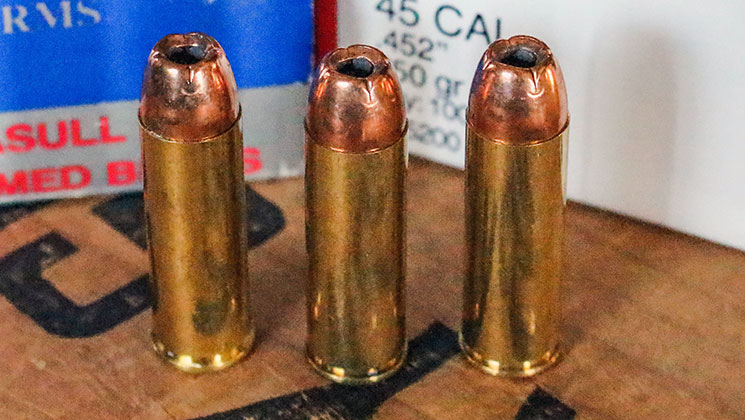
Structurally, the Casull case is more than an elongated .45 Colt. It is longer—1.383” for the Casull vs. 1.285” for the Colt—but it is thicker, with a case head set up for a small primer pocket. The Casull case uses a small rifle primer, while the Colt uses a large pistol primer, which not only provides a hotter spark for the larger powder charge, but enhances the strength of the case.

While the latest developments in hunting handgun technology—namely the gargantuan .460 S&W and the .500 S&W—may dwarf both the .454 Casull and .45 Colt, I feel the .454 makes a perfectly logical balance of weight, recoil and horsepower. Due to the fact that the Casull is simply an elongated .45 Colt case, the Casull chamber can and will shoot .45 Colt ammunition, making for a very effective and affordable practice round, as well as a solid choice for a shooter who is new to using a hard-kicking handgun, and wants to develop good skills at the lower recoil level.

There are many good choices of projectile for the Casull’s power range; bullets that will easily stand up to the higher impact velocities. The Swift A-Frame will make a great choice for those interested in hunting truly large game with a handgun, as will the Barnes XPB. The A-Frames are available in 265, 300 and 325 grain weights, while the Barnes is offered in 200, 225 and 250 grains. Grizzly and Corbon ammunition offer some good hard-cast lead projectiles that will also ruin a game animal’s day. Hornady’s XTP and Speer’s Gold Dot are also wonderful choices for both hunting as well as a personal defense round.

The .454 Casull requires a heavy crimp, to keep the projectiles from working their way out of the case during recoil, so if you intend to load your own ammunition, please keep that in mind. It is not a cartridge for the faint-of-heart, and will require a shooter to put in a considerable amount of time at the practice range in order to become a proficient hunter. However, once that happens, you’ll have a very effective hunting tool in your hands.
Categories
All About Guns

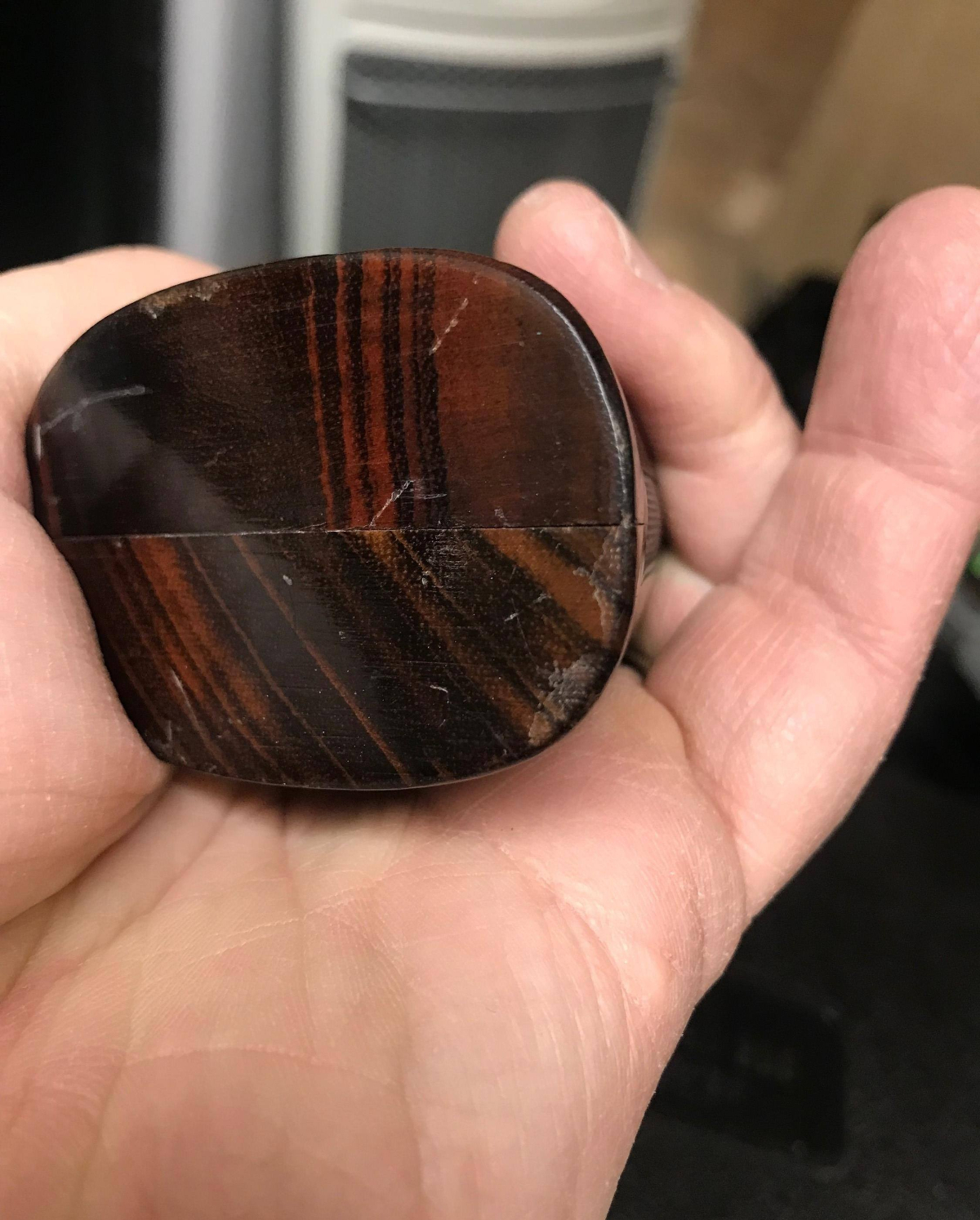
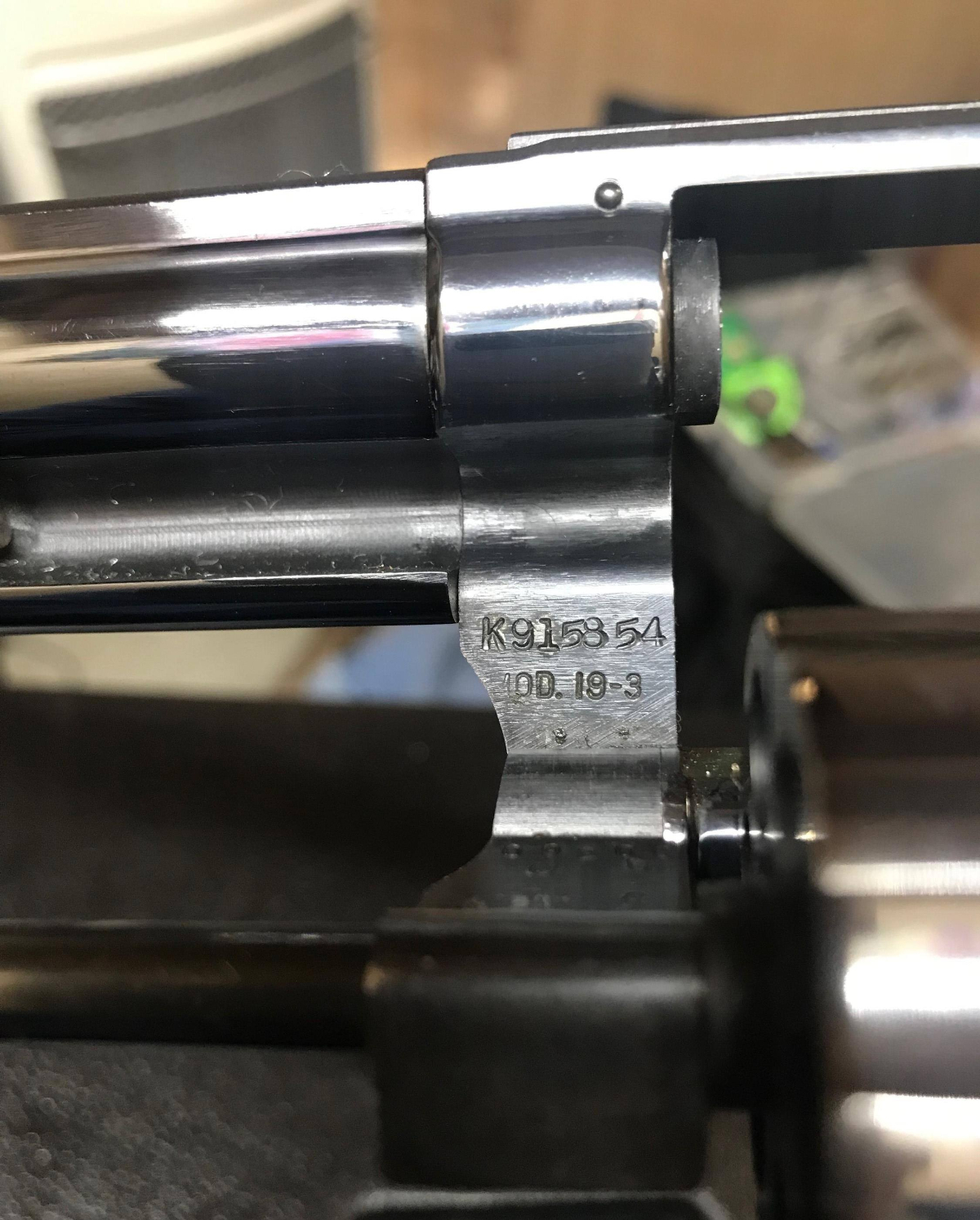
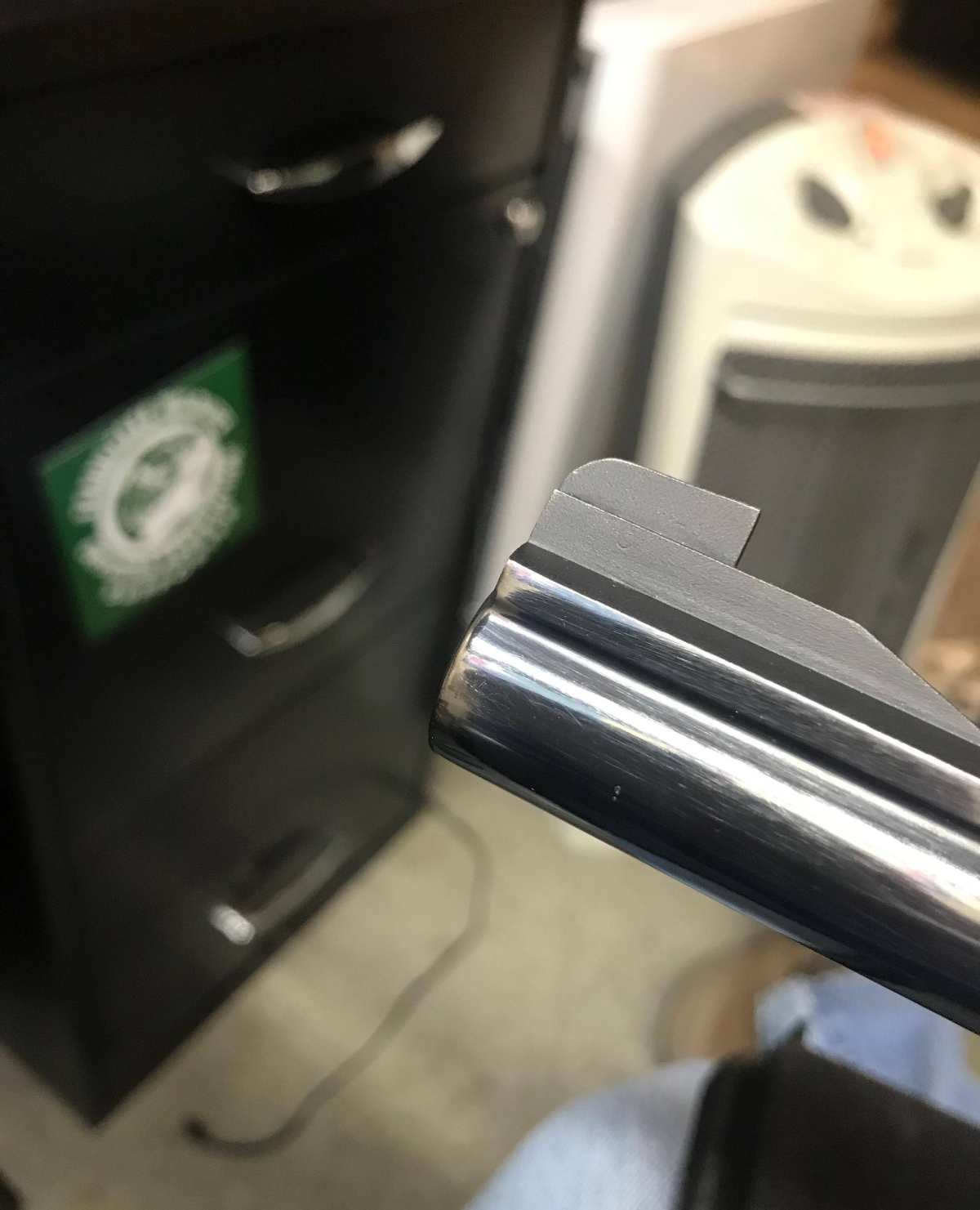
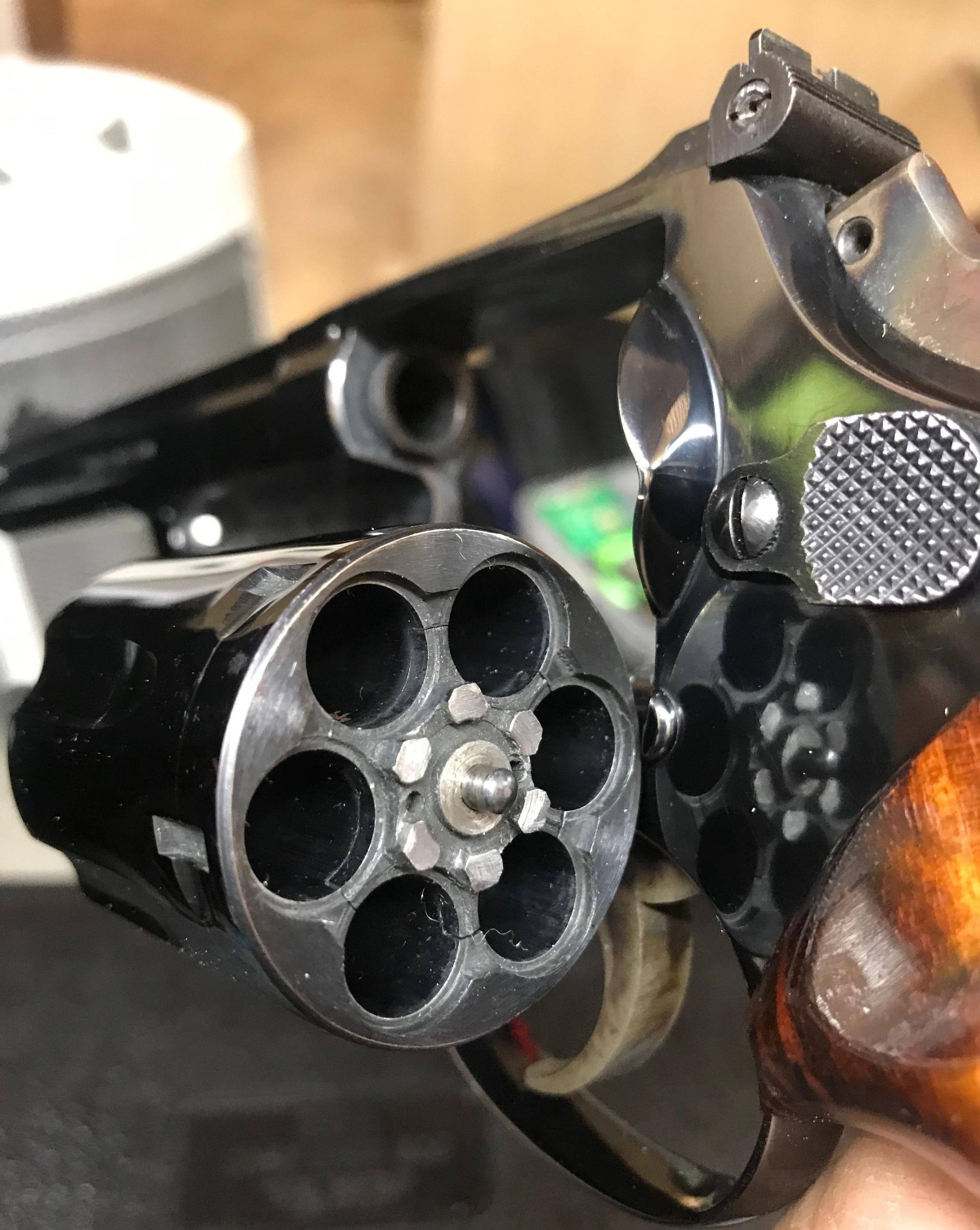
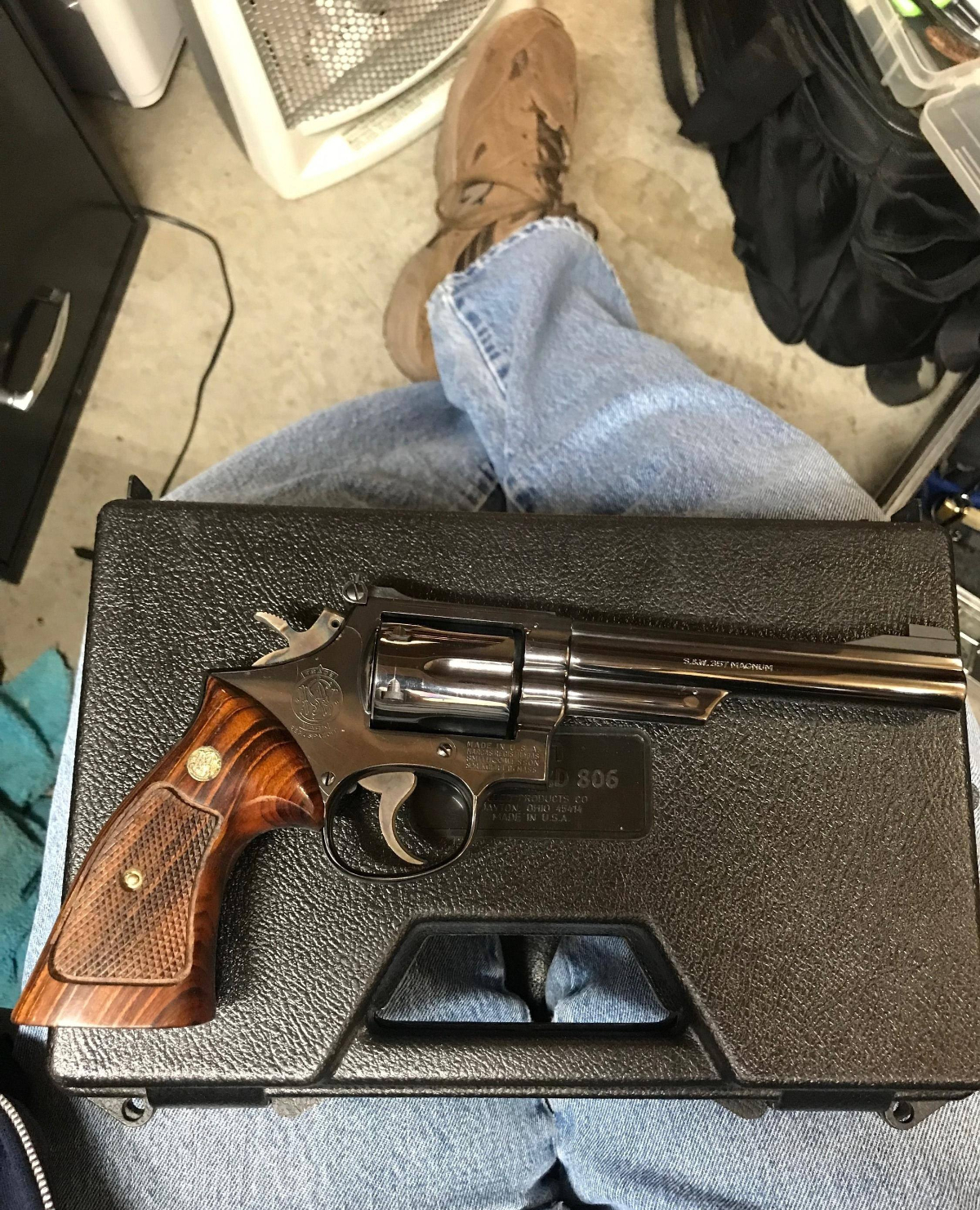
A Smith & Wesson Model 19-3 with a Barrel Length of 6 inches in caliber 357 Magnum

Smith & Wesson Model 19-3 Barrel Length 6 inch Condition Used Metal Condition Excellent Wood Condition Excellent Bore Condition E .357 Magnum - Picture 1

Smith & Wesson Model 19-3 Barrel Length 6 inch Condition Used Metal Condition Excellent Wood Condition Excellent Bore Condition E .357 Magnum - Picture 2
Smith & Wesson Model 19-3 Barrel Length 6 inch Condition Used Metal Condition Excellent Wood Condition Excellent Bore Condition E .357 Magnum - Picture 3
Smith & Wesson Model 19-3 Barrel Length 6 inch Condition Used Metal Condition Excellent Wood Condition Excellent Bore Condition E .357 Magnum - Picture 4
Smith & Wesson Model 19-3 Barrel Length 6 inch Condition Used Metal Condition Excellent Wood Condition Excellent Bore Condition E .357 Magnum - Picture 5
Smith & Wesson Model 19-3 Barrel Length 6 inch Condition Used Metal Condition Excellent Wood Condition Excellent Bore Condition E .357 Magnum - Picture 6


Categories
Uncategorized

THE UNDERWATER FIREARMS USED BY THE WORLD’S COMBAT FROGMEN by Travis Pike

Oh, boy, was the Cold War a wild time! Man, the early development of Special Operations forces led to some truly weird developments. SEALs and Spetznaz troopers, in particular, proved that a small team of seaborne commandos could be hell on Naval infrastructure. As such, these seaborne commandos would need specialized weaponry to fight like legitimate frogmen. This led to the development of the underwater firearm concept.

Underwater firearm? Are you serious?

As a heart attack. In the 1970s, there was a vision of teams of frogmen fighting each other underwater as if a Mack Bolan novel came to life. If it were to come true, normal firearms wouldn’t do the trick in frogmen firefights. So, militaries had to develop an underwater firearm, or at least come up with some underwater knife fighting techniques.

So they developed a few different variants of the underwater firearm idea, and I’ve gathered them here today. Plenty of ideas might have been patented, but I only include the underwater firearms that were developed and actually produced. Here are the five we know about. Who knows what others state governments have kept as a secret.

Related: The strangest Spec-Ops firearms in SOCOM’s armory

Mk1 Underwater Defense Gun

The development of the first underwater firearm comes from the United States in the form of the Mk1 Underwater Defense Gun. The Mk1 entered service in 1970, and the Naval Special Warfare center desired to keep it as secret as possible. It became a sign-out-only weapon that required troops to do paperwork to take the weapon out of the armory.

The Mk1 utilized a pepperbox style design, and this means you have individual barrels that rotate and fire. The double-action trigger rotated the cylinder and fired the weapon. As an underwater firearm, the weapon couldn’t use standard ammunition. In place of your normal projectile, they used metal darts.

These 4.25-inch tungsten metal darts had four fins to ensure rotation and looked like a miniature arrow. The effective range of the weapon was only 10 meters, and the darts moved at about 730 feet per second.

Related: Before the Navy SEALs came the Underwater Demolition Teams

HK P11

The Mk1’s replacement came in 1976, and the German firm Heckler and Koch created it. The P11 offered NATO shooters from a variety of nations their first underwater firearm, despite being old hat for the United States by then. The P11 used a five-shot pepperbox design, and each barrel held a 7.62x36mm dart.

Each barrel is completely sealed, and when fired, the seal is broken. All five barrels form a cluster, and clusters can be reloaded by the factory or discarded entirely in combat. The 7.62x36mm darts featured a 15-meter effective range, which outperformed the older Mk1 by a full third.

The P11 used an electric firing system with a battery located in the pistol grip of the gun. It’s a truly fascinating weapon that might still be in service with NATO frogmen today.

Related: How the Navy SEALs’ forefathers came of age in Korea

SPP-1

The SPP-1 came out of Russia and represented The Russian entry into the world of underwater firearms. This four-shot, pepperbox-style pistol fired a .18mm dart that was roughly 4.5 inches long. This big double action only pistol started its service in 1975 and apparently remains in service to this day.

The SPP-1 shows some Russian ingenuity, as the weapon is much less bulky than western variants of the underwater firearm. The SPP-1 launched darts at about 790 feet per second and had an effective range of 17 meters or so. The Russian pistol seems to outperform the Western models, but it’s tough to say since the ballistic measurements are tough to calculate underwater, and Moscow’s reputation for offering up legitimate performance data on their weapons isn’t particularly good.

Does the larger dart size of the Western P11 outperform the smaller dart of the SPP-1? Tough to say without some serious testing underwater.

Related: 3 more things movies always get wrong about a fight

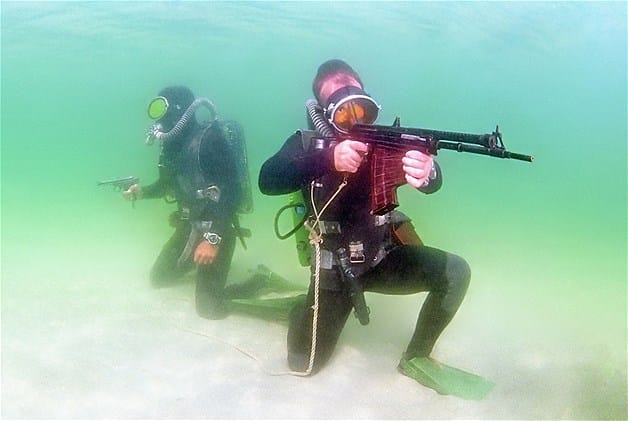
APS Amphibious Rifle

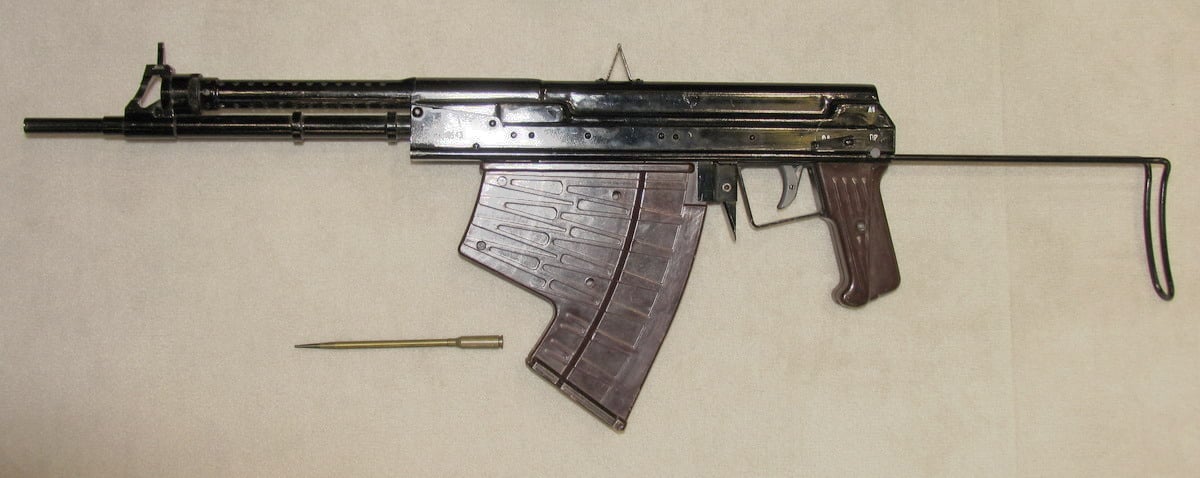
The Russians didn’t stop with the SPP-1. They also wanted an underwater rifle, and the man who designed the SPP-1 would go on to design the APS Amphibious rifle as well. The APS offered a rifle-sized platform, but it’s technically not a rifle, since the barrel isn’t rifled. I guess the term long gun probably describes it best.

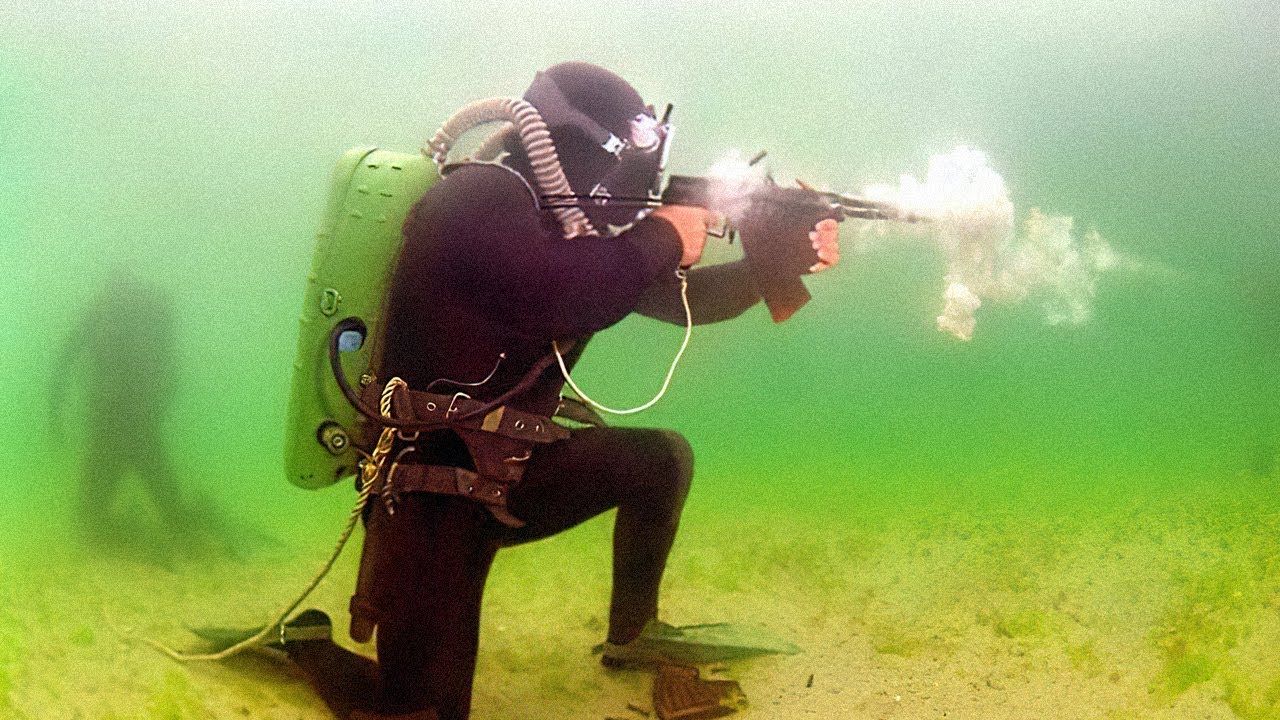
Regardless of nomenclature, the APS Amphibious rifle offered an effective range of 30 meters. That’s a fair bit more than the pistols offered by on either side of the Iron Curtain. Plus, the weapon used a specialized magazine that allowed the APS to hold 26 rounds of the special underwater projectiles.

The weapon fired a 5.66mm steel dart and could fire in fully automatic. The downside to a rifle like this, however, comes from its size. Its bigger, heavier design makes it harder to maneuver underwater, especially with its large and awkward magazine.

Related: Quiet Special Purpose Revolver: The tunnel rat’s lost sidearm

ADS Amphibious Rifle

The ADS Amphibious rifle is the evolution of the APS. Unlike the APS, the ADS actaully is a rifle, as it utilizes a rifled bore. The ADS came to be because the APS worked well underwater, but sucked above the surface. The options were to carry two guns (and that must’ve been a pain when dealing when swimming, dealing with all your scuba gear, and fighting) or to create a new platform that could function in either medium.

The ADS promised to do both very simply, with users having to simply swap magazines as they went from above the surface to below or vice versa. Below water, the ADS used a 5.45x39mm PSP round. Above water, the weapon uses standard 5.45x39mm ammunition. The range underwater was roughly 25 meters and the weapon offered select-fire operation.

The ADS Amphibious rifle uses a bullpup design. This mitigates length and size and makes the weapon easier to use underwater, and those benefits translate well above water as well. The ADS came to be in 2013 and shows that the Russians remained very concerned with frogmen firefights right into the 21st century.

Related: Is the service rifle of the future a bullpup?

The threat of the Underwater Firearm

The underwater firearm doesn’t necessarily kill by penetrating deeply into a guy’s chest. Sure it can, but it seems like the real advantage in frogmen firefights would be targeting gear. Ripping apart masks, breathing tubes and harnesses, protective wetsuits, helmets, and targeting the thin, often plastic windows of mini-subs are all ways these weapons could render swimmers combat ineffective with quickness and ease.

Has one of these frogmen firefights ever actually happened? If so, it’s not documented or discussed freely. However, the idea fascinates me. An underwater firearm seems a little silly these days, but they’ve clearly stuck around for quite some time, and that means the nations that operate these platforms must see a good reason.

Categories
All About Guns

The Kentucky Rifle

Categories
All About Guns

Harpers Ferry 1842 .69 Caliber Smoothbore

Categories
All About Guns War

Mike Loades Tests Iconic Weapons Of The Peninsular War!

Categories
This great Nation & Its People

How I want to go out!

Categories
All About Guns

Springfield XDm 10mm – SHOT Show 2019

Categories
All About Guns Allies Grumpy's hall of Shame Gun Fearing Wussies You have to be kidding, right!?!

Liberals are banning hunting rifles

Categories
All About Guns

A 5.7 Surprise: The Ruger LC Carbine