Categories
Well I thought it was funny!

Top 10 Mythical Game Species by PHILIP MASSARO

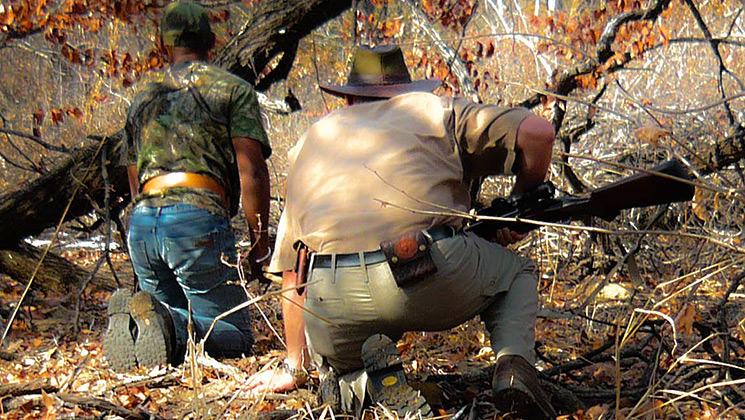
hunting_the_mythos_f.jpg

Big game hunting is a fantastic proposition, from deer to elk to moose to hippo to elephant, but the true rarities—the mythological beasts—that require a serious time investment to find, and an even more serious financial investment are the ultimate hunting adventure.

Now, I know what you’re thinking—that it’s possible to simply hire a Professional Hunter and book airfare to begin the pursuit of a dragon or the Loch Ness Monster; however, it isn’t that simple. Many of the Professional Hunters of today are well-trained, courteous and as stout as any man could be, but few have the experience with the arcane creatures of the wild places, so you need to choose your man wisely, as well as do your own homework.

My first experience with the supernatural came from a trip to the Selous Reserve, to hunt Cape buffalo. I was following a pair of magnificent trackers—Andrea and Daniel, a Kikuyu and WaKamba, respectively—while they sorted out the path of a trio of dagga boys, when we saw a set of huge lion tracks; much larger than normal. It appeared this lion had killed an African porcupine; there were the marks of the huge, pointed quills.

The trackers immediately lost all color in their faces and backed away, to begin a heated, yet whispered exchange in Swahili. I can speak a fair amount of that language, and I caught the word ‘Mtosimba’—Lion-Man. I began to question them about it—I needed to know more. As we did our best to exchange facts through the language barrier, I understood that these brave men were quite afraid. “Uchawi hapana m’zuri hapa.” Bad magic.

My mind returned instantaneously to my youth—which was filled with mythological movies like Jason and The Argonauts, books from H.P. Lovecraft and J.R.R. Tolkien, as well as hours of Dungeons & Dragons—and I was filtering through the lists of monsters I’d read about as a younger man, when Andrea looked at me and uttered slowly “Mhan-Tee-Koh.”

My mouth went slightly agape, as I finally comprehended: a Manticore. This was no joke—a manticore has the body of the lion, the head of a man, a large spiked tail and a set of huge wings, not to mention a notoriously foul disposition. I tapped the Winchester 70, chambered in .416 Remington Magnum, and told them “Bunduki m’kubwa hapa.” Big rifle here.

“Ndio, twende haraka. Twende wa gharri.” They wanted to immediately return to the truck, though it was far away. Terry Calavrias—an excellent Professional Hunter—never did understand why we were forced to abandon the tracks. I’m not sure what his trackers told him, but I never said a word.

Years later, while hunting elephant in Matabeleland, Zimbabwe, I was able to work with yet another pair of talented trackers: M’Butha and Sylvester. We were trying to sort out the tracks of a large-footed bull leaving the dried-up waterhole, when ‘Butha and I saw a very strange set of tracks. They were buffalo tracks, sure enough, and looked to be from an old dagga bull, with well worn edges. However, there were two, not four. It was plain to see: this bull walked bipedal. ‘Butha began sweating profusely, though it was cool that morning, and when I offered him a cigarette, his hands were shaking while he lit it. “You are believing this, Bwana?”

I nodded in affirmation, and asked him to explain. He looked around to assure that we were alone—the rest of the party was on the far side of the waterhole examining a rather interesting specimen of dung—when ‘Butha explained what we saw, in his best English. “Qwatalii-Muna. It is a sorts of buffalo-man, he is walkings like a man, on two feets.” Minotaur, I knew, no doubt about it. “You will be needing the big rifle; give your bullets here, I am giving them blessings.” ‘Butha explained that in Botswana, the shenzi, the wild witch-doctor men, cursed the worst of criminals, and created these upright monsters that roam the desolate places. “The smaller rifles will not be working on Qwatalii-Muna, you need to break the spells with big m’futi.” M’Butha went on to explain that these ‘Cape Minotaurs’, if you will, are protected magically, and what I inferred from his tales was that the big elephant calibers—.404 Jeffery, .458 Lott, .470 Nitro Express and the like—were required for Qwatalii-Muna, and then with only the best of projectiles. After the blessing, we took a good bull elephant the next morning. Coincidence?

M’Butha also believes he had seen a chimera—a beast with the forelegs of a lion, hind legs of a goat, and three heads, dragon, lion and goat—once, deep in the mopane forests of Pandamatenga, but I can’t confirm that. He does, after all, enjoy his pombe.

Africa isn’t the only continent with strange, ancient beasts. Call him what you like—Yeti, Bigfoot, SamSquampch—but the fabled giant of the remote mountains has been a controversial topic for centuries. My own first exposure with this monster was in the wilds of northern Quebec, while pursuing caribou.

It was cold—dangerously cold—that December, and while crossing the hills that fill in the gaps between small ice-covered lakes, just at dusk, I heard a blood-curdling howl. Not the howl of a wolf, it was lower, guttural, tortured. I stopped in my tracks, and searching the ridgelines I saw, through the foggy binoculars, a creature—upright, huge, yet stooping—with the long stride of the ‘Squatch, slip over the horizon. I was carrying a .300 Winchester Magnum, and while that may be considered a little heavy for caribou, I’ll never carry a smaller caliber in a place like that again. I

’ve heard that howl in the Adirondacks as well—in the early bear season in September. At first I thought it was a pair of mating hipsters that had gotten lost and were making the best of the situation, but there was no mistaking it. From that day I’ve carried extra ammo loaded with Woodleigh Hydrostatically Stabilized solids, in both my .308 Winchester and .300 Winchester Magnum; I’m not taking any chances, nor do I wish to become a statistic. If you share your hunting area with a SamSquampch, look to the larger bore rifles: .35 Whelen, .338 Winchester Magnum, .45-70 Government, so you’ll return safely to your loved ones.
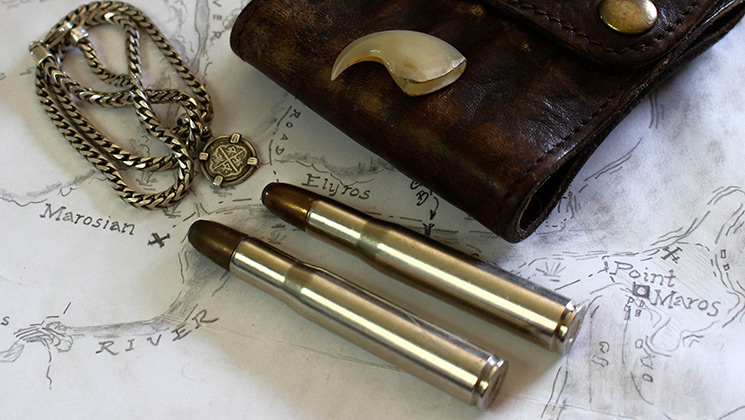
Years ago, in San Angelo, Texas, I was on a hunt with Federal Premium and Mossy Oak for trophy whitetail. My guide, Ben “Brother” Lawrence, and I had tagged out on the first evening, taking a tall seven-point buck. The next day we took a couple management does, and after that we were, well, bored. We took some game rides, trying to spot a huge buck that was reportedly on the ranch. The other gents on the hunt hadn’t been seeing much, despite their best efforts, and what they were seeing was skittish. While driving back to camp at dusk, Brother and I found out why. At the edge of the cedar thicket, three or four hundred yards out, it stood, broadside, while it’s blood-red eyes reflected the truck lights: Chupacabra.

“G-g-get the rifle!!” Brother stammered, as he fumbled for his binoculars for a better look. Despite my best efforts (I got hung up in the seatbelt in the rush) I couldn’t get to the Savage .243 Winchester in time. My last glimpse of the hairless, slavering, evil canine was an open mouthed growl-hiss, as it disappeared into the cedars. With a couple of flashlights, Brother grabbed his favorite .308, and I the little .243, and we tried to track it. Brother explained “These things are crafty; more often than not they’ll track you. With that little 6mm bullet, you need to place your shot carefully; this isn’t a coyote. I’ll watch ahead, you cover behind us.” We didn’t track it far when we’d found our own tracks in the dark cedar thicket; the Chupacabra had led us in a complete circle. Ben and I didn’t stay in there one moment longer, and we decided keep this experience to ourselves, but the story must be told now. After our encounter, the deer came back, and Brother and I were convinced the beast headed for greener pastures.

I consulted with an expert after that: a noted African Professional Hunter whom we’ll call “J.” who hunts in south Texas for half the year. “Phil, the Chupacabra is no stranger to me. While I don’t want to scare my clients, I see them on a regular basis during javelina hunts, and while I have yet to take one due to the legality of it all, they are here. Stick with the hotter 7mm and .30 caliber cartridges. I firmly believe these things are lycanthropes, and that’s why they are spotted at dawn and dusk. You’ll want to hammer them if you get a shot.” I know J. well, and I know he doesn’t lie. Is that the answer? Are they Werecoyotes? Does that legally confuse things if you hunt them in Chupacabra form? There’s no clarity in that law, but I’m taking no chances, and will follow J.’s advice.

If you prefer to stay with the confines of a traditional hunt, I wouldn’t blame you at all. There’s plenty of excitement, for sure, but if you seek the greatest adventure, pay strict attention, dig out your copy of the AD&D Monster Manual, and be ready to answer the call when opportunity knocks.

The Top 10

1. Minotaur
As stated above, you’ll want a large bore rifle—.375 H&H and larger—and a worthy guide who can differentiate the tracks from a normal bovine. Use the stiffest bullets available; solids are no handicap when dealing with Qwatalii-Muna.

2. Chimera
Though I’ve only heard tales of these creatures actually existing, I wouldn’t take them lightly. Three heads equals three times the ability to see you, and the capability of flight certainly changes the game. Were I serious about the pursuit of Chimerae, I’d opt for the hardest hitting double rifle I could handle effectively. The second shot may save your bacon.

3. Manticore
While the hunting of any lion—irrespective of whether or not it can fly, talk or kill you with a poisonous spiked tail—is a hotbed of media discussion, dealing with a manticore requires a large diameter expanding bullet, of good sectional density. Think Woodleigh Weldcore, Swift A-Frame and North Fork semi-spitzer, in a minimum of .40 caliber.

4. Chupacabra
Under this heading—though biologists have yet to affirm this fact—I’ll include all the lycanthropes: Werewolves, Werejackals, Werehyenae, and the like. They don’t require a large caliber (6.5mm and up is a good choice), but will require precise shot placement. Should you wound one, and have the misfortune to be bitten, well, I hope you like taste of Purina…

5. Sasquatch
Look, folks, people have been searching for the “Reigning Hide and Seek Champion” for decades, with little or no effect. It’s up to us hunters—we who can master the wild places of the world—to settle this debate. I like a rifle starting at a minimum of .30 caliber, and mated with a stout bullet. I see no handicap in carrying the big bore brush guns, like the .444 Marlin and .45-70 Government, as the SamSquampch likes the thick, heavily-forested places. I’d also carry a good revolver in .44 Magnum or .45 Colt as backup.

6. Rakshasa
Most common in India and Pakistan, I first heard tell of these evil spirits, wrapped in humanoid form with the outer appearance of a tiger, from the folks who spent time pursuing gaur, bear and tiger, when India was open to hunting. They inhabit the populated areas, living among us, and enjoy wearing the finest of fashion. I know hunting is closed in India, but Pakistan is open, and you’ll need a guide who is well versed in the magics of that region. This is the one hunt that I feel a handgun will work just fine, as the Rakshasa will more than likely be in the same room with you when it all goes down. A svelte .45 ACP—perhaps a quick-pointing 1911—would be my personal choice.

7. Naga
A hideous beast is the Naga, having a snake’s body and a female human head. They were encountered often in ancient, abandoned temples in Northern Africa and the Middle East, by archaeologists roaming the ancient ruins. I’d opt for a slower medium caliber, like .35 Whelen, .358 Winchester or .338 Federal, with a minimum of 225-grain slugs, with a low-power scope or peep sight. They are over 15 feet long, and quick as lightning, so a fast handling rifle is paramount. A good Jeff Cooper-style scout rifle would be perfect here.

8. Snarks
While Lewis Carroll made light-hearted poetry regarding the hunting of snarks, they are no joke at all. It was not by accident that George R.R. Martin included the snarks in his Song of Ice and Fire series—he understands the severity of a snark encounter. For these crafty little gremlins, I’d choose a good tactical 12-gauge shotgun, and the best 000-Buck loads you can find. And please, don’t take these home for taxidermy; they’re best left where they fall.

9. Vampire
If historical literature has proven one point concerning mythological creatures, it that Nos Feratu is one tough customer. While I’m no Professor Van Helsing, I have it on good authority that the Winchester SilverTip line was put into production especially for the vampire, and only later they discovered what a good general hunting bullet it was. The Ballistic Silver Tip line was brought to light for the Special Forces, who prefer to eradicate the living dead from a greater distance, and require the better Ballistic Coefficient. I’d also opt for a laminate stock comprised of holly…

10. Basilisk
While hunting hogs in Florida with the late Jay T. Carlson, who also happened to be a Professional Hunter in the Philippines, we discussed the komodo dragons of Southeast Asia, and how dangerous they could be. It was then that Jay T. related the dangers of a basilisk. “They differ from the komodo in that they have eight legs, and in that if you lock eyes with them, their gaze can turn your muscles to stone, and then they’ll have their way with you.” Jay routinely wore Serengeti sunglasses, the green-tint mirrored kind, to ward off the effect. “I can fake them out by staring at their feet, and while they try to do that gaze-thing, I let the 12-gauge sort them out.” Regrettably, Jay passed away before we had a chance to hunt basilisk together. I still wear green Serengeti’s in his honor.
Categories
Well I thought it was funny!

Seasons greetings from my neck of the woods

Categories
Cops

Police Chief Accused of Moonlighting as Shady Machine Gun Dealer Has Wild Defense by Pilar Melendez

Photo Illustration by Luis G. Rendon/The Daily Beast/Getty

Bradley Wendt knows he may be in some trouble. But he’s holding out hope that being criminally charged with lying to the feds while selling machine guns for a profit—allegations he denies—might not be the career setback it looks like.

The police chief of Adair, Iowa, a tiny town of about 800 people with three other officers on its force, Wendt was placed on leave in September after the Bureau of Alcohol, Tobacco, and Firearms (ATF) raided his office and his two gun stores.

This week, the feds detailed their case against him, saying Wendt obtained dozens of machine guns for his trio of cops over the last four years. According to an indictment unsealed Thursday, Wendt was exploiting his law enforcement position to obtain military-level weaponry that he resold in his private gun stores—and his buddy’s separate firearms business.

In a Friday phone call and text message exchange with The Daily Beast, Wendt admitted that he was “overwhelmed” by the allegations. And while he deferred any questions about the indictment to his attorney, Wendt added that he “certainly” hopes he can keep his job as the top cop in Adair.

The decision, he said, is “up to city council members,” who are set to have a meeting on Monday to discuss his career fate.

“I just want people to know the truth,” he said—before his attorney added that his client was just trying to do right by his neighbors.

“Mr. Wendt’s purpose here was not to provide a personal benefit to himself or anyone else. He is a trained police officer and firearms instructor, as well as a Federal Firearms Licensee, and only sought to benefit his community,” his lawyer, Nick Klinefeldt, told The Daily Beast.

By all accounts, Adair is quintessential small-town America. The rural enclave, which sits roughly an hour outside Des Moines, has six churches and one main road. The place is best known for its massive yellow “smiley-face” water tower along Interstate 80.

“Welcome to Adair, it’ll make you smile,” the city’s slogan states.

So when Chief Wendt started collecting machine guns, the feds took notice.

“Brad Wendt is charged with exploiting his position as chief of police to unlawfully obtain and sell guns for his own personal profit,” FBI Omaha Special Agent in Charge Eugene Kowel said in a statement.

In the indictment, prosecutors allege that between July 2018 and August 2022, Wendt provided “law letters” to the ATF in which he justified his acquisition of guns “not lawfully available to the public” by falsely claiming they were for his department—or that he wanted them demonstrated to his officers for potential future purchases.

Then, Wendt and his friend, Robert Williams, would allegedly either resell a majority of their weapons or have paid demonstrations where patrons could shoot the machine guns.

In all, Wendt allegedly requested 90 machine guns for purchase or demonstration. ATF did not approve all the police chief’s requests for the latter.

Wendt and Williams have been charged with conspiracy to make false statements and defraud the ATF—and the police chief is also facing 18 additional counts of making a false statement to the federal agency and one count of illegal possession of a machine gun. Williams is charged with three counts of making a false statement and aiding and abetting a false statement to the ATF. (His attorney told The Daily Beast that all the firearms associated with Williams “were acquired after ATF approval with letters authored by Chief Wendt that tracked ATF forms indicating an interest in seeing sample firearms, and the firearms were all accounted for in Mr. Williams’ inventory.”)

Wendt’s lawyer said the police chief intends to plead not guilty to the charges, stating his client “has faithfully and honorably served the people of Iowa as a law enforcement officer for over 20 years.”

“All of the transactions were approved with the full knowledge of the ATF. He looks forward to proving his innocence at trial,” Klinefeldt added.

The lawyer did not respond to a follow-up request for clarification about how, exactly, Wendt obtaining and demonstrating the use of military-style weapons would benefit the residents of Adair.

Neither Adair’s mayor nor any of its city council members responded to a request for comment. Adair City Attorney Clint Fichter declined to comment about whether Wendt has been permanently removed as police chief after his arrest, stating, “I don’t support the media anyway.”

This is not Wendt’s first time having to defend himself against some wild allegations.

After nine years serving as a police officer with the Denison, Iowa, Police Department, Wendt was fired by the city in February 2017 after a lengthy administrative leave spurred by charges he was hit with two years prior. In December 2015, the Iowa Department of Natural Resources alleged that Wendt illegally killed two buck deer with two other people.

The case was eventually dismissed in November 2016. Wendt’s request to be reinstated, however, was denied by the City of Denison—which claimed that his conduct was in violation of numerous rules of the police department.

Wendt went on to file a preliminary injunction, claiming retaliation, before ultimately filing another lawsuit against the city and police department. In the end, he settled both legal actions in 2019, receiving more than $600,000 from the city due to the alleged emotional distress and loss of wages from the whole debacle. The Denison Police Department did not immediately respond to a request for comment.

Wendt soon found employment again, scoring a job at the Lake View, Iowa, Police Department—before becoming Adair’s chief of police in July 2018. Meanwhile, the indictment states that Wendt has owned two firearm supply stores—BW Outfitters—since 2013.

Prosecutors say that Wendt’s scheme involved both layers of his professional life—that he “obtained 10 machine guns for the Adair Police Department and 13 machine guns for BW Outfitters.”

He also allegedly wrote “approximately 22 additional demonstration law letters… requesting a demonstration of 52 total machine guns to the Adair Police Department for potential future purchase,” the indictment states. “Of those 52 guns requested by Wendt for demonstration… approximately 27 were in fact transferred and acquired” by other gun stores.

In total, prosecutors allege that Wendt purchased 25 machine guns for his police department—of four total people, including himself—and requested 65 more for demonstration. Among the weapons Wendt sought to obtain for the department, according to the feds, was a rotary M134 minigun, a firearm that is usually mounted on military helicopters.

“The Adair Police Department does not own a helicopter,” the indictment says, noting the ATF denied the transfer.

Then, Wendt allegedly sold several guns registered to the force for profit—and rented out machine guns registered to his department or gun store. The indictment notes that some of the weapons were bought with Wendt’s personal funds, and it is not immediately clear if he used any city money in the alleged scheme.

If Wendt is determined to paint the federal case as some kind of harsh crackdown on sane gun-loving behavior, he may not be able to count on universal support from the local law enforcement community.

A spokesperson for the Iowa Police Chiefs Association said that while she was not familiar with Wendt’s case, the organization “partners with federal law enforcement agencies and that includes ATF.”

“All officers are sworn to an oath to enforce the laws of the land and Constitution,” the spokesperson added. “Violating that oath is an embarrassment to the profession.”

Categories
All About Guns Cops

TSA Reports Record Number Of Gun Interceptions At U.S. Airports By Brandon Drey

Jeffrey Greenberg/Universal Images Group via Getty Images

Transportation Security Administration (TSA) officers said Friday the agency intercepted a record number of firearms at airport security checkpoints this year, a nearly 10% increase over 2021’s record level.

Officials reported the agency stopped 6,301 firearms from crossing through secure areas of airports since the beginning of 2022 and anticipates detaining approximately 300 more before the new year. Of those firearms, more than 88% were loaded, the agency said.

The number of firearm interceptions surpassed the previous record of 5,972 firearms detected in 2021.

“I applaud the work of our Transportation Security Officers who do an excellent job of preventing firearms from getting into the secure area of airports, and onboard aircraft,” TSA Administrator David Pekoske said in a news release. “Firearms are prohibited in carry-on bags at the checkpoint and onboard aircraft.”

Although firearm possession laws vary by state and local government, passengers are prohibited from carrying guns in carry-on bags at any TSA security checkpoint, even if a passenger has a concealed weapon permit. However, the agency says passengers may travel with a firearm — but it must be unloaded and locked in a hard-sided container and transported as checked baggage only and declared each time they present it for transport as checked baggage.

The agency said that TSA had increased the maximum civil penalty for a firearms violation to $14,950 to reduce the threat of firearms at checkpoints.

“When a passenger brings a firearm to the checkpoint, this consumes significant security resources and poses a potential threat to transportation security, in addition to being very costly for the passenger,” Pekoske said.

According to the agency, TSA firearm catches have increased since 2010, rising from just 1,123. However, the number of interceptions dipped in 2020 by more than 1,000 amid the COVID pandemic, when the industry took a massive hit after non-essential air travel nearly came to a complete stop.

Sheldon H. Jacobson, a professor of computer science at the University of Illinois Urbana-Champaign and an expert on aviation security, told The New York Times, “the majority of people are not doing it with malicious intent.”

“They’re simply forgetting,” Dr. Jacobson said, adding the gun sales increasing nationwide among first-time gun buyers could explain the rise in interceptions.

Last year, the Times reported data from Northeastern University and the Harvard Injury Control Research Center that showed about a fifth of all Americans bought firearms for the first time, with about 39 percent of all American households owning guns.

Comparing the number of Americans owning a firearm from 2016, a General Social Survey, a public opinion poll conducted by a research center at the University of Chicago, showed that the number increased from 32 percent.

David Fitz, a spokesman for the TSA, told the Times that “the most common reason given by passengers bringing a firearm into a checkpoint is ‘I forgot it was in the bag’ or ‘Someone else packed my bag for me.’”

Fitz added that most “parts of the country where open carry and concealed weapons permits are higher” trend typically in Southern states.

The agency said although some airlines may have additional requirements for traveling with firearms and ammunition, passengers traveling by air who wish to transport firearms must do so in checked baggage by following proper packing guidance for firearms in checked baggage.

Categories
All About Guns Fieldcraft

Cooper’s Color Code | You’re Doing it Wrong by Aaron Haskins

Col. Cooper's Color Code is frequently misinterpreted and taken to be a "Situational Awareness" mnemonic; this is fundamentally incorrect.

Col. Cooper’s Color Code (the “Cooper Color Code”) — you’re very likely doing it wrong. There’s a possibility this article will slaughter a few sacred cows. It is certain to cause some ass pain. That’s okay, though. What we want to do, more than anything else is to get engaged professionals talking whether they agree with the author’s contention or not. Know why? Because discussion, disagreement, and civil discourse are where learning occurs.

If you’re going to teach Cooper’s Colors, don’t teach it as advocating a mythical and unattainable concept of situational awareness. Teach it as the man intended: mental preparation for the decision to press the trigger.

Situational Awareness & Your Mind: Rethinking Cooper’s Color Code

At some point in the 1970s, Jeff Cooper created what is often called the Color Code. When he originally thought it up, and as he taught it, his purpose was to describe a shooter’s “…capacity…to cross the psychological barrier that inhibits [the] ability to take deadly action,” i.e., his or her mental preparation to press the trigger on a live target.[1]

The “situational awareness” interpretation of the Color Code is fundamentally flawed.

Cooper’s Color Code: Mistranslated and Misunderstood

In Cooper’s original intent, one could scale from Condition White, in which one is completely unprepared for combat, to Condition Red, in which one is psychologically committed to combat, regardless of whether the fight has actually begun or not. Essentially, he recognized many people must mentally gear up for violence, and his code traced that progression to help the mental switch.

That is not, however, how Cooper’s Colors are generally used in the modern firearms training world.

Instead, they have been reinterpreted as shorthand to describe an individual’s “situational awareness.”  Per this interpretation, the one most commonly cited in blogs and articles across the firearms community, an individual in Condition White is relaxed and unaware of what is happening around them. In Condition Yellow they’re in a state of “relaxed awareness”—not specifically paying attention to anything, but generally aware of what’s going on around them. In Condition Orange, they’re focused and specifically paying attention to something they’ve identified as a potential threat. And in Condition Red they’ve identified a threat and are completely focused on it, ready to respond to anything it does. It’s a simple, easy-to-remember system.

Unfortunately, whereas Cooper’s original Color Code is an effective tool to help ramp up to a mental state suited for combat, the “situational awareness” version so commonly used today is essentially useless and misleading. It fundamentally misunderstands how the brain scans for and responds to threats, and thus can harm shooters by leading them astray during training and development of their situational awareness skills.

The deliberate mind is lazy and cannot multitask.

Cognition and Reaction | the Duality of Grey Matter

Cognitive psychologists and decision scientists often model the brain as operating on two related but very different systems.[2] In this dual-system model of cognition, System 1 may be thought of as the “automatic” mind and System 2 as the “deliberate” mind. The automatic mind runs the vast majority of what you do. It multitasks and makes decisions very quickly without you ever consciously thinking about them. The deliberate mind, on the other hand, only deals with one thing at a time, and does so much more slowly than the automatic mind. This distinction is critical to understanding decision making because each system does so via different processes.

The deliberate mind uses what is sometimes called “analytical” decision making, in which it assesses the situation and evaluates multiple options to choose the best one.[3] The automatic mind, however, uses intuitive decision making, in which it only evaluates a single choice based on the available information, assesses its suitability by running a mental simulation, and either implements it or discards it (in which case it begins assessing the next potential choice). We all like to think we’re primarily analytical, assessing all our options and making the best possible choices.  But the truth is we aren’t. The deliberate mind is lazy—it takes extra blood flow to the brain to make analytical decisions. And, more importantly, it literally can only focus on one thing at a time.  The deliberate mind cannot multitask—when it tries to do so, it just shifts attention from task to task to task and does none of them well. So it shifts as much work as possible to the automatic brain.

To see how this works, think about when you first learned to drive a car. The first time you sat behind the wheel, you were trying to pay attention to everything: your hands on the wheel, the speedometer, your side and rear-view mirrors, the road in front of you, your blind spots, all the vehicles and pedestrians and obstacles around you, etc. And you weren’t doing any of it well. That’s because when you first learn a task, your deliberate mind is in charge, and its efforts to do everything at once lead you it doing everything badly. But the automatic mind learns through repetition. So you practiced, and after a few times driving, you began to relax. You kept your eyes primarily on the road in front of you, occasionally automatically scanning your mirrors and blind spots to update your picture of the situation around you, but then returning to the road. You learned to talk to passengers and listen to the radio without pulling your attention away from the road and becoming a danger to yourself or others. This is because as you learned, your deliberate brain began passing tasks off to your automatic brain, freeing itself up to pay attention to other things, like that audiobook you’ve been listening to for the past six hours, or the beautiful scenery along the highway.

This lack of paying deliberate attention to everything all the time doesn’t mean you’ve lost your ability to react to danger. To understand why let’s look at how the automatic mind processes information and makes decisions.

Never be in Condition White” is an effectively meaningless phrase.

Your Script: Recognition-Primed Decision Making


Information about the world around us reaches our brain through our five senses, and the brain then must process and decide based on this data.[4] Because the automatic mind is always on and always processing, it responds to this information first, and only activates the deliberate mind if it deems it necessary. It does so by a process that intuition researcher Gary Klein calls Recognition-Primed Decision Making, or pattern recognition. Essentially, the brain has a massive repertoire of stored patterns, and the automatic mind compares the information it receives from the senses to this pattern library.  The brain also has a store of heuristics (which Klein calls “action scripts”)—simple automatic algorithms of decision-making designed to lead to “good enough” results in most situations, if not the best possible outcome for any specific case.[5]

When the automatic mind matches the information it’s receiving from the senses to one of the patterns stored in its library, it applies an appropriate heuristic. This is what’s commonly called intuition or a “gut feeling.” Generally, the automatic brain does not weigh its options. Rather, it picks a good fit choice, imagines the outcome, and if it doesn’t identify a problem, it executes. Only if its mental simulation reveals a potential problem does it discard the initial heuristic and move on to the next choice. This is intuitive decision making in a nutshell. It happens very rapidly, often completely unconsciously, and most of the time achieve very good results.

The deliberate mind doesn’t even enter the decision-making process unless the automatic mind first notes a problem. My colleagues and I informally refer to this as the “risk monitor,” the process by which the automatic mind, in the process of matching sensory information to stored patterns, identifies either a known risk pattern or an unknown situation and triggers the deliberate mind to begin focusing on the problem and analyzing its potential courses of action. Of course, the automatic mind operates much faster than the deliberate mind, so it is often applying the appropriate action script (heuristic) even as the deliberate mind begins assessing the situation. To illustrate this, let’s return to our driving example.

You’re now an experienced driver, and on the highway, you’re comfortable letting your automatic mind deal with the task of actually driving and the myriad sub-tasks that actually involves. And you’re most likely comfortably driving 5-10 miles per hour over the speed limit. But the instant you recognize the shape of a potential police car up ahead by the side of the road, what happens? If you’re like most people, your attention shifts from wherever it was before and you begin focusing on the car to see if it is, in fact, the police—because your automatic mind matched that pattern of information to the known risk of a potential speeding ticket. And yet, while you’re assessing and deciding the best course of action, your foot probably shifted from the gas to the brakes, because while the slow deliberate mind is still spinning up and figuring out what to do, the fast automatic mind already applied the appropriate action script to ensure you’re under the speed limit and reduce the risk of a ticket, just in case it’s a cop. Beyond that, the deliberate mind takes control and decides whether to maintain your (new) current speed, slow down even more, or what.

“So that’s interesting and all,” you may be thinking to yourself,[6] “but how is it relevant to self-defense?” It’s fairly simple: knowing how the brain processes information and makes decisions means we now know the key to effective threat identification and taking the appropriate immediate action. Such action, whether it’s ducking for cover, drawing and firing, running away, or any other response lies in the automatic mind. That’s the part of your mind that is always active, always scanning, always comparing what it sees to known patterns to identify the appropriate response.

So, much loved as they are in the firearms community, what this means is that the situational awareness interpretation of Cooper’s Colors can only describe the deliberate mind’s level of attention to a given potential problem. But given that the deliberate mind can only pay attention to one thing at a time, and takes significant energy to focus, the adage (and occasional admonishment) to “Never be in Condition White” is effectively meaningless.

We’re almost always in “Condition White,” because the deliberate mind is busy focusing on the task at hand and not scanning for threats

It is all but impossible to actively scan for threats while talking on the phone or finding a debit card in a wallet at the ATM, or doing any of the thousands of tasks our deliberate minds must focus on throughout the day. Trying to do both at once just makes us ineffective at both, just as trying to pay attention to everything makes us bad drivers. To expect otherwise is unrealistic and potentially dangerous.

Training should focus on the ability to capture relevant information, identify potential threats, and respond heuristically.

Condition Fight

Instead of this unhelpful misinterpretation of Cooper’s Colors, then, I suggest that we in the firearms and self-defense community begin moving away from a useless “constant vigilance” philosophy and focus instead on training shooters to let the automatic mind shoulder the burden of identifying and responding to threats.

We don’t respond properly to threats when:

a) we don’t perceive the relevant information because our sensors are directed elsewhere;

b) our brains don’t interpret that information correctly to alert us to the threat; or

c) our brains don’t immediately know the appropriate action script or heuristic with which to respond to an identified threat.

This is what “Condition Yellow” is really talking about.

Thus, training should focus both on building habits that increase the likelihood of the sensors capturing relevant information, and then on building known patterns and action scripts in the automatic mind to correctly identify and respond to potential threats. The former is as simple as ensuring we aren’t walking around staring at our phones with headphones in, oblivious to the world around us. We need to ensure our sensors can capture the relevant information around us, which is what “Condition Yellow” is really talking about.

Without the next steps, without making sure the mind can put the pieces together and respond appropriately, looking and listening does nothing for us. And that aspect is much more difficult, and generally overlooked by those talking about “mindset” and “awareness.” Violent encounters often occur much too quickly for the deliberate mind ever to react and make conscious decisions, so we must set ourselves up for success by training our automatic minds to spot threats and apply the appropriate heuristic for that situation.

What does that look like? Well, as mentioned, the automatic mind learns through repetition and practice. Taking a class on indicators of violent intent is great, but it does absolutely nothing to build those patterns into the automatic mind’s library of stored threat patterns. Repetitive scenario training and simulations are probably your best bet for safe and effective training (which is no more a new concept than is stress inoculation). It’s time-consuming and resource-intensive, but the military uses such training to great effect to make threat identification and response almost instinctive. When a Soldier hears an explosion in a combat zone, the hundreds or thousands of similar times he or she’s been through that scenario in training means he or she’s unlikely to freeze in indecision. The automatic mind already knows what to do: take cover, identify the source, and continue as the situation dictates.

Athletes, law enforcement officers, pilots, and many others working in fields that require the ability to instantly react to changing circumstances at a rate much faster than the deliberate brain can respond all use variations of scenario practice and repetition to build that automaticity. It works, and it works well.

Action scripts must be built before-hand.

Cooper’s Color Code: Codify It

If you don’t have the time and resources for high-quality resource training, there are other options. The goal is just to build the patterns and responses into the automatic mind, which can be done visually. After you’ve taken that class on threat indicators, watch lots of videos of violent attacks (which can be found on YouTube) and practice spotting those indicators in real situations.

See if you can figure out who and where and how the attack will happen before it does. Then reinforce that with visualization: run through mental scenarios where you see and respond to specific indicators as appropriate. Build those action scripts, and attach them to sensory patterns, so you’re not having to stop and think your way through every decision when action and reaction are being measured against each other when every tenth of a second counts.

This is critical:

If you’ve never even imagined doing something, you cannot do it.

The brain has no mental simulation to judge against during its intuitive decision-making process. With the exceptions of basic instinctive heuristics like fight/flight/freeze, an action script will literally not even appear as an option to your automatic mind unless you build it beforehand. Visualization implants the script in the brain, and repeated visualization means the automatic mind is more likely to draw upon it as a first or second choice option when it identifies the associated sensory pattern. If you can’t do scenario practice, you must do visualization practice.

The instant you stop to think is the instant you’ve lost.

As You See So Shall You Compete

These same principles can be applied to competitive shooting, as well as defensive situations.

Many high-level competitors visualize each stage before running it. All they’re doing is prepping the automatic mind, so their deliberate mind is free to focus on deliberate decisions in response to potential unexpected and changing conditions. The time saved in decision making, by ensuring the automatic mind already knows which targets to shoot and in what order, adds up over the course of a stage and a match. New competitors hesitate because they don’t have the sensory patterns and action scripts mastered that allow them to flow through a course. Experienced competitors just execute.

Many top-level competitors, in any form of competition from shooting to martial arts to ball sports, will tell you that the instant you stop to think is the instant you’ve lost. Whether you’re playing for a title, or prize money, or the higher stakes of life and death, the mechanics of decision making remain the same. But to take advantage of them, you have to do more than give lip service to a vague concept like “situational awareness” or “vigilance.” You have to set yourself up for success by training your automatic mind.

Col. Cooper himself fought gains the ineffective (incorrect) reinterpretation of his Code.

Cooper’s Color Code Correct

An interesting note: this mental preparation of the automatic mind before the fight kicks off is pretty much exactly what Cooper intended with his original version of the Color Code. He focused on the psychological difficulty of the decision to kill, but the principles of decision making apply exactly as I’ve described. Col. Cooper spent decades combatting the ineffective reinterpretation of his Code so commonly heard today, because “constant vigilance” just doesn’t work. If you’re going to teach Cooper’s Colors, don’t teach it as advocating a mythical and unattainable concept of situational awareness. Teach it as the man intended: mental preparation for the decision to press the trigger. A tool to set your automatic mind up for success.


Cooper's Color Code for situation awareness and threat awareness has been distorted and misunderstood over the years.

Acknowledgements: A number of firearms, martial arts, and self-defense industry professionals and other subject matter experts reviewed this article for clarity and accuracy prior to publication. In no particular order, the author would especially like to thank Claude Werner (The Tactical Professor), Jon Hauptman (PHLster), Morgan Atwood (BFE Labs), James Quigg (Fight IQ), Benn Coren (Environmental Testing & Inspection), Keith Finch (GAT Marketing), Brandon Foat (Minnesota Sword Club), Rob Reed, Stephen Bell, and Will Morgan, among others, for their input and feedback during the writing and editing process.

[1] Jeff Cooper, “Commentaries,” Vol. 12, No. 5.

[2] This model is discussed in many books and articles, including works by Sloman (1996), Stanovich (1999), and Hogarth (2001), but is most well-known from Daniel Kahneman’s book, “Thinking, Fast and Slow” (2011).  The now-standard “System 1 and System 2” terminology itself originated in Stanovich and West (2000), but for clarity’s sake I have chosen to use the informal terminology of “automatic mind” and “deliberate mind” to refer to the exact same System 1 and System 2, respectively.  This model of cognition has been widely applied in fields ranging from social psychology to behavioral economics.

[3] Well, sometimes.  The deliberate mind sometimes uses the same intuitive decision-making process as the automatic mind, too.  It’s a bit weird and confusing, but it’s also not terribly relevant to our purposes here.

[4] A disclaimer: I am not a cognitive neuroscientist, neurologist, or neurophysiologist.  While it is my understanding that there *is* neuroscientific evidence to back up this model of cognition, from Paul Glimcher and others in the cross-disciplinary field of neuroeconomics, I will leave that examination to subject matter experts and constrain my comments to my own areas of expertise.  Therefore, I will not attempt to describe the specific mechanisms in the nervous system by which information reaches the brain and the various parts of the brain itself that sort through this information and make decisions, and will comment only on how this is applied in terms of cognitive psychology and applied decision science.

[5] These heuristics are built up through experience, by trial and error and practice over one’s lifetime.  Some basic heuristics even appear to be hardwired into our brains through evolutionary processes, such as fight/flight/freeze responses to potential danger.

Categories
All About Guns Art

Nice!

Tumblr media

Tumblr media

Tumblr media

Categories
All About Guns

Time to clean up!

Tumblr media

Categories
War

Throwback Thursday: The POWs of Camp Perry by W.H. “CHIP” GROSS

german-pows-public-domain.jpg

Since 1907, Camp Perry on the Ohio shores of western Lake Erie has hosted the NRA National Rifle and Pistol Matches. But few people today realize that, for several years during the mid-1940s, Camp Perry served a very different purpose. It was a prisoner-of-war (POW) camp, housing some 6,000 German and Italian prisoners in America’s heartland.

During World War II, the United States maintained 511 base camps and 175 branch camps within its borders, containing nearly 430,000 prisoners. There were more camps in the eastern half of our nation than the west, and all but three states—Nevada, Montana and North Dakota—had POW camps.

The camps were established to help alleviate the overcrowding of POWs housed in Great Britain. Had just Italian (50,273) and Japanese (3,915) POWs been shipped to the U.S., American camps could have easily handled those numbers. But when an additional 371,683 German prisoners began debarking from troop ships onto America’s shores late in the war, the POW prison system was soon overwhelmed. U.S. military leaders went scrambling to find suitable camp locations, construct facilities, train guards, interpreters and other support personnel—a monumental task.

Camp Perry was considered a major POW base camp, and had several smaller branch camps located in or near seven Ohio cities, as well as Fort Wayne, Indiana. Italian soldiers captured on European battlefields began arriving at Camp Perry in 1943, followed by German soldiers in 1944. A small portion of the Germans, an estimated 10 percent, were hardcore Nazi sympathizers. Most of those were former Rommel Afrika Korps members who still firmly believed that Germany would ultimately win the war. As a result, they often intimidated the other German prisoners who were less enthusiastic toward Nazi beliefs, through verbal and physical abuse.

The prisoners at Camp Perry were housed in small, wood-framed, tar-papered-covered buildings, groupings of which were called “hutments.” Measuring 16’X16’, each building was a single story constructed on a concrete slab, double-walled with double-pane windows, and heated by a wood-burning stove. Five prisoners were assigned per building. A nine-strand, barbed-wire fence 9 feet high, with 11 guard towers, enclosed the entire encampment.

Prisoners were required to work while at the camp, doing daily routine maintenance of the many buildings, cooking, cleaning and other chores, as needed. As a result, they earned a small number of coupons per day which they could then redeem at the prison “canteen,” what today would be known as the camp PX, or Post Exchange. Officers were exempt from working if they so chose, but many worked to help pass the time and ease the boredom of routine prison life.

An interesting aside is that the German prisoners did not think much of the American 3.2 percent alcohol beer they could purchase at the camp PX for 10 cents per bottle—it was just too bland and mild for their tastes. However, they did like the Coca-Cola that sold for four cents per bottle.

Some POWs worked offsite of Camp Perry, employed at area businesses or planting and harvesting farm crops; overseen, of course, by armed camp guards. Northwest Ohio has some of the most productive farmland in the world, but due to the ongoing war effort able-bodied American farmhands were in short supply in the 1940s. As a result, POWs were often pressed into service, and this decision was not always popular with local civilians. They claimed that POWs were filling paying jobs that should have gone to them.

There was also cultural resentment of the POWs. For instance, at one canning company German prisoners worked alongside American civilian women whose husbands and sons were fighting German forces overseas.

Another complaint heard from civilians was that prisoners were being coddled. As part of the war effort, food rationing of meats and canned goods was in effect for all Americans. Yet they saw prisoners being provided three meals each day, sometimes eating the brand-name foods citizens couldn’t readily obtain.

On the other hand, certain civilians took the food disparity issue and the fact that they had a POW camp in their backyard philosophically. A story in the October 1, 1943, Port Clinton Herald and Republican newspaper quoted an area resident as saying, “This is war, and we’ll just have to make the best of it.”

Some civilians went out of their way to interact with the prisoners, while others refused to have anything to do with them. One Ohio resident, who chose to get to know some of the men at Camp Perry, commented, “You could tell the Germans from the Italians because the Italians were laid-back and so friendly, while the Germans were stoic and stern and did not talk much, although they worked hard.”

Did any POWs ever escape from Camp Perry or any of its satellite camps? There were several attempts. In January 1945, a prison guard shot and killed a German prisoner who had threatened him. The guard lost his footing on icy ground and was rushed by the prisoner, whom he then shot. The guard underwent a court-martial for the shooting, but was found not guilty.

If a prisoner tried to escape and was caught, or purposely violated any other major rule, he was placed in solitary confinement and put on a diet of bread and water three times per day. (At the time, such treatment of prisoners was in alignment with the Geneva Convention of 1929.)

Suicides were less common than escape attempts, but a few did happen. One POW who slipped away from a work detail near Defiance, Ohio, was found a few hours later drowned in the Maumee River. Another prisoner, who had allegedly escaped from Camp Perry, was found hanging from a tree near Port Clinton about a week later. Camp officials described him as mentally imbalanced and, until his body was discovered, the only German prisoner who had successfully escaped from the camp.

May 8, 1945, V-E Day (Victory in Europe), marked the end of World War II in Europe, with Japan surrendering in the Pacific a few months later that same year. As a result, POWs held in American prison camps, including Camp Perry, began to be sent home to their native countries. Interestingly, a number of German and Italian prisoners eventually returned to America to live permanently and become citizens. Impressed by how well they had been treated as POWs, they wanted to experience the opportunities and freedoms they had seen while in America that their home countries did not offer.

Today, three-quarters of a century after the last POW marched out of Camp Perry, there is still much tangible evidence of that era remaining, thanks to ongoing historic preservation efforts. For instance, the brick buildings known as “Commercial Row” that house firearms vendor displays during the annual National Matches were once the mess halls of the POWs of World War II.

Categories
War

Shotgun’s Home of the American Civil War – FOX’S REGIMENTAL LOSSES

FOX’S REGIMENTAL LOSSES  

Regimental Losses In the American Civil War
1861-1865
A Treatise On the Extent and Nature of the Mortuary Losses in the Union
Regiments.  With Full and Exhaustive Statistics Compiled From The Official
Records On File in The State Military Bureaus And At Washington

By William F. Fox, Lt. Col., U.S.V.

President Of the Society Of The Twelfth Army Corps, Late President Of The
10th N.Y. Veteran Volunteers’ Association and Member of the New York
Historical Society

Albany, N.Y.
Albany Publishing Company
1889

. . .There has been a dearth of official information regarding a certain class of regimental statistics which are essential to the history of the war, and are of interest, not only to the surviving participants, but to all who are interested in the story. Regimental affairs are of more importance to the average soldier than Corps or Army matters; and, so, an effort has been made to supply within these pages certain facts regarding regimental losses which are outside the province of the Government publications.
It is with pleasure that acknowledgment is made of courtesies extended by the Adjutant-Generals of the various State Military Bureaus, and the Adjutant-General’s office at Washington.  Without their kindly assistance the work could not have been completed.
No statistics are given here that are not warranted by the official records. The work represents the patient and conscientious labor of years. Days, and often weeks, have been spent on the figures of each regiment. It is hoped that before disputing any essential fact, a like careful examination of the records will be made. Having done that, if any fail to reconcile facts and statements, they will confer a favor by addressing a communication on the matter, so that an opportunity may be afforded to explain the seeming discrepancy, or, if an error, to correct it in a subsequent edition.

THE AUTHOR.
ALBANY, N.Y., May 1, 1888.

Chapter I This chapter deals with the casualties of war, maximum of killed in Union regiments, maximum of percentages. As you might guess, lots of tables.
Chapter II

This chapter presents the maximum of regimental loss in killed in any one battle–proportion of wounded to killed

Chapter III Percentage of Killed in Regiments in Particular Battles–Comparison of Such Losses With Those of European Regiments.
Chapter IV Loss in Officers–List of Generals Killed–Surgeons and Chaplains Killed
Chapter V This chapter deals with the losses in the Civil War compared with those of European wars, Loss in each arm of the service, classification of deaths by causes, etc. Keep in mind this deals with the Union Army only!
Chapter VI The colored troops. History of their organization, their losses in battle and by disease
Chapter VII    Muster -Out Rolls –Anthropological Statistics. Very interesting. Not at all what you might think. Every thought about how tall the average Union soldier was?
Chapter VIII Union Corps Organization. Want to know a little of the history of each Union Corps that fought in the late Rebellion? This is the place.
Chapter IX This chapter deals with famous Divisions/Brigades. I have provided a selected few in this portion of the site. Again keep in mind this deals with the Union Army only!
Chapter XII

List Of Regiments And Batteries In The Union Armies With Mortuary Losses Of Each–The Number Killed And Number Of Deaths From Disease Or Other Causes.

Chapter XIV This chapter deals with the greatest battles (and many of the minor ones) of the late Rebellion. It give stats such as killed, wounded, captured, etc. Not complete yet but will be soon.
Chapter XV Confederate Losses, Strength of the Confederate Armies–Casualties in Confederate Regiments–List of Confederate Generals killed–Losses in the Confederate Navy.
Chapter XVI Conclusion. Don’t be fooled by the title. Good thoughts here.


Categories
All About Guns

Curator’s Corner: Flintlock Cemetary Gun