Categories
All About Guns Fieldcraft

Tips and Tactics for DIY Hunting and Fishing in Hawaii by ARAM VON BENEDIKT

photo-1.jpg (1)

There are few places on earth more enchanting than the isles of Hawaii. Most people think of Hawaii in terms of beautiful, well-groomed resorts, turquoise water, extravagant gift shops and Shave Ice. Not me. I think of Hawaii in terms of hunting abundant game through almost-impenetrable jungle, sheer cliffs plunging to the sea, guava fruit hanging ripe along steep mountain trails and kaleidoscope schools of fish just out of reach of my three-prong spear. And Shave Ice.

Hawaii is a relatively unknown sportsman’s paradise. Truth be known, there is more hunting opportunity to be found along the jungles and cliffs of the islands than in most of the mainland states.
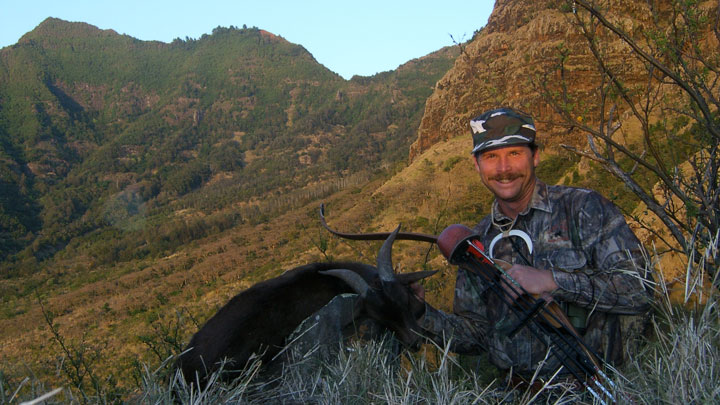
Author poses with a downed billy, Hawaiian mountains in the background.


DIY in Hawaii
In my opinion, the finest opportunities for the do-it-yourself hunter in Hawaii are found in backcountry settings, meaning you’ll have to hike to access them. Most of the islands offer public lands that anyone can hunt. Those lands are often surrounded by private property, but there are usually trailheads that offer access. An experienced mountain hunter can rapidly get into good hunting, but don’t make the mistake of expecting the hunting to be easy.

My first hunt on the islands was a fast-and-light excursion into the cliffs after wild goats. I stuffed a sleeping bag, some water and my takedown recurve bow into my pack, and climbed through the cactus and thornbush on the dry side of the island toward the base of a cliff. I had only 24 hours to hunt. A thousand feet above the sea I found goats, stalked the band for several hours and finally placed an arrow through a young billy. I watched him tip over dead, but his last kick sent him sliding over a cliff. Fortunately, I was able to find my way down to him and got some photos as the sun set across the sea far below. I quartered the goat out, hung the meat in a tree and slept the night on the mountain before packing out to the trailhead, 22 hours after I’d headed up. It was awesome.
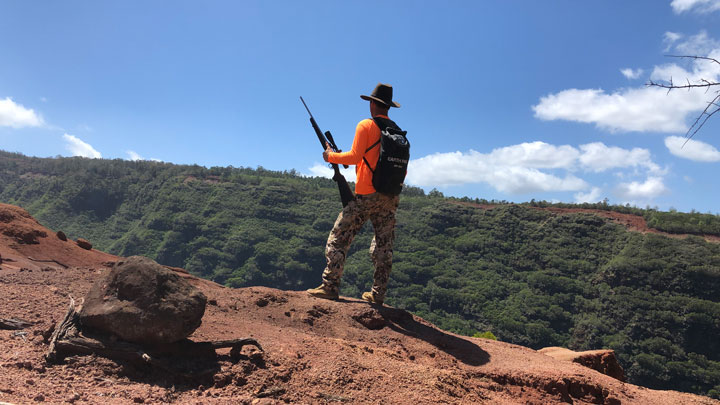
Hunter with a skyward rifle pressed to his thight stands, looking out over a cliff


Seasons and Species
None of the big-game species found on the islands are indigenous. They have no natural predators, and some of the species proliferate so effectively they become problematic to the island habitat. As a result, seasons are long and limits incredibly generous. Huntable species vary from one island to another. If I’m not mistaken, pigs and goats can be hunted on almost all the islands, with mouflon sheep, axis, whitetail and Colombian blacktail deer huntable on select islands. Often the limit is one or two animals of each species per day. While you shouldn’t expect to fill those limits due to tough terrain, smart wildlife and dense vegetation, it’s still awesome to go hunting with “tags” in your pocket for multiple deer, goats and hogs every day. (No tags are needed in most areas, though you must have a license.)

Season dates are usually long, lasting months on end. Often there are several days (usually, but not always, Tuesday through Thursday) that are closed to hunting every week. Rules and regulations can be extensive and confusing, and vary from island to island and unit to unit, so be sure you study them well.

Hunting and Fishing Licenses
Obtaining a hunting license in Hawaii is not difficult, but you must plan ahead. Your stateside Hunter’s Education certificate is valid in Hawaii, but must be approved before you can buy a license. This can take three weeks or more. Paperwork and details are available online, but don’t fail to submit it at least a month prior to your trip. Island time is pretty awesome unless you’re waiting on something important like a hunting license. Have your approval letter in hand well before your trip, then you can walk into any game office and purchase your license on the spot. If you’ll be bowhunting, you may need an extra certificate. Everything should cost you right around $100. As of my last visit, no fishing license was required to fish from the beach with rod or spear, but be sure and check the regulations for the island you’re on.

Hawaiian DFG Kiosk


Checking In
Each hunting area on the islands features a check-in station. These vary from a simple kiosk, where you open a lid and sign in, to more elaborate stations offering maps, information and sign-in portals. In my experience, the local hunters take this process seriously, which inspires me to take it seriously, as well. After your hunt, you’re required to sign out and report any game harvested.

Rifle or Bow
One of my toughest dilemmas when planning a hunt to Hawaii is whether to hunt with bow or rifle. A bow requires no paperwork or permitting, while using a rifle requires you to undergo a significant permitting process, including being fingerprinted and registering the rifle at the police station within five days of arrival. You must have an address where the rifle will be kept, and it’s supposed to stay at that address unless at the range or hunting.

Another thought-provoking element that should influence your decision is the fact that many of the good local hunters consider 40 yards to be a rather long shot at either deer or hogs. Most are closer due to the dense jungle vegetation, somewhat equalizing the effective range of bow and rifle.
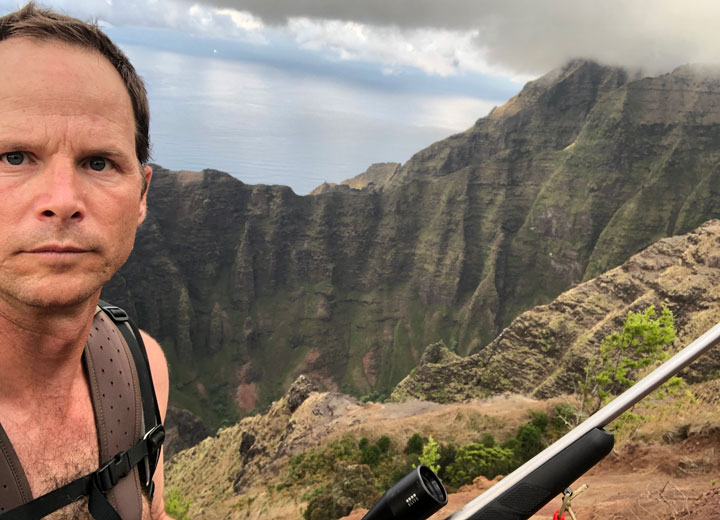
Hunter with pack and rifle looks into camera, with cliffs in the background.

That said, on a recent hunt to the islands, I passed up shots at five deer at distances greater than 250 yards. They were across a canyon, and while I was confident I could harvest them cleanly, I was not confident I could cross the canyon and recover them. Deer on that particular island are plentiful, but extremely hard to find and harvest—indeed they seem to be the Holy Grail of game there. I left my perch on the ridge exuberant at just seeing a deer, let alone five—the knowledge that I could have killed them was icing on the cake. I just needed to find a way across that canyon.

Most, if not all of the islands have archery-only units offering better access and more liberal hunting dates. It is my opinion that, all things considered, you’re usually better off hunting Hawaii with a bow than a rifle. You’ll simply experience more and better opportunity.
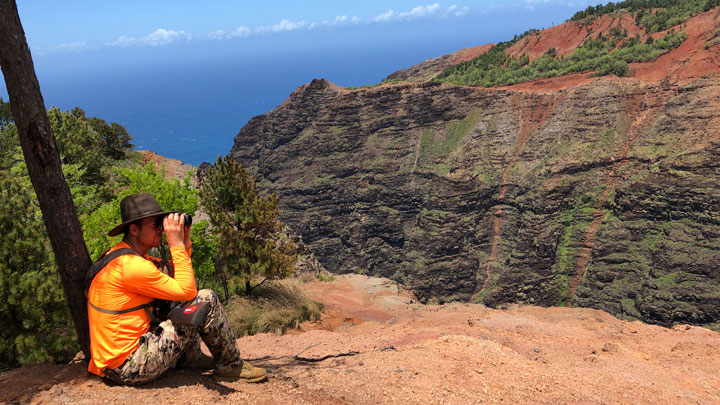
Hunter sits cross-legged by a tree, and glasses a nearby ridgeline from the top of a cliff.


Respect the Locals
There is a strong hunting tradition among the islanders, and in my opinion, it’s important to recognize and respect that. After all, those folks live and hunt there, often depending on the hunting for meat and recreation. You’re the visitor, so try to find ways and places to hunt that don’t intrude. It’s the ethical thing to do, and it may keep you out of a confrontation that’s not likely to end in your favor.

Wild Hawaiian berries and plants.

Ropes, Crampons and Taking the Shot
On my last trip (the same one where I passed up the five deer), I hunted my way down a giant ridge that hung above the sea like some primeval monster. I was looking for goats, and I found them. Several big billy goats strutted around, checking females and hunting breakfast in the sunshine of a beautiful Hawaiian morning. They were within easy range of my rifle and I spent hours shadowing them, watching my crosshairs on their ribs. The problem was, the cliffs they were living in were steep enough to scare an eagle, and there was no way I could access a goat had I shot one.

Some Hawaiian goat territory is not so steep and dangerous, but much of it is. You’ve got to be careful, especially when hunting solo, as I was. Next time I climb the ancient volcanic ridges of the islands hunting goat, I plan to have a set of strap-on crampons for my shoes, and several hundred feet of climbing rope. That way, if I shoot a goat, I’ll have the right tools with which to recover it.

The terrain on the islands—especially when hunting goats—can be extreme. Be prepared to pass up shots at animals you can’t ethically and safely recover. There will be some, even when you have crampons and climbing ropes. A goat or a deer is not worth risking a fall to your death, even in the most enchanting place on earth.
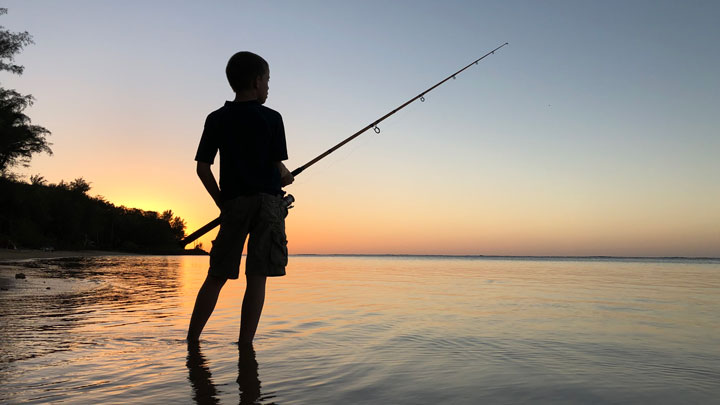
Boy with a fishing rod on a Hawaiian beach stands silhouetted against the setting sun.


Coolers and Meat Care
One of the biggest challenges to hunting on the islands is keeping your meat safe after the harvest. Humidity and heat are a constant challenge. I use a YETI cooler full of ice, and bury my meat in the ice as soon as I get it to the truck. The YETI is super tough and keeps the meat and ice cold for a good long time.
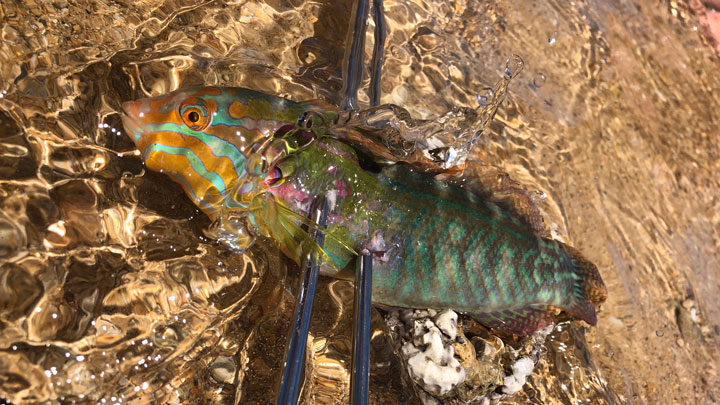
Fish with spears protruding


Fishing the Reefs
Thousands of colorful and tasty fish cruise inside the reefs that ring the islands. You can catch them with a little piece of raw shrimp on a hook cast into a channel or pocket in the reef, or spear them while snorkeling with a traditional three-prong Hawaiian spear. The locals set giant poles rigged with big hooks cast far out into the channels, with a bell to wake them if a big fish or shark strikes during the night. Fishing from the shore does not require a license, and you can pick up a basic rod and reel or a three-prong spear for $50 at the local Ace Hardware store. There are minimum-length requirements for the fish you’re allowed to spear, so study the regs before you snorkel into the blue yonder with your three-prong. Fish look bigger underwater than they actually are, so make sure they’re big enough before loosing your spear.

Two young girls enjoying shave ice, one throwing up the traditional Hawaiian, hang loose hand signal.


“Relax, This Ain’t the Mainland”
It’s one of my favorite sayings on the islands. Life and attitude are different there; being on time is not real critical, drivers are very courteous (even in heavy traffic) and people are not as tense and stressed. I love the feeling.

Being able to hike and eat guava fruit and thimbleberries picked fresh along the mountain trail is pretty awesome, too. Hunting through dense jungle, stalking along towering green cliffs draped with waterfalls and listening to the surf as the sun sets over the sea all combine to make the islands one of my favorite places on earth to hunt.

And of course, there are the sandy beaches, the snorkeling, surfing and the Shave Ice. Always the Shave Ice.

Categories
All About Guns

THE WEBLEY REVOLVER: SIDEARM OF AN EMPIRE By Will Dabbs, MD

September 15, 1916, was a Friday. As dawn broke on this fateful day, the French 6th and British 4th Armies squared off against the Imperial German 1st Army in France. This assault precipitated the third phase of the Battle of the Somme, World War I’s largest engagement on the Western Front. Some three million men tore at each other, spilling a veritable sea of blood. Fully a third fell as casualties. The Battle of the Somme was one of the costliest conflicts in human history.

Webley Mk IV revolver
The Webley Mk VI was prized for its innate accuracy as well as the knockdown power of its massive .455 cartridge.

While the Battle of the Somme established any number of milestones in mankind’s timeless effort to annihilate itself, it also saw the first massed employment of tanks. The British Mk 1 tanks used during this engagement were intended to provide mobility.

In a war characterized by a ghastly protracted stalemate, these advanced wonder weapons were expected to be the catalyst that got the Tommies up and out of their trenches and into the mobile fight. The lessons learned from this early armored assault shape land warfare to this very day.

The Mk 1 tank came in two broad variants denoted by the strangest terminology. One version sported a crew of eight, three Hotchkiss 8mm machineguns, and two 6-pounder cannons. This version was called the “Male.” Sporting a top speed of 3.7 miles per hour and an all up weight of 28 tons, the Mk I Male packed the heaviest punch.

British Mk I Tank Male
The Mk 1 “Male” tank was the cannon-armed version of the basic British heavy tank of World War I.

The “Female” version weighed 27 tons and carried four .303-in Vickers guns as well as one French Hotchkiss. These things were crammed with machinegun ammunition and served to support the cannon-armed Male versions as well as friendly infantry. Both contraptions were little more than death traps. The noxious fumes from their primitive internal combustion engines quite literally poisoned the crews at times. They also horrified the Boche.

Lieutenant Arthur Herbert Blowers commanded D5, one of the female tanks. Blowers was born on November 5, 1891, in Knodishall, Suffolk, the 13th of 14 siblings. He called his radical new armored war machine “Dolphin.”

Lt. Arthur Blowers
Lt. Arthur Blowers showed tremendous valor in leading his crew back to friendly lines during the Battle of the Somme.

Blowers and his crew guided the Dolphin across No Man’s Land as part of a coordinated assault against the German trenches. They made excellent progress at first, but eventually the Boche begin swarming the vehicles. German artillery in the direct fire mode took a toll as well. Most of the British tanks were eventually disabled or destroyed. However, their appearance on the battlefield signaled a paradigm shift in the nature of ground combat.

With the Dolphin immobilized by artillery, Blowers and his men burned through the entirety of their belted ammunition for all five of their machineguns. By now the tank was on fire, and the crew was forced to abandon it. It was here that Lt. Blowers’ day got truly interesting.

Webley Mk VI revolver that LT Blowers carried
The Webley Mk VI revolver LT Blowers carried during the Battle of the Somme is currently on display at the Bovington Tank Museum in England.

Once clear of the tank, Lt. Blowers took a piece of shrapnel to his head that he ultimately carried with him to the grave. Blowers nonetheless still returned to the burning Dolphin to rescue his driver trapped inside. With the wounded man in tow, he then made his way back to friendly lines armed with nothing more than his issue Mk VI Webley revolver.

Lt. Blowers later said of that trusty pistol, “I fired over a hundred rounds … none of the targets was more than about 10 yards away, so I didn’t miss many!”

The Weapon

The handgun Lt. Blowers used to fight his way back across No Man’s Land was known as both the Webley Top-Break Revolver or the Webley Self-Extracting Revolver. The gun served for three-quarters of a century as the standard-issue service pistol for the British armed forces. Introduced in 1887, the Webley was not retired until 1963. Though offered in both .455 and .38/200 chamberings, the basic mechanism remained unchanged.

Different caliber Webley revolvers compared
Webley and Scott revolvers armed British forces for more than 75 years. The .38-caliber Mk IV is shown on the left alongside the .455 Mk VI.

The Webley was produced in six different “Marks”, starting in 1887. The majority of the guns in service were the Mk IV in .38/200 and Mk VI in .455. The Mk IV saw extensive service during the Boer War, while the heavier Mk VI was introduced in 1915 for service throughout World War I. Roughly 600,000 copies were produced.

The Mk IV .38-caliber Webley launched a fairly uninspired .38/200 round, also known as the .38 Super Police. The .38/200 cartridge pushed a 200-gr. soft lead bullet to around 600 feet per second. Despite its marginal ballistics, this long soft bullet did tend to destabilize in flesh and create impressive wounds.

Webley-Fosbery automatic revolver
The Webley-Fosbery automatic revolver was a unique design.

Subsequent Mk VI Webley revolvers were chambered for the heavy .455 rimmed cartridge. Many of these surplus WWI-era wheel guns had their cylinder faces shaved to accept .45 ACP rounds on moon clips. However, the pressures generated by .45 ACP cartridges far exceed those of even .455 proof loads. Many modern shooters running these shaved Mk VI pistols will handload underpowered .45 ACP rounds and feed them using pressed steel clips.

Mechanical Details

The Webley’s double-action/single-action (DA/SA) trigger combined with its top-break action made the old British wheelgun exceptionally efficient for its genre. The top-break design made for exceptionally fast reloads. Pressing the release catch and tipping the barrel down and forward automatically activated the Webley’s star-shaped extraction system. This exercise extracted and ejected all six cases in a single move.

Webley revolver war finish
The Webley revolver proved itself time and again for the British, and was produced in very large numbers — often under the pressure of wartime needs.

While individual cartridges still had to be tediously loaded one round at a time, running the gun was still markedly faster than a more traditional weapon like the Colt Single Action Army. The Webley represented the state of the art for its day.

Their Money’s Worth

If properly maintained, these rugged revolvers last about forever. As these old vintage guns soldiered on into the 1960s, the limiting reagent became their weird, obsolete ammunition. A British armorer tasked with maintaining these weapons in active military service in Germany in the 1960s was quoted as having said the ammo allotment would be, “two cartridges per man, per year.”

Top break action of Webley revolver
The top-break design of the Webley wheelgun offered fast ejection of empties.

The British also fielded a similar pistol called the .38/200 Enfield No 2. The Enfield looked a bit like the Webley but was mechanically dissimilar. The Mk1* was the same Enfield revolver with the hammer removed for double-action-only operation. Bobbing the hammer spur helped keep the gun from catching on stuff within the confines of an armored vehicle.

One of the more bizarre variants of this rugged design was the Webley-Fosbery automatic revolver. Produced for 15 years starting in 1900, this weird autoloading wheelgun included a sliding upper half driven by recoil forces. This complex mechanism indexed the cylinder and cocked the hammer automatically. The result was a light, pleasant trigger that made it a popular target gun. Vintage Webley-Fosbery revolvers are just stupid expensive these days.

Denouement

At a time when most of the world was fielding advanced autoloading designs, the British filled the hands of their tankers and fliers with this 19th-century DA/SA break-open wheelgun. As a result, the Webley family of revolvers endeared itself to generations of Englishmen. Alongside iconic weapons like the Spitfire fighter, the Sten submachine gun and the Lee-Enfield rifle, the Webley revolver subsequently came to represent the long arm of the British Empire.

Webley revolver and Enfield rifle
Webley revolver, shown with Enfield SMLE rifle in .303 British.

Arthur Herbert Blowers was quite a piece of work. Later in life, he said when boredom overtook him in the trenches he purportedly would leap up and race along the parapet of the British trenches in full view of the German gunners. His goal would be to reach the next opening in the defensive works before the Maxim gunners could wake up and draw a bead on him. They just don’t make them like that anymore.

Cpt. Arthur Blowers died in Spixworth, Norwich, Norfolk, United Kingdom of liver cancer in 1980. He was 89. His actions leading the armored assault deep into German lines and subsequently rescuing his crew under fire earned him the Military Cross, Britain’s third-highest award for gallantry in action. The remarkable Webley Mk VI revolver that he carried during that engagement is on display at the Bovington Tank Museum in Southern England today. Arthur Blowers was a larger-than-life hero and an archetype for the indefatigable British soldier.

Categories
All About Guns

Cameron fires the .700 Nitro Express

Categories
All About Guns Allies

Must be Texas!

Categories
All About Guns Allies

Santa has his sh*t together

Categories
All About Guns

Shooting a marlin dark 30-30

Categories
All About Guns Soldiering War

Sharpshooter Showdown: A Friendly Contest Among History’s Finest Snipers Lyudmila Pavlichenko, Chris Kyle, Simo Hayha and Carlos Hathcock: Who would win? by DAVID HERMAN

man shooting long-range from prone position

American Sniper; Shooter; Enemy at the Gates; the public’s fascination with sniper movies is both old and well-documented. Of course, this is not without reason. From old Jack Hinson to more well-known figures like Vasily Zaytsev, men and women who can hit targets at fantastic distances have gained a mythic status, even amongst other shooters, who attribute an almost black-magic ethos to practitioners of the art. This being America however, the home of competitive spirit, we’ve decided to take our admiration one step further on this Throwback Thursday. Of four of the best-known snipers—Chris Kyle, Carlos Hathcock, Simo Häyhä and Lyudmila Pavlichenko—who would come out on top in a friendly, but realistic, shoot-off?

To properly hold a contest of course, we’ll need some basic parameters by which to judge our contestants. So why not mimic the current real-world test of sniping skill, the International Sniper Competition, held annually at Fort Benning, Georgia? Not simply a test of shooting prowess, the International Sniper Competition tests mental and physical endurance, as well as the ability to evade detection. Thus we will use anecdotes from the careers of our contestants to roughly evaluate the following three parameters: accuracy; endurance; and stealth.

Fourth Place-Chris Kyle

The protagonist of American Sniper, Chief Petty Officer Chris Kyle is undoubtedly the most well-known sniper of recent years. With a Silver Star and four Bronze Stars with valor (among other awards), it’s not hard to see why. Kyle grew up hunting the Texas countryside with his father, before becoming a rodeo rider and attending several years of college. Having already lived more in 25 years than most have in 60, Kyle then joined the Navy SEALS, where he was assigned to SEAL Team-3, sniper element, Platoon “Charlie.”

Serving in many of the major battles of the Iraq war, Kyle stacked up more than 150 confirmed kills, earning him a bounty on his head that started at $20,000, and was later increased to $80,000. His most impressive was what he described as a “straight-up luck shot” from 2,100 yards, using his McMillan TAC-338 sniper rifle. Chris served four tours of duty in the Iraq War, which he survived despite being shot twice, and being involved in six IED detonations.

All of the above means Kyle was one impressive shooter, but on this list that’s almost a prerequisite. For endurance, the man served four tours despite being wounded multiple times, so he earns some definite points there. As far as stealth is concerned, however, there are no reported instances (at least, not available to us civilians) which attest to any particular ability to stay hidden. In fact, given that he often served as overwatch for teams of door-kickers, it’s reasonable to assume that concealing himself was never something of especial concern (relative to the other snipers we will come to, who often worked alone and behind enemy lines). Thus, Chief Petty Officer Kyle occupies position four on this list.

Third Place- Lyudmila Pavlichenko

The infamous “Lady Death,” bane of Nazi existence, comes next. Lyudmila Pavilchenko was born in Bila Tserkva, in what is now Ukraine. He early shooting skills were molded in the local OSOAVIAKhIM paramilitary youth program, where she achieved the “Voroshilov Marksman” badge, second degree, entailing not just sharpshooting, but also but also navigation, grenade throwing and physical training. While she left the program in her early adulthood, she returned to it as the clouds of war formed over Europe, enrolling in the two-year OSOAVIAKhIM sniper course in Kiev which familiarized her with the Mosin model 1891/1930 she was later to carry.

When Pavilchenko first attempted to enlist in the armed forces in 1941, she was turned away with an admonishment to try nursing. Luckily for the USSR, she was far too persistent to listen, and enrolled the next day in the 25th Chapayev Rifle Division. When she finally got her hands on an old Mosin (she had to take it from a fallen comrade), Lyudmila already knew its intricacies and weaknesses. She removed wood from the forend allowing her to better bed the barrel, filed the gunstock tip, padded where the receiver and magazine join and filed the bolt mechanism to ensure reliability.

Once the rifle was up and running, Pavilchenko wreaked a line of havoc across Odessa, Moldavia and Sevastopol. In just 11 months, she notched 309 confirmed kills, 36 of which were enemy snipers she stalked and dispatched. The most famous instance of this saw a three-day cat-and-mouse battle between her and an enemy sniper. When she felled him on the third day, Pavilchenko simply remarked, “he made one move too many.” Pavilchenko became such a thorn in the Germans’ side that they attempted to affect her defection by offering her chocolate and an officer’s rank over loudspeakers. When that didn’t work, they turned their rhetoric to naked threats, warning she would be torn to shreds. The Russians however, as ecstatic with her performance as the Germans were annoyed, promoted her all the way to Junior Lieutenant.

Unfortunately, this increased attention eventually caught up with Junior Lieutenant Pavilchenko. In June 1942, she was grievously wounded when an artillery barrage blew off half her right ear. She spent the rest of the war touring the USSR and the USA, in an attempt to inspire morale, and convince America to open a second front in Europe.

Junior Lieutenant Pavilchenko’s marksmanship, not to mention her technical know-how in reconstructing her rifle, are quite impressive. Staying hidden from a sniper on her trail for three days, ultimately besting him, is even more so. For these reasons alone, Junior Lieutenant Pavilchenko arrives at third place on our list.

Second Place-Carlos Hathcock

I can hear the angry Marines at my door already. Please keep in mind that second-best among some of the most legendary combat shooters in history is still rarified air by any stretch of the imagination, and Gunnery Sergeant Hathcock certainly has the lungs to breathe it. Utilizing a self-converted M21 Springfield variant he dubbed the M25 “White Feather”, after the nickname given him by the People’s Army of Vietnam (PAVN) for the tall feather he wore in his bush hat, Hathcock made his presence well known in-country. Already an experienced shooter prior to combat service, Hathcock grew up hunting on visits to his relatives in Mississippi, and later shot competitively. This culminated in his winning the Wimbledon Cup at Camp Perry in 1965.

On the battlefield, these skills served Hathcock well. He racked up a deadly reputation, with his fellow Marines dubbing him “the Legend” for countless incredible deeds. While his sheer number of downed enemy is certainly impressive, sitting at 93 confirmed (but more likely between 300 and 400, considering no third party was ever present to “confirm” things when he was behind enemy lines), his skill and tenacity is far more so. The PAVN themselves placed a $30,000 bounty on his head for killing so many of their own snipers. One of his most famous deeds occurred in just such a counter-sniping scenario, when seeing the glint off an enemy sniper’s scope, he shot him directly through the scope’s tube. While he claimed the damaged rifle, hoping to bring it home as a trophy, it was unfortunately stolen from the armory and lost to history. Another display of skill, not to mention sheer grit, came when he inched his way over 1,500 yards across a field, over four sleepless days and three nights, to eliminate a PAVN general. During this ordeal, he remained hidden despite almost being bitten by a bamboo viper, and stepped on by an enemy patrol

In 1969, Hathcock’s wartime career came to an unfortunate end when his LVT-5 struck an anti-tank mine. While the burns he sustained were too severe for him to return to combat, Hathcock continued his work on the home front, helping to establish the Marine Corps Scout Sniper School at the Marine base in Quantico, Virginia.

While he may never have made a shot at 2,100 yards like Chris Kyle, Hathcock’s skill with the old M21 was impressive. After all, placing a bullet through another’s scope, a feat so incredible it was officially “busted” on the Discovery Channel program Mythbusters, cannot be overstated. As far as mental and physical endurance is concerned … have you ever stayed awake for 84 hours to crawl across a field of snakes? Has ANYONE else, for that matter?? He also managed to stay fully hidden during this feat, earning him high marks across both our final two categories. Gunnery Sergeant Hathcock, therefore, sits at position two on our list.

First Place-Simo Häyhä

Simo Häyhä, the unassuming wintertime warrior from Finland, unquestionably wins this contest. Born in the rural Küskinen, Rautjärvi province (which is now Russian territory), Häyhä honed his skills from a young age, hunting in the Finish woods around his home. At the age of 17, he joined the Rautjärvi Civil Guard, and later served mandatory conscription in the Army from 1925-1927, in Bicycle Battalions 1 & 2. After being discharged, he continued on in the Civil Guard, winning numerous Viipuri Civil Guard regional competitions throughout the 1930s. Outside of the guard, his primary living was made as a hunter and trapper, meaning that in all areas of his life, a rifle rarely left Häyhä’s hands.

When the Winter War began, with Russia conducting a false-flag shelling of its own village of Manilla to initiate conflict, 450,000 Soviet troops poured over the Finnish border. His abilities quickly recognized, Häyhä was immediately relied upon to take out high-value targets others could not reach. Counter sniping, therefore, became his primary responsibility. This particular duty meant Häyhä conducted his business primarily with iron sights, an unthinkable method for a 20th century sharpshooter. He did this to prevent other snipers from spotting him in the snow, where the telltale glint of a scope could prove fatal. At one point, Häyhä even dislodged a well dug-in enemy sniper at 400 yards with such a setup. Eschewing any and all comforts in pursuit of his craft, Simo regularly removed his gloves to use them as a rifle rest, despite weather that dipped to -43 degrees Celsius, and filled his mouth with snow to eliminate the steam from his breath.

As the small ranks of the Finnish military required even snipers to pull double duty, Häyhä was sometimes called upon to fight in close. During one such occasion, he crawled silently with his comrades almost to the light of a Russian campfire, before opening fire on the unsuspecting soldiers and making off with their weaponry. All this technique, daring and skill led Häyhä to rack up 542 confirmed kills over just 98 days on the Kollaa front. The Soviets became so frustrated with the devastation he wreaked that they began to call down artillery strikes onto his suspected positions. But Häyhä always escaped into the safety of the forests, leading the Finnish media to bestow upon him the moniker of “White Death,” for his ability to materialize, kill, and vanish into the snow without a trace.

Finally, on March 6, 1940, Häyhä was grievously wounded in close-quarters combat in the forests of Ulismaa. A Russian infantryman hit Häyhä in the jaw with an exploding bullet, shattering the bone and half his face. Despite being taken for dead and thrown onto a pile of corpses (according to one story, anyway), Häyhä was recognized as alive when someone saw his boot twitching around, and was transported to the hospital on a sleigh. There Häyhä remained in a coma for seven days, until March 13. By the time he awoke, the war was over.

Häyhä ‘s prowess not just with a rifle, but with a fully unmagnified one, puts him atop our list for sharpshooting skill. The endurance displayed despite the bitter cold and long odds lend him high marks there as well, while finally, his total evasion of airstrikes and counter-snipers, only eventually being wounded when acting as infantry in a pitched battle, combine to thrust Second Lieutenant Häyhä to the top of our list.

We hope you’ve enjoyed this Throwback Thursday sniper shoot-off. For more on Simo Häyhä and Lyudmila Pavilchenko in particular, check out the following stories right here at nrafamily.org:

Categories
All About Guns Art

Awesome!

Tumblr media

Categories
All About Guns

Henry Single Shot Slug Barrel Review : Advantages of Single Barrel Shotguns

Categories
All About Guns

Ruger SR1911 Light Weight Commander 45 Hand Engraved