



A possessed sentient car that locks you inside and then goes where it
wants is actually a pretty terrifying concept. Source: Wikipedia/Vmanjr.
Kids today simply have no idea how cool it was to grow up in the 1970s. Telephones were the size of a loaf of bread and were tethered to the wall. Serious computers would fill a typical bedroom. Fashions of the day could precipitate blindness if gazed upon unduly, and big garish conversion vans were cool rather than creepy. And then there were the movies…
We are spoiled rotten to movies these days. Most anything ever put to film is just a few keystrokes away any time of the day or night. Back then, however, the movie theater was the cultural epicenter of my tiny little Southern town.
Ours was titled the Boswell Showcase, and it was not much larger than a decent barn. You found out what was playing by riding your bike by to check the posters outside or looking in the newspaper (an actual thing made of paper that later did double duty as a toy boat, hat or fire starter). When something extra cool debuted, it left the entire town abuzz. One such tour de force event was “Herbie: The Love Bug.”

“Herbie: The Love Bug” was shockingly popular given its vapid premise. Source: Wikipedia.
The original “Herbie” movie hit the big screens in 1968. It was the second-highest-grossing film in theaters that year. The narrative orbited around an adorable little Volkswagen Beetle that was apparently, with the benefit of hindsight, demonically possessed.
The diminutive car sported a prominent racing stripe and the number “53” emblazoned along its side. The car drove itself, manipulated the humans around it to do its bidding, and just generally did adorable things that would be pretty darn horrifying in the real world. That first movie spawned four sequels. In 1977, that would be “Herbie Goes to Monte Carlo.”
1977 also saw the premiere of “Star Wars,” and Jaws hit two years before. The Hollywood bar was set fairly high. It became obvious that making Herbie’s latest escapades through the French Riviera financially viable was going to require some sort of gimmick. The gimmick in Clarksdale, Miss., came in the form of the coolest little Herbie go-kart.
A Near-Religious Experience
There were clearly not as many trial lawyers around back in 1977 as there are today because this thing was a death trap. The go-kart in question was a simple, no-frills rig powered by a Briggs and Stratton lawnmower engine and adorned with a fiberglass Herbie shell. It sat in the lobby of the movie theater so that all the passing kids could adequately lust after it. To make this rolling death machine your own, all you had to do was write your name and phone number on your ticket stub and drop it into a container. When the movie’s run was complete, they would raffle off the kart.
I likely saw that stupid movie half a dozen times. I coveted that go-kart in a manner that bordered upon unseemly. I literally prayed for that thing. No kidding, I promised God that if He would give me that Herbie go-kart, I would gladly become a preacher. I actually offered a life of full-time Christian service in exchange for that cheesy motorized suicide sled.
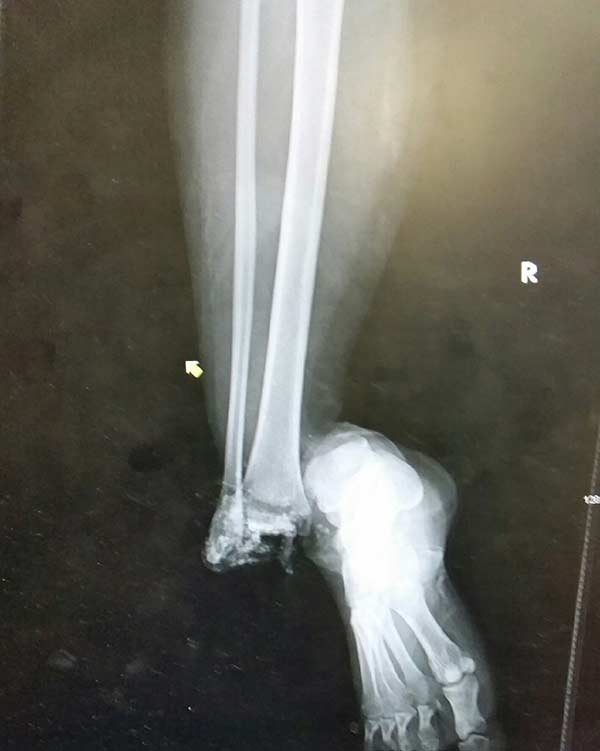
4-wheelers and go-karts can be terribly dangerous. I really didn’t want this to happen to my mom.
On the appointed day, not only did I not win the go-kart, but a scruffy little kid right down the street did.
You need to understand, in the 1970s, there were essentially no rules as we might imagine them. The little menace tore up and down public roads in that thing at all hours, and nobody cared. He bounced across lawns and spun out in driveways. Folks back then just thought it was cute. As I sat in my room and stewed over this travesty, I had to listen to that neighbor kid screaming back and forth right outside my window in what should rightfully have been my Herbie go-kart. It was enough to make an 11-year-old question his religion.
Then, one day I heard a fearsome commotion outside. I tore out my front door to find a modest crowd gathered around the Herbie go-kart, now upended. The lucky kid’s mom had taken a spin in the thing and had inadvertently gotten her foot through the bottom of the frame. As this was the 70s, she was wearing neither shoes nor a helmet. Her bare toes caught on the asphalt with predictable results. It was literally months and a couple of nasty surgeries before she could walk again.
Ruminations
The whole sordid experience taught me a great deal about life. I love my mom … I mean, a lot. I really wouldn’t want to see her foot all but torn off in a horrible go-kart accident.
Perhaps with the benefit of hindsight, God knew more about what was best for me than I did. That simple yet timeless truth has since carried me through several careers, and a life aggressively lived. And that’s also how close I came to a career not as a physician, engineer, pilot, and writer, but as a Baptist minister.

There are few places on earth more enchanting than the isles of Hawaii. Most people think of Hawaii in terms of beautiful, well-groomed resorts, turquoise water, extravagant gift shops and Shave Ice. Not me. I think of Hawaii in terms of hunting abundant game through almost-impenetrable jungle, sheer cliffs plunging to the sea, guava fruit hanging ripe along steep mountain trails and kaleidoscope schools of fish just out of reach of my three-prong spear. And Shave Ice.
Hawaii is a relatively unknown sportsman’s paradise. Truth be known, there is more hunting opportunity to be found along the jungles and cliffs of the islands than in most of the mainland states.
DIY in Hawaii
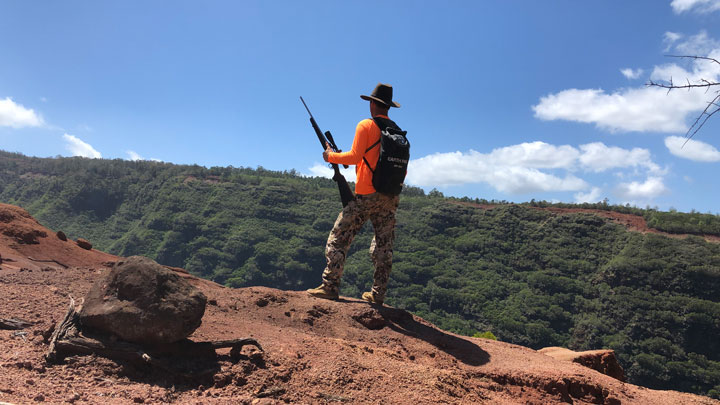
In my opinion, the finest opportunities for the do-it-yourself hunter in Hawaii are found in backcountry settings, meaning you’ll have to hike to access them. Most of the islands offer public lands that anyone can hunt. Those lands are often surrounded by private property, but there are usually trailheads that offer access. An experienced mountain hunter can rapidly get into good hunting, but don’t make the mistake of expecting the hunting to be easy.
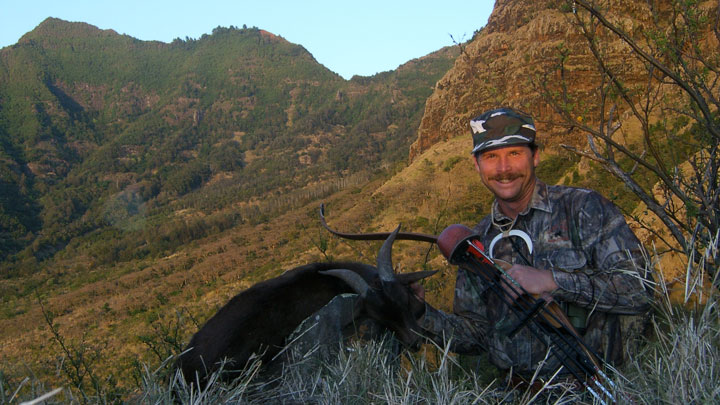
My first hunt on the islands was a fast-and-light excursion into the cliffs after wild goats. I stuffed a sleeping bag, some water and my takedown recurve bow into my pack, and climbed through the cactus and thornbush on the dry side of the island toward the base of a cliff.
I had only 24 hours to hunt. A thousand feet above the sea I found goats, stalked the band for several hours and finally placed an arrow through a young billy. I watched him tip over dead, but his last kick sent him sliding over a cliff. Fortunately, I was able to find my way down to him and got some photos as the sun set across the sea far below. I quartered the goat out, hung the meat in a tree and slept the night on the mountain before packing out to the trailhead, 22 hours after I’d headed up. It was awesome.
Seasons and Species
None of the big-game species found on the islands are indigenous. They have no natural predators, and some of the species proliferate so effectively they become problematic to the island habitat. As a result, seasons are long and limits incredibly generous. Huntable species vary from one island to another. If I’m not mistaken, pigs and goats can be hunted on almost all the islands, with mouflon sheep, axis, whitetail and Colombian blacktail deer huntable on select islands. Often the limit is one or two animals of each species per day. While you shouldn’t expect to fill those limits due to tough terrain, smart wildlife and dense vegetation, it’s still awesome to go hunting with “tags” in your pocket for multiple deer, goats and hogs every day. (No tags are needed in most areas, though you must have a license.)
Season dates are usually long, lasting months on end. Often there are several days (usually, but not always, Tuesday through Thursday) that are closed to hunting every week. Rules and regulations can be extensive and confusing, and vary from island to island and unit to unit, so be sure you study them well.
Hunting and Fishing Licenses
Obtaining a hunting license in Hawaii is not difficult, but you must plan ahead. Your stateside Hunter’s Education certificate is valid in Hawaii, but must be approved before you can buy a license. This can take three weeks or more. Paperwork and details are available online, but don’t fail to submit it at least a month prior to your trip. Island time is pretty awesome unless you’re waiting on something important like a hunting license. Have your approval letter in hand well before your trip, then you can walk into any game office and purchase your license on the spot. If you’ll be bowhunting, you may need an extra certificate. Everything should cost you right around $100. As of my last visit, no fishing license was required to fish from the beach with rod or spear, but be sure and check the regulations for the island you’re on.
Checking In
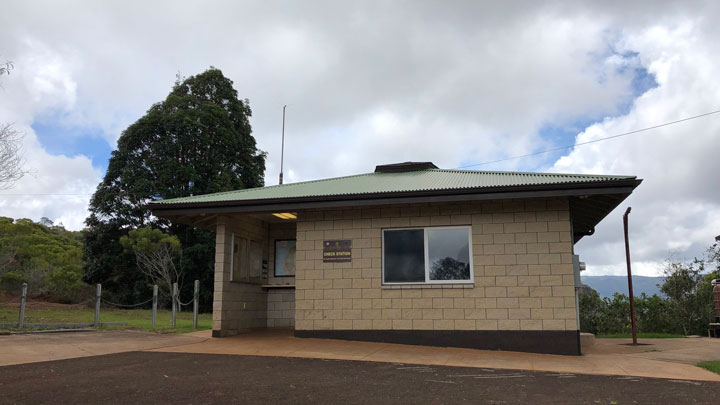
Each hunting area on the islands features a check-in station. These vary from a simple kiosk, where you open a lid and sign in, to more elaborate stations offering maps, information and sign-in portals. In my experience, the local hunters take this process seriously, which inspires me to take it seriously, as well. After your hunt, you’re required to sign out and report any game harvested.
Rifle or Bow
One of my toughest dilemmas when planning a hunt to Hawaii is whether to hunt with bow or rifle. A bow requires no paperwork or permitting, while using a rifle requires you to undergo a significant permitting process, including being fingerprinted and registering the rifle at the police station within five days of arrival. You must have an address where the rifle will be kept, and it’s supposed to stay at that address unless at the range or hunting.
Another thought-provoking element that should influence your decision is the fact that many of the good local hunters consider 40 yards to be a rather long shot at either deer or hogs. Most are closer due to the dense jungle vegetation, somewhat equalizing the effective range of bow and rifle.
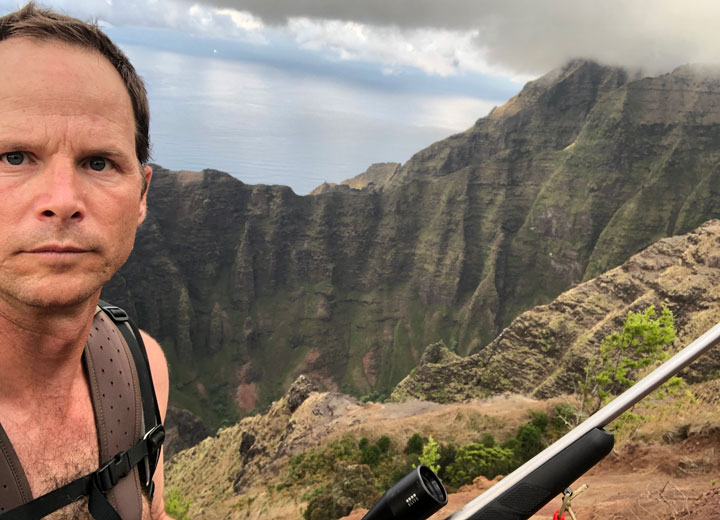
That said, on a recent hunt to the islands, I passed up shots at five deer at distances greater than 250 yards. They were across a canyon, and while I was confident I could harvest them cleanly, I was not confident I could cross the canyon and recover them. Deer on that particular island are plentiful, but extremely hard to find and harvest—indeed they seem to be the Holy Grail of game there. I left my perch on the ridge exuberant at just seeing a deer, let alone five—the knowledge that I could have killed them was icing on the cake. I just needed to find a way across that canyon.
Most, if not all of the islands have archery-only units offering better access and more liberal hunting dates. It is my opinion that, all things considered, you’re usually better off hunting Hawaii with a bow than a rifle. You’ll simply experience more and better opportunity.
Respect the Locals
There is a strong hunting tradition among the islanders, and in my opinion, it’s important to recognize and respect that. After all, those folks live and hunt there, often depending on the hunting for meat and recreation. You’re the visitor, so try to find ways and places to hunt that don’t intrude. It’s the ethical thing to do, and it may keep you out of a confrontation that’s not likely to end in your favor.
Ropes, Crampons and Taking the Shot
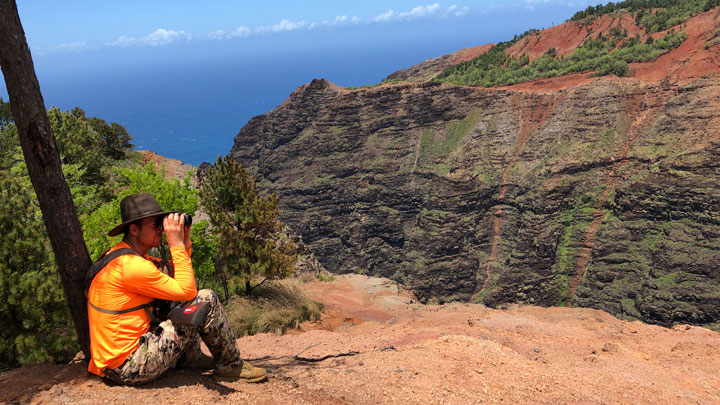
On my last trip (the same one where I passed up the five deer), I hunted my way down a giant ridge that hung above the sea like some primeval monster. I was looking for goats, and I found them. Several big billy goats strutted around, checking females and hunting breakfast in the sunshine of a beautiful Hawaiian morning. They were within easy range of my rifle and I spent hours shadowing them, watching my crosshairs on their ribs. The problem was, the cliffs they were living in were steep enough to scare an eagle, and there was no way I could access a goat had I shot one.
Some Hawaiian goat territory is not so steep and dangerous, but much of it is. You’ve got to be careful, especially when hunting solo, as I was. Next time I climb the ancient volcanic ridges of the islands hunting goat, I plan to have a set of strap-on crampons for my shoes, and several hundred feet of climbing rope. That way, if I shoot a goat, I’ll have the right tools with which to recover it.
The terrain on the islands—especially when hunting goats—can be extreme. Be prepared to pass up shots at animals you can’t ethically and safely recover. There will be some, even when you have crampons and climbing ropes. A goat or a deer is not worth risking a fall to your death, even in the most enchanting place on earth.
Coolers and Meat Care
One of the biggest challenges to hunting on the islands is keeping your meat safe after the harvest. Humidity and heat are a constant challenge. I use a YETI cooler full of ice, and bury my meat in the ice as soon as I get it to the truck. The YETI is super tough and keeps the meat and ice cold for a good long time.
Fishing the Reefs
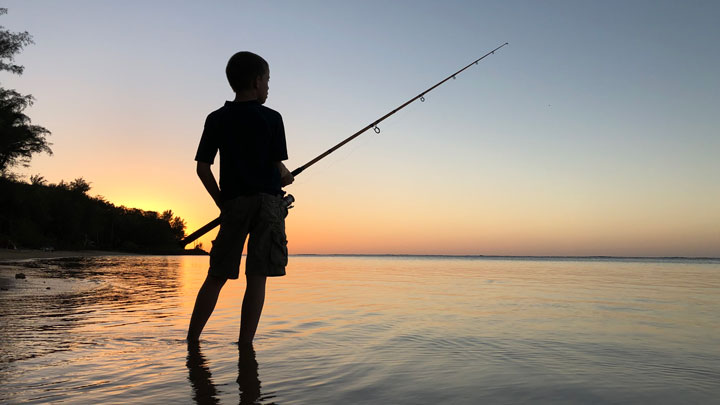
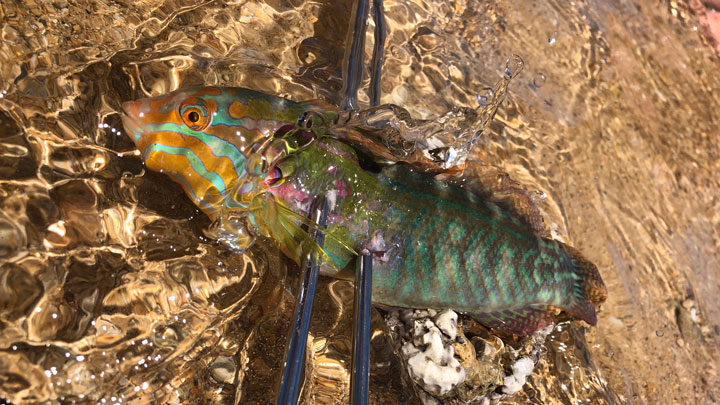
Thousands of colorful and tasty fish cruise inside the reefs that ring the islands. You can catch them with a little piece of raw shrimp on a hook cast into a channel or pocket in the reef, or spear them while snorkeling with a traditional three-prong Hawaiian spear. The locals set giant poles rigged with big hooks cast far out into the channels, with a bell to wake them if a big fish or shark strikes during the night. Fishing from the shore does not require a license, and you can pick up a basic rod and reel or a three-prong spear for $50 at the local Ace Hardware store. There are minimum-length requirements for the fish you’re allowed to spear, so study the regs before you snorkel into the blue yonder with your three-prong. Fish look bigger underwater than they actually are, so make sure they’re big enough before loosing your spear.
“Relax, This Ain’t the Mainland”
It’s one of my favorite sayings on the islands. Life and attitude are different there; being on time is not real critical, drivers are very courteous (even in heavy traffic) and people are not as tense and stressed. I love the feeling.
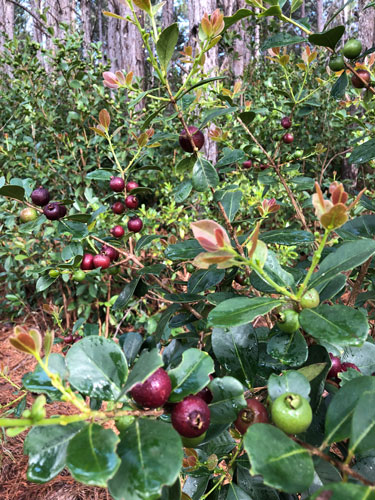
Being able to hike and eat guava fruit and thimbleberries picked fresh along the mountain trail is pretty awesome, too. Hunting through dense jungle, stalking along towering green cliffs draped with waterfalls and listening to the surf as the sun sets over the sea all combine to make the islands one of my favorite places on earth to hunt.
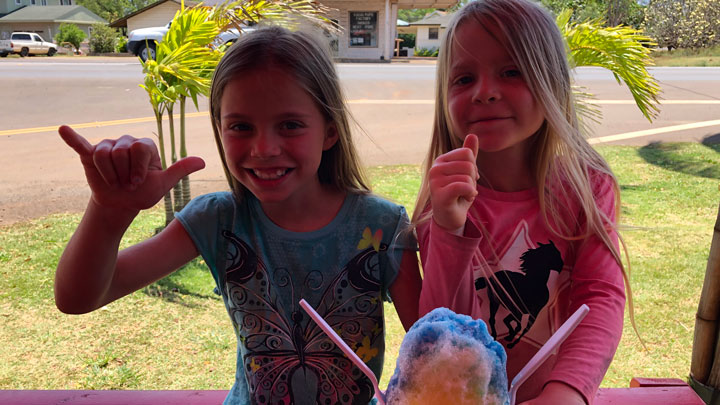
And of course, there are the sandy beaches, the snorkeling, surfing and the Shave Ice. Always the Shave Ice.


Way too much gun for that Rookie!




Special operators inserting via HALO (High Altitude Low Opening) parachute jump to launch a pitiless fight to the death with a fanatical enemy bent on global destruction is actually just the stuff of spy movies. That kind of thing almost never happens in the Real World. However, in November of 2001, the British Special Air Service launched Operation Trent. Trent was the stuff about which fiction writers scrawl.

In the modern era, most warriors see combat only sporadically. The Global War on Terror has been an anomaly, but most professional soldiers in the West only go to war for real about once or twice in a career. In the case of Special Operations Forces, their commanders are always on the prowl for proper missions. Early into the coalition invasion of Afghanistan SAS commanders got the tasking to take out an al-Qaeda opium plant near Koh-I-Malik Mountain in the Registan Desert, Helmand Province, Afghanistan.

Al-Qaeda was and is a truly world-class mob of villains. When they’re not actively bombing civilians they support themselves by refining and trafficking illicit narcotics. Though they drape themselves in the mantle of religion, the reality is that they are just fanatic thugs who want to watch the world burn.

The opium factory in this case was a fortified military facility of caves, bunkers, buildings, trenches, and hardened compounds. Intelligence estimates put the number of defenders at between 80 and 100 hard-core foreign fighters. These maniacal lunatics were well-armed, well-trained, and highly motivated.

Based upon the availability of close air support assets the assault would have to take place in daylight. Though the SAS is justifiably sketchy on operational details it is estimated that between 100 and 140 operators took part. Given the remote nature of the objective and the large numbers of troops required it was determined that insertion would be via C130 transport aircraft.

The first order of business was to establish a makeshift airstrip to allow air landing of troops and vehicles via C130. As a result, G Squadron’s Air Troop inserted an eight-man reconnaissance patrol via HALO parachute jump. Jumping from a coalition C130 at more than 20,000 feet, this combat element dropped through subzero temperatures using supplemental oxygen and parachutes that opened automatically at 4,000 feet. They secured the air landing site, marked out a 900×40-foot runway, and established lay-up positions.

Seventeen hours later a flight of half a dozen USAF C130 aircraft touched down just long enough to disgorge a contingent of Land Rover DPV 110 “Pink Panther” vehicles, a pair of logistics trucks, and eight Kawasaki dirt bikes. The DPV 110’s were originally painted in a pink desert camouflage. Hence the name. During the 120-mile drive to the target one vehicle was lost due to mechanical failure. Its three-man crew remained behind to guard it. I suspect they were livid.

A Squadron drew the duty of assaulting the al-Qaeda facility, while G Squadron provided a base of supporting fire. Once in position under cover of darkness, these two elements awaited first light and a preparatory airstrike to launch their attack. Just after 0700, a combined strike package of US Navy F-14 Tomcats and F/A-18 Hornets kicked off the party.

The Navy strike aircraft pummeled the al-Qaeda facility until they ran out of ordnance, taking out a bunker with a GPS-guided JDAM bomb and strafing another position dangerously close to friendly operators. Under cover of the chaos, A Squadron elements approached the defensive works in their Pinkies, while the G Squadron blokes opened up with vehicle-mounted M2 .50-caliber machineguns, 7.62mm L7A2 GPMGs, L16 81mm mortars, MILAN antitank missiles, and Barrett M82A1 .50-caliber sniper rifles. What followed was a truly epic fight.

The .50-caliber M2 or “Ma Deuce” as it is known by anyone who has ever donned a uniform, is the longest-serving weapon still in general issue by the US military. The M2 was contrived by the firearms luminary John Moses Browning in response to a request from General John “Blackjack” Pershing, the commander of the American Expeditionary Force in WW1.

The recoil-operated M2 weighs 84 pounds and cycles at around 500 rounds per minute. The Army has tried and failed to replace this apparently perfect weapon several times in the past century. However, today’s M2 that sits atop the M1 Abrams and modern MRAP vehicles is really minimally changed from the WW1-era original. The max effective range for the Ma Deuce is 1,800 meters.

The L7A2 is the British version of the Belgian MAG (Mitrailleuse d’Appui General) Gun. This 7.62x51mm air-cooled, belt-fed, General Purpose Machinegun was designed in the 1950s by Ernest Vervier. The MAG combined the best features from the American Browning Automatic Rifle and the German MG42. This same basic weapon serves in the American military as the M240.

The L7A2 weighs 26 pounds and cycles at around 650 rounds per minute. This same chassis has been used in fixed aircraft mounts, pintle mounts on vehicles, and as a man-portable support weapon in Infantry and Special Ops formations. The L7A2 fires from the open bolt and has been adopted by the militaries of some 89 nations.

The L16 81 mm mortar is a beast of a thing. It began as a joint venture between the UK and Canada. The L16 weighs 78 pounds and is typically serviced by a crew of three. This mortar offers a sustained rate of fire of a dozen rounds per minute and will throw an HE bomb up to 5,675 meters.

The MILAN antitank missile system is a joint French/German contrivance that first entered service in 1972. MILAN stands for Missile d’infanterie Leger Antichar. MILAN is also French for “kite.” MILAN is a wire-guided SACLOS (semi-automatic command to line-of-sight) missile. It weighs 36 pounds and has a maximum effective range of 2,000 meters.

Western nations supplied the Afghan Mujahideen with MILAN missiles during their war with the Soviets in the 1980s. These weapons took a devastating toll on Soviet armor. The newest versions of the MILAN use a 115mm HEAT warhead and advanced jam-resistant electronics.

The Barrett M82A1 is a semiautomatic recoil-operated anti-materiel weapon used throughout the free world. First launched in 1989, the M82A1 weighs 30 pounds and has a max effective range of 1,800 meters. The gun feeds from a 10-round detachable box magazine and is used by 55 different nations.

I first met the Barrett M82A1 while it was being used to detonate unexploded ordnance by a military EOD unit. The unique Barrett rifle has been used as a long-range sniper platform in a variety of operational conflicts. With match ammo, the Barrett is indeed a deadly and powerful long-range platform.

A Squadron assaulters covered the last stretch of extremely difficult terrain on foot, engaging in a furious firefight with defenders in the process. One SAS operator was wounded during the approach, but another dozen gained access to an al-Qaeda cave complex. Here they killed six al-Qaeda fighters with no loss to their own. One SAS officer caught two rounds to his ceramic body armor and third through his canteen.

The al-Qaeda fighters were maniacal in their fervor, frequently running out from behind cover while firing only to be cut down by the attacking SAS men. The SAS Regimental Sergeant Major was shot through the leg while organizing the G Squadron supporting fires. Over the course of the next two hours, SAS troopers cleared buildings and caves of fanatical terrorist fighters, all at such close range as to make close air support ineffective.

Four hours after the initial airstrikes the compound was secure and the foreign fighters neutralized. A total of four SAS men were wounded. The attackers killed as many as 73 enemy soldiers and destroyed $50 million worth of opium. They also came home with several laptops and written records that were invaluable in unraveling the terrorist network.

A US CH47D extracted the wounded operators, while the rest of the force exfilled via C130. Three weeks later the shooters were back in the UK. Several of the SAS operators were decorated for their performance during the operation, and the al-Qaeda facility was thoroughly disrupted.


The Real World is never as clean or as tidy as the movies make it out to be. Combat is a terrifying, chaotic thing that strains even the most elite soldiers. However, the British SAS literally set the bar for special operations forces around the globe. In the case of Operation Trent, the largest SAS undertaking since WW2, the rarefied tactics and heroic exploits were everything you might find in a big budget action movie.

From G Squadron’s initial HALO assault to the unit’s mass exfil via C130 aircraft on an improvised runway, everything went down as it should have. The drug-making facility was destroyed and its operators killed. The SAS guys also retrieved a trove of invaluable intelligence materials. Operation Trent was the real deal, a special operator’s dream.

There are few places on earth more enchanting than the isles of Hawaii. Most people think of Hawaii in terms of beautiful, well-groomed resorts, turquoise water, extravagant gift shops and Shave Ice. Not me. I think of Hawaii in terms of hunting abundant game through almost-impenetrable jungle, sheer cliffs plunging to the sea, guava fruit hanging ripe along steep mountain trails and kaleidoscope schools of fish just out of reach of my three-prong spear. And Shave Ice.
Hawaii is a relatively unknown sportsman’s paradise. Truth be known, there is more hunting opportunity to be found along the jungles and cliffs of the islands than in most of the mainland states.
DIY in Hawaii
In my opinion, the finest opportunities for the do-it-yourself hunter in Hawaii are found in backcountry settings, meaning you’ll have to hike to access them. Most of the islands offer public lands that anyone can hunt. Those lands are often surrounded by private property, but there are usually trailheads that offer access. An experienced mountain hunter can rapidly get into good hunting, but don’t make the mistake of expecting the hunting to be easy.
My first hunt on the islands was a fast-and-light excursion into the cliffs after wild goats. I stuffed a sleeping bag, some water and my takedown recurve bow into my pack, and climbed through the cactus and thornbush on the dry side of the island toward the base of a cliff. I had only 24 hours to hunt. A thousand feet above the sea I found goats, stalked the band for several hours and finally placed an arrow through a young billy. I watched him tip over dead, but his last kick sent him sliding over a cliff. Fortunately, I was able to find my way down to him and got some photos as the sun set across the sea far below. I quartered the goat out, hung the meat in a tree and slept the night on the mountain before packing out to the trailhead, 22 hours after I’d headed up. It was awesome.
Seasons and Species
None of the big-game species found on the islands are indigenous. They have no natural predators, and some of the species proliferate so effectively they become problematic to the island habitat. As a result, seasons are long and limits incredibly generous. Huntable species vary from one island to another. If I’m not mistaken, pigs and goats can be hunted on almost all the islands, with mouflon sheep, axis, whitetail and Colombian blacktail deer huntable on select islands. Often the limit is one or two animals of each species per day. While you shouldn’t expect to fill those limits due to tough terrain, smart wildlife and dense vegetation, it’s still awesome to go hunting with “tags” in your pocket for multiple deer, goats and hogs every day. (No tags are needed in most areas, though you must have a license.)
Season dates are usually long, lasting months on end. Often there are several days (usually, but not always, Tuesday through Thursday) that are closed to hunting every week. Rules and regulations can be extensive and confusing, and vary from island to island and unit to unit, so be sure you study them well.
Hunting and Fishing Licenses
Obtaining a hunting license in Hawaii is not difficult, but you must plan ahead. Your stateside Hunter’s Education certificate is valid in Hawaii, but must be approved before you can buy a license. This can take three weeks or more. Paperwork and details are available online, but don’t fail to submit it at least a month prior to your trip. Island time is pretty awesome unless you’re waiting on something important like a hunting license. Have your approval letter in hand well before your trip, then you can walk into any game office and purchase your license on the spot. If you’ll be bowhunting, you may need an extra certificate. Everything should cost you right around $100. As of my last visit, no fishing license was required to fish from the beach with rod or spear, but be sure and check the regulations for the island you’re on.
Checking In
Each hunting area on the islands features a check-in station. These vary from a simple kiosk, where you open a lid and sign in, to more elaborate stations offering maps, information and sign-in portals. In my experience, the local hunters take this process seriously, which inspires me to take it seriously, as well. After your hunt, you’re required to sign out and report any game harvested.
Rifle or Bow
One of my toughest dilemmas when planning a hunt to Hawaii is whether to hunt with bow or rifle. A bow requires no paperwork or permitting, while using a rifle requires you to undergo a significant permitting process, including being fingerprinted and registering the rifle at the police station within five days of arrival. You must have an address where the rifle will be kept, and it’s supposed to stay at that address unless at the range or hunting.
Another thought-provoking element that should influence your decision is the fact that many of the good local hunters consider 40 yards to be a rather long shot at either deer or hogs. Most are closer due to the dense jungle vegetation, somewhat equalizing the effective range of bow and rifle.
That said, on a recent hunt to the islands, I passed up shots at five deer at distances greater than 250 yards. They were across a canyon, and while I was confident I could harvest them cleanly, I was not confident I could cross the canyon and recover them. Deer on that particular island are plentiful, but extremely hard to find and harvest—indeed they seem to be the Holy Grail of game there. I left my perch on the ridge exuberant at just seeing a deer, let alone five—the knowledge that I could have killed them was icing on the cake. I just needed to find a way across that canyon.
Most, if not all of the islands have archery-only units offering better access and more liberal hunting dates. It is my opinion that, all things considered, you’re usually better off hunting Hawaii with a bow than a rifle. You’ll simply experience more and better opportunity.
Respect the Locals
There is a strong hunting tradition among the islanders, and in my opinion, it’s important to recognize and respect that. After all, those folks live and hunt there, often depending on the hunting for meat and recreation. You’re the visitor, so try to find ways and places to hunt that don’t intrude. It’s the ethical thing to do, and it may keep you out of a confrontation that’s not likely to end in your favor.
Ropes, Crampons and Taking the Shot
On my last trip (the same one where I passed up the five deer), I hunted my way down a giant ridge that hung above the sea like some primeval monster. I was looking for goats, and I found them. Several big billy goats strutted around, checking females and hunting breakfast in the sunshine of a beautiful Hawaiian morning. They were within easy range of my rifle and I spent hours shadowing them, watching my crosshairs on their ribs. The problem was, the cliffs they were living in were steep enough to scare an eagle, and there was no way I could access a goat had I shot one.
Some Hawaiian goat territory is not so steep and dangerous, but much of it is. You’ve got to be careful, especially when hunting solo, as I was. Next time I climb the ancient volcanic ridges of the islands hunting goat, I plan to have a set of strap-on crampons for my shoes, and several hundred feet of climbing rope. That way, if I shoot a goat, I’ll have the right tools with which to recover it.
The terrain on the islands—especially when hunting goats—can be extreme. Be prepared to pass up shots at animals you can’t ethically and safely recover. There will be some, even when you have crampons and climbing ropes. A goat or a deer is not worth risking a fall to your death, even in the most enchanting place on earth.
Coolers and Meat Care
One of the biggest challenges to hunting on the islands is keeping your meat safe after the harvest. Humidity and heat are a constant challenge. I use a YETI cooler full of ice, and bury my meat in the ice as soon as I get it to the truck. The YETI is super tough and keeps the meat and ice cold for a good long time.
Fishing the Reefs
Thousands of colorful and tasty fish cruise inside the reefs that ring the islands. You can catch them with a little piece of raw shrimp on a hook cast into a channel or pocket in the reef, or spear them while snorkeling with a traditional three-prong Hawaiian spear. The locals set giant poles rigged with big hooks cast far out into the channels, with a bell to wake them if a big fish or shark strikes during the night. Fishing from the shore does not require a license, and you can pick up a basic rod and reel or a three-prong spear for $50 at the local Ace Hardware store. There are minimum-length requirements for the fish you’re allowed to spear, so study the regs before you snorkel into the blue yonder with your three-prong. Fish look bigger underwater than they actually are, so make sure they’re big enough before loosing your spear.
“Relax, This Ain’t the Mainland”
It’s one of my favorite sayings on the islands. Life and attitude are different there; being on time is not real critical, drivers are very courteous (even in heavy traffic) and people are not as tense and stressed. I love the feeling.
Being able to hike and eat guava fruit and thimbleberries picked fresh along the mountain trail is pretty awesome, too. Hunting through dense jungle, stalking along towering green cliffs draped with waterfalls and listening to the surf as the sun sets over the sea all combine to make the islands one of my favorite places on earth to hunt.
And of course, there are the sandy beaches, the snorkeling, surfing and the Shave Ice. Always the Shave Ice.