


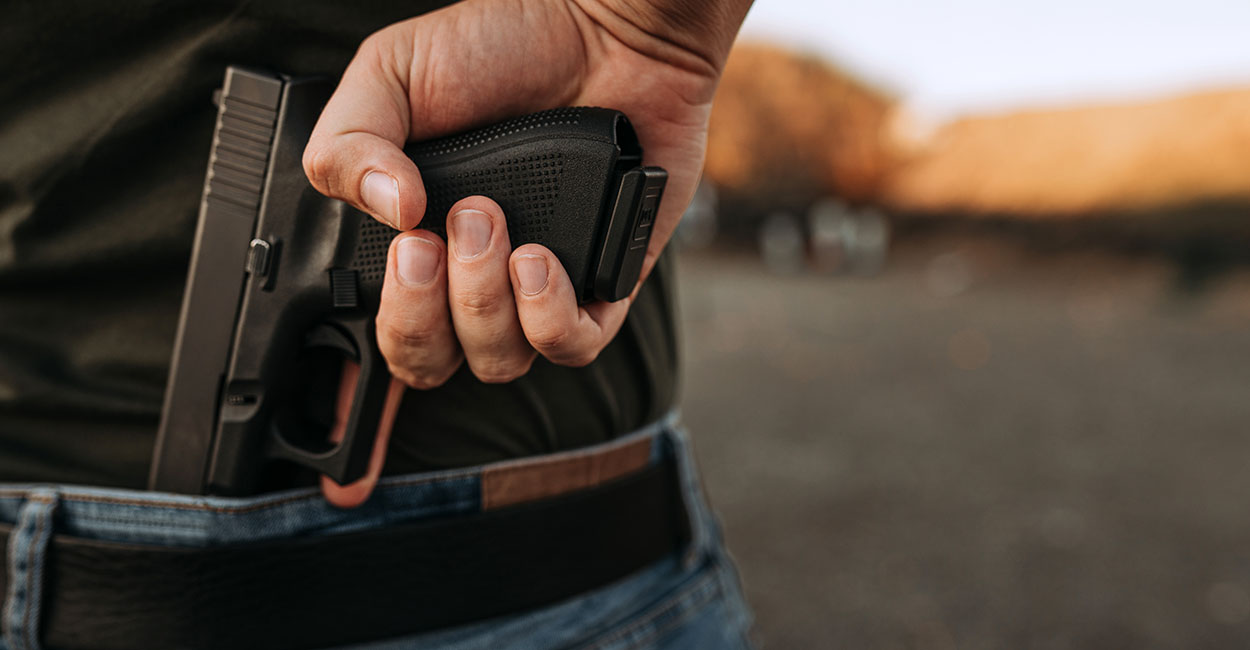
These American gun owners aren’t “fanatical” or “irrational” for possessing firearms or defending themselves and others with them. (Photo illustration: nortonrsx/Getty Images)
The editorial board of a major New Jersey newspaper started the year off with an anti-Second Amendment screed, decrying the right to keep and bear arms as a “curse” perpetuated by a “fanatical” interpretation created by the Supreme Court in 2008.
Among other things, editors at the Newark-based Star-Ledger bemoaned that the Second Amendment keeps the nation from enacting “rational” gun control along the lines of Canada—which is a hair’s breadth away from banning all firearm sales—and called for readers to imagine the possibilities if the Supreme Court would just reinterpret the Constitution according to the justices’ personal perceptions of “reasonable” public policy.
The editorial, unsurprisingly, gets many things wrong.
For example, far from “suddenly siding” with the National Rifle Association in 2008 about the meaning of the Second Amendment, the Supreme Court in District of Columbia v. Heller merely affirmed the long-established interpretation of the right, universally held by stalwarts of constitutional law such as William Rawle and Joseph Story.
But the most egregious aspect of the editorial is its air of disdain for peaceable Americans who want to protect themselves with firearms in such unimaginable public places as “restaurants” and “nursing homes.”
Perhaps these editors should spend less time pontificating about other countries and more time investigating the reality of defensive gun use in this one.
Almost every major study on the issue has found that Americans use their firearms in self-defense between 500,000 and 3 million times annually, according to the latest report on the subject by the Centers for Disease Control and Prevention. Just last year, a more comprehensive study concluded that roughly 1.6 million defensive gun uses occur in the United States every year.
For this reason, The Daily Signal each month publishes an article highlighting some of the previous month’s many news stories on defensive gun use that you may have missed—or that might not have made it to the national spotlight in the first place. (Read other accounts here from 2019, 2020, 2021, and 2022.)
The examples below represent only a fraction of the news stories on defensive gun use that we found in December. You may explore more by using The Heritage Foundation’s interactive Defensive Gun Use Database. (The Daily Signal is Heritage’s multimedia news organization.)
The American gun owners described above were not “fanatical” or “irrational” for possessing firearms or defending themselves and others with them. Far from it.
What’s irrational is the belief that governments—which killed 200 million largely unarmed civilians in the 20th century—should be entrusted with a monopoly on instruments of force, instead of held in perpetual check by a well-armed citizenry.
What’s fanatical is Gun Control Inc.’s obsession with disarming peaceable persons and effectively rendering moot their inalienable right to self-defense based on a promise that the government always will be able to protect them from all harms.
For the Americans in the incidents outlined above, and for countless others who defend themselves with firearms every year, the right to keep and bear arms is not a curse.
When the government failed to protect these Americans, the Second Amendment was their greatest blessing.
Have an opinion about this article? To sound off, please email letters@DailySignal.com and we’ll consider publishing your edited remarks in our regular “We Hear You” feature. Remember to include the url or headline of the article plus your name and town and/or state.


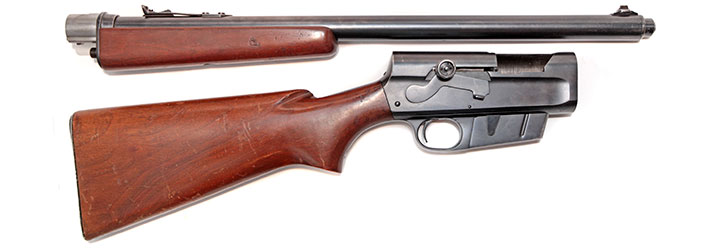
“Modern Sporting Rifles” have caused semi-automatics to gain wider acceptance within hunting circles, but self-loading hunting rifles have been around for more than a century. Pictured is one of the first—John Browning’s design as manufactured by Remington.
Winchester beat Remington to the market by one year with a center-fire, semi-automatic rifle, but its Model 1905 was a blowback design that fired what amounted to an oversized pistol cartridge. In 1906, Remington introduced its “Autoloading Repeating Rifle,” which it advertised as the only locked-breech high-powered rifle in America. It functioned on the long-recoil principle, as used in the Automatic-5 shotgun (both shared the familiar “humpback” receiver profile), of which Remington also manufactured a version.
In 1911, the rifle earned the designation “Model 8.” It was Remington’s first modern, high-power, repeating rifle design, coming to the market six years before Remington introduced its slide-action Model 14 in the same chamberings and 15 years before it offered its first modern sporting bolt-action rifle. The Model 8 was chambered for four unique rimless cartridges: .25, .30, .32 and .35 Remington. The magazine was a fixed box, though the loading process could be sped up through the use of charging clips similar to those used in contemporary military rifles. With no gas system to contend with, and a bolt that locked directly into the barrel extension, the Model 8 design lent itself well to quick takedown. Removing the fore-end revealed a lever attached to a screw that held the barrel and action together. In two pieces, the 41″ Model 8 was reduced to 23″.
“Built to withstand hard service this hard hitting, big game rifle has the most rapid operation with the least disturbance of any rifle made,” Remington advertisements claimed, but alas, American hunters are a conservative lot. The Model 8 was outsold by Remington’s slide-action designs. Those who wanted a semi-automatic rifle also paid a premium. The Model 8 cost 40 percent more than the pump-action Model 14 and 15 percent more than the bolt-action Model 30.
In 1936, the Model 8 was updated as the Model 81 “Woodsmaster.” The changes were mainly cosmetic, with the Model 8’s straight-grip buttstock gaining a pistol grip. The .25 Rem. chambering was dropped within that first year, and, in 1940, the .300 Sav. was added.
The Model 81 was discontinued in 1950. During its 14-year run, 56,091 had been made. It was replaced in 1955 by Remington’s Model 740, a modern, sleek, gas-operated semi-automatic that was chambered in popular bolt-action rifle cartridges such as .30-’06 Sprg. Post-World War II, returning Garand-trained veterans were more willing to embrace a semi-automatic hunting rifle. In its five years of production almost twice as many Model 740s were sold than all of the Model 8s and 81s in their 44-year production history. The 740 led to Remington’s successful 7-series semi-automatic rifles, which were in production until 2016.
The Model 81 pictured was manufactured in June 1950, and is chambered in .30 Rem. The rifle was offered in five grades, from “Standard” to “Premier,” and this is an example of a Standard model. It is valued at $750. Higher-grade Model 81s bring a premium, as do rare models, such as the factory “Police Special” rifles with their extended magazines.
Model 81s in .35 Rem. and .300 Sav. are the most popular, as ammunition in those chamberings is more readily available. Manufacturers such as Buffalo Arms and Ventura Munitions still make the .25, .30, .32 Rem. in small batches. There is a demand for such cartridges because, every fall, hunters still take to the woods with America’s original, self-loading, high-powered sporting rifle.
Gun: Model 81
Manufacturer: Remington
Chambering: .30 Rem.
Serial Number: 557XX
Manufactured: 1950


LT Hugh Mills earned three Silver Stars, three Bronze Stars, four Distinguished Flying Crosses, and the Legion of Merit during three tours as a combat helicopter pilot in Vietnam. Mills was shot down sixteen times and thrice wounded in combat. He flew 3,300 combat hours in OH6A and AH1G helicopters.


The Hughes OH6 Light Observation Helicopter (LOH) was affectionately known as the Loach by all who encountered it. Looking much like a giant angry bumblebee, the Loach was fast, nimble, and crashworthy. Improved versions soldier on as MH6 and AH6 Little Birds with the TF160 Night Stalkers today.

The OH6 was supplanted in US military service by the Bell OH58. Though entirely different designs both of these aircraft shared a common engine. I flew OH58’s myself, but we all mourned the passing of the Loach. It was a massively better aircraft.

For operations in Vietnam, the Loach was typically flown single pilot. In helicopters, the command pilot sits on the right. Behind the pilot also on the right was a crew chief armed with an M60 belt-fed machinegun. The crew chief also had access to a variety of smoke, frag, and white phosphorus grenades. Counterbalancing the two-man crew on the other side of the aircraft was typically an M134 minigun in an XM27E1 mount along with its 2,000-round ammunition load.

The M134 minigun was an electrically-driven 7.62x51mm Gatling gun featuring two different rates of fire. Pulling the trigger on the cyclic stick partway back ran the gun at 2,000 rounds per minute. A full pull resulted in 4,000 rpm. In Vietnam, the gun was typically aimed by means of a simple grease pencil mark on the Plexiglass bubble.


A Hunter Killer team consisted of a Loach flying extreme low level while a Cobra gunship trailed behind at 1,500 feet or so to provide fire support. These aircraft were in constant radio communication. The scout crew would identify targets and then break off to allow the Snake to engage with rockets, miniguns, and automatic grenade launchers.

The use of helicopters in combat was pioneered during the Vietnam War. Aviators like LT Mills figured it out as they went along. The end result was some of the grittiest combat in the history of modern warfare.

It was the summer of 1969 and LT Mills was on a routine trip to Dau Tieng for a briefing with the Brigade S3 operations staff. In the back of his Loach was Jim Parker, his regular crew chief. Paul Fishman flew the Cobra gunship that was his cover. None of the American aircrew were looking for trouble, so Mills was enjoying a little vigorous NOE (Nap of the Earth) flying.

NOE is the reason God made combat helicopters. NOE in an Aeroscout aircraft means tearing along five feet or so off the ground sans doors following the contours of the ground while maneuvering to avoid obstacles. The biggest difference between NOE flying back then and the same thing in my day was that, thanks to night vision goggles, we could also do it in the dark.

As LT Mills popped over a modest treeline he happened upon an NVA heavy weapons platoon. All involved were comparably surprised. It was on.

Mills opened up with his minigun. AK47 fire rose up from all directions while Jim Parker engaged NVA troops with his sixty. The end result was unfettered chaos.

As the NVA soldiers ran for cover a pair of them charged down a paddy dike. The rearmost soldier had a large black rice-cooking pot affixed to his back. Mills aligned his Loach with the running man, centered his grease pencil mark on the pot, and squeezed the trigger on his cyclic. His minigun buzzed out a burst that passed through the closest soldier and killed the man running ahead of him as well.

Richard Jordan Gatling was trained as a physician but never practiced medicine. He was by profession an inventor, contriving designs for an automatic seed planter, a screw propeller, a steam tractor, and an improved toilet, to name but a few. What most ties him to history, however, was the multi-barrel gun that will forever bear his name.

Dr. Gatling envisioned his weapon as a mechanism to depopulate battlefields. He rather naively believed that by providing armies with such efficient weapons fewer troops would be needed, and overall casualties from both combat action and disease would therefore be minimized. The reality was obviously not quite so tidy.

In July of 1893 Gatling was awarded a patent for an electrically-powered version of his gun. This weapon sported ten barrels chambered in .30 Army and was driven by a belt drive attached to an electric motor. This gun ran at around 1,500 rounds per minute.

Developed in 1963, the GE M134 minigun was an evolutionary development of the M61 Vulcan 20mm aircraft cannon. Featuring six 22-inch barrels and chambered in 7.62x51mm, the M134 could cycle reliably at rates up to 6,000 rpm. The gun weighed 85 pounds and was 31.5 inches long. Some 10,000 miniguns were used during the Vietnam War.


In the late 1990’s Dillon Aero purchased several used miniguns from a foreign user and upgraded the design. Designated the M134D, these modernized versions found an enthusiastic home with the Army’s TF160 Special Operations Aviation Regiment. These weapons are widely used on AH6, MH60, and MH47 aircraft today. Dillon miniguns have since been exported to dozens of friendly countries as well.

Mills darted his Loach back and forth around the little clearing, engaging NVA soldiers as they scattered. His crew chief did the same thing until his M60 ran dry. At one point Parker had to get Mills to level the wildly maneuvering aircraft so he could get a clear shot without perforating his own rotor blades.

As Parker’s gun fell silent, Mills lined up on another target and squeezed his trigger. His only answer was the spinning barrels of his Gatling gun, its ammo supply exhausted. Parker then engaged the remaining NVA with his personal M16 and finally an Ithaca pump-action 12-gauge shotgun he kept underneath his seat.

Mills carried an M1911 .45 on his belt and a .357 Magnum Colt Python in a shoulder holster. Steadying the collective with his left knee he flew the aircraft with his right hand while shooting his Python left-handed out of the right door of the aircraft. He expended all six Super Vel Magnum loads before finally breaking clear to make room for the hungry Cobra orbiting above.

Fishman rolled hot with his Snake and blew the treeline to pieces with 2.75-inch rockets. He punctuated his run with flechette warheads. These diabolical monsters flew a set distance out from the aircraft before bursting automatically with a visible puff of red smoke. At that point the warhead released a thick cloud of 1,180 pressed steel darts.

These flechettes look like finishing nails with little stabilizing fins pressed into their rear ends. Thousands of these tiny darts would absolutely shred soft targets in the manner of a gigantic shotgun. Ouch.

A replacement Hunter Killer team was soon on station allowing Mills and Fishman to return to base at Phu Loi. Once Mills landed his Loach he took stock.

The aircraft had been hit a total of twenty-five times. The airspeed indicator and altimeter were both blown away. The armor plate underneath Parker’s seat stopped two rounds, while Mills’ seat armor caught several as well. Five rounds passed through the Plexiglas canopy, two perfed the tail boom, and three bullets ventilated the rotor blades.

One AK slug passed all the way through the engine compartment, miraculously missing anything vital. One round tore the op rod off of Parker’s M60 and left a half-moon crescent in the bottom of the barrel. Between Mills’ minigun, Parker’s -60, and their personal weapons the two men had expended several thousand rounds in less than 120 seconds of frenetic combat.

ARP (Aero Rifle Platoon) grunts subsequently inserted via UH1 Hueys and swept through the area. They cataloged 26 KIA and captured a pair of POWs, recovering a large number of AK47 rifles, a 60mm mortar, a pair of Russian pistols, and an SGM heavy machinegun. They also came back with a cooking pot sporting some twenty-four 7.62mm bullet holes.

LT Mills’ combat memoir Low Level Hell is one of the most compelling accounts of modern combat I have ever read. The prose reads like an action novel, and it is chock full of gun stuff. The details about the weapons they carried, captured, and wielded from their aircraft are worth the read, while the gripping nature of the action is red meat to guys like us. The book is available on Amazon.

We have discussed aviators’ personal weapons in Vietnam here before. Here’s the link.


Mills’ original Loach, Miss Clawd IV, is on permanent display in the US Army Aviation Museum at Fort Rucker today.
