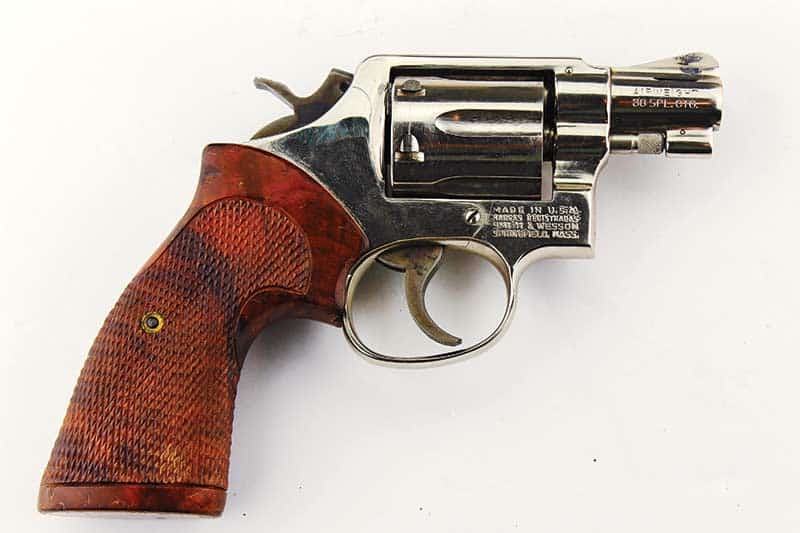
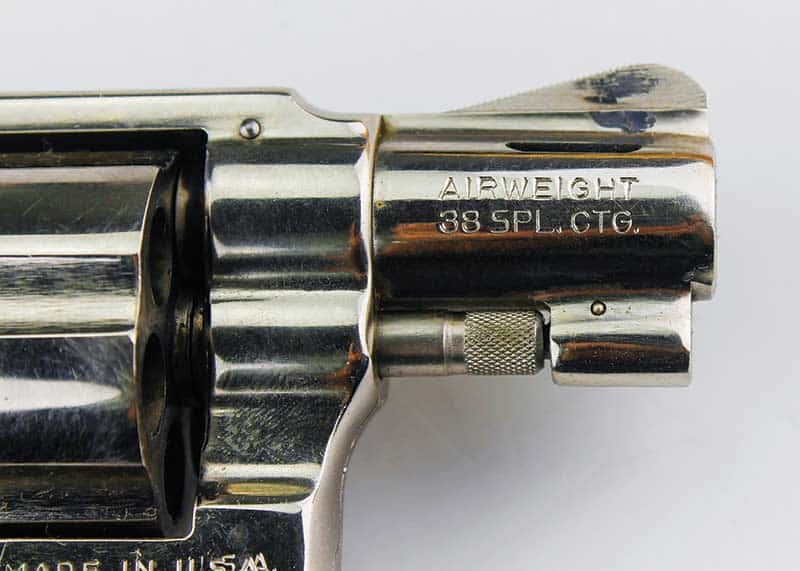
Nickel 2″ Model 12 (top gun) had square-butt Herrett stocks
and Mag-na-porting when Mas found it.
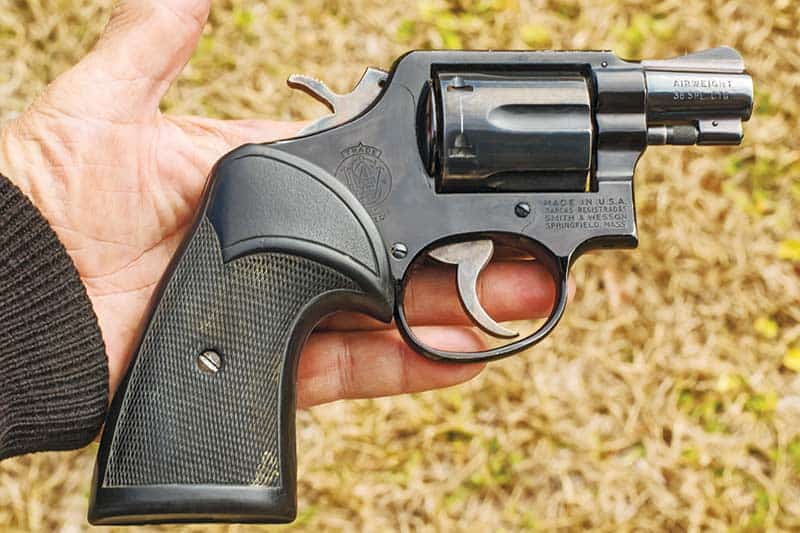
Blued square-butt 2″ Model 12: The original stocks are gone
but Pachmayrs fit suitably to cover “frame gap.”
Introduced in 1953 as the Military & Police Airweight, renamed the Model 12 in 1957, the lightweight version of Smith & Wesson’s super-popular six-shot .38 Special service revolver went through its siblings’ “dash-X” modifications up through Model 12-4 before lack of sales finally caused its discontinuance in 1986.
Born in the mid-20th Century USAF search for an ultra-light revolver for pilots that first gave us aluminum-framed revolvers — the Colt Cobra of 1950 and S&W’s subsequent Airweight series — the Model 12 was the black sheep of the K-Frame family. Slightly larger and a few ounces heavier than Colt’s Cobra holding the same six rounds and roughly a quarter-pound heavier and distinctly larger than S&W’s own J-Frame five-shot Airweight, it was just a tad too big for pocket carry even with its original and definitely most popular barrel length — two inches. I just never saw the need for a Model 12 back when I could order one new for a reasonable price at the gun shop. I guess most others felt the same.
The more fools, we.
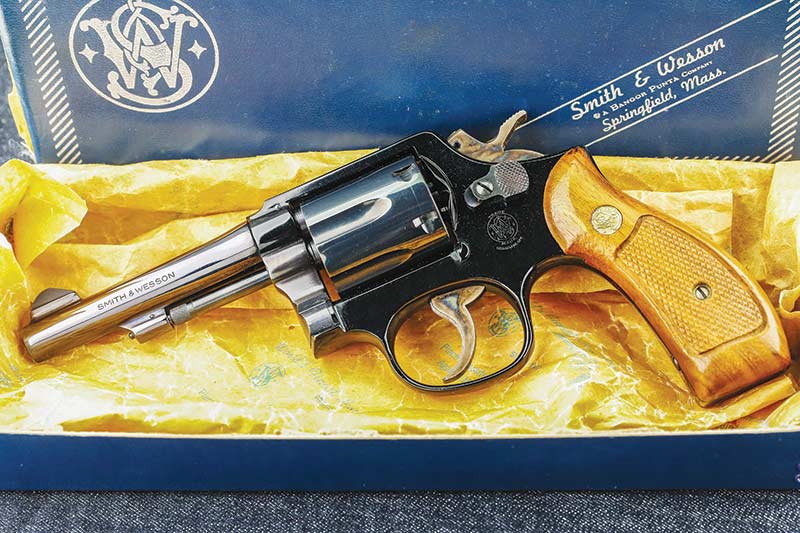
The grail gun: 4″ Model 12-3, “minty.”
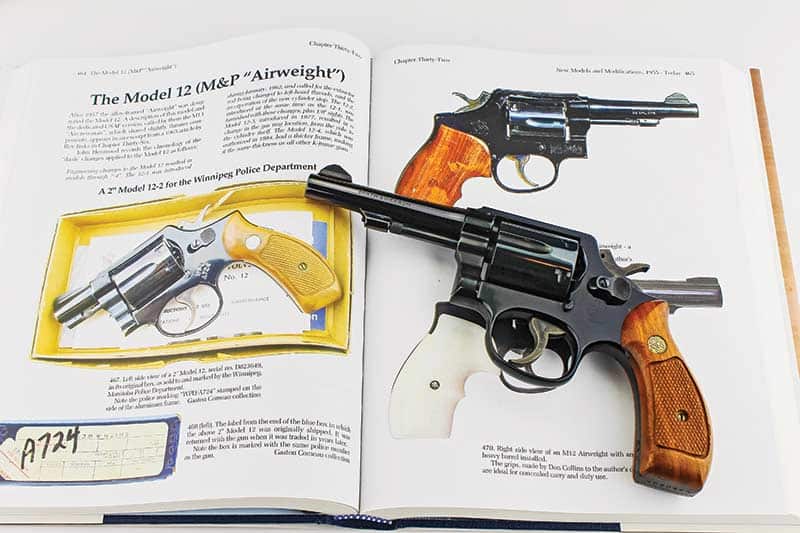
The Model 12 with its chapter in Tim Mullins’ excellent book, The K-Frame Revolver.
Awakening
One day in the 1980s, I was in one of the great American gun shops of all time, Riley’s in Hooksett, NH, when I spotted a 2″ round-butt Model 12 in the used handgun showcase. On a whim, I asked to see it. The bonding was like what happens when you meet the right puppy at the ASPCA. I “rescued” it and brought it home. I liked the way it shot and the way it felt in my hand — no revolver has ever fitted me better than a K-Frame Smith — and I shot +P FBI loads in it against S&W’s recommendation, with a set of Pachmayr Compacs to cushion the recoil.
When one of my sisters-in-law needed a gun, I lent it to her. I had been carrying it because it felt so sinfully comfortable and being a guy who advocated packing more serious firepower, I felt a tinge of hypocrisy wearing a snub as primary. I went back to carrying service autos. When I finally got it back, it was missing its cylinder latch and I had mislaid its original stocks, a mistake since until the dash-4 model, S&W made these guns with thinner frames and regular K-Frame stocks didn’t fit right. My friend Tom Givens, another Model 12 fan, later helped me out with a pair of original stocks. Thanks, Tom.
Along the way, I had read old friend Roy Huntington’s paean to the Model 12 in American Handgunner and it reminded me of how much I liked the gun, perhaps irrationally. I picked up a 2″ square-butt blued one at Welch’s Gun Shop in Lebanon, NH, and a Mag-na-ported nickel duplicate with Herrett stocks at a gun shop in Louisiana. Neither, unfortunately, shot quite to the sights. I confess to envying Roy on this count, because his specimens shoot to point of aim/point of impact.
I even picked up one of the rare, short-lived Model 315 Nightguards, which shot great but because it had Scandium in it for +P durability, weighed 24 oz. instead of the original Model 12 snubby’s 18 oz. This put the 315 about halfway between the original 18-oz., 2″ Model 12 and the chunky 2″ all-steel Model 10.
Mag-na-porting helped tame muzzle jump on the lightweight .38 Special.
Grail Gun
I got the urge for a 4″ Model 12. The slight added weight is compensated for by two more inches of barrel that significantly improve sight radius and lever the gun butt into the body for better concealment in a belt holster — counterintuitive, but true. My primary day job is that of instructor and I’ve found even in an auto pistol world, a double-action revolver lets you demonstrate trigger control better than anything else. As the instructor works the trigger, the students can see the even, uninterrupted rise and fall of the hammer and turn of the cylinder, as well as watching the long pull of the index finger on the trigger. I figured it would make a good teaching gun, and being old with sciatica, which interrupted my life-long comfort with a heavy pistol on my hip, a decent carry gun as well. With a six-shooter, a full-length ejector rod as on the 4″ model is desirable, too.
OMG — try to find an affordable 4″ Model 12, at a reasonable price, in the 2020s.
The search lasted for a couple of years and ended at Christmas of 2021, when my lovely bride found one on Gunbroker.com and put it under the tree for me. There it sat in its original box, pristine, practically needing a microscope to find a hint of a turn line on the cylinder …
… and I experienced a cognitive dissonance attack. Or maybe it was multiple personality disorder. My shooter self said, “Let’s take this baby out and shoot it, now! That’s why we have a range on our property!” But the ghost of my Scottish maternal grandfather seemed to say, “Nae, laddie, dinnae shoot it! Ye’ll ruin its collector value!”
Which is why it’s still in the safe, as yet unfired — and why I’m looking for a seasoned, “shooter-grade” 4″ Model 12, preferably with a round butt.
If you’re a gun enthusiast, I know you’ll understand.
As any Second Amendment supporter in the state can tell you, California has a lot of laws on the books; far too many of them aimed at turning a fundamental right into a criminal offense. Meanwhile, those accused of violent crimes are far too often treated as victims themselves; of circumstance if not the criminal justice system itself.
That may very well be the case when it comes to the man accused of murdering Riverside County Sheriff’s Deputy Isaac Cordero last week. William Shae McKay had a criminal history dating back more than 20 years; including a 2021 conviction on charges of false imprisonment, receiving stolen property and evading police officers. Unbelievably, McKay was still allowed to post bail and leave jail after that conviction in November of 2021; a decision that local law enforcement believe had a direct link to Cordero’s murder a little more than a year later.
He was facing a third-strike sentence of 25 years to life in prison, but his attorneys asked for a new trial and that one of his strikes be dismissed.
McKay’s bail was reduced from $950,000 to $500,000 while his case was pending, and he was released on bail in March. In October, a warrant was issued for his arrest when McKay failed to make a court appearance. The trial judge in his case was Cara D. Hutson.
Riverside County Sheriff Chad Bianco and San Bernardino County District Attorney Jason Anderson said the justice system had failed Deputy Cordero.
In a news release, Anderson noted his office opposed the bail reduction as well as the motion to dismiss a prior strike.
“Our office upheld our oath of pursuing justice by prosecuting convicted felon McKay in November of 2021, however a failure in the process to separate McKay from society and hold him accountable for his crimes has resulted in the tragic loss of a law enforcement deputy,” Anderson said.
Cordero’s uncle, Carlos Padilla, echoed his own frustration with the system and Judge Hutson.
“The law that he swore to uphold took his life,” Padilla said. “They said ‘You’re being dropped in the battlefield,’ and then they abandoned him. It’s so heart-wrenching that the same people we allow to be in office can do something like this.”
Hutson, a Democrat, was appointed to the San Bernardino County Superior Court bench in 2007 by then-Gov. Arnold Schwarzenegger. Before that, she worked as a deputy district attorney from 1994 until her appointment. She was last elected in June 2022 when she ran unopposed.
Serious crimes that could have resulted in decades behind bars, but thanks to the judge’s largesse, McKay was able to post bail post-conviction and stroll out of custody free as a bird.
California lawmakers are set to resume their attacks on legal gun owners in just a few short days, with restricting the right to carry one of their top priorities for the new year. Ensuring that violent offenders like McKay stay behind bars, on the other hand, isn’t much of a concern for the politicians intent on carving up our Second Amendment rights into a never-ending series of non-violent possessory crimes. In the twisted worldview of the anti-gun left, guys like McKay are always deserving of another chance, while peaceable gun owners are considered a threat until or unless they’re disarmed.
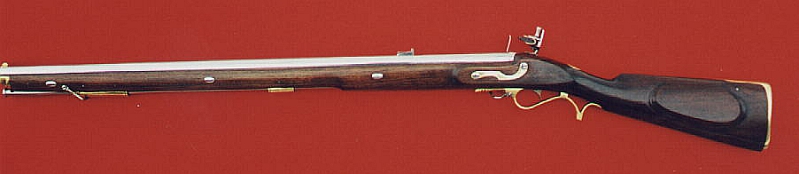
The British Army learned the value of accurate rifle fire the hard way. Pennsylvania Rifle-equipped Americans sniped from the forests and cut down officers from the first fight at Lexington and Concord until the American Revolution ended in 1783. The wars against Revolutionary France demonstrated the need for new tactics, especially after the rise of Napoleon Bonaparte. The British Army adopted its first standard rifle in 1800 to meet those demands. The gun’s official designation was the “Infantry Rifle,” but history remembers it as the “Baker Rifle.”
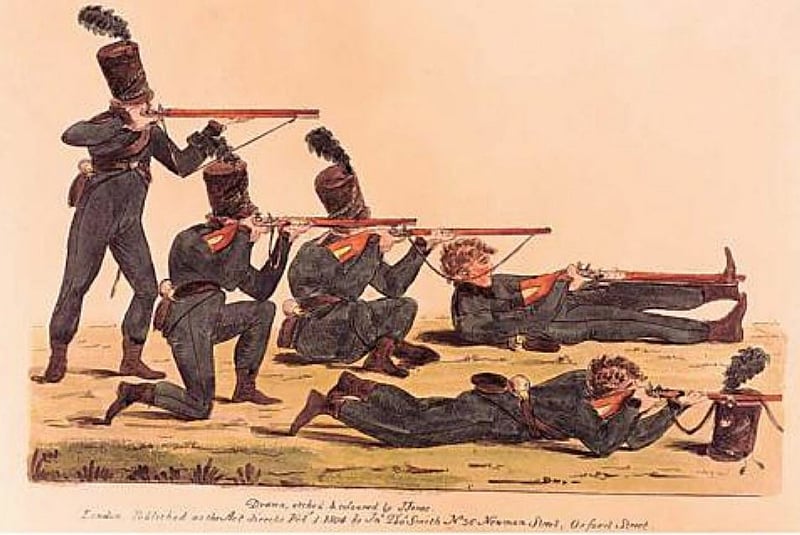
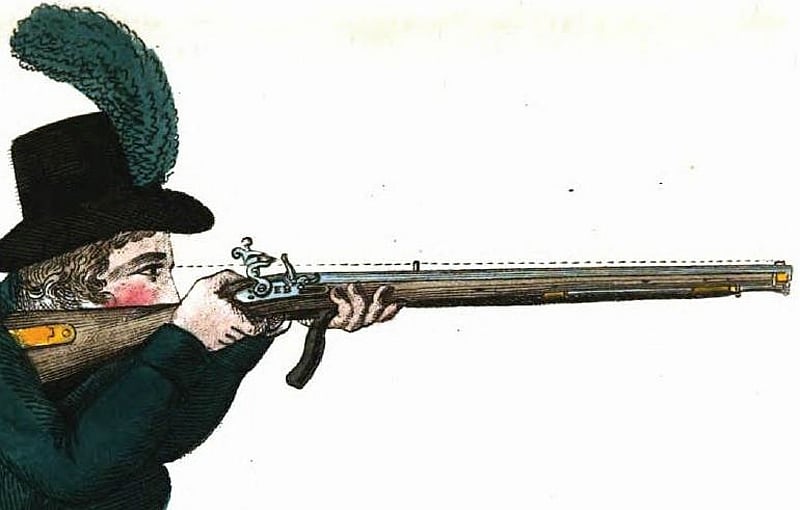
The approved firing positions from the British Army’s Napoleonic Era rifleman’s manual. (militaryheritage.com)
Despite recognizing the rifle’s usefulness, the British Army knew they needed a standardized weapon. An imperial power could not effectively deploy individualized rifles like the Americans and Prussians had. Plus, existing rifles of the time were considered too long, heavy, and generally cumbersome for the skirmishers and light infantry for whom they were intended. The army needed a robust, but easily handled weapon that would stand up to extended campaigning.
Ezekiel Baker’s Rifle…with a Little Help from the Prussians
Ezekiel Baker was a master gunsmith in Whitechapel, London. He submitted a rifle design to the British Board of Ordnance trials in February 1800. Baker’s rifle won the trials, but the design needed work. The first prototype was similar to the standard British infantry musket but was deemed too heavy for its mission.
The army gave Baker a Prussian Jӓger rifle to model what they wanted. Jӓger units were light troops who served as skirmishers and screened heavier infantry formations. They usually carried their own highly accurate hunting rifles in the field, hence the name Jӓger, which means “hunter.” The Jӓger rifles and ammunition were not standardized but the general specifications showed Baker what the army had in mind.
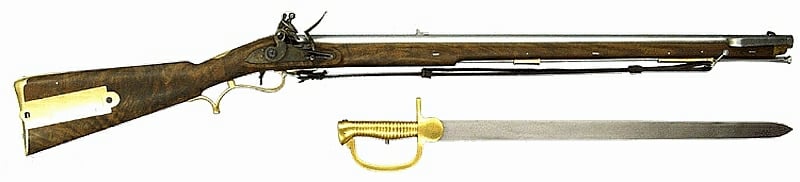
The original Baker Rifle was designed to accept the 24-inch sword bayonet. (military-history.fandom.com/wiki/Baker_rifle)
Further Development
Baker’s second prototype was a .75 caliber weapon, the same as the standard “Brown Bess” musket. It had a 32-inch barrel and an eight-groove rifling pattern. The army accepted the prototype, but more changes followed.
The third and final prototype reduced the caliber to .653 and the barrel was shortened to 30 inches with seven rifling grooves. The rifle fired the .625 caliber carbine bullet paired with a greased patch to engage the rifling. The production Pattern 1800 Infantry Rifle had a .625 caliber bore, firing a .615 caliber projectile with the greased patch. Its effective range was 200 to 300 yards, though it could and did fire much further.
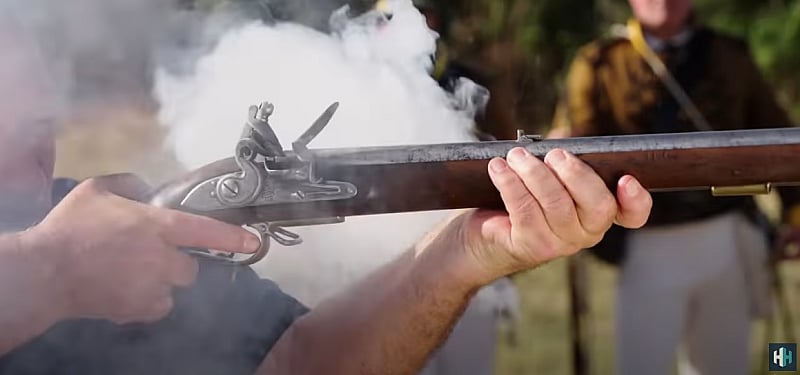
The seven rifling grooves in a reproduction Baker Rifle. (History Hit YouTube Channel)
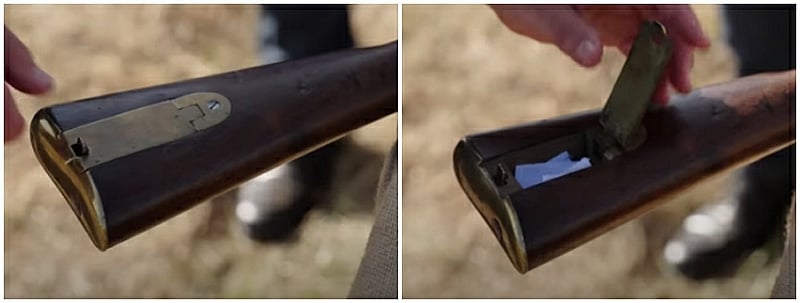
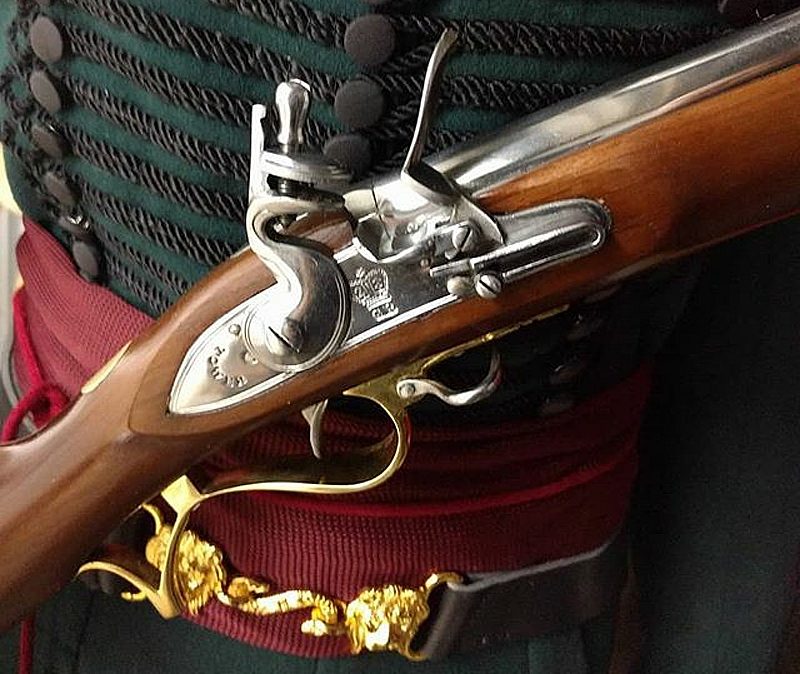
The original Baker Rifle shared the Brown Bess musket’s standard large lock system and swan neck cocking piece. The lock was updated in 1810 to match the new Short Land Pattern Musket. The walnut stock featured a raised cheekpiece on the left side. A scrolled brass trigger guard ensured a firm grip and patches were stored in the buttstock, covered by a hinged brass lid. The Baker accepted a 24-inch sword bayonet.
The Baker’s greased patches were stored in a compartment on the stock. (History Hit YouTube Channel)
Specifications
Caliber: .625 (the Pattern 1809 Infantry Rifle increased the caliber to .75)
Projectile: .615 caliber lead ball
Firing System: Flintlock single shot muzzleloader
Barrel Length: 30.375 inches (the Duke of Cumberland’s Corps of Sharpshooters specially ordered 33-inch models in 1803)
Overall length: 45.75 inches, 12 inches shorter than the Infantry Musket
Weight: 9 pounds
Rifling: 7 grooves
Standard Rate of Fire: 2 aimed shots per minute
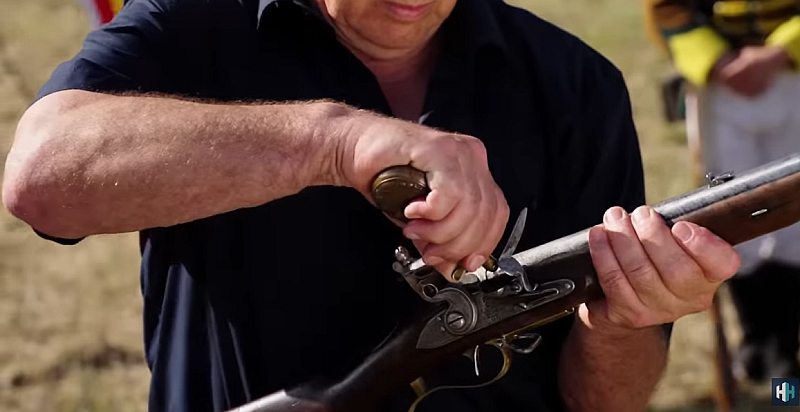
Historian Mike Loades applies powder to his reproduction Baker Rifle. (History Hit YouTube Channel)
The Baker Rifle’s Service History
The Napoleonic Wars
The year 1800 saw the advent of the Baker Rifle and the “Experimental Corps of Riflemen,” raised, trained, and commanded by Colonel Coote Manningham. Manningham was a veteran of the Great Siege of Gibraltar (1779-1783) and served in the Caribbean during the early French Revolutionary Wars.
The Baker Rifle’s lock. (militaryheritage.com)
As war with Napoleon loomed, Manningham and his Lt. Colonel, William Stewart, took their light infantry lessons from the Caribbean and proposed a new rifle-centered unit to the British Army. The new unit originally provided scouts, sharpshooters, and skirmishers to larger formations. That the Experimental Corps of Riflemen should be equipped with Baker Rifles was only natural.
European line regiments used volley musket fire to make up for their weapons’ inherent lack of accuracy and range. Unlike the smoothbore muskets of the day, the Baker Rifle was extremely accurate, making the soldier more effective at a longer range. Rifles were also more difficult and expensive to manufacture, limiting their use to specialists like the Experimental Rifle Corps.
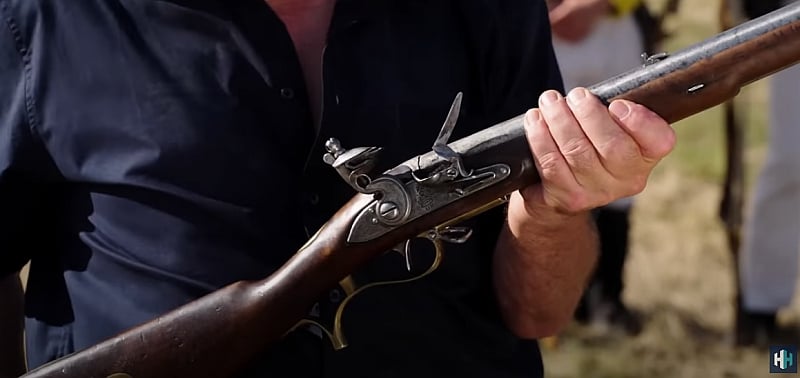
Historian Mike Loades with a reproduction Baker Rifle. (History Hit YouTube Channel)
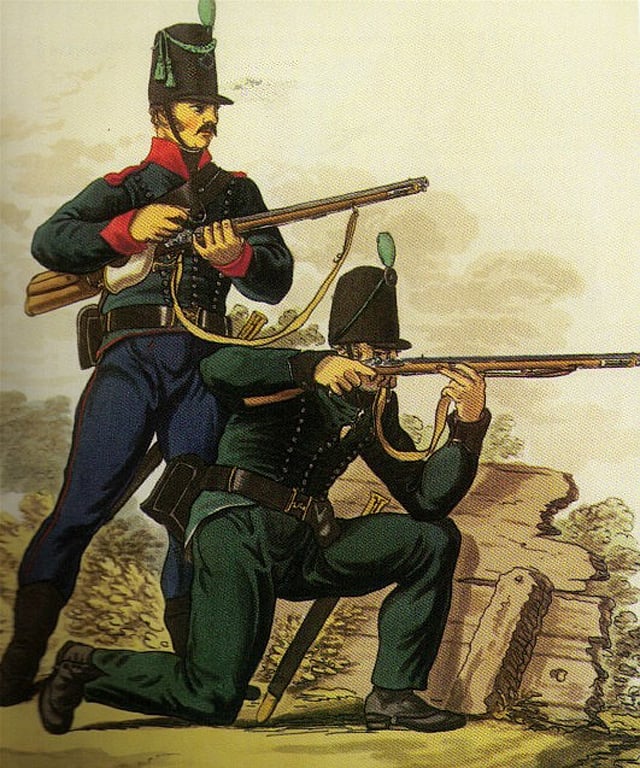
Befitting their mission, the riflemen wore dark green uniforms with black facings instead of the standard red coat with white trim. They wore black belts and had green plumes on their tall shako hats.
The Rifle Corps saw its first action on 25 August 1800, spearheading a British amphibious landing at Ferrol, Spain. The landing eventually failed, but the riflemen distinguished themselves by helping clear Spanish defenders from the high ground overlooking the beach. A company of riflemen used their Bakers as shipboard sharpshooters at the Battle of Copenhagen the following April.
The 95th Regiment of Foot
The Rifle Corps officially joined the British Army as the 95th Regiment of Foot in 1802. Their Baker Rifles went with them. The 95th served all over the world, from Germany to South America to Denmark. It was in Denmark that the 95th first served under Brigadier Sir Arthur Wellesley, the future Duke of Wellington.
August of 1808 saw the 95th dispatched to Portugal under Wellesley. The riflemen fired the opening shots of the Peninsular War against Napoleon in a skirmish at Óbidos on 15 August. Two days later, the 95th participated in the war’s first pitched battle at Roliça.
(militaryheritage.com)
The Baker Rifle’s Most Famous Shot
Rifleman Thomas Plunkett made the Baker Rifle’s most celebrated shot at the Battle of Cacabelos on 3 January 1809. The 95th formed part of the rear guard for Sir John Moore’s retreat to La Coruña, Spain. Hard pressed by French General Auguste François-Marie de Colbert-Chabanais, the rear guard defended a stone bridge over the Cua River with the 28th Foot, 52nd Foot, and six guns of the Royal Horse Artillery.
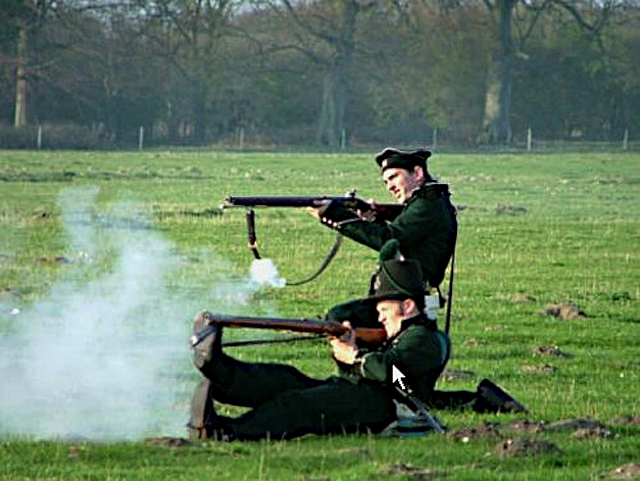
As the French rushed the bridge, Plunkett rushed onto the span, lay on his back, and rested his Baker on his crossed feet with the stock under his right arm. Plunkett aimed his rifle at General Colbert, leading the charge on a distinctive grey horse, and dropped him with one shot. Then, to prove it wasn’t a fluke, he killed the staff officer who rushed to the general’s aid. The French retreated in confusion. Plunkett then ran back to the British lines.
95th Regiment reenactors demonstrate rifle firing positions. The man on his back mimics Thomas Plunkett’s famous shot. (military-history.fandom.com/wiki/Rifle_Brigade)
Many sources cite the range of Plunkett’s shot as 600 yards. The best that historians and battlefield investigators can estimate is somewhere between 200 and 600 meters. A remarkable feat either way. Plunkett had served with the 95th since at least 1807. He continued throughout the Peninsula Campaign and later in the Hundred Days Campaign that ended at Waterloo in 1815.
A Distinguished History
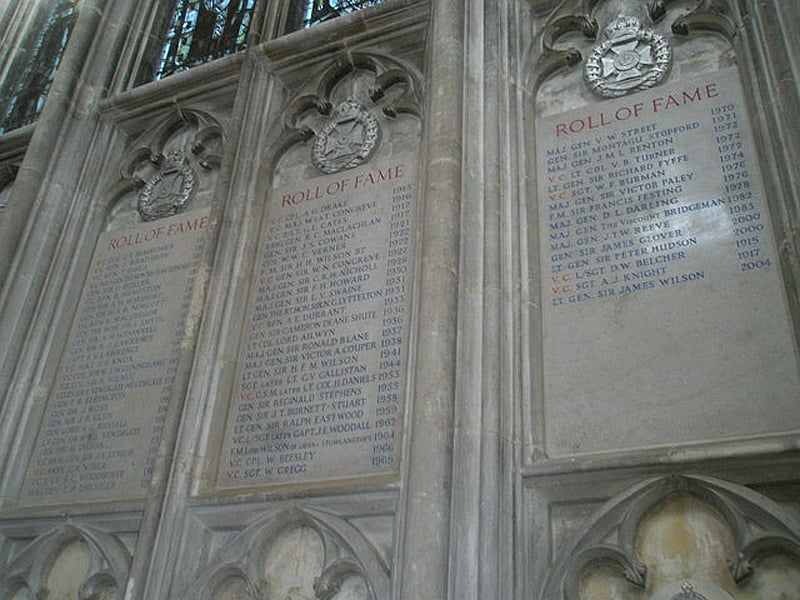
The 95th Regiment served with distinction until Napoleon’s defeat. They also saw action in Canada and the 1814 Battle of New Orleans in the War of 1812. Their distinguished record ensured their survival when the British Army downsized in 1816. They were redesignated as the “Rifle Brigade” on 23 February of that year. Wellesley, the victor at Waterloo and now the Duke of Wellington, served as the unit’s Colonel-in-Chief from 1820 until his death in 1852. The Rifle Brigade is one of the British Army’s most celebrated regiments to this day.
The Rifle Brigade’s Roll of Fame in Winchester Cathedral. (geograph.org.uk)
The Baker Rifle Around the World
The 95th Regiment of Foot was the most famous unit to deploy the Baker, but the rifle also saw good use by the elite 60th Regiment of Foot and the King’s German Legion included sharpshooter platoons in each of its line battalions. The 10th Hussars used a cavalry variant of the Baker Rifle. The British also supplied Bakers to their Portuguese, Austrian, and Russian allies against Napoleon. American forces reportedly used captured Bakers in the War of 1812.
Riflemen from the elite 60th Regiment of Foot (left) and the 95th Regiment of Foot from the Napoleonic Era. (militaryheritage.com)
British forces deployed the Baker in Canada in the War of 1812 and Santa Anna’s Mexican army used them at the Alamo in 1836. Baker Rifles were even supplied to Nepal, some of which were released from storage in 2004, though they were so badly deteriorated that most could not be saved.
The British produced Baker Rifles until 1838 and issued them until 1841. The rifle’s official 42-year service life attests to its quality and effectiveness.
Shooting the Baker Rifle
As with other muzzleloaders, the Baker Rifle had a precise loading drill. It consisted of seven distinct steps that were learned by command. Loading on command is more appropriate for line units than skirmishers, but the Baker did serve in line regiments.
Historian Mike Loades fires a reproduction Baker Rifle. (History Hit YouTube Channel)
Once loading was complete, the rifleman responded to the commands “Company,” “Ready,” and “Present.” “Present” told the rifleman to bring the weapon to his shoulder, acquire his target, and fire as soon as he was ready. Rifles were more accurate than muskets, so aimed fire, instead of volley fire on command, was more effective. This drill only applied to the standing position.
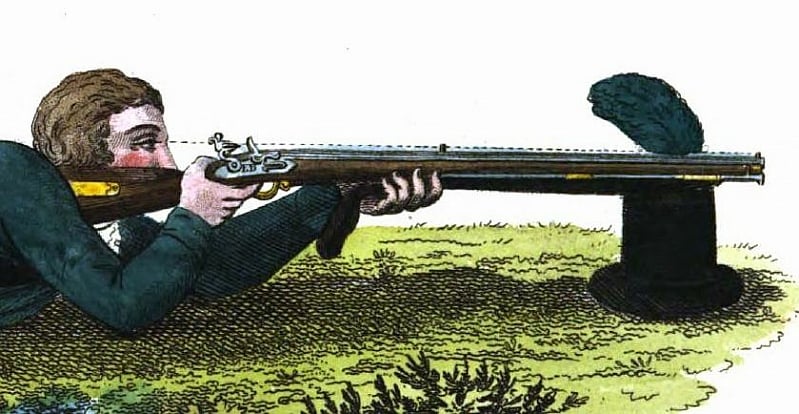
The British Napoleonic Era Rifleman’s manual illustrates the prone firing position with the shako hat. (militaryheritage.com)
Firing Positions
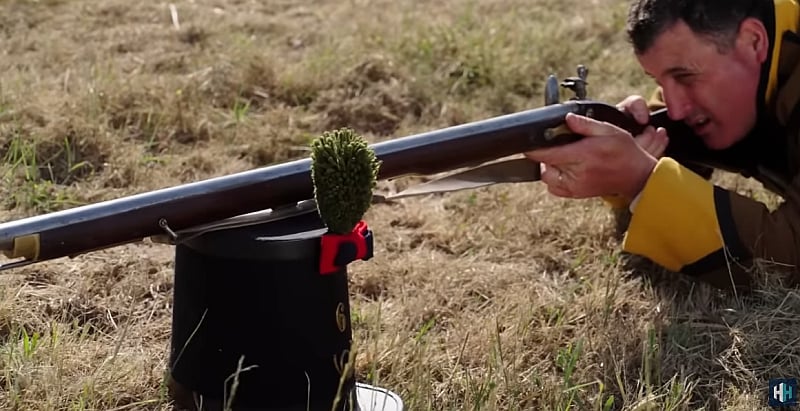
Skirmishers’ and sharpshooters’ firing positions were more varied, so they operated as the situation demanded. There were at least five different “approved” firing positions for the British riflemen: standing, kneeling, sitting, prone, and lying on one’s back. This last position saw the rifleman use his ankle or foot, often crossed over the other, as a shooting rest. The riflemen often rested their weapons on their shako hats in the prone.
A Portuguese reenactor fires his Baker Rifle from the prone using his shako hat as a rest. (History Hit YouTube Channel)
Thanks to the greased patch, which necessarily fitted tight in the barrel, the Baker Rifle loaded slower than the musket. The standard Baker rate of fire was two aimed shots per minute, whereas the musket’s rate could be as high as four. Experienced riflemen could reportedly fire three rounds per minute under ideal conditions. The nature of skirmishing and sniping often led to a much slower fire rate since it often depended on stealth and targets of opportunity.
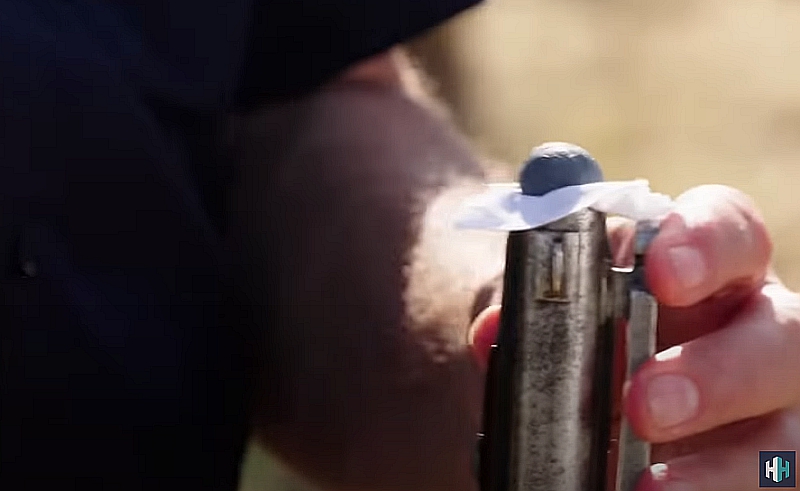
The greased patch engaged the Baker’s rifling. (History Hit YouTube Channel)
Riflemen were known to not use the patch in hot situations, preferring faster reloads to precise marksmanship. They used standard paper cartridges instead. This was probably more prevalent in the line units than the skirmishers or sharpshooters, but riflemen could use their normal projectiles without the patch in emergencies, though accuracy suffered considerably.
The Baker Rifle’s Legacy
The Baker Rifle was maybe the finest of its type for nearly forty years. Ezekiel Baker himself made 712 Baker Rifles. He subcontracted the other 22,000 or so to over 20 other gunsmiths and shops. The production process often had different contractors make different parts, with the final product assembled at the end.
The Baker’s concurrence with Manningham’s Experimental Rifle Corps combined to give the British Army not only a new weapon system, but the troops and doctrine to use it effectively. The British Army began experimenting with percussion caps in 1834, finally adopting percussion rifles and muskets in 1842. Percussion caps were far more efficient than flintlocks, and so better technology overtook the Baker.
Proper aiming technique in the British Army’s Napoleonic Era rifleman’s manual. (militaryheritage.com)
Still, the Baker Rifle is a classic military firearm that served the world over, nowhere more prominently than in the gargantuan wars against Napoleon. In the age of musketry, the Baker Rifle was a force on the small arms battlefield.
Few period Baker Rifles survive today. They saw hard service and the British made no real effort to preserve them. There are reproductions available but make sure you do your homework on the companies producing them. It looks like parts kits are perhaps the best route, assuming you have that kind of skill and the tools needed for the job. If you like that sort of thing, maybe pick one up and experience a little history.
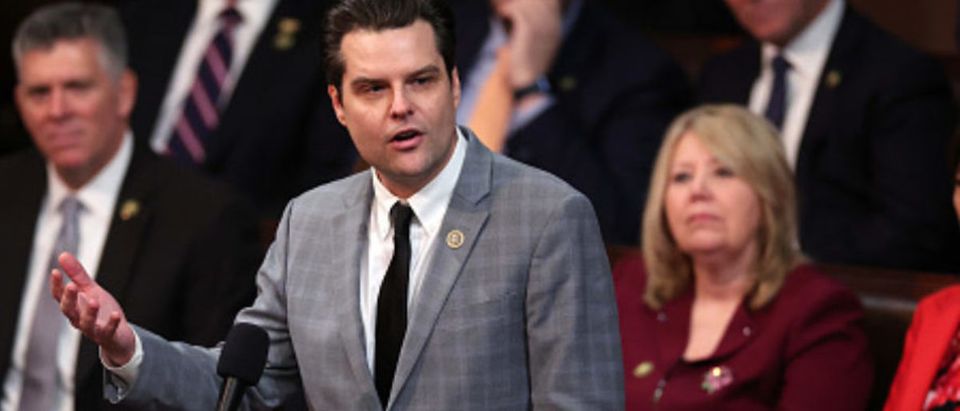
Republican Florida Rep. Matt Gaetz introduced legislation Wednesday that would abolish the Bureau of Alcohol, Tobacco, Firearms and Explosives (ATF) after they enacted a rule that would make pistol stabilizing braces illegal for anyone without a certain license.
The legislation, titled the “Abolish the ATF Act,” would totally eliminate the ATF immediately after the bill is enacted. Gaetz introduced the bill after the ATF announced they would make gun owners face the possibility of being charged with a felony if they do not register their firearms with the stabilizing braces.
Gaetz said that the House GOP has the ATF in their “crosshairs.”
“House Republicans have the ATF in our crosshairs. The continued existence of the ATF is increasingly unwarranted based on their repeated actions to convert law-abiding citizens into felons. They must be stopped. My bill today would abolish the ATF once and for all,” Gaetz said in a statement.
In June of 2021, Republican Georgia Rep. Marjorie Taylor Greene also introduced legislation that would abolish ATF if signed into law, which Gaetz was a co-sponsor of. The Daily Caller first obtained that legislation, titled the “Brian A. Terry Memorial Eliminate the ATF Act.” The bill was named after Marine and Border Patrol Agent Brian Terry, who was killed in a gunfight after a group of armed men attempted to rob smugglers who were transporting drugs from Mexico to the U.S. (EXCLUSIVE: Marjorie Taylor Greene To Introduce Legislation That Would Abolish The ATF)
Democrats have been focused on passing legislation that would stop gun trafficking, ban the import, sale, manufacture, transfer or possession of high-capacity magazines, raise the purchase age for certain rifles from 18 to 21 and promote safer storage of guns.