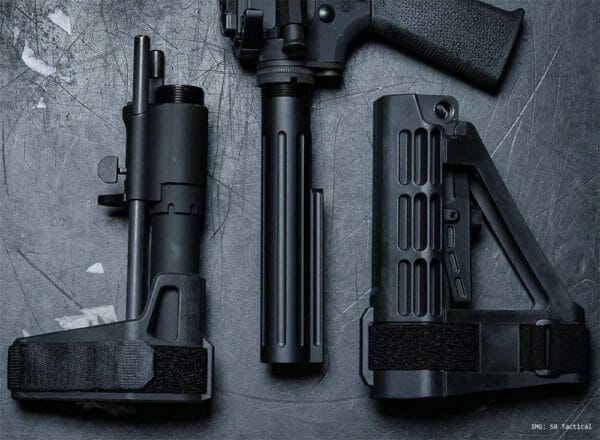
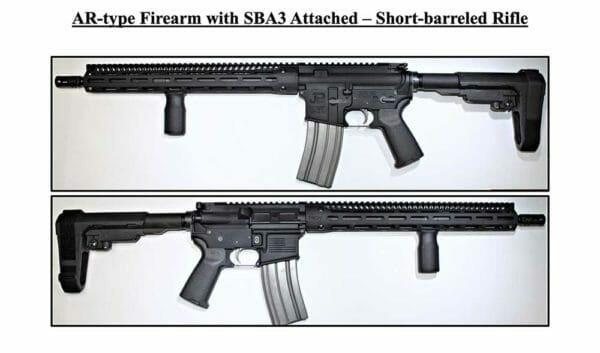
The new rule (ATF final rule 2021R-08F) was published on the ATF’s website today and is set to be posted on the Federal Register on Monday, one day before the industry’s largest trade show, SHOT Show. The regulation will affect millions of Americans that currently own pistol stabilizing devices. What has been considered pistols for years will now be regarded as short barreled rifles (SBR) and be subjected to the National Firearms Act (NFA).
The proposed rule used a form known as “Worksheet 4999” to determine if a firearm equipped with a pistol brace would be considered an SBR by using a point system. The ATF ditched the form in favor of a widespread declaration that almost every pistol equipped with a brace of any kind would be considered an SBR.
“Worksheet 4999 was intended to ensure uniform consideration and application of the statutory definition of those terms. Based on the comments received, the Department agrees that the proposed Worksheet 4999 and point system did not achieve these intended purposes,” the Final Rule reads.
Under the new rule, any firearm that is “designed or redesigned made or remade and intended to be fired from the shoulder” will be considered an SBR.
This designation includes devices such as pistol stabilizing braces which the ATF assumes the shooter installed to be able to shoulder the gun. Also, if a firearm merely has the surface area that would allow it to be fired from the shoulder, the ATF might consider it an SBR if it has a weight or length consistent with a rifle.
ATF Releases Final Version of Pistol Brace Rule
Any pistol with a length of pull that is consistent with that of what would be found in a rifle would be considered an SBR. Any adjustable attachments, such as a multi-position buffer tube, would also automatically make the pistol an SBR. If the shooter places an optic on their firearm that requires an eye relief that is consistent with what’s used on a rifle, such as a scope, then that gun will also be considered a short barreled rifle. If a firearm has the surface area to be fired from the shoulder, such as a firearm equipped with a nonadjustable buffer tube, then that will be considered an SBR, basically making every AR-15 pistol and SBR.
“Whether the surface area that allows the weapon to be fired from the shoulder is created by a buffer tube, receiver extension, or any other accessory, component, or other rearward attachment that is necessary for the cycle of operations,” the document reads.
The ATF will also look at marketing material offered by the manufacturer to determine if installing that device on a firearm will convert it to an SBR. Several lawsuits involve companies suing over California’s law preventing the advertisement of firearms to people under the age of 18, including safety classes.
The ATF will also look at how the people in the firearms community use a gun to determine whether it is an SBR. You could use a device as intended by the manufacturer and still violate the rule if others use it in a way that is not consistent with how the manufacturer designed the device to be used.
There is a 120-day grace period to apply for a tax stamp for any device now considered an SBR that was previously considered a pistol.
Although the ATF states a 120-day grace period to register a pistol as an SBR, the ATF only promises not to enforce NFA rules on these devices for 60 days. The ATF will give a tax forbearance for the $200 tax stamp fee. A tax forbearance means that the ATF will not collect the $200 tax fee, although, by the law, you still owe the fee; it just will not be collected. The rule is set up the way it is because the ATF cannot waive a tax.
Gun owners must use e-Forms to file for the tax stamp. Only individuals would qualify for the tax stamp on devices with pistol stabilizing braces. If someone wanted to put the firearm into a trust, they must first register as an individual and then pay the $200 transfer fee to transfer it into a trust. Many people who own NFA items prefer having their firearms in a trust.
Some states do not allow for SBRs. Gun owners in those states do have options.
They could add a 16-inch or greater barrel, converting the firearm from a pistol into a rifle. In the past, the ATF has stated that a pistol could never be converted into a rifle, but the regulation seems to change this determination. The pistol stabilizing device could also be removed, and the gun owner can modify their firearms not to be able to accept a pistol brace. The gun owner also has the option of destroying the firearm. The final option would be turning the gun into the ATF for zero compensation.
The new regulation is expected to cost gun owners over $260 million. It is expected to cost the federal government over $3 million. In addition to the cost, it will put an increasing burden on the already overwhelmed NFA division of the ATF. the ATF claims that the average wait time will be 90 days, although Silencer Shop is showing a wait time of eight months for a tax stamp. Not only will it bog down the new tax stamp applications for SBRs, but it might drastically increase the wait time for other NFA items, such as sound suppressors.
Ammoland News reached out to SB tactical for a comment on the final rule but has not received one at the time of this writing.
About John Crump
John is a NRA instructor and a constitutional activist. John has written about firearms, interviewed people of all walks of life, and on the Constitution. John lives in Northern Virginia with his wife and sons and can be followed on Twitter at @crumpyss, or at www.crumpy.com.
Murders occur overwhelmingly in dense urban areas, many with tough anti-gun restrictions, and far less in suburban and rural areas where firearm ownership is more common, according to a national study of killings.
“This research shows that murders in the U.S. are highly concentrated in tiny areas in the U.S. and that they are becoming even more concentrated in recent years,” said the report from John R. Lott’s Crime Prevention Research Center.
The new report, shared with Secrets, showed that big cities, including Chicago, Los Angeles, and Washington, D.C., are murder centers and that even in those cities, the areas where killings occur are growing more concentrated.
Lott’s report is all numbers and little editorial. It describes a nation that is seen on TV every night: shootings are common in cities.
Graphic courtesy Crime Prevention Research Center
“The worst 1% of counties (the worst 31 counties) have 21% of the population and 42% of the murders. The worst 2% of counties (62 counties) contain 31% of the population and 56% of the murders. The worst 5% of counties contain 47% of the population and account for 73% of murders. But even within those counties, the murders are very heavily concentrated in small areas,” he wrote of the 2020 numbers.
Comparing years, he said that the concentration of murder in tiny areas of cities and counties has surged since 2010.
The murder map in the report looks like the map of the concentration of Democratic voters in the nation.
His top 10 list of murder areas included Chicago, Los Angeles, Houston, Philadelphia, New York City, Detroit, Baltimore, Dallas, Miami, and Washington.
“Murder isn’t a nationwide problem,” Lott’s study said. “It’s a problem in a small set of urban areas and even in those counties murders are concentrated in small areas inside them, and any solution must reduce those murders,” it added.
Lott’s crime center often writes about gun use and crime, and he included a note that challenges conventional thinking that the surge in legal gun ownership has led to more killings.
“According to a 2021 PEW Research Center survey, the household gun ownership rate in rural areas was 79% higher than in urban areas. Suburban households are 37.9% more likely to own guns than urban households. Despite lower gun ownership, urban areas experience much higher murder rates. One should not put much weight on this purely ‘cross-sectional’ evidence over one point in time, and many factors determine murder rates. However, it is still interesting to note that so much of the country has both very high gun ownership rates and zero murders,” he said.
A former American Navy SEAL was killed this week during Russia’s assault on eastern Ukraine while fighting alongside Ukrainian forces, a Navy official tells TIME.
Daniel Swift, a Navy Special Warfare Operator First Class who had gone AWOL, died Jan. 18 after suffering injuries with a unit under attack by Russia, the official said.
The Navy confirmed that Swift has been in “an active deserter status since March 11, 2019,” according to his releasable service records obtained by TIME.
Swift, who is from Oregon, first enlisted in 2005. He received an Iraq Campaign Medal, Afghanistan Campaign Medal, and Global War on Terrorism Expeditionary Medal, the records say. The records don’t detail any of Swift’s deployments or SEAL teams he may have served on, but list an assignment with a Naval Special Warfare “Cold Weather Detachment” out of Kodiak, Ak. in 2007 and separate stints with two “West Coast-based Special Warfare Unit(s)” from July 2007 to January 2014. Swift’s most recent assignment began in August 2017 and was with a “West Coast Special Warfare Unit.”
.
The U.S. State Department wouldn’t confirm Swift’s identity but said in a statement that an American was killed in action.
“We can confirm the recent death of a U.S. citizen fighting in Ukraine,” the statement says. “We are in touch with his family and providing all possible consular assistance. Out of respect for the privacy of the family during this difficult time, we have nothing further to add.”
Since Russia first invaded Ukraine last February, the Biden Administration has insisted that U.S. troops will not fight in Ukraine and encouraged Americans not to travel to fight there.