
Mohsen Fakhrizadeh was an Iranian scientist born in 1958 in Qom, Iran. After the Iranian Revolution in 1979, he joined the Islamic Revolutionary Guard Corps (IRGC). In 1987 he earned his BS in nuclear physics from Shahid Beheshti University in Tehran. Literally translated Shahid Beheshti supposedly means “Martyr Paradise.” I would find it a bit unsettling to attend “Martyr Paradise University” myself. If nothing else I doubt it was much of a party school. He later earned a Ph.D. in nuclear radiation and cosmic rays.

Fakhrizadeh technically taught physics at the Imam Hossein University. However, in 2007 the CIA announced that this was simply a cover story. Apparently, Mohsen Fakhrizadeh was actually scrambling madly to build a nuclear bomb.

The AMAD Project ran from 1989 until 2003 and was suspected of being the cover for an Iranian nuclear weapon program. The Iranian government denied its existence, but keep in mind that these are some sneaky rascals. Fakhrizadeh subsequently founded the Organization of Defensive Innovation and Research (SPND). I have no idea how they got that acronym out of that name. I don’t read Farsi. Fakhrizadeh was SPND’s director from 2008 until 2011.

Fakhrizadeh also chaired FEDAT, the Field for the Expansion of Development of Advanced Technology. That acronym I can understand. I’m pleased to see that the creation of bizarre acronyms is not solely an American disease. While the Iranian government has claimed throughout that their nuclear program is entirely peaceful, apparently somebody else felt otherwise. This all came to a head one fateful day in November of 2020.
The Attack

Fakhrizadeh was a strategic national asset for Iran, and everybody involved knew that there were forces at play in both the US and Israel who felt that the world might be better off without him. Donald Trump came to a similar conclusion about Qasem Soleimani and blew him straight to hell. Soleimani was known locally as “The Shadow Commander” due to his propensity to skulk about killing people, equipping terrorists, and generally fomenting chaos. Good riddance.

In the year leading up to November 20, 2020, tensions escalated between Iran and the US as well as Iran and Israel. There were rumors of a pending assassination attempt, but these reports got lost in the mind-boggling clutter that is intelligence gathering in the Information Age. There has been some fairly impressive retrospective self-flagellation in Iran as a result.

Fakhrizadeh’s security team begged him not to travel. However, he had an important meeting and claimed he also needed to lecture his students. He was traveling on a rural road in his Nissan Teana near Absard between Tehran and his weekend villa. His Nissan was part of a three-vehicle convoy. He had eleven trained security operatives in tow and sat alongside his wife. Along a deserted stretch of road, the little convoy approached a Nissan truck parked on the shoulder. During a subsequent debriefing, the security forces claimed it looked like the pickup truck was carrying a load of wood.

The attack lasted less than three minutes. Fakhrizadeh was shot a total of thirteen times from a range of 150 yards. His chief security officer purportedly threw himself on top of the Iranian scientist and caught four rounds for his trouble. Fakhrizadeh’s wife was sitting some ten inches away and was unharmed. Apparently, Fakhrizadeh was hit, climbed out of the car, and was then cut to pieces. The gun clearly tracked him as he moved. Once the attack was complete the Nissan pickup truck simply exploded.

In the immediate aftermath, the Iranian government spun an elaborate yarn about multiple attackers and a suicide bomb. They claimed that three bodyguards died while either three or four of the attackers were killed. They even dredged up a few witnesses who corroborated part of the story, claiming that the suicide bomber lingered on for a bit after the blast before succumbing to his injuries. Apparently, all of that was made up.

The Fars News Agency later reported that Fakhrizadeh had actually been killed by some kind of killer robot. They stated that a remotely-controlled machinegun linked to Israel by satellite and utilizing both Artificial Intelligence and facial recognition had identified Fakhrizadeh and gunned him down. A subsequent article in The Jewish Chronicle quoted unnamed intelligence sources claiming that the attack was indeed the work of the Israeli Mossad using a remote-controlled automatic weapon. Holy crap.

The article went on to state that the entire system weighed about a ton and was smuggled into Iran in small components before being assembled and deployed. They asserted that it was Fakhrizadeh’s predictability in going to his villa every Friday that ultimately killed him. The operation purportedly involved some twenty individuals between Mossad operators and disaffected Iranian resistance fighters. The Chronicle article claimed that there were actually operatives onsite but that the explosive destruction of the gun was adequate to cover their escape. We’ll likely never really know the details.

After his untimely death, the Iranians even announced that this Ph.D. physicist with a specialty in nuclear radiation and cosmic rays was actually the primary force behind the Iranian COVID-19 test and vaccine. Iran’s Defense Minister Amir Hatami went so far as to say that Fakhrizadeh had made “great strides in the field of developing COVID-19 vaccine.” He added that the center led by Fakhrizadeh went through the first phase of clinical human trials in the field of developing corona vaccine and “did great things for our dear people.” I struggle to believe that, however. The Iranian government lies a lot.

I’m no scientist myself, but in my experience, nuclear physicists do not develop vaccines. Those are two very different disciplines. It would be like having an auto mechanic regulate your cardiac medications or your plumber cook your meals. Once again, consider the source.
The Weapon

The 1997 thriller The Jackal starred Bruce Willis, Richard Gere, and Jack Black and orbited around a shadowy international assassin who used a remote-controlled machinegun to try to take out a high-value target. This was one of Jack Black’s first major roles. Though the critics were not kind to the film, I thought it was awesome. At the time it seemed fairly far-fetched. Nowadays it appears technology has caught up with the filmmaker’s vision.

The CROWS (Common Remotely Operated Weapon System) is a fixture on US military vehicles operating downrange today. The CROWS will host a variety of automatic weapons and allows the operator to deliver effective fires while under armor. Whether it is an Mk19 automatic grenade launcher, an M240 GPMG, or a Ma Deuce .50-caliber machinegun, the CROWS allows more accurate fire while keeping the friendly operator safe.

The Talon gyrostabilized weapon mount from Paradigm SRP takes things one step farther. The Talon compensates for movement to provide a stable and accurate firing platform even from a maneuvering vehicle. The mount accepts a variety of conventional rifles and machineguns and has an effective range in excess of 700 meters. The Talon was originally designed to operate off of helicopters, though it is comparably at home on ground or maritime mounts as well.

As soon as mounts like the Talon could be operated wirelessly they could be managed from anywhere in the world. A system like the Talon could be placed in an ambush position and left for a protracted period of time before a target or vehicle came within range. Solar cells could even free you from battery constraints. Powerful long-distance cameras allow the host weapon to be accurately and precisely targeted.

Remotely operated weapons are actually becoming more and more common in the internecine conflicts that seem to define the Middle East and elsewhere. I couldn’t find any specific references to the weapon system used in the Fakhrizadeh hit beyond that it might have been built around a modified FN MAG gun. However, I did find images of a wide variety of improvised remote-controlled gun stations.


The current term is “teleoperated weapon systems,” and they are rapidly becoming commonplace. Several companies make commercial versions like the Paradigm SRP Talon and Smart-Shooter Smash Hopper. However, the most impressive to me are the homebuilt improvised DIY versions. The ready availability of inexpensive servos, immensely capable high-resolution cameras, and widespread cell coverage make improvising these things ever easier. Anyone with an Internet connection and a credit card can track down the components.

I found references to improvised mounts using SVD Dragunov sniper rifles, FN FALs, PKM light machineguns, MG74 LMGs, and AKM rifles. All that is required is to construct a gimbaling mount, equip it with a remotely accessible video camera, and rig a solenoid to the trigger assembly. Surplus rifles can be used to build these things up on the cheap. The most compelling example I found came out of Syria and was built around a WW2-era MP44 assault rifle.

Syrian rebels purportedly captured around 5,000 of these vintage weapons from Syrian government stocks. A friend who has been over there recently tells me that these classic guns sell for between $25 and $50 apiece. However, he said magazines are rare and 7.92x33mm ammunition is all but nonexistent. Suffice to say that transferable examples on this side of the pond are quite a bit spendier.
Ruminations

Whoever carried this out covered their tracks beautifully. Without a literal and figurative smoking gun, Iran cannot retaliate without risking a massive international outcry. Meanwhile, Mohsen Fakhrizadeh remains quite very dead.

It is only a matter of time before the Iranians do indeed complete an operational nuclear weapon. It may yet take a while, but the fateful day is coming when Iran joins the rarefied ranks of nuclear-capable nations. Let us hope that when that time comes cooler heads prevail and the Iranians do not opt to exercise their sparkly new plaything. If recent events are any indicator, however, the Israelis, or whoever it was that actually ganked Mohsen Fakhrizadeh, will be thoroughly prepared come what may. Lord help us all.

The opinions expressed by contributors are their own and do not necessarily represent the views of RedState.com.
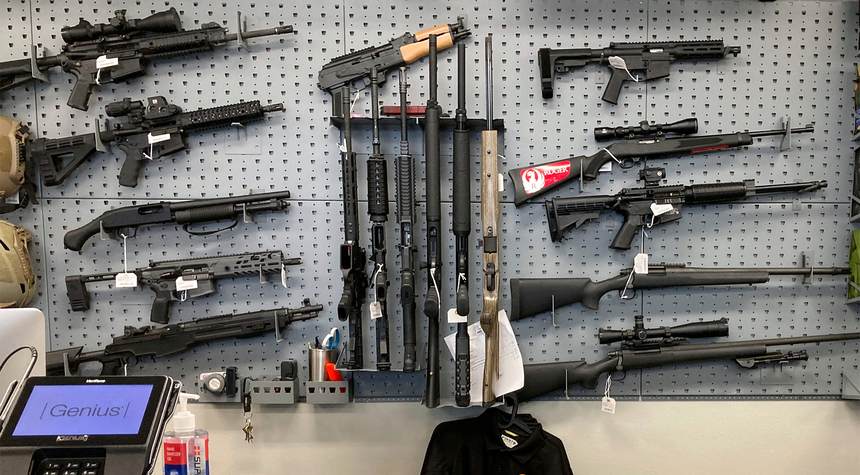
The Second Amendment remains under attack, and it’s time for Congress to demand that “Fair Access to Banking Services” rules be re-prioritized by the banking industry.
Earlier on Saturday, my colleague Kira Davis reported that Wells Fargo canceled the accounts of Del Ray, Florida-based Wex Gunworks. Reportedly, Wells Fargo deemed the dealership, which supplies a full range of firearm services to Floridians, too risky for a banking relationship with the company.
Of note to students of 2A politics, in the case of Wex Gunworks, is that it is a federally-licensed NFA Class III dealer in machine guns and silencers, which are legal for Floridians to own. But gun control activists have been pushing ESG departments to act against companies, regardless of state law or business legality. Reportedly, Wells Fargo went further and severed the personal accounts of owner Brandon Wexler as well.
According to a report in The Reload by journalist Stephen Gutowski,
Wexler, who has been cited in stories by the New York Times, Washington Free Beacon, CNN, ABC, and many more publications, said nothing had changed with his business. He said he believed the move by Wells Fargo was motivated entirely by animus against the gun industry.
“It feels like it’s a direct attack against gun dealers,” he said. “This all just happened recently, and we have been in business for many years. I’ve never ever seen anything like this.”
Except this isn’t the first time Well Fargo has been in the news doing this.
Back in July 2020, I penned an article on RedState titled “Wells Fargo Risks Reputation Over Private “Chokepoint” Policy Against Gun Industry,” noting that the bank was under scrutiny that it might be changing its stance on accounts with the firearms industry to follow the policies of what is known in policy circles as a privatized version of the discredited government initiative known as Operation Chokepoint.
This was when banks turned to adopting discriminatory Environmental, Social, Governance (ESG) policies that effectively redline certain impolitic industries, which includes the firearms industry, under the nebulous definition of “too risky to do business with.” My article at that time noted that in 2020, it was already official bank regulatory policy that financial institutions had been instructed to cease this type of business/industry redlining practice since 2015.
But some banks chose to carry on with the practice while being careful not to document the political reasons for cutting ties with a booming firearms industry. This article reported that a US Senate committee had expressed concern and was making inquiries to bank regulators as to why this practice was being allowed to continue.
By December 2020, I reported in my RedState article, “As Gun Industry Continues to Be Shunned by Banks, Regulators Move to Enforce Fair Access,” that the Office of the Comptroller of the Currency was responding to the call for fair access to banking services by the hampered industries and was in the process of issuing a new rule that would ban such practices. That rule was passed in January 2021 and was then put on hold, following the transition from the Trump to the Biden presidency.
This continuing hold on enforcing fair access enabled this latest incident to happen to Mr. Wexler’s company. I recently updated my coverage of this saga on December 25, 2022, in an article in America’s 1st Freedom, “The Financial War on Our Freedom,” which describes how some banks have continued to weaponize their ESG to attack politically incorrect companies. Mr. Wexler’s company became a victim of this ideology war around the same time the article was published, proving the concern remains a present danger and deserves attention by Congress and regulators in 2023.
It’s redlining when banks attack otherwise healthy businesses in economically robust industries and cause them to be less viable in the marketplace. Using the excuse that internal risk calculations by the bank as the basis for non-participation in a credit, lending, or account services relationship is the same excuse that some banks have used in the past to avoid establishing accounts or making loans to minority or impoverished communities.
When a bank does the latter, forces are set into motion where a government enforcement agency begins to compile evidence of a pattern of discrimination, eventually leading to enforcement actions and payments of fines or settlements, often amounting to millions of dollars, as part of reparation of harm done.
Congress should demand the same type of aggressive enforcement for fair access principles in business credit and lending that the massive federal apparatus is doing for housing and community development. Impolitic or not, every healthy business is a vital part of keeping the US economy afloat, particularly during an inflationary and recessionary phase. Washington should be asking why the “Fair Access to Banking Services” rules that would punish banks for weaponizing their ESG departments against their customers are in a state of limbo in the Code of Federal Regulations.

Now if it was mine, not that I could ever afford one. I would never take it out of the safe except to show to my trusted friends! Grumpy










Categories
Thanks guys!

Categories
Include me too!
