Categories
All About Guns

The Lovely Art of Going Afield, Shotgun in Hand by MICHAEL LUDERS

hunter with shotgun
Steve Oehlenschlager/Windigo

We leave the store just after lunch and head for the covers. We still have an hour to drive, and in the distance, the great New England mountains loom. We drive through towns we know from history books. They are all the same, with their brick-front buildings, coffee shops and diners; their central squares proud with monuments. Small towns where everything is known, wrote the poet Robert Lowell. I am struck by the resistance here to becoming like other places. We are back in time. Ahead of us still, more of the same. There is snow already on the peaks, and it’s only October.

Each year at this time, we are untroubled, content. The air is pure, crisp. The light is changing, and with the windows down, we can smell the season. It seems as if the leaves on the trees are changing as we drive, not by days but miles. Soon they will be bare, perhaps around the next bend. A train races us, a long line of rusted boxcars. It is ahead and behind us at the same time.

We are going hunting; the licenses we just purchased are folded neatly within our vests. The image of the woman who sold them to us—she couldn’t exist anywhere else—is still fresh in my mind. There is something about all this, the way it issues forth each year, unfolding as the stories we read in old hunting magazines. Nothing changes. This is what draws me. I know each year will be the same.

Later that afternoon, we are in the woods, and a belled setter is coursing the brush. We hold our guns—the same ones our fathers carried—across our chests. They are oiled against the briars, wet with melting frost. They are British doubles, but they don’t have to be. There is no hierarchy in these covers. An acquaintance carries an American pump-action. He kills more birds than anyone I know. I have a friend who will switch from 20-gauge to 12 when the leaves are finally down. I need the extra punch, he tells me; partridge don’t hold in December. I’m sure he’s right, but I stick with my 20. He kills more birds, too.
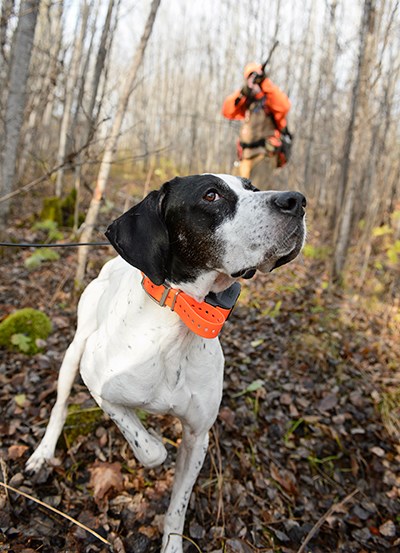
Hunting dogIn November, we slip into different covers. The birds we chase are creatures of habit. Diets change as the food withers. Bird hunting in New England is a sport of tradition. We practice it as our fathers did, or we try to. Canvas vests and coats. Thorn pants that are torn and resewn. Some holdouts still wear Bean boots, toes frozen, soles slipping. Others resist, unwisely, blaze-orange, as if it is an affront to the color of autumn—a blight, even. There is a new breed, of course. Like anything, there always is. Their dogs wear GPS collars, their truck beds are loaded with steel crates. They might dress differently—they’re certainly drier and warmer. But they aren’t any different, really. The game is the same. We practice similarly. We love the same dogs. We shoot the same guns. It is a culture, in a way, one that is startlingly accommodative.

It is not just about guns, but also of the things that surround the things we do with our guns. The shells we might load ourselves. The feathers that puff from the pockets of the vests we toss off at the end the day. The fingers bloodied from cleaning birds. It is the cast-iron skillet that browns the breasts. The gun oil and the gun cases. The dog, the point, the flush. The tales told.

When I look at my shotgun, I see the vault where it was once stored. Somewhere in Britain, between the wars, as they say, a tweeded chap takes it afield in late summer. His gun room is the size of a pantry. There is a table, long ebony cleaning rods and brass brushes. The floor is littered with oiled clumps of lambswool. Upstairs, downstairs, indeed. I imagine he spends his time downstairs, with his servants. Here they are equal. To the chagrin of his pouty, proper wife, he even takes the cook hunting with him. How his gun came to me is an interesting story, even if it bears no resemblance to any truth. The hunters I know all envision stories behind their guns. I have a hammer gun that is even older, made sometime in the 1880s. The game it must have shot!—my imagination goes wild. 

In London, where both were made, there are the famed gunmakers—Purdey, Woodward, Boss. These are guns few of us can afford, but dream we might anyway. Some of us will opt for the lesser names, keen just to own an English double. There is the legend of them, the mythic balance and feel, the extraordinary lines, a sense of refinement absent in all others. Whether it is true or not, some say London gun craft is unparalleled. I love them. My pal does not. He is a Parker partisan. Another fellow I know hunts with an L.C. Smith. They, too, are better shots. After a day in the woods, when the bourbon is poured, we pluck our birds, debate our preferences. This can go long into the night. The American enthusiasts are usually victorious, usually by way of attrition. Does it matter? The fun is in our opinions, our championing of them. In the end, we love bird guns; carry them we will.

There was a shop in the town just north of where I grew up. It sold fly rods and flies. One came here for everything from waders to duck stamps. On the walls were signed prints by Pleissner, Reneson, Abbott—it was quite the thing in those days to collect hunting art. In the back were the guns. I went with my father often to buy shells; we could hunt locally then. Now it’s all developed, but then it was possible to bag woodcock just down the road. The gun racks held all the brands—Browning, SKB, Daly. My first bird gun might well have come from there, though I can’t remember. If it didn’t, it came from a place just like it. 

As we walked out with our ammo, there would always be a few men gathered in the front, around the owner. I was just a boy, but I was sure then, as I am now, that a certain ritual was occurring. I would linger. They were talking in some language I wanted to know. I had heard the words before, but did not know their importance: Gauges, chokes, shot sizes, loads … it was a vocabulary that would soon become part of me. Like baseball fans and their obsession with statistics, these men would weigh forth certainly on matters that will forever go unsettled.

The shop is gone now, and, with it, the men who made the place so special. To find it again, we must travel farther north, to those unchanged towns, those woods without settlements. One day, not far off, a young boy or girl might pass me in that local shop and hear the talk, hear me even arguing against choked barrels for grouse. “You’re either on, or you’re not,” I will say.

There is some truth that New England upland hunting is the province of a certain breed of character. One might call him a “prep.” But today I might meet a father and his young daughter, or a public-school teacher on short break. Once, I ran into a bear hunter, from the back of his truck the yelping of hounds. I’d like to try this, he told me, eying my broken shotgun and oilskin chaps. The men I hunt with once a year in the north country come from Boston, from Connecticut. They are gentlemen, gracious and charming. And, yes, they are preppy.

The hunters I know all envision stories behind their guns. I have a hammer gun that was made sometime in the 1880s. The game it must have shot!—my imagination goes wild.

They duck hunt and they bird hunt. Their fathers had done so. Times change, and places do, too. But not these men. I imagine they hunt exactly as their fathers had. It’s wonderful to be around them. We come back from the covers separately, to a place they call bird camp, though, really, it’s a rough-shod ski lodge, empty because the season is still months away. Someone has an in with the owner. We lay our guns on the tables to dry. Spanish doubles, English, too. It is hard for me not to pick up each, weigh it in my hands. The stories behind them come to mind, again without any regard for truths. These are the guns of the upland enthusiast. I might even find a pin-feather stuck to the end of a barrel, clue to the success of its owner.

At dinner, we talk about old hunts, missed birds. Often, if not mostly, we talk about our cherished shotguns. One of us had once left his leaning against the fender of his car as he took off his boots, and crated his dogs. It had been a long day, and the weather had turned. He drove away and it wasn’t until he arrived back at camp that he realized he’d left it behind. He had been down a long, rough, two-track, deep into the cover. No one ever went back there. He returned, but, alas, it was gone. He was crushed. In 1948, Nash Buckingham had done the same thing with his beloved Fox. When it was found, some 57 years later—the great man long dead—it sold for $200,000. There is no replacing my friend’s gun, not because one can’t find its duplicate, but because one can’t find that gun. It had served him well. In a way, it had been an extension of himself, not just as the tool weathered by his grip, but as the means to say to the rest of us, this is who I am in the woods. There is more to our guns than just gun.

The seasons can’t touch us; we are immortal during them. We come together once a year for some weeks—months for the lucky—and we are immune to everything. They are days of unmitigated joy. The rest of the year is mortgages, taxes and doctor’s appointments. One friend begins counting toward opening day in May. I can’t imagine this. It’s hard enough starting in July. We take our shotguns to the ranges. “Send up clays like this,” we say to the trappers, waving arcs that mimic exploding grouse. When we miss, we insist, “Not like that, like this.” Again and again, we shoot every scenario, imagining flushes finally impossible for birds to follow.

Home to clean our guns. Phone calls to critique each other. “You’re taking your cheek off the stock every time,” someone tells me. I know that. Still, I keep doing it. There is tennis, and golf. Some of us like to sail. I don’t. I like to shoot. Clays in spring and summer, birds in fall and winter. Oh, I like venison, too.

My first bird gun was my father’s. I wish I could say it’s the same gun I shoot today. I can’t. The reasons are myriad. Short stocks and short barrels are a bad idea. It was always his, never mine, even when he gave it to me. I like side-by-sides, mostly because they suggest bygone times. I’m a romantic. They’re harder to shoot, I’m told. That’s okay—I need excuses. When I saved some money, I starting looking for my bird gun. I knew just what I wanted. When I found it, I said to a pal, “This is it! I’ll never need another.” He looked at me as if I had spoken in tongues.

“You’ll always need another,” he said. He was right. The next year, I bought a hammer gun.

I’m saving both guns for my daughter; she’s a lefty, too. When I told her, she said, “Why would I want those antiques?”

What does one say to that?
Categories
All About Guns

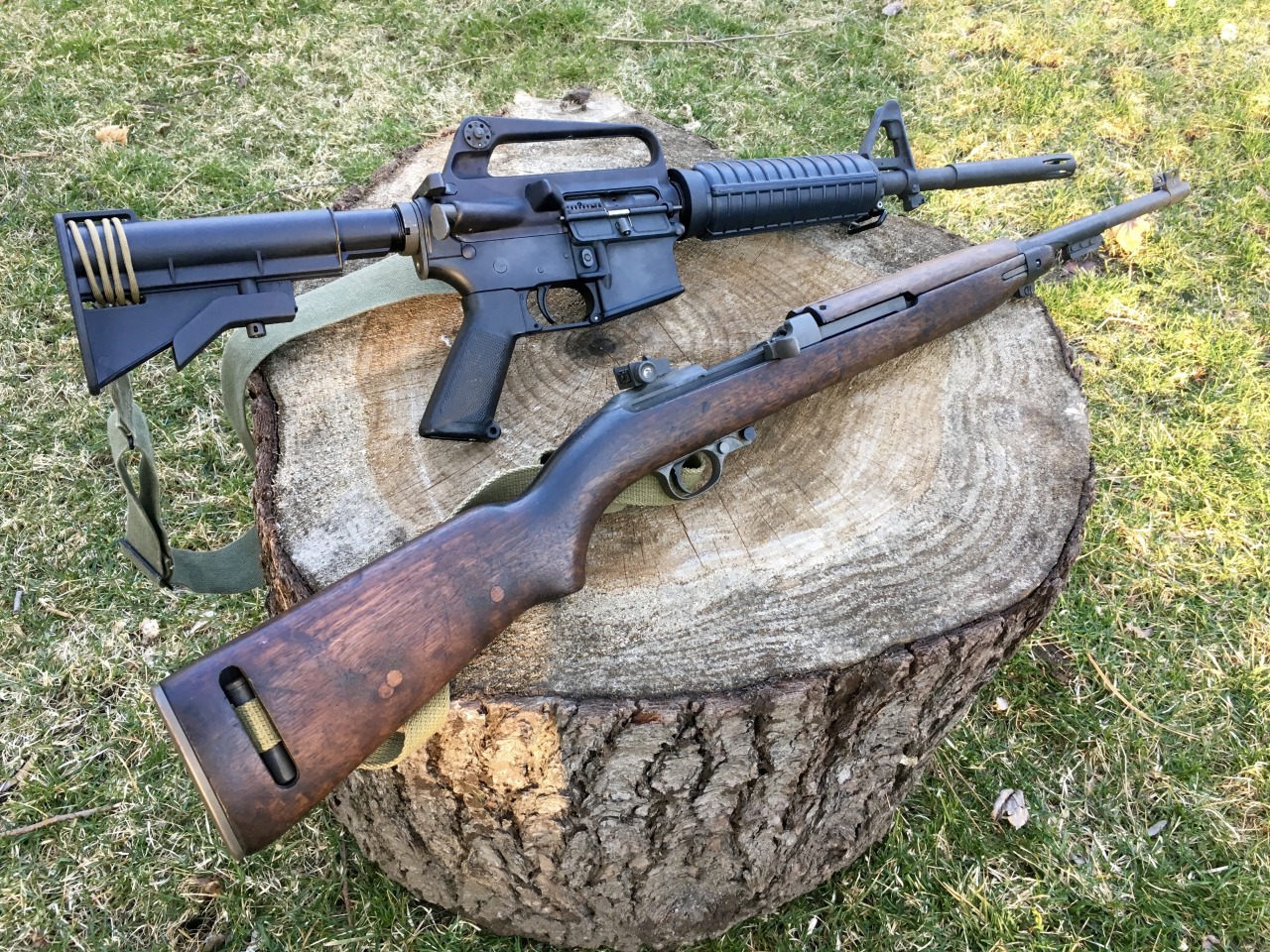
Carbines past and present

Categories
All About Guns

I Have This Old Gun: Winchester Model 12 ‘Trench’ Gun by S.P. FJESTAD

Trench

This article appeared originally in the February 2006 issue of American Rifleman. To subscribe to the magazine, visit the NRA membership page and select American Rifleman as your member magazine.


How many of you would trade an original, similar condition Winchester 28-ga. Model 12 with factory Cutts compensator “even up” for this World War II Model 12 trench gun? It may surprise you that the trench gun is now worth more money.

Until the mid-1990s, U.S. military long arms, including shotguns, had not been as popular or collectible as U.S. military handguns. Then things changed in a hurry, but what made the difference? A surge of popular public awareness in World War II history, including various 50th anniversaries and the movie “Saving Private Ryan,” became the main catalysts for renewed collector interest in military long arms. The U.S. military shotguns finally reached a comparable level of acceptance that military handguns and most rifles and carbines had enjoyed for decades.

This unaltered, blued specimen has a correct 20 7⁄8″  round barrel with ventilated shroud, and its serial number (1014XXX) indicates that it was manufactured during 1943. A Remington “1917” marked bayonet, which may have been an original World War II issue for this Winchester shotgun, with scabbard also adds value.

brown bayonet for shotgun

Approximately 80,000 Model 12 trench guns were manufactured between 1941 and 1944, and later production featured a Parkerized metal finish. Careful inspection will reveal four rows of holes in the handguard for barrel heat venting, changed from six during 1917.

Gun: Winchester Model 12 “Trench” Gun
Condition: 80 percent overall (NRA Modern: Very Good)

Originality is Polar North for U.S. military long-gun collectors, which means it is essential to know exactly which proofmarks should be present and where they are located. Note the “U.S.” and the ordnance flaming bomb proofs on the right side of the receiver and crisp stock cartouche with inspector’s initials, in addition to the sling swivels. When evaluating U.S. military shotguns, carefully examine the originality of the hardware and choke marking on the barrel (beware of cut barrels), look for possible new or restamped proofmarks and cartouche, and check for metal or wood refinishing that might indicate a non-original finish.

Categories
All About Guns

Ruger Mark IV Close-up

Categories
All About Guns This great Nation & Its People War

COMBAT RIFLES OF THE PACIFIC WAR By Will Dabbs, MD

Combat in Europe during World War II orbited around massive set-piece battles across expansive terrain. By contrast, the Pacific War was characterized by ferocious conflicts of extermination, typically fought over relatively small isolated pieces of dirt. The weapons used in the island hopping campaigns served in some of the most demanding environments in the history of warfare.

M1 Carbine USMC Saipan beach invasion
U.S. Marines hit the beach with M1 Carbines during the Battle of Saipan.

With few exceptions, troops in the Pacific carried the standard infantry weapons issued by their nations’ militaries serving elsewhere. Combat environments ranged from the fetid jungles of Guadalcanal to the frozen wastes of Attu and Kiska. Throughout it all, fighting men on both sides battled to the death for their particular ideologies.

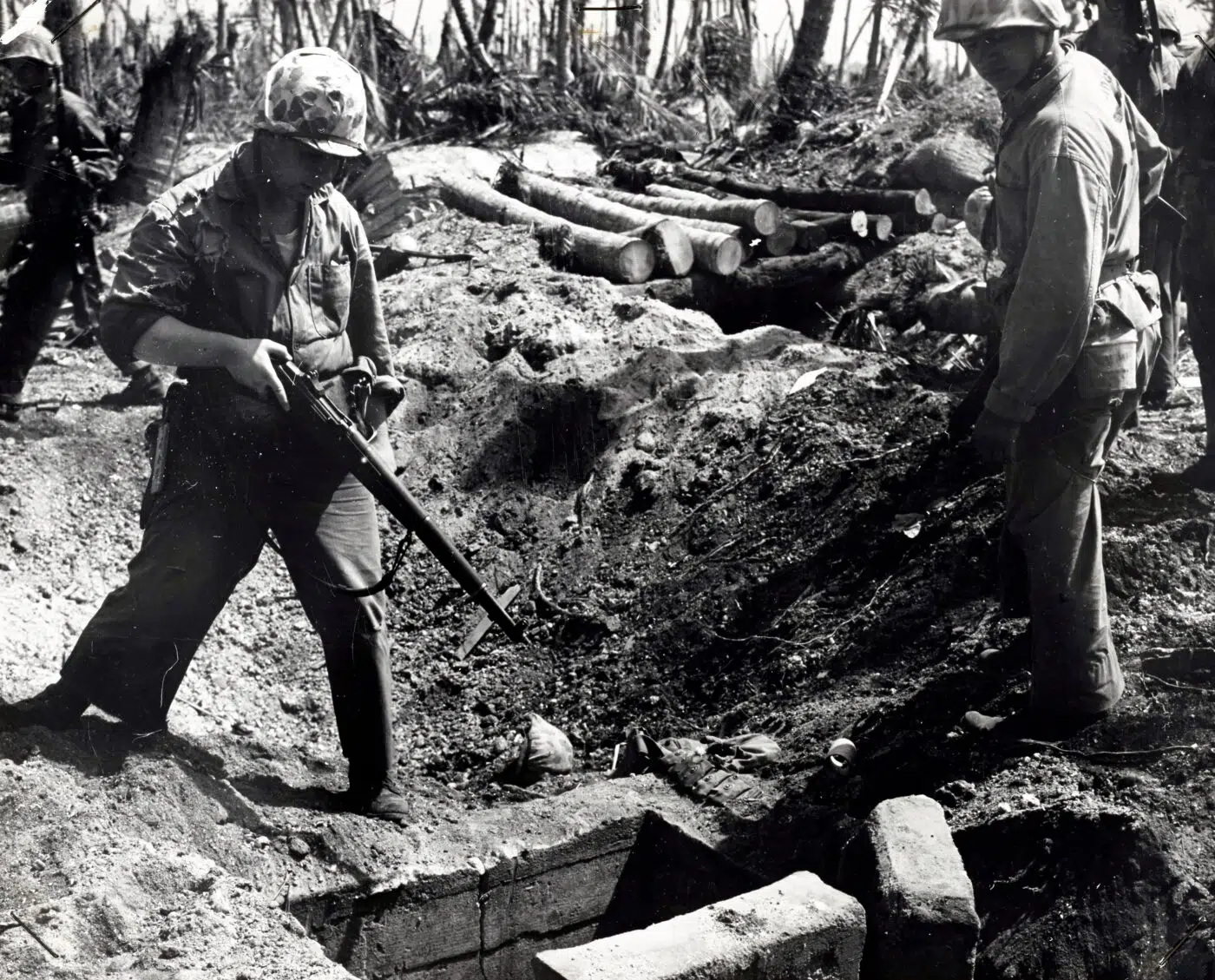
US Marine with M1 Garand inspects a beach bunker
A U.S. Marine inspects a Japanese beach bunker. He is carrying the staple of the U.S. military in World War II: the M1 Garand.

United States

John Cantius Garand began design work on what was to become the M1 rifle in 1924. The U.S. Army adopted the weapon in 1936. It officially entered service a year later.

M1 Garand firing on Bougainville Puruata Island 1943
A U.S. Marine fires his M1 Garand during the Bougainville Campaign on Puruata Island in November 1943.

The M1 fired a full-sized 7.62x63mm/.30-06 round. The rifle fed from an eight-round en bloc clip that ejected automatically on the last round fired. The semi-automatic M1 was indeed the most capable battle rifle of the war. U.S. troops appreciated the M1’s penetration in heavy jungle foliage.

Marine team with M1903s Solomon Islands
When the U.S. Marines entered the Solomon Islands campaign, many were equipped with the M1903 Springfield rifle instead of the modern M1 Garand.

While the M1 was powerful, reliable, and mean, it also weighed 9.5 lbs. empty and was nearly 44″ long. As a result, in 1938 the Ordnance Department began development on a light rifle for use by truck drivers, mortarmen, radio operators, and the like. The resulting M1 Carbine weighed a paltry 5.8 lbs.

M1 Carbine at the Battle of Tarawa
This U.S. Marine holds his M1 Carbine while making a radio transmission during the Battle of Tarawa in Operation Galvanic.

Those early semi-automatic carbines fed from 15-round detachable box magazines and fired a straight-walled 7.62x33mm cartridge. While the carbine has been denigrated for its performance when compared to the M1 Garand, that’s not really fair. The carbine was intended to supplant the handgun, not the rifle. As a PDW (Personal Defense Weapon), the carbine was indeed a prescient design. For close quarters applications in jungles, caves, and tunnels, the carbine excelled.

M1 Garand and M1 Carbine
The M1 Garand (top) and the M1 Carbine complemented each other during the Pacific War. Despite similar designations, the buttplate screw was the only part common to both weapons.

Commonwealth Forces

British Commonwealth troops first saw action in Malaya, Singapore, and Hong Kong the day after the Pearl Harbor attack. They fought alongside U.S. forces until the two atomic bombs ended the war. Standard infantry rifles across the Commonwealth forces were sundry variations of the bolt-action Lee-Enfield.

SMLE Burma June 1945
Many Commonwealth troops were equipped with various versions of the Lee-Enfield rifle.

Variations of the Lee-Enfield served from 1895 until 1957. Despite firing an archaic rimmed .303 round, the rugged and fast Lee-Enfield action remained one of the most effective bolt-action designs of the war. The basic rifle evolved through several Marks.

General Wingate SMLE rifle Burma
Major General Orde Charles Wingate boards a plane with his SMLE. Wingate died in 1944 when his B-25 Mitchell crashed in northeast India.

The SMLE (Short Magazine Lee-Enfield) Mk III was the standard British infantry weapon of WW1. British Tommies affectionately referred to them as “Smellies.” All Lee-Enfield rifles fed from detachable 10-round box magazines. However, most loading was still undertaken via stripper clips from the top. Some versions even had their magazines affixed to the rifle with a short length of chain. Early WWI-vintage SMLE’s included a sliding magazine cutoff that effectively turned the rifle into a single-shot weapon. This feature was wisely deleted in short order.

The SMLE was a superb rifleman’s tool, but it was expensive. The subsequent No. 4 Mk I sported a simplified sighting system and redesigned barrel. The SMLE has a characteristic flat-nosed appearance, while the No. 4 Mk I sports a stubby bit of barrel out the front. Both weapons were comparably effective in action.

SMLE and Lee Enfield Mk IV
The SMLE (bottom) served alongside the subsequent Lee-Enfield No 4 Mk I throughout the Pacific campaigns.

Though the No. 4 Mk I was the more recent design, many Commonwealth troops used the SMLE throughout the Pacific War. While British production focused on the later weapon, the Indians and Australians manufactured the SMLE throughout the war. Australia did not retire the SMLE until the late 1950’s.

Lee-Enfield No 5 Mk 1 Jungle Carbine
The Lee-Enfield No 5 Mk I “Jungle Carbine” was specifically designed for close quarters operations. Photo by Rama, used with permission.

Canadians first saw action during the battle for Hong Kong on December 8, 1941. 290 Canadians perished before the garrison surrendered on Christmas Day. 5,300 Canadians took part in the Aleutian campaign in August of 1943. Period photographs depict the Canadians involved in the operations on Attu and Kiska carrying No. 4 Mk I rifles.

M1 Carbine Brigadier General Stockwell British Burma November 1944
Not every member of the Commonwealth carried a Lee-Enfield. Brigadier General Hugh Stockwell is pictured here with an M1 Carbine.

BSA Shirley and ROF Fazakerley produced a total of around 250,000 No. 5 Mk I “Jungle Carbine” versions of the Lee-Enfield for use in the Pacific Theater. This short-barreled variant of the No. 4 Mk I used the same action but incorporated a conical flash suppressor. Recoil was fairly epic.

Lee Enfield No 4 Mk I
The stubby bit of barrel protruding from the nose is the easiest way to differentiate the later No 4 Mk I from the previous hognosed SMLE Mk III.

Japan

The Japanese began their 1930’s campaigns in China with Type 38 rifles chambered for the 6.5x50mm semi-rimmed cartridge. The Type 38 was designed in 1905 and produced until 1942. The subsequent shorter Type 99 shared a similar action but fired the heavier 7.7x58mm round. These weapons were frequently called “Arisakas” in reference to their primary designer Colonel Arisaka Nariakira. There were other rifles in Japanese service, but the Type 38 and Type 99 were by far the most common.

Japanese troops bayonets propaganda photo
In this propaganda photo, Japanese soldiers are shown with Arisaka rifles and mounted bayonets.

The safety was a big knob on the back of the receiver. To manipulate it you would press in with the palm and rotate the knob in the desired direction. Early safety knobs were heavily knurled to conjure a vaguely chrysanthemum vibe.

Japanese private with Arisaka
Arisaka rifles proved effective in combat. With a bayonet, the weapon could be quite intimidating.

As the American B-29 Superfortresses pummeled Japanese industry, production quality for Type 99 rifles began to fall off. Where early guns sported complicated folding anti-aircraft sights, a collapsible monopod and a removable sheet steel action cover, the so-called “Last Ditch” late-war weapons were much simpler. Last ditch Arisakas had fixed peep sights, crude furniture, and a wooden buttplate held in place with three carpenter’s nails.

Japanese weapons captured in China
This cache of Japanese weapons were collected in China. Shown are Arisaka rifles, machine guns and even gas masks.

In post-war tests conducted by the NRA, the Arisaka was deemed to be the strongest bolt-action rifle of the war. These guns served everywhere the Japanese fought. Veterans brought these weapons home by the thousands as souvenirs. Most vet bring-back guns have had the emperor’s chrysanthemum mark on the receiver ring ground away.

Japanese rifles of WWII
From bottom to top are the Type 38, the Type 99 and the Last Ditch Type 99 rifles. These were the most common rifles carried by Japanese soldiers.

China

Chinese soldier with Gewehr 88
A Chinese soldier shares a fire with a U.S. airman near a B-29. The Chinese soldier is armed with either a Gewehr 88 or a Chinese copy.

The most common Chinese service rifle was the Hanyang 88, a near copy of the WWI-vintage German Gewehr 88 chambered for the 7.92x57mm round. The Chinese produced around a million copies before manufacture wrapped up in 1944. The Chinese Chiang Kai-Shek rifle was a local copy of the German Mauser 98k carbine.

Chinese troops train with M1917 rifles
These Chinese troops train with M1917 rifles from the United States during World War II.

Other Chinese weapons included the FN Model 1924, the Mosin-Nagant 1891 and the Italian Carcano 1891. The Chinese used American-supplied M1917 EnfieldsM1903A3 Springfields, and M1 Carbines as well. Keeping those disparate calibers supplied in an austere environment must have been a Gordian chore.

Chinese troops armed with M1903 rifles late 1945
These Chinese nationalist troops are equipped with 1903 Springfield rifles. The photo was taken in late 1945 in front of the USS Cullman.

Ruminations

The Russians joined the Pacific War just twenty-four days before the Japanese capitulation. In their defense, the Soviets were fighting for their very lives against the Nazis on the Eastern Front and were too preoccupied to put a whole lot of effort into the Pacific. The Soviets made widespread use of the Mosin-Nagant M1891 everywhere they fought.

US Marine with his M1 Garand on Iwo Jima Mt Surabachi flag
A U.S. Marine and his M1 Garand stand watch over the beaches of Iwo Jima. Nearly 35 million people died in the Pacific Theater of World War II.

The Pacific War spanned thousands of miles and ultimately claimed some 6.5 million combat troops. 27 million civilians perished. Troops wielding these weapons served from the West coast of the U.S. all the way into China, Burma and India. Cultural influences from that global war shape the geopolitics of our modern world even today.

Categories
Ammo

Ah the good old days when the shelves were full and the prices were reasonable too!

Categories
All About Guns The Green Machine War

Forlorn Hope: The Story of the 1st Maine Heavy Artillery Regiment

Categories
Dear Grumpy Advice on Teaching in Today's Classroom Soldiering Useful Shit Well I thought it was neat!

Could You Survive As A Roman Soldier On Hadrian’s Wall?

Categories
All About Guns

Almost everything you need at the Range (As hearing protection would be nice to have)

Categories
All About Guns War

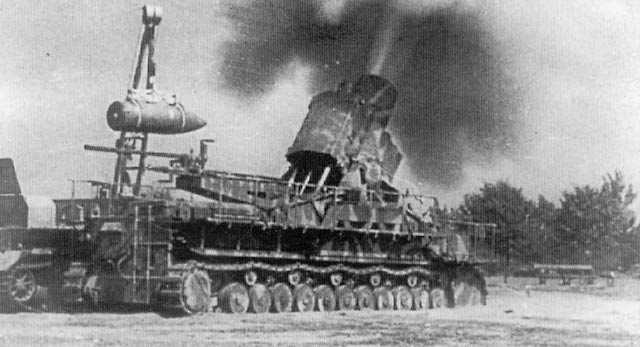
Typical German over engineering!

Final drive for the 60cm Karl Gerat SPG

Karl-Gerät - Wikipedia