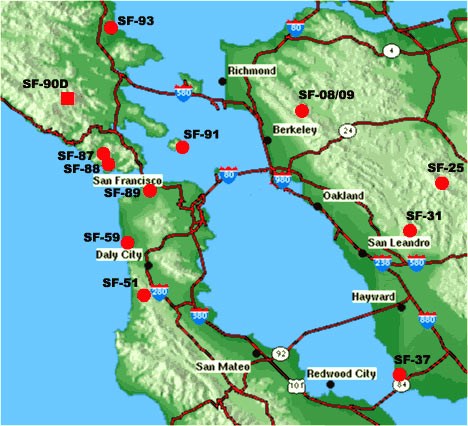
 This map shows all the Nike missile sites in the Bay Area.
NPS image
Categories
Works for me


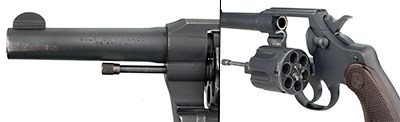
Parkerized and minimalist, the Commando was obviously engineered for hard use on the battlefield • Released by a simple pull latch, the six-round cylinder is robust • Colt’s rollmark indicates the pistol’s martial background.
At the turn of the last century, Colt and Smith & Wesson were the two most prolific American revolver manufacturers. Both were vying for the military and civilian markets that clamored for the newly developed .38 Spl. cartridge. While Smith & Wesson hit the market with its .38 Spl. Military & Police revolver first (1899), Colt was soon in the game with its Army Special, also chambered in .38 Spl., in 1908. By America’s entry into World War II, Colt’s Army Special was now called the Official Police, and sales were brisk at $28.50 each.
 As you can imagine, following the attack on Pearl Harbor in December, 1941, the U.S. Government was scrambling to provide arms and supplies to millions of new recruits. The standing army of the U.S. was slightly less than 500,000 men in 1940, but it would grow to nearly 16 million by 1945. The Defense Supplies Corporation (DSC) was established in 1941 to provide arms and ammunition to the thousands of non-military guards and police charged with protecting America’s munitions plants, war production factories, depots, trains, rail yards and dozens of other sensitive sites. In July, 1942, the DSC contracted with Colt for 20,000 .38 Spl. revolvers. It selected the 4-inch-barrel .38 Spl. Official Police as its choice, but balked at the $28.50 price tag.
Colt countered with a version of the Official Police that was Parkerized (Parco-Lubrite) and had plastic (Coltwood) grips lacking checkering on the trigger, hammer and cylinder release latch. The Colt Commando was born, yielding a $2.50 savings over the MSRP of the Official Police. (Smith & Wesson had done the same with its M&P and called it the Victory Model).
According to Charles W. Pate’s excellent book, “U.S. Handguns of World War II” (1998), a few prototypes of the Commando were initially sent to the Chief of Ordnance in October of 1942 and the first deliveries of the 4-inch Commando were begun in early March, 1943.
In a strange arrangement, the U.S. Army’s Ordnance Department inspected and received all the Commandos produced by Colt initially and then delivered the guns to the DSC, charging them a “handling fee,” which no doubt put the cost of the guns back over the $28.50 price that the DSC had tried to avoid in the first place. By mid-1944, the DSC was able to procure the Commando directly from Colt, eliminating those “handling charges.” (By the end of the war, Colt had raised the price to $32.30).
I’ve often heard folks say, “If this gun could talk, I wonder what tales it would tell.” And to that I would counter, “Let’s give it a look over and see what it can already tell us.” According to Pate, the Colt Commando was serial numbered from No. 1 to No. 50,280, accounting for the full run of more than 50,000 produced during World War II. Of that 50,000, the U.S. Army Ordnance Department received the first 36,000 between March, 1943, and June, 1944. So, if a Commando falls below the serial number of 36,000 it should have U.S. military markings on it such as an Ordnance bomb cartouche on the upper left side of the frame. Of these 36,000 revolvers, 20,000 or so were sent to the DSC for distribution to the non-military end users as stated above. However, 16,000 revolvers were used by the U.S. military in a number of roles. Some made it over to Europe—even GA Eisenhower was known to have one. The CID and OSS were each also recipients of the Commando for clandestine operations. After June of 1944, or serial number 36,000, Commandos encountered without inspector marks were Commandos that were sold directly to the DSC. Those destined for military use were stamped with the ordnance bomb, “W.B.” or “G.H.D.” There are some exceptions to this rule as the Army “loaned” some revolvers to the DSC when urgencies arose unexpectedly and vice versa, so the best way to know is to write to Colt and have the company provide an official letter.
Almost from the receipt of the first prototypes in 1942, Colt began to produce a 2-inch-barreled model that some call “The Junior Commando.” The Ordnance Department began receiving the first shipments of the 2-inch model around the same time that the first shipments of the standard 4-inch model were arriving in March, 1943. It is believed only 3,450 of the 2-inch “Junior Commandos” were manufactured and used during the war.
The Army and the DSC were not the only ones to employ the Commando during the war, as approximately 1,700 were delivered to the U.S. Navy. In early 1944, a U.S. Navy Sailor dropped his Smith & Wesson “Victory” model on the deck of his ship and it discharged, fatally wounding him. The delivery of the Smith & Wesson revolvers was placed on hold while a suitable fix was found to prevent their accidental discharge. Colt was able to bridge the gap somewhat by delivering Commandos to the Navy during the interim period.
The Colt Commando mostly saw service during the war as a stateside guardian, a vital role, no doubt. The limited numbers produced—50,000 total—pale in comparison to the Smith & Wesson Victory model in .38/200 (775,000 manufactured) and .38 Spl. (350,000 manufactured).
According to the “43rd Edition of the Blue Book of Gun Values,” an example of the Colt Commando in “as-issued” condition is worth about $1,350, while the .38 Spl. version of the Smith & Wesson Victory model runs about $100 more.
The reader is encouraged to see Charles W. Pate’s “U.S. Handguns of World War II” as well as Gary H. Peer’s “The Colt Double Action Snub-Nose (Pocket) Revolver” for more information about the fascinating revolvers of this period.

Categories
Uber Cool!

Categories
The 1909 Schwarzlose Pistol Pistol
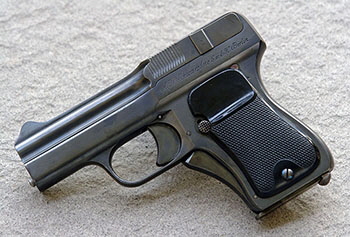
The most notable feature of the 1909 Schwarzlose is its “blow- forward” or “reverse-recoil” action, which allows the barrel to be the same length as that of any “blow-back” pistol, while the overall length of the gun may be shorter than usual, since the magazine is positioned beneath the barrel rather than behind it.
Another feature, not quite so obvious is the flat mainspring that tensions the hammer, the magazine release, and the safety lever. When the grip safety on front of the grip is squeezed it pulls a u- shaped connector bar at the base of the grip forward, putting enough tension on the bottom of the mainspring to allow the gun to be fired.
The magazine release serves as a fulcrum point for the spring. If the grip safety is not squeezed there is insufficient tension in the mainspring to enable the hammer to ignite the primer. In its forward position, the grip safety blocks the trigger. A button on the left side of the gun may be pressed upward and allowed to come down when the safety is squeezed to lock the safety back, which makes it easier to aim the gun carefully for target shooting
Categories
Some lever action porn
From top to bottom: 1900 vintage Winchester Model 1873 .38-40, 1887 vintage Winchester Model 1886 in .45-90, 1896 vintage Winchester Model 1892 .32-20, 1904 vintage Winchester Model 1895 .405 WCF, 1941 Winchester Model 94 in .32 Winchester Special with a 1955 Savage Model 99 in .300 Savage.


Steve Oehlenschlager/Windigo
We leave the store just after lunch and head for the covers. We still have an hour to drive, and in the distance, the great New England mountains loom. We drive through towns we know from history books. They are all the same, with their brick-front buildings, coffee shops and diners; their central squares proud with monuments. Small towns where everything is known, wrote the poet Robert Lowell. I am struck by the resistance here to becoming like other places. We are back in time. Ahead of us still, more of the same. There is snow already on the peaks, and it’s only October.
Each year at this time, we are untroubled, content. The air is pure, crisp. The light is changing, and with the windows down, we can smell the season. It seems as if the leaves on the trees are changing as we drive, not by days but miles. Soon they will be bare, perhaps around the next bend. A train races us, a long line of rusted boxcars. It is ahead and behind us at the same time.
We are going hunting; the licenses we just purchased are folded neatly within our vests. The image of the woman who sold them to us—she couldn’t exist anywhere else—is still fresh in my mind. There is something about all this, the way it issues forth each year, unfolding as the stories we read in old hunting magazines. Nothing changes. This is what draws me. I know each year will be the same.
Later that afternoon, we are in the woods, and a belled setter is coursing the brush. We hold our guns—the same ones our fathers carried—across our chests. They are oiled against the briars, wet with melting frost. They are British doubles, but they don’t have to be. There is no hierarchy in these covers. An acquaintance carries an American pump-action. He kills more birds than anyone I know. I have a friend who will switch from 20-gauge to 12 when the leaves are finally down. I need the extra punch, he tells me; partridge don’t hold in December. I’m sure he’s right, but I stick with my 20. He kills more birds, too.
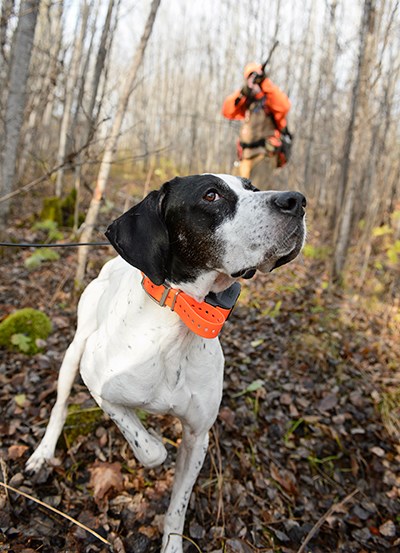 In November, we slip into different covers. The birds we chase are creatures of habit. Diets change as the food withers. Bird hunting in New England is a sport of tradition. We practice it as our fathers did, or we try to. Canvas vests and coats. Thorn pants that are torn and resewn. Some holdouts still wear Bean boots, toes frozen, soles slipping. Others resist, unwisely, blaze-orange, as if it is an affront to the color of autumn—a blight, even. There is a new breed, of course. Like anything, there always is. Their dogs wear GPS collars, their truck beds are loaded with steel crates. They might dress differently—they’re certainly drier and warmer. But they aren’t any different, really. The game is the same. We practice similarly. We love the same dogs. We shoot the same guns. It is a culture, in a way, one that is startlingly accommodative.
It is not just about guns, but also of the things that surround the things we do with our guns. The shells we might load ourselves. The feathers that puff from the pockets of the vests we toss off at the end the day. The fingers bloodied from cleaning birds. It is the cast-iron skillet that browns the breasts. The gun oil and the gun cases. The dog, the point, the flush. The tales told.
When I look at my shotgun, I see the vault where it was once stored. Somewhere in Britain, between the wars, as they say, a tweeded chap takes it afield in late summer. His gun room is the size of a pantry. There is a table, long ebony cleaning rods and brass brushes. The floor is littered with oiled clumps of lambswool. Upstairs, downstairs, indeed. I imagine he spends his time downstairs, with his servants. Here they are equal. To the chagrin of his pouty, proper wife, he even takes the cook hunting with him. How his gun came to me is an interesting story, even if it bears no resemblance to any truth. The hunters I know all envision stories behind their guns. I have a hammer gun that is even older, made sometime in the 1880s. The game it must have shot!—my imagination goes wild.
In London, where both were made, there are the famed gunmakers—Purdey, Woodward, Boss. These are guns few of us can afford, but dream we might anyway. Some of us will opt for the lesser names, keen just to own an English double. There is the legend of them, the mythic balance and feel, the extraordinary lines, a sense of refinement absent in all others. Whether it is true or not, some say London gun craft is unparalleled. I love them. My pal does not. He is a Parker partisan. Another fellow I know hunts with an L.C. Smith. They, too, are better shots. After a day in the woods, when the bourbon is poured, we pluck our birds, debate our preferences. This can go long into the night. The American enthusiasts are usually victorious, usually by way of attrition. Does it matter? The fun is in our opinions, our championing of them. In the end, we love bird guns; carry them we will.
There was a shop in the town just north of where I grew up. It sold fly rods and flies. One came here for everything from waders to duck stamps. On the walls were signed prints by Pleissner, Reneson, Abbott—it was quite the thing in those days to collect hunting art. In the back were the guns. I went with my father often to buy shells; we could hunt locally then. Now it’s all developed, but then it was possible to bag woodcock just down the road. The gun racks held all the brands—Browning, SKB, Daly. My first bird gun might well have come from there, though I can’t remember. If it didn’t, it came from a place just like it.
As we walked out with our ammo, there would always be a few men gathered in the front, around the owner. I was just a boy, but I was sure then, as I am now, that a certain ritual was occurring. I would linger. They were talking in some language I wanted to know. I had heard the words before, but did not know their importance: Gauges, chokes, shot sizes, loads … it was a vocabulary that would soon become part of me. Like baseball fans and their obsession with statistics, these men would weigh forth certainly on matters that will forever go unsettled.
The shop is gone now, and, with it, the men who made the place so special. To find it again, we must travel farther north, to those unchanged towns, those woods without settlements. One day, not far off, a young boy or girl might pass me in that local shop and hear the talk, hear me even arguing against choked barrels for grouse. “You’re either on, or you’re not,” I will say.
There is some truth that New England upland hunting is the province of a certain breed of character. One might call him a “prep.” But today I might meet a father and his young daughter, or a public-school teacher on short break. Once, I ran into a bear hunter, from the back of his truck the yelping of hounds. I’d like to try this, he told me, eying my broken shotgun and oilskin chaps. The men I hunt with once a year in the north country come from Boston, from Connecticut. They are gentlemen, gracious and charming. And, yes, they are preppy.
The hunters I know all envision stories behind their guns. I have a hammer gun that was made sometime in the 1880s. The game it must have shot!—my imagination goes wild.
They duck hunt and they bird hunt. Their fathers had done so. Times change, and places do, too. But not these men. I imagine they hunt exactly as their fathers had. It’s wonderful to be around them. We come back from the covers separately, to a place they call bird camp, though, really, it’s a rough-shod ski lodge, empty because the season is still months away. Someone has an in with the owner. We lay our guns on the tables to dry. Spanish doubles, English, too. It is hard for me not to pick up each, weigh it in my hands. The stories behind them come to mind, again without any regard for truths. These are the guns of the upland enthusiast. I might even find a pin-feather stuck to the end of a barrel, clue to the success of its owner.
At dinner, we talk about old hunts, missed birds. Often, if not mostly, we talk about our cherished shotguns. One of us had once left his leaning against the fender of his car as he took off his boots, and crated his dogs. It had been a long day, and the weather had turned. He drove away and it wasn’t until he arrived back at camp that he realized he’d left it behind. He had been down a long, rough, two-track, deep into the cover. No one ever went back there. He returned, but, alas, it was gone. He was crushed. In 1948, Nash Buckingham had done the same thing with his beloved Fox. When it was found, some 57 years later—the great man long dead—it sold for $200,000. There is no replacing my friend’s gun, not because one can’t find its duplicate, but because one can’t find that gun. It had served him well. In a way, it had been an extension of himself, not just as the tool weathered by his grip, but as the means to say to the rest of us, this is who I am in the woods. There is more to our guns than just gun.
The seasons can’t touch us; we are immortal during them. We come together once a year for some weeks—months for the lucky—and we are immune to everything. They are days of unmitigated joy. The rest of the year is mortgages, taxes and doctor’s appointments. One friend begins counting toward opening day in May. I can’t imagine this. It’s hard enough starting in July. We take our shotguns to the ranges. “Send up clays like this,” we say to the trappers, waving arcs that mimic exploding grouse. When we miss, we insist, “Not like that, like this.” Again and again, we shoot every scenario, imagining flushes finally impossible for birds to follow.
Home to clean our guns. Phone calls to critique each other. “You’re taking your cheek off the stock every time,” someone tells me. I know that. Still, I keep doing it. There is tennis, and golf. Some of us like to sail. I don’t. I like to shoot. Clays in spring and summer, birds in fall and winter. Oh, I like venison, too.
My first bird gun was my father’s. I wish I could say it’s the same gun I shoot today. I can’t. The reasons are myriad. Short stocks and short barrels are a bad idea. It was always his, never mine, even when he gave it to me. I like side-by-sides, mostly because they suggest bygone times. I’m a romantic. They’re harder to shoot, I’m told. That’s okay—I need excuses. When I saved some money, I starting looking for my bird gun. I knew just what I wanted. When I found it, I said to a pal, “This is it! I’ll never need another.” He looked at me as if I had spoken in tongues.
“You’ll always need another,” he said. He was right. The next year, I bought a hammer gun.
I’m saving both guns for my daughter; she’s a lefty, too. When I told her, she said, “Why would I want those antiques?”
What does one say to that?
Categories
Carbines past and present