





How I see myself & then there is what my body tells me empathically with lots of pain !
Categories
Curator’s Corner: Weird Derringers
Gov. Hochul proposes changes to New York’s concealed carry laws
More changes could be on the way for New York’s concealed carry law after Governor Kathy Hochul made several new proposals in her latest budget.
NEW YORK – Governor Kathy Hochul is proposing changes to New York’s new concealed carry law that would allow for armed security guards outside houses of worship and exempt retired police officers from the law.
Last year, the Supreme Court struck down the state’s century-old concealed carry law stating that it was too restrictive.
In response, New York State lawmakers passed the Concealed Carry Improvement Act, which designated “sensitive locations” where firearms are banned including Times Square and public transportation. It also requires applicants to prove that they are of “good moral character.”
But some argue that these tweaks being proposed don’t go quite far enough.
According to the NYPD, antisemitic hate crimes have more than doubled in November 2022 from November 2021, a 125% spike.
Alan Mindel, Chairman of the Holocaust Memorial and Tolerance Center of Nassau County says they have had to spend thousands on upgrading their security.
“We have an event this weekend at Lake Success Jewish center with a choir and we are thankful that the Lake Success police are going to be providing security for the event, without which I’m not sure it would be safe,” Mindel explained.
Right now under the state’s new concealed carry improvement act, places of worship are considered “sensitive locations” where firearms are banned.
RELATED: Handgun owners carrying daily in US doubled in 4 years; self-protection cited as main reason: study
Security guards can be armed outside the place of worship, but technically this law does not specify that they can be hired.
Hochul wants to change this, but Mindel worries this might not be enough.
“It’s unaffordable really for these institutions to provide this security,” Mindel said. “And unfortunately, it’s not fair to ask police to constantly provide the security that today, these institutions require. “We have to be willing to allow people, ordinary citizens, to bring guns into these houses of worship for the sole purpose of protecting those that are participating in events.”
Hochul wants to make another tweak by allowing retired law enforcement officers to be exempt from the concealed carry laws.
Paul Digiacomo, President of the Detectives’ Endowment Association says even retired officers still face threats of violence.
“The uptick in crime is because of the illegal guns on the street, not the legal guns on the street,” Digiacomo explained. “But New York City detectives that carry their guns, whether active or retired, it adds another layer of safety to the people of this city and state.”
There are numerous lawsuits challenging the Concealed Carry Improvement Act, including one brought forward by the Gun Owners of America-NY.
A federal judge last August ruled in favor of the organization, saying that the new concealed carry law is unconstitutional. The New York Attorney General’s office is currently appealing the decision.
In a statement the Senior VP of GOA, Erich Pratt, wrote “Kathy Hochul knows this law blatantly violates the Second Amendment and the Bruen precedent, and in turn, she hopes that some of these changes will prevent the courts from striking it down like they are already indicating is imminent. Instead of half-baked measures, she would be wise to come to terms with the state’s overreach and encourage the legislature to repeal this law and in turn save millions in legal fees, which will be paid for by her taxpayers.”
In a separate case, New Yorkers for Constitutional Freedoms argue that the restrictions on firearms in places of worship are a violation of civil rights.
“I think what we’re seeing now with the governor’s budget initiative trying to put that proposal in there is this quiet acknowledgement that the houses of worship were right all along,” Executive Director for New Yorkers for Constitutional Freedoms Jason J. McGuire said.
There are some other tweaks to the law Hochul wants to work out in the budget, including clarifying that firearms are allowed at military ceremonies, funerals and on movie production sets.
She also wants firearms to be allowed in the Adirondack and Catskill state parks.

Some of about 125 weapons confiscated in a gang takedown are displayed at a press conference on May 21, 2009 in the Los Angeles-area community of Lakewood, California. (Photo by David McNew/Getty Images)
In the wake of a devastating mass shooting in Monterey Park last month in which 11 people were killed during a Lunar New Year celebration, the Los Angeles County Board of Supervisors is set to evaluate and discuss new gun control measures in hopes of curbing gun violence in the county.
Several motions are expected to be presented at Tuesday’s Board of Supervisors meeting, with proposals both ambitious and small in scale.
Countywide gun owner registry
Supervisors Lindsey Horvath and Hilda Solis have proposed a motion that would direct the County’s legal counsel to study the feasibility and legality of implementing a countywide gun registry.
The registry would be created in partnership with the Los Angeles County Sheriff’s Department and would use existing data and records to create a database that is “easily accessible for law enforcement first responders.”
Horvath and Solis say that the current system for gun tracing is a slow and tedious process and a countywide registry would make it easier for law enforcement officers to track down criminals.
“Having access to a database that lists the firearm(s) registered to a certain address would allow first responders to better assess the situation and adjust their approach accordingly when responding to a call for service at an address with a licensed firearm,” the motion reads.
Even if the Board of Supervisors agrees to move forward with the proposal, a countywide registry would not be immediately implemented and it would likely face many legal challenges. Federal law currently prohibits the Federal Government from having its own nationwide gun owner registry, the motion says.
Liability insurance
Additionally, the motion directs Los Angeles County to look into the possibility of requiring gun owners in the county to carry some form of liability insurance for their firearms.
The hope, according to the motion language, is that the insurance requirement will encourage firearm owners to “take safety classes, use gun safes, install trigger locks, or utilize chamber-load indicators.”
The idea of liability insurance requirement is a popular suggestion among gun control advocates, and the Supervisors’ proposal says there is some data to support its effectiveness.
The County’s Counsel would be required to report the findings of both the registry and insurance items within 90 days of the motion’s passage — if it passes.
Warning signs and secure storage
While those two proposals are quite ambitious and abstract at the current juncture, there are two additional items that appear likely to move forward with some immediacy.
If passed, the County would require new signage that warns of the dangers of firearms to be displayed at businesses where guns are sold.
Additionally, a requirement could be instituted that would require firearms at a gun owner’s home be securely stored in a locked container or disabled with a trigger lock.
Citing a study from the Journal of the American Medical Association, the proposals states that households with locked firearms and ammunition saw a vast decrease in self-inflicted firearms injuries and a much lower risk of unintentional firearms injuries among children.
Currently, California law requires firearm owners to keep guns safely secured and requires trigger locks be sold simultaneously with firearms sales. But, the motion argues, the State does not clearly define what counts as “safe storage” and the requirement only exists for home in which children live or regularly visit.
“The County has the ability to build upon state law with specific requirements for safe gun storage which could prevent the unintentional deaths of children and teen suicides by as much as 85% depending on the type of storage and could also prevent guns from being easily stolen in the case of a home invasion,” the motion reads.
Consumers can buy gun storage devices that are approved by the United States Department of Justice for as little as $40 and trigger locks can often be obtained for free from police and sheriff’s stations.
Assault weapons ban
Another motion authored by Solis and Supervisor Janice Hahn urges the Los Angeles County Board of Supervisors to publicly support efforts by California Sen. Dianne Feinstein to reinstate the nation’s expired ban on the sale and manufacture of assault weapons.
.50 caliber ammo ban and County property restrictions
And a third motion, also authored by Solis and Hahn, aims to ban the sale of .50 caliber firearms and ammunition in Los Angeles County and restrict the carrying of firearms on County property.
County property includes beaches, playgrounds, plazas and County department buildings, the motion reads.
Both ordinances have been researched and are ready for immediate introduction, Hahn and Solis say.
That motion also includes language to evaluate L.A. County’s zoning regulations. If passed, the County will begin researching the legality of implementing zoning restrictions on firearms dealers, including establishing a safe “buffer zone” to keep those businesses a yet-to-be determined distance from schools, parks and daycares, among other “sensitive areas.”
It will also call for stricter requirements for ammunition and firearms dealers to become licensed locally.
The L.A. County Department of Regional Planning and Treasurer and Tax Collector would be tasked with finalizing those two ordinances and would be asked to submit the findings to the Board for approval “as soon as possible.”
“Too many people have lost loved ones to gun violence in Los Angeles County. We must be united in our fight against gun violence and enhancing local regulations is an important part of the fight,” Solis and Hahn wrote in that motion.
It’s unclear at this time which, if any, motions will survive past Tuesday’s Supes meeting, but the Board currently carries a 4 to 1 Democrat majority and the lone Republican, Supervisor Kathryn Barger, has at times shown a propensity to support increased gun control measures during her terms as Supervisor.
SACRAMENTO, Calif. —
California lawmakers held an oversight hearing on Tuesday to figure out how to improve the state’s Armed and Prohibited Persons System, also known as APPS, which is a program that is supposed to keep guns out of the hands of potentially dangerous people.
The program has faced criticism for using antiquated systems and having the workload outweigh the manpower.
“California leads with some of the most stringent gun laws, but gun violence is a daily reality for communities across our state,” Assm. Reggie Jones-Sawyer said. “We know gun violence across California requires stronger action.”
The APPS program, which only exists in California, places legal gun owners on a list of people who are prohibited from having weapons if they are convicted of a felony, violent misdemeanor, have a restraining order against them or for a mental health reason. The program has been in place since 2001 and uses the state’s Automated Firearms System, which tracks in state registration of firearm owners across the state. The California Department of Justice oversees the APPS program.
“The program has been plagued with numerous challenges since its introduction,” said Assemblymember Cottie Petrie-Norris in Tuesday’s hearing, noting there were 24,000 people on the APPS list. “That is just not good enough,” she said.
Tuesday’s oversight hearing included lawmakers from the Assembly Public Safety Committee and Administrative Review Committees.
The CA DOJ was still in the process of putting together its latest data, which is expected to release sometime in the spring, so the agency used numbers from its 2021 report in Tuesday’s hearing.
CA DOJ officials said of the 24,000 people on the APPS list, 10,000 of them were still in the process of being investigated to have weapons taken away. Another 14,000 are considered “pending cases,” meaning the investigations were exhausted because of reasons including agents being unable to clear weapons, unable to locate the person, or those on the list moved out of state. Officials said they expected the 10,000 figure to remain consistent, noting prohibited people land on the list daily.
The CA DOJ has 73 special agents dedicated to taking weapons away from those prohibited from having them every day. Officials said 56 special agents are currently doing the work while the agency tries to fill 17 vacant positions, noting turnover is high when other large law enforcement agencies have better pay.
Former California Highway Patrolman and Republican Assm. Tom Lackey said law enforcement retention and recruitment go beyond pay.
“Morale amongst law enforcement is low right now; all agencies are having trouble because the incentive has been thwarted,” Lackey said. “Everybody hurts when we demonize an entire profession for conduct of a few.”
San Diego’s police department and city attorney’s office have a state-leading gun violence restraining order program. The state has earmarked $1 million for the agency to help train other local agencies across the state.
Sgt. Thomas Dillon and Chief Deputy City Attorney Nicole Crosby suggested lawmakers consider approving resources to create regional APPS/Gun Violence Restraining Order task forces. They noted this will help boost manpower and streamline communication between agencies.
“We have a great relationship with DOJ but the burden of firearms collection falls on local law enforcement,” Crosby told lawmakers.
“The biggest concern we have is to maintain accurate information in a timely manner,” Dillon told lawmakers, who noted the APPS system uses old technology and requires the use of several state databases to gather information on a prohibited person.
Republican Assm. Laurie Davies introduced a bill, Assembly Bill 303, that would create a new database for the APPS system.
Tuesday’s hearing was informational, meaning no votes or action was taken. It’s possible state lawmakers could address the system’s issues through legislation or the state budget process.
Categories
Brass Cigars !?!
Categories
577 TYRANNOSAUR
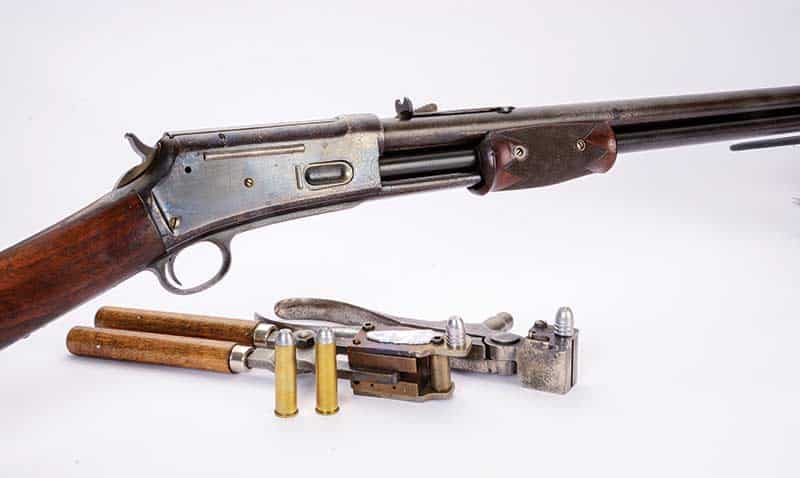
This Colt Lightning .50-95 wears British proof marks. Collectors today call
it a “cat gun,” because it was likely intended for lion or tiger hunting.
From the advent of metallic cartridge ammunition unto this day, .50 caliber rifles have won the hearts and minds of American riflemen. A remarkable variety of rifles chambering the huge .50 BMG are floating about nowadays. Likewise, there was no shortage of .50 caliber rifles in the Old West.
Builders
They were built by all the premier rifle manufacturers of the time. For example, the famous Sharps “buffalo rifles” of the 1870s were made for three lengths of .50 caliber cartridges. Remington only chambered for one .50. However, their factory turned out 900,000 military and sporting No.1 (rolling blocks) by 1877. A significant portion of them were .50-70s so they were likely only second to the U.S. Government in making .50 caliber rifles. Three different .50 cartridges bore the Winchester name between 1878 and the early 1900s, none of which set great sales records.
The U.S. Government got the .50 caliber ball rolling in 1866 with a conversion of leftover Civil War .58 caliber rifle-muskets to shoot a .50 cartridge of 1¾” case length. Military spec loads for the .50 Gov’t were 450-grain bullets over 70 grains black powder — hence the nickname .50-70. The first .50 Gov’t was the Model 1866. It was followed later by Models 1868 and 1870. They were used all over the west.
Sharps Rifle Company grabbed the government’s idea and literally stretched it. Their rifles also chambered the .50-70 but they also developed a .50 with a 2″ case. It went nowhere and is virtually unknown. The third was a .50 with 2½” case famous today as .50-90 Sharps, although the Sharps factory always loaded it with 100 grains of black powder. Remington had to stick with the .50-1¾” case because the long hammer spurs of their No.1s wouldn’t allow passage of longer cases. Their factory loads came with 400- and 450-grain bullets, both over 70-grain powder charges.
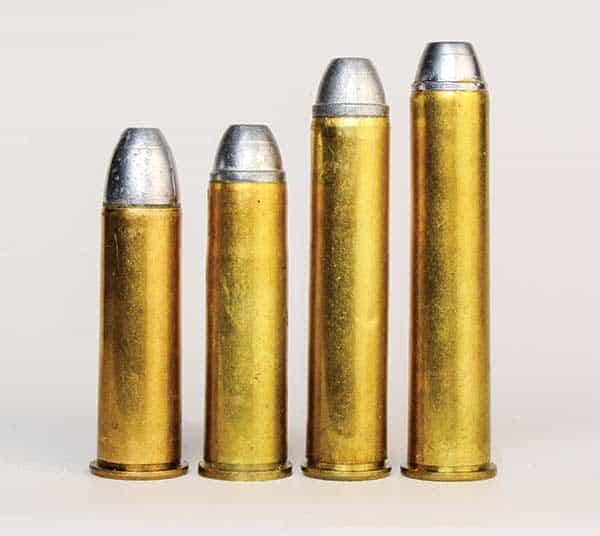
The Murderer’s Row of Old West .50 caliber cartridges. From left:.50
Gov’t (.50-70), Winchester .50-95, Sharps .50-90 (aka .50-100)
and Winchester .50 Express (aka .50-110).
Winchester
Winchester cornered the repeating rifle market early on but had difficulty in coming up with a .50 caliber repeater. In 1878 they gave it a try with their Model 1876. Case length had to be reduced to 1.94″ and bullet weight was only 312 grains. However, the 95-grain powder charge did give it some oomph. In 1887 Winchester gave .50s another try in their strong Model 1886. Using a 2.40″ case, they were able to fit 110 grains of black powder under 300-grain bullets. The round was called logically .50-110 but it seems rifles for it were caliber stamped .50 Ex (Express). Winchester’s .50 Express made it into the smokeless powder era and wasn’t dropped from Winchester’s catalogs until 1919.
There is no lack of bogus information about Old West fifties. For instance, despite original factory records proving no Sharps rifles were ever chambered for a .50 cartridge with 3¼” case, misinformation about such existing still abounds. Actually Winchester did chamber their single shot (aka “Model 1885 High Wall”) for a .50 with 3¼” case for a short while.

Duke shooting a Uberti/Cimarron Model 1876 .50-95 with black powder handloads.
Short Is Better
There is also the fallacy .50s were long-range cartridges. They weren’t; their bullets were short and wide. Long range bullets were longer and of lesser caliber. Fifty caliber rifles were meant to smack large animals hard! Out west there were bison, elk, grizzly and moose, and there were horse-mounted native warriors of all sorts roaming the west. A .50 caliber hit on a warrior’s horse effectively put him out of the fight.
Interestingly, some Winchester Model 1876 .50-95, Model 1886 .50-110 and even Colt Lightning pump action .50-95’s carry British proof stamps. They were imported to Africa and India for hunting lions and tigers. Collectors today call them “cat guns” and they bring premium prices. The .50 caliber oomph factor in a repeating rifle was important to big cat hunters.
No Speed Demon!
Velocities given by Old West .50 calibers are not impressive compared to the .50 BMG at 2,700 fps. The .50 Gov’t gave about 1,250 fps and Winchester’s .50 Express could break 1,500 fps.
Starting in 1981 I became a Big Fifty shooter and handloader with a modern Shiloh Sharps Model 1874 .50-90. Since then, I’ve gained experience with a few dozen Old West .50s and I’ve shot whitetail deer, mule deer, elk and bison with them. We who appreciate those Old West big bore rifles should give thanks to manufacturers like Shiloh and C. Sharps, and importers such as Cimarron Arms, for making available modern replica Big Fifties!