Categories
IF THEY GO….I GO !!!
This photo, taken in 1945, in the Pacific theater, shows Sgt Archie C. Vanskike Sr. (third from left and his three sons, PCF Clarence E. Vanskike, PFC Louis E. Vanskike and PFC Archie R. Vanskike Jr. (they all came from Galveston, Texas). During WWII, when Clarence, Louis and Archie Jr. went off to war, their 43-year-old father decided to go with them.
These four American heroes took part in the New Guinea campaign and the Liberation of the Philippines. Against all odds, they all survived the war and all went back to Texas. This amazing father passed away in 1962, Clarence died in 1978, Louis died in 1979, and Archie died 1988. They are now resting in peace, all together, at Evergreen Cemetery in Galveston.
Categories
From summer patriot, winter soldier
all indications are that Russian “offensive pushes” are falling apart amid appalling losses, very poor command, and no visible gains …..
russian soldiers and armor are pushed into battle without adequate training and support, and are being stopped before they really get started, and are suffering appalling losses. performance of troops is horrible. discipline is summary. troops are fighting among themselves, and there is no semblance of cooperation between troops from different regions, and different conscription campaigns.
command is a joke.
russian soldiers are dying by the droves.
for russia, it is a tragedy that will take many years, perhaps decades, to recover from.
for the western alliance, for n.a.t.o., it is a gift that no one anticipated just a short year ago ….. the destruction of the russian conventional military.
for china, … , who knows how this cuts, and the chinese are not saying. territorial gains in russia’s eastern regions, coming to the chinese? the chinese & russian partnership that some projected? for the chinese, however it turns out, it looks as though they will finance it; russia cannot be counted on to contribute much, as their spending will be directed towards rebuilding. at this point, russia would be best advised simply to attend to its survival as a state.
for the ukraine, it is the continued spilling of their life’s blood, and no one knows to what extent, as the ukrainians are not saying. war is never without costs, even in victory.
john jay @ 02.08.2023
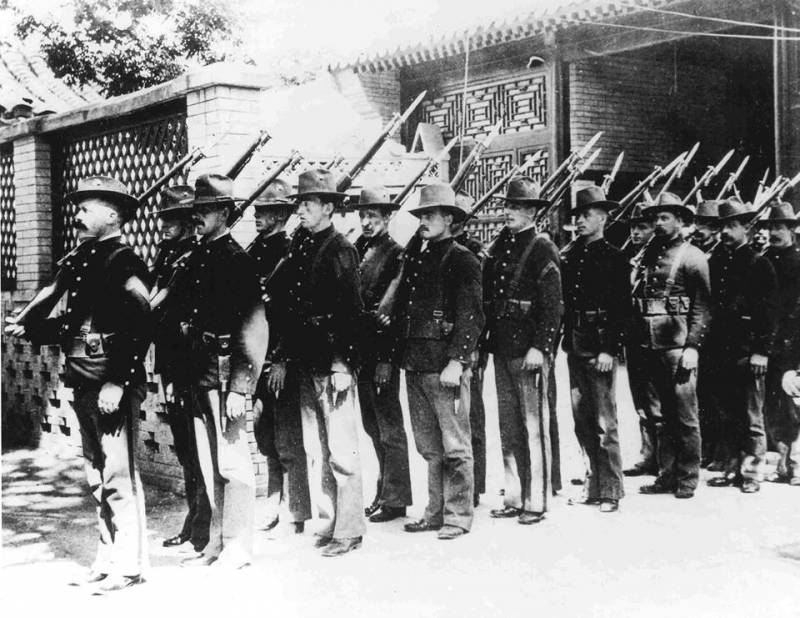
1895 US Marines with Paris Lee Rifles
With the guns of the new system you go, gentlemen,
I felt how they are loaded, they always hit.
Luck is for white rifles, they bring death
Pay and I’ll show you what the Bear can do.
Rudyard Kipling, World War with a Bear, 1898
I felt how they are loaded, they always hit.
Luck is for white rifles, they bring death
Pay and I’ll show you what the Bear can do.
Rudyard Kipling, World War with a Bear, 1898
stories about weapons. It must have annoyed the army that the navy was now armed with bolt-action rifles while its soldiers were still running around with single-shot springfield bolt-action rifles. Therefore, in 1882, the army began new tests, opposing the Lee rifle to the Winchester-Hotchkiss and Chaffee-Reese rifles. All of them were five-shot caliber .45-70.
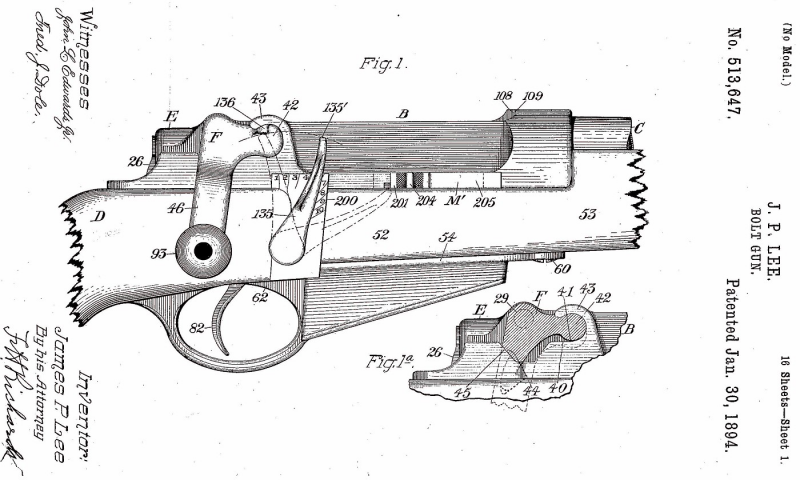
Schematic diagram of the breech mechanism on a Lee rifle from an 1894 US patent
Looking at the rifle that Lee submitted for testing, one can see that it had clear improvements over the first model of 1879. The rifle featured a comfortable bolt handle located behind the receiver, an improved locking system, and a redesigned magazine with longer cartridge jaws.
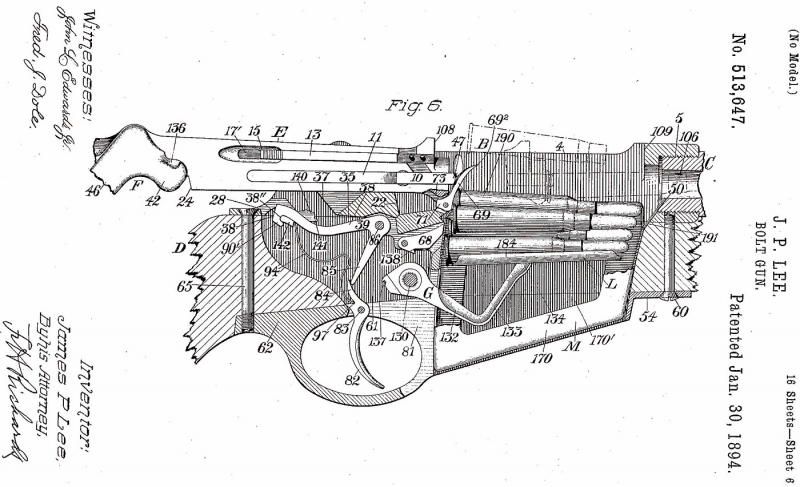
Interior view of the Lee rifle mechanism from an 1894 US patent
It was issued to more than 149 companies representing infantry, cavalry and artillery. “Lee” won the test unconditionally, but for inexplicable reasons, the head of the artillery department decided that “Spingfield” would remain.
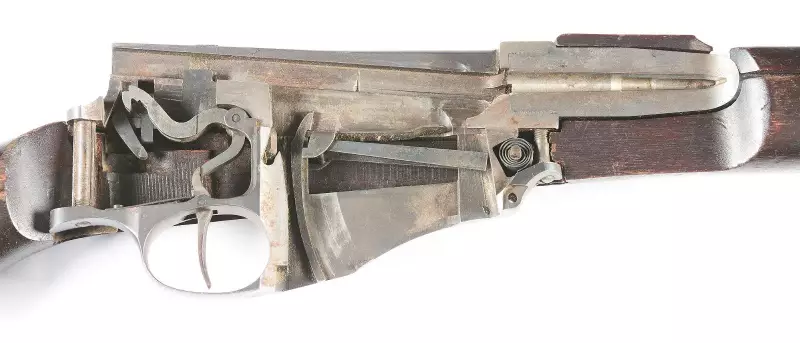
And here is how this very mechanism turned out in metal. As you can see, there is a difference, and a considerable one. Noteworthy is the arrangement of the store. It is not removable, but permanent. It is loaded with a clip for 5 rounds, which is inserted into the magazine along with the cartridges and falls out of it after shooting the first two
Despite being defeated in military trials, the basic Lee military rifle, manufactured by Remington in .45-70 and .43 Spanish calibers of various models, was widely sold around the world. Based on it, the 1885 model was released, which was described in the previous material, but Lee did not calm down on this success. Moreover, in 1886 the first rifle chambered for cartridges equipped with smokeless powder had already appeared.

1895 Lee rifle. Right view. Photo liveauctioneers.com
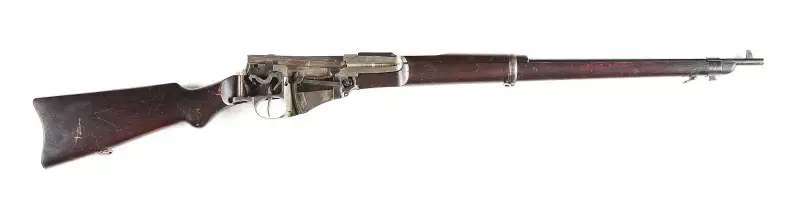
The same rifle in the cut. View from the left. Photo liveauctioneers.com
By 1894 he had developed a new rifle chambered for smokeless powder, and he was on time. In the same year, the US Navy announced a competition for a new “naval” rifle for fleet. The competition was more than democratic and solid in terms of the number of participants. Van Patten, Dodeto, Briggs-Nyland, Miles, a Russell-Livermore repeating rifle, five Remington models (all with side magazines) and a Lee rifle with a “direct motion bolt” were tested.
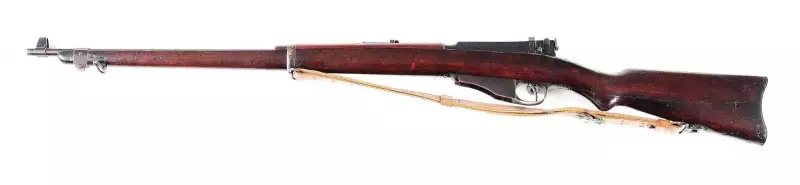
Rifle Lee 1895. Left side view. Photo liveauctioneers.com
At the same time, the Navy emphasized that sailors would like to have a rifle loaded with clips, but
“because conditions of service may require the use of loose cartridges or may result in the magazine being disabled, it is desirable that small arms can be loaded with single cartridges.”
Lee’s rifle had a magazine loaded with clips, and fully met the task. By the way, she also had a caliber approved by sailors – 6 mm. Therefore, it was she who was chosen as the winner in repeated tests and adopted by the US Navy in 1895 under the name “Lee rifle, model 1895, caliber 6 mm”, also known as the M1895 Lee-Navy (that is, “Lee naval” ).
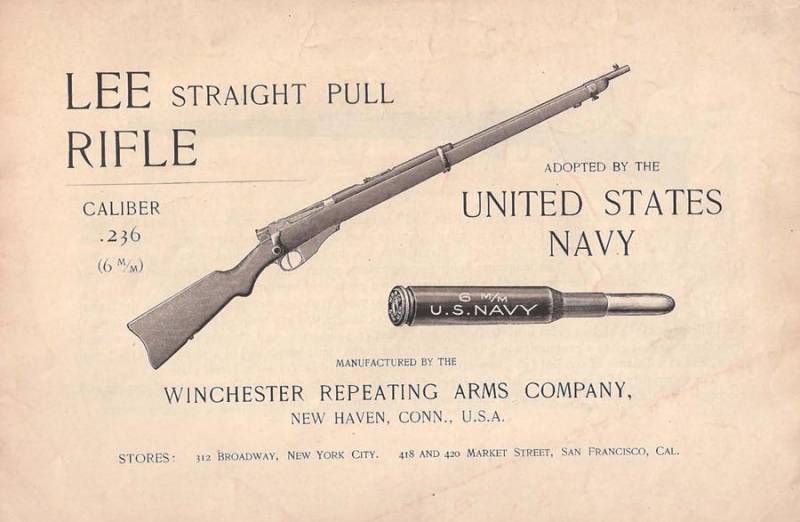
A page from the manual for Lee’s rifle
But the old Remington-Lee rifles were not removed from service after that and were used until the end of the 1890s, and they were replaced with the 6-mm Winchester-Lee rifle of 1895, in general, slowly. At the same time, even the Colt-Browning machine gun was created for the new caliber, so that the interchangeability of ammunition among shooters and machine gunners in the American Navy was achieved one hundred percent!

Remington-Lee sporting rifle. Photo remingtonsociety.org
The Remington company, in turn, released a model of the Lee sporting rifle, also in 6 mm (.236 Navy), but also in other calibers, such as: 7 × 57, 7,65 Belgian, .30-30, and .30- 40. But between 1899 and 1905, only about 1500 copies of Lee’s sporting rifle were sold, so it is unlikely that she made good money on it. Overall, though, the rifle was excellent. It is distinguished from combat rifles by a semi-pistol grip and a shortened forearm.
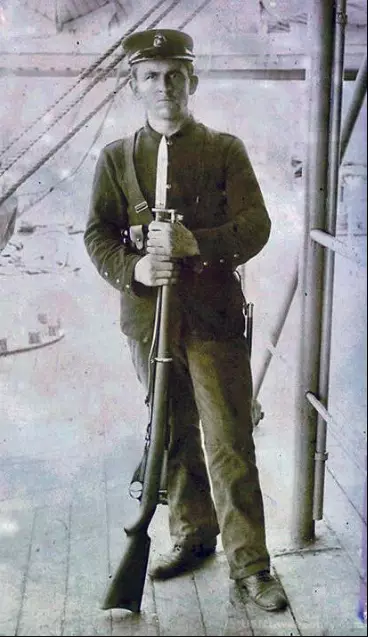
Marine with a Lee-Navi rifle
As is usually the case, a lot of the high combat qualities of the new rifle was the result of a new cartridge adopted in 1894. It was the first U.S. military cartridge designated in metric caliber, the first cartridge to be equally suitable for both rifles and machine guns, and the smallest caliber cartridge ever adopted until the advent of the 5,56×45mm NATO cartridge. in 1964. At first, the bullet had a steel jacket with a copper-nickel coating and developed a speed of 780 m / s. But then the shell was made purely copper, which increased the life of the barrel to 10 shots, in contrast to 000 with a steel shell.

Cartridge 6 mm
Interestingly, the new cartridge had significantly greater penetrating power than the US Army .30 (.30-40 Krag) cartridge, and could penetrate 58 cm of softwood at a distance of 640 m, and 9,5 mm thick boiler steel sheet from a distance at 30 m. A 7 mm thick chrome steel sheet (without a substrate) made its way from 50 m.

Lee rifle mechanism. Photo liveauctioneers.com
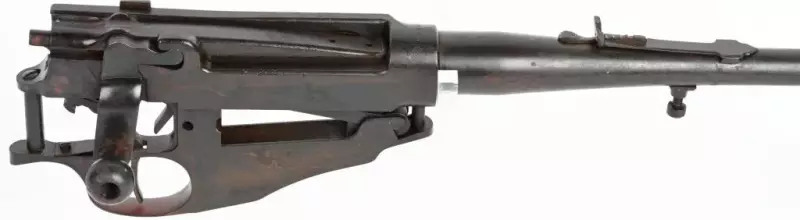
Rifle mechanism close-up. Right view. Photo liveauctioneers.com
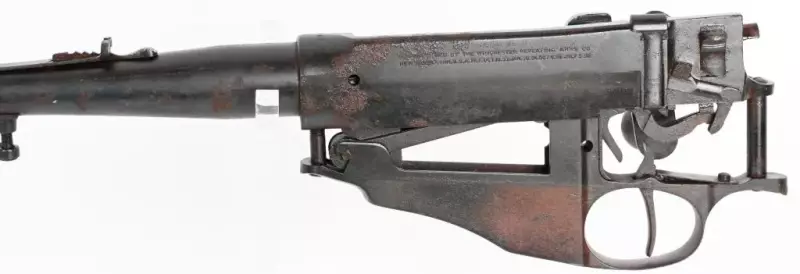
Rifle mechanism close-up. View from the left. Photo liveauctioneers.com
Another important advantage of the new cartridge was the significantly reduced weight of the ammunition. So, 220 rounds weighed about the same as 160 rounds of .30. As a result, an 1898 US Marine carried 180 rounds of 6mm rounds packed in five-round clips and placed in black leather pouches. An army rifleman of the time who usually carried only 100 rounds of 30-caliber rounds in separate pockets of his bandolier.
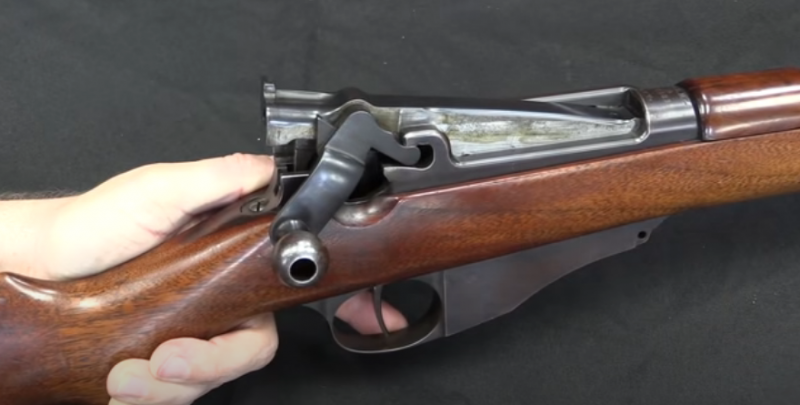
Bolt handle and one combat stop. Photo forgottenweapons.com
But the main “highlight” of the design of this rifle was its unusual shutter, which had the form of a rectangular bar, which did not need to be rotated when loading. That is, where, in order to control a cylindrical bolt, it was necessary to first turn the bolt and only then move it back and forth, while with Lee’s rifle it did not rotate and only moved back and forth and that’s it. In addition, she had only one combat stop, which was very unusual. The bolt control handle first had to be raised at an upward angle and then pulled back sharply in order to eject and extract the spent cartridge case. By pressing the bolt handle forward, the cartridge from the magazine was fed into the chamber, and the drummer was cocked, and the rifle was ready to shoot. The rifle had a fuse located at the top of the receiver on the left, which was raised with the thumb.

The rifle was controlled by three levers: the first on the left is the fuse, which was discussed above, the second is the bolt lock, which released the bolt and allowed it to be removed from the rifle, and the inclined lever, pressing which raised the bolt up. Photo forgottenweapons.com
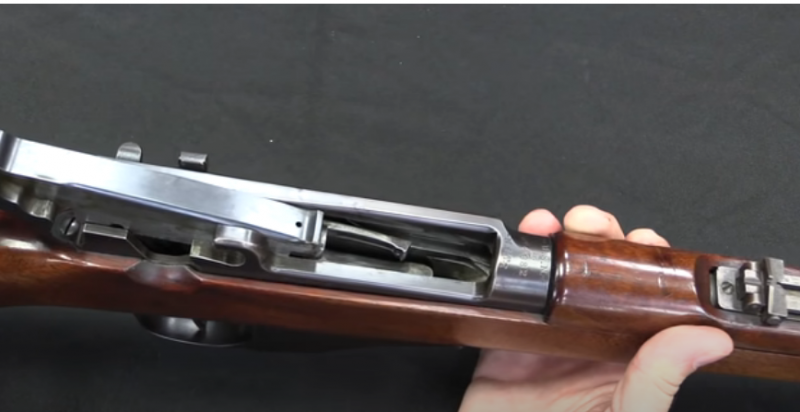
The extractor was very unusually arranged for this rifle. Firstly, it was very long and … was not attached to the shutter. Secondly, it had its own spring, and it could easily be separated from the shutter when the latter was removed. He simultaneously moved along the groove in the bolt and in the bolt frame and pulled out the sleeve, holding it by the groove, but at the same time he pulled himself out of the bolt. And then the compressed spring pressed on the long plate of the extractor, and it also worked as an ejector! By the way, it happened that the extractor was forgotten to be inserted during cleaning and even lost! Photo forgottenweapons.com
The rather strange “up and back” movement of the bolt was unusual for shooters at first, and besides, the slightly inclined stroke of the bolt opening proved inconvenient for some men when the rifle was held at the shoulder. But despite this, the chief of artillery of the Navy, apparently not without reason, said that the action of Lee’s rifle allows you to shoot “at a higher speed” than most rotary-action rifles adopted for service.
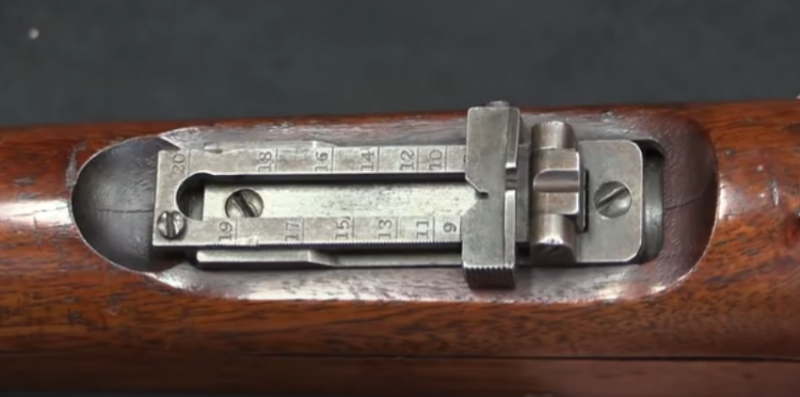
The sight allowed shooting at 2000 yards. Photo forgottenweapons.com
True, erosion of the Metford-rifled barrel was soon discovered, but nothing could be done about it, just like improving the quality of smokeless powder for 6-mm cartridges supplied to the USA from … Great Britain! In total, about 15 of these rifles were made.
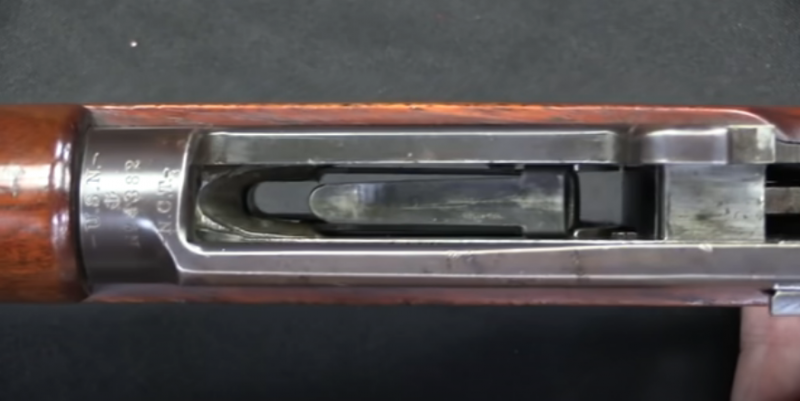
Ammo feed plate. Photo forgottenweapons.com
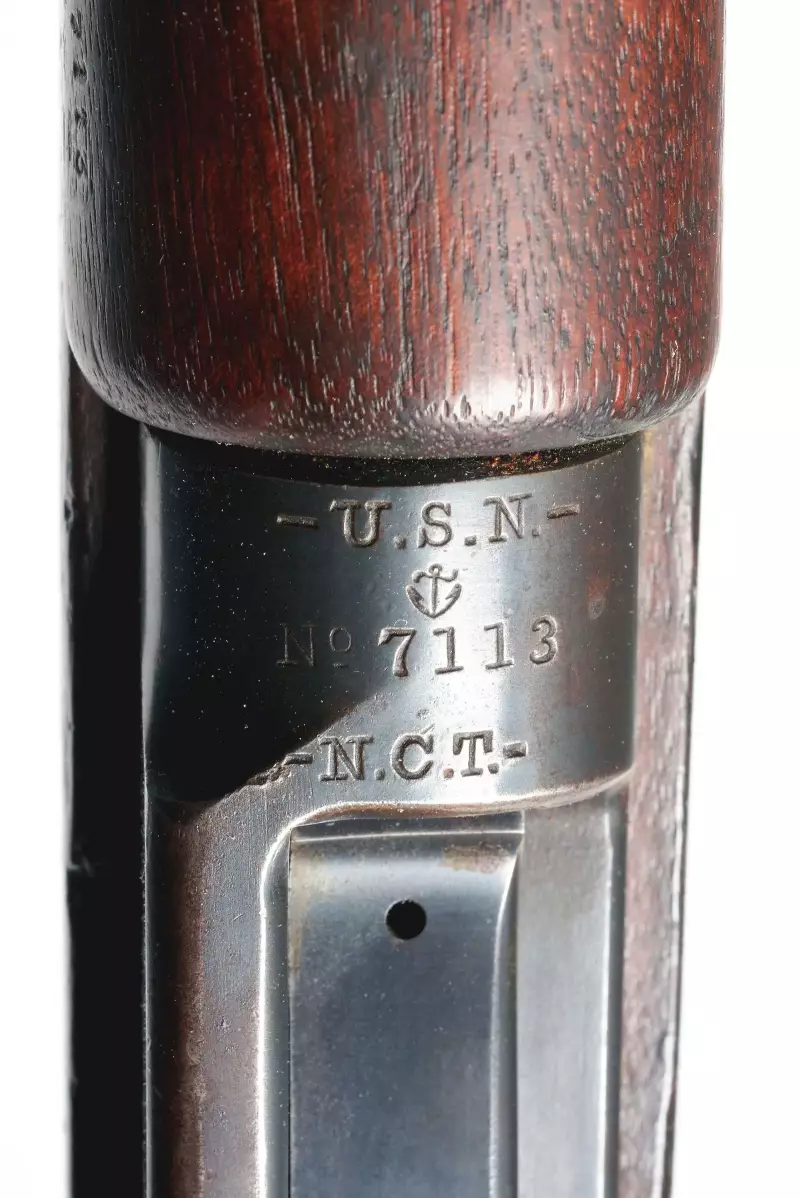
U.S. Navy Lee rifle markings. Photo liveauctioneers.com
The rifle performed well in combat in Cuba during the Spanish-American War, during the suppression of the Boxer uprising in China and the Moro uprising in the southern Philippines. Its qualities such as flatness and accuracy of combat, as well as the ability to take a lot more cartridges with you, were noted everywhere. However, the presence of two calibers of small arms in one army turned out to be very inconvenient from a logistical point of view. Already in 1898, it was decided to stop at the 7,62-mm caliber for rifles of all branches of the US military, including the Marine Corps. Nevertheless, on the ships of the Navy, the decommissioned Lee rifles were preserved as training weapons until the 20s of the twentieth century.
- Author:
- Vyacheslav Shpakovsky

PTR’s green-stocked GIR .308 rifle is a dead ringer for the Bundeswehr-era G3,
with the addition of a Picatinny 1913 rail. Add low-cost practice options and you’re off to the races!
The ammo shortage is no longer news and has sharply limited most of our ability to practice. Fortunately, this scarcity is not new to the military which has used things like subcaliber conversions for nearly a century. A .22 conversion was one of the first accessories developed for the M1911 and the U.S. military even adopted a floating-chamber .22 conversion for their belt-fed .30 machine guns — both, interestingly, designed by Dave “Carbine” Williams of M1 carbine fame. With its 0.223″ bore, the M16/AR15 was and remains particularly easy to convert. Alas, it’s harder for us who love the .308 as $0.50 a shot was a good price in normal times. But there is hope.
Millions of HK roller-locked G3 .308s (and its predecessor the CETME) were issued across the world and semiauto versions are common in the U.S., largely thanks to South Carolina’s PTR which purchased Portugal’s HK-licensed G3 tooling. They lead the U.S. industry in semiautomatic versions of the iconic .308, including producing receivers on an OEM basis for other makers.
Along with the very affordable Century Arms C308, PTR guns cost far less than original HK rifles such as the HK91, which goes for more than some cars I’ve owned. As many countries have moved to newer rifle designs, spare G3/CETME parts of all kinds have flooded the market, including two of particular interest to us — a rollerless bolt for plastic training ammo and a .22 rimfire unit.
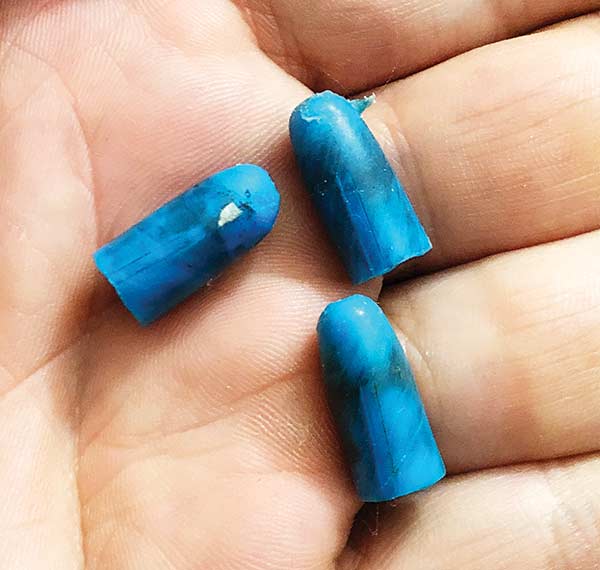
Not a toy, the 9.9-grain plastic bullets still penetrated the
plywood target backer at 100 yards.
Plastic Fantastic
Reportedly available in multiple colors for different applications, I’ve only ever seen the plastic ammo in blue. Basically a one-piece plastic case with a metal casehead, upon firing the powder charge separates the casehead and the bullet, sending the little plastic pill downrange at a blistering 4,000+ fps. Word to the wise: While not appropriate for hunting or self-defense, this is still a bullet and is fully capable of taking a life. Treat it like the lethal projectile it is. While no longer readily available, plastic training ammo was also made in 9mm, for which HK made a dedicated MP5. Sounds like fun, but I’m sure it costs more than my house.
As a safety feature, both the casehead and training bolt face for plastic ammo are slightly smaller in diameter than the usual .308 to keep the unlocked bolt from being able to fire full power ammunition. I fired several hundred rounds of the blue ammo using the training bolt or cycling them by hand in an unmodified C308 and a Ruger Scout rifle. In spite of the smaller casehead, there were no extraction issues.
Basic physics tells us a 9.9-grain bullet has little momentum and will slow quickly, so long-range accuracy with plastic bullets is not a thing. And while the limited recoil is a welcome reprieve, the cartridge’s low power cannot cycle the stock action. The simple solution is to manually cycle the bolt, which gets really old, or purchase the rollerless training bolt/carrier assembly.
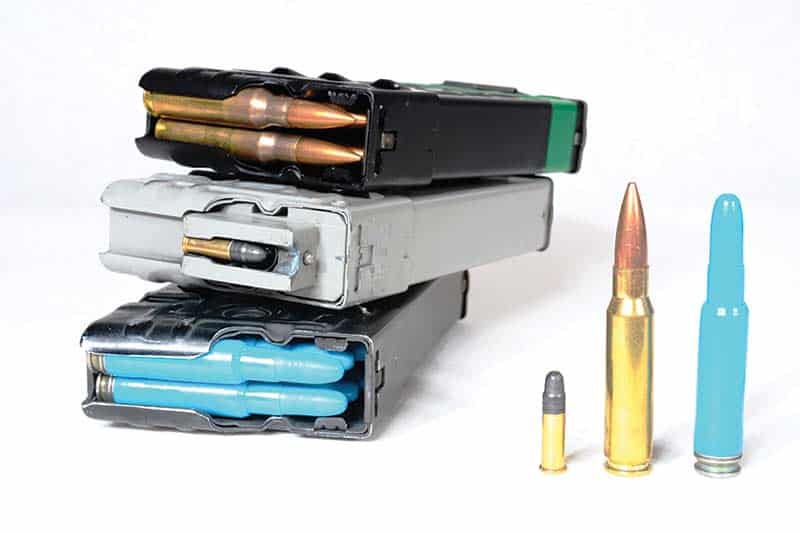
Training adaptors for the G3 family make it possible to keep
shooting even in the midst of an ammo drought.
.22 Adapter
Unlike the blue ammo training bolt which removes the locking element of the design, the .22 conversion has a smaller, lighter breechblock mounted in the carrier and powered by its own recoil spring. While the carrier is still used to manually load or unload, it does not reciprocate with recoil, which leads to one of the conversion’s quirks. While it only needs a short length of travel to cycle with .22 ammo, the carrier can still be drawn back the full length required for .308 rounds. When you do this, the carrier modifications required to make the smaller .22 round feed will cause it to get stuck behind the hammer where it will stay until you field strip the gun and fix it.
The wise .22 shooter will get a length of vacuum hose at the local car parts store, slit it and slide 2″ of it on the recoil spring guide rod to act as a stop to keep the carrier from coming back too far. Magazines are likewise a bit of a sore spot. The grey-bodied conversion mags have a separate .22 magazine bolted into place in a positioning block riveted into a steel .308 magazine. The internal .22 mag holds 20 rounds just like the big boy version and is surrounded by a standard .308 magazine spring, a bit of superfluity only serving to retain the magazine baseplate.
Two mags usually come with the conversion, but they are unobtanium if purchased separately and run around $200. Black Dog Machine, however, sells a magwell insert that will take their Uzi magazines: the insert and one mag are $25, while the insert alone goes for $10.
While mine feeds well, the standard or even high velocity .22 LR will not push the bolt back far enough to eject. This likely means hyper velocity ammo will be required, further reducing cost savings.
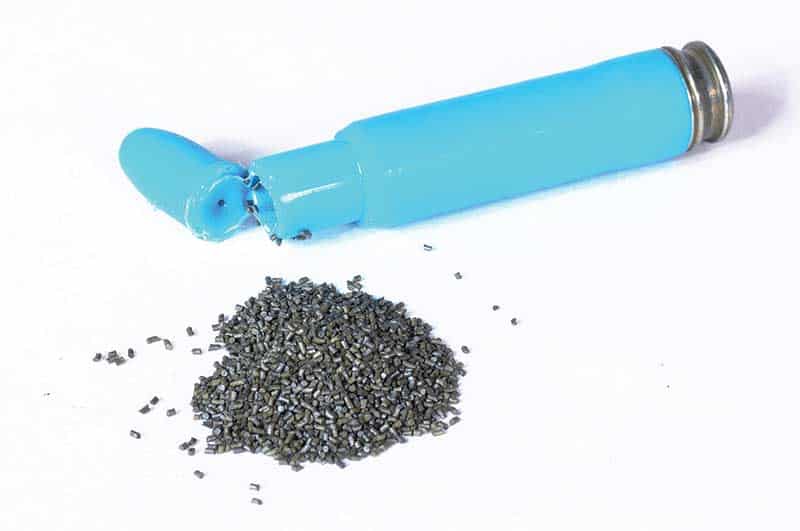
Don’t let the cheerful color fool you — the plastic “bullet” does better than 4,000 fps!
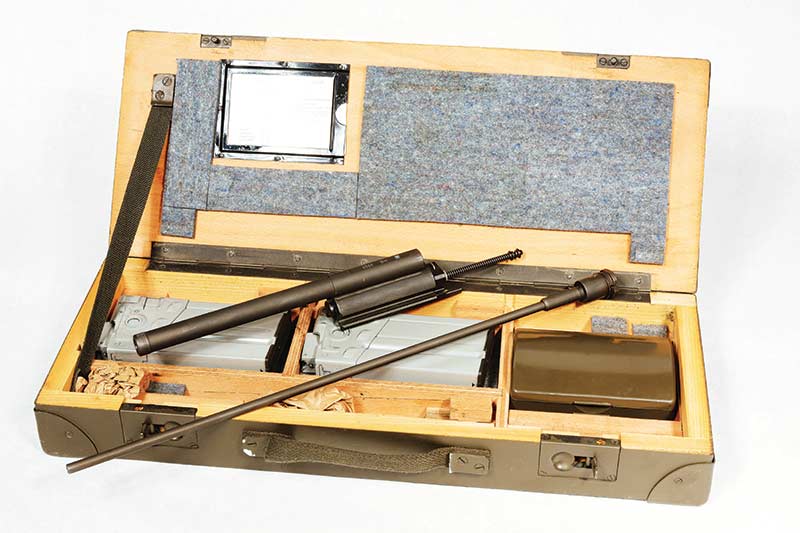
Cooler but more finicky, the .22 conversion kit includes a rifle barrel insert,
the conversion and a couple of the super-rare magazines.
Installation
For those unfamiliar with the roller lock, both conversions are installed in the same way. After clearing the rifle, push out the two push pins holding the stock in place and slide the stock backwards off the receiver. Since, unlike the AR, the pins are not captive, feel free to stow them in the two holes in the stock provided for this purpose. Pivot the trigger housing downwards at the rear until it can be pulled off of its forward mounting point at the rear of the magazine well. Use the cocking handle to unlock the bolt carrier and remove the carrier from the rear. If installing the .22 conversion, insert the barrel liner into the bore prior to reassembly, which is in reverse order.
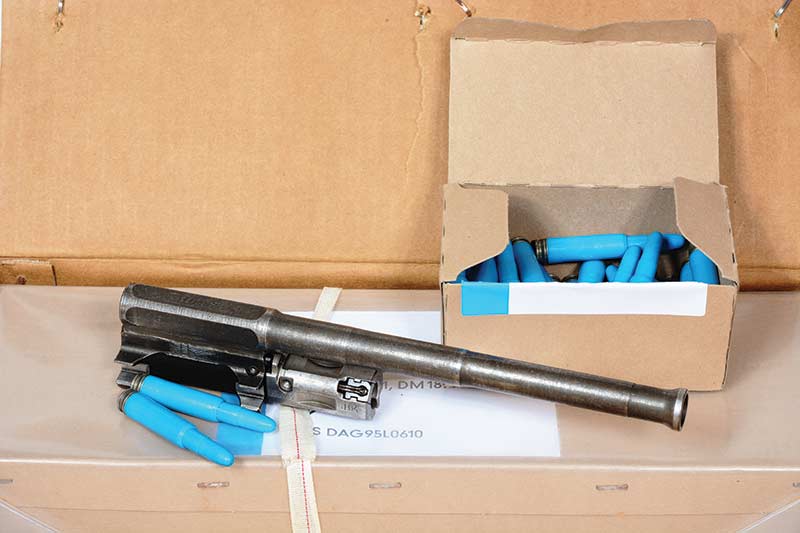
Blue plastic ammo and the matching training bolt can be purchased as a package.
Jeremy paid under $300 for the bolt and a thousand rounds and it’s been available
ever since the pandemic started.
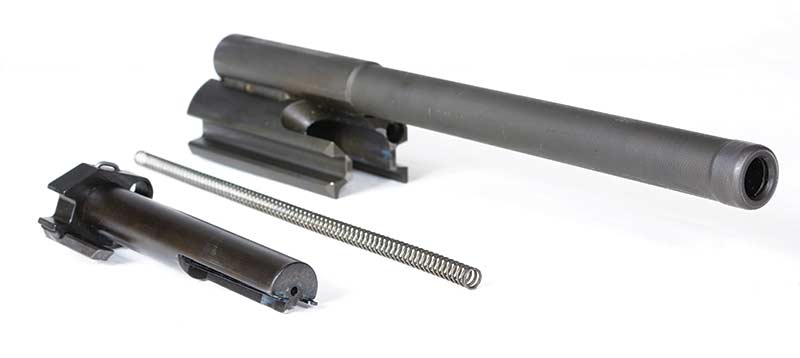
The .22 conversion uses a smaller, separately sprung bolt contained
within a full-sized carrier which is used to cock the rifle —
and, if you’re not careful, to overcock it.
Testing
For semi-auto fire, I used the training bolt in a pair of PTR rifles, one a modified 16″ collapsible stock gun and the other a green-stocked GIR, a dead ringer for the Bundeswehr G3. In order to get the best out of the gun, I paired the GIR with Leupold’s VX Freedom AR scope. I mounted it in a pair of 30mm rings sourced from Brownells, mounted to an AR-style riser to get the scope up above the rear sight.
Assuming good magazines are used, the plastic training ammo ran flawlessly although malfunctions basically break the cartridge in half. The light recoil made it a joy to shoot. While there is some change in point of impact, my Scout Rifle with a 200-yard zero put them at point of aim at 100 yards. At this distance, groups tended to open up and when the bullets struck in the plywood target backer, most penetrated. Like I said, not a toy.
Blue ammo has gone in and out of stock through the years but as this is written, it’s still available online — as it has been throughout the pandemic — for under $200 per thousand.
The .22 conversion is somewhat less of a money saver. Running between $500–$600, the G3 .22 conversion comes in a wooden case with dividers to hold two magazines, the bolt, a barrel liner, a manual in German and the ubiquitous plastic cleaning kit.
For the coolness factor, it’s hard to beat the .22 unit. But you’ll pay for it and its ammo needs mean you won’t get the same savings as most rimfire conversions. The same money buys a training bolt and 2,500 rounds of blue ammo. Much as I’m a sucker for a rimfire, if you can only get one, it’s an easy choice.