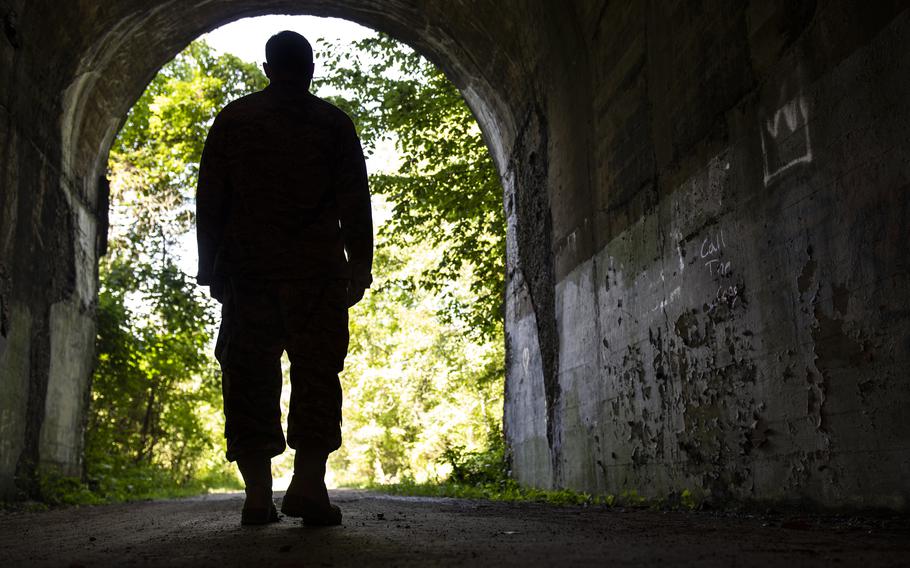
Suicides in the active-duty military increased in the first three months of 2023 compared to the same time last year, according to a newly released Pentagon report. The Defense Suicide Prevention Office revealed in its quarterly report that the overall number of active-duty suicides — 94 — from January through March was up 25% compared to the number of troops — 75 — who took their own lives in the first three months of 2022. (Joshua J. Seybert/U.S. Air Force)
WASHINGTON — Suicides in the active-duty military increased in the first three months of 2023 compared to the same time last year, according to a newly released Pentagon report.
The Defense Suicide Prevention Office revealed in its quarterly report that the overall number of active-duty suicides — 94 — from January through March was up 25% compared to the number of troops — 75 — who took their own lives in the first three months of 2022.
“Every death by suicide is a tragedy,” according to the report. “Data includes all known or suspected suicides (both confirmed and pending) as of March 31, 2023.”
The Army had the greatest increase in suicide deaths, from 37 to 49. The Marine Corps increased from eight to 14. The Air Force had one additional suicide compared to 2022 and there was no change for the Navy or Space Force, the Defense Department report states.
The 94 active-duty suicides are the most that the military has seen since 97 were reported in the second quarter of 2021. Among reserve troops and the National Guard, the report said suicide figures did not change between the first quarter of 2022 and the same period this year.
Pentagon data have shown a rise in military suicides in the past decade, including a significant spike in 2020 during the coronavirus pandemic, and the Defense Department has spent millions of dollars on efforts to try to prevent them.
In May, the department enacted the long-awaited Brandon Act to let troops seek mental health services confidentially and any time that they need it. It’s named after Navy Petty Officer 3rd Class Brandon Caserta, who committed suicide in 2018. According to Defense Department data, there were almost 29 suicides per 100,000 troops in 2020 — up from 17.5 per 100,000 in 2010. That figure fell to 24.3 per 100,000 in 2021, but it still represented a serious uptick in suicides compared to most of the 2000s and 2010s.
“There is still a gradual increasing trend for suicide in the military over a 10-year period, and we need to see a sustained long-term reduction in suicide rates to know if we’re really making progress,” Beth Foster, executive director of the Pentagon’s Force Resiliency Office, said when the 2021 Annual Report on Suicide in the Military came out in the fall.
The Defense Suicide Prevention Office was created by a Pentagon task force in 2011 to find more effective suicide prevention methods. Earlier this year, the Pentagon’s Suicide Prevention and Response Independent Review Committee, after studying the problem for a year, made several recommendations, including restricting troops’ access to firearms, imposing waiting periods for gun and ammunition purchases and raising the minimum age for buying both to 25. Firearms are used in about two-thirds of all active-duty military suicides, according to the Defense Department. The Pentagon is reviewing the recommendations.
The second quarter ended June 30 and the Defense Suicide Prevention Office traditionally doesn’t issue an updated suicide report covering that period until October. The Pentagon’s comprehensive yearly study on military suicides also is typically released in October. This year’s will analyze 2022.
“The numbers presented in this report are preliminary and subject to change as previously unknown suicide cases are reported and some known cases are further investigated,” the four-page report states. “Caution should be used when making comparisons across groups and/or interpreting changes in suicide counts across time.”
In addition to Pentagon-wide programs, each of the military services has its own suicide program designed to provide help for troubled troops. Further, the national suicide prevention hotline was streamlined last year and became available by dialing 988. Pressing “1” after calling the number takes callers to the Veterans Crisis Line. Service members and veterans can also text 838255 or visit VeteransCrisisLine.net for help.

————————————————————–
I really think that the Joint Chiefs need to SERIOUSLY look into this and fix the causes of this Tragedy!
For example, Operational Tempo, Army Speak for having the Troops doing way too much work & less & less down time.
Also the Big Guys need to start pounding down on a Units leadership for missing the signs of suicide.
I myself would be relieving the Commanding Officer & Senior NCOs of that command for not doing their job of looking out for their people! Plus I would get on the Chaplains and the MDs too as that is one of their jobs too! As they need to get off their butts & get out into the barracks and housing units of the base.
As I am willing to bet that if you do that a few times. Then the word would get out through through the back channels of the Officers Club & NCO Club asap.
Now granted this would not cure the problems of suicide in the service. As there is always going to be someone who is going to check out no matter what. But it would get the numbers down a lot. Grumpy
Except for oh say, An Airstrike, Mortar Barrage, a good sniper, a TOT Arty call and other stuff. But what do I know, right? Grumpy
Categories
Two ways to reload a pistol.
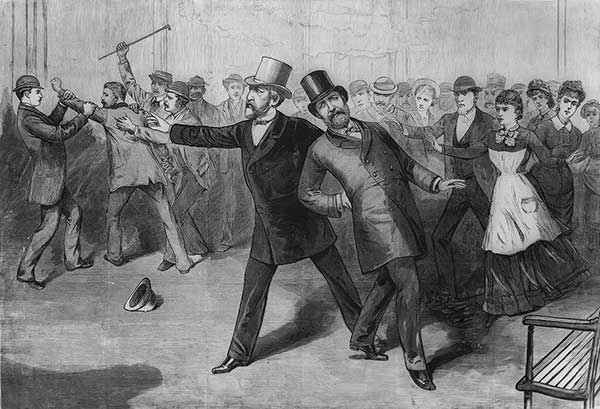
The assassination of James Garfield by the lunatic Charles Guiteau
was made all the worse by the misadventures of the presidential physicians.
Given the internet-fueled insanity that has been American government for the last decade or so, one might be forgiven for believing that crazy people doing crazy things in the name of politics was a recent phenomenon. However, that is simply not the case.
Two days before Independence Day in 1881, a professional loser named Charles Guiteau worked up a righteous rage and shot the president. With the benefit of hindsight, the wounded chief executive likely would have been fine had his physicians simply left him alone.
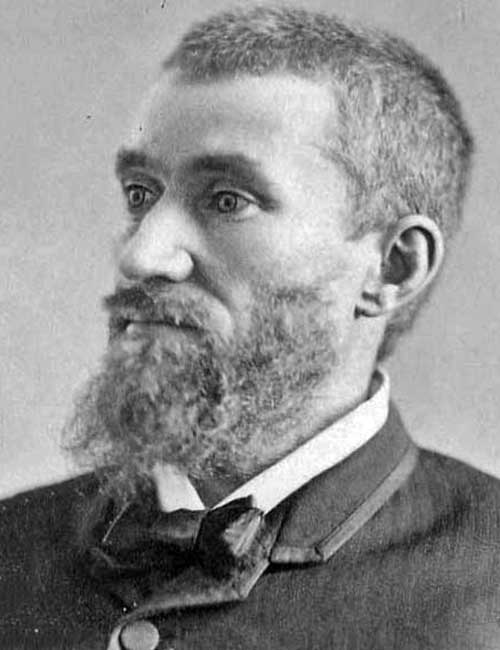
This is Charles Guiteau. He was legitimately certifiable.
The Killer
In retrospect, Guiteau was clearly delusional. A lawyer by training, he penned an unsolicited speech supporting then Republican candidate for president, James Garfield. He had several hundred copies printed and then refused to pay for them. As near as we can tell, nobody ever read the speech, but Guiteau nevertheless became convinced that he was singlehandedly responsible for Garfield’s election.
Guiteau felt it only fair that he be granted the consulship in Vienna or Paris for his efforts. This disheveled crazy man wandered about Washington, DC making his case to anyone who would listen. Along the way, he ran out of money and adopted the trappings of a homeless person. This did not help advance his argument. He was eventually banned by name from the White House waiting room. Secretary of State James Blaine told him to his face, “Never speak to me again on the Paris consulship as long as you live.” This just made him mad.
Guiteau’s family had previously had him declared insane, but he had escaped before he could be formally committed. He borrowed $15 from a relative (about $430 in today’s money) and sought out O’Meara’s Store in Washington. He knew next to nothing about firearms but appreciated that he would need something substantial, so settled on the .442 Webley Bulldog.
George Armstrong Custer carried a brace of Webley Bulldogs at the Battle of the Little Bighorn. It was a solid gun. O’Meara’s had two in stock. One had wooden grips, the other was ivory for a dollar more. Guiteau chose the ivory because he knew the gun would hang in a museum after his crime.
The Bulldog with ivory grips, a box of ammunition, and a penknife set him back $10. He actually successfully talked the proprietor out of the ivory gun for the wooden grip price. Guiteau fired a total of ten rounds into the trees along the bank of the Potomac River to get familiar with the weapon.
Presidents of the United States did not travel with security agents back then. On July 2, 1881, President Garfield struck out for the Baltimore and Potomac Railway Station on Constitution Avenue, intending to take a brief vacation. Guiteau crept up behind him and fired twice at near contact range. The first round harmlessly grazed his shoulder. The second, however, passed the first lumbar vertebra and came to rest behind his pancreas.
A passing policeman named Patrick Kearney apprehended Guiteau but was so excited he neglected to search him. The cops found the gun once they got him back to the police station. However, the president’s ordeal was just beginning.
The Doctors of Death
President Garfield was returned to the White House and informed that he would not survive the night. The following morning, however, he actually looked a little bit better. That’s when his doctors really went to work.
The Germ Theory of Disease was considered quackery at this time, so Garfield’s physicians aggressively probed his wound with unwashed fingers.
The geometry of the wound implied that the bullet should be on the right side, so that is where they concentrated their efforts. One enthusiastic sawbones actually perforated the poor man’s liver in the process. Alexander Graham Bell built a metal detector for the express purpose of finding the bullet in Garfield’s body. The machine failed because they were looking at the wrong side. Bullets are weird that way.
Over the next 79 days, Garfield’s weight dropped from 210 to 130 pounds, and he lost the ability to eat. Navy engineers built a machine that used ice to lower the temperature in his quarters by 20 degrees in an effort to protect him from the oppressive DC heat. Volunteers built a dedicated railroad spur line to get the president’s train to the Jersey Shore in hopes that the sea air might help. Nonetheless, President Garfield succumbed to the toxic combination of sepsis, pneumonia, and the not-so-gentle affections of his doctors on Sept. 19, 1881.
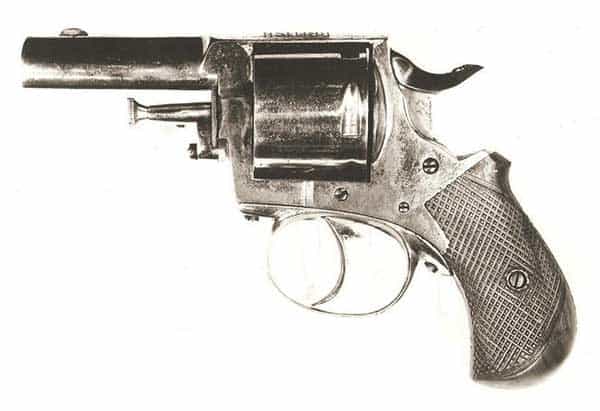
This is a Webley Bulldog revolver similar to the one used by Charles Guiteau to shoot President James Garfield. The original was stolen from the Smithsonian collection.
Charles Guiteau Gets Justice
At his subsequent trial, Guiteau was clearly still crazy. He solicited legal advice from strangers in the gallery and penned his autobiography. Knowing it would later be published, he ended this time with a personal ad for a “Nice Christian lady under 30.” He began making plans for a lecture tour and a personal run for the presidency after his expected release.
The jury was having none of it. Guiteau was convicted of murder and sentenced to death. On the appointed day, he danced up the gallows, shook hands with the executioner and waved enthusiastically at the bystanders. Once atop the gallows, he read a poem he drafted that morning titled “Going to the Lordy.” The last stanza is reproduced below —
“I wonder what I will see when I get to the Lordy,
I expect to see most splendid things,
Beyond all earthly conception,
When I am with the Lordy! Glory hallelujah! Glory hallelujah!
I am with the Lord.”
Charles Guiteau was hanged on June 30, 1882. His brain is on display today in the Mütter Museum in Philadelphia. The Guiteau revolver was part of the Smithsonian collection for years but was eventually stolen. Its current whereabouts are unknown.