Categories
Categories
Nat’l. Pina Colada Day NSFW





A short time ago, SIG SAUER introduced a pair of 9mms that could hardly be farther apart in size and application. It’s particularly interesting to examine the P320 X5 Legion heavy duty shooter and the P365 XL concealed carry pistol side by side.
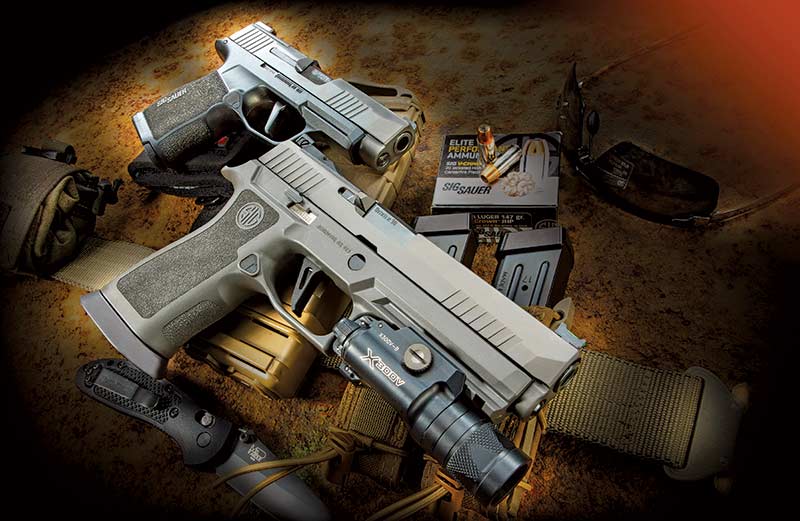
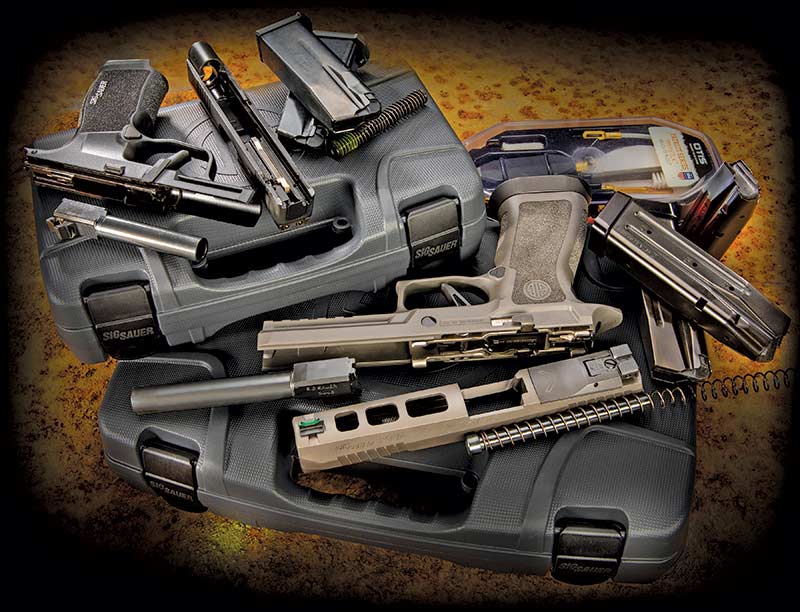
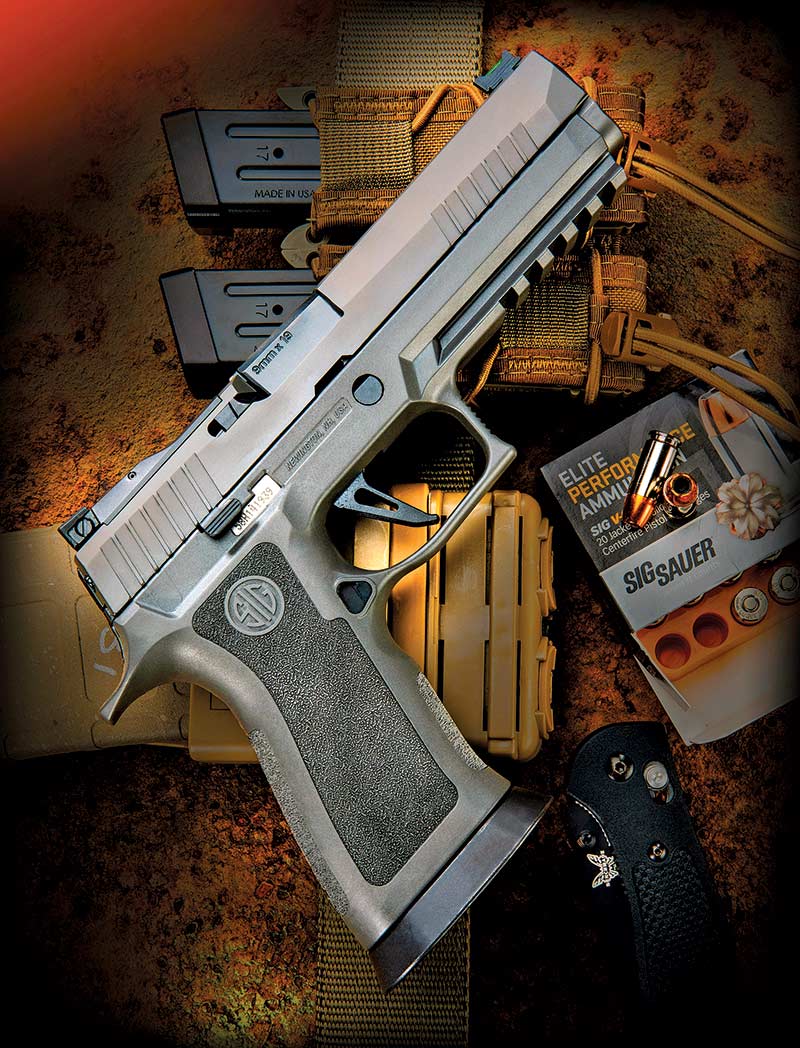
P320 X5 Legion
The P320 pistol has come a long way since the New Hampshire-based SIG team led by Ethan Lessard finalized the design circa 2013. A striker-fired modular pistol based on the P250, which was a DAO hammer-fired gun, it has evolved past some issues and been adopted by agencies such as the Oklahoma state troopers, the Texas Department of Public Safety, and most famously, by the U.S. military as the M17 service pistol.
Its latest variation is the Legion. The “target” version of the P320, the X5, morphs into the Legion by more than its “SIGnature” Legion chevrons. The key differences are its heavy tungsten-infused polymer frame and its 30 percent lighter trigger pull.
The rationale of this model SIG is to combine the recoil-dampening weight we associate with all-steel frames with the kick-absorbing flexion of polymer. Hence, the new frame element. Phil Strader, pistol product manager for SIG, is a top-tier competitive shooter himself. He explained to American Handgunner, SIG learned “the company that actually makes some of our polymer material could add tungsten powder to the original mixture of polymer, glass, etc.
After a few iterations of (this) TXG material, we found the perfect balance of extreme weight and durability. The process has never been used in the firearms industry and SIG has a patent pending for its use.”
We found the recoil was indeed mild. It’s a hackneyed phrase to say, “This centerfire pistol kicks like a .22,” but with the P320 Legion, that’s actually pretty much the case. The Legion model is geared for competition. In Steel Challenge matches, where it’s generally one shot per target, the lighter polymer framed X5 would be my choice from the P320 line for its faster handling. Recoil recovery takes place as you’re tracking between the multiple targets. In games like USPSA or IDPA, however, it’s generally multiple shots per target and here, recoil recovery between shots is more critical.
Phil Strader told me, “The P320 XFIVE Legion is approved for USPSA Open, Limited, Production/Carry Optics (with the magwell removed), NRA Action Pistol Metallic and Production divisions, and IDPA Carry Optics, SSP (with the magwell removed) and ESP (with either the magwell or the internal grip weight removed). Removing the magwell or grip weight brings the weight of the XFIVE Legion to 41.7 oz. or 42 oz. respectively, well below the 43-oz. weight limit for SSP and ESP.”
The Mechanics
The P320 X5 Legion’s trigger is flat-faced, skeletonized and does not have a GLOCK-ish trigger tab or similar device. I think all serious shooters should have a trigger pull gauge, like the Lyman digital unit I got from Brownells. On mine, the test sample (serial number 58H116216) averaged 3.84 lbs. when measured from the toe of the trigger. While it’s a common measuring point, most human fingers generally pull from the center of the trigger, offering less leverage, and from there our P320 X5 Legion averaged 4.67 lbs.
The test Legion’s trigger had significant backlash to it, i.e., rearward movement after the striker released. This can cause gun movement between the trigger release and the instant of the shot. I haven’t experienced this with previous P320 X5s I’ve shot so am not sure why this was the case.
From a Matrix rest on the 25-yard bench, I tested it for accuracy with FMJ loads in the three most popular bullet weights. Five-shot groups weren’t up to what I got with my first P320 X5, and tended toward “4+1” clusters running in the 3″ to 4″ range. The best group was with SIG’s own 115-gr. FMJ, measuring 3.05″ for all five shots, with four of them in 1.5″ and the best three in 1.3″, measured center to center to the nearest 0.05″. The “best three” measurement factors out enough human error to reasonably predict what the same gun and load could be expected to do with all five from a machine rest.
With no holster to suitably fit the big, square beast, testing the P320 X5 Legion for ergonomics under pressure at a match was off the table. I went with the old Bianchi Cup falling plates test instead. Eight runs at six 8″ plates, twice each at a pace of six seconds at 10 yards, seven at 15, eight at 20, and nine seconds at 25 yards. I tightened each run by a second to allow for a low-ready instead of holstered-gun start. The pressure was applied by the unforgiving CED electronic timer. I wound up with 46 out of 48 possible plates down, missing one each at 20 and 25, and finished convinced the P320 X5 Legion could have shot a perfect score, even though I couldn’t that day!
The P365 XL
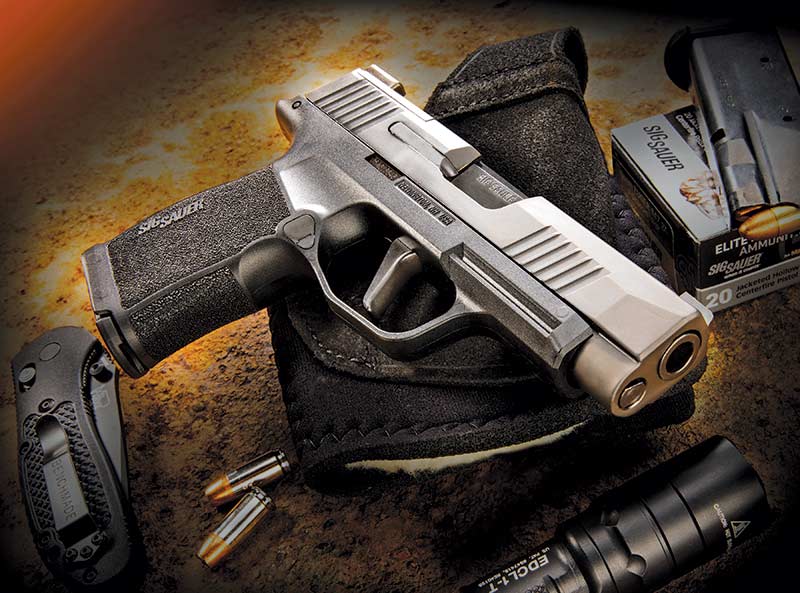
The P365, a “slim-nine” amazingly packing 10 rounds into a magazine scaled for a tiny grip-frame, was a game-changer and an instant hit when it was introduced at the beginning of 2018. I liked mine enough to buy it. The P365 XL is simply that slim, small-grip pistol extended at muzzle and butt. Magazine capacity is now 12+1, two rounds up from the standard P365. At 6.6″ long with 3.7″ barrel, 4.8″ high and 20.7 oz., it’s 0.8″ longer overall, 0.5″ greater in height (read: butt protuberance), and 2.9 oz. heavier than its smaller predecessor — not counting the two extra cartridges when fully loaded.
SIG categorizes the original P365 (still in the catalog, of course!) as a “micro-compact” and this new XL variation as “The perfect balance of micro-compact concealability with full-size shootability.” SIG also offers a 15-round P365 magazine, and while I haven’t tested it, I trust gun expert Chuck McDonald who tells me the 15-rounders run fine in his extensive P365 experience.
On our test sample, serial number 66A494274, the trigger pull ran an average 5.59 lbs. from the toe, and 7.64 lbs. from the center of the trigger on the Lyman gauge.
From the Matrix rest on a concrete bench, I ran it with SIG’s own load actually designed for the original short P365. The “365” cartridge comprises a 115-gr. V-Crown JHP spec’d for 1,050 fps velocity, running the gun fine, with very mild recoil. Five shots went into 3.35″, with the best three into 1.60″. The 147-gr. subsonic shot better, with the flat-nose Winchester FMJ grouping all five into 2.80″, four of those into 1.25″ and the best three in the tightest measurement of the test at 0.8″. The best five-shot group came with the Speer Gold Dot 124-gr. +P bonded hollow point at 1.95″ — with the best three into 1.05″. Yes, the little P365 XL grouped tighter than the big, heavy P320 X5 Legion. At least with these two particular pistols, in my hands.
Handling Thoughts
in the P365 XL, even with +P ammo, and slightly less than with the original smaller model. The topmost round may be a little tight to squeeze into the magazine, and with the slide forward, the 12-rounders coming with it wanted to be seated firmly because of limited flex in the stack of cartridges when filled all the way up. The gun came with a flat trigger which, on this model, I liked better than the traditionally curved one on my original P365. There was a little creep in the pull, but it seemed to disappear in rapid fire.
I tested it for ergonomics, among other things running it over an off-duty police course encompassing 60 rounds, five-speed reloads, multiple draws, one hand only with each hand, and use of cover positions, from four to 15 yards. The pistol came with only two 12-round magazines, but the course of fire was “revolver neutral” with six round strings and mandatory reloads, so I got by mixing tactical reloads with speed reloads and filling one mag with six and the other with 12 for 18-round strings of fire.
The P365 XL gave me a full 300 out of 300 possible points, with some three-fourths of those in one ragged hole. The overall group measured about 5″. For a “micro-compact” pistol it would have been hard to ask for more than this. My reloads weren’t terribly fast. To make those many rounds fit into that compact a pistol, the P365’s mag release had to be mounted forward on the grip-frame requiring a push more to 5 o’clock than 3 o’clock to dump the empty mag. My old arthritic thumbs don’t handle that well. Some P365 shooters have addressed this by swapping the release button to the starboard side (instructions are in the owner’s manual) and ejecting the spent mag with the trigger finger.
I carried the XL for a while in a Bullseye Kydex OWB. No surprises: this 1.1″ thick pistol concealed very well and very comfortably, just as it was designed to do.

Reliability
Everyone wants to shoot new guns, allowing me to get lots of hands on test firearms. Hundreds of rounds went through each of these SIGs, in the hands of five-foot-tall females and six-foot-plus testosterone monsters alike. There were no malfunctions except for failures of the slide to lock open when people left their thumbs on top of the slide stop levers — a shooter malfunction, not a gun issue.
What particularly impressed me was the P365 XL performed so reliably when it came out of the box bone dry. I know we should field strip and lube new guns before we shoot them. I also know most gun buyers don’t, so I test them as they come out of the box. Thus, for this little P365 XL, the test was somewhat abusive, but it still ran fine. Big thumbs up for that. Be smarter than me and lube yours, though!
Through the broad range of P320 options, this model has proven reliable enough for U.S. military adoption. The P365 has been approved by many law enforcement agencies for plainclothes, off-duty and backup carry. One such entity is the Orlando, Florida Police Department. Many of their 800-plus sworn officers have opted for the P365, including Rangemaster Kevin Williams, who happened to be wearing his own when I interviewed him. He says the P365s have done fine in training and qualification with department issue Winchester 124-gr. +P Ranger Bonded ammunition.

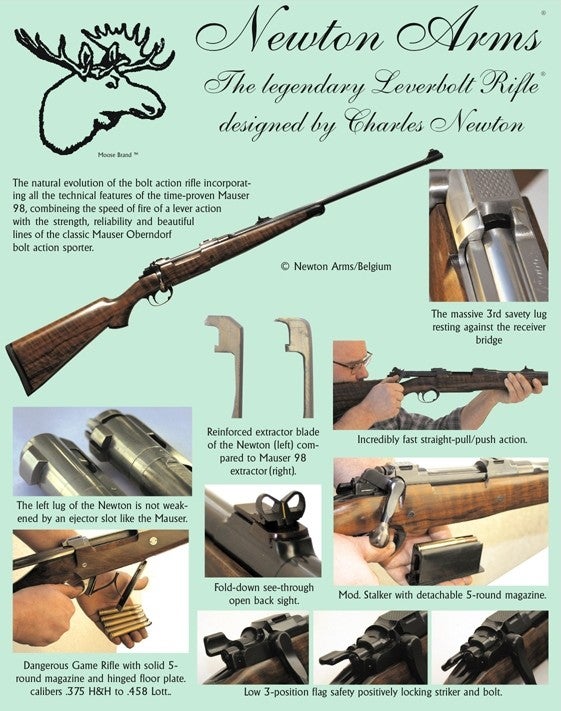
Newton Arms have revived the Leverbolt rifle that was invented by the famous gun and cartridge designer Charles Newton in 1929. The design borrows element from the Springfield, Lee Navy and the Winchester lever-action. By utilizing a lever the bolt can be cycled faster than a traditional straight pull bolt action.
Click to expand.
According to my copy of Bolt Action Rifles (4th Edition), the story of the Leverbolt is a sad one. Charles designed the rifle after this business, Newton Buffolo Rifle Corporation, folded in early 1929. Unbeknown to him, and everyone else, the stock market would crash in October of that year heralding the beginning of the Great Depression.
Newton approached Marlin who agreed to limited production only if he could secure at least 500 orders. The cost was a $25 downpayment and an addional $35 on delivery. He failed to secure the neccessery orders and once the market crashed any chance of the rifle being manufactured was gone. Charles died a few years later aged 62.
Mehul, a moderator at nitroexpress.com and expert of the topic emailed me information about the Newton rifle:
For a straight pull action that is much sleeker than any of its competitors today (the Blaser R 93, Strasser RS 05 and the Heym SR 30 are three popular designs that come to mind) the Newton Leverbolt is especially interesting because it comes with a controlled feed and extraction system that would make it ideal for dangerous game. The speed of reloading and getting repeat shots off would also be ideal for an African rifle – with a 5 shot magazine in calibers from 375 H&H to 458 Lott this could be much better than anything else available today.
I am not sure of pricing or availability of the rifle at this time.
A big thanks to Mehul for the info.

Steve Johnson
I founded TFB in 2007 and over 10 years worked tirelessly, with the help of my team, to build it up into the largest gun blog online. I retired as Editor in Chief in 2017. During my decade at TFB I was fortunate to work with the most amazing talented writers and genuinely good people!

 Can you Dear Reader name the guns? Grumpy