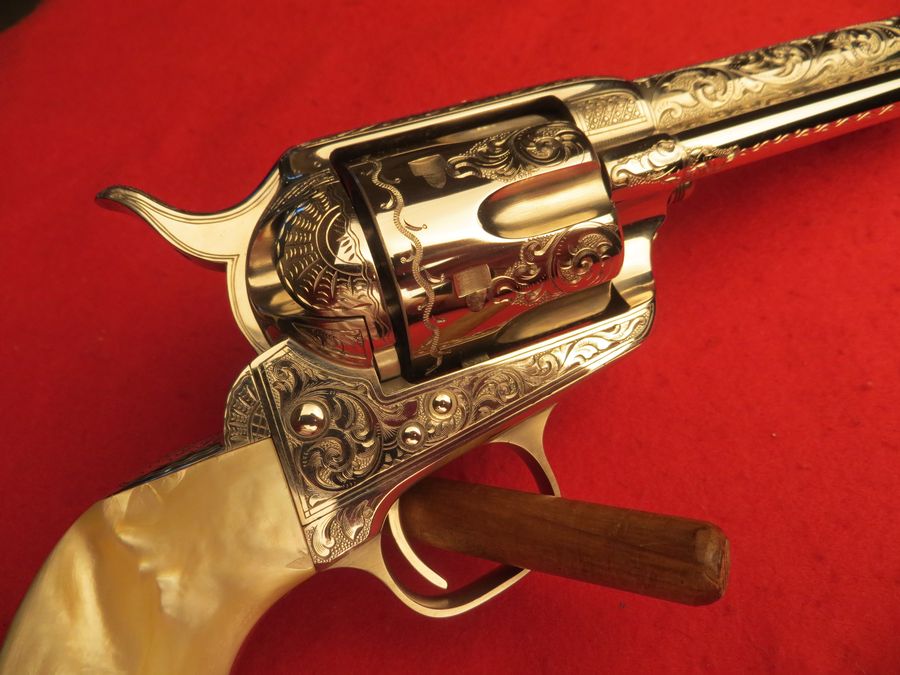
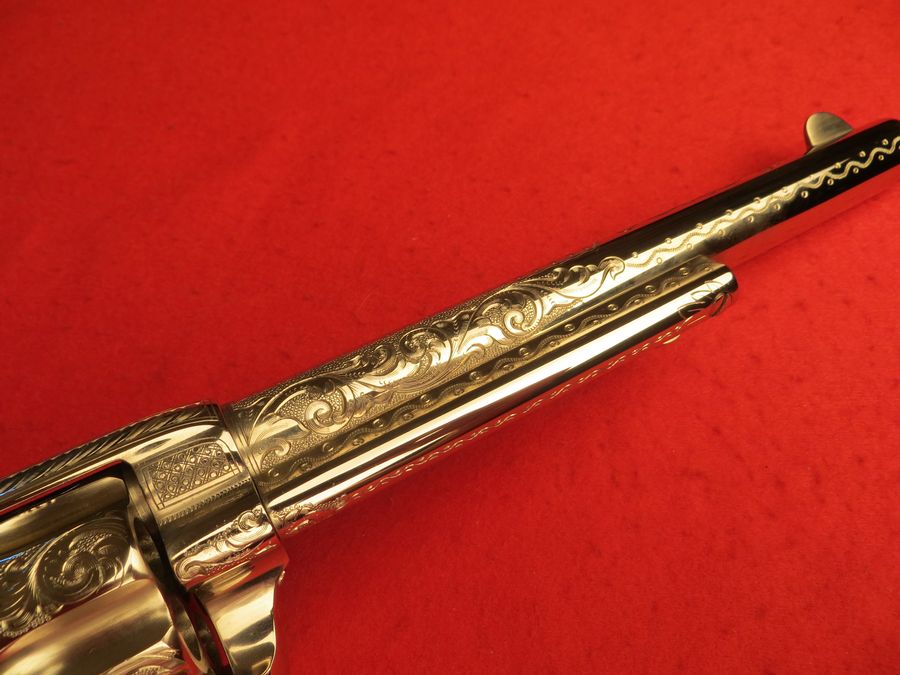
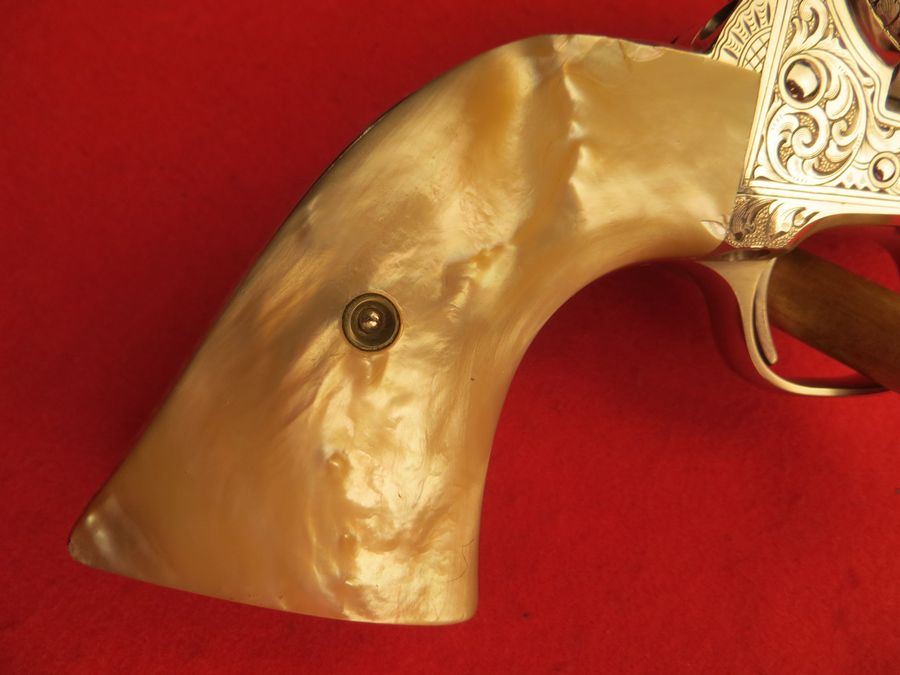
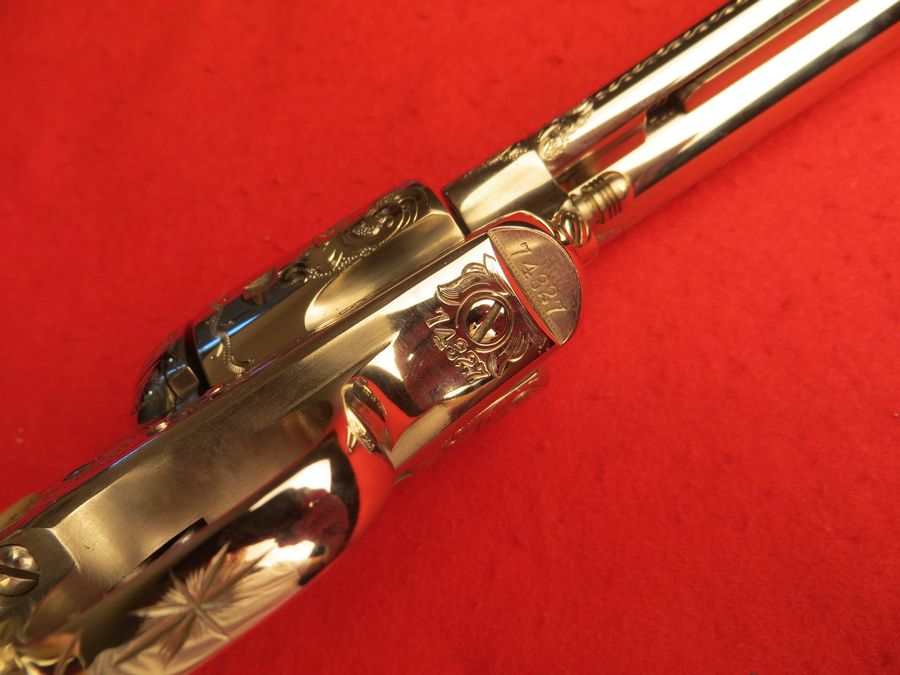
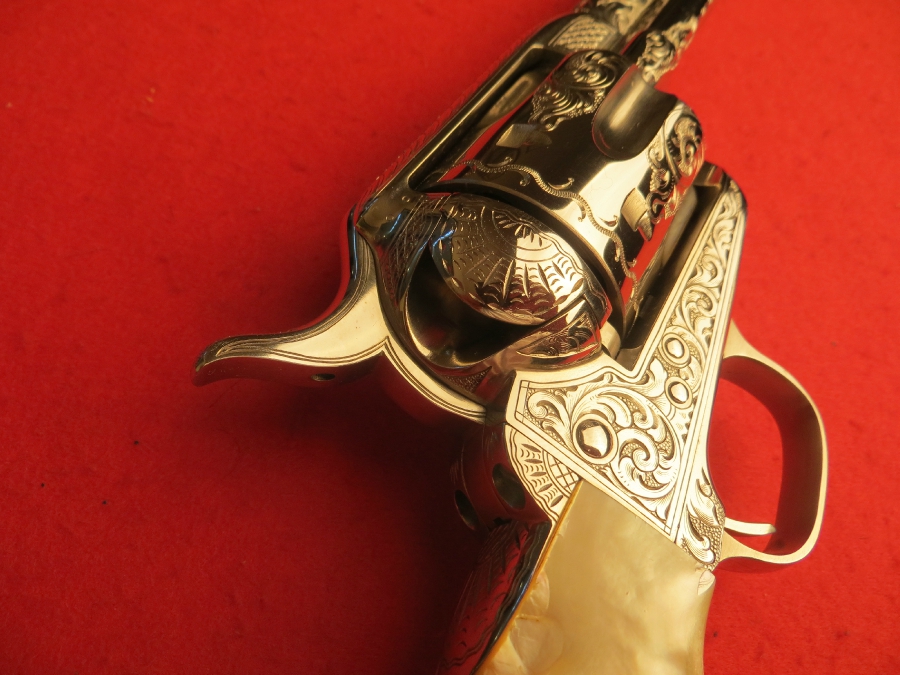
Starting in 1976 I have been to Gunsite more times than I can remember. Besides meeting life-long friends, one of the best things is the networking always taking place.
At a three-day revolver/lever-action rifle event last year, I took my Colt New Service and a Model 92 Winchester, both chambered in 45 Colt. Records show my revolver was made in 1907 — roughly half a century before I was born. Two years after this one was made, the U.S. Army adopted it as the Model 1909, two years before the iconic 1911 became the standard issue sidearm.
I love my Pythons, and K- and L-Frame Smith & Wessons, but I have a soft spot for the older revolvers, especially the large frame Colts. Mechanically this revolver was in good shape and I have used it at several Gunsite events.
However …
The exterior was another story and I confess toying with the idea of refinishing the big Colt. The original blue was about 60 percent and showing honest use. This was not a concern as I believe such wear shows character. There were, however, some nicks and scratches I wanted to correct.
Among other things the bottom of the frame appeared as though it had been used for hammering something — I like to think it was from hanging up a wanted poster from some long-forgotten Arizona desperado.
Decisions
After much internal debate I finally decided to give the old war horse a facelift.
At the Gunsite event mentioned above I met a young man by the name of David Fink. Fink has, among other things, both a Gunsmith Master Certification and a Gunsmith Advanced Certification to his name. Dave offers custom gunsmithing, custom rifle and pistol builds, machining and prototyping, along with re-bluing and Cerakote coatings. In short, it’s a full service shop.
I saw several examples of Fink’s work at Gunsite, including refurbishing and re-bluing a beat-up Smith & Wesson Model 10. All examples I observed showed superb workmanship so I made arrangements with Dave to remove the imperfections and re-blue my revolver.
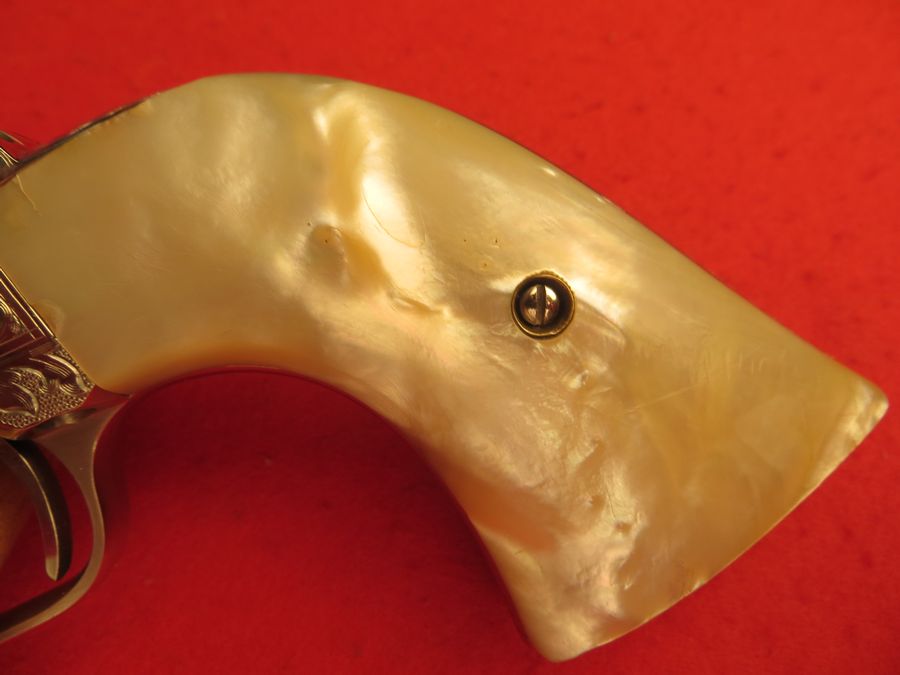
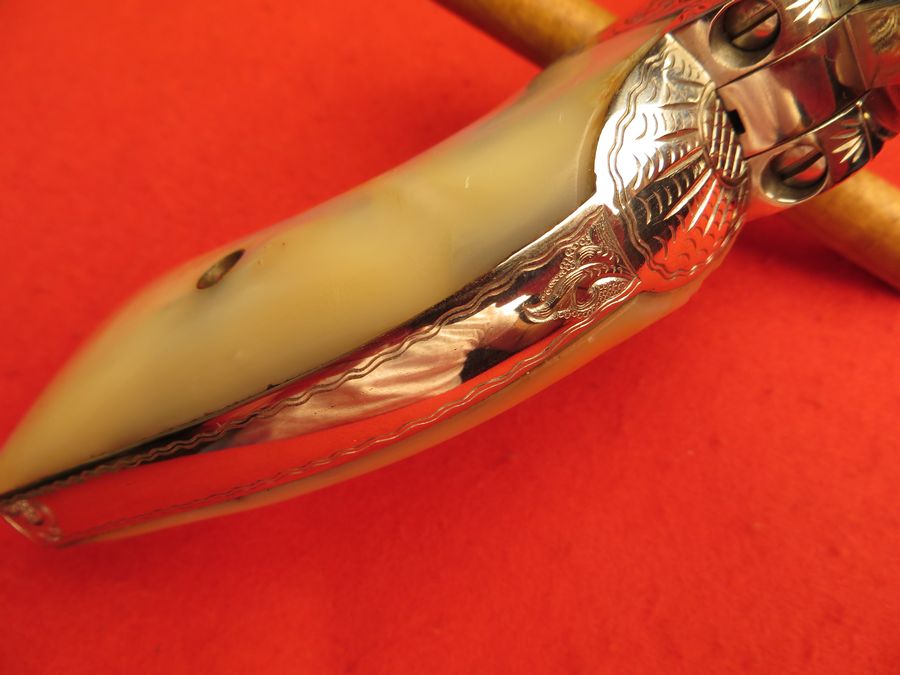
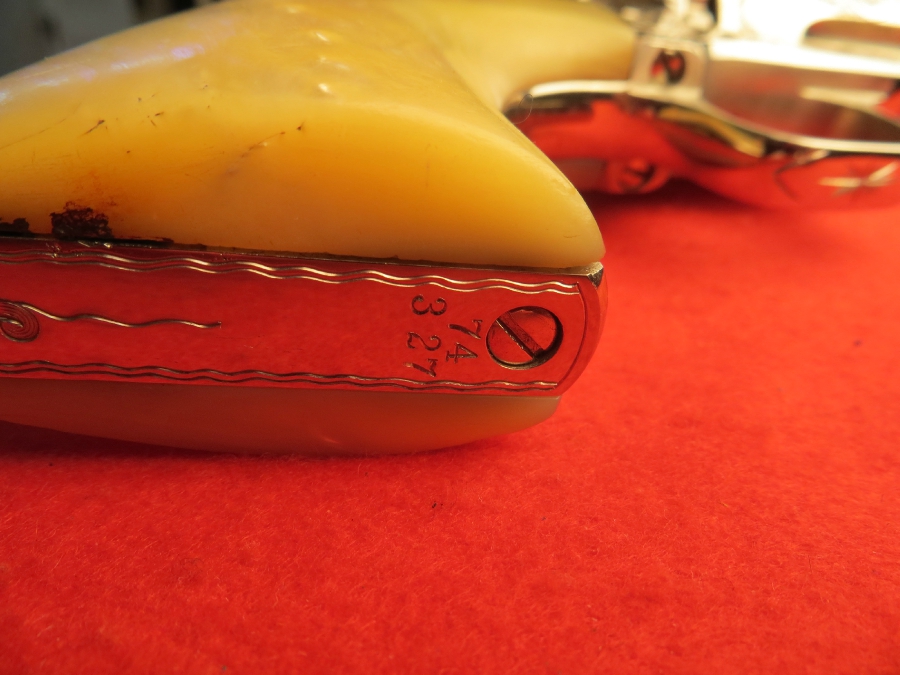
After acquiring a pair of ivory stocks with gold Colt medallions from N.C. Ordnance to replace the original worn, hard rubber grips, I gave the Colt to Dave. The only thing left was the anticipation of receiving back the finished sixgun, reload some more 45 Colt and head to the range.
As custom work goes, I didn’t have long to wait as Dave completed the revolver in six weeks!
The Facelift
In addition to the damage on the bottom of the frame mentioned above, the cylinder had deep scoring caused by a sharp burr on the front sideplate screw from a previous owner. There were some small dings on the top strap of the frame as well as on the barrel towards the muzzle.
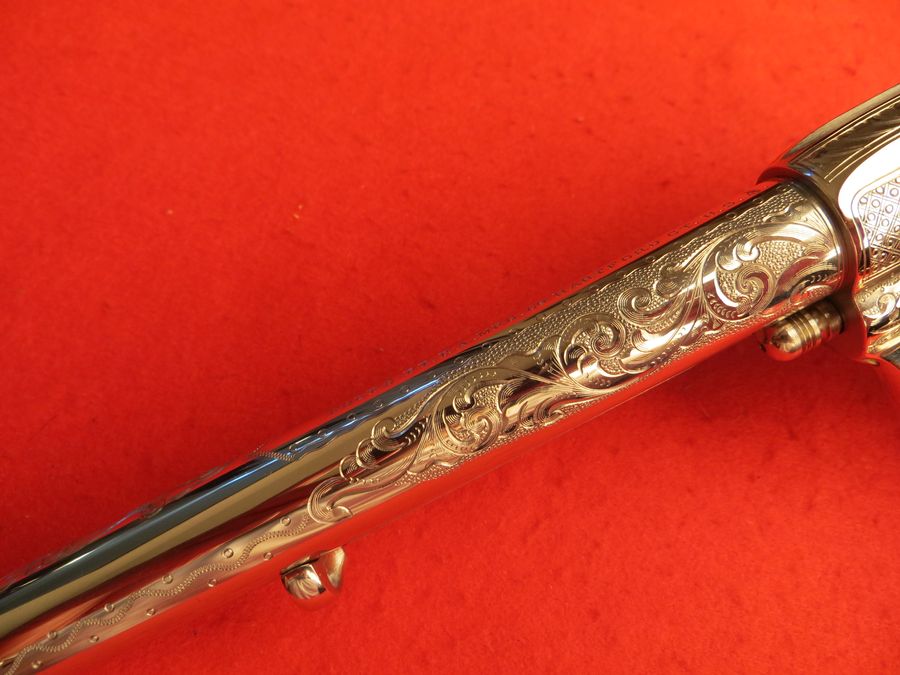
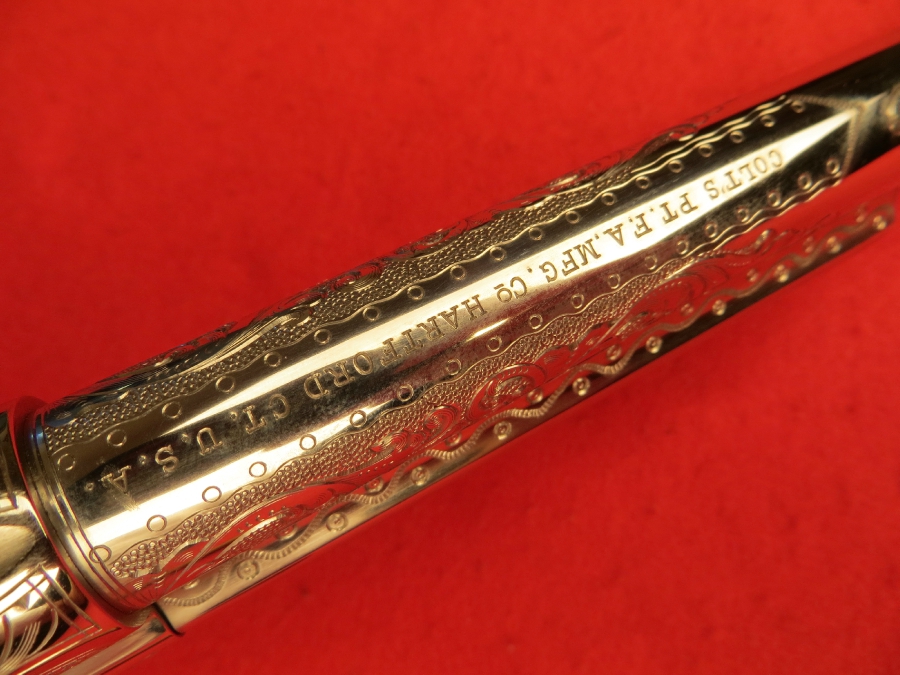
The Rampant Colt logo and inspector stamp were very shallow and I asked Dave to retain them during finishing if at all possible. He was able to retain the markings on the sideplate and the marking “New Service 45 Colt” on the barrel is still crisp and clear.
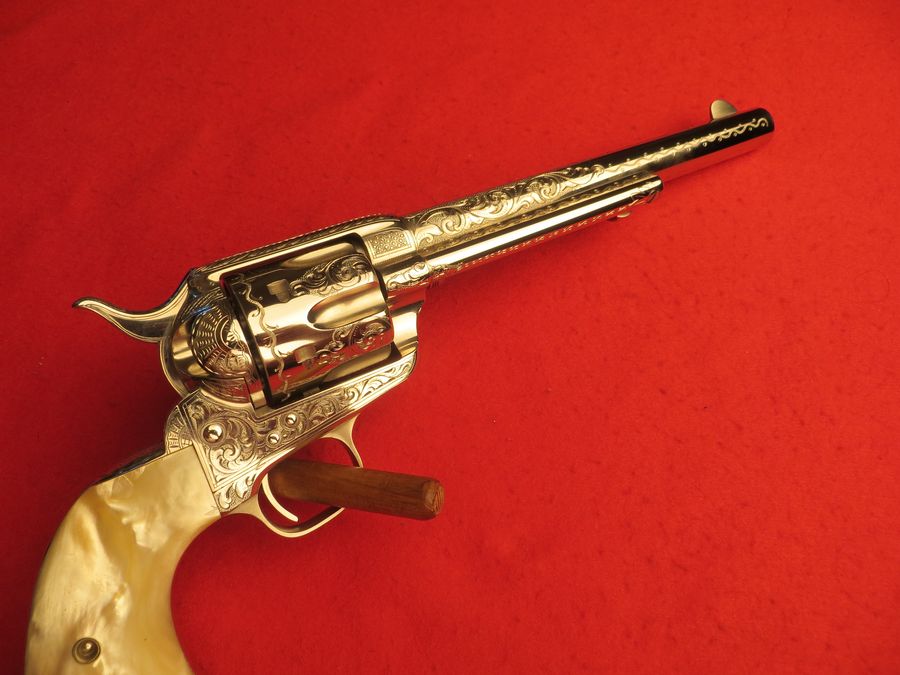
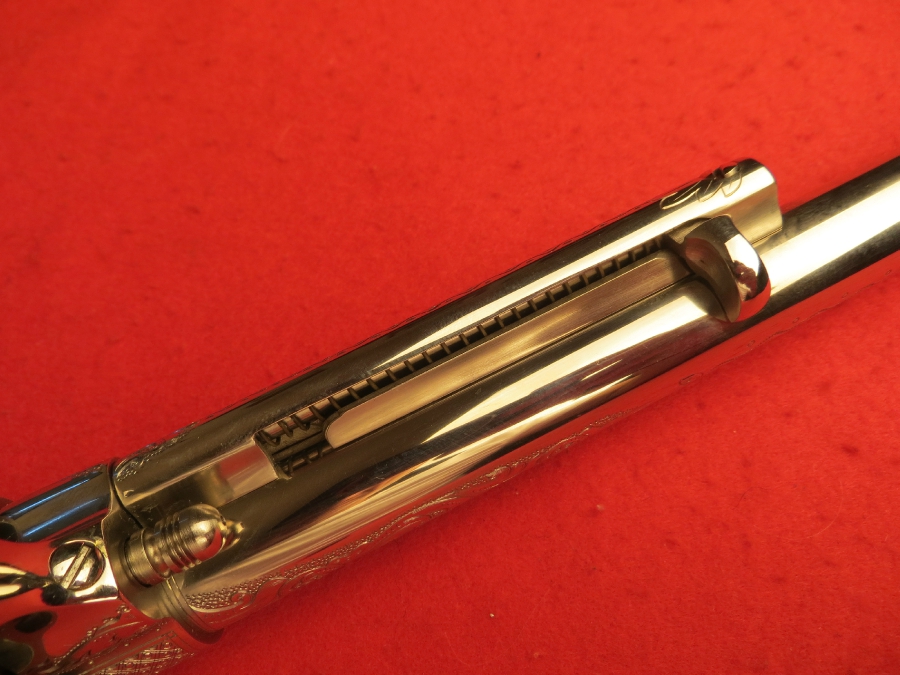
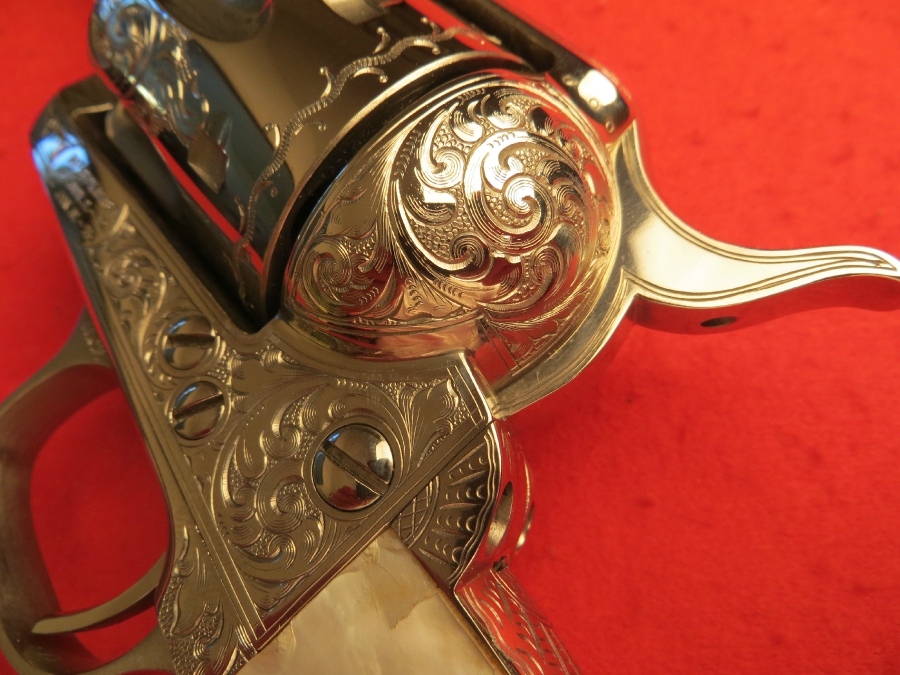
Dave recontoured the previously burred sideplate screw and fit it flush with the frame. The overall finish is a bright, polished blue and is so deep it is reminiscent of the finish applied to Colt and Smith & Wesson years ago.
The nitre-bluing process (sometimes referred to as fire bluing) can produce a wide range of colors from light yellow to super bright “peacock” blue. Dave finished the screws, trigger, hammer, cylinder release, lanyard ring and ejector rod head in a gold color to contrast with the bright blue and compliment the gold medallion in the stocks.
The completed restoration was more than I could have hoped for. At the risk of sounding melodramatic, it was simply stunning.
100-lb. Trigger
The double-action trigger pull on my New Service was light — as long as you had a mule handy to hitch to it! The pull weight bottomed-out every gauge I own. The single-action pull wasn’t much better, being roughly the same as the double-action pull in many revolvers. I asked Dave to lighten it up some if he could.
Colt revolvers use a “V”-shaped mainspring. One method of lightening the trigger pull is to put something between the upper and lower leg of the “V” and bend the top leg upwards. This method sometimes barely lightens the trigger pull and if bent too much, it results in unreliable ignition.
Dave tried the above technique, but because the 112-year-old spring was so brittle, it snapped before any bend could be made. He ordered a new main spring and much to his and my surprise, the double-action trigger pull was now at a very manageable 9 lbs., with single-action breaking at a crisp 2.5 lbs.
Proof Test
I couldn’t wait to shoot it and despite the temperature being in the mid-30s with drizzling rain, I went to the range the same day I picked it up, along with a quantity of Keith-type 255-gr. semi-wadcutter rounds. To my great satisfaction the old revolver was more accurate than before. The restoration itself had nothing to do with the increased accuracy but it can be attributed to the much lighter trigger pull, allowing a smoother press while the sights were on the target.
Any new finish will add a few thousandths to the thickness on the metal surface. As a result, there was a barely perceptible hitch in the cylinder release. I have no doubt this will disappear with use as the parts wear in.
A friend remarked the old Colt is now too pretty to carry. However, I don’t own any “safe queens” and I’m looking forward to more trips to Gunsite to put some honest holster wear back on the old warhorse.
After 50 years of buying Colt Single Action Army revolvers in many calibers and all generations, I had never actually had one custom-made to my specs. Of course, I’ve had special ivory, bone or fancy wood grips fitted and I’ve had special-order barrel lengths such as a 3rd Generation .38-40 with a non-cataloged 4″ barrel with matching ejector rod and housing.
Going OIld-School
Recently in a conversation with Eddie Janis, head of Peacemaker Specialists located in Paso Robles, Calif., he mentioned his “1880s Package.” It consists of taking a 3rd Generation SAA with the so-called “black powder” frame and remodeling it to duplicate an 1880s Peacemaker as closely as possible. Now, I’ve been friends with Eddie for over 20 years and had him slick up the internals on a couple of Colts, and purchased items from his extensive inventory of parts for all generations. After he described the alterations for a 1880s Package, I got to thinking — “I’m now approaching my seventh decade. If I want to have a special Colt, it better get in the works.” So it did!
Let me describe the 1880s Package. Please note any of the services mentioned next can be purchased individually and the customer does not have to go for all of them.
Here’s the list — the barrel and all blued parts are cleaned of finish and markings, then restamped as they would have been in the 1880s. The cylinder flutes are lengthened and front of flutes beveled. Beveling is also done to the front of the ejector rod housing, and toe and heel of grip frame. The hammer spur is checkered and outlined and hammer is color case hardened. The other parts, after cleaning and re-marking, are then rust blued.
After the cosmetics, there is the inside of the Colt to consider. First off, I’m sad to say the internals of third Generation SAAs are often a mess. They usually function OK but most specimens are gritty and heavy when cocking the hammer. Likewise with the trigger pull. Cylinder looseness is a gripe often mentioned by new buyers.
Peacemaker Specialists makes all those problems go away. When I received my gun back, its action was remarkable. Cocking the hammer made me wonder just how it could be so smooth and light, without any sideways wobble the 3rd Generation hammers sometimes have. Trigger pull was right about 3 lbs. with absolutely no creep or grit and the cylinder — how can it be so tight, both with hammer cocked and at rest? There is not one iota of shake either laterally or fore and aft. It baffles me.
Stocking Up
When it comes to handgun stocks, I’m a bit of a nut job. Hardly any of my handguns wear factory issue stocks except the military collectibles. Factory stocks are usually too thick, too thin or just too ugly for me. Contrary to many Peacemaker lovers, I’m not big on ivory stocks as a grip material although I do have some. Bison bone is a great material for SAA stocks but the fellow who made mine is now deceased. The truth of the matter is I’m simple in my tastes and prefer good American (black) walnut. I instructed Eddie to use ordinary straight grain walnut as Colt would have used circa 1880 and to make them one piece as Colt did. They fit perfectly.
I didn’t go for one service offered by Peacemaker Specialists — a new cylinder, made by rechambering a smaller caliber cylinder so the chamber mouths match .45 Colt barrel groove diameter. Colt SAA .45s have 0.451″ barrel groove diameter as standard but their cylinder chamber mouths usually run 0.455-457″. The redone cylinders offered by Peacemaker Specialists have 0.452″ chamber mouths. For years, I’ve preached against Colt putting those huge chamber mouths in .45s, so why didn’t I go for the smaller size with this SAA?
The answer is logistics. I have a dozen other .45 Colt revolvers, most with those huge chamber mouths. My .45 Colt handloading is usually with softer 1:20 tin-to-lead alloy bullets sized to 0.454″. This system gives more than adequate accuracy from all my .45 sixguns. Thus, I wanted to leave the cylinder chamber mouths of this special .45 the same dimension so I didn’t have to load different .45s rounds for it.
Of Pins And Locks
From introduction in 1873 until the mid-1890s, Colt Peacemakers had their cylinder base pins secured by a screw angling in from the front of the main frame. In the 1890s, Colt began phasing this system out in favor of a transverse spring-loaded lock. Somehow, the first system got the moniker “black powder frame” although Colt did not guarantee SAAs for smokeless powder ammunition until 1900. Therefore both frame styles were actually sold prior to the smokeless powder warranty.
Regardless, for Peacemaker Specialists to do a true 1880s package the customer must supply them a “black powder frame” sample on which to work and it’s actually not as easy as it sounds. Colt reintroduced a limited number of black powder frames in their 1873-1973 Peacemaker Centennial Commemoratives. In the 1980s, with their 3rd Generation production, Colt began to offer black powder frame SAAs as a custom shop option and continued to do so albeit intermittently into the 21st century. They do not offer them now. The only option for people like you and me is to find one on the Internet or sitting in a gun shop.
After my conversation with Eddie Janis about the 1880s Package I began perusing Gunbroker.com for a black powder frame 3rd Generation .45. Initially, I wanted it with a 4-3/4″ barrel so Peacemaker Specialists could re-mark it with the old style double address line. It took a few months of Internet searching but I finally found a 4-3/4″ .45 back in Kentucky. Once it arrived, I fired it 10 rounds, hit the stump of wood I aimed at every time and shipped it right to Eddie
Project Hits A Snag
Soon Eddie called and in an almost regretful tone told me essentially the following — “A friend wouldn’t build something for a friend knowing it was going to come out substandard in the end.” My quickly bought-and-shipped 4-3/4″ .45 was manufactured during a time when Colt was having problems with fit and finish of third Generation SAAs. He pointed out several flaws I should have noticed so he returned it and my search started again.
After a couple months I hit the jackpot upon encountering a new-in-box 7-1/2″ SAA made in 2008. It was a beauty. Although I wasn’t going to get my two-line address, the 7-1/2″ length is actually my favorite for shooting. It was sent to California and Eddie approved of it.
Waiting, Waiting …
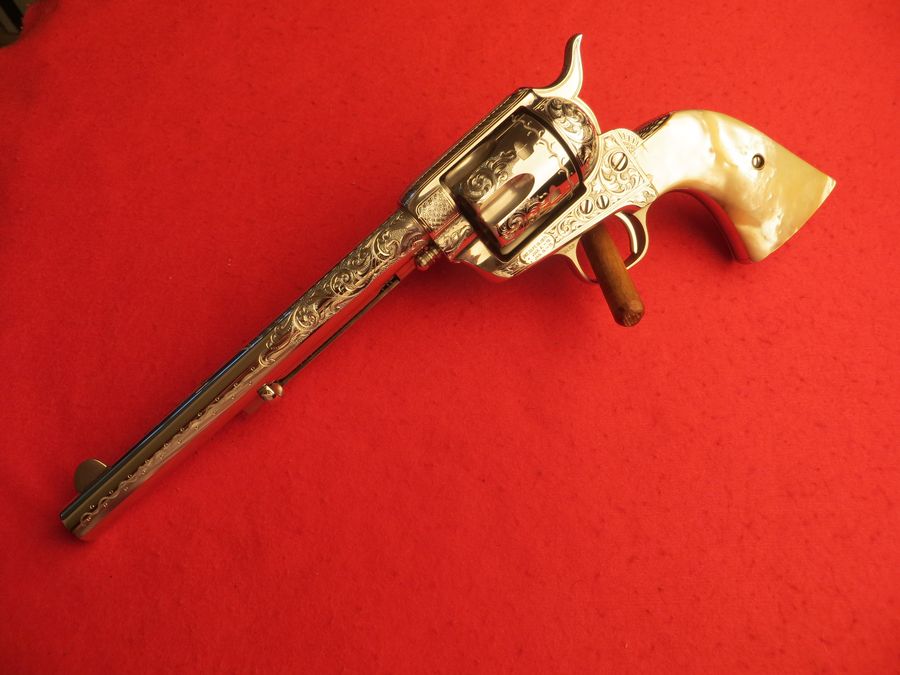
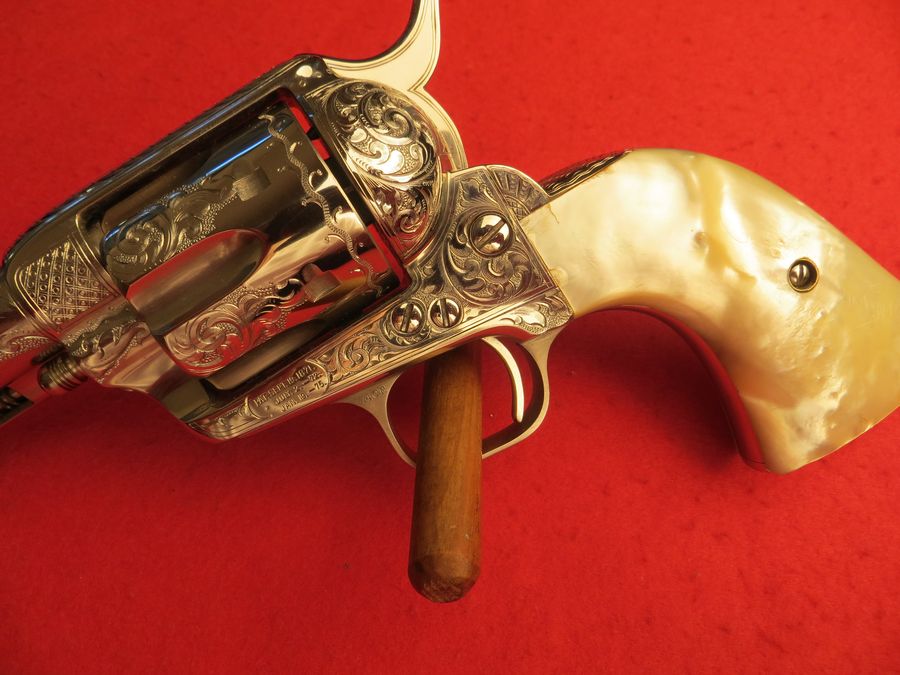
To make a long story short, months passed but finally my new old gun arrived back home. It’s a beauty!
How does it group on paper? Darn if I know; having never shot it on paper. I can hit steel or wood time and time again despite my 70-year-old eyes. Even better, those eyes can bask in the Peacemaker’s radiance when taking a break at my word processor because I’ve been keeping it near me on my desk.
The Ingram Model 10, better known as the MAC-10 (Military Armament Corporation) submachine gun, was produced in both 9mm and .45 ACP versions. Here’s everything you need to know about it.
On July 11, 1979, a white Ford Econoline van cruised through the parking lot of Dadeland, urban Miami’s largest shopping mall. Dade-land was fifty acres of late 1970s awesome, populated with niche shops, anchor stores, and throngs of families out doing what Americans did in the years immediately prior to Ronald Reagan.
Among the many shoppers enjoying the mall that day was one German Jimenez Panesso and his bodyguard, Juan Carlos Hernandez. (German was his name, not his nationality.) German Jimenez Panesso was a Colombian drug lord.
Panesso traveled in an armored Mercedes limousine befitting the stature of one of Miami’s top drug dealers. At 37, Panesso was handsome, rich, powerful, and on top of his game. At 2:30 pm on this torrid Miami afternoon, Panesso and Hernandez made their way into Crown Liquors to procure their weekly supply of Chivas Regal. Both men were sufficiently at ease for Hernandez to leave his 9mm Browning Hi-Power behind in the Mercedes.
The Ford van pulled up and parked outside the liquor store. The astute observer would have noted that one side of the van read “Happy Time Complete Party Supply.” The other declared, “Happy Time Complete Supply Party.” The question of whether the van supplied the party or was the party itself I shall leave to the philosophers.
Two men left the van and followed Panesso and Hernandez into the shop. The larger of the two then produced a .380 Beretta pistol equipped with a sound suppressor and shot Panesso four times in the face. His companion hosed the store down with a fully automatic .45ACP MAC-10 submachine gun, in the process killing Panesso’s associate, Juan Carlos Hernandez.
The two assassins returned to the van and liberally sprayed the parking lot and surrounding shops with gunfire apparently just for meanness. Authorities later found the van abandoned behind the shopping center. In addition to quarter-inch armored plate affixed around the vehicle, there were also several gun ports covered with nondescript plastic covers.
Inside the van, the cops found more than twenty firearms including shotguns, handguns, and automatic weapons. Panesso and Hernandez were the 37th and 38th Miami homicides for 1979. At a time when there were untold millions to be made moving drugs into south-central Florida, the MAC-10 submachine gun found its most sinister applications.
Reality
Such sordid stuff as this makes for popular copy. Prose describing unfettered violence catches the eye, and I just crafted a bit of it myself. However, the dirty little secret is that criminal usage of legitimate automatic weapons was and is actually vanishingly rare in the United States. In fact, Thompson submachine guns and Browning Automatic Rifles could be found in Sears and Roebuck stores as well as conventional gun shops prior to the passage of the blatantly unconstitutional National Firearms Act of 1934.
Before the passage of that law, machineguns were sold over the counter and uncontrolled wherever there was money enough to purchase them. It was simply that following on the heels of the Great Depression nobody had any money. A Thompson sold for $225 back then. That’s about $4,400 today. A BAR was the equivalent of about $6,000.
Dangerous Game Cartridges
Just before 1 a.m., the Denver Police Department tweeted that they were investigating a shooting in the 2000 block of Market Street.
DPD said nine gunshot victims were located and that they identified a suspect who also had a gunshot wound.
Three victims were in critical condition at a local hospital, and the other victims appeared to have non-life-threatening injuries, according to DPD.
At around 1:11 a.m., DPD said they were investigating a shooting in an area where one person was shot. However, officers provided an update that the victim was actually shot in a different location and self-transported to the hospital.
In total, 10 people were injured in the 2000 block of Market Street, which is next to Coors Field.
DPD said this shooting is complex and the investigation is in its early stages. Early information suggests that multiple shots were fired during an altercation that involved several people.
Around 11:50 p.m. Monday, DPD said they were also investigating a shooting in an area a block away from the 16th Street Mall and several downtown hotels.
One person was taken to a local hospital, but their injuries were not immediately known.
Officers were working to obtain suspect information.

He was a prolific writer, the first Briton to be awarded the Nobel Prize for Literature, who nonetheless declined the appointment as Poet Laureate and turned down a knighthood. Rudyard Kipling was feted in his day for his portrayal of stiff-upper-lip Englishness – even though his traditional values and literary reputation are now occasionally vilified by fashionable revisionism. This is the familiar Kipling. However, there was another side to him. The author and poet had a passion that later went on to be shared by millions. He loved motoring.
Kipling was drawn into the fraternity of the road by newspaper magnate Alfred Harmsworth, who drove down to Rottingdean on the Sussex coast in October 1899 to demonstrate his Panhard car to his literary friend. Motoring was “like being massaged at speed”, Harmsworth declared. Kipling and his wife, Carrie, took a 20-minute trip and were equally enthralled. The outing left them ‘white with dust and dizzy with noise – but the poison worked from that hour’, Kipling declared in Something of Myself.
Kipling and his wife were enthralled by motoring
He hired a car he called The Embryo, a Lutzmann Victoria of carriage crudeness with a single-cylinder engine and belt drive, capable of 8mph. The weekly cost, including chauffeur, was 31/2 guineas. When it arrived, it was “pawing the ground before the door” and the children started dancing around it, according to their cousin, Angela, granddaughter of Edward Burne-Jones (who later became the novelist Angela Thirkell).
Kipling promised the children a ride, but “the monster” refused to start. “We sat and sat in it while the chauffeur tinkered at its insides, and then had to get out with a promise for a real ride some day,” Thirkell wrote.
The GWK light car was one of the vehicles Kipling took an interest in
Kipling and his wife used it through the summer of 1900, ostensibly for house-hunting although he admitted that they simply enjoyed the “small and fascinating villages” of England. They were driven 20 or 30 miles after breakfast, lunching in hotels and returning home in the evening on virtually empty roads.
In 1901, Kipling purchased a US built Locomobile steam car that spent much of its time off the road, mainly because the petrol burners habitually blew out in a crosswind. On one 19-mile trip the car “betrayed us foully”, he wrote to a friend. “It was a devil of a day. It ended in coming home by train.” The car was noiseless, he conceded, “but so is a corpse”. Kipling felt he had been let down. “Her lines are lovely, her form is elegant, the curves of her buggy-top are alone worth the price of admission, but as a means of propulsion she is a nickel-plated fraud.”
British cars and innovation
The underwhelming experience with the Locomobile directed him towards British cars and genuine innovation, qualities that were combined in the Lanchester produced in Birmingham by Frederick and George Lanchester. They were designed as a motor car rather than a carriage adaptation, and with a power train that owed nothing to stationary engines and transmissions. Kipling’s 1902 purchase had a centrally mounted 10hp air-cooled engine with horizontally opposed cylinders. Plus each piston had its own crankshaft and flywheel assembly, and two contra-rotating shafts to provide mechanical smoothness, a solution that later appeared in many modern engines. Unfortunately, this car, too, was trouble. On its delivery trip from the factory to Rottingdean, driven by George Lanchester, it suffered 21 tyre deflations.
A portrait of Rudyard Kipling from 1865
Flats were commonplace at that early stage of motoring. Tyres were poorly constructed and road surfaces were rugged, so a set on a light car was expected to last no more than 2,000 miles and on a large car perhaps 1,000 miles. The Lanchester’s delivery journey proved to be a foretaste. Once in Kipling’s ownership, it broke down so often that he christened it Jane Cakebread after a prostitute notorious for 93 convictions. This is possibly the first recorded instance of a pet name for a car. Kipling became an addict. In 1903, the car underwent a six-month overhaul but still broke down so often that Lanchester provided a full-time engineer at 30 shillings a week, as well as a driver. Only after June 1904, when the firm supplied a new 12hp car that Kipling named Amelia, did the author experience comparatively trouble-free motoring.
The fuel for Kipling’s passion
Amelia fuelled Rudyard Kipling’s devotion to motoring so much that he said a car was a means of indulging one’s sense of English history. “A time machine on which one can slide from one century to another,” he said. Plus, he added, cars were good for the nation’s temperance and education, since drivers needed to remain sober and to read road signs. After trying a Siddeley in 1905, Kipling bought a Daimler he called Gunhilda. But in 1910 he was won over to what became known as ‘the best car in the world’. Travelling through France with his wife, Kipling encountered two friends in Avignon. These were the motoring peer Lord Montagu, who was trying out a new 60hp Rolls-Royce, and Claude Johnson, managing director at Rolls-Royce and the man known as the hyphen in the brand’s name.
Kipling accepted the offer of a spin and the party drove into the Alps, soaring up winding passes beyond the snowline as mountain panoramas unfolded with a grandeur beyond the expectations of even the much-travelled author. He followed up this experience with a lift to Paris and promptly ordered a Rolls-Royce Silver Ghost with limousine landaulet body by coachbuilder Barker. It was delivered in March 1911 – all for £1,500. He wrote to Johnson: ‘This place, which was reasonably quiet, simply stinks and fizzes with every make of car except R-R. It’s a Christian duty to raise the tone of the community. So when you’re ready, send it along.’ However, a fire at Barker’s and royal requests for coaches for the forthcoming coronation delayed the order.
Rolls-Royce raised the tone
Rolls- Royce lent him a car, then sent a Hooper-bodied limousine. Kipling rejected it and decided to pull strings through Max Aitken, later Lord Beaverbrook. He was also his friend, investment adviser and a Rolls-Royce shareholder. Aitken wrote to Johnson: ‘I warn you that Kipling is being lost to you entirely through downright neglect and ill usage.’ Johnson’s response was that, because of Kipling’s ‘complaints and wailings’, he would be glad to be rid of him, but the matter was settled amicably and the author took delivery of The Green Goblin. He ran it for two years, then part-exchanged it for another Silver Ghost 40/50hp he called The Duchess, which took the family to France in March 1914. Kipling kept it for seven years and sold it for £200 more than it had cost him, remarking dryly that Rolls-Royces were the only cars he could afford to run.
With their lives overshadowed by the fate of their 18-year-old son, John, unaccounted for after a Loos action in 1915, the Kiplings motored many miles after the war. They hoped to find someone who knew what had happened to him. They travelled many more to cemeteries as part of Kipling’s work as an Imperial War Graves commissioner. However, fast motoring could still enliven their day. Leaving the Villers- Cotterets cemetery where an Irish Guards memorial was mooted, The Duchess ‘broke all modest records… the first 16 miles in 25 minutes,’ he wrote. Then, at 46mph, they were overtaken by ‘a light blue two-seater with lots of luggage behind’.
Kipling in hot pursuit
Kipling ordered his chauffeur to set off in pursuit. The Rolls wound up to 50mph, ‘but even then we could not see him’. However, on a Scottish bend taken too fast, The Duchess came into her own: the car, he wrote, ‘hung on with her teeth and toenails, shattering gravel like shot under her mudguards and literally swearing like a cat on a wall’. Kipling owned three Silver Ghosts through the 1920s. He sold one back to the company, which shipped it to India where it was converted into a mobile temple. In 1928, he bought a Phantom 40/50 with his favourite black-and-green coachwork, dubbed Esmeralda. With blue Windover body, this car passed to the National Trust and is housed at the Kipling family home, Bateman’s, in Rottingdean.
But his enthusiasm was beginning to wane. In 1930, Rudyard Kipling lamented that careless drivers and accidents were taking the fun out of motoring. Nevertheless, in 1932 he bought a Phantom 1 20/25 with body by Abbott of Farnham, specifying that he could wear his top hat in the back. Although trips to the south of France and Marienbad were taken by train, the chauffeur drove the car from England to meet them. The Phantom 1 was Kipling’s last car. He died in 1936, and Carrie three years later. The next reference to it seems to have been a 1963 advertisement in The Times, offering it for sale with the stipulation that ‘only Empire loyalists or persons of similar persuasion need apply’.
The famous author was ‘no driver’
Keen on swift regal motoring though he was, Kipling was no driver. Chauffeurs sustained his passion and, for all his writings, a handful of simple lines published in the Daily Mail in 1904 seem to offer his motoring epitaph. It was entitled The Dying Chauffeur: Wheel me gently to the garage, since my car and I must part. No more for me the record and the run. That cursed left-hand cylinder the doctors call my heart Is pinking past redemption – I am done. They’ll never strike a mixture that’ll help me pull my load. My gears are stripped – I cannot set my brakes. I am entered for the finals down the timeless untimed road To the Maker of the makers of all makes.
Acknowledgements: Toni and Valmai Holt, The Kipling Society, Motor Sport
Want to read more motoring content from The Field? Click here. Read about the classical cars being given an environmental makeover here. And click here to read our guide to the best UTVs for rural estates.