
Ever have one of those days when an idea — that started off bad — went steadily downhill from there?
This began on a Sunday morning in mid-July when — for reasons I still can’t explain — it seemed like a grand notion to start prepping for my early season small game hunting, which kicks off Sept. 1 for cottontails and catches fire Sept. 15 when the grouse season opens here in Washington. The catch: I’m going to use a rimfire pistol on the opener.
How I talk myself into these fixes is a mystery. However, in for a penny, in for a pound, which is typically a really dumb standard for long-term contentment.
Out of storage comes my trusty old, original Ruger Standard (precursor of the MK I), and I should have stopped right there. To make sure everything would be ready to rock, I decided to strip this classic handgun down for a full cleaning. Somewhere in the back of my mind, I faintly heard comedian Jay Leno asking, “How stupid is that?”
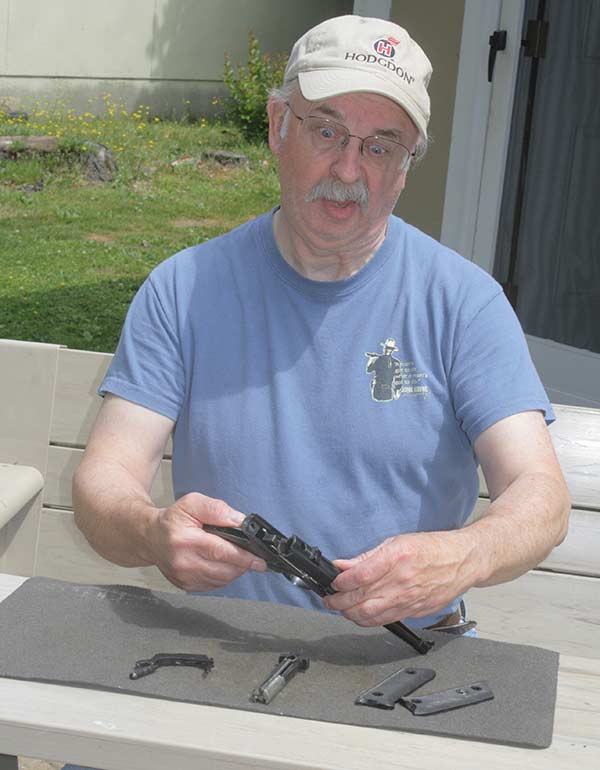
“Lessee, the framus slides onto the guzinto; no, wait a minute,
I forgot to insert the doohickey.”
My longtime, and sadly gone, amigo Dick Burnett once observed, “The Ruger .22 pistol is a gun you can take apart in about a minute, and then you spend the next hour trying to put it back together again.” Uh, huh.
Dismantling the Ruger Standard — and subsequent MK I, II and III versions — is not that difficult, usually. Pull the locking arm in the middle of the mainspring outward, using a paper clip because it can be tight. Then pull the mainspring assembly out, and down, withdrawing the big bolt plug which goes up through the rear of the upper receiver, holding the bolt in place. It may take some tapping with a nylon rod. In my case, several taps didn’t do it. I had a feeling the pistol was trying to tell me something, but I don’t hear so good these days …

To begin this process, one must use a paperclip or some other
makeshift tool to pull a small bar out from the mainspring assembly…
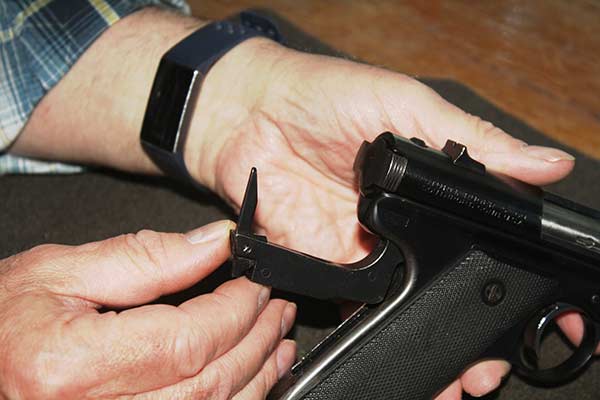
…Until it is straight out, and then can be used to pull the mainspring.
Disassembly takes about a minute if you do it slowly and carefully.
I don’t know why, but this time the bolt block initially wouldn’t budge. After applying a few drops of penetrating oil, it came out lickety-slick! Go figure.
I did some cleaning, inside and out; the bolt, firing pin, the interior of the receiver and chamber and then applied a couple of drops of really good gun oil. Putting this pistol back together requires patience (there’s an annoying video on YouTube of a guy getting it all back together in 16 seconds; I hate videos like this) and a good feel for things.
There’s a small arm that comes down from the hammer, and you’ve got to catch it just right on the mainspring as the pistol is reassembled, or the gun just won’t work. If you feel a little pressure as the you seat the mainspring, you’ve done it right. If not, you’ve joined a huge fraternity of Ruger pistol owners who now know better.
Somewhere, I heard gun shops often have older Ruger MK I, II and III pistols for sale because the owners just couldn’t stand reassembling the buggers. Not sure I believe that (I’ve never seen it), because they’re very accurate pistols, and with the advent of today’s aerosols, disassembly isn’t really necessary. But, if you do take one apart, set aside twice as much time as you think will be necessary, unless you’re one of these show-offs on video.

Dave keeps his prized Ruger Standard pistol in a padded wood box,
along with 250 rounds of ammunition, spare magazines and a holster
he knocked together several years ago. You’ll never find this classic pistol in a gun shop!
Have a Good Light
It’s good to do this where there is plenty of light because you’ll be looking repeatedly into the mainspring slot to make sure the little arm from the hammer is hanging down where the mainspring can catch it.
My now-retired family doctor had one of these pistols, and so far as I know, he never got it back together after disassembly about eight or nine years ago. He told me about it. I sent him a how-to video, and even offered to come over and help him put everything back where it belonged. It’s probably still in parts in a box because he got interested in racing cars after retirement, and they go back together a lot easier, I’ve determined.
Moving right along, after getting my pistol back together, I grabbed a box of cartridges and headed to the range. All four of my magazines were already loaded with a full nine rounds apiece, so I had just over 85 rounds to fiddle with.

Dave’s vintage Ruger pistol came with original 9-round magazines,
which have this thick baseplate. Alas, the gun also features a vintage
European magazine release, which adds a new meaning to “pain in the butt.”
I’ve written here before about how I snagged this pistol at a gun show many years ago, taking it to the range that evening and literally hitting everything I aimed at. Kudos to Ruger for building a pistol that, in my case at least, was dead-bang accurate. Couple of months later, I was conking grouse with it. That was then …
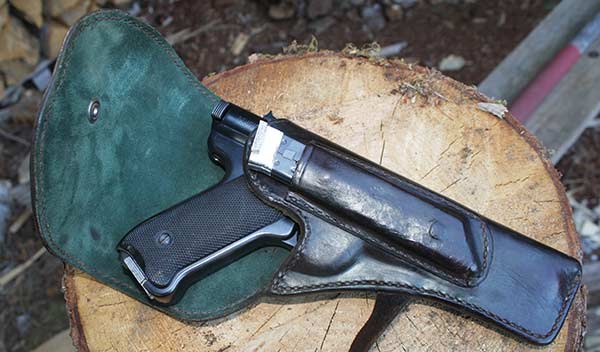
Dave will pack his small game gat in this holster with
a spare magazine starting next month
Low and Left
This time, well, I evidently need more range work. My first two attempts to fire were scary, because both cartridges misfired. They simply didn’t go “BANG!” It was unnerving because it’s never happened before like that, and I started worrying that I had broken something. The third, and every subsequent round, did go off, so contentment was partly restored as everything worked.
However, the pistol was now shooting slightly low and to the left as shown in the accompanying image. Lucky for me I’ve got a healthy stockpile of .22 LR ammunition, so as you read this, I’m probably down at the range. Or having my eyes checked.
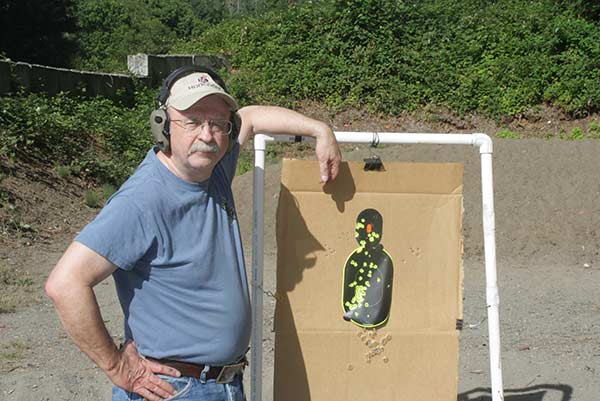
Dave’s initial trek to the range to check the pistol’s accuracy
after the teardown was a little disappointing. He knows the Ruger
can shoot to point of aim at 25 yards because he’s done it before
on live game. Well, back to the range!
My pistol has fixed sights, though the rear is drift-adjustable, being dovetailed into the top rear of the receiver. Past experience told me the pistol is capable of point-of-aim accuracy, so I’m convinced the problem is me, not my classic Ruger.
There are a couple of takeaways in this tale. First, be prepared to spend some time at the range if you get inspired to hunt small game with a rimfire pistol. Second, give serious consideration to not stripping down your semi-auto. Third, just because I’m planning to do it doesn’t mean you need to follow my example. You’ve been warned!
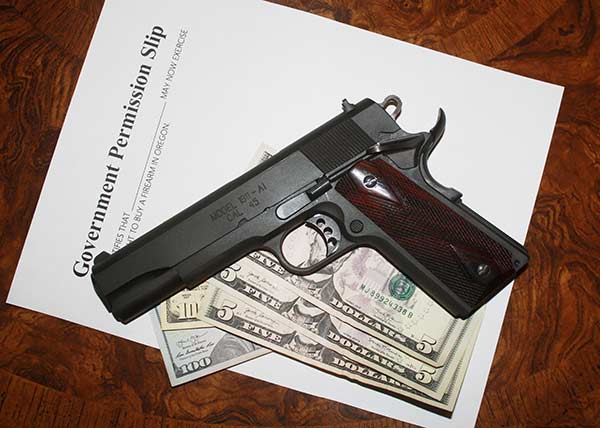
A federal judge in Oregon last month upheld Measure 114, which
requires a permit to purchase a firearm. The ruling is being appealed
by the Second Amendment Foundation, National Shooting Sports
Foundation and others.
Oregon Battleground
Last month, anti-gunners were chortling in Oregon when U.S. District Judge Karin Immergut handed down a 122-page decision in a federal challenge of Oregon’s hotly contested gun control Measure 114, which makes the Beaver State a rotten place for gun owners.
Immergut consolidated four federal lawsuits, and her ruling displayed some strained logic. At one point, the judge observed, “The Supreme Court has held that Second Amendment protects an individual right to self-defense inside and outside of the home. LCMs are not commonly used for self-defense and are therefore not protected by the Second Amendment.”
Better consult millions of law-abiding armed citizens, especially those who have defended themselves with handguns fitted with LCMs (large capacity magazines), and a million street cops now armed with GLOCK, SIG Sauer, Smith & Wesson and other duty sidearms, also equipped with magazines holding more than ten cartridges.
Judge Immergut — a Donald Trump appointee — also declared, “Plaintiffs have not shown that the Second Amendment protects large-capacity magazines, defined as magazines capable of firing eleven or more rounds without reloading. And even if the Second Amendment were to protect large-capacity magazines, this Court finds that Defendants and Intervenor-Defendant have established that Oregon’s restrictions on the use and possession of large-capacity magazines are consistent with the Nation’s history and tradition of firearm regulation.”
The measure also requires proof of safety training in order to obtain a permit-to-purchase from law enforcement and undergo a background check including a mental health check. Together, this sounds like Oregon considers the right to keep and bear arms as a government-regulated privilege.
Appeals from the Second Amendment Foundation, National Shooting Sports Foundation and other participants in the four federal lawsuits are in the works.
Meanwhile, a trial is scheduled next month in the state level challenge which has continued to block implementation of Measure 114. The trial will be held in Harney County Circuit Court in eastern Oregon.
Oh, the Irony
A report on Fox News last month got my attention for reasons that will become obvious momentarily.
After the Supreme Court handed down its Bruen ruling last year, lawmakers in New York scrambled to make their concealed carry law worse than the one which was nullified, allowing certain places to be designated “sensitive areas.” These zones were deemed “gun free” and firearms, even licensed ones previously allowed, are now prohibited. One of these places is Times Square in New York City.
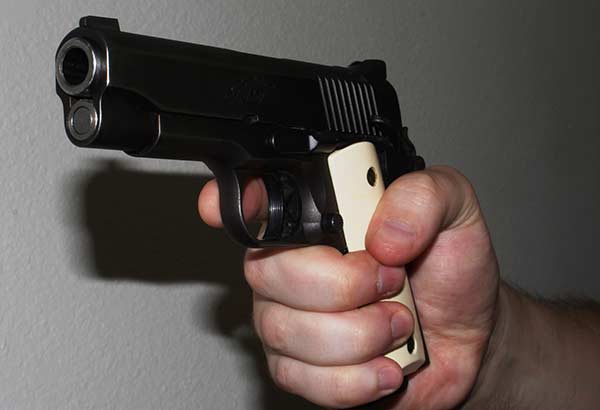
This is a pistol. They’re not allowed in New York’s Times Square.
Evidently, bad guys missed the memo.
Evidently, criminals didn’t get the memo because on July 17, three teens were shot by a fourth guy outside of a restaurant in the Square, apparently following some sort of dispute. Two of the wounded youths, ages 15 and 18, were taken to Bellevue Hospital, the report noted. The third victim, age 17, ended up at a Harlem hospital.
B-b-b-b-but wait! That wasn’t supposed to happen in a “gun-free zone.”
According to the New York Daily News, two of the three victims were hit in the leg and the third was “grazed” in the armpit. The newspaper said something else which made my eyes roll: “Images of guns blazing and tourists scampering at the Crossroads of the World do nothing to improve the city’s image, law enforcement officials said.” Oh, ya think?
In fairness, the NYPD reported a 16.8% decrease in Big Apple shooting incidents in June, compared to June 2022. Over the first six months of this year, shootings city wide were down 24.7%, Fox News said.
This probably is significant, except to people who get shot in a gun-free zone.

.gif)
.gif)
.jpg)
.gif)
.jpeg)
.jpg)
.gif)
Categories
The whole nine yards
Somebody really wanted that Zero ass! Grumpy
PS P-51 Mustangs carried 9 yards of 50 cal. ammo on board. Hence the saying giving them the whole nine yards!