Categories
One way to REALLY end the party

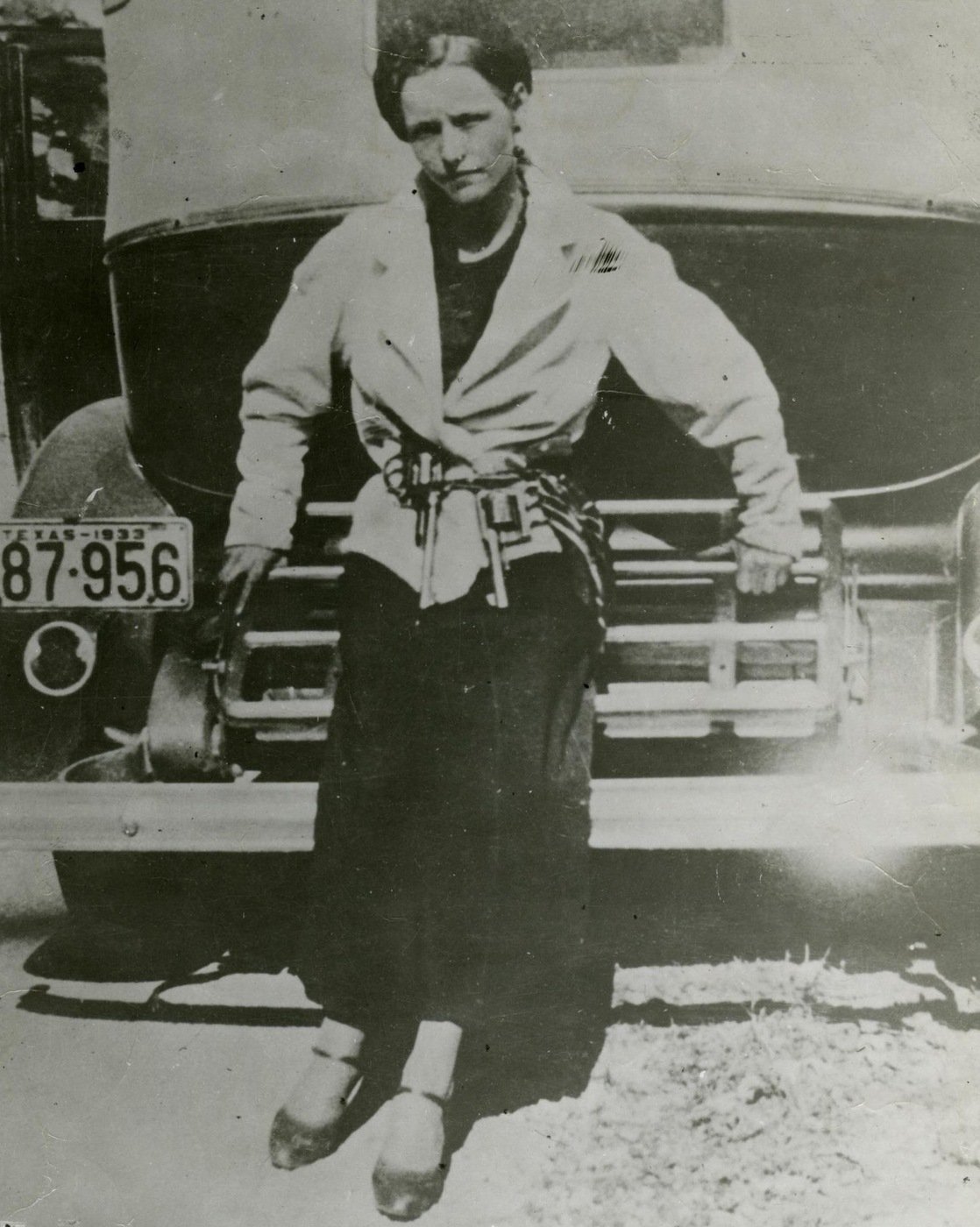 Bonnie packing both a Smith&Wesson and a ColtPistol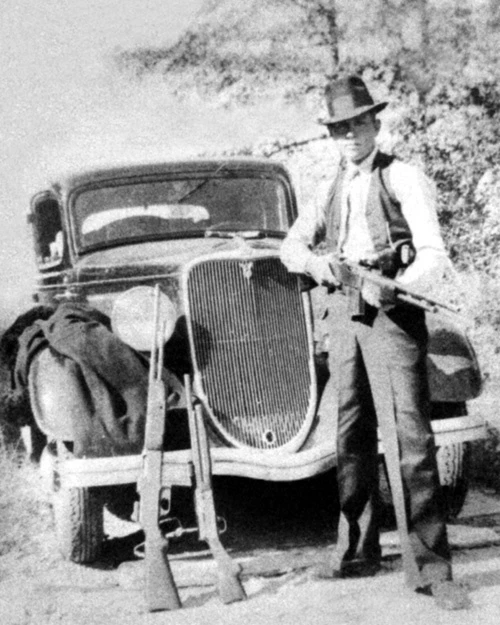
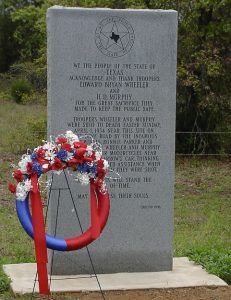
The Easter Sunday Murders
April 1, 1934, was idyllic Easter weather in Dallas. 26 year-old Edward Wheeler, a Texas highway patrol officer, and his young wife, Doris, shared a biscuit-and-gravy breakfast and made plans to celebrate after Edward, whom most called E.B., completed his shift on motorcycle patrol that day. Just across town, 22 year-old Holloway Murphy was also up early,excited to begin his first day on the job as a THP motorcycle cop.
This would be, he thought,his next to last Sunday living at the local YMCA, before moving into an apartment with his fiancé, 20 year-old Marie Tullis. Marie might or might not have noticed that Holloway placed a handful of 12 gauge shells in his pocket rather than in the chamber of his shotgun; he wanted to be careful about riding his motorcycle with a loaded gun, in case he took a spill and the gun went off, hurting a civilian. H.D. and Marie were to be married 12 days later on April 13.
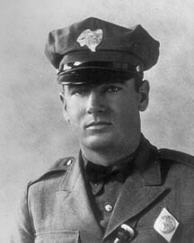
Both Wheeler and Murphy set about that Easter day thinking that their lives were yet in front of them, not knowing that the plans they were making would soon be waylaid. By mid-afternoon, the two young motorcycle patrolmen, following senior patrolman Polk Ivy, were casually cruising along state highway 114 just north of Grapevine, northwest of Dallas. About 3:30pm, they noticed a lone vehicle, black with yellow wire wheels, parked 100 yards up a dirt road.
The patrolmen U-turned their bikes, rolled up toward the vehicle; it appeared that the occupants were stranded and in need of assistance. Polk Ivy continued down Hwy 114 for some distance, until he realized his two junior officers were no longer behind him.

Farmer William Schieffer heard the motor bikes coming from a distance. He had been doing Sunday chores on his hardscrabble lot that bordered the dirt road, and around 10:30am he observed a young couple “necking” in the roadside grass. He was only 30 feet away at that point, hauling rocks from his orchard.
The girl was “petite with bushy hair,” and holding a white rabbit in her lap. Easter picnic, he figured. As he pushed his wheelbarrow across his orchard that morning, he watched the couple stroll down to the highway — and back — as if looking for someone.
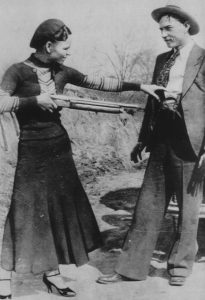
Now, the day was getting on and Farmer Schieffer’s two daughters came out of the house to call their dad in for Easter dinner. That’s when they spotted the two motorcycle patrolmen stopping their bikes just a few paces from the mystery car. From approximately 100 yards away,
the farmer and his daughters—Miss Isabella Scheiffer and Mrs. Elaine Adams—saw the officers dismount and stroll towards the parked Ford. Before the officers could even reach the vehicle, they were abruptly felled by shotgun blasts. E.B. was killed instantly, but Murphy survived the initial volley, falling on his side. Stunned, Schieffer and his daughters watched
both shooters — including the young woman wearing brown riding pants and boots — walk up to the dying man and fire upon him again, at point-blank range.
In seconds, two families were destroyed so that Clyde Barrow and Bonnie Parker, two of the most notorious criminals in US history, could evade justice a little longer.
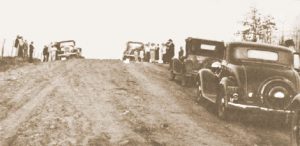
Investigators and others look at the scene of the ambush along Hwy. 114 in what is now Southlake.
Schieffer and his daughters were not the only witnesses that Easter day. Jack Cook, a lifelong resident of Dove Road (who died in October of 2013) saw a young couple, male and female,
at the site just prior to the shootings. Shortly after, a Mr. and Mrs. Fred Giggals had been on a Sunday drive along Hwy 114, some distance behind Ivy, Wheeler, and Murphy. Speaking on behalf of his wife and himself, Mr. Giggals reported that they heard the initial shots
after they drove past Dove Road and turned around to see what had happened. According to Giggals, he and his wife exited their car briefly and saw what they thought were two men, with the taller
shooting into one of the prostrate bodies.
The Giggals were only within sight of the shooters for a matter of seconds, approximately 100 yards away and with their view obscured by grove of trees. Mr. Giggals said the shooters looked over and saw them, at which point the couple beat a hasty retreat to their car and sped away.
*****
The Texas Highway Patrol (THP) was a nascent organization in 1934. After the brutal
execution of Wheeler and Murphy, chief Louis G. Phares took quick and decisive action, issuing a $1000.00 reward for the killers and assigning his entire force of more than 120 officers to search for them.
Phares also sought out the services of legendary former Texas Ranger captain Frank Hamer—who, unbeknownst to Phares, was already on the killers’ trail and assigned another former Texas Ranger, THP trooper B.M. “Maney” Gault, to work with him, at Hamer’s request.
By the time Murphy’s young fiancée wore her wedding dress to his funeral, efforts to deflect responsibility away from the killers were already underway.
Clyde Barrow himself wrote a letter to the prosecutor in which he placed the blame for the Grapevine murders on his former partner-turned-nemesis, Raymond Hamilton.
This ruse was briefly successful, likely because Hamilton was traveling in an identical Ford V8 with Bonnie’s younger sister and doppelganger, Billie Mace. However, they were soon exonerated due to validation of their whereabouts at the time, physical evidence at the scene, and forensic evidence directly linking the true killers to the crime.
The Barrow and Parker families also attempted later to recast the blame for the Grapevine murders, albeit in a manner that, ironically, contradicted Clyde’s own story.
Clyde’s family claimed that he told them his associate Henry Methvin was the lone shooter in Grapevine and killed both officers with a Browning Automatic Rifle (BAR). Bonnie’s mother also claimed that Methvin had “confessed” to her.
But these claims, which are unsubstantiated hearsay at best, are contradicted by the available evidence. First, Methvin reported to the FBI that he had been asleep in the car all day while Clyde and Bonnie played with the pet rabbit in the grass and
that he was awakened by gunfire. Methvin’s statement jibes exactly with the sworn witness accounts of Schieffer and his two daughters, all of whom consistently stated that there were two shooters and that one of them was female and matched Bonnie’s general description. Second,
the theory that there was a lone shooter using a BAR cannot be reconciled with the ballistics evidence from the scene (six large buckshot shotgun shells, five .45 auto pistol cartridges, and only one 30.06 shell casing).
Still, there are those today — a good many — who passionately defend Bonnie Parker and claim that she never fired a gun at any point during the Barrow Gang crime spree.
Yet, even a year before Grapevine, a police raid on an apartment in Joplin, Missouri led to another account of Bonnie Parker firing a weapon. This time, as Clyde, his brother Buck, and W.D. Jones, fired on and killed a detective and a constable, Bonnie laid down cover with a Browning Automatic Rifle (BAR).
The fusilade forced Highway Patrol Sergeant G. B. Kahler to seek cover behind an oak tree while the .30 caliber bullets shredded the other side.
Patrolman Kahler would later report, “That little red-headed woman filled my face with splinters on the other side of that tree with one of those damned guns”.
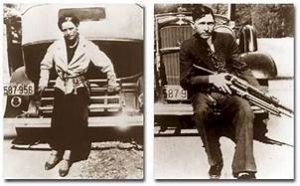
Protestations of Bonnie’s alleged innocence are, for the most part, strictly teleological in nature, rather than accurate assessments of contemporary perspectives and evidence.
They are also, more often than not, heavily influenced by romanticized popular culture and media depictions of the pair. It is true that Clyde Barrow introduced Bonnie to robbery and murder, activities which she took to with enthusiasm
according to numerous eyewitnesses from across the country. In fact, on two occasions Clyde was known to have chastised her for shooting too
quickly, thereby placing them in greater danger of getting caught.
Bonnie had long been attracted to and reveled in the criminal lifestyle, and she showed no regard for the gang’s many victims. She wrote numerous letters and poems demonstrating as much, repeatedly asserting her intention to continue their crime spree until death and insisting that she and Clyde would “go down together.”
The truth is that Parker and Barrow were not anti-establishment social anti-heroes standing up against banks and oppressive authorities and sharing their booty with the poor and oppressed like some sort of 20th century Robin Hoods.
Their criminal careers predated the Great Depression by almost half a decade, and Clyde only robbed three banks during his eight-year criminal career. Under Clyde’s hair-trigger leadership, the gang scraped by primarily by stealing cars and robbing individuals, families, and small independent businesses struggling to stay afloat, often murdering their prey or officers to avoid arrest. The simple
fact was that they preferred to steal rather than work and to kill rather than risk being caught, as even Clyde’s own sister and mother attested to after his death.
At Eastham Prison Farm, Clyde once had a fellow inmate chop off his toe with an ax so he could get transferred out of work detail. Bonnie had dreamed of being a Broadway or movie star (she adored Myrna Loy); front page photos, stories, and her own published poetry provided her the fan base she had dreamed of as an impoverished West Dallas girl. She called the American people “her public.”
But did Bonnie Parker actually pull the trigger at Grapevine? The physical, forensic, and eyewitness evidence from the time indicates that she did. The only sources for claims to the contrary were Barrow and Parker’s families who were obviously not present at the scene and obviously not unbiased; a number of their family members—including both their mothers were soonafter convicted and sentenced to federal prison for aiding and abetting their fugitive relatives.
******
The contemporary evidence of Bonnie’s culpability includes the clear and consistent
testimony of eyewitnesses to those murders and the ballistics analysis that matched Bonnie’s custom altered shotgun— a weapon she was frequently photographed with that was found in the death car after the ambush.
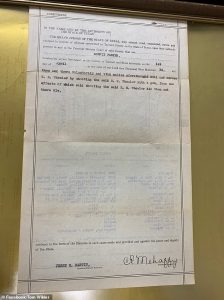
Various published claims that William Schieffer’s testimony was later “refuted” or “recanted” have failed to produce any contemporary evidence to support such contentions. Furthermore, Bonnie Parker was, in fact—and again, contrary to published claims—under indictment for the Grapevine murders before she died; original documentation of this fact recently resurfaced as part of an archival digitization project.
https://www.dailymail.co.uk/news/article-6684095/Texas-court-clerks-indictments-Bonnie-Clyde-old-records.ht
Flawed analysis and facts regarding the Grapevine murders also undermine the claims of Bonnie-apologists, such as assertions that the key eyewitness was “several hundred yards away” from the scene, leading them to erroneously conclude that he could not possibly have made a reliable identification.
In fact, he had been as close as 10 yards to the killers at least at one point earlier in the day, and was—along with his two daughters—only 100 yards distant at the time of the murders. The three Schieffers provided investigating officers, the press, and later in court, consistent and detailed descriptions of the shooters and their activities leading up to and during the crime.
As the people who were present the longest, closest to, and had the clearest view of the scene, their key eye-witness accounts should not be discarded in favor of claims by those with dubious objectives who were not present.
Finally, the focus on disputing Bonnie’s role in Grapevine ignores her lengthy and violent criminal career: at least ten other shootings, two jail/prison breaks, eight to ten kidnappings, and more than a dozen armed robberies. Her crimes left six more men dead and eight wounded, and left widows and children to survive without their husbands and fathers in the midst of the Great Depression.
Arthur Penn’s celebrated 1967 film, a well-deserved cinema landmark, used some real-life names but was never intended to document the real-life crimes and the very real human costs of the choices made by members of the Barrow Gang. Nevertheless, most modern Americans have received what little they think they know about the homicidal duo—on which the film was very loosely based—from that work of fiction. Still others have been misled by those seeking to exonerate Bonnie out of some misplaced sympathy, often influenced by an antiestablishment narrative.
Whatever the motivation, the effect is to erase the experiences, perspectives, and memory of the many victims and their families, thereby compounding the injustice inflicted upon them. Friends and family of Marie Tullis report that “she was never the same” and never married. In the words of E.B. Wheeler’s widow, Doris, “[P]opular culture…made heroes of the gang who killed my husband . . . . nobody ever thinks about those of us who were left behind.” Doris
lived on, to the age of 96, but “the anguish never ended.”
OLYMPUS DIGITAL CAMERA
Dr. Jody Edward Ginn is a former law enforcement investigator and U.S. Army
veteran who works as a historical consultant to museums and educational
institutions, and is an adjunct professor of history at Austin Community
College. Ginn has authored numerous publications on Texas history topics,
including “Texas Rangers in Myth and Memory,” in Texan Identities…(UNT
Press, 2016). Ginn’s latest book, East Texas Troubles: The Allred Rangers’
Cleanup of San Augustine (O
Eyal Ben-Ari tugged at the heavy assault rifle hanging over his shoulder as he tiptoed out of his pink house at sunrise, hoping not to wake his wife or six children.
Walking to synagogue in Safed, a hill town above the Sea of Galilee known for centuries as a center of kabbalah, or ancient Jewish mysticism, he said he still didn’t feel great about the gun.
Sleeping with the rifle under his pillow, he worried about it being stolen. After his 13-year-old son came home with a toy replica, Mr. Ben-Ari considered returning the real thing, doubting his decision to join the newly formed civilian militia that had given him the weapon.
“I feel like it’s very — artificial,” he said, struggling to find the right word in English, looking down at the gun. “It’s not human. It’s not life.”
At the synagogue, men with graying beards and black suits — all fellow members of the Chabad movement, an ultra-Orthodox sect of Judaism — slapped Mr. Ben-Ari on the back. They were happy to see him. Happy to see his gun. It was the only one there, but far from unique. In this small city near the Lebanon border, where Hezbollah’s rockets have often rained down in recent months, Israel’s deep sense of vulnerability has led to a surge of citizens arming themselves.
In Safed, as in the rest of Israel, people fear a repeat of Oct. 7, when gunmen with Hamas crossed from Gaza into Israel and killed 1,200 people in rural villages, army bases and cities, according to Israeli authorities. The police and the military were slow to respond that day. In many communities, the only ones fighting back were volunteers with rapid response teams that are known in Israel as Kitat Konenut.
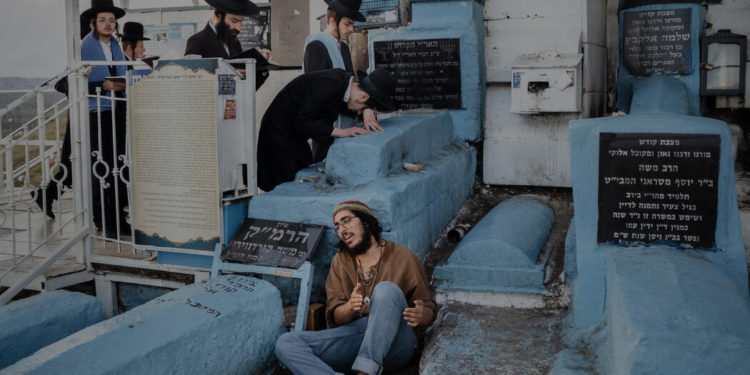
Before the attack, much of Safed didn’t think it needed such a group. For decades, this city of 40,000 has drawn the very religious and very creative, those seeking to commune with nature, art and wine, or pray at Safed’s main landmark — a hillside cemetery where 16th-century rabbis lie in graves painted baby blue to signify bringing the sky and heaven down to earth. Madonna, a kabbalah convert, visited in 2009.
These days, tourists are too afraid to come. Safed, called Tzfat in Hebrew, now sees itself a city under siege, Israel in miniature, struggling to reconcile God, love, and light with grief, rage, fear and a craving for protection.
“People are concerned,” said Yossi Kakon, Safed’s mayor, in an interview at his office overlooking the city. “They want guns.”
He stood up. On his hip sat a black pistol, newly acquired.
100,000 New Guns
Guns, of course, have long been like stars of David in Israel: too common to discuss.
Military service is compulsory, and full-time soldiers and reservists are required to carry their weapons at all times, which means they show up in unexpected places: with backpack-laden students on public buses; bumping into the legs of fathers pushing strollers in Jerusalem; on the shoulders of young women by the beach in Tel Aviv.
The Kitat Konenut have also been woven into the country’s security fabric for decades. Many of the groups formed around kibbutzim and villages near Israel’s borders after the Arab-Israel war of 1967.
The earliest volunteers for the Kitat Konenut were often sharpshooters or veterans with elite military training. Over time, the groups seemed less necessary and as some of their old guns started to disappear to theft or loss, the Israel Defense Forces or IDF imposed tighter restrictions: guns had to be kept at an armory, with keys held by a trusted local leader.
On Oct. 7, some of those leaders were the first ones killed. Those who had guns saved lives. In the village of Pri Gan, Azri Natan, one Kitat Konenut fighter in his 70s told me he held off gunmen for hours, alone, firing from behind a palm tree in his yard.
Stories like his led Israeli politicians to champion more arms for civilians. Itamar Ben-Gvir, Israel’s right-wing National Security Minister, has made it a personal priority.
In March, after making the process for getting a gun easier and faster, he announced that 100,000 licenses had been approved since October. Another 200,000 were in the pipeline.
“Weapons save lives,” he said.
Critics, however, worry that even with Israel’s background checks and training requirements, too many guns are being given out with too little concern for how they might fuel internal tensions.
Israeli settlers in the occupied West Bank are among those arming most rapidly, at a time when settler violence is at its highest level since the U.N. began recording attacks in 2006. And while hundreds of new rapid response teams have formed in municipalities that are majority Jewish, Arab communities — including those close to Israel’s borders — have not been granted the same leeway to form armed volunteer groups.
To many Arab Israelis, who make up about 20 percent of the country’s population, Mr. Ben-Gvir’s gun campaign looks like a threat — a politically motivated tool for intimidation or state-sanctioned violence, engineered by a government minister from a settlement, who has brandished a weapon in public and has several convictions for incitement to racism.
“Just thinking that Minister Ben-Gvir is behind this means that his motives are racist and anti-Arab,” said Asad Ghanem, a political science professor at the University of Haifa. Mr. Ben-Gvir’s spokesman did not respond to requests for comment.
Habib Daoud, the owner of a restaurant in Rameh, an Arab town near Safed, said, “People are afraid, yes, but we’re more afraid because the guns aren’t in our hands.”
Safed’s volunteer fighters insist their mission is purely defensive. With the exception of local colleges that draw students from across the area, the city’s Arab population — a prewar majority — has mostly fled, or been expelled since 1948, never to return, as part of what Palestinians call the Nakba. The old Arab Quarter is now the Artists’ Quarter. The main mosque is a gallery with white walls and chic lighting.
The threat, for Safed’s Jewish community, feels just over the horizon. It’s a community that has voted more strongly for right-wing parties like Mr. Ben-Gvir’s in recent years, and so for many now — especially without tourists around — time is spent preparing for the worst. Rabbis and civilian officials now carry pistols. Instead of praying or glassblowing with tour groups, residents are adding bomb shelters to schools. At a city government warehouse, shelves are packed with black flak jackets in shiny plastic.
In Safed, the responses to the war fall on an especially wide spectrum. At one end, there is unconditional love and Kabbalah’s emphasis on bringing light to the world, with expressions of sadness for the suffering in Gaza wrought by war sitting alongside a hunger for safety; at the other are dark visions — an apocalyptic belief that the Jews of Israel are at the start of a holy war, a bloody battle to end all wars and produce a Messiah.
‘We Can’t Rely on Anyone’
Mr. Ben-Ari falls somewhere in the hazy middle. At home one evening, his nurturing instincts were on display when one of his daughters accidentally tipped over a giant jar of instant coffee in the kitchen and he simply smiled at the powdery mess.
He grew up on a kibbutz. He said he became religious only after serving in the military and going to India with plans to become a yoga teacher. Now he laughs at the memory — “that was a long time ago,” he says — but with his faith and his job as a social worker, he still seems eager to make people feel better. The gun doesn’t exactly help.
“My clients, many of them, are afraid of it,” he said.
His wife, Lihi Ben-Ari, is too.
“I don’t like it,” she said, sitting at the kitchen table with two daughters sculpting clay.
“At first, it was fine — we were scared,” she said. “Now?”
She walked to a bedroom and pulled out the toy assault rifle belonging to their son, delivering a scolding glare that softened into a shrug of what-do–you-expect.
“The soldiers have become the superheroes,” she said. “Everyone wants to be like one.”
Mr. Ben-Ari, 44, said he was constantly telling his son that his military-grade weapon was just for defense, “that it’s not something we like.”
“It’s a duty,” he said.
That is also the argument made by Safed’s Kitat Konenut leaders. One night, Netanel Belams and Shmuel Tilles, described by city officials as the commander and deputy commander of the group, agreed to meet at a wine shop at the base of the Artist’s Quarter.
Mr. Tilles, the shop’s owner, greeted customers seeking craft beer or a nice Cabernet with “Shalom,” meaning peace, while holding a high-powered rifle with red-dot sight for quick target acquisition at close range.
He and Mr. Belams hesitated to describe their previous military service but confirmed they had both worked with the special forces. Over craft beer in plastic cups, they explained that their mission now was simple.
As Mr. Tilles put it, speaking in English with the hint of a Bronx accent brought to Israel by his parents decades ago: “Our job is to bring security to our people.”
He said they effectively formed the Kitat Konenut on Oct. 7 when around 15 seasoned combat veterans in Safed, in close contact with the Israeli military, got ready in case Hezbollah decided to bring their own forces into Israel. When that didn’t happen, they made plans to officially form a rapid response team that would coordinate with the authorities in an attack.
More than 100 men volunteered. The commanders selected 60 to 70, favoring those with combat experience. The government provided weapons and paid for training, which they’ve done around once a week.
In photos of their sessions, most of the men — including Mr. Tilles and Mr. Belams — have the long beards associated with the Orthodox community, known as Haredi in Israel. They are a small minority in the Israeli military because of a longstanding exemption from conscription for those studying in seminaries, but their presence in Safed has been expanding for a while and the war has made them more unified and organized.
Politically, they mobilized a few months ago to elect Mr. Kakon — Safed’s first Haredi mayor. And with the Kitat Konenut, they have found a new community role. Terms like “religious Rambo” are now thrown around by secular officials in Safed with a degree of admiration.
And yet, in a crisis, it’s hard to tell how obedient they would be to the traditional chain of command. Mr. Belams in particular did not hide that he sees his role as ordained by God.
“After Oct. 7, we saw that we can’t rely on anyone — not the IDF, the police or the state,” he said. He added that he believed he was on the front line of a holy war that would bring about the end of times and the messiah’s coming to Earth.
“This is the start of Gog and Magog,” Mr. Belams said, referring to a battle prophesied in the Bible that some Jews believe will lead to Messianic redemption.
Mr. Tilles tried to make clear that fighting was not their first choice. “I’m into wine. I don’t even want to do this,” he said. “It’s only because of the threat.”
He added, however, that the same kabbalah tenets that tell him to “make this a place that God could dwell in with peace and love” also say that “when somebody comes to kill you, you’ve got to protect yourself first.”
Asked about the war in Gaza, he argued that because Hamas, in his view, teaches children to hate and murder Jews, Israel has to fight with an expansive definition of national defense.
“It’s a war over here. There’s no such thing as innocent,” he said. “You can’t say we have to give our enemies food in order for them to one day come back and kill us.”
For many of his neighbors, it is a question of priorities. Is Safed (or Israel) more likely to thrive by focusing on war and weapons, or through introspection and deeper change?
At a small gallery near the wine shop, Avraham Loewenthal, an artist and kabbalah devotee originally from Michigan, tried to elevate the conversation.
“The war is really between love and hatred — between focusing on the bad in others or trying to understand them and find the good,” he said. “Are we blaming others for all the bad in the world or striving to see how together we can make it better for everyone?”
He said he felt deep pain from the suffering of the people in Gaza and also that Israel has no choice but to keep fighting to disable Hamas and other terror groups. Asked if he was able to extend his unconditional love to those shooting rockets at Israel — in February an attack killed one soldier in Safed, and wounded eight more — he initially gave a roundabout answer. A few days later, he emailed a clarification.
“It is hard to believe there is goodness in people who are doing horrible things,” he wrote. “We need to do everything we can to stop them, but trying to see God in everyone is what we are here to do.”
Seeing Threats Among the Neighbors
At Mr. Ben-Ari’s home, the journey also continues. His wife is still struggling with how to reconcile her faith with his weapon.
“It’s not our way,” she said at one point.
Mr. Ben-Ari said he felt a little better knowing that his rabbi approved — he asked before joining the Kitat Konenut. But he still can’t shake the sadness of seeing divisions being sharpened. After the Hamas attack, one of his daughters started saying “I’m afraid the Arabs are going to take me.”
“She’s 4,” he said.
He admitted that after Oct. 7 he also lost “that safety feeling” around Arabs in Israel and elsewhere. Safed’s right-wing chief rabbi, Shmuel Eliyahu, has a long history of pushing for Jews to expel Arabs outright (his office declined interview requests), but Mr. Ben-Ari seemed heartbroken by his own personal shift. Fear, sadness, responsibility, he made clear, they were hardening hearts and daily life in Safed.
Did that mean he would keep the gun if or when the war ended?
The weapon sat in his lap, marked by two colorful stickers: one identifying the weapon and its owner as part of the Kitat Konenut; the other a symbol for the Chabad movement.
Mr. Ben-Ari paused and thought for a minute about the question. Then he said yes.
“The situation needs this,” he said, as his children played all around him. “It needs me.”
The post In a City of Ancient Jewish Mysticism, Israelis Arm for a Fight appeared first on New York Times.
Categories
Product Spotlight: The Glock™ 47
Categories