During the folk music revival of the 1960s, the American singer-songwriter Tom Paxton penned the line, “It’s a lesson too late for the learning,” in one of his greatest hit songs, The Last Thing On My Mind. Hopefully, the following saga will be a lesson that is, indeed, not too late to learn by collectors of antique and vintage arms, and may help them “not to do as I have done” (another bow to the 1960s music scene) when working on old guns.
In the summer of 2017, Ross Jones, my newly found friend in Quebec, and fellow co-author on an article about Fenian guns in the Journal of the Company of Military Historians, alerted me to a .56-cal. M1865 Spencer Rifle in that was being advertised for sale on an internet site by an antique arms dealer in California. While it wasn’t what I would call cheap, it was still far below the asking price for a Civil War-era .56-52 M1860 Spencer rifle. I bought the rifle, and after it arrived on my doorstep, I spent quite a few evenings cleaning out its badly rusted bore. While the rifle was disassembled on my workbench for weeks on end, I examined the interior parts and took photographs of them.
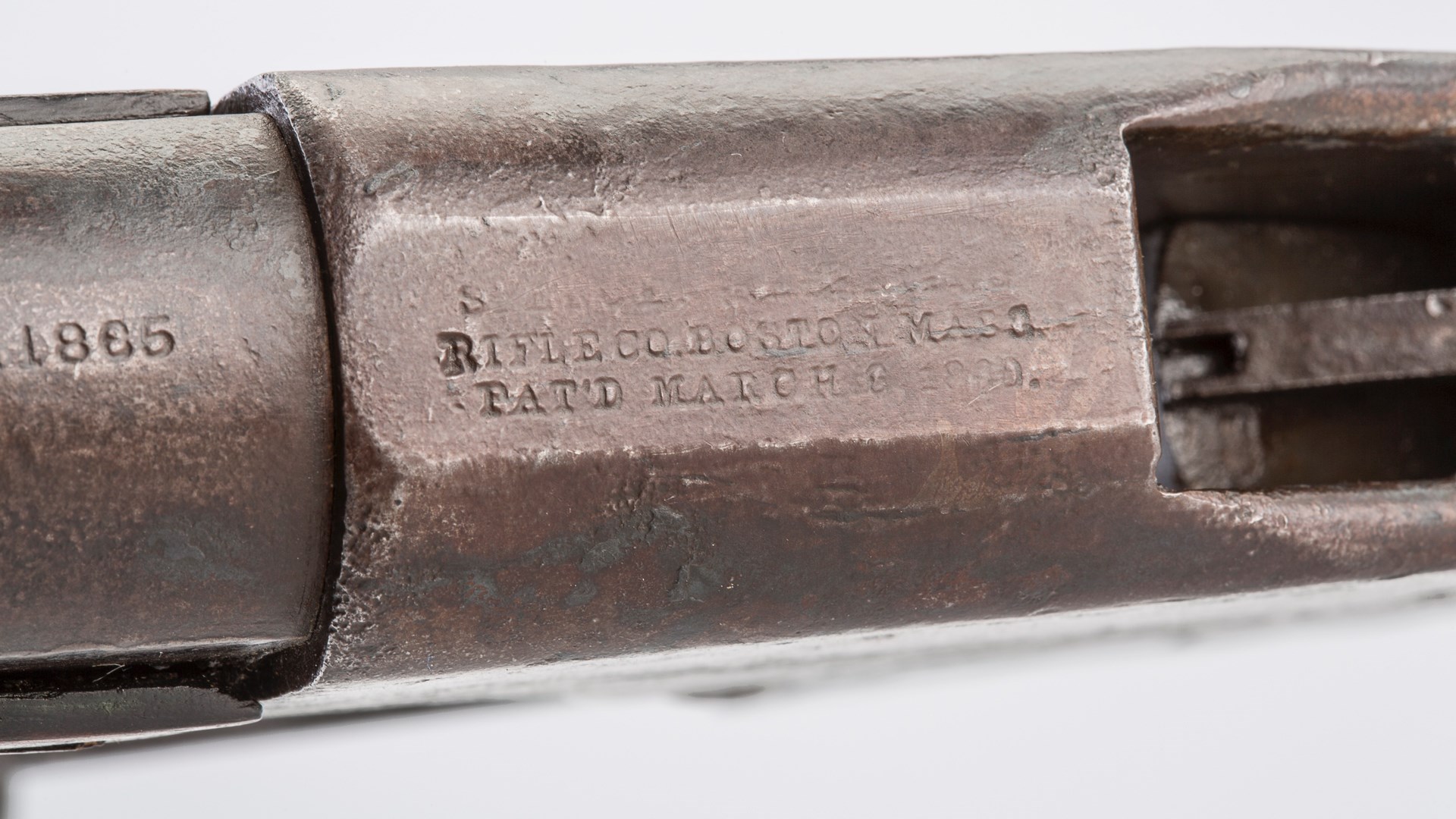 The Canadian government acquired more than 2,000 M1865 Spencer rifles in 1866, and 2425 fits in the range of the serial numbers on those guns. Courtesy of American Rifleman magazine, photographed by Forrest MacCormack.
I was delighted to have this rifle, as its serial number, 2425, was within the range of the known 2,000-some M1865 Spencer rifles that the Canadians had purchased in 1866 to confront the Fenian threat from the United States. Moreover, according to the Roy Marcot’s comprehensive book on Spencer arms, the company only made about 2,500 of these rifles, so my chances of ever finding another one were fairly slim. I needed the rifle for two reasons: First, to illustrate an article that I was writing on the guns of the 1866 Fenian Raid for AmericanRifleman.org (published in September 2020); and, secondly, to display in an exhibit of Fenian arms that a group of friends and I used to set up each year at the annual Maryland Irish Festival near Baltimore, Md. According to what I had learned from Dr. Peter Vronsky’s book on the 1866 Battle of Ridgeway, Number 5 Company (No 5 Coy) of Toronto’s “Queen’s Own Rifles” (QOR), 2nd Battalion, Canadian Militia, had exchanged their muzzle-loading Enfield rifles for 49 M1865 Spencer breechloading repeaters (nine carbines and 40 rifles) the day before the battle.
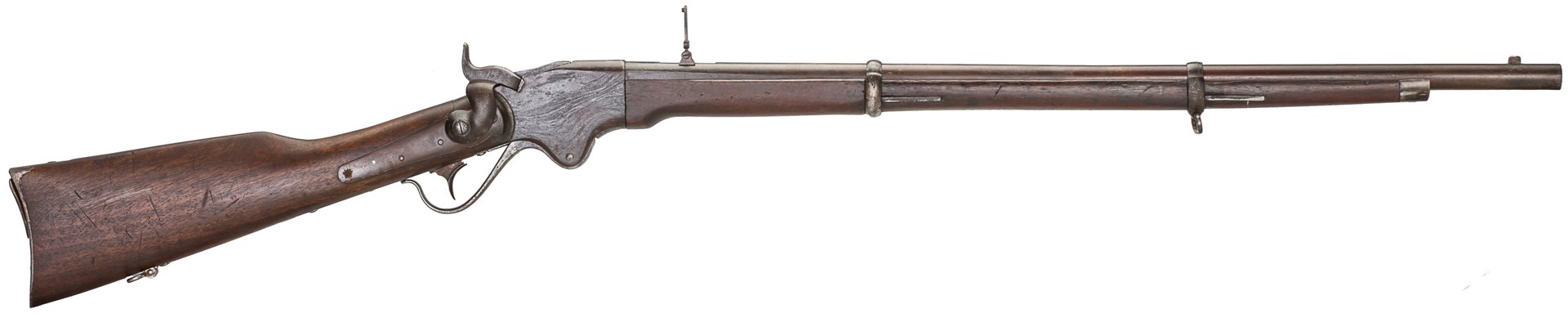 The ‘Frankenspencer’ rifle from Ridgeway, with its two barrel bands— and they are spaced oddly apart. Courtesy of American Rifleman magazine, photographed by Forrest MacCormack.
However, while cleaning the rifle, I was concerned about the odd-looking barrel bands on it and the seemingly well-worn wooden fore stock. I was beginning to get worried, as my new gun only had two barrel bands on it, and I had not yet been able to find enough information about M1865 Spencer rifles to confirm whether they were supposed to have two bands, or three, like the M1860 Spencer rifle. I must admit that, at the time, I really didn’t know any more about Spencer rifles than could be expected of a retired military museum curator who had never before personally owned one. The only Spencer arms I had ever handled in detail was a tin-plated M1860 Navy rifle on display in the Marine Corps’ museum and two others (a carbine and an Army rifle) that had been donated to the museum in the 1970s. Still, I reassembled the rifle and hung it in my collection room.
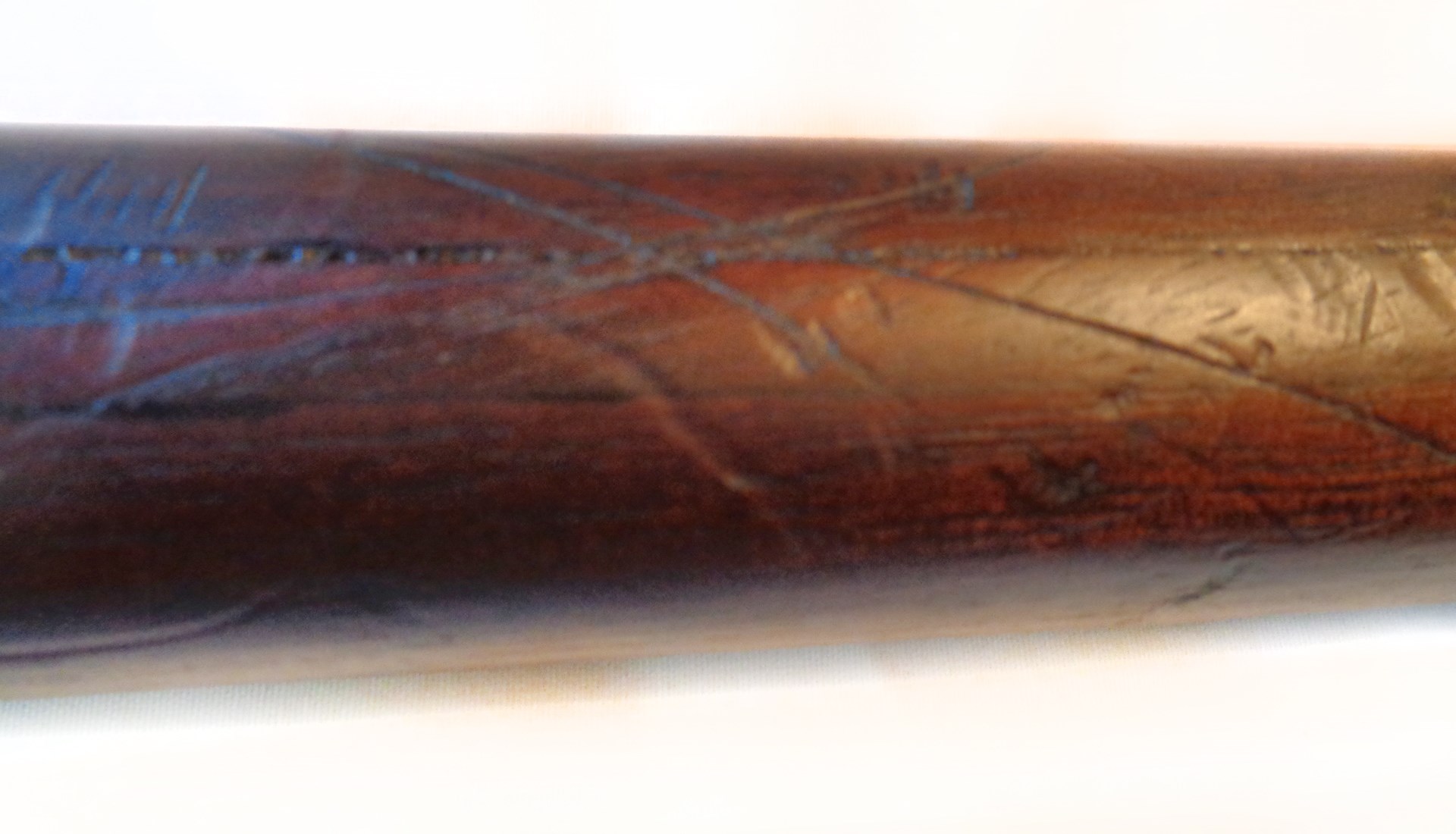 Since the lines between the forestock and the walnut dowel glued into the cleaning rod channel are barely discernible, it is obvious that a skilled woodcrafter did this work. There are deep scratches and gouges across this part of the fore stock, indicating the repair was made many years ago. Image courtesy of author.
While I was being filmed for the National Rifle Association’s weekly American Rifleman television show in October 2017, the staff photographers at NRA headquarters took a series of images of my new gun for my forthcoming article. While my fellow commentators were in front of the camera, I took the opportunity to slip away and conduct some research in the NRA’s staff library. With a sinking heart, I confirmed that my rifle was NOT what I had thought it was! Not only were there only two bands on the fore stock of my new rifle, instead of three, the band springs were on the side, and not on the bottom, of the fore stock.
The only other two-banded Spencer rifle that I could find described in the library was a variant that had been produced in small numbers at the Springfield Arsenal in 1871, but my rifle clearly was not one of these. While re-examining the rifle in detail with one of the editors of the American Rifleman, we found that a cleaning rod, or ramrod, channel in the stock had been very expertly filled in with a matching walnut dowel, and it was obvious that the work was done by a real craftsman many, many years ago. There were old, deep scratches and gouges across the fore stock, and the replaced piece of wood in the channel (appearing to be ‘pommel marks’ from constant rubbing on a saddle horn), and it obviously was a 19th-century repair.
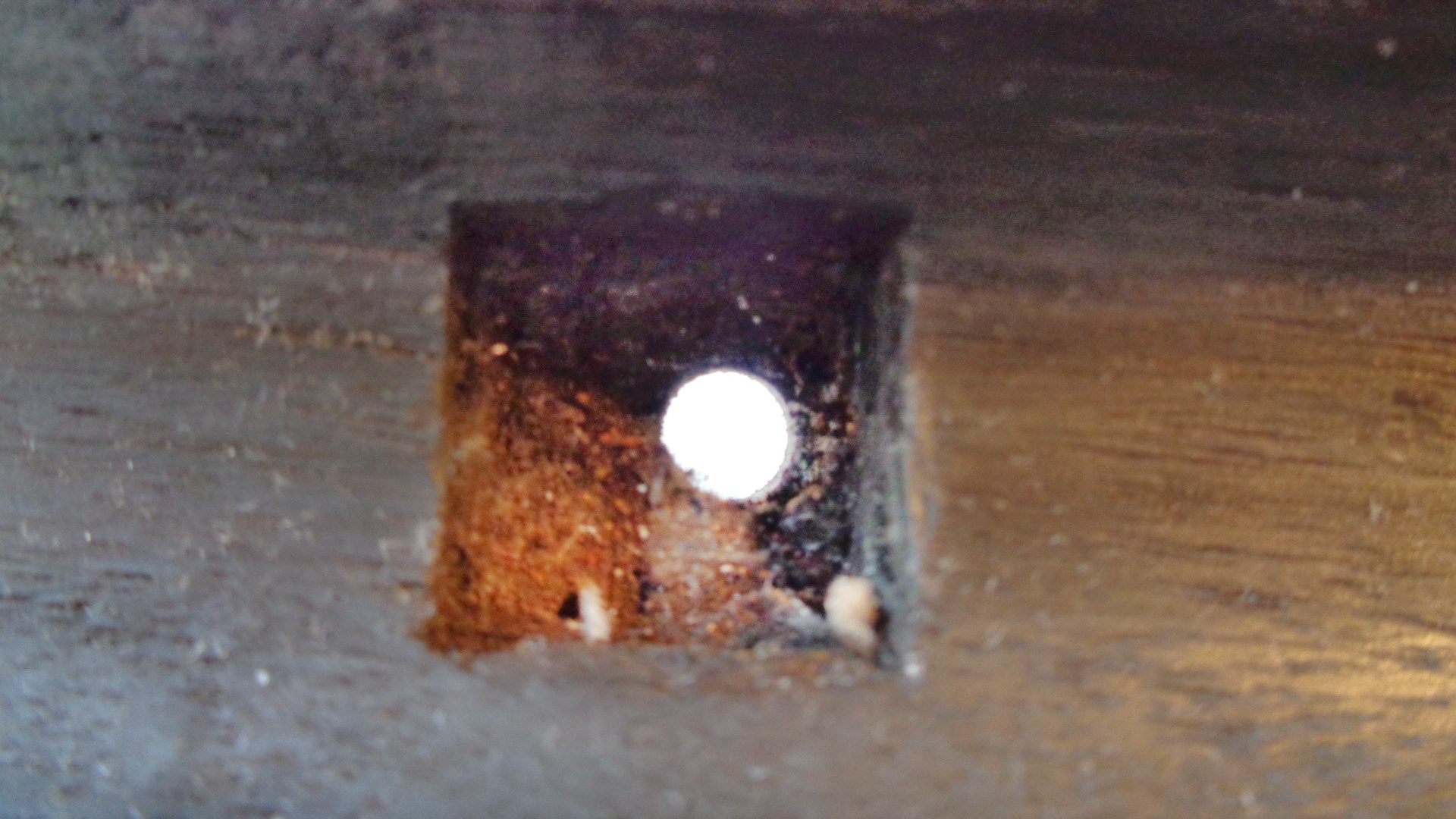 Unlike the fine work on the cleaning rod channel, the mortise cut in the interior of the forestock’s barrel channel looks like the work of an amateur. Image courtesy of author.
When I got home and disassembled the Spencer rifle again, it looked to me like the replacement forestock may have been made from two different pieces of wood, which had been spliced and glued together, leaving a unique spacing between the barrel bands. From the front of the frame to the lower band, it measured 7 ¼”, then from that point to the upper band, it was 9 5/8”, and then 7 ½” from the rear of the upper band to the upper end of the fore end tip.
Try as I might, I couldn’t find any military arm, from any country or period, that corresponded to any of these measurements. There was a small rectangle of what appeared to be distressed wood in the barrel channel that I thought may have been a glue block to hold the spliced parts together. The square mortise cut in the lower one-third of the stock (to accommodate the square bolster under the barrel for the attaching screw) looked to me like it had been made by an amateur, unlike the reconfiguration work done on the cleaning rod channel.
The steel fore-end cap was not recessed for a ramrod, or cleaning rod, and instead of the screw entering it from the inside—as is the case with nearly all mid-19th century longarms—it entered from the outside, and screwed directly into the underside of the barrel, but not very securely. The forward end of the wooden fore stock stopped short just after this screw and about ½” before the end of the nose cap.
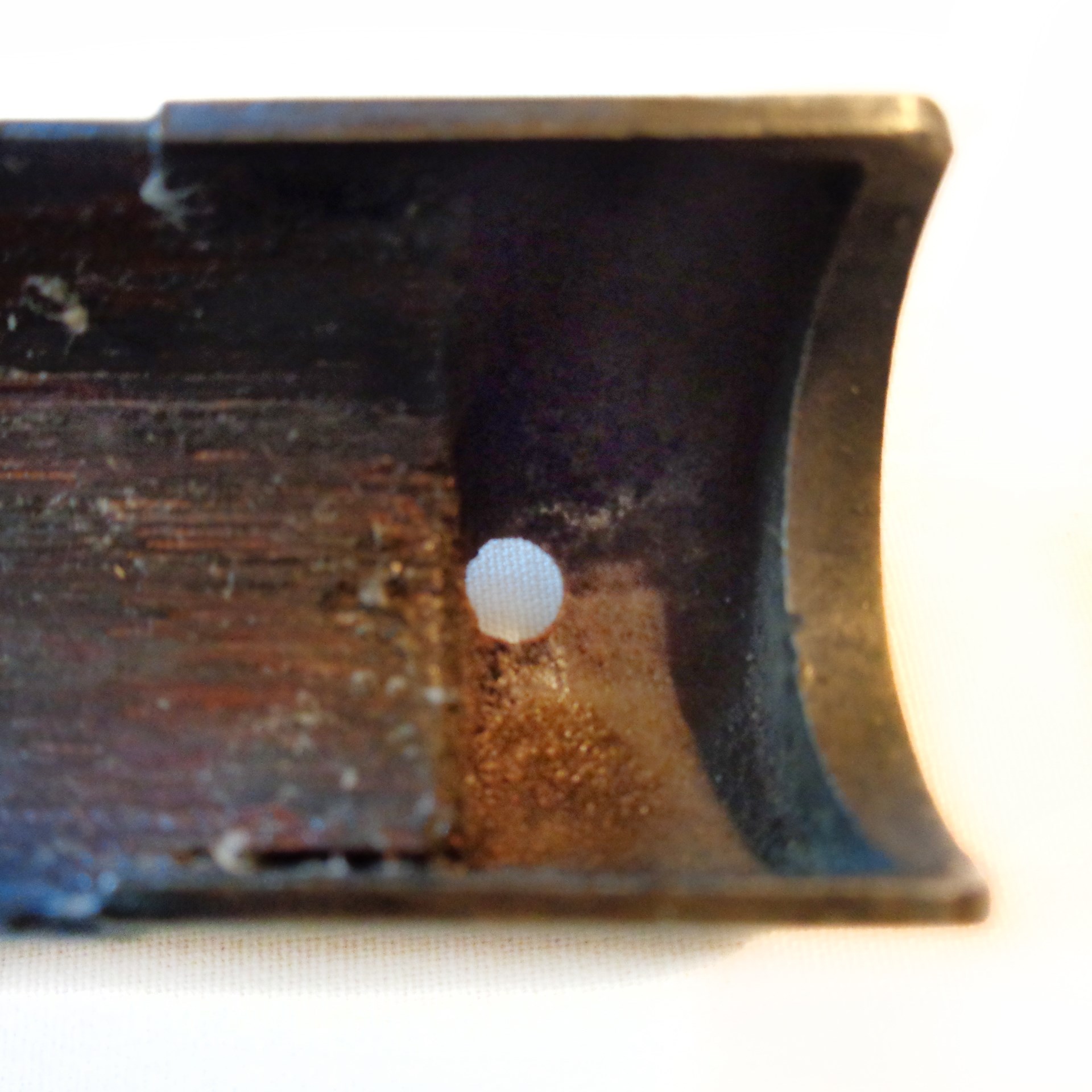 The fore-end cap’s retaining screw enters from the outside, instead of the inside, unlike any other known military shoulder arm, and it screws loosely into the underside of the barrel. Image courtesy of author.
Curiously, I now noticed that the lower band was a middle band from a “Type II” Pattern 1853 Enfield rifle-musket— a variant of the P53, also known as the “P1856,” or “Windsor” model. It even matched the barrel band on my Nepalese Snider-Enfield. This variant had solid barrel bands and band springs, unlike the standard Pattern 1853 Enfield that had screw-tensioned bands. The American firm of Robbins and Lawrence, of Windsor, Vt., and British gun makers in Birmingham, England, as well as Belgian arms manufacturers in Liege, had made this variant for the British government during the Crimean War.
These muskets were fairly rare in the United States (prior to the influx of the “hoard” of “Type II” Enfields from Nepal in the early 21st century), since the British army had returned to a system of screw-tightened barrel bands by the time that many thousands of Enfields were imported by both the Union and the Confederacy during the American Civil War. Even more puzzling was the replaced upper band, as although it looked like an Enfield band, the method of attaching the sling swivel was, again, unique. The upper band was too corroded to find any legible markings on it, although the lower band was clearly stamped with a small crown, over a “B”, and that over a “15”, all in typical British typeface of the period. Both of the barrel bands were tight, requiring two people for disassembly.
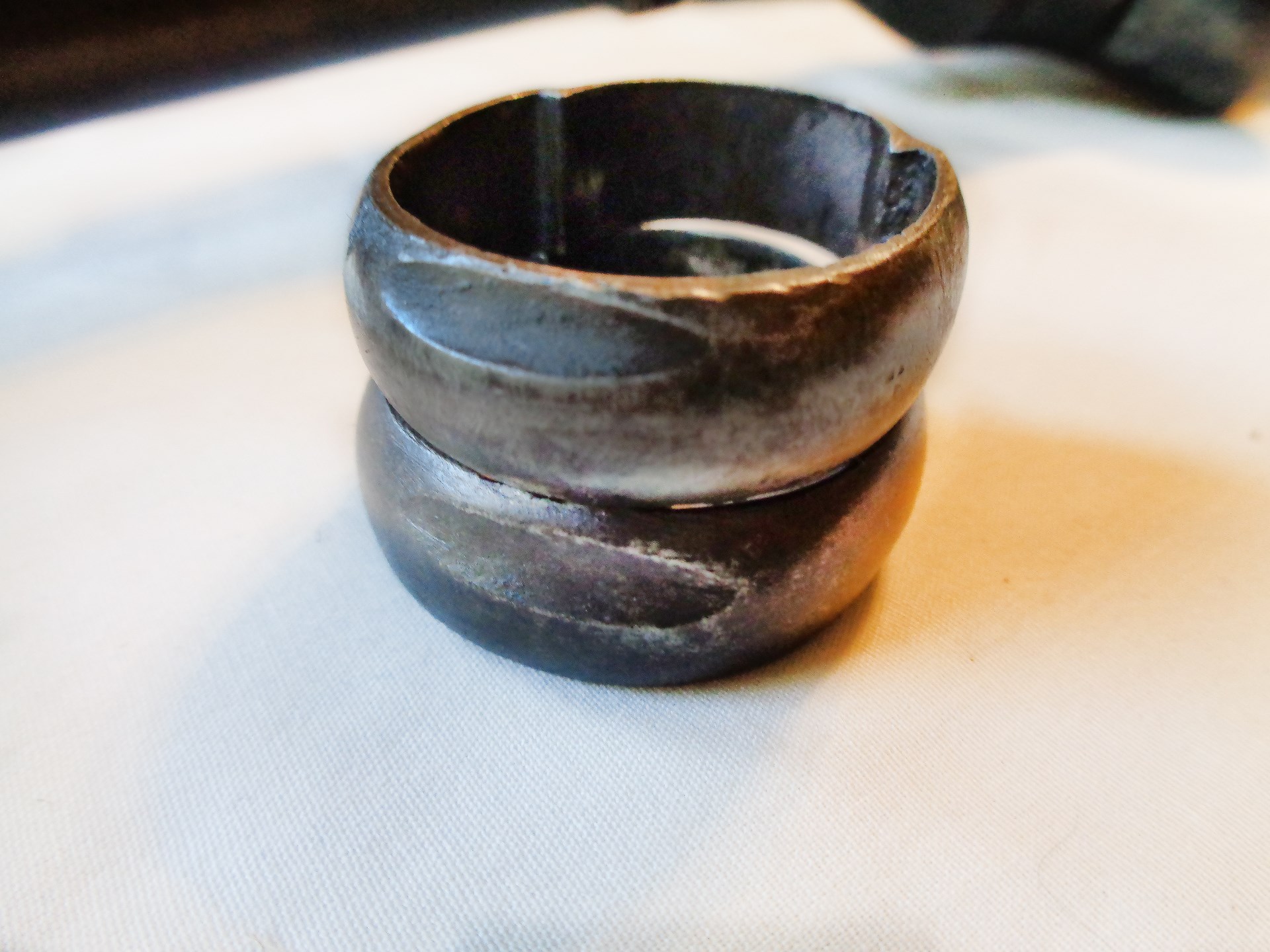 The lower barrel band of the “Frankenspencer,” alongside the distinctive middle barrel band of a “Type II,” or “Windsor,” Pattern 1853 Enfield rifle-musket, both with their telltale milled “notches.” This comparison was the first indication that the “Frankenspencer” had been repaired in Canada. Image courtesy of author.
Over the winter, I kept wondering, ‘What catastrophic event could have been responsible for the damage to this rifle that then would have required replacing its entire forestock?’ Aside from battle damage, which I discounted, there seemed to be only four possibilities: Fire, water, vehicles or accidental damage in the field. However, the barrel on my Spencer rifle showed no signs of fire damage, nor was it rust-pitted on the outside from extensive immersion in water. My rifle also did not appear to have been run over by a vehicle, as the barrel was straight and true, with no scuffing.
Finally, if the damage had occurred during a hunting accident, after the rifle had been sold as surplus, even if a hunter had dropped it on a rock from a great height, why would he have had someone re-stock it to an approximation of its original military configuration? The single stock screw into the bolster on the underside of the stock would have sufficed to attach a new “sporter” version of a fore-end, which would have been preferable for a hunting firearm. Moreover, since most all of the Canadian Spencers ended up being sold to an American surplus dealer in 1871, where would an American gunsmith have found relatively rare British musket parts to rebuild the gun after its catastrophic damage?
I also checked out the possibility that, instead of being a Canadian Spencer, it could have been a Fenian Spencer. The Fenians were the only paramilitary group between the Rio Grande River and the Canadian border that was actively acquiring military arms in any sizeable quantities after the Civil War, and their Spencer rifles were in the same serial number range as the Canadian Spencer rifles. In the fall of 1866, General George G. Meade had reported that his troops had seized some Spencer rifles from the Fenian arms ship, the E.B. Pray, near Eastport, Maine, a month before the battle of Ridgeway, and that they had been rusting away in poor storage conditions for months. However, the British barrel bands on my rifle, and its lack of rust pitting, precluded the theory that it could be a reconditioned Fenian Spencer.
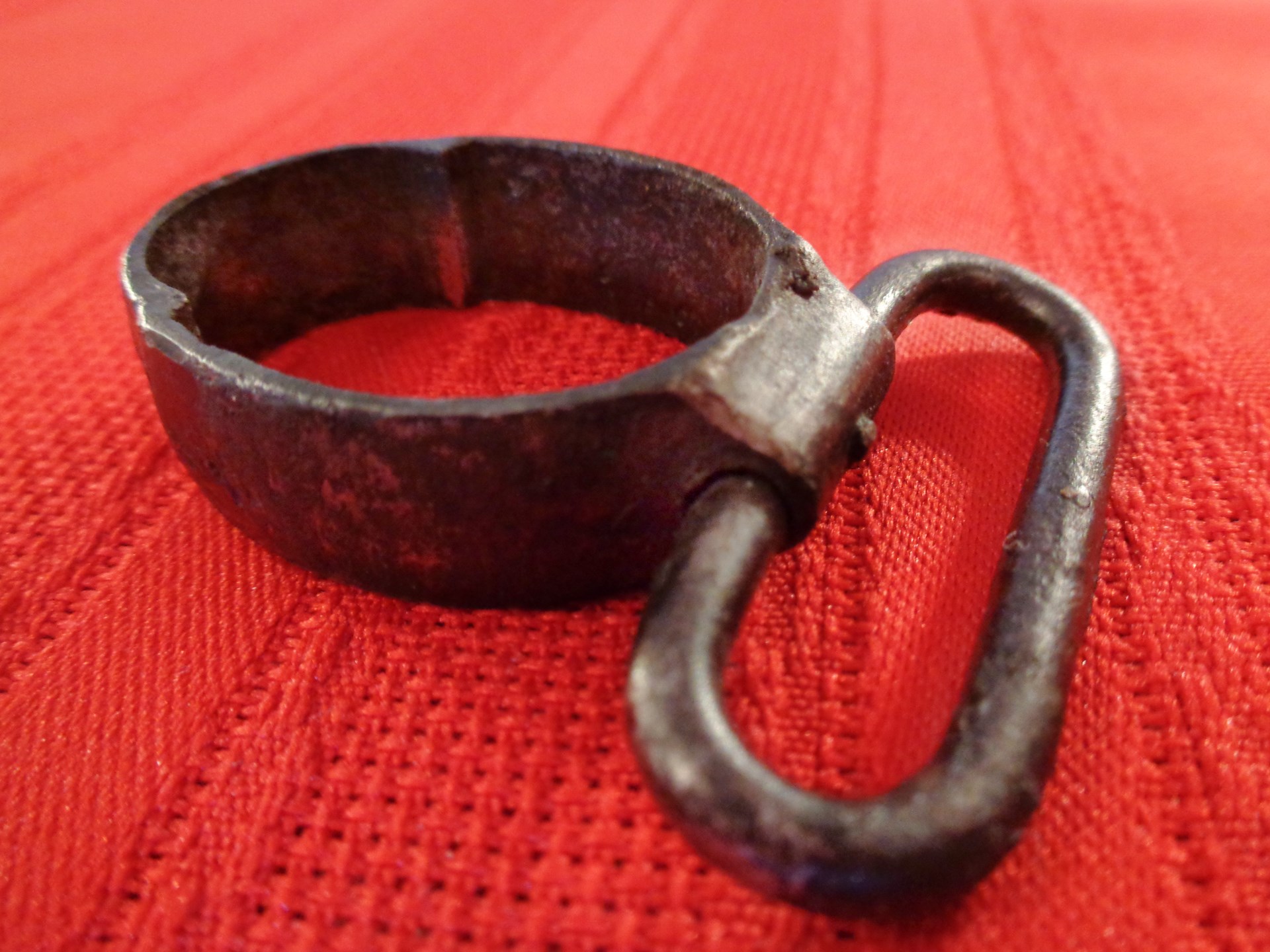 The upper barrel band of the “Frankenspencer” was reworked from a wide upper band of a Type II (“Windsor”) Enfield rifle musket, and the forging marks can be found under intense magnification. Image courtesy of author.
During this same time, I searched for more information on M1865 Spencers online, and I was chagrined to find a discussion in a series of postings on a Spencer collectors’ online forum concerning my rifle, when it was still up for sale by the dealer from whom I had purchased it. One of the commentators on the website referred to my rifle as a “Frankengun,” and, like several of my long-time collecting friends had commented when they examined the rifle, he said that it was nothing more than an odd composite gun of strange parts—a real Frankenstein. My collector pals agreed with him and told me that no one would ever figure out why it is the way it is. At this point, I just gave up trying to puzzle out the reasons why my rifle was rebuilt and who had done the work.
I began to refer to my rifle as the ‘Frankenspencer,’ but I was just glad that I finally had a M1865 Spencer rifle, albeit significantly altered, to feature in our annual “Guns and Music of the Fenian Raids” exhibit. Ross felt terrible about advising me to buy the gun and was embarrassed that he had not noticed that it only had two bands. He admitted to me that he had been too excited about the markings on it, and its serial number, to notice the barrel bands, as I, too, had been. He jokingly told me, “I will stoutly maintain that a Fenian picked it up off the battlefield at Ridgeway and brought it back to the USA as a souvenir. That’s my story, and I’m sticking to it!” We both got quite a chuckle out of that.
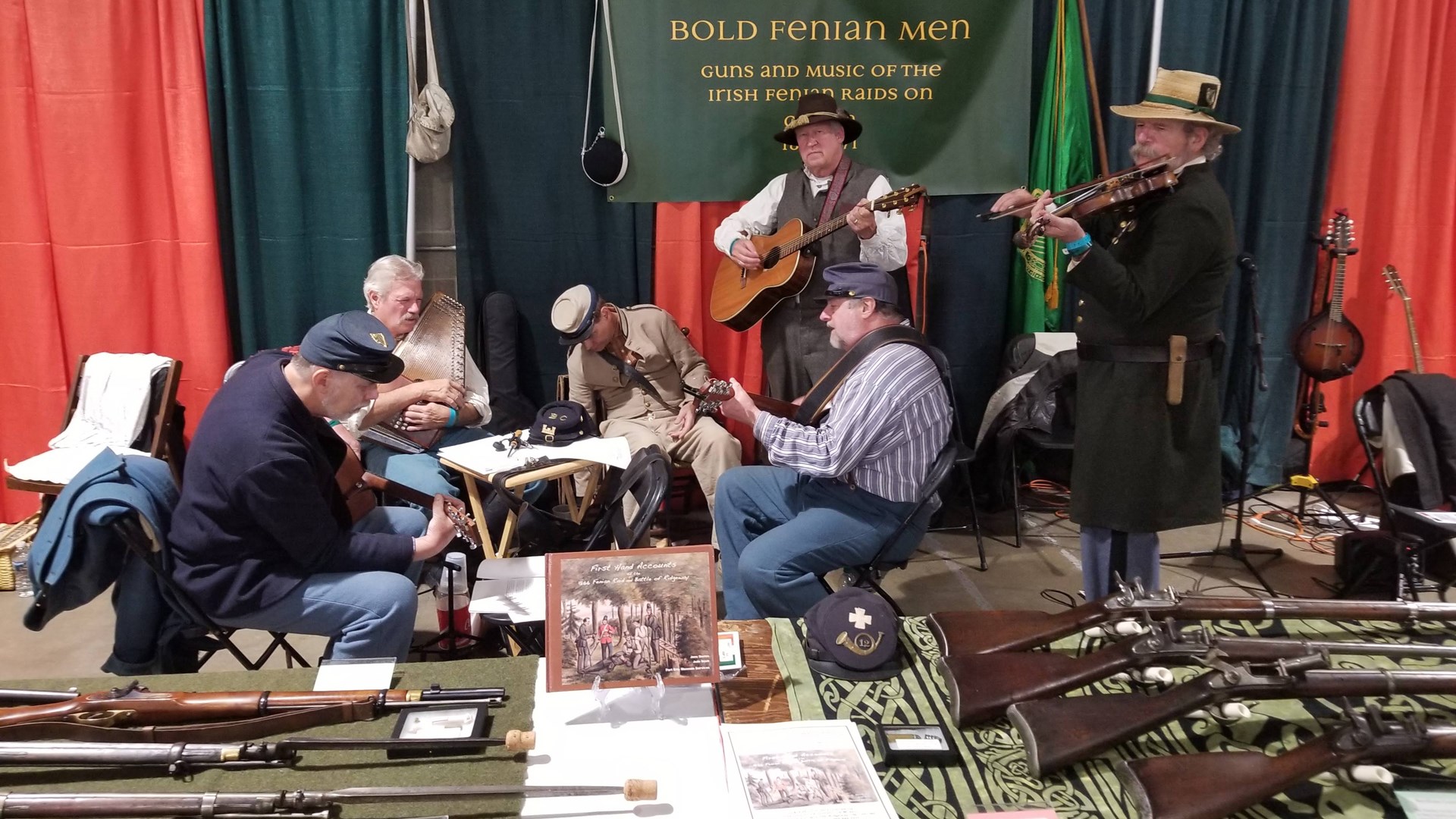 This exhibition and presentation, combining Fenian music with the guns carried by both sides in the Fenian Raids, was an annual feature at the Maryland Irish Festival near Baltimore, and it needed a Canadian Spencer rifle—even an altered one. Image courtesy of author.
Over the next few months, I didn’t give my Frankenspencer any more thought, but by June, I was getting back to the article that Ross and I were writing on Fenian Needham conversion rifles, so I had started to go back through two of the books that I had used for the magazine article I had written about the guns at the Battle of Ridgeway. I wanted to make sure that what Ross and I said about the Fenians’ first acquisition of Bridesburg muskets in 1865 and 1866 was in line with Vronsky’s account, and also with Captain John MacDonald’s story in his 1910 book, Troublous Times in Canada.
At the same time that I was skimming through these books in bed at night, I received an email from a good friend, Owen Conner, a curator at the National Museum of the Marine Corps. Owen was well aware of my interest in Fenians. He and his family were visiting his wife’s relatives in Toronto, and they had toured the Casa Loma estate in the city, where the QOR maintains a museum. Owen very kindly sent several photographs of the exhibits there to me, and when I got a chance to look at them closely, I was surprised to read in the artifact label for a Spencer rifle on display that it had been “excavated” in the 1980s.
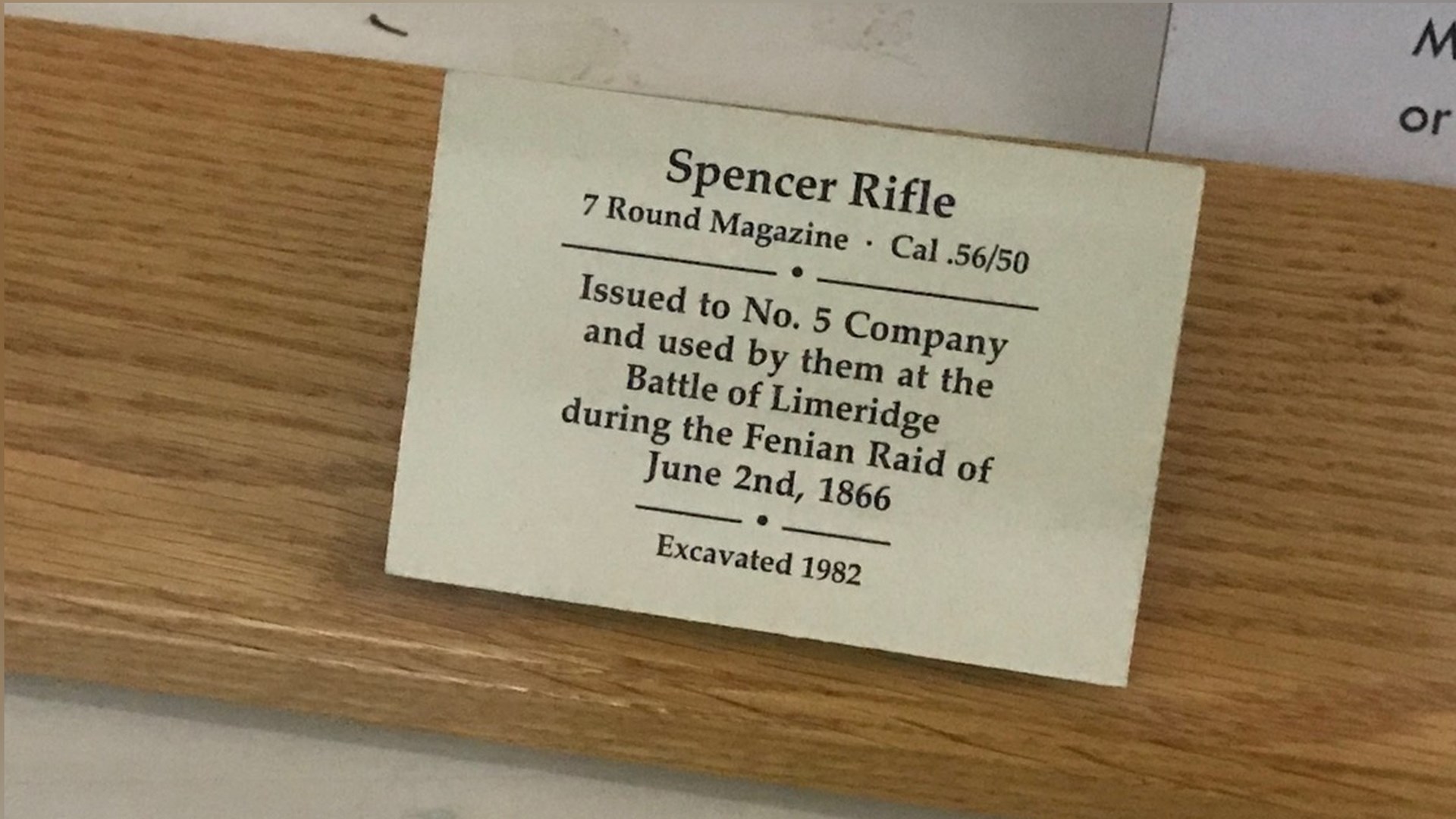 This was the first clue that the Frankenspencer may actually have seen service at the Battle of Ridgeway. Image courtesy of Owen Conner.
However, the rifle in the picture looked to be in really good condition for having been “excavated.” In the Fredericksburg, Va., region, we have lots of “excavated” Civil War guns, but none of them look as nice as this Spencer rifle! When I turned back to the two books, I thought that I would try to calculate just how many Spencers may have been lost on the battlefield, in addition to this “excavated” one in the museum. Vronsky stated in his book that No. 5 Coy of the QOR went into the battle with 40 Spencer rifles and nine Spencer carbines, citing a memorandum of “Arms and Clothing on Hand” that had been sent by the QOR to Lt. Col. Drurie, the assistant adjutant general of Canada, on June 25, 1866—three weeks after the Battle of Ridgeway. In addition, he also based his statement on a detailed memoir by No. 5 Coy’s Rifleman McIntosh, who carried a Spencer rifle in the battle. According to MacDonald’s book, several officers, from both the QOR and Hamilton’s 13th Battalion, claimed, in a court of inquiry held shortly after the battle, that No. 5 Coy had “about forty Spencer rifles” in the battle.
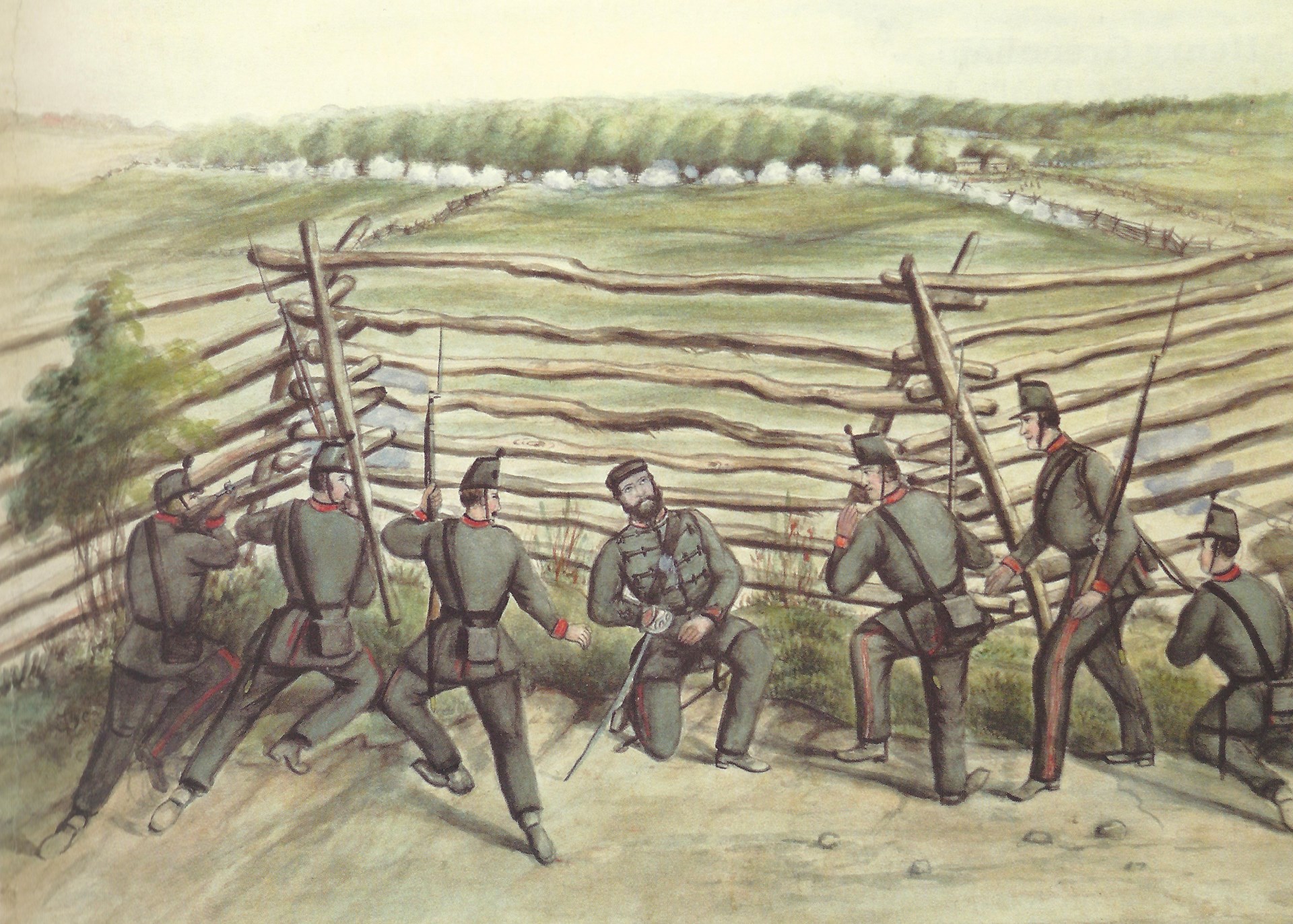
Imagine my surprise when I read that that No. 5 Coy had suffered only three casualties in the Battle of Ridgeway, before they fell back from the front of the lines at the beginning of the fight, having expended all of their Spencer ammunition. (Each man had only been given 28 rounds—four magazine loads—on board the City of Toronto ferry, heading across Lake Ontario from Toronto to the Niagara area.) Their ensign, Malcolm MacEachern, was mortally wounded, another private named Charles Bell had been wounded in the knee, but Private Walter B. Copp had been “wounded in the wrist.” That revelation made me sit up in bed and wonder, ‘Which wrist?’ If he was wounded in his left wrist, there was a chance that, as he was firing his rifle, the bullet that wounded him also MAY have shattered the fore stock of his Spencer rifle!
 Ensign Malcolm McEachern, a family man and a Sunday school teacher, was considered to be one of the best shots in Number 5 Company of the Queen’s Own Rifles. He was mortally wounded after taking a Spencer carbine from one of his NCOs and firing at the Fenians—showing the sergeant “how it should be done.” From the book, First Hand Accounts of the 1866 Fenian Raid and Battle of Ridgeway, courtesy of the Fort Erie Museum, Ontario, Canada.
I mentioned this to Ross, and he recounted a story to me of his great uncle, who had been shot through the left wrist in 1917 at Vimy Ridge in France, with the German bullet smashing the fore stock of his Short Magazine Lee-Enfield rifle. In my museum career, and at arms shows, I had seen other rifle stocks that were battle-damaged in a like manner, and some of them had been repaired and re-issued. We agreed that there just may be something here, and I was determined to look further into the matter.
Ross sent a copy of an article to me that had been written in 1989 by a Canadian museum curator, Donald Webster, and it explained the “excavated” Spencer. In 1986, a construction crew unearthed a wooden crate of ten Spencer rifles from the same area of the Toronto dockside from which the QOR had embarked on a ferryboat, the City of Toronto, for the Battle of Ridgeway. The workmen had made off with seven of the relic rifles before the authorities could claim three of them for museum purposes. The most well-preserved rifle underwent conservation, and, thanks to its having been in an anaerobic environment (cold mud) for more than a century, it was in fairly presentable condition. Webster surmised that the Spencers must have been lost during the QOR’s hurried embarkation, because any subsequent shipments of Spencer rifles from Montreal (their point of entry into Canada) would have come to Toronto by rail, and not by water. However, later research showed that this unrecovered crate most likely was one of about 120 cases of Spencer rifles that been thrown into Lake Ontario to save them from a fire in a warehouse at Malloy’s Wharf, while the guns were awaiting shipment to Montreal in 1871. At least 510 of these rifles were recovered, and then sold to an American surplus dealer in New York City.
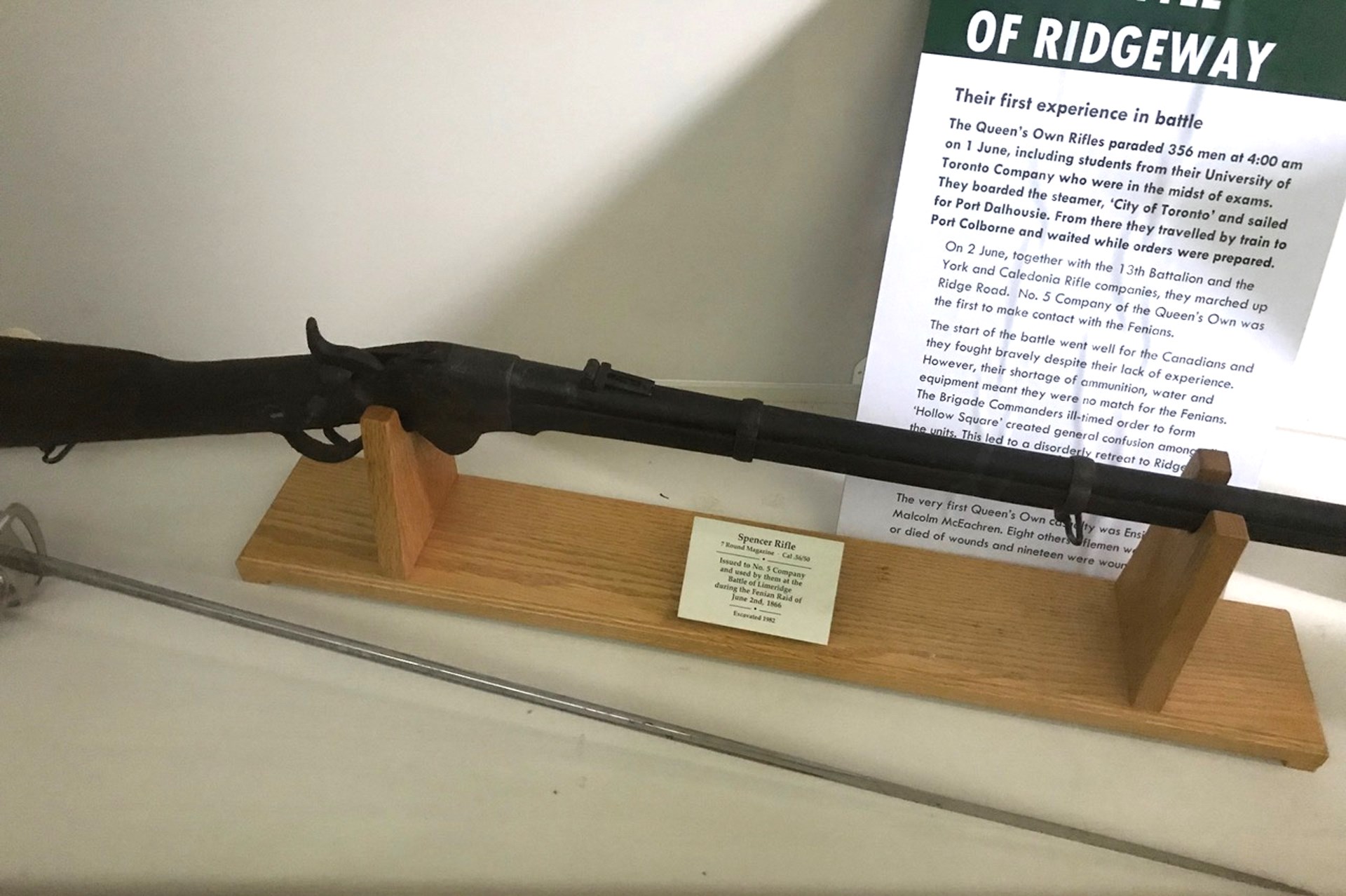 This “excavated” M1865 Spencer rifle in the QOR Museum was not recovered from the Ridgeway battlefield, but rather from Lake Ontaria along Toronto’s waterfront, and it was not one of the 40 Spencer rifles issued to No. 5 Company, Queen’s Own Rifles in June 1866. Image courtesy of Owen Conner.
I read an online version of a 1962 history of the QOR, and found that each company in the battalion had been reduced to no more than fifty enlisted men several months before Ridgeway, so 49 guns made sense—the three officers (a company captain, a lieutenant, and an ensign), were all armed with swords and revolvers (one of the men in No. 5 Coy had been commended for retrieving the mortally-wounded Ensign MacEachern’s sword and revolver during the battle), with the enlisted men being armed with the Spencers.
Ross also sent an image of the QOR after the battle to me, and it showed a mixture of Spencer rifles and carbines being carried by the men in the photograph. The photograph came from an album (now in the QOR Museum’s archives), that the unit’s adjutant, Capt. Otter, assembled during his career, and he apparently had photographs taken of several of the battalion’s companies in the days after the battle. The questions then remained: Had one of the QOR’s Spencer rifles (Copp’s Spencer?) been damaged in the battle? If it had been damaged in the battle, retrieved, repaired and then re-issued, who could have done the work?
I found an annual report online that gave a full fiscal accounting for Canada in 1866. There was one section in the Public Accounts for the Province of Canada, 1866-1867 that was devoted to military expenditures. I went through it page-by-page, and line-by-line— a long process! On p. 116, I found the only entry concerning the repair of small arms in the entire report: A “J. Hamilton” of London, West Canada, had been paid $38.46 for “repairing rifles.” At this point, I turned to my wife’s best friend, Sue Bellinger, who is an expert genealogist, and very fortunately, I caught her two days before her international subscription to a commercial genealogy website ran out—and one which she had not planned to renew. She raced through the documents that were available online and sent a constant stream of them to me over the next two days. From what she found, I was able to discover what I needed to know about “J. Hamilton” and Pvt. Walter Brown Copp in order to make a connection between them.
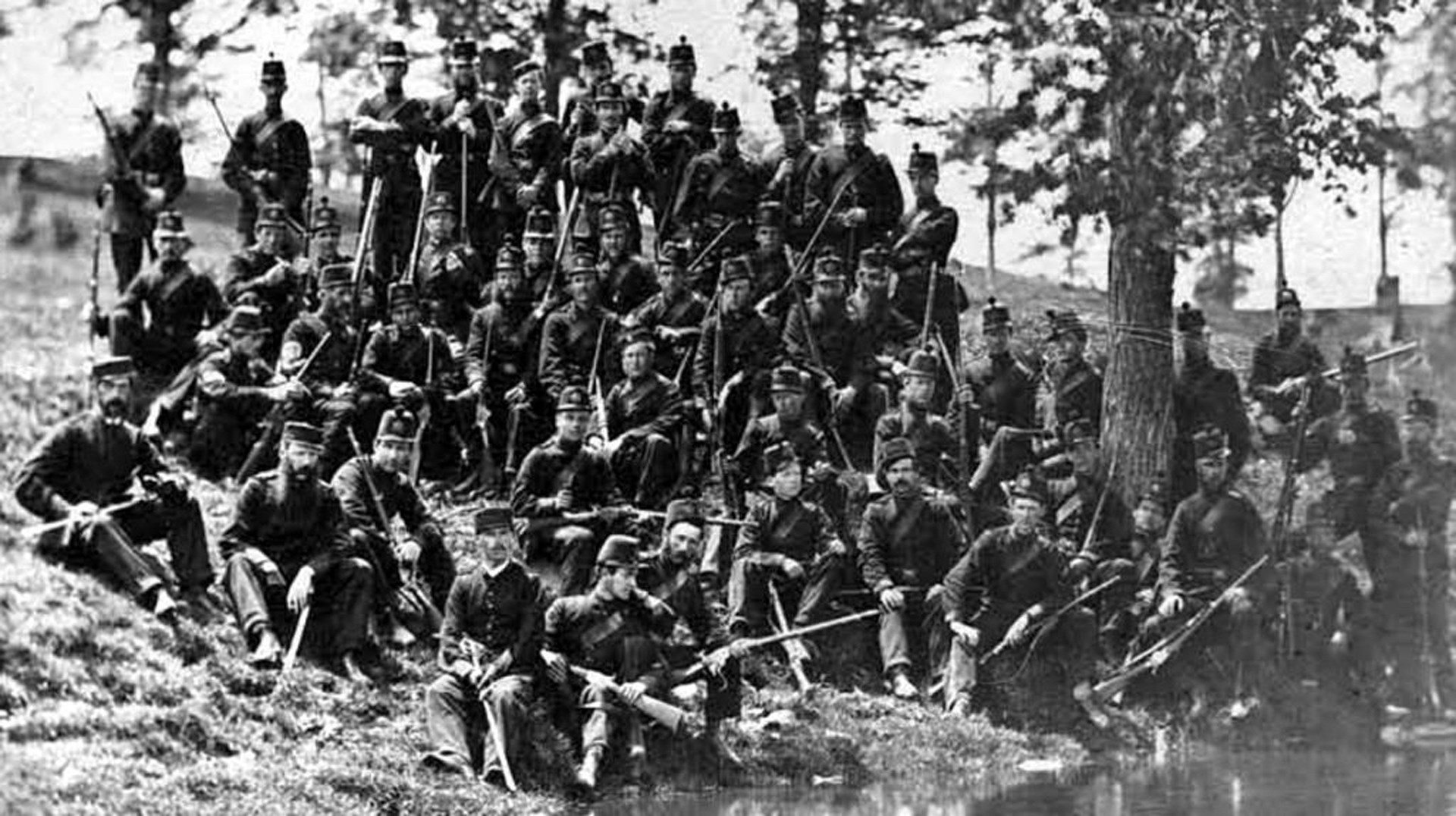 Members of No. 5 Company, Queen’s Own Rifles (2d Battalion, Canadian Militia) pose after the Battle of Ridgeway. The unit’s founder, Lieutenant Colonel William Smith Drurie, may be the officer (with the mustache and side whiskers) seated between the two surviving company officers. At the time, Drurie was the Assistant Adjutant General for Canada. Note the mix of Spencer rifles and carbines. Image courtesy of the Queen’s Own Rifles Museum.
John Hamilton’s parents had emigrated from the United States to Canada between 1836 and 1838, when John was about a year old. Although his father was a grocer, John was a blacksmith in the town of London, where the expanding family lived in a two-story wooden framed house. John was a private in the 7th Battalion, Canadian Militia, and he had been called out for border service during the Fenian “scare” in the months preceding Ridgeway. While the 7th Battalion arrived too late to take part in the Battle of Ridgeway, his unit, along with the QOR, was sent to the battlefield on the day after the battle. While there, both battalions were involved in recovering military equipment that had been jettisoned by the Canadian troops during the rout. Local civilians had already started to scavenge the battlefield, and the military authorities had to issue sharp warnings to them to turn in any salvaged firearms. John Hamilton must have been more than “just a blacksmith” as he later was awarded a proficiency certificate in military engineering from the Military College in Kingston in the 1880s, when he was still enrolled in the militia.
Private Copp’s father was a well-known bookseller and publisher (the Copp company is still operating in the Toronto area), and Walter was employed as a clerk by a firm of merchants in the city. The members of No. 5 Coy were mainly clerks and businessmen, and the unit was known as the “Mercantile Company.” Details of Copp’s wounding can be found in both Vronsky’s book, and in the depositions of veterans and observers in the appendices to MacDonald’s book, but since Copp never applied for compensation, there are no military records of his wounding. Copp died of a spinal infection just a few years after Ridgeway and apparently left no memoirs behind.
It was obvious that Copp was superficially wounded in his left wrist, as a medical orderly of the 13th Battalion treated Copp for a “furrow across his wrist” during the battle, and there are several other accounts describing his wound as “light.” Several accounts tell of Copp staying on the battlefield and helping the doctors to move wounded Canadians and Fenians after the battle. His wound could not have been in his right wrist, as, if he were right handed, he couldn’t have helped move the wounded very well. Moreover, he signed his pay receipts at the end of May, and at the end of June 1866 in the same beautiful copperplate handwriting—a forward slanting cursive of a right-handed writer, not the upright, or back-slanting handwriting of a left-handed one.
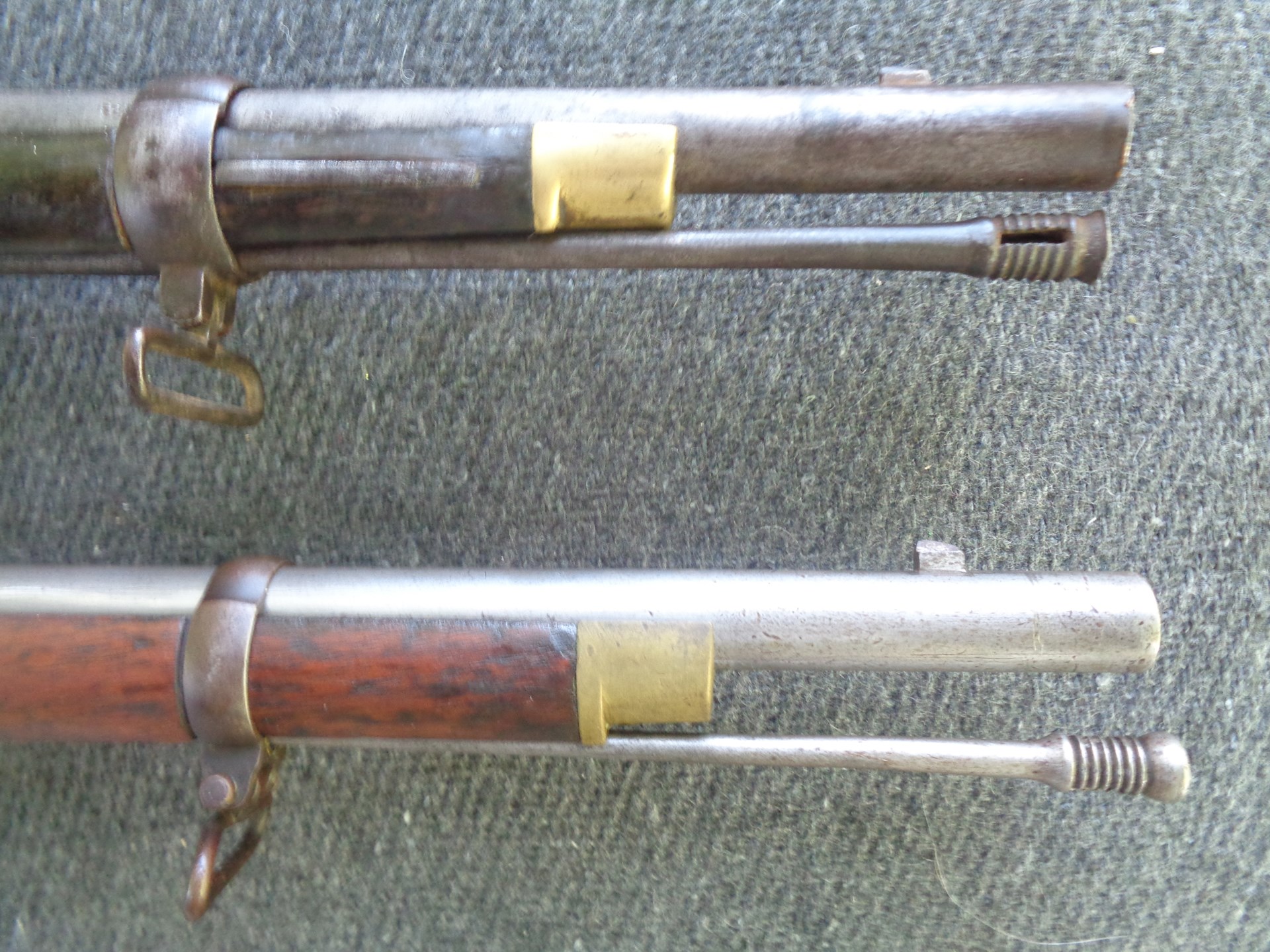 There is a distinct difference between P53 (lower) and “P56”, “Type II” or “Windsor” (upper) Enfield rifle-muskets. The upper barrel band of the Frankenspencer was reworked from a wide upper band of a Type II Enfield rifle musket, and the replaced band spring (perhaps from Private Shuttleworth’s damaged rifle-musket) had already been damaged when Hamilton installed it in the new fore stock that he had carved. Image courtesy of author.
Two months later, and to my absolute delight, I found a watercolor painting was in a book published by Ontario’s Fort Erie Museum in 2016 that showed Copp (with his bandaged left wrist) and it cinched my theory. Copp most certainly was wounded in his left wrist and almost assuredly while firing his Spencer rifle.
A scenario began to form in my mind— Copp is wounded in his left wrist during the battle, and his Spencer rifle is damaged. The day after the battle, a group of officers are standing around a pile of discarded and damaged Enfield rifle-muskets on the Ridgeway battlefield and wondering what to do with them, since the Canadian militia did not have an established small arms repair program at that time. Private John Hamilton steps up and offers to repair as many of them as can be salvaged. At least one long Enfield had an irreparably damaged muzzle, since, according to an account in MacDonald’s book, a Fenian’s bullet had smashed into it when Pvt. Shuttleworth, of the 13th Battalion, was taking aim at the Fenian. Copp’s seriously damaged Spencer rifle must have been among the Enfield rifle-muskets. After learning of Hamilton’s occupation and abilities, the officers release the guns to him for repair.
I thought that this was beginning to be a plausible scenario. I double-checked the references in my personal library, and in Bulletin Number 1 (1963) of the Upper Canada Historical Arms Society, I found that the Canadian militia had received at least 2,500 “Type II,” or “Windsor,” Enfield rifle-muskets in 1856. The 13th Battalion most likely carried at least some of these rifle-muskets at Ridgeway, and one QOR-marked example is in the Canadian Military Heritage Museum in Brantford, Ontario. Hence, there would have been metal parts of the type on my Frankenspencer available to Hamilton for him to use when repairing Copp’s Spencer rifle. There also would have been wooden forestocks as well, if the measurements of the Type II stocks checked out with mine. The problem was that they didn’t!
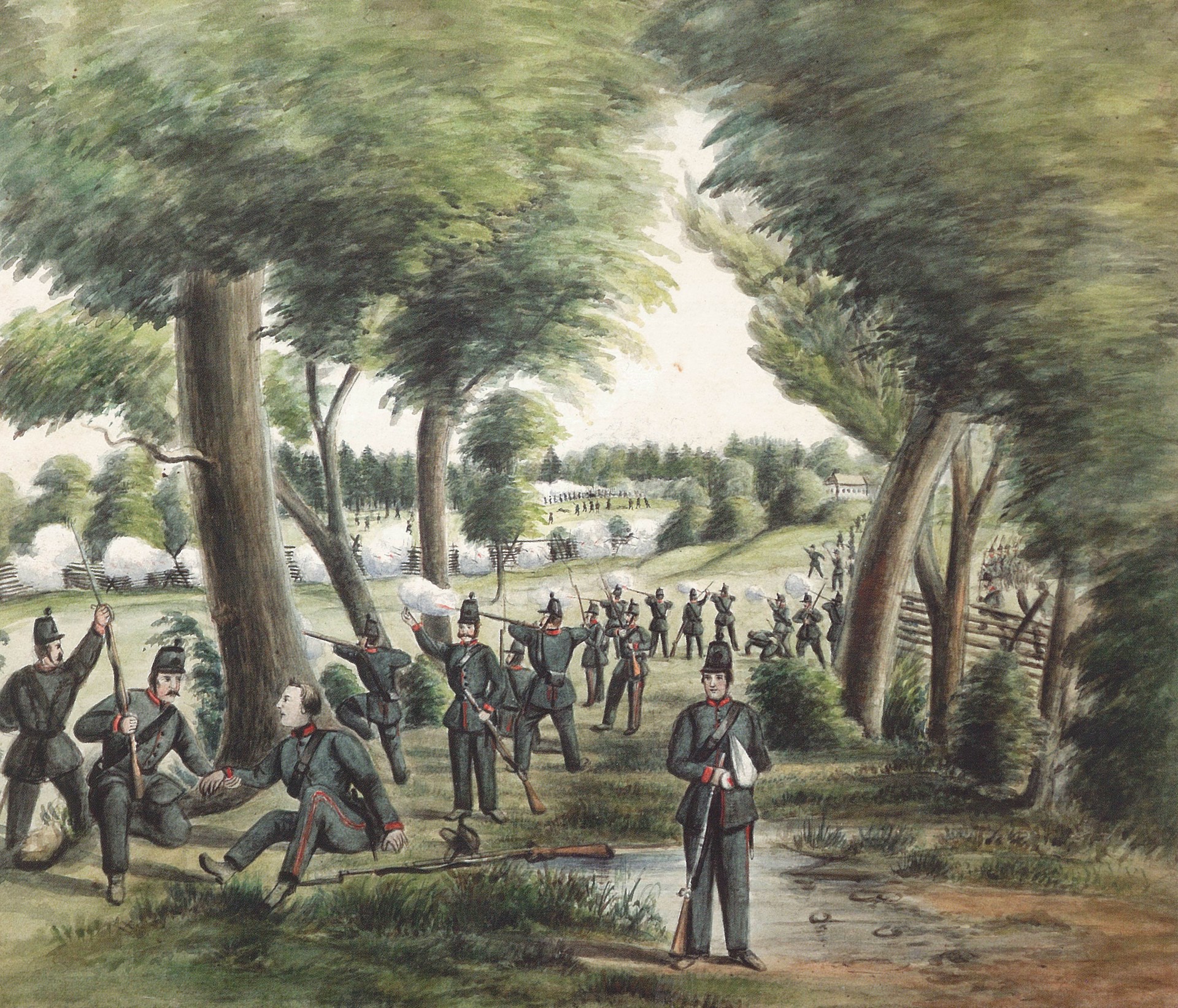 Private Walter Brown Copp is shown here, with his bandaged left wrist in a white cloth sling, in this painting by German-born Canadian artist, Alexander von Erichsen Behind him, Private Charles Bell is sitting on the ground, with his wounded knee. Copp was the only casualty in the Queen’s Own Rifles who was wounded in the wrist, and the artist shows his rifle without a fore stock. From the book, First Hand Accounts of the 1866 Fenian Raid and Battle of Ridgeway, courtesy of the Fort Erie Museum, Ontario, Canada.
During this period of research, I kept having a nagging feeling that “J. Hamilton” was somehow familiar to me. It rang a bell, but only with a dull thud. I vaguely thought I remembered something about a set of carved initials. I checked the photographs that I had taken of the barrel channel when I first cleaned the rifle, but I couldn’t see any carved initials in the photographs. When my brother, Steve (a fellow antique gun collector and shooter), came to our home for a visit in early September 2018, he and I disassembled the rifle again, and excitedly double-checked for carved initials, but we found none. He and I both re-checked the stock measurements between the barrel bands, but, again, we came away baffled.
I then had another thought about a possible source for the replaced forestock. I knew well that the Americans, the French, the Austrians and the Saxons had all developed “cadet” sized muskets for their military academies. Perhaps the British government had authorized a limited run of “cadet” (usually 7:8 scale) P1856 muskets for the budding young officers at Sandhurst or Woolwich? Was there a possibility that some cadet muskets had been sent to Canada for the young members of the QOR’s “University Rifles” company? If so, then perhaps the forestock on my Spencer, or at least a part of it, may have come from a scaled down “Windsor” cadet musket. I contacted Lisa Traynor at the Royal Armouries in Leeds, and, as always, she quickly responded and searched their collection for such a gun. David Penn, retired arms curator of the Imperial War Museum, also sent out my appeal to several noted British arms historians, but, apparently, no such cadet musket ever existed. About this same time, I also asked Rene Chartrand, curator emeritus of Parks Canada, about the possibility of Canadian “cadet muskets”, and he used this opportunity to provide me with a wealth of supporting documents from his previous research on Canadian Spencers.
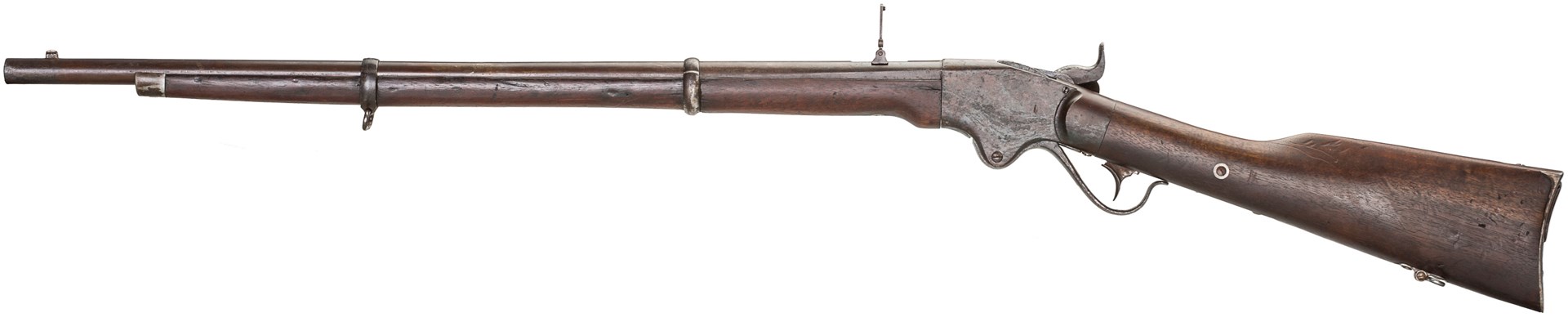
The distances between the receiver, the barrel bands, and the nose cap on the Frankenspencer do not correspond with any known military shoulder arm. Image courtesy of American Rifleman magazine, photographed by Forrest MacCormack.
A few weeks later, I was catching up on correspondence at my desk in our basement, and I happened to glance over at the large sliding glass window beside me. In the metal channel at the bottom of its frame, I saw one of the antique canes that I had retrieved from my late father’s home a year earlier. Before leaving on a trip to Ireland, I hurriedly had jammed it in the channel, as a temporary deterrent against burglars. On the side of the wooden cane, I saw the initials “H A R” carved on it, and wondered—as I have wondered for nearly 60 years (since Robert Martin, a boyhood friend of mine, found the cane in the woods and gave it to my dad)—who “H A R” had been. Dad and I had often remarked that, “we would never know who ‘H A R’ was.” Suddenly, and sickeningly, I recalled the scene when I was working on the Frankenspencer rifle, late at night, a year earlier. It was not a “J H” carved into the barrel channel that I had seen, but a tiny, brown, crumbling bit of paper that fell out of the fore stock, when the stock was upside down, and I was lifting it from the barrel.
With crystal-clear clarity, I now remembered seeing that little rectangle of disintegrating paper flutter down and come to rest on a pile of oil-soaked and rust-stained bore patches on the floor. On it was a pair of initials, “J H”! The bell in my brain now rang loud and clear—that was why “J Hamilton” had seemed so familiar to me! I recalled wondering who “J H” could have been when I saw it, and then getting into an argument with myself. The angel on one shoulder said, ‘Go upstairs and get a plastic sandwich bag, put that scrap of paper in it, label it and put it away in your files, as you dutifully have done with scores of such scraps over the past 50 years.’ However, the devil on the other shoulder said, ‘Ahhhh, fuggedaboudit! You won’t live long enough to find who “J H” might have been, and even if you ever do discover his identity, will anyone really care? Besides, when you die, the crumbling bit of paper in that plastic bag will be just another thing that your family will have to wonder about before they throw it away.’ I was tired, and it was late at night. Although I had saved many unidentifiable scraps of paper and cloth from numerous artifacts, both at work in museums and at home in my own study collection, I could not, at that moment, recall a single instance in which their retention had ever had a significant impact on the provenance of the artifact. The devil won the argument. I gathered up that tiny bit of paper with the dirty patches, threw them all into the trashcan, and trudged upstairs to bed.
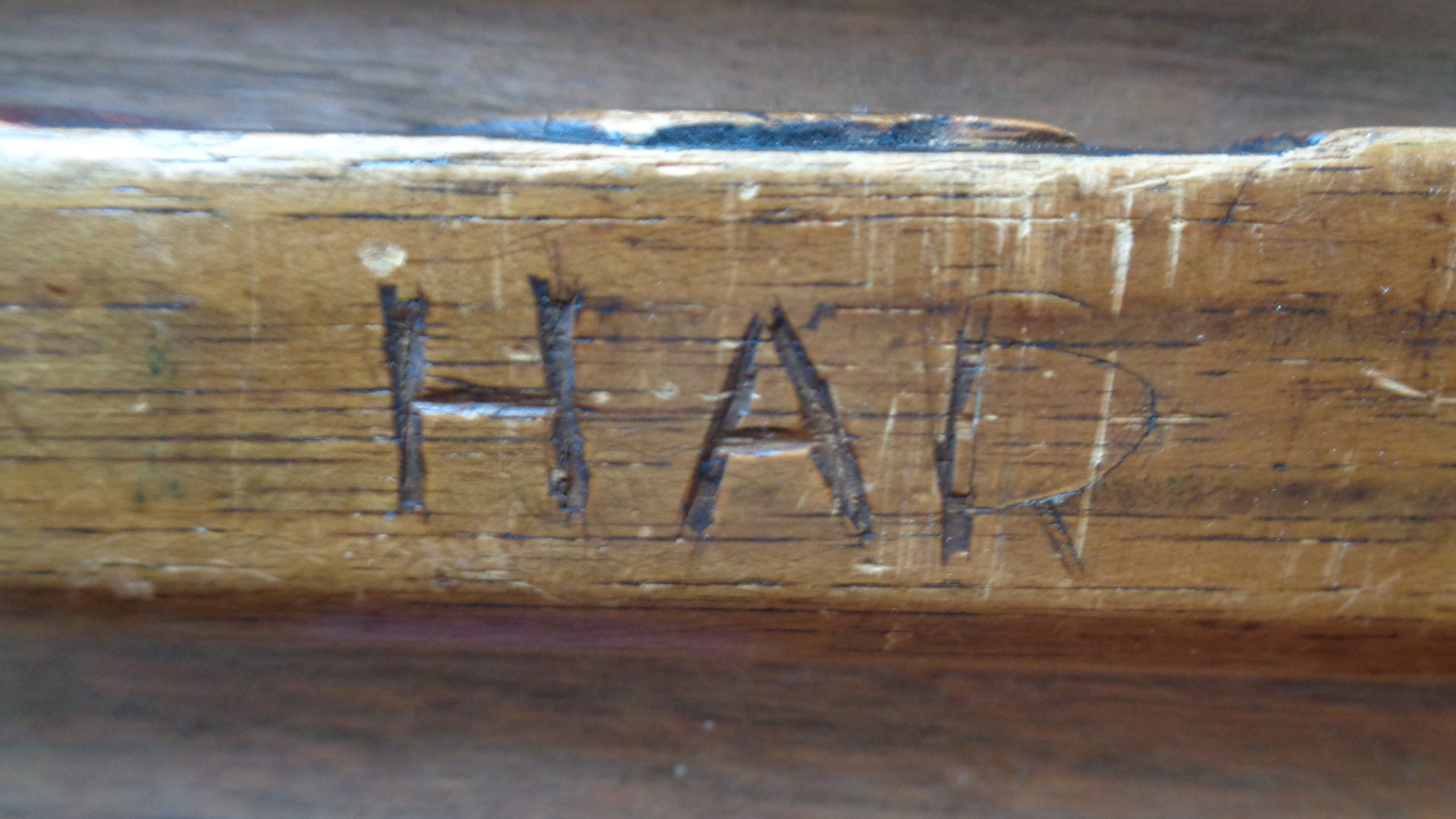 The initials of an unknown previous owner on this cane proved to be the catalyst for the realization that the initials, “JH,” were on a piece of paper, and not in a carving under the Frankenspencer’s barrel. Image courtesy of author.
After I recalled the embarrassing incident, I sheepishly told Ross Jones about it, and, after much soul-searching, I also shared the story with another good friend, Les Jensen, the curator of arms at the U. S. Military Academy Museum at West Point. Les offered to examine the Frankenspencer at a reunion of our Revolutionary War Bicentennial living history group in Williamsburg, Va., the following week. After the two of us again disassembled the rifle, Les pointed out that the forestock had not been spliced together from different parts of other stocks as I had thought it may have been, but instead was made from one piece of wood. It was also handmade. He also found that the retaining pin on the upper band spring was already broken off when Hamilton installed it in the new fore stock. At the same reunion, noted arms historian Fred Gaede confirmed that the lower barrel band truly was from a “Windsor” Enfield, and he later informed me that it had been made in Birmingham. I had already determined that the band springs were from a “Windsor” Enfield—a short upper spring and a modified middle spring.
A week later, another dear friend, Harris J. Andrews, III, examined the rifle under strong magnification, after we had spent the day together in the woods, hunting deer with our flintlocks. Harris discovered that what I had thought was a rectangle of glued wood in the barrel channel, was, in reality, the place where the bacteria from the animal hide glue on the back of the paper scrap had eaten at the wood fibers. More importantly, he also determined that the upper band indeed had been forged, and reconfigured, from the distinctive wide upper band of a “Windsor” Enfield.
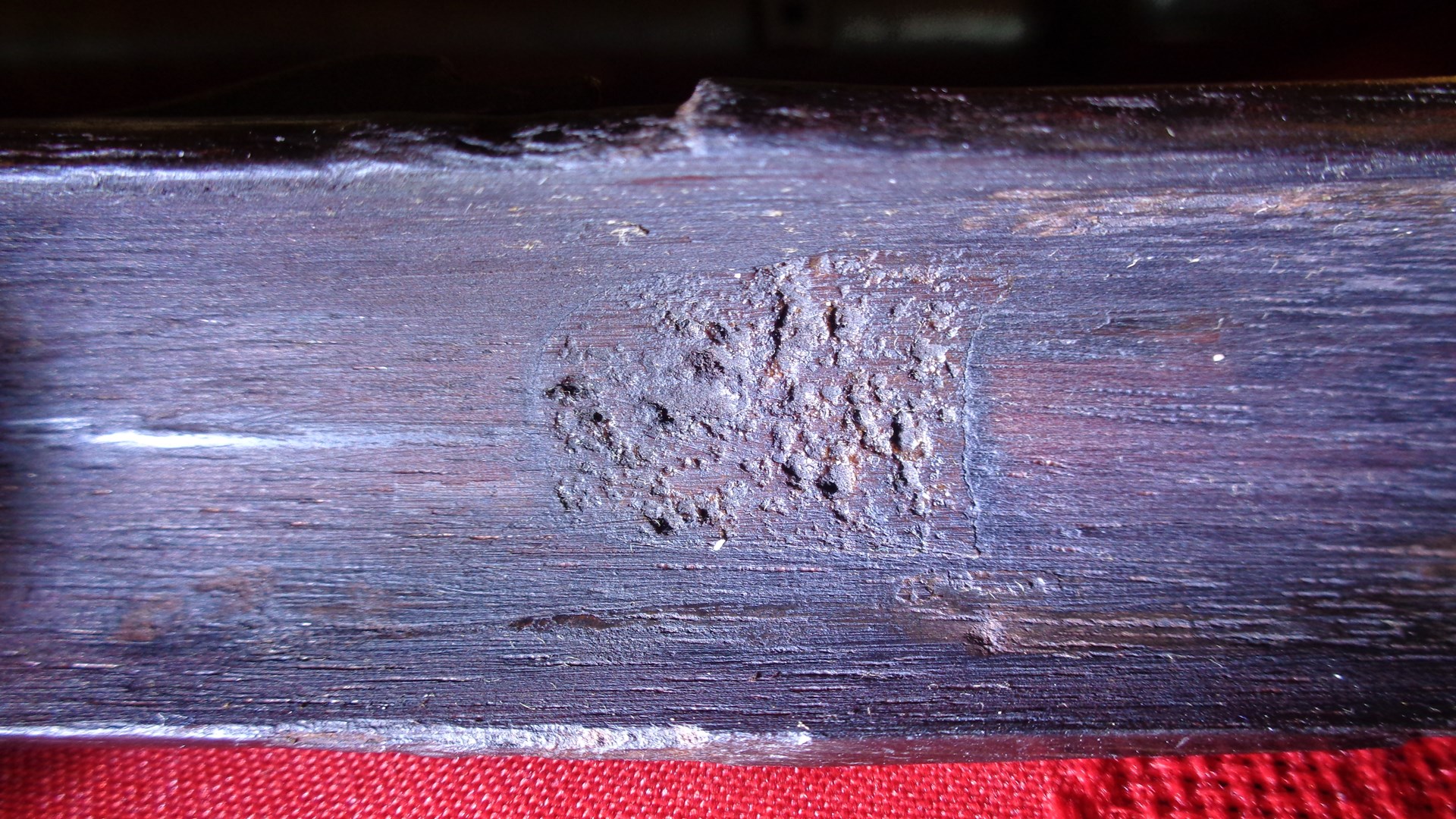 The little rectangle of disintegrating paper (with the initials “JH” on it) had been glued in the rifle stock’s barrel channel on an area that, over time, had deteriorated from the bacteria in the animal hide glue. When first noticed, it was mistaken for a splice block. Image courtesy of author.
However, one question remained, and one on which I had been fixated all along. The forestock had an expertly filled-in cleaning rod channel. That is why I desperately had been searching for a candidate used forestock from another rifle, because, since the replaced stock had a channel for a cleaning rod, or a ramrod, it MUST have come from another musket or rifle. Finally, it dawned on me that the damaged Spencer must have been missing its shattered original wooden forestock and steel furniture when it was turned over to John Hamilton for repair. Otherwise, Hamilton simply would have repaired the broken stock, with all three of its original barrel bands and springs. Or, if the shattered wood of the fore stock were beyond repair, he would have carved a new fore stock, and fitted it with its original bands and springs, in their proper configuration. However, since Hamilton undoubtedly had never seen a Spencer rifle before, he could not have known that M1860 and M1865 Spencer rifles (and Sharps rifles) inexplicably (and unlike nearly every other rifle of the 19th century) were made without any provision for a cleaning rod. Based on Hamilton’s limited prior experience with military arms, it would have been inconceivable for him not to have drilled a channel for a cleaning rod when he carved the replacement fore stock.
One can only imagine the surprise at the QOR headquarters when Hamilton delivered the “repaired” Spencer rifle. Not only did it now only have two bands, instead of three, and springs on the side (and not the bottom) of the stock, but it also had a cleaning rod! By the autumn of 1866, the entire battalion had been re-armed with Spencer rifles, and the QOR was considered to be one of the “crack” militia units in Canada. It would be hard to discount the unit’s concern at having 499 “proper” three-band Spencer rifles with no cleaning rods and one “ugly duckling” two-band rifle—with a cleaning rod—on parade. At the least, the cleaning rod would have to go, and it can only be assumed that a first-class cabinetmaker in Toronto must have been called upon to fill in the empty cleaning rod channel with a matching walnut dowel. The odd nose cap appears to be an even later replacement.
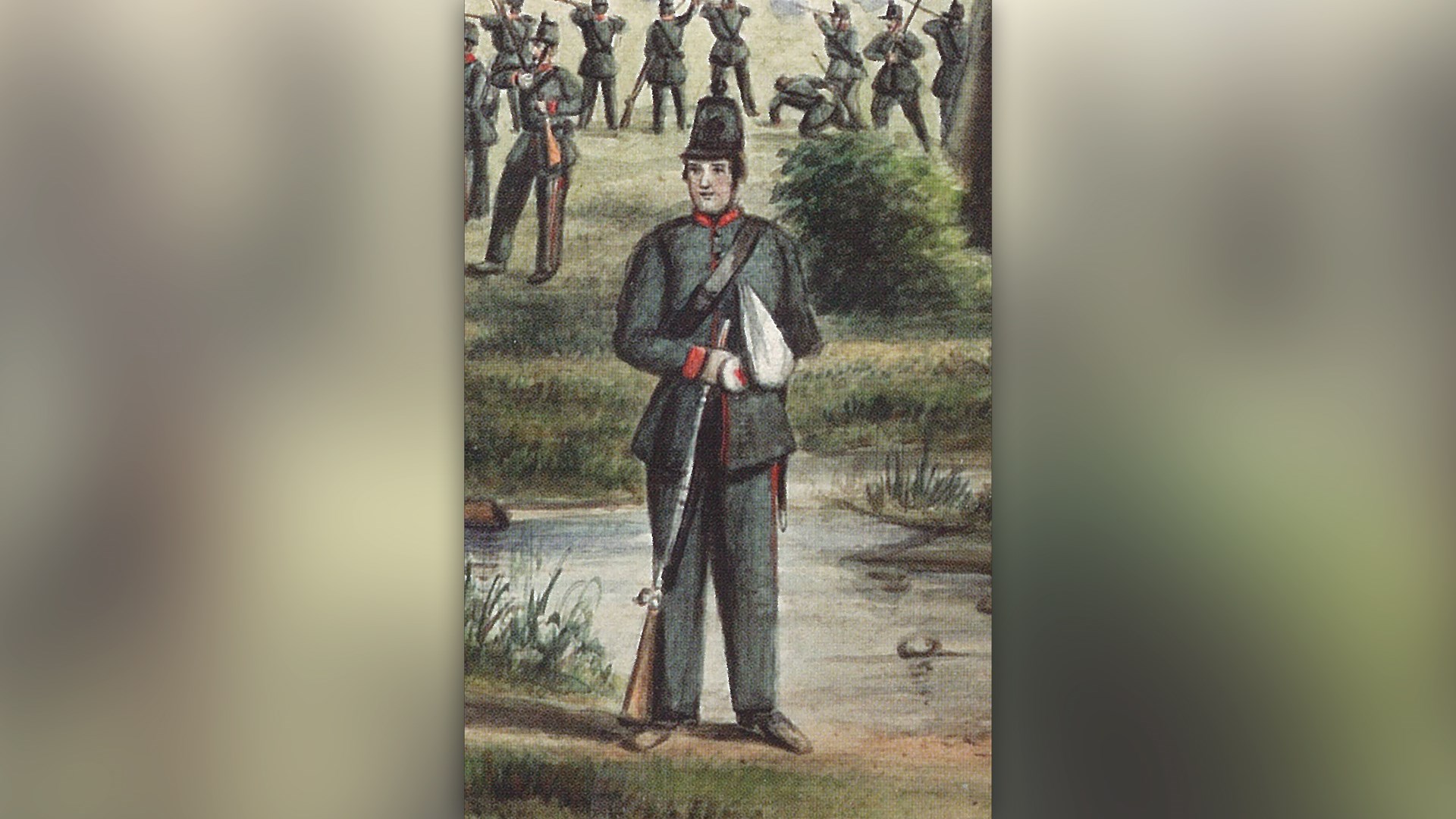
While it is certain that Copp was wounded while firing his M1865 Spencer rifle, and that it was later repaired by John Hamilton, the scrap of paper with Hamilton’s initials “JH ”on it is the missing piece of evidence that would confirm its provenance. From the Erichsen painting in the book, First Hand Accounts of the 1866 Fenian Raid and Battle of Ridgeway, courtesy of the Fort Erie Museum, Ontario, Canada.
Canadian arms historian Grant Rombaugh, and Maj. John Stephens, the curator of the Queen’s Own Rifles Museum, both concur that the officers of No 5 Coy most likely never made a list of the serial numbers of the Spencer rifles being handed out on board the City of Toronto in the pre-dawn darkness of June 1, 1866. At least no such list exists today—or if it does, no one has ever seen it. Although there is no “smoking gun” document that shows M1865 Spencer rifle, serial number 2425, was issued to Private Walter Brown Copp, it certainly seems that it was, based on the circumstantial evidence that I have been able to uncover—with a lot of help from my friends. However, having a small scrap of paper from the rifle’s barrel channel, with the initials “J H” on it certainly would go far as confirming evidence! The only benefit from my embarrassing mistake of disposing of that scrap of paper, is to advise arms collectors and museum curators alike that if they “don’t think twice” before succumbing to temptation, and disposing of seemingly meaningless bits of evidence from old guns, the results may not turn out to be “alright.”
While the Beatles could “get by with a little help from their friends,” I never could have discovered the provenance of the Frankenspencer, or unraveled its mystery, without a whole LOT of help from my friends. They include: Harris J. Andrews III, Susan Bellinger, René Chartrand, Owen Conner, Fred Gaede, Les Jensen, Ross Jones, Mark Keefe III, Forrest MacCormack, David Penn, Grant Rombaugh, Tom Rutherdale, Rick Shaver, Brian Sheetz, Kay Smith, Steve Smith, Major John Stevens, Lisa Traynor and Garth Wetherall.
This article is drawn largely from one that was published in the May 2019 issue of the International Committee of Museums and Collections of Arms and Military History’s online ICOMAM Magazine, and from presentations that were made to the Company of Military Historians in 2021, both in New Jersey and in Virginia.