
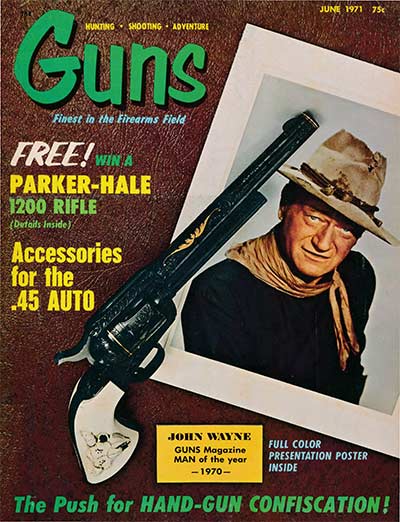
John Wayne was selected as GUNS Magazine Man of the Year for 1970
and presented with this 71⁄2″ .45 Colt.
“I mean to kill you or see you hang in Judge Parker’s court.” “That’s mighty big talk for a one-eyed fat man!” “Fill your hand you sunnovabitch!” And with those words Rooster Cogburn, with the reins in his teeth, twirling his Winchester in his right hand, and cocking the Colt in his left hand, charges into the Ned Pepper gang and wins his first and only Oscar for his real self, John Wayne. The movie was True Grit and Wayne said it was the first movie in which he played a character instead of himself. “You’ve gone to seed Rooster,” says John McIntyre in the sequel, but the pot belly and eye-patch will be forever linked to John Wayne as one of his best, perhaps the best film role of his 169-film career spanning more than 50 years from 1925 to 1976.
Depending upon the biographer consulted, Marion Michael Morrison — or Marion Robert Morrison — was born in 1907 or 1908 in Winterset, Iowa. His father was a pharmacist and due to bad health moved the family to California when Marion was five years old. The move was good for both father and son and young Marion attended Glendale High School where he starred on the football team. After being unable to win an appointment to Annapolis and a Navy career, he eventually secured a scholarship to USC and played in the Rose Bowl.
At the time, silent movie Western star Tom Mix arranged for summer jobs for USC football players and Morrison worked in the property department. He was spotted by John Ford, who hired him as an extra in what would be Morrison’s first film, Mother Machree, and set the stage for the future and some of the greatest films ever, John Ford Westerns.
As a youngster Morrison had a large dog named Duke, from which he received the nickname “Little Duke” and in his first movies he was known as Duke Morrison. Duke would appear in six more movies and was then hired by Raoul Walsh to play the scout in the epic Western, The Big Trail in 1930. Morrison arrived on set after two weeks of acting lessons and Walsh had to spend time washing away those lessons so he would be the natural person needed for the role. In later years Duke would say he never acted, but rather was just himself and we can thank Raoul Walsh for that.
Duke’s first Western film did not do well, however it gave him a new name and set the stage for a long line of “B” Westerns. Marion Morrison simply would not do, so Duke became John Wayne. During the 1930s John Wayne made a long string of, as he says, “Each film more forgettable than the last,” budget Westerns. In 1935 he starred as Stoney Brook in The Three Mesquiters movies and also began a long friendship with the man who was probably the greatest of all stunt men, Yakima Canutt. Not only did Canutt do many of the Duke’s stunts, he taught him how to stage fight scenes and also appeared as a heavy in many of Wayne’s and other’s budget Westerns.
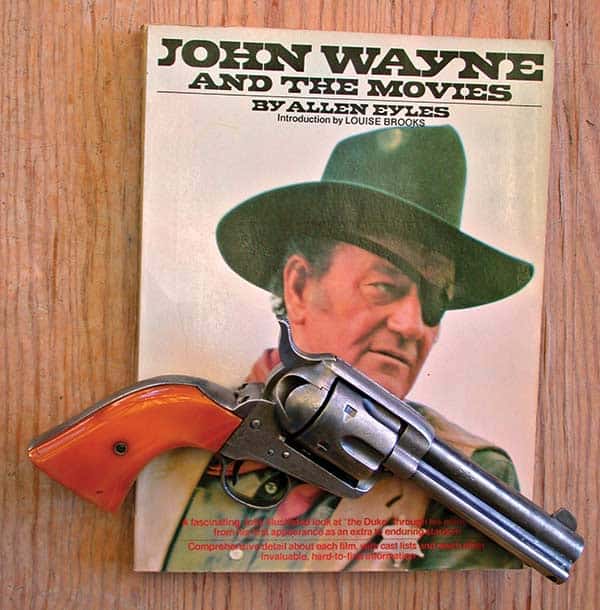
The Duke packed this .44 Remington converted to cartridge
firing in the early scenes of Red River.
Guns As Stars
With such a long career it’s easy to categorize John Wayne’s Western films in many ways. One of the easiest divisions is made by looking at the Colt Single Actions he used. Throughout most of his low-budget, make-‘em-fast B-Westerns his Single Action Army of choice was a 51⁄2″, nickel-plated, ivory stocked .38-40 or .44-40 carried in a fully carved belt and holster, sometimes Buscadero style with the holster hanging from a loop in belt. Others featured more of a Tom Three persons-style holster riding high on the belt. In either case John Wayne was appropriately armed and outfitted as a true B-Western movie hero. He may not have thought much of his B-Western roles, however he was the hero of countless numbers of young boys during the Depression era.
Throughout the 1930s he was stuck in the B-Westerns, however that was about to change. In 1939 he was chosen for the role of Ringo in Stagecoach, of the all-time great Westerns, which was his 65th film. This is one of the few Westerns he made without a Colt Single Action. His co-star in this movie was the first appearance of a Winchester Model 92 with the large loop lever now forever
known as the John Wayne Lever. When the Duke stood in front of the stage to Lordsburg and swung that rifle a new phase of his career began. The stunt man in Stagecoach was once again Yakima Canutt, who performed the memorable stunt of falling from the running team of horses, going under the moving coach, grabbing the back of the coach and coming back up on top. He did many such stunts, making John Wayne look very good and providing grand excitement. In later years, Canutt was replaced by the Duke’s standard stunt man and stand-in, Chuck Roberson.
Stagecoach was a definite hit and would launch another phase of Wayne’s career, however he was still under contract for several more B-Westerns before he left them forever. Better parts came along beginning with Tall In The Saddle in 1944. This combination mystery and Western has one of my all-time favorite John Wayne scenes as he faces the bad guy in the middle of street and says, “Touch that gun and I’ll kill you!”
With this movie we see his leather and sixgun have changed. The flamboyancy of B-Westerns was no longer needed and the holster, made by Cap Hardy or Ed Bohlin, was of plain leather and of the style Wayne would wear in the rest of the films; a Tom Three persons style with a longer drop loop. The sixgun is now a standard finished Colt Single Action with black gutta percha grips. The style would be carried well into the 1950s and returned to in his 126th film in the 1960s, a black and white feature, The Man Who Shot Liberty Valance.
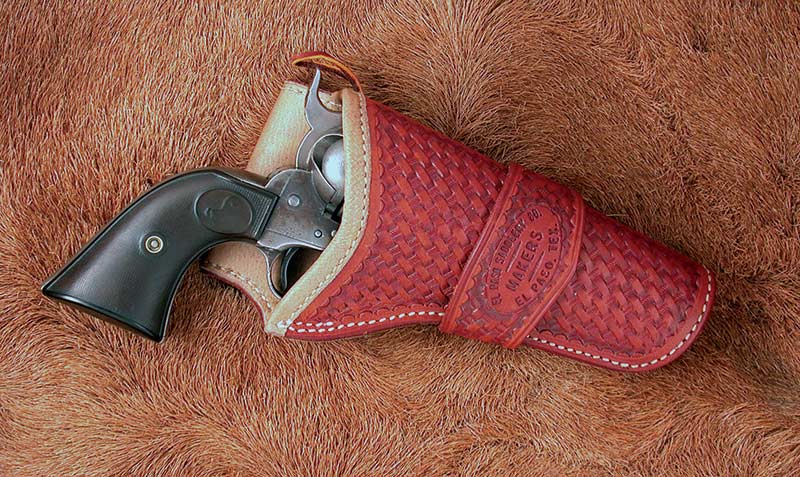
El Paso Saddlery offers this rendition of the John Wayne holster.
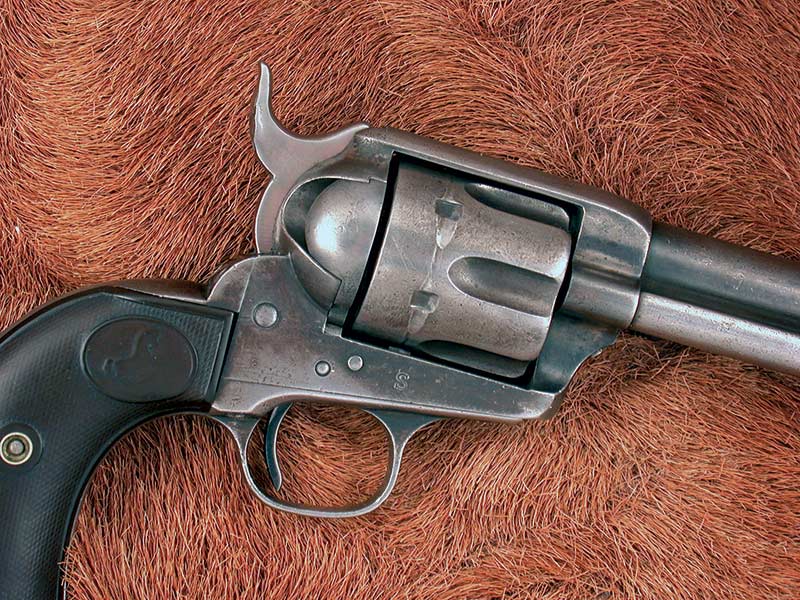

This Remington .44 (converted to cartridge) was used by Duke.
Producer
In 1947 Wayne not only starred in, but also produced, his first film, Angel And The Badman. This is the earliest John Wayne Western I remember firsthand. I was eight years old at the time and along with my five-year-old cousin walked several miles to see John Wayne as gunfighter Quirt Evans. One year later I would ride the bus to town by myself to see The Three Godfathers, Wayne’s first color western. As I think back on these wonderful growing up years it pains me to realize how times have changed. Not only do young kids no longer have heroes, at least the right kind, there aren’t many places left in the country where young kids can travel safely on their own.
Duke would soon become a top box office draw. The John Wayne/John Ford Western Trilogy of Fort Apache, Rio Grande, and She Wore A Yellow Ribbon saw Wayne cast not as a cowboy or gunfighter but rather a member of the United States Cavalry on the frontier, a role he would return to several times in the future. These three pictures were among the last of his black and white features, and all of his future Westerns except one would be big budget color features.
In 1964, Wayne, who had been a chain smoker most of his life, was found to have cancer. Instead of trying to keep it secret he went public to encourage others. He survived, however lost a lung in the process. Films made after this time show some of the effects of cancer as the stunt man and stand-ins become more obvious, however what he is still able to do himself is most remarkable.
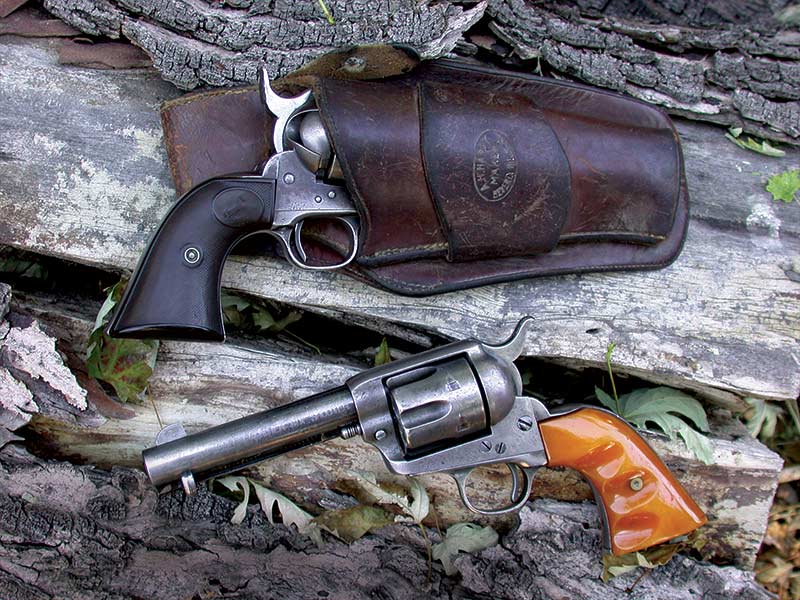
Cap Hardy of Beverly Hills built this particular holster used by Wayne in
many of his features in the late 1940s and early 1950s.

This large-loop Winchester Model 92 .44-40 starred with
Wayne in 1939 in Stagecoach.
Different Guns
The third phase of John Wayne’s sixguns begins in the late 1950s and early 1960s as he begins carrying the Colt Single Action most of us are familiar with, as well as what has now become typical John Wayne leather. The belt is now a folded-over suede leather money belt, and the holster, which is now offered by El Paso, is a higher riding rendition of an earlier Cap Hardy holster. His sixgun, which he wrongfully called a “Navy Colt” in at least two movies, is a 43⁄4″ Colt Single Action Army, or more correctly a Frontier Six Shooter chambered in .44-40. On the screen it appears to be nickel plated with yellowed ivory stocks. In reality the finish is well worn and may have originally been nickel or blue, and the yellowed ivory stocks with finger grooves are actually made of a tough pre-micarta synthetic known as Catalin. These grips were made by a Texas gun shop owner by the name of Maurice Scarlock who worked in San Antonio and El Paso in the 1920s and 1930s. They are available today from Buffalo Brothers.
In 1969, with only one lung, and now in his early 60s, pot belly and all, John Wayne put on an eye patch and became Rooster Cogburn in a memorable performance. Rooster was a man with true grit and Hollywood finally recognized his contributions.
After True Grit, John Wayne would make some of his most enjoyable and best Western films: Chisum, Rio Lobo, Big Jake (“I thought you was dead!”), The Cowboys, The Train Robbers, and Cahill, U.S. Marshall. In Big Jake John Wayne was teamed with Maureen O’Hara as he had been in The Quiet Man, Rio Grande and McClintock; every theme was the same, that of the war between the sexes.
I won’t argue the fact but Maureen O’Hara was certainly the most beautiful actress to ever appear on film. After the Duke’s death she led the effort, along with Elizabeth Taylor, to have a Congressional Medal issued to celebrate Wayne; it simply said “JOHN WAYNE, AMERICAN” as he was a true American patriot.
In 1971 John Wayne was chosen by our sister publication, GUNS, as their first “Man Of The Year” and presented with a 71⁄2″ ivory stocked .45 Colt Single Action. The last two films made by John Wayne rank way up on my list of his favorites. My son-in-law came over last night and asked to watch a John Wayne movie. I plugged in the 1975 Rooster Cogburn with the Duke paired with a memorable performance by Katharine Hepburn in what is essentially a re-make of The African Queen. This film would be the last time Wayne used his 43⁄4″ .44-40 “ivory-stocked” Colt Single Action.
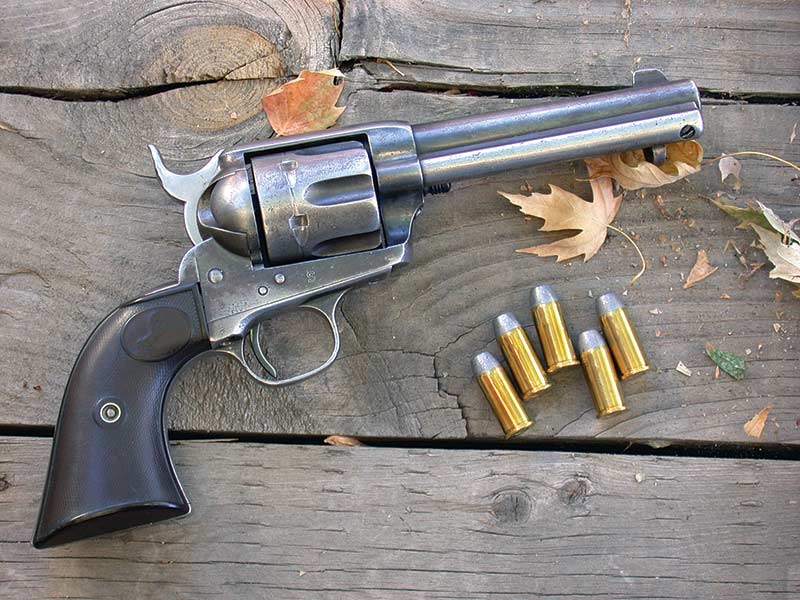
SAA used in The Man Who Shot Liberty Valance. Note the fanning hammer.
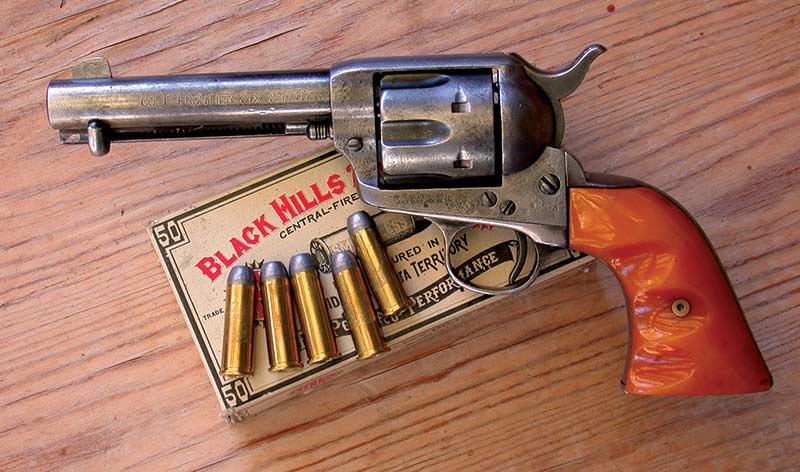
Colt Frontier Sixshooter .44-40 used in most of the Duke’s films in the 1960s and 1970s.
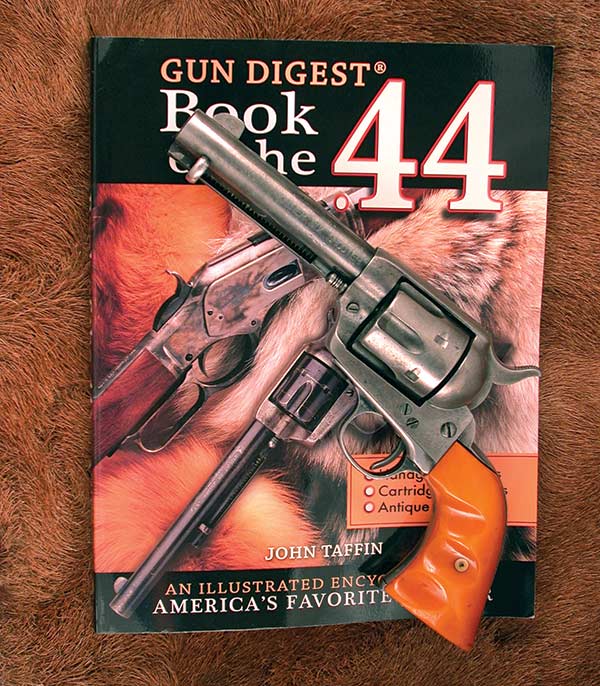
The sixgun most associated with John Wayne is this catalin-gripped Colt .44-40.
The Last Go
John Wayne had one more film left in him. In 1976, now nearly 70 years old, his 169th and last film would be The Shootist which tells a story of an aging gunfighter dying of cancer. His sixgun, actually sixguns, are also different. He uses two of them, one fully engraved; and, at least according to very reliable sources, they are not Colts but actually Great Westerns presented to him by Great Western in the 1950s. Wayne is pictured in Sixguns By Keith (1955) with his pair of Great Westerns.
John Wayne, as my two other lifetime heroes Theodore Roosevelt and Elmer Keith, was uniquely American and a true one-of-a-kind. We shall not see their like again. I have been privileged to have four guns used by John Wayne in many movies on hand for several months. They are a Remington .44 converted to cartridges and used by him in the opening scenes of another grand B&W film, Red River; a Winchester Model 1892 .44-40 with the large loop lever; and two Colt Single Action Army models, both with 43⁄4″ barrels. Neither sixgun has any finish left. The oldest, in the 125,000 serial number range, dates to 1888. It has no caliber markings, and wears the standard gutta percha grips. The hammer has been modified for easier fanning as used by Wayne as Tom Doniphan in The Man Who Shot Liberty Valance. The only cartridge I can find which will chamber in the sixgun is a .44 Russian.
The second sixgun, dating back to 1896, and as noted is a 43⁄4″ .44-40 Colt Frontier Six Shooter with yellowed stocks, he used in many movies from the 1950s through the 1970s. All of these guns originally belonged to Stembridge Rentals which rented guns to the movies for nearly 60 years. They closed their doors in 1999 and all guns were sold off. Fortunately they kept very accurate records on which guns were loaned to who and used in which movies.
The guns pictured now belong to Al Frisch. If you are interested in old movie guns and history contact Al Frisch at 24907 Meadview Ave., Newhall CA 91321, (661) 259-9789. He also has an excellent DVD video of a modern B Western he has produced which has an extra bonus presentation of many of the movie guns hosted by himself, Phil Spangenberger and Buck Taylor. Both the movie, Vengeance Trail, and the extra added feature Star Guns of Western Films are most enjoyable and guaranteed to take the viewer back in time.
When asked how he would like to be remembered, Wayne said “Feo, Fuerte, y Formal” which translated from the Spanish is “He was ugly, was strong, and had dignity.” Not a bad epitaph.
Situation: A man is beating a woman and child. He is armed with a bat. You are the only one effectively capable of stopping him.
Lesson: Aimed fire works at close range. Deadly force against a violent criminal attempting to disarm you is justifiable. And even the most righteous shooting can have devastating reverberations.
October 16, 2018, Clarksville, Indiana. Dusk is fading into darkness. It is early evening at the River Chase apartment complex, a pleasant neighborhood where families barbecue and children play on lawns. It is not the sort of place where one expects deadly violence to break out.
Until it does.
Brandon Haycraft, 31, lives there. He is a tormented man. His baby has died a short time before, while lying in bed next to him, and he is swamped by guilt. He has been caught up in a cycle of substance abuse. One co-worker will later describe him as “a mean drunk.”
THC is in his bloodstream now, but the marijuana hasn’t mellowed him. He has taken anti-depressants, but they aren’t helping. Neither is booze. At the moment, his blood alcohol content is 0.228%, almost three times the legally drunk limit. He has told his significant other that he’s going to die tonight one way or the other, and he might just take her with him.
His prediction is at least partly correct.
Meanwhile …
Among Brandon’s many neighbors in this peaceful area is Adam Nesvick, 37. On this seemingly normal Tuesday evening he is home alone for the moment, preparing a dinner of tacos for the rest of his family who are due to arrive at the apartment soon.
He is interrupted by the sound of loud shouting. This is a neighborhood where children commonly play outside at this hour, and at first, he thinks it’s just kids getting a little rowdy. Glancing out the window, he sees his wife’s car has just pulled up, and he goes outside to meet her.
The tableau before him is unexpected. He notices his wife is on her cell phone, and he hears her scream, “My God, he’s going to kill her!” He’ll later learn 911 dispatch is on the other end of his wife’s conversation. A neighbor cries out plaintively, “My God, isn’t someone going to do something?”
And now Adam sees the cause of the trouble. His neighbor across the street is brutally punching his girlfriend in the face as she sits on the ground, feebly trying to protect herself. Her daughter, age nine, swings what appears to be an aluminum T-ball bat into the big man’s back, trying to stop him from beating her mom.
Adam watches in horror as Brandon rips the bat away from the child and throws her some six feet away.
Adam and Brandon both weigh about 240 lbs., but Adam is five-feet-nine while Brandon stands six-feet-two and is rippled with muscle. He’s also now armed: He has the metal baseball bat. Adam realizes he can’t deal with this bare-handed.
Adam runs back inside his apartment for his gun.
He’s had a carry permit since he was 18 years old. His current carry gun is a SIG SAUER M11-A1, fully loaded with 9mm Speer Gold Dot 124-grain +P bonded hollow points. He’s left it on his desk in an IWB Comp-Tac holster, and now he pulls it from its Kydex scabbard and sprints back toward the door, the pistol in his dominant right hand.
When he emerges from the door, he can see the situation has degraded. Before, the man had been punching the downed woman in the head, brutally. Then, she had been down on her butt as he beat her; now, she is down on her back on the front lawn with the boyfriend hulking over her, holding the bat horizontally in both hands across her throat, trying to crush her larynx.
The beatdown has turned into attempted murder in progress.
Closing to a distance of about 15 feet from attacker and victim, Adam stands in the street, levels the gun at Brandon and shouts, “Get the f**k off of her! Sit the f**k down or you’ll be shot!”
The big, angry man turns to face the rescuer. He flings the bat at Adam. It lands halfway between them on the lawn, some six or seven feet from the armed citizen who is still standing in the street.
Safe for the moment, the little girl runs into her apartment, followed by her mom. Brandon sits on the steps and puts his head in his hands. Adam lowers his SIG to a ready position. The man has obeyed his commands. Adam hopes it is over.
It isn’t.
Attack
The lull in the action lasts about 30 seconds. Then Brandon rises, his muscled body tensed with rage, and screams at Adam, “You don’t know me, motherf**ker!” He starts moving toward Adam and yells, “You gonna shoot me, motherf**ker? You aren’t going to do anything with that [gun], you fat ass!”
Adam is backing away from him, the pistol raised again now, and he is shouting, “Stop! Don’t do it! Stop! Stop!”
But the antagonist can move forward faster than the defender can backpedal, and is closing the distance fast, and at last there is only one thing left to do.
Shots Fired
Under the streetlights, the sky nearly dark, the green Trijicon night sights on the SIG glow like beacons. Adam Nesvick puts the front sight high on his attacker’s chest.
He fires as fast as he can hold the front sight in place. He sees blood squirt toward him from the man’s chest. Suddenly Brandon falls, pitching forward at about a 30-degree angle, and lands heavily face down in the street, motionless.
And, just that quickly, it’s over.
Immediate Aftermath
The Clarksville Police arrived quickly, some 30 seconds after the last shot had been fired. Adam’s wife Shannon had described the situation to the police before they got there, and none of the cops felt a need to take Adam at gunpoint. Per protocol, however, they patted him down, handcuffed him, and placed him in the back seat of a patrol car.
Adam said later, “I remember sitting in the back of the car praying for the soul of the man I had been forced to shoot, praying for the mom and daughter, praying for the well-being of my family, praying the police understands the situation and I actually get to go to my daughter’s wedding in four days and am not sitting in jail. While I was in the car, I noticed my left hand and arm were covered in blood spatter.”
It didn’t take the police long to sort things out. Haycraft had not survived. Nesvick’s aim for upper chest had been true. One of his four hits had pierced the man’s aorta, accounting for the blood spurt and spatter, and another had smashed the spine; that bullet, Nesvick opines, was likely the shot that finally dropped the attacker.
Immediate Aftermath
Nesvick’s first realization he wasn’t in trouble was probably when a female officer approached him while he was still handcuffed and confided, “You know you’re a hero to that woman and little girl.” Adam later told American Handgunner, “That remark helped steady my nerves and ground me.” He added, “I … was approached by the Chief of Police for our town and he said, ‘What you did was heroic, you probably saved their lives.’ He told me they had had prior dealings with the man and he was a dangerous individual.”
Says Adam, “Fast forward another hour and I’m sitting in the office area of the police station waiting to make my statement, watching the forensics officer check in the evidence … I saw them check in my gun, and there was blood on the slide. They checked in the bat, and they checked in a chunk of hair that had come from the mother, and a few other miscellaneous things.”
Adam continues, “While I was sitting there, finally in some kind of light, I noticed blood stains all over my shirt and pants. He was really close when I shot him. Anyway, I gave my statement, keeping it simple and to the point. The biggest thing I remember them pressuring me on was ‘Was it an accident? Did you inadvertently fire?’ My answer was ‘No, officer, I was scared shitless, but it was a conscious act to fire because I knew my life was in danger.’ I had my wife bring me new clothes so they could put mine in evidence, and I walked out and got in the car. The officers thanked me repeatedly for being cooperative.”
It took a while for the prosecutor to call Adam to confirm he considered Adam a hero, and he definitely wasn’t going to be charging him with anything. At this writing, no lawsuit has been filed, and the window for plaintiffs to do so will have closed by the time you read this. The prosecutor’s finding actually came sooner than that.
Wave3 News reported soon after the shooting, “‘He did approach the individual who was assaulting the lady and her child and did, at gunpoint, instruct him to leave them alone and sit down on the curb,’ said Clark County Prosecutor Jeremy Mull. Police said the man complied for a while, but then tried to attack the neighbor and ignored warnings to stop. When he came at the neighbor, police said he shot him. ‘Based upon what we learned last night, I’m of the belief that it was self-defense, that it was justified under the law and therefore there was no arrest made in the case,’ Mull said. ‘In a case where an individual was acting violently and had just violently assaulted a child and a defenseless lady. Due to his intervention, the assault was terminated, and this individual was ultimately killed in an act of self-defense.’”
The legal side of it was, for all practical purposes, over. It had clearly been a justified homicide. But there were still the emotional and psychological elements to deal with.
Personal Aftermath
It is common for defensive gun usages to happen at or near one’s home. Often, family members are present, and it’s a traumatic thing for them to experience. You’ll recall Adam’s wife, Shannon, was outside the house and in fact the first to call 911. She told American Handgunner, “When Adam stepped out with the firearm, I told 911, ‘My husband has a firearm, he has a permit, he’s trying to get the guy to sit down.’ I heard the dispatcher say ‘Weapon involved’ or ‘Weapon on scene.’ My husband walked over to the curb and had the husband sit down. I saw the woman and girl run into the house. A car blocked my view of Brandon, I couldn’t see if he was sitting or lying. In 30 seconds, I saw the man jump up and come rapidly toward my husband and when they got about 10 feet apart, my husband started backing up. He was telling my husband, ‘You aren’t going to do anything with that, you fat ass.’ He began to lunge at Adam, and Adam fired. I thought it was three shots. He collapsed. I saw blood squirting everywhere.”
Altered perceptions are extremely common in these incidents. Far more often than not, auditory exclusion or auditory muting will occur. Adam Nesvick was no exception. He told AH, “I had auditory exclusion so bad I didn’t hear everything he said as he came at me while I was screaming ‘Don’t do it!’ When I fired, I remember hearing muffled gunshots. I heard little pops, but I was deaf as a post for three days later.”
Another extremely common phenomenon is tunnel vison. Adam told us, “When the woman and the little girl went into the house and he got up, I realized ‘Oh, my God, this is going to happen, I’m probably going to have to shoot,’ and I hyper-focused on him from then on.”
When multiple shots are fired, relatively few participants remember the round count correctly. This was true here as well. Adam and Shannon each thought Adam had fired three shots, while one eyewitness insisted five shots were fired. All were incorrect: Evidence incontrovertibly proved Adam had unleashed four rounds.
After you’ve been in an incident like this, people treat you differently. Dr. Walter Gorski, the great police psychologist who is credited with defining “post shooting trauma” as something separate and distinct from Post Traumatic Stress Disorder (PTSD) referred to it as Mark of Cain syndrome. Sometimes, you are excoriated as a murderer. On the opposite end of the spectrum, you may be treated like a hero. The latter of course is better, but can still leave you wondering whether people still see you as the good neighbor, the good professional, the good worker at your job; instead, they see you as “He Who Killed,” and it changes the way they treat you, which in turn can change the way you feel about yourself.
Little kids had always seemed to play outdoors in their neighborhood; after the shooting, not so much. The mom and daughter whom Adam had rescued spent a couple of days in the hospital, refused to look at Adam or Shannon after coming home, and soon moved away. Other neighbors started moving away too.
That said, though, Adam reports, “No one really dumped on us. One of the little kids, who was a friend of the little girl who used the bat to try to get Brandon to stop beating her mom, saw us on the street and gave us a big thumbs up. Brandon’s best friend told me, ‘I’m sorry he died, but you did what you had to do.’ The apartment complex gave us a $50 gift certificate to go to dinner on them.”
Sleep disturbance is a virtually universal experience among those who’ve had to kill to survive. “I didn’t sleep for three days afterward,” Adam told us. “This eventually went away. I had flashbacks for a long time and still do occasionally, but not as bad or as vivid. Shannon had really bad flashbacks. We were comfortable talking about it, and that got us through a lot. Shannon got counseling. I got help from friends who had been through similar things, maybe more help than I would have gotten from a psychologist.”
In 2020, the Nesvicks moved to another state. “I thought getting away was the best thing, not being in the place every day where I had shot someone,” Adam explained.
The police gave him his gun back a month later. He was deeply touched to note the cops had not only wiped the blood spatter off the SIG but had cleaned and oiled it too.
His SIG went away. It carried too many unpleasant memories. Today Adam carries a CZ P10C.
Lessons
Excellent marksmanship, delivered at speed with the front sight visually indexed, put every shot where it needed to go and quickly ended the attack. The SIG M11-A1 had a full magazine of fifteen 9mm rounds. If Brandon had gotten it away from Adam, that was enough to kill the rescuer, his wife Shannon, and Brandon’s own significant other and her little girl, and any other witness who came into the line of fire. Adam Nesvick’s defensive gunfire very likely saved more lives than his own.
Adam had worked hard to develop shooting skill. He had learned from friends, read many books, and participated in gun-related internet forums. After the incident, he decided to seek formal training, and took a class from nationally recognized instructor John Murphy of Virginia. John told me Adam was very competent. Indeed, it was John Murphy who put me in touch with Adam and brought his story to these pages.
A lot of gun owners think home carry — wearing a handgun on their physical person when at home — is paranoid. If we think about it, the practice is a minor inconvenience for which in trade the homeowner gets instant access to a loaded gun when deadly danger suddenly presents itself. Had the SIG been on his hip instead of on his desk, Adam might have been able to back down Brandon before the latter put his bat to the throat of his victim. But there is no telling for certain.
You’ve all heard of “suicide by cop,” the self-destructive person who forces a lawman to kill him. This incident is a case of “suicide by armed citizen,” not the first such I’ve seen.
Adam Nesvick did the right thing. The criminal justice system immediately recognized that. Adam doesn’t consider himself a hero. He’s the only one who doesn’t.
.gif)



The SKS has a powerful history across the world, but especially in Vietnam. Take a look at its history on the infamous “Hamburger Hill” and its potential today.
May 02, 2023
On May 10, 1969, ten Allied Infantry battalions launched Operation Apache Snow into the A Shau Valley in Vietnam’s Thura Thien-Hue Province west of the city of Hue. Friendly combat elements included portions of the ARVN 1st Division, the 9th Marine Regiment, and the 187th, 501st, and 506th Infantry Regiments of the 101st Airborne Division.
The storied 101st Airborne Division has deep historical roots reaching all the way back to the Second World War. The 506th Infantry Regiment, as an example, was the unit depicted in the powerful miniseries Band of Brothers. In Vietnam, the VC and NVA referred to 101st sky troopers as the “Chicken Men” based upon their distinctive Screaming Eagle shoulder patch. Enemy commanders were said to have avoided combat with the “Chicken Men” whenever possible due to their legendary fierceness in battle.
The mission of Operation Apache Snow was cold and calculating. The A Shau Valley was a conduit for troops and supplies infiltrating into South Vietnam from Laos. American forces had little use for terrain. With hundreds of helicopters at their disposal American commanders could seize most any piece of dirt they wished. Apache Snow was about corpses. The overarching plan was to block escape routes into Laos as well as to find, fix, and destroy enemy combat units in the valley.
This operation involved some of the fiercest ground combat of the war. American artillery, helicopter gunships, and close air support worked synergistically with the ground elements to crush NVA units when and where they could be found. Over a ten-day period the 3d Battalion of the 187th Infantry Regiment made eleven assaults up Hill 937, destroying NVA fortifications and grappling with enemy units at close range.
The men involved in this grueling pitiless fight came to refer to this often hand-to-hand conflict as the Battle for Hamburger Hill. After roughly four weeks of bitter combat American forces withdrew and abandoned their hard-fought territorial gains. American forces lost 113 killed while the ARVN 1st Division lost another 31. On the other side of the balance sheet American forces recovered the bodies of 977 NVA regulars and took five prisoners.
Mike was a typical American teenager. He enlisted in the U.S. Army at age eighteen in search of adventure, camaraderie, and relief from the drudgery of rural Michigan.
In late 1968, as an Infantryman in Vietnam, he found all those things and more. Mike was a rifleman with the Screaming Eagles during Operation Apache Snow. He fought in the A Shau Valley and became intimately familiar with the rich black dirt of Hamburger Hill. Some of those 113 young, strong, brave Americans lost on that forgotten hillside were his dearest friends.
At one point while assaulting through a trench line Mike and his buddies came under intense small arms fire. The NVA were masterful jungle fighters, and rooting them out of fixed defensive works was a formidable task. The 101st Sky Soldiers had been fighting these particular NVA for days. Mike’s rifle platoon pinned the NVA defenders in place with murderous suppressive fire from their M60 machineguns supported by M61A1 rifles and M79 grenade launchers.
Their attention held by the platoon’s steady base of fire, Mike slipped around the periphery of the fight and crouched behind a heavy tree trunk. He retrieved an M61 frag grenade from alongside his magazine pouch, thumbed off the safety clip, pulled the pin, and tossed it over the edge of the trench. Mike ducked back behind the heavy tree and, for a pregnant moment, just waited. Four seconds is an eternity when you’re waiting on a grenade to go off. The little bomb detonated with a dirty crump and gray-black smoke billowed up from the NVA trench. Mike leapt up and vaulted over the edge, his M16 tracking for movement.
There were three figures lying jumbled on the floor of the trench, their black pajamas torn and wet with gore. Two were inert, but the third moved. Mike reflexively pivoted his M16 and triggered an eighteen-round burst on rock and roll. Suddenly everything was still. (Troops in Vietnam frequently loaded their 20-round box magazines with eighteen rounds to improve reliability.) Mike’s breath came in ragged gasps, his ears rang, and his hands shook. He swapped out his empty magazine for a fresh box containing another eighteen rounds and studied the area around the trench for any signs of enemy activity. Satisfied that the area was secure, his squad consolidated the position, took stock of the weapons, equipment, and intelligence material, and held in place while the rest of the company assaulted forward.
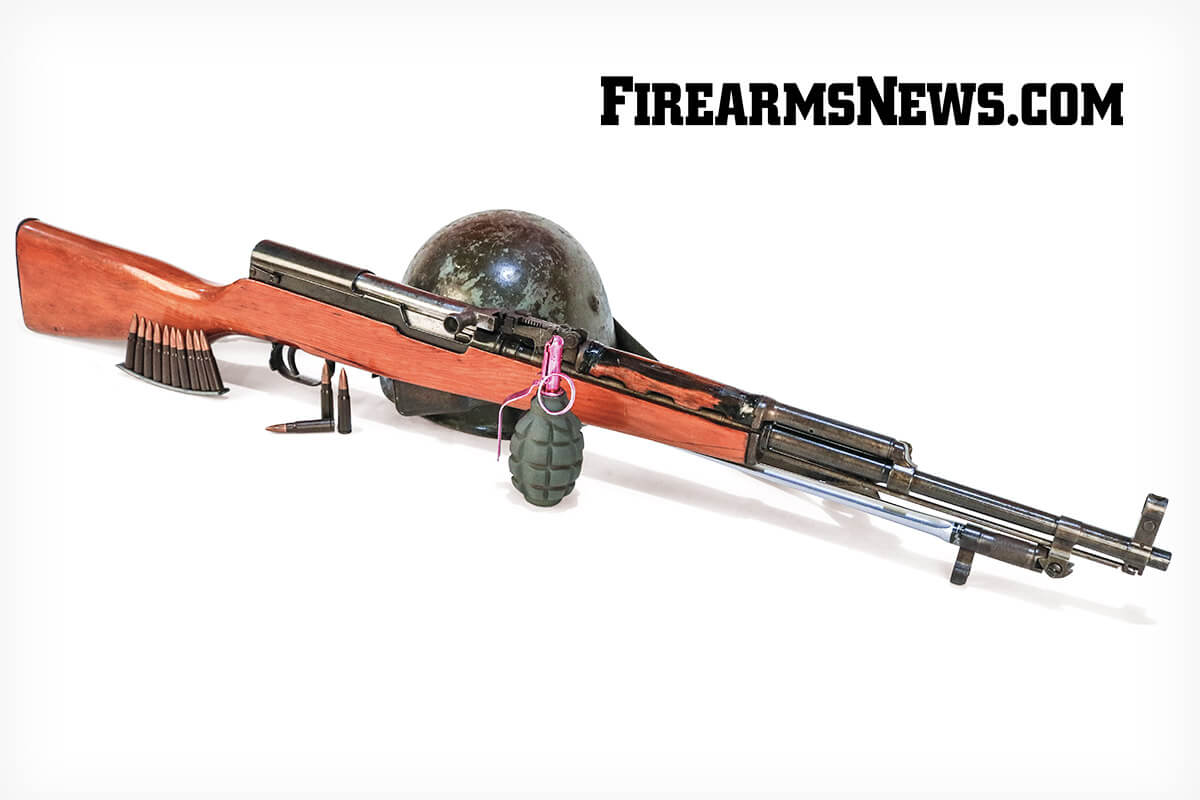
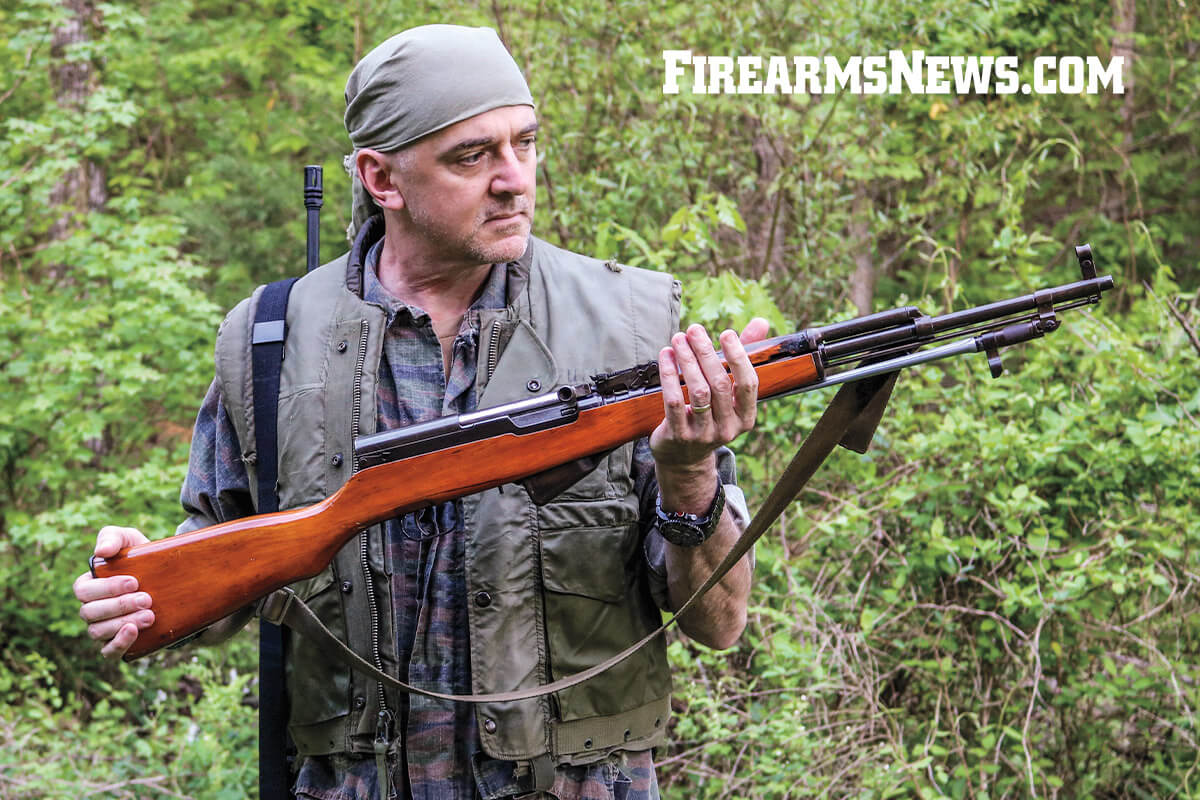
The three NVA soldiers looked pitifully small. Most dead men seem small, but these were also young. The man Mike had killed with his last long burst had been carrying a Chicom SKS rifle. Mike lifted the weapon up from the chaos and filth of the trench and held it aloft. The weapon was mechanically intact, and the barrel was still uncomfortably hot to the touch. A fragment from his grenade had penetrated the side of the box magazine, and a portion of the stock was shattered. Despite this damage the weapon remained functional, a sour testament to the resilience of their foes and the firearms they wielded.
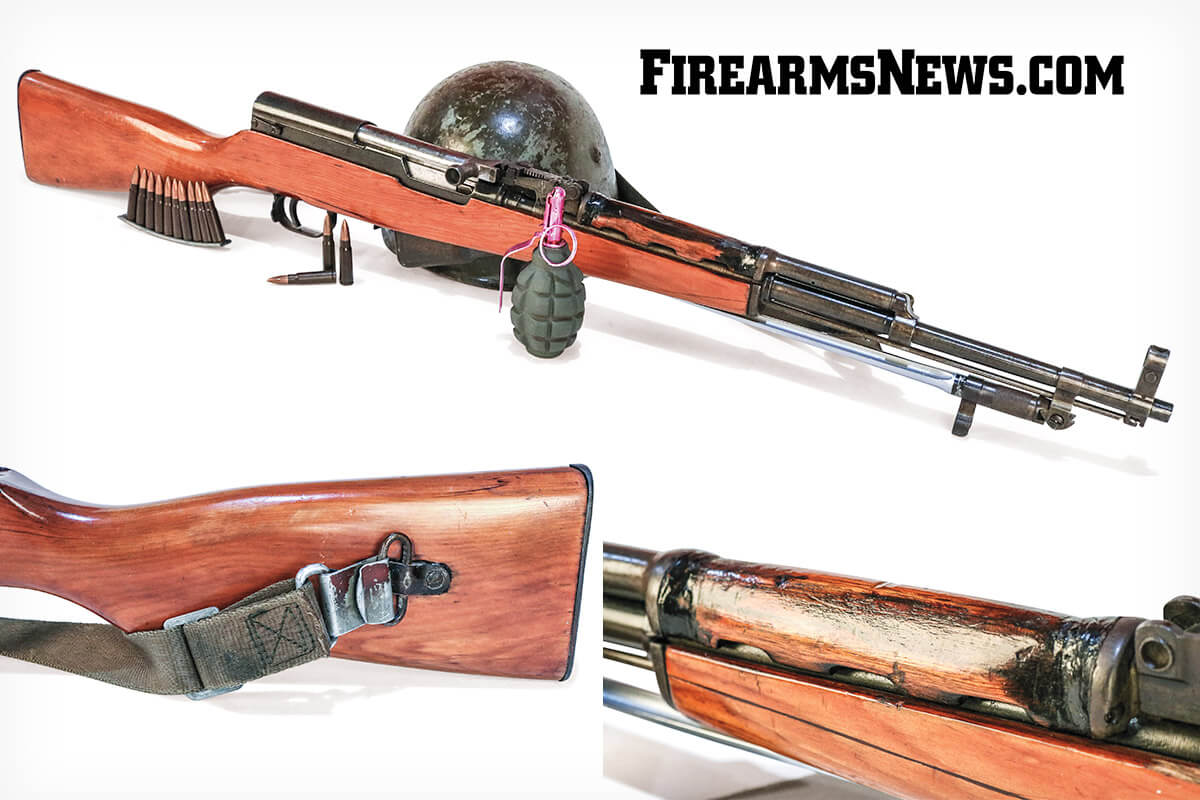
The upper handguard was literally burnt to a crisp, and the bottom of the trench was dirty with shell casings. There was no telling how many rounds this NVA soldier had fired through his weapon in the preceding few days. Mike laid claim to the gun and tagged it with the cooks for safe keeping. When his year-long tour was finally up he filled out the obligatory paperwork, begged his Company Commander for a signature, and brought the beat-up Chinese rifle home in his duffle bag, a poignant memento of the most horrible and exciting time of his young life.
The Rest of the Story
Like so many combat veterans of that generation, Mike had a rocky return to the World. In 1969, America was sick of war in Southeast Asia, and misguided activists stupidly vented their frustrations on the young men who served there. After three years on active duty Mike married and transferred to the Michigan National Guard as the NBC NCO of an Infantry unit. Military service is nothing if not a brotherhood, and Mike made new friends in his Guard unit. Over time they grew close. Eventually in the late eighties Mike’s marriage went sour, and he fell on hard financial times.
Desperate for cash during the divorce, in 1987 Mike offered the beat-up Chinese rifle to a buddy in the Guard for $200. The friend accepted with the caveat that Mike could buy it back any time he wanted for its purchase price. Two years later Mike developed cancer from his exposure to Agent Orange during the war. In 1991, Vietnam ultimately killed Mike at age 41, a continent and a lifetime away from his tour in-country.
The Phone Call
Last year, my friend and editor here at Firearms News, Vince DeNiro, let me work up an article about a Japanese Type 99 rifle damaged during the island campaigns of the Pacific War in WWII. A gentleman read that article and tracked me down at the medical clinic where I work. This man, himself a Vietnam combat veteran, was the Michigan National Guardsman who bought the SKS rifle from Mike.
As is so often the case among gun guys, what began as a transaction ended as a friendship. He related the story behind the gun and explained that there wasn’t anyone in his life with a sufficiently deep interest in the weapon to venerate it with the respect it deserved. As such, we struck a deal, and I assumed stewardship of this most remarkable treasure.
The Gun
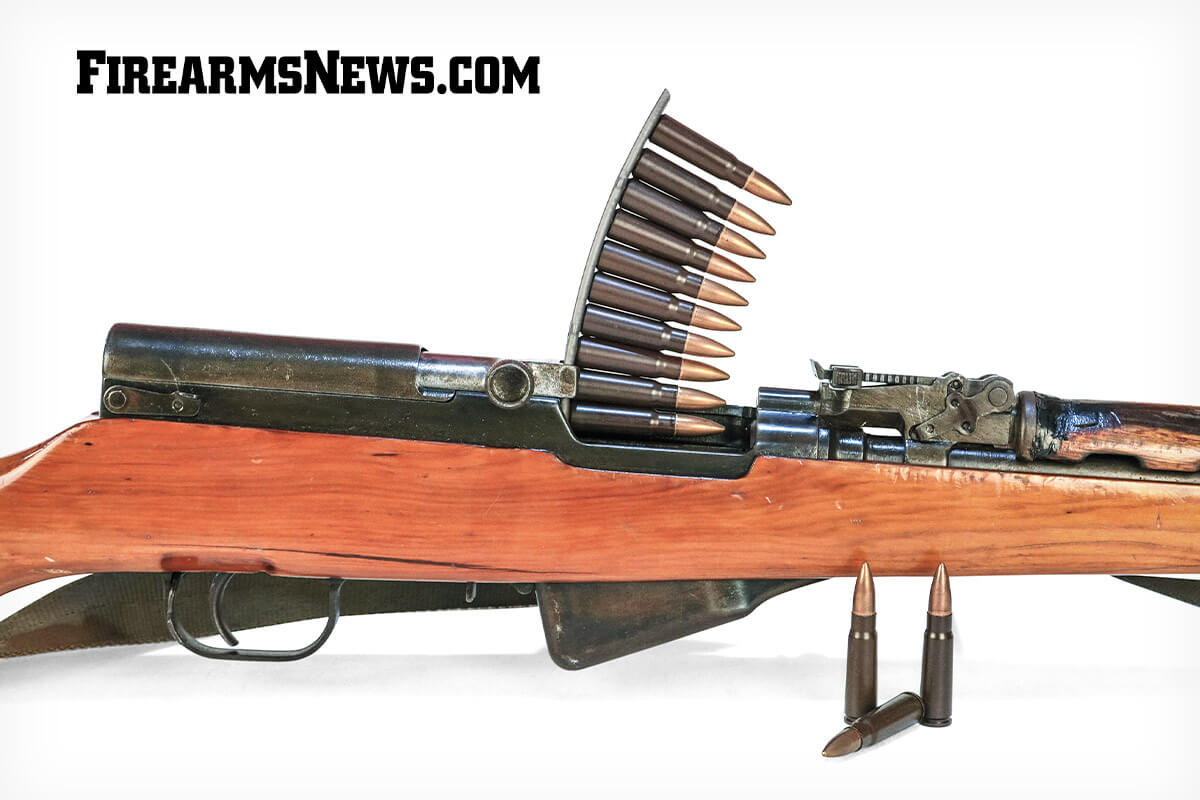
The SKS was designed in 1943 by Sergei Gavrilovich Simonov and formally entered service in 1949. A rugged and maneuverable carbine, the SKS was actually obsolete at the time of its introduction. The AK47 that entered service around the same time offered everything the SKS did and more. The Soviets still ultimately produced some 2.7 million SKS Carbines. Variations were manufactured in China, Yugoslavia, Romania, Albania, North Vietnam, North Korea, and East Germany. More than fifteen million total copies were produced.
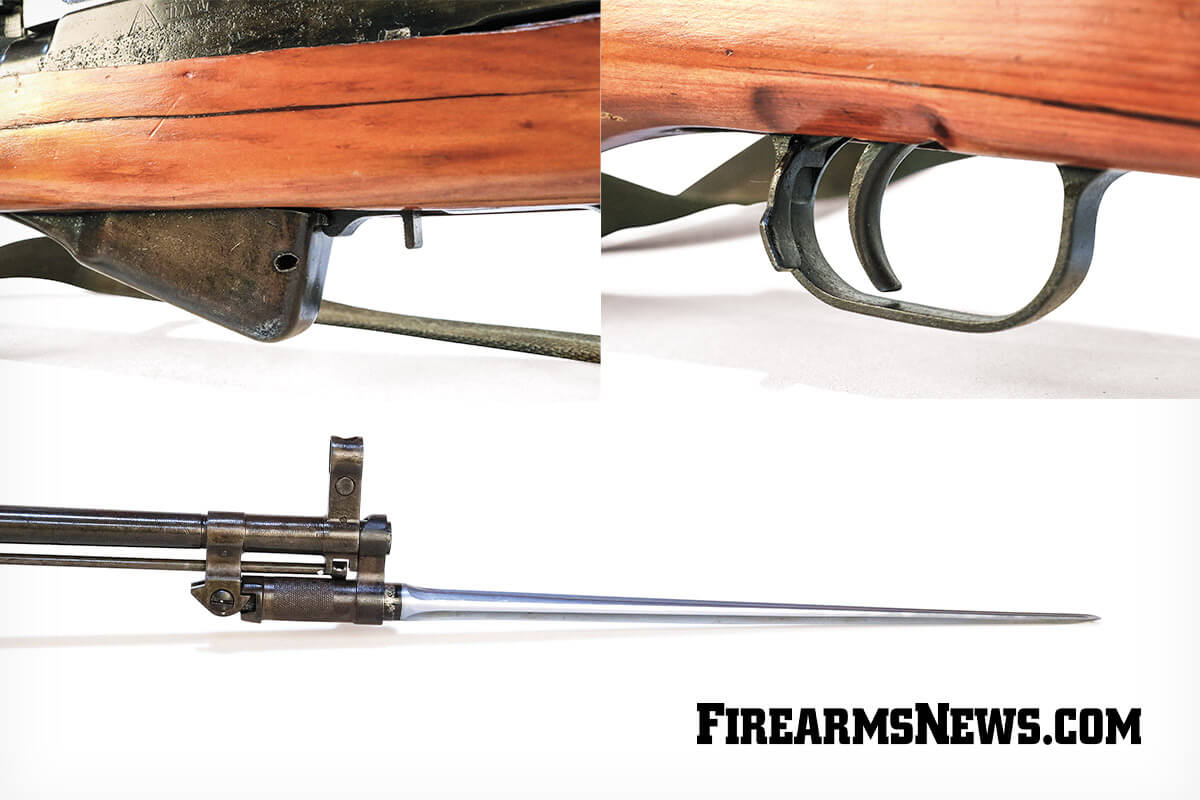
The SKS is a self-loading, semiautomatic rifle with a tilting bolt and a short-stroke gas piston action. The weapon features an integral 10-round box magazine, and the bolt locks to the rear automatically on the last round fired. To load the piece the operator opens the bolt, sets a 10-round stripper clip into the stripper clip guide on the top of the weapon, and presses the rounds into the magazine. With a little practice reloading the weapon is quick and intuitive.
The safety is a pivoting lever on the right side just behind the trigger. Forward is safe. Back is fire. It’s easy to manipulate the safety with your trigger finger. The charging handle is an integral part of the bolt carrier and reciprocates with the action. The magazine is fixed to the chassis of the weapon but can be readily pivoted forward for service via a sliding latch just ahead of the trigger guard.
The SKS is as much a cartridge as a rifle. Early in WWII it became obvious that the full-sized rifle rounds of the day were grossly overpowered for most Infantry combat engagements. Most soldiers in the field packed bolt-action rifles capable of delivering accurate fire out to two kilometers. However, typical infantry engagements were found to be executed at three hundred meters or less. This observation sparked a sea change in military weapons design. The Germans responded with the 7.92×33 kurz round and the StG44 rifle to fire it. Every modern Infantry weapon draws inspiration from this remarkable gun. Meanwhile, the Soviets developed the M43 7.62x39mm intermediate round.
A committee of experienced gun designers came together to craft this new round in 1943. From a possible 314 cartridge designs they winnowed the field down to the 7.62x39mm. This radical new intermediate round was originally intended to feed a semiautomatic carbine, a selective-fire assault rifle, and a belt-fed light machinegun. In the SKS, AK47, and RPD the Soviets filled those requirements.
Specifics
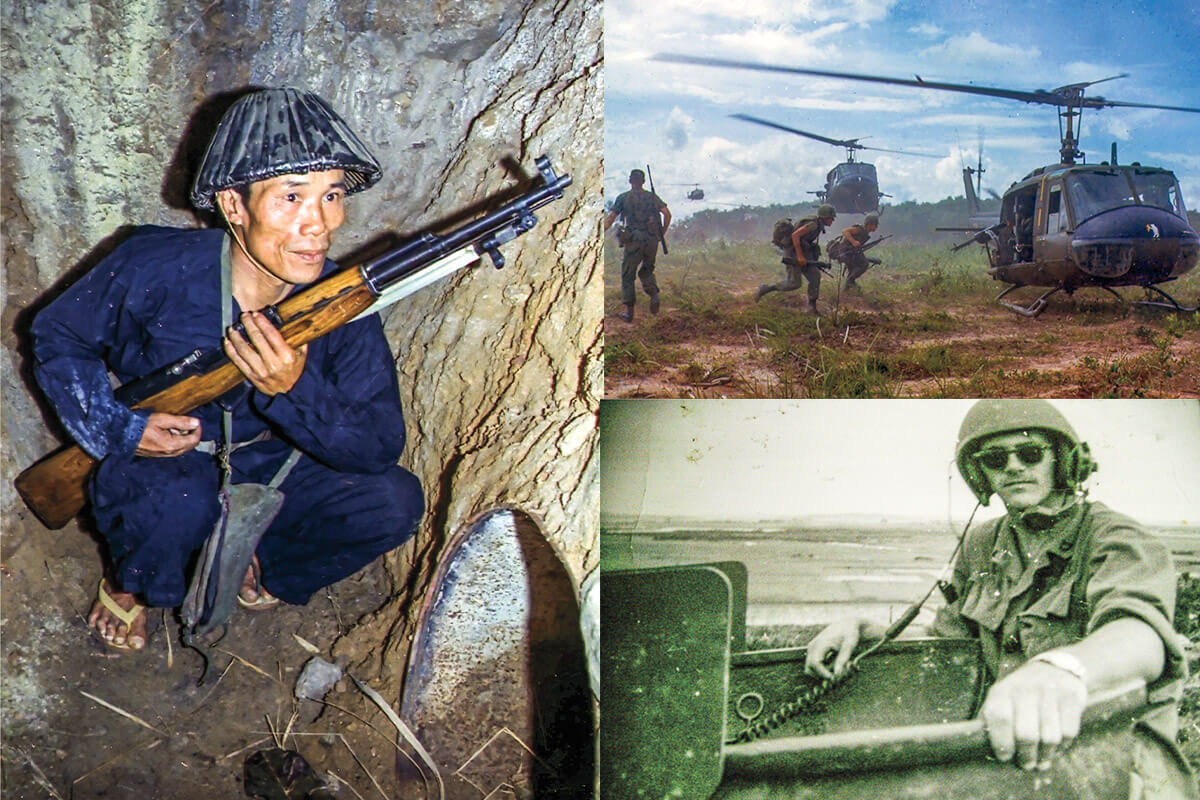
Built in the Jianshe Arsenal in 1966, this particular SKS has had a fascinating life. The Chinese began production in 1956 and referred to the gun as the Type 56 as a result. This can be confusing as the Chicom AK47 is also referred to as the Type 56 as well. The Chicom Type 56 SKS went through a variety of tweaks between 1956 and the present. Sometimes you will find two examples from the same factory that differ significantly in their details. Milled versus stamped receivers, variations in safety levers, and sundry different stocks differentiate the various strata. Most military weapons feature stocks cut from a dark wood, while the civilian counterparts are built around stocks made from a blonde material called Qiu wood.
The buttstock on this rifle appears to be a locally made replacement for the factory original. The fit is good but not perfect, and the buttstock trap for the cleaning kit was never bored out. The wood is heavily varnished but relatively soft. Chicom Type 56 rifles with serial numbers less than 9 million typically sported the Soviet-style folding blade bayonet.
Most guns above that serial number cutoff were fitted with the spike-style cruciform bayonet. I’d sooner not get poked with either. The buttstock on the SKS is a bit short for many corn-fed Americans, but the gun remains nonetheless comfortable and pleasant on the range. Recoil is mild, and the trigger is good enough. The sights are optimistically graduated out to 1,000 meters.
While SKS rifles have appreciated markedly in value in the past couple of decades, they were once absolutely dirt cheap. I recall a time back in the eighties when you could walk out of an American gun show with a case of Chinese 7.62x39mm ammo and the dealer would throw in a brand-new Chicom SKS for free like a Happy Meal. In its heyday the SKS was the poor man’s Kalashnikov.
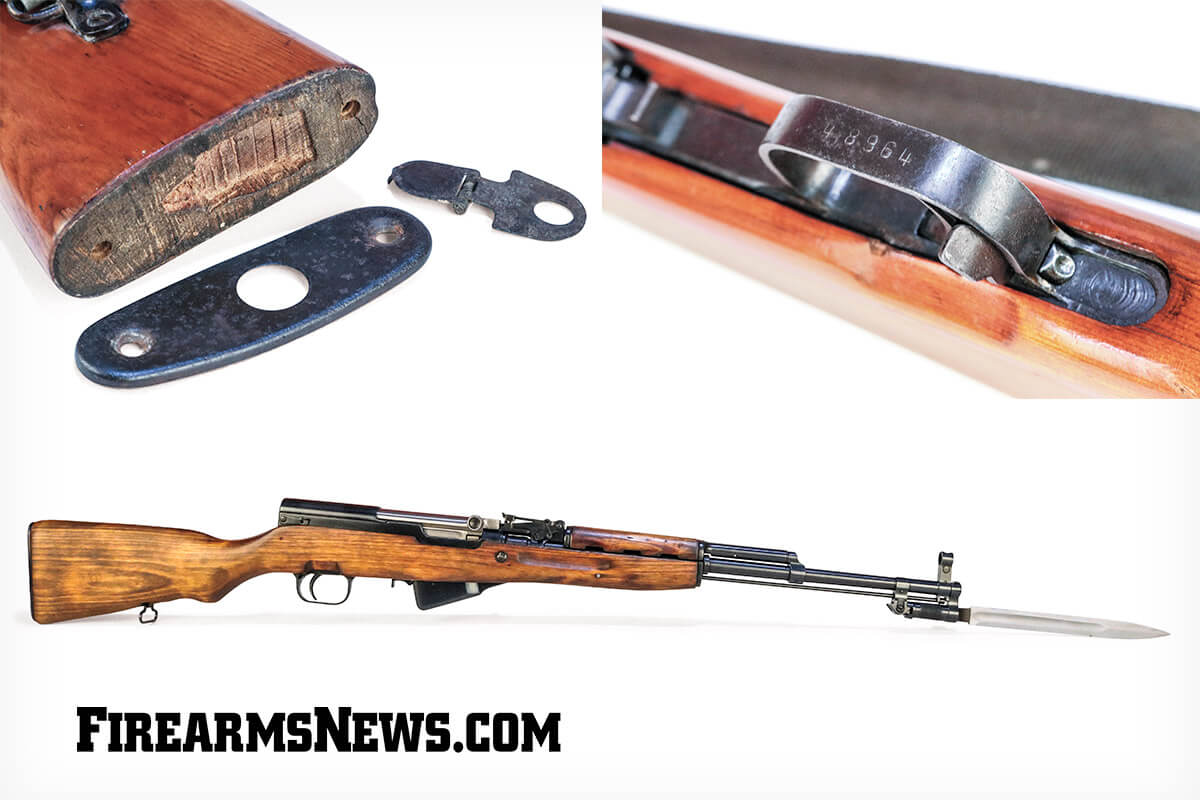
There are scads of accessories all designed to enhance and upgrade the SKS. However, I like the original milspec ambience myself. At the time of this writing, J&G Sales had a supply of early Jianshe Chicom Type 56 SKS rifles in serviceable condition at a sweet price.
These guns are high mileage combat weapons with scads of character still awash in cosmoline. It is one thing to read about history from a safe, comfortable distance. Cold facts and dispassionate numbers conspire to excise the passion and emotion from some of history’s most significant episodes. However, hefting the guns that were actually there brings home the power of these events in a much more moving way.
A young man died clutching this battered old rifle. His lifeblood spilled out on the side of Hamburger Hill as he gave his last full measure of devotion for a cause he felt was just. Similarly, the young man who took his life was fighting for a cause of his own. At a certain level both men fought for their comrades alongside them. That one lived and the other died was a function of the cruel vagaries of Fate.
This rifle was fired in anger so profusely as to char the handguard. Through the fog of history there is literally no telling the mayhem it wreaked. Now it sits quietly with me, a mute testament to a most remarkable time. Want a surplus Chicom SKS rifle of your own? J&G Sales has them in stock at a reasonable price. They’re also C&R eligible. These veteran rifles show the cool stigmata of hard use and are slathered in cosmoline.

About the Author
Will is a mechanical engineer who flew UH1H, OH58A/C, CH47D and AH1S aircraft as an Army Aviator. He is airborne and scuba qualified and summited Mount McKinley, Alaska, six times…at the controls of an Army helicopter. After eight years in the Regular Army, Major Dabbs attended medical school. He works in his urgent care clinic, shares a business building precision rifles and sound suppressors, and has written for the gun press since 1989.
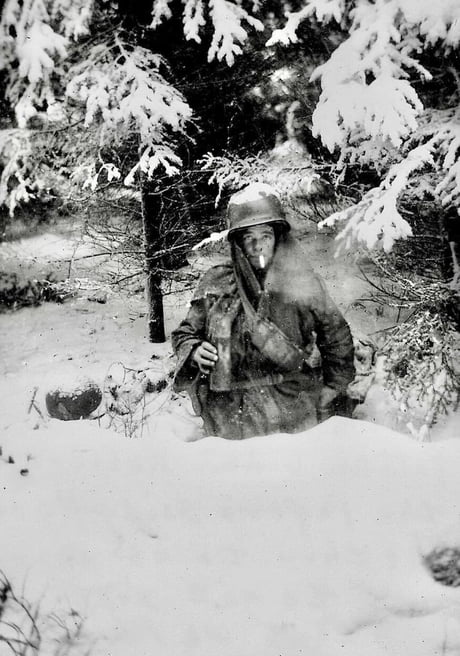
Pfc George A Guckenberger, D Company, 2nd Battalion, 506 Parachute Infantry Regiment, 101st Airborne Division in his foxhole near Bastogne. Circa January 1945, He was killed in action on January 14th 1945, aged 22
