Categories
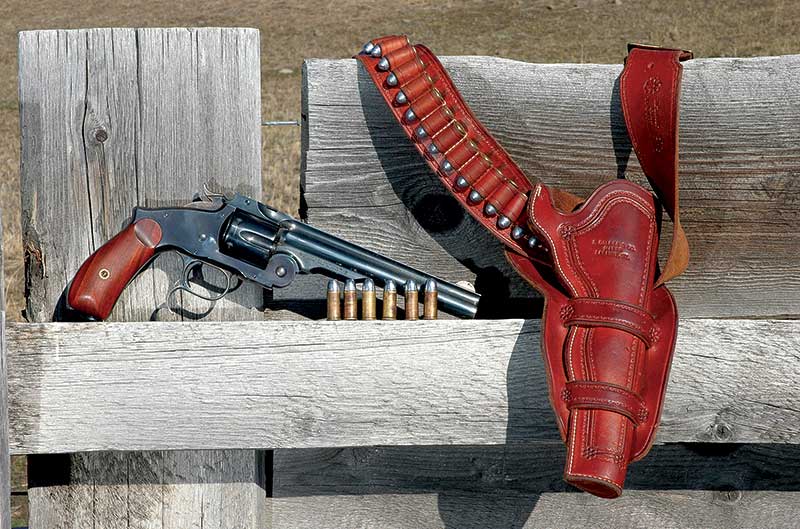
This is Duke’s Navy Arms 3rd Model .44 Russian. He did not even
consider selling it during Duke’s Great Gun Sale in 2008.
After writing a feature recently on why the .44 S&W Special isn’t so special, now I’m going to detail why I do like its ballistic twin, the .44 S&W Russian. At least I like it in this one particular revolver. That’s the Navy Arms’ replica of Smith & Wesson’s Model #3, 3rd Model .44 Russian.
Circa 1872 the Russian Government wanted to start buying Smith & Wesson’s new top break Model #3 revolvers. Very important to the company was the fact they were willing to pay in gold. But the Russians wanted nothing to do with Smith & Wesson’s own .44/100 cartridge because it used a heel-type bullet. That’s where a reduced diameter shank fits inside the cartridge case while the full diameter of the bullet is the same as the outside of the cartridge case. Just look at a round of .22 Long Rifle. They’re still made that way. The Russians explained if the bullet fit inside the cartridge case with revolver chambers bored accordingly things would work much better. They certainly did, and still do. Of course with all that gold in the balance Smith & Wesson said, “you bet!”
The result was the .44 S&W Russian. Smith & Wesson’s own cartridge then gained the name of .44 S&W American. Case length for the Ruskie one was set at .97″ with bullet diameter at .429″. Through the decades the .44 S&W Russian was loaded with bullets as heavy as 275 grains over black powder charges as heavy as 23 grains. By the smokeless powder era in the early 1900s, factory loads were standardized with a 246-grain roundnose bullet at about 755 fps. And when the .44 S&W Special came along in 1908 it was given the exact same bullet at the exact same speed but in a case 1.16″ long.

Why the odd hook on the trigger guard?
In its first 30 years of existence the .44 Russian cartridge gained a superb reputation for accuracy, of course as fired in the several versions of Smith & Wesson top break revolvers. It’s recorded some notable handgun target shots were able to keep five .44 Russian bullets inside a 3″ circle at 50 yards. That’s probably true, and it should be emphasized not many handguns made today will do that even with smokeless propellants.
Between 1872 and 1874 the Smith & Wesson Model #3 went through three revisions as requested by the Russians. Collectors named them 1st, 2nd and 3rd Models. With each, the Russians asked for design changes altering the Model #3’s appearance so much the company started to grouse — despite the gold.
By the 3rd Model .44 Russian, the S&W Model #3 had a “knuckle” at the top of the grip resulting in a saw-handle shaped grip frame, and that odd spur hanging off the trigger guard. Many theories have been thrown out as to the purpose for the spur. The most likely one is Russian Cavalry tactics called for horse mounted troopers to charge with their revolvers cocked and with the trigger finger resting on the spur. That likely saved a lot of horses from being shot in the back of the head as Lt. Col. George A. Custer did to his own horse once when chasing a bison. I’ve found the spur makes a dandy finger rest for two-handed shooting and the saw handle grip keeps the hand positioned on the revolver exactly the same from shot to shot.
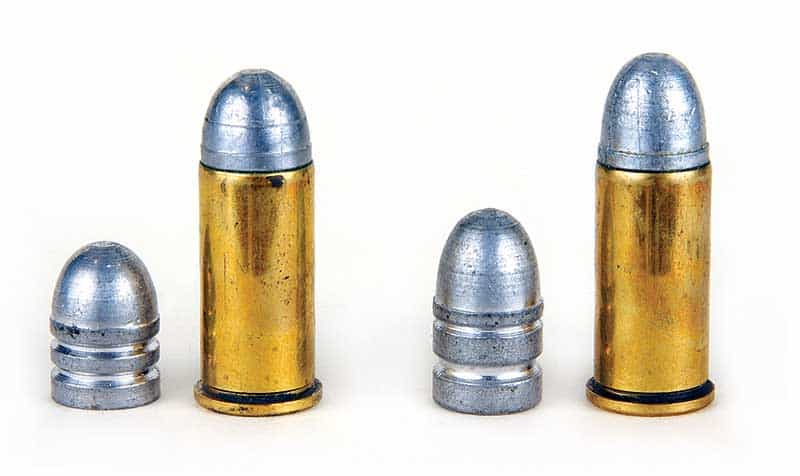
Left is Lyman #429478 (200 grains) and at right is Lyman #429383 (248 grains).
At one time I owned a sample of each of those vintage S&W .44 Russian revolvers but hardly ever fired them because they were very fragile and also very valuable. So when Navy Arms announced their replica of the 3rd Model .44 Russian about 10 years back, I jumped on it. While it is not an exact clone of the old S&W 3rd Model .44 Russians, it’s not bad, and the differences are minor. The Navy Arms’ version has a 7″ barrel as opposed to the original’s 6½”, and the original had a front sight forged integral with the barrel while the replica’s is pinned on. Oh, and some dimensions are slightly different by a few hundredths of an inch. So what.
My Navy 3rd Model .44 Russian is extremely accurate with either smokeless or black powder loads. I’ve settled on two loads: 248 grain roundnose bullets (Lyman #429383) or 200 grain roundnose bullets (Lyman #329478) over 4.0 grains of Bullseye or 19 grains of Swiss FFFg blackpowder. Its point of impact is about dead on with the latter bullet and about 2″ higher than point of aim at 50 feet with the former. Despite its tiny sights I’ve gotten one hole groups at 50 feet from a sandbag rest, and standing with two hands I can keep dueling tree paddles swinging. It doesn’t gum up with black powder fouling for at least 50 or so rounds.
When I had Duke’s Great Gun Sale in 2008 and disposed of 50 seldom used firearms, all my original S&W .44 Russian revolvers went. Putting the Navy Arms 3rd Model .44 Russian on the auction block was never even considered.



Dangull-ektrix!” the RangeMonster bellowed, squinting at a twisty-wisp of black smoke curling upward from the rocker switch on his plywood control console. “Loo-KEY! Yahl FAHR-opp attair gice jinni naow, hyahr?”
Others less dialectically gifted than I may not have understood what the RangeMonster — that title was `blazoned on his sweatshirt — was saying, but fortunately, I knew something of his language. It’s called Jaw-Juh Muh-Zurran; a patois spoken by a small handful of nomadic peoples originating in the state of Georgia, and later migrating to Missouri. A loose translation of his outburst would be, “These darned electrical devices! Lucas! Would you please start the gasoline-powered generator now? Do you hear me?”
The RangeMonster dearly wanted to show off his motorized target-return system to “thet citti feller” — me — and was most upset when the controls shorted out. Judging from the inky smoke smudges and burns around the switch, this wasn’t the first time. He had taken a wheeled irrigation line, welded on some target frames, and rigged it to roll out to the 100-yard line and back. It looked like some kinda bizarre crossover from Star Wars to The Dukes of Hazzard, but, I was assured, it worked “lak a summa-gun.”
Then Lucas — “Lukey” — ambled out. Construct a roughly humanoid figure from six and a half feet of cables and angle iron, wrap it in bib overalls, top it with a shock of yellow wheat straw, insert sugar cubes for teeth, and you’ve got Lukey. He tore a tarp off an ancient generator, spit on his right thumb and forefinger and smiled. The RangeMonster smiled, too. “Yawl watch ’issere,” he drawled. “Itta be goo-o-o-o-o-d.”
Over the next coupla minutes, I learned that in order for “jinni” to run, a spring-loaded bridging device had to make contact with two different voltage widgets. The spring, however, appeared to have sprung sometime during the Spanish-American War, and just sorta laid there, occasionally jumping out of place when Jinni hacked up a hairball.
That’s when Lukey would crane his body out gingerly like a crippled stork, grab that “sparkin’ rod” with his spit-wetted fingers, press it down, and ride the lightnin’! until Jinni settled down again to a guttural rumble.
Each time this happened, Lukey’s body shook like a sack `a crazed weasels, his yellow thatch spiked straight up and his eyes popped bigger, taking on the appearance of fried blue cat’s-eye marbles. Once, when he appeared about to involuntarily scratch his left ear with his right hind foot, I moved to grab him.
“Lee-vim be, Connor,” the RangeMonster warned. He advised me if I were to grab Lukey “whilst he’s got a-holt a’ that sparkin’ rod,” I’d be doin’ Saint Vitus’s Dance an’ drooling down to my socks. “Besides,” he said, “Lukey likes it!” I hastily jotted down, “UN-Written Range Rule #29: Don’t Grab Lukey When He’s Grabbin’ Jinni.”
I’ve shot at a lot of ranges, and learned lots of rules you’ll never see posted on signboards. Like, “Never say the words cheese or mother to the range tech wearing the aluminum-foil hat.” At another, “If the range-resident raccoon takes an interest in your lunch, just back away and don’t whistle!” They’re the kind of rules all the locals know — and visitors learn the hard way.
I have a certain history with snakes, spiders, centipedes and other creepy-crawlies. I’ve spent a chunk of my life lyin’ doggo in situations where I had to let `em slither & skitter over my camo-clad self in strict silence, and I did not get used to it. Instead, I developed a barely-controllable case of the Extreme Heebie-Jeebies. When I saw the men’s room at one particular range, my first, second and third inclinations were to tiptoe into the dank-drippy swamp beyond and take my chances with the copperheads and cottonmouths. But others were going in, and I had urgent business to conduct, so…
It was a “basement” facility, though it looked like it had possibly been built above ground, and then submerged into the muck on its own, like a mossy, stone submarine. The first three warped, wafer-thin plywood stalls looked bad enough, but the last one on the right, butted against the mud-weeping rock wall was, well … foreboding. I noted that men were waiting to use the other stalls; not the fourth.
It wasn’t just the shoulder-squeezing width, the fine patina of dust on the toilet lid, or the strangely yellowed, unused appearance of the toilet paper that disturbed me. After re-conning the seat and taking the throne, I realized what it was: the eerie feeling of — you ain’t alone, dude. I finished hurriedly, and reached for the TP.
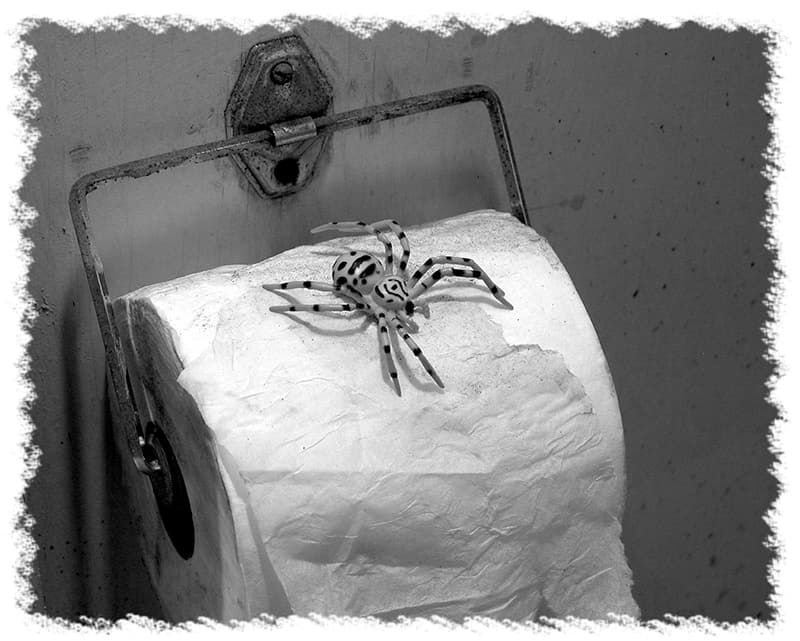
Rotating the roll brought the owner of that paper up into fighting position — a fist-sized spider, straight outta science fiction. I recoiled left, rubbin’ the rock wall and instantly felt something scurry onto my shoulder. Have you any idea how huge a 5″ centipede looks when he’s reared up on his back fifty legs, wavin’ the front 50 at you, 3″ from your nose?
I paid for damages to those fragile stalls — the ones which had stood — past tense — between me and the stairway. I apologized to all and sundry for the deafening screams. One fellow who had been severely constipated thanked me. He was cured. And I wrote in my book: “UN-Written Range Rule #30: The far right stall is unused for a reason. Try the swamp.”
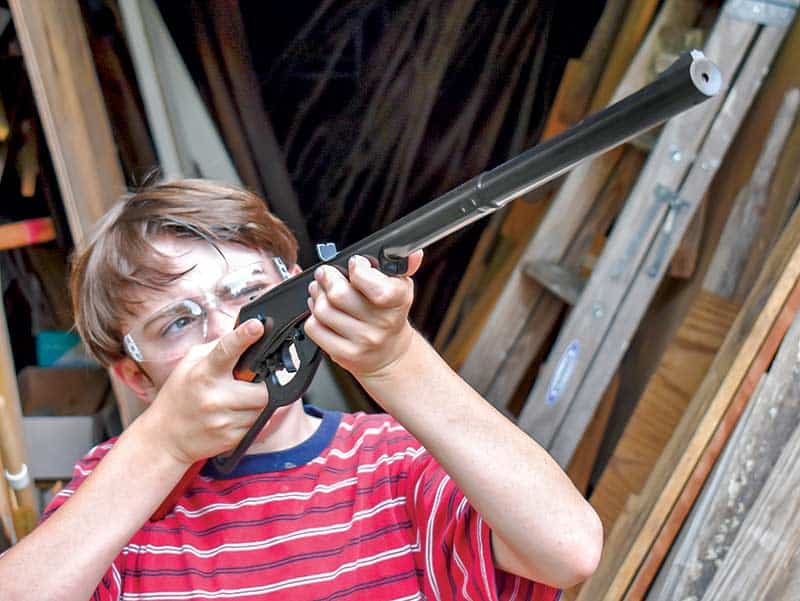
My favorite sixth-grader found the new Daisy Buck 105 to his liking.
I pursue firearms like a weasel stalks a hot dog. The hunt imbues me with a certain singularity of purpose. I meticulously plan my conquest and then pursue it like a hellhound until I’ve made it mine. However, during a recent trek through Walmart I experienced some serendipitous spontaneity.
With the horsepower of 11,484 stores, Walmart has the clout to keep prices low. It was this more than anything that first caught my eye. There nestled amongst the stove fuel, life jackets, archery supplies, and deer lure was a bare-bones Daisy BB gun for a mere $17.96. Just glancing at it brought back remarkable visceral memories.
I grew up in the Mississippi Delta, the son of a college football star and a beauty queen, and we were well acquainted with the outdoors. Weekends were spent in a modest travel trailer kept parked on the river side of the levee. Hunting, fishing and scampering about terrorizing the countryside were my standard weekend fare.
At age seven, I formally announced I wished to buy a gun. There was a lever-action Daisy repeater on the wall at the local Otasco for $7 calling my name. I held out little hope for success.
Much to my amazement, my folks acquiesced. Mom seemed reticent, but dad was forever the bad influence. He even offered to pay half, but $3.50 was a veritable king’s ransom back then.
I gutted my piggybank and tore the house apart, searching for loose change. At the terminus of my quest, I beheld exactly $3.50, mostly in pennies. I secured my fortune in a brown paper sack, planning to strike out for Otasco the following day with my dad.
We arose early and got to the hardware store when it opened. In my exuberance, however, I lost my footing somewhere near the power tools and fumbled my paper sack. The bag exploded and pennies rolled everywhere from Clarksdale, Miss., to Budapest, Hungary. My dreams dashed, I descended into a fit of less-than-manly sobs.
Ah, dads. It was just one of those priceless moments. He hefted me to my feet with his granite-like grip and smiled.
“Find what you can,” he said. “I’ll take care of the rest.”
At that moment, I learned a great deal about the fine art of parenting well.
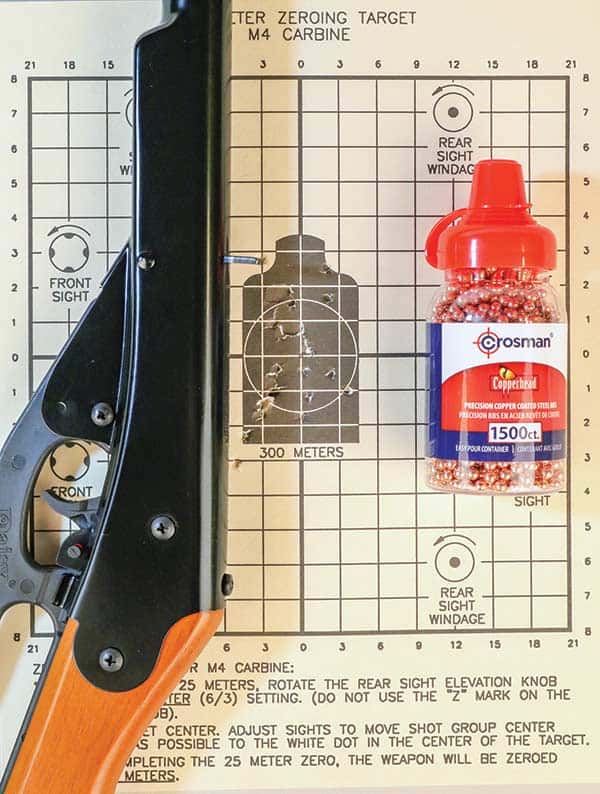
What started out as a 5-shot 12-meter group eventually became a 50-shot
12-meter group. It’s tough to show restraint when ammo costs $3 for 1,500 rounds.
The gun was all cold blue steel with a plastic woodgrain stock. In point of fact, the weapon was actually painted blue. It ultimately launched untold thousands of BBs. Along the way, I enjoyed some extraordinary feats of marksmanship. You do something long enough and amazing things inevitably happen. That’s the inimitable power of random.
I once killed a bumblebee in flight. I also dropped a sparrow on the wing with a single shot from the hip. We’ll not discuss how many times I attempted those things and failed. I used the little gun to launch a few venomous snakes to their eternal damnation and ventilated enough disused beverage cans to populate a proper WWII-era scrap drive. I shot the gun until it just wouldn’t shoot anymore and then retired it to its place of honor on the wall. The little blue Daisy BB gun sparked a career that has led all the way up to this very moment.
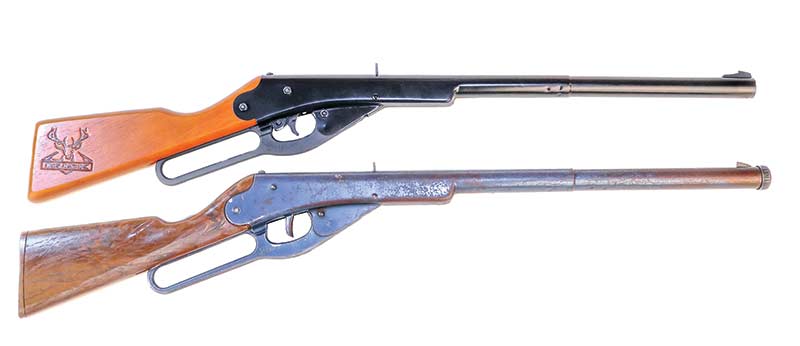
The modern Daisy Buck 105 on top is the obvious heir apparent to the storied
original Will bought for $7 back in 1973. Adjusted for inflation the current version
is half the cost of the ’70s-era gun.
The modern iteration is delightfully accurate. The trajectory it describes becomes parabolic out beyond about 30 meters, but that’s half the fun. My chronograph averaged 273 fps. Shooting off the back porch, I can arc BBs into stumps out in the lake all day long once I get the elevation right. Bracketing distant targets is more akin to adjusting artillery than basic rifle marksmanship.
I have dumped some obscene amounts of money on guns that required special papers or were wielded in places most remarkable. I have also dropped a 20-spot, taking my kids out for burgers. Trust me, even as a graduate-level gun nerd $18 at Walmart for the ultimate backyard plinking machine is money quite well spent.