
Categories
All About Guns You have to be kidding, right!?!

A Brief History of Guns in the U.S. By Cathy Shufro (Hint she works for a guy named Bloomberg)

How to explain Americans’ astonishing personal arsenal? Start with politics, fear, and marketing.

Let’s start with a few facts about firearms in the U.S.: Americans own 393 million guns, the Geneva-based Small Arms Survey reports.

Firearms can be found in 44% of U.S. households, according to a 2020 Gallup survey.

And, tragically: Almost half of Americans know someone who has been shot, a 2017 Pew Research Center report noted.

How did we get here? Marketing, politics, racism, fear, and other forces have contributed to America’s exceptional proliferation of guns.

Soon after the end of the Civil War, gunmakers with surpluses sought peacetime customers. They convinced dry goods stores to sell handguns alongside flour and sugar; they ran classified ads in newspapers; and they told parents that a rifle would help “real boys” to develop “sturdy manliness.” Private gun ownership dramatically expanded.

The end of slavery catalyzed the formation of armed groups, some seeking to protect newly freed Black men, others to terrorize them. After Reconstruction failed, supremacist military groups like the White League in Louisiana used guns to threaten and sometimes murder Black men attempting to vote.

While the popular imagination holds that gunslingers sauntered down the dusty streets of Western towns, that’s largely a myth, according to UCLA law professor Adam Winkler, JD. “Frontier towns—places like Tombstone, Deadwood, and Dodge—actually had the most restrictive gun control laws in the nation,” Winkler wrote in the Huffington PostWhen visitors arrived in Dodge City, Kansas, they encountered a billboard announcing, “The Carrying of Firearms Strictly Prohibited.”

Indeed, by the early 1900s, 43 states limited or banned firearms in public places. Gun control would become sharply divisive only with the federal Gun Control Act of 1968, made law after the assassinations of President John F. Kennedy, Malcolm X, Martin Luther King Jr., and Robert F. Kennedy. The legislation limited interstate sales of firearms but did too little to satisfy gun control advocates including President Lyndon Johnson.

By the late 1990s, fear became a potent selling point as cultural attitudes changed. In a 1999 poll, most gun owners said they kept guns for hunting and target shooting; only 26% cited protection as paramount. By 2015, however, 63% cited self-defense as a primary motivation for gun ownership, according to a 2015 National Firearms Survey. In reality, having access to a gun triples a person’s risk of suicide and nearly doubles the risk of being a homicide victim, according to a 2014 Annals of Internal Medicine meta-analysis. For a woman living with an abusive partner, the risk of being murdered increases fivefold if the partner has a gun, according to an American Journal of Public Health study led by Jacquelyn Campbell, PhD, MSN, a faculty member of the Johns Hopkins Center for Gun Violence Prevention and Policy at the Bloomberg School.

As gun owners increasingly emphasized self-defense in recent decades, restrictions on carrying concealed firearms evaporated. Whereas in 1990 concealed carry in public spaces was illegal in 16 states (including Texas), by 2013 all 50 states and Washington, D.C., allowed some civilians to carry hidden guns.

At the same time, gunmakers have redesigned their wares. “Technology has focused on making smaller and smaller handguns, with more lethality, and with almost no attention to safety,” says Josh Horwitz, JD, who directs the Coalition to Stop Gun Violence. For example, the popular $450 Smith & Wesson M&P Shield 2.0 pistol is 6 inches long and carries 15 9mm cartridges. And children now have their own firearms, like the 2½-pound, .22-caliber Crickett (“my first rifle”). Its gunstock comes in pink, camo, and “amendment”—Second Amendment text overlaid on American flags.

  • 1791

    Congress ratifies Bill of Rights, including the Second Amendment.

  • 1934, 1968

    First major federal gun control laws are passed.

  • 1977

    Activists opposed to gun control seize control of NRA at national convention.

  • 1985–86

    Congress creates “gun-show loophole” by limiting federal firearm licensing requirements.

  • 1993

    “Brady Bill” requires background checks for gun buyers at federally licensed dealers.

  • 1994, 2004

    Federal Assault Weapons Ban becomes law; then Congress lets it lapse.

  • 1996–2019

    Congress imposes limits on CDC gun research, shrinking federal funds for studies.

  • 2005

    New law gives gun industry unprecedented protections against lawsuits.

  • 2008

    Supreme Court votes 5–4 to recognize individual right to bear arms for “defense of hearth and home.”

  • 2009, 2020

    Gun sales spike during Obama presidency and surge again as pandemic begins.

Horwitz says lobbyists and owners of military-style weapons increasingly embrace “the insurrectionist idea.” Since 2009, he has warned of armed citizens who claim that “threatening violence against government officials is within normal bounds of political discourse.”

The multiplication of “stand-your-ground” laws marked another shift in American attitudes, with Florida taking the lead in 2005. Today, 34 states give gun owners the right to use deadly force outside of the home with no duty to retreat or use other means to protect themselves. The laws “make it much easier for a person to legally kill someone,” writes University of Texas sociologist Harel Shapira, PhD, who credits the laws with “the militarization of everyday life.”

“In almost any aspect of public health, culture and policy are reinforcing and reflecting each other,” says Daniel Webster, ScD ’91, MPH, director of the Center for Gun Violence Prevention and Policy. “You gradually see carrying a gun around as normative.” Forty years ago, if someone brought a gun to a party, Webster says, “you would have been shocked. It would have been incredibly abnormal.” Now, gun ownership is a lifestyle choice, one rooted in the individualism “baked into our culture and our laws.”

In recent decades, the National Rifle Association has identified its greatest foe as the government itself. After Congress passed the Federal Assault Weapons Ban of 1994, NRA President Wayne LaPierre told members that the bill “gives jack-booted government thugs more power to take away our constitutional rights, break in our doors, seize our guns, destroy our property, and even injure or kill us.”

“The gun lobby thrives on fear and drives fear,” says Horwitz. In many ways, he adds, “this is about white men feeling less powerful.”

Horwitz notes that gun sales rose during the past year. “People are afraid of other people with guns, so now they’re buying guns. Breaking that cycle is really important. Are we too far down the road? I don’t think we are, but we’ve got to make major changes in how we approach gun violence, soon.”

Categories
All About Guns

Some geat looking pre-64 Winchester Model 70’s anyone?

Categories
All About Guns Gun Fearing Wussies You have to be kidding, right!?!

Anti-Militia Bill Likely to Hurt Firearm Training By Tom Knighton

With the anniversary of January 6th behind us, we’d think all the insurrection rhetoric would be behind us, at least for a time.

Unfortunately, that’s asking way too much.

You’d think that, at some point, the people screaming about it would recognize that if the political demographic most likely to be armed and pay for training out of their own pockets were interested in overthrowing the government, they’d bring more than signs to the party.

But alas, that isn’t entering most people’s brains.

Yet I can’t help but think at least some understand that on some level.

I say this because of a new bill in the House that I was made aware of Thursday evening.

Washington (January 11, 2024) – Following the anniversary of the January 6th attack on the United States Capitol, Senator Edward J. Markey (D-Mass.) and Congressman Jamie Raskin (MD-08) introduced the Preventing Private Paramilitary Activity Act, legislation that would create a federal prohibition on paramilitary groups through civil and criminal enforcement. The prohibition would hold individuals liable who directly engage in certain types of conduct, including intimidating state and local officials, interfering with government proceedings, pretending to be law enforcement, and violating people’s constitutional rights, while armed and acting as part of a private paramilitary organization.

“Patrolling neighborhoods, impeding law enforcement and storming the U.S. Capitol, private paramilitary groups like the Oath Keepers, the Three Percenters and the Proud Boys are using political violence to intimidate our people and threaten democratic government and the rule of law,” said Congressman Raskin. “Our legislation makes the obvious but essential clarification that these domestic extremists’ paramilitary operations are in no way protected by our Constitution. I’m grateful to Senator Markey for his partnership on this critical effort to protect the rule of law, deter insurrection and defend our democracy.”

A copy of the legislation can be found HERE.A one-page overview of the legislation can be found HERE.

The legislation creates different tiers of criminal penalties based on whether violations result in injury or property damage; provides harsher penalties for repeat offenders; and allows for a probationary sentence for first-time offenders. It also creates civil remedies by authorizing the Department of Justice to seek injunctive relief against paramilitary activity, and by creating a private right of action for individuals harmed by paramilitary activity to seek injunctive relief and/or damages. The legislation contains clear exceptions for activities such as historic reenactments, state-sanctioned trainings, and veterans’ parades.

Among specific points brought up regarding what this bill will restrict was, “training to engage in such behavior.”

But let’s be honest, what lawmakers claim a bill will do and what the text says can be quite different. I was already uncomfortable with what I was reading, since “patrolling” has a specific meaning in a lot of contexts, but I can also see someone applying it to a pro-gun march with some folks open carrying.

Was that what this bill was trying to address?

So, I took a look and, frankly, I’m not exactly thrilled with what I see.

For one thing, the word “patrolling” is mentioned several times in the press release announcing the bill and is expressly prohibited in the text of the bill, but is never actually defined by the bill. That means the definition of “patrol” is likely to be subjective.

But there’s worse.

For example, from the bill itself:

‘‘§ 2742. Unauthorized private paramilitary activity

‘‘(a) OFFENSE.—It shall be unlawful to knowingly, in a circumstance described in subsection (b), while acting as part of or on behalf of a private paramilitary organization and armed with a firearm, explosive or incendiary de8 vice, or other dangerous weapon—
‘‘(1) publically patrol, drill, or engage in techniques capable of causing bodily injury or death;
‘‘(2) interfere with, interrupt, or attempt to interfere with or interrupt government operations or a government proceeding;
‘‘(3) interfere with or intimidate another person in that person’s exercise of any right under the Constitution of the United States;
‘‘(4) assume the functions of a law enforcement officer, peace officer, or public official, whether or not acting under color of law, and thereby assert authority or purport to assert authority over another person without the consent of that person; or
‘‘(5) train to engage in any activity described in paragraphs (1) through (4).

Now, based on this alone, all sorts of things will fall under this regulation and, theoretically, be prohibited. Arguably, even your kid’s tae kwon do class would be illegal, since that would be training in “techniques capable of causing bodily injury” at a minimum.

Luckily, it’s not quite that stupid. It does require certain other conditions to be met as well. The problem? Those conditions are kind of a low threshold to clear.

Note that the above section clearly states that a circumstance from section (b) must be met, so that seems to say that if any of those apply, we’ve got a problem. I’m not a lawyer, so I may be misreading this, but it seems they’re pretty easy to meet, including crossing state lines, using “instrumentalities of interstate or foreign commerce,” involve a gun or explosive device, uses a so-called-high capacity magazine, or takes place within the United States.

And since the next to last listed uses the word “or” before going on, it makes it pretty clear that only one needs to be met.

The problem here is that just traveling on a road at all could be construed to be using an instrumentality of interstate commerce.

While it’s unlikely to be enforced that way, it sure looks like the fact that you’ll drive to a Brazilian Jiu Jitsu class could meet this criteria.

However, a far more likely issue arises when we look beyond that.

For example, if you’ve never been in the path of a natural disaster, you probably don’t realize what it’s like to find your local law enforcement overwhelmed. People can and do decide to take advantage of that and a lot of people join together to protect their neighborhoods. One could say they patrol the neighborhood.

It would seem this bill would prohibit that.

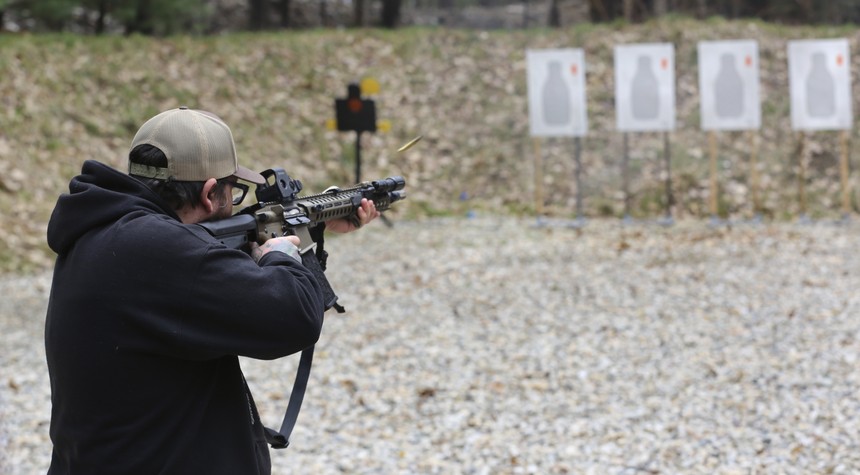
More than that, though, it seems that a lot of firearm training classes could be negatively impacted. After all, are we not learning “techniques capable of causing bodily injury or death” when we attend? I mean, isn’t that the point?

Plus, you’re going to take a road at some point or another, meeting at least one of the circumstances laid out in the bill, as well as using a firearm–again, that’s kind of the point–and probably a magazine that holds more than 10 rounds, which is how the bill defines “high capacity magazine.” Literally any firearm training class seems like it would violate the law.

Any.

Now, again, I’m not a lawyer. It’s possible that there’s some quirk in how this is written that my layman eyes are missing that prevents it from meaning what it sure looks like it means, but I doubt it.

If there’s any good news to be found in this travesty of a bill, it’s that this is in the House, which the GOP controls. What’s on the page right now will likely never come to a vote. The absolute best-case scenario for this bill would be for the committee to gut this thing and rebuild it to not be a complete and total abomination.

Even then, I don’t see this going anywhere. It’s far more likely to get assigned to a committee where it can die a lingering death.

If it doesn’t, the gun training industry is going to need to lawyer up.

Categories
All About Guns Art War

The Martini-Henry – In The Movies

Categories
All About Guns

Mystery Solved? Buchenwald Concentration Camp Gun

Categories
All About Guns

39 Different Smith & Wessons

Categories
Gear & Stuff Gun Info for Rookies

Tyler T-Grip

Categories
Well I thought it was funny!

What the Aussies call a “Keeper!”

Categories
All About Guns

W.A.R. – the Winchester Automatic Rifle

Categories
All About Guns

Browning Buck Mark UDX 22 Pistol Review