Postal police going unused as mail thefts increase
FOX 26 Reporter Abigail Dye explains why a resource that could help curb mail theft isn’t being used.
HOUSTON – Postal Police Officers, or PPO’s, exist. PPO’s have been employed by the United States Postal Service and overseen by the United States Postal Inspection Service for decades.
According to the National President Postal Police Officers Association, Frank Albergo, they patrolled streets for 50 years protecting mail and mail carriers.
“People are not going to rob a letter carrier knowing that postal police officers are on patrol,” he said.
But in 2020, a USPS memorandum changed their jurisdiction, making it so PPO’s are only allowed to man postal buildings – no longer able to patrol.
“There are postal police officers in Houston, and they’re not being utilized to stop mail theft. This isn’t hard to figure out. You have postal police officers that specialize in mail theft prevention and protection of mail carriers and the postal service refuses to use them,” said Albergo.
USPIS has acknowledged an intense rise in mail carrier robberies in the latest annual report of their Fiscal Year (FY) 2022.
They say those robberies target mail carriers to get access to their “arrow keys” that open numerous mail boxes.
According to those reports, from 2019 to FY 2022, robberies more than quadrupled from 94 to 423. While the arrest rate concerning those robberies plummeted from 70% to 23%. Arrests rates for all crime dropped from 98% in FY 2019 to 78% in FY 2022.
“It’s been an absolute disaster. Mail is being stolen day after day, letter carriers are being robbed, identities stolen, bank accounts drained, something has to be done,” said Albergo.
We reached out to USPIS asking for an interview to better understand the circumstances around PPO jurisdiction.
They declined to interview and responded with an email that can be read in its entirety below.
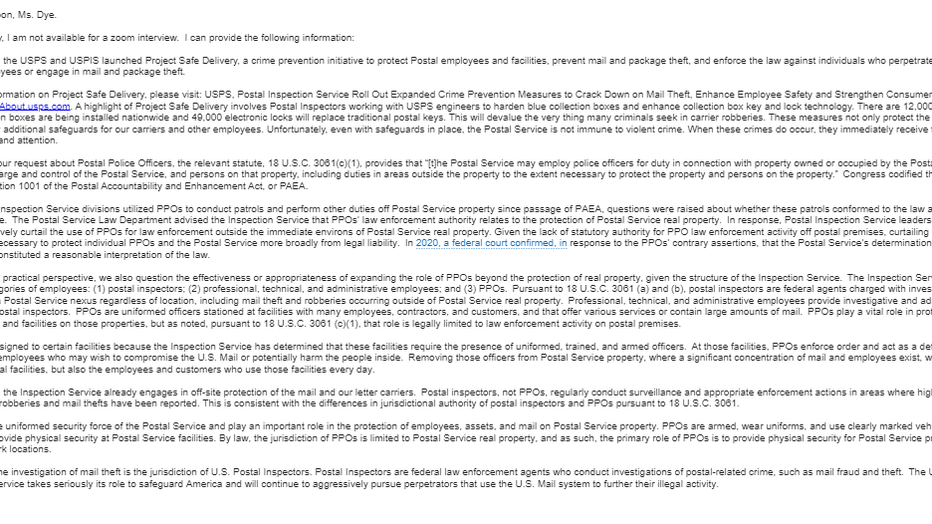
In the email they say, “Given the lack of statutory authority for PPO law enforcement activity off postal premises, curtailing such use of PPOs was necessary to protect individual PPOs and the Postal Service more broadly from legal liability. In 2020, a federal court confirmed, in response to the PPOs’ contrary assertions, that the Postal Service’s determination of PPOs’ jurisdiction constituted a reasonable interpretation of the law.”
They also explain how the inspection service is structured, saying, “From a more practical perspective, we also question the effectiveness or appropriateness of expanding the role of PPOs beyond the protection of real property, given the structure of the Inspection Service.”
Going on to say, “The U.S. Postal Inspection Service takes seriously its role to safeguard America and will continue to aggressively pursue perpetrators that use the U.S. Mail system to further their illegal activity.”
There are currently two bills in Congress that would restore the jurisdiction of PPO’s. House Bill 3005 and Senate Bill 3356.
Categories
Cool!

Magnetism is some cool stuff

HONOLULU (HawaiiNewsNow) – One of the few remaining links to Pearl Harbor’s past is now gone.
Family of war veteran Sterling Cale announced his passing Wednesday, saying he died on Jan. 20 at his Aiea home overlooking Pearl Harbor’s ‘Battleship Row’.
On Sunday, Dec. 7, 1941, Cale was a 20-year-old pharmacist mate assigned to the U.S. Naval Hospital. He was wrapping up working a night shift when he saw military maneuvers in action. He thought it was odd for a Sunday.
“But right then, an aircraft flew over his right shoulder and it gave him shudders he said,” his son, Sterling Cale Jr. said. “As it banked, he saw the ‘red meatball’ of the Japanese empire and he knew that we were at war.”
Categories
Always

Well, that didn’t take long, did it? (6 hours actually)
President Joe Biden has pointed to the recent shooting in Kansas City as supposed proof to lawmakers that they should support his bid to ban assault weapons.
The longwinded statement – issued some six hours after the shootout at the city’s Super Bowl Parade – said the day’s events should ‘shock’ and ‘shame us’ into acting.
He added how the US’s most recent mass shooting ‘cuts deep,’ and used it to urge Americans to ‘make [their] voice heard in Congress.’

A measure recently introduced in the Idaho legislature seeks to keep companies that discriminate against firearms-related businesses or groups from receiving contracts from the state government.
Senate Bill 1291 was introduced in the state Senate earlier this week. The measure would prohibit public contracts with individuals or companies that are boycotting those that engage in or support the manufacture, distribution, sale or use of firearms, and would also require companies that contract with the state to disclose if their policies discriminate against the firearms industry.
Interestingly, the measure also includes the same protections for a few other industries that often find themselves in the crosshairs of so-called “progressives.”
Per the text of the measure, no company can be granted a state contract if it is engaged in, or plans to engage in, a boycott of any individual or company because the individual or company: “(a) Engages in or supports the exploration, production, utilization, transportation, sale or manufacture of fossil fuel-based energy, timber, minerals, hydroelectric power, nuclear energy or agriculture; or (b) Engages in or supports the manufacture, distribution, sale or use of firearms, as defined in section 18-3302(2)(d), Idaho Code.”
As the legislation’s language explains, “boycott” means, “without a reasonable business purpose, refusing to deal with an individual or organization, terminating business with an individual or organization, or taking another action that is intended to penalize, inflict economic harm on, or limit commercial relations with an individual or organization because the individual or organization: (i) Engages in a particular business sector; (ii) Engages in a particular business sector and does not commit or pledge to meet standards beyond applicable federal and state law; or (iii) Does business with an individual or organization that engages in a particular business sector.”
If the legislation passes, it will be in effect for contracts executed on or after July 1, 2024. As for contracts issued before that date, the legislation states: “Any contract executed prior to July 1, 2024, that violates the provisions of this section shall not be renewed unless the contracting authority obtains the written certification described in subsection (1) of this section.”
The measure will first be considered in the Senate State Affairs Committee.