




Categories
Cops

UNDERSTANDING POLICE USE OF FORCE WRITTEN BY MASSAD AYOOB

Militarized police? S&W has called their mainstream L.E. service handguns “Military & Police” from 1899 to present.

Misunderstandings, some knowingly fostered by the anti-cop crowd, are rampant among the general public. Here are some truths with which to shoot back.

Generalities

Why not do away with qualified immunity for police? First, it’s not the magic “get out of jail free” card some claim it to be. At the risk of oversimplification, it’s the same Reasonable Person standard the court demands in an armed citizen self-defense case. The triers of the facts must ask themselves, “What would a reasonable, prudent person have done in the same situation, knowing what the defendant knew?”

For qualified immunity, that becomes “What would a reasonable, prudent, trained and experienced police officer have done in the same situation, knowing what the accused knew at the time?” In either case, the standard of judgment is called objective reasonableness. This was defined by SCOTUS more than 30 years ago in the landmark case of Graham v. Connor, which has been the guiding light of police use of force training ever since. If this standard was taken away from police, you could expect something similar to follow for armed citizens, which would greatly compromise the right of self-defense.

Why can’t we have peace officers instead of law enforcement officers, guardians instead of warriors? Because you can’t have one without the other. The officer keeps the peace by enforcing the law upon those who shatter the peace and endanger the peaceful.
What does a guardian do? Guard against danger, which requires the tools necessary to overcome that danger. To fight fire with fire, you must first have … fire.

One must become a warrior to guard against life-threatening violence. The police are, literally, society’s designated gunfighters. Police trainer and writer Ed Sanow wasn’t being hyperbolic when he spoke of patrol officers as “America’s road warriors.”

Why can’t we de-militarize the police? For one thing, police work has always been paramilitary in organization. Look at the rank structure. Ask yourself why in most jurisdictions state police are called “troopers.” Compare the Class A uniform of the idealized Peace Officer in the famous Norman Rockwell painting to the dress uniform of an Army officer of the same period. Why do SWAT teams have military surplus armored vehicles or similar commercial Bearcats? To stop criminal bullets, not to project force. You don’t see Bearcats equipped with cannons.

Why can’t we send psychologists to domestic violence calls instead of police? Why can’t cops learn to de-escalate? Because the wife-beaters and child-beaters will beat the hell out of the unarmed psychologist, too.

The cops are ahead of the self-styled reformers on this: Many departments have experimented with CIT, Crisis Intervention Teams, and many of the rank and file have been trained in verbal crisis intervention such as George Thompson’s Verbal Judo since the 1980s.

Unfortunately, the escalating suspect gets a vote too, and many don’t respond to calm words or reason. There’s also the matter of cost. The average cop earns about $52K a year and the average psychologist almost $78K. One of each in every patrol car is more than most budgets can bear, especially since there are fewer calls for the doc to handle than the cop.

From the old Bucheimer palm sap to the “police flashlight” and beyond, less-lethal
police tools have long created controversy.

Specifics


How can police justify shooting a man pointing a stolen TASER at them? For the same reason they’ve always been allowed to shoot the guy who snatched and wielded their baton, and later their Mace and pepper spray. State attorneys general have long since ruled each of these is a less lethal weapon when used as trained. The suspect who violently wields one is not trained to avoid vital zones with what is now “a deadly weapon, to wit a bludgeon.”

If he incapacitates the officer, he can take his service pistol, murder him, and then murder whoever else he chooses, particularly since he can take the keys to the patrol car, use its communications to evade capture, and pull over the unsuspecting victim of his choice. Thus, less lethal in the cop’s hands, but highly lethal and a danger to society in a criminal’s hands.

Why do police need AR15s? Remember, American police were using autoloading rifles long before the American military. If your son or daughter had to respond to multiple violent criminals alone, would you want your kid to have an AR15 or a six-shot revolver designed in 1899?

And it’s time to answer a question with a question: Why do elected officials and the media do nothing to educate the public in the realities of police use of force?

Categories
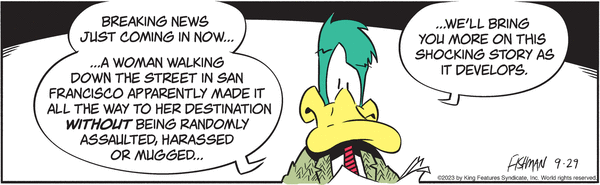
Well I thought it was funny!

The Top 5 Ways You’re Being “That Guy” at the Range

Categories
All About Guns

Some S&W Combat Magnums (Model 19’s and 66’s).

Categories
All About Guns

Best Savage Rifles Ever Made – 2022 Complete List

Categories
All About Guns

HK VP9SK

Categories
All About Guns Gear & Stuff

NOSLER SR-30K “K-CAN” SUPPRESSOR BY GUNS STAFF

The all-new Nosler SR-30K — more popularly referred to as a K-Can — was designed with hunters in mind. The K-Can, derived from the German word “Kurtz,” meaning “short,” is two inches shorter and two ounces lighter than the SR-30AlTi employing a proprietary baffle stack design for maximum performance in a minimalist package.

At less than 6 inches in overall length and 7.2 ounces in weight, the K-Can is easier to maneuver than a full-size suppressor making it ideal in a treestand, blind or on longer rifles. The lightweight, diminutive footprint provides superior handling characteristics and offhand balance.

The K-Can (MSRP $729) incorporates the same attachment system as the rest of the Nosler suppressor line and can be mounted either over a brake or direct-threaded to the muzzle with the use of the included adaptor.


SPECS

• Weight: 7.2 ounces

• Length: 5.834 inches

 Diameter: 1.740 inches

• Color: Black

• Thread Pitch: 5/8×24

For more information about Nosler suppressors, including the new K-Can, visit Nosler.com.

Categories
War

Patriot Missile System How it Works | Air Defence Missiles

Categories
All About Guns

Russian Contract Colt 1911

Categories
All About Guns

Kalthoff 30-Shot Flintlock: The First Repeating Firearm Used in War (1659)

Categories
All About Guns

I Have This Old Gun – Browning Model 1919