By Virgil Caldwell
For most of my life I have owned a number of reliable, effective and useful handguns. I have obtained the best I could afford and they have served me well. I have also always kept on hand a good rifle for emergency use. This is quite different from a hunting rifle although some of the pieces were useful for hunting.
I kept a Winchester Model 94 .30-30 on the front line for many years. The shorter barrel versions are best for all-around carry and the longer barrel classic version is best for hunting. I also have used the SKS rifle and the AR-15.
A type of rifle I’ve owned and used for some time, though, is the lever action rifle chambered in a pistol caliber. I used a Marlin .44 Magnum for boar hunting and have owned several Winchester clones for recreational use. But like a lot of gun owners, I wanted a real Winchester and I am glad I finally found one.
While those clones are OK and may be improved with some careful gunsmithing, the Winchester originals offer excellent performance and more than a little pride of ownership.
Sure, a good centerfire bolt action rifle with a scope is generally a better hunting firearm. But I wanted a compact, fast handling rifle to do most anything I needed including riding behind the seat of the Silverado.
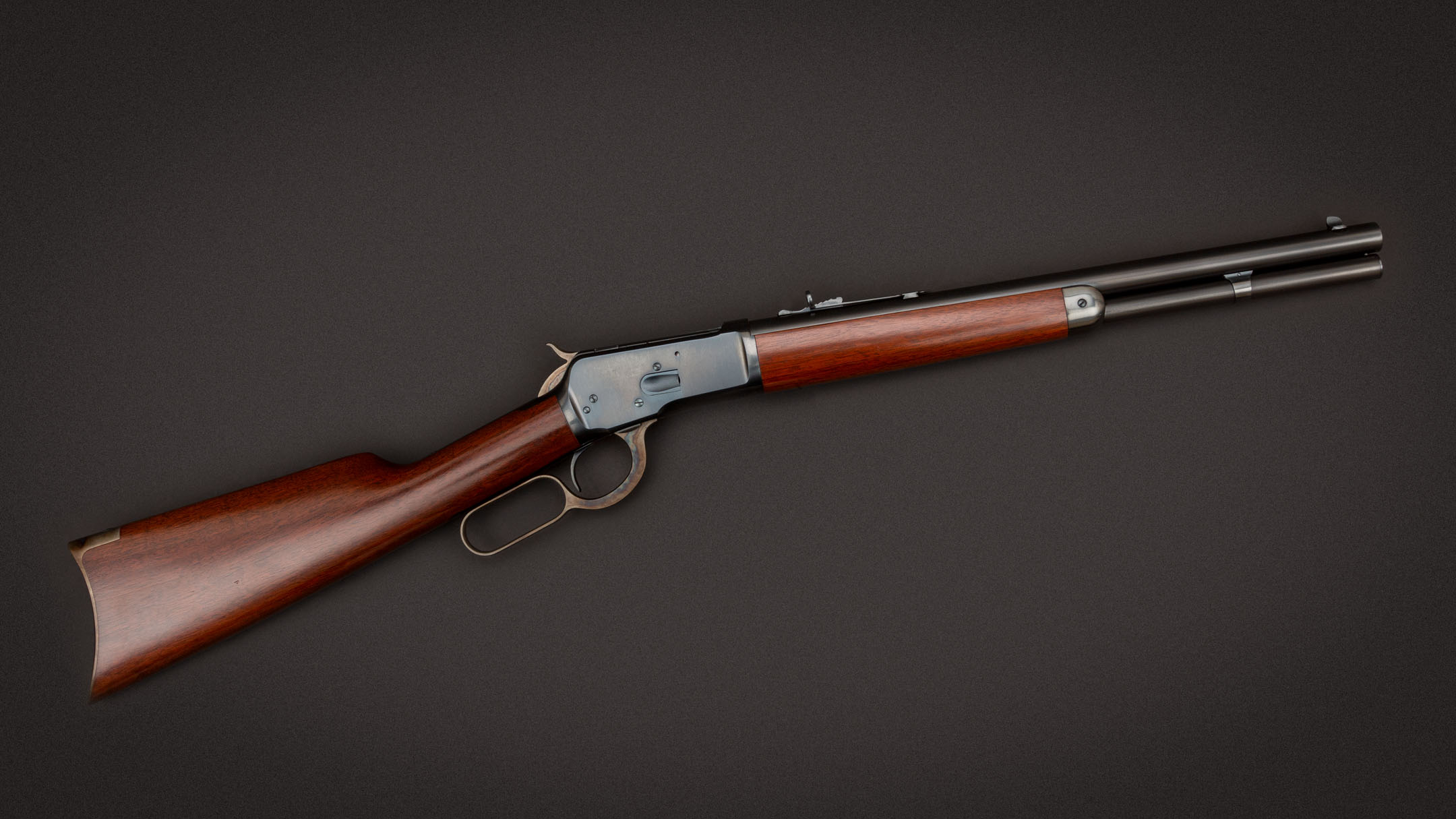
I was lucky to find a pre owned – perhaps even unfired – Winchester Model 1892 Short Rifle in .45 Colt.
The Winchester 1892 is a joy to carry and shoot. With its pistol caliber chambering and short throw lever action, cycling is better and quicker than with the Winchester ’94 .30-30. The locking lugs are plenty strong and the rifles often exhibits fine intrinsic and practical accuracy.
The Winchester Model 1892 features a 20-inch glossy blued barrel with an oiled black walnut stock and forend. The straight grip and crescent-shaped buttplate make for quick mounting and fast shooting.
Since I already own a Colt Single Action Army in .45 Colt — a near perfect match for this lever gun — it wasn’t any problem to test the rifle with a variety of loads.
I had on hand plenty of hard cast SWC handloads using the Hornady 250 grain XTP bullet, and a number of factory loads from Remington, SIG SAUER, and Fiocchi.
My handloads proved reliable and clean burning. Stand out loads for accuracy were the Remington 230 grain JHP and the SIG SAUER V Crown hollow point.
The Hornady 225 grain LeveRevolution load is a hard hitter worth your time and testing. At 25 yards the rifle’s iron sights were easily regulated. With the ten-round magazine capacity, the Winchester 1892 has much potential for both personal defense and short range hunting.
It was awfully easy to punch the bullseye at 25 yards. I was pretty happy. The loads don’t gain a whole lot of velocity in a rifle barrel in the manner that .357 Magnum does, but the gain is still useful.
The primary advantage of the 1892 is the potential for accurate shot placement well past handgun ranges. But then I moved to fifty yards.
At that range my best efforts resulted in vertical stringing and lateral dispersion, even from a solid bench rest firing position. Then two bullets from my handloads went into the same hole at fifty yards. The next three opened the group to six inches. That’s twice what I expected. My only conclusion: my eyes are no longer any good!
I can read without glasses but buckhorn sights and over-sixty eyes aren’t the best combination. I hung my head and sulked back to the truck. I hadn’t shot the carbine much better than my pistol at that range.
Next on the agenda, I ordered a set of XS peep sights. Now we were talking. They aren’t traditional but I’m a shooter not a collector. The peep or aperture sight better leads the eye to center on the front sight.
The express type front sight offers greater clarity for aging eyes and greater speed for just about anyone. There’s simply little comparison between the original buckhorn and bead sights and the XS replacement sights, at least out to the 100 yards or so distance that’s the mission profile of this rifle.
After a bit of familiarization with the XS sights I re-tested the rifle as far as 100 yards.
With careful application of the trigger the SIG SAUERf V Crown load turned in several 2 to 2.5 inch groups at 50 yards.
I am very happy with that. There are lots of heavy loads that are very useful in the carbine that you would not wish to fire in a revolver. The Winchester 1892 handles them easily and even a relatively modest load, say 300 grains at 1,000 fps, offers real power for game shooting inside of 100 yards.
The Winchester 1892 .45 Colt makes the grade for my all of my uses.
Velocity testing, .45 Colt loads, Winchester 1892
| Colt 4.5″ Barrel | 1892 20″ Barrel | |
| Remington 230gr JHP | 930 fps | 1132 fps |
| SIG SAUER 230gr JHP | 760 fps | 1050 fps |
Specifications: Winchester Model 1892 Short Rifle
Caliber: .45 Colt (also available in .44 Rem Mag and .357 Mag)
Action: Short Throw Lever Action
Weight: 6.0 lbs
Barrel Length: 20 inches
Sights: Buckhorn rear
Length of pull: 12.75 inches
Magazine capacity: 10 rounds
Finish: Blued steel
Stocks: Dark Walnut
MSRP: $1070 (about $925 retail)
Ratings (out of five stars):
Style, Fit and Finish: * * * *
The blue finish is excellent. The walnut stock and forend are well fitted, but rather ordinary in appearance…if a cut above the modern average.
Reliability: * * * * *
No issues, with about six hundred cartridges fed, fired, and ejected.
Ergonomics: * * * * *
On the lever gun scale this is the top of the list. It’s fast to shoulder, quick on target and easy to shoot.
Accuracy: * * * *
She gets four stars. It’s not bad at all and great for hunting at the distances you’ll use a lever gun. A .357 Magnum lever action rifle may be more accurate, but I wanted one in .45 Colt.
Overall: * * * *
There are more powerful and more accurate rifles, but the classic Winchester Model 1892 is fast and extremely effective in the 100-yard-or-so range at which I use a lever action carbine.
And in rebuttal –
Categories
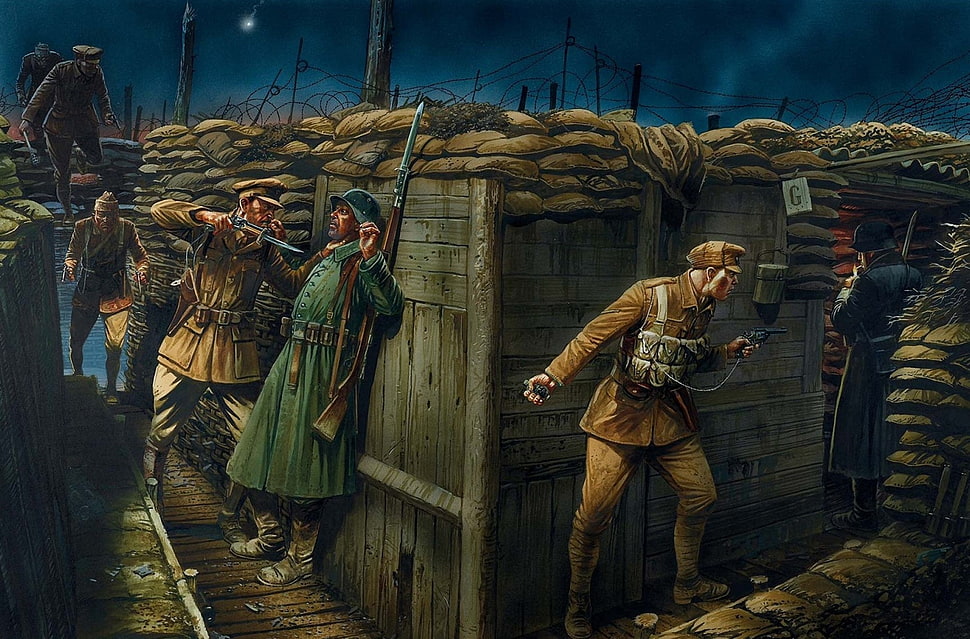
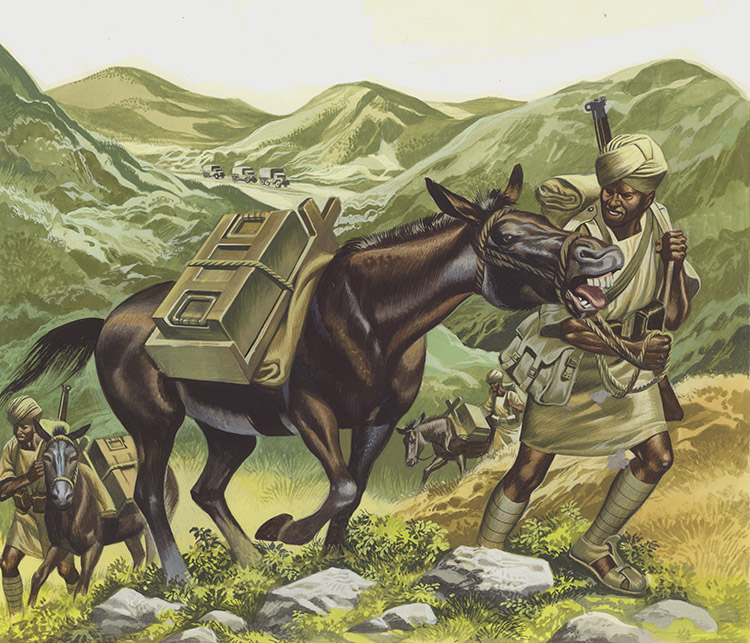
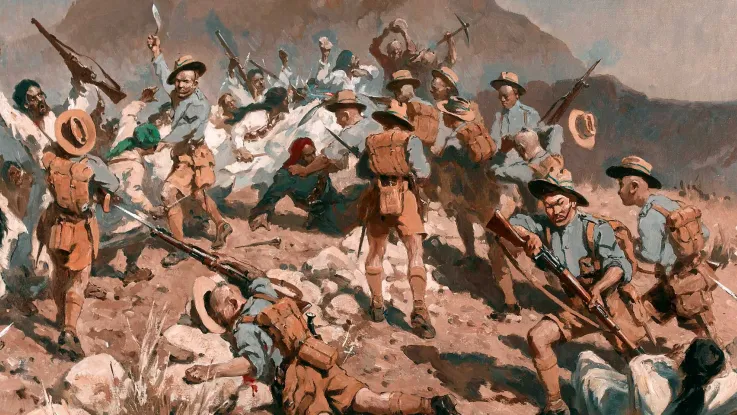
Some more hard men at war art




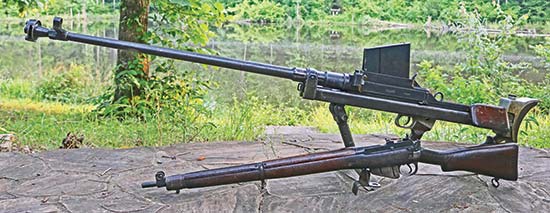
Brit standbys: The Boys Rifle dwarfs a No. 4 Enfield.
Nobody really needs an anti-tank rifle. When I informed my long-suffering bride of the newest acquisition she just rolled her pretty eyes, shook her head, and wandered off to do something productive. You don’t buy an anti-tank rifle because you need it. You buy an anti-tank rifle because it’s just so freaking cool.
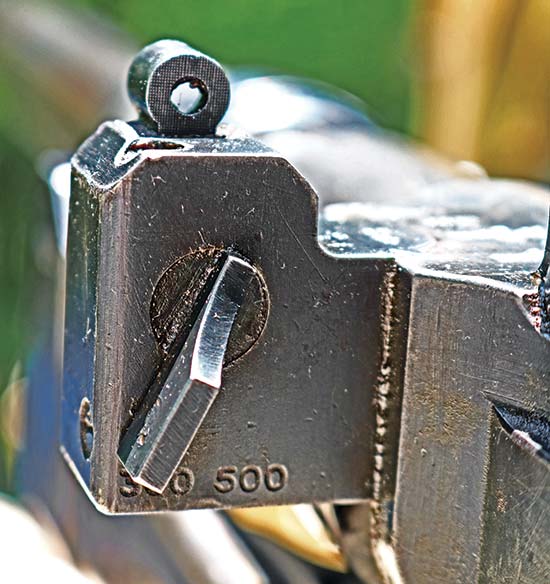
The rear sight is easily adjustable between 300 and 500 yards.
Descent Into Madness
It all began with an email from a dear friend. You know the type. The only thing better than spending your own money on something old, black and oily is spending your buddy’s money on something old, black and oily. He already had a Boys Rifle, so when he tripped over another he naturally thought of me. He dangled the thing in front of me like some kind of worm, and I gobbled it straight up without a fuss.
An anti-tank rifle is a Destructive Device. Never mind that it weighs as much as a Buick and shoots a ridiculously expensive antique round that has been out of production for more than half a century. In the eyes of the government it is Extra Special Dangerous (not a real federal classification so far), so it requires the same $200 transfer tax and interminable wait as might a machinegun or grenade launcher. At the terminus of all this hassle, however, this monster gun makes quite the fashion statement.
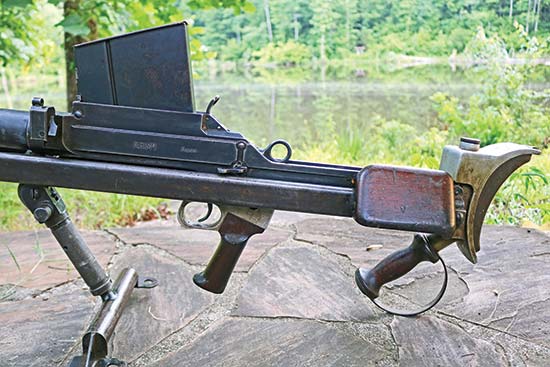
The forward-swept pistol grip on the Boys is perhaps its most distinctive feature.
Settle behind the gun and you’ll see the wisdom of this geometry.
Back Story
The .55 caliber rifle was born in 1937 of one Capt. Henry C. Boys. Boys was the Assistant Superintendent of Design at the Royal Small Arms Factory in Enfield, England. The gun was originally supposed to be called the “Stanchion,” but Boys died a few days before the weapon was approved for service, so they named it after him.
The Boys Rifle was actually obsolete when it was introduced. Against early light tanks and tankettes (a real thing used fairly extensively by the Italians, French and Japanese) the weapon was relatively effective. In fairly short order, however, armored vehicle technology had rendered the rifle’s 47.6-gram bullet little more than an inconvenience.
Optimized rounds sported a tungsten core and travelled at around 2,800 fps. These hardened projectiles would penetrate just under 1″ of steel armor plate at 100 yards.
The Boys Rifle was liberally supplied to the Finns during their Winter War with the Soviets in 1939. The weapon was popular with Finnish troops as it could reliably deal with the T26 light tanks the Russians fielded at the time. It was also used extensively in North Africa. After the Battle of France, however, the Boys had developed a reputation for ineffectiveness that was getting tough to shake.
Desperate to restore confidence in the gun, the Canadian government contracted with Walt Disney in 1942 to create a short animated film titled Stop That Tank! It can be seen on YouTube and is pure unfiltered awesome. Hitler ultimately has his personal tank destroyed by a Boys Rifle and ends up in Hades alongside his pal, Satan.
The USMC purchased Boys Rifles from Canada prior to the Pearl Harbor attack and used them to destroy a pair of Japanese seaplanes off Makin Island. The widespread employment of the Browning M2 .50 HMG — which had comparable penetration — rendered the Boys superfluous. The Boys Rifle was ultimately replaced by the PIAT (Projector, Infantry, Anti-Tank) in British service. The PIAT was a man-portable spigot mortar firing a shaped charge warhead that was hugely more effective against tanks.
The Boys Rifle was used sporadically throughout the war and saw limited use in a variety of brushfire conflicts around the Pacific afterwards. The last known combat use of the Boys occurred in September 1965 when members of the Irish Republican Army used a Boys Rifle to fire on the British fast-attack patrol boat HMS Brave Borderer, damaging one of its turbine engines. Nowadays Boys Rifles are only of interest to gun geeks like me.
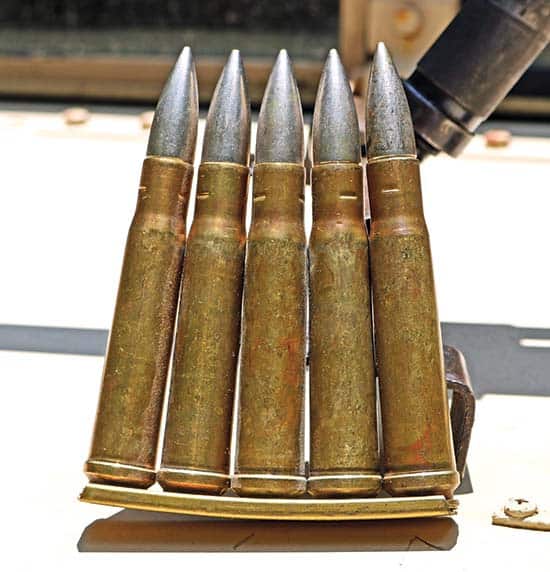
The massive belted .55-caliber rounds could put paid to early light tanks. However,
armored vehicle technology soon eclipsed the Boys Rifle’s capabilities.
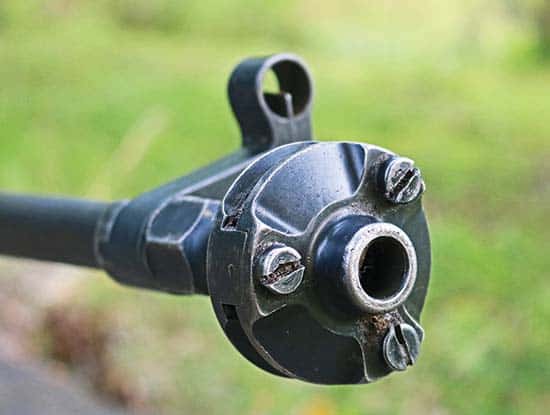
The Boys Rifle came in three major variations. The first sported this interesting circular muzzle brake.
Details, Details
The Boys Rifle weighs 35 lbs. (empty) and is just over 5 ft. long. It sports a conventional bolt action set into a spring-retarded sliding chassis that helps absorb the gun’s prodigious recoil. There were three variations built around the same basic action and my gun is the earliest sort.
The gun feeds from a top-mounted single-stack 5-round box magazine and sports iron sights that are flip-adjustable between 200 and 300 yards.
The odd forward cant of the two pistol grips accommodates the human form nicely, though there is no conceivable way to carry the Boys comfortably. Production culminated at 62,000 copies in 1940, and many available today have been rechambered to .50 BMG.
Heavy, inefficient, obsolete and cool, my Boys Rifle is now the epicenter of my gunroom.