Category: Well I thought it was neat!

Categories
Remember when…
It took three minutes for the TV to warm up.
Nobody owned a purebred dog.
When a quarter was a decent allowance, and made with real Silver!
You’d reach into a muddy gutter for a penny. Made with real copper! Looking to see if it was a 1943 copper penny!***
You got your windshield cleaned, oil checked, and gas pumped, without asking, all for free, every time. And you didn’t pay for air? And, you got trading stamps to boot.
Laundry detergent had free glasses, dishes or towels hidden inside the box. Not to mention Cracker Jacks!
It was considered a great privilege to be taken out to dinner at a real restaurant with your parents.
They threatened to keep kids back a grade if they failed…and they did it!
When a 57 Chevy was everyone’s dream car… to cruise, peel out, lay rubber or watch submarine races, and people went steady.

No one ever asked where the car keys were because they were always in the car, in the ignition, and the doors were never locked.
Playing baseball with no adults to help kids with the rules of the game.
Stuff from the store came without safety caps and hermetic seals because no one had yet tried to poison a perfect stranger.
*** According to the American Numismatic Association, the 1943 copper–alloy cent is one of the most idealized and potentially one of the most sought–after items in American numismatics. Nearly all circulating pennies at that time were struck in zinc–coated steel because copper and nickel were needed for the Allied war effort.
Approximately 40 1943 copper–alloy cents are known to remain in existence. Coin experts speculate that they were struck by accident when copper–alloy 1–cent blanks remained in the press hopper when production began on the new steel pennies.
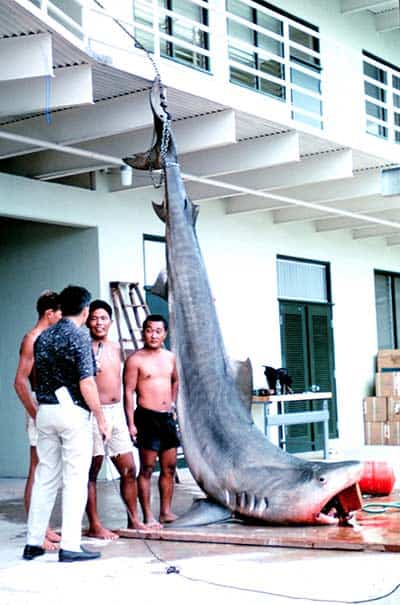
The tiger shark eats most anything it can catch.
On Thursday, April 25, 1935, a proof reader for The Sydney Morning Herald named Narcisse Leo Young was out enjoying the collection of exotic fish at the Coogee Aquarium and Swimming Baths near Sydney, Australia. Their accumulated menagerie was impressive for its day. The newest addition was an 11.5-foot Tiger shark that had been caught by an angler a week before some two miles out to sea. All were mesmerized by the massive beast as it cruised menacingly around its ample tank.
Narcisse saw the big shark begin to behave erratically. The beast suddenly wretched and deposited some unfortunate guy’s left arm in the pool. Aquarium personnel duly retrieved the ghastly limb. She later reported that the stench was “frightful.”
The arm was duly presented to police on the justifiable assumption that its former owner might yet have a vested interest in it. A forensic analysis showed that the stump had been severed cleanly with a cutting tool. There the case likely would have languished had it not been for a certain distinctive tattoo.
Adorning the unfortunate man’s severed limb was a crude depiction of two boxers in mid-punch. There was also a short length of rope tied around the wrist. While the arm had clearly seen better days, the tattoo remained both unique and intact. The authorities documented the curious ink extensively.
Three days after the shark’s unfortunate performance it was sacrificed for the greater good. Here the tale gets even weirder. Inside the creature was found a smaller shark that had apparently done the actual arm eating.

Behold the regurgitated shark arm. This distinctive tattoo gave
police insight as to the arm’s original owner.
The fingers were surprisingly intact, so the cops were able to retrieve usable fingerprints. The prints were traced to a small-time thug named Jim Smith, who had gone missing nearly three weeks before. His wife Gladys and brother Edward positively identified the tattoo.
Jim Smith was a known associate of a crooked local businessman named Reginald Holmes and a former soldier-turned-criminal named Patrick Brady. Holmes was a boat-builder by trade who used his fast powerboats to retrieve cocaine shipments dropped from passing ships to make a little dark money on the side. These three model citizens supported themselves by running a variety of rackets ranging from check forgery to insurance fraud.
The criminal fraternity is a fickle thing indeed, and the successful businessman Reginald Holmes had the most to lose. Diligent police work uncovered some compelling circumstantial evidence tying the now unarmed (an intentionally awkward metaphor) Smith with the veteran Brady, as well as some good old-fashioned blackmail of the bent businessman Holmes. Now distraught over the inevitable brewing scandal, Reginald Holmes retired to Sydney harbor aboard one of his boats and shot himself in the forehead with a .32-caliber automatic pistol.
Alas, the synergistic combination of Holmes’ thick skull and his little mouse gun resulted in nothing more than a flattened slug and a killer headache. Reggie Holmes was knocked into the water by the blow but revived in short order. He then remounted his personal speedboat and led the harbor patrol on a merry chase for several hours before finally being apprehended.
What likely got Jim Smith in deep with the criminal Brady in the first place was his reported cooperation with police as an informant. Now, Reginald Holmes saw a cozy relationship with law enforcement as his lifeline out of this mess. The following month he spilled the beans to Detective Sergeant Frank Matthews.
It seemed that Brady had indeed killed and dismembered the hapless Jim Smith. Always game to optimize his return on investment, Brady then materialized at Holmes’ domicile with Mr. Smith’s severed arm in tow. He brandished the appendage to prove he was serious and then purportedly demanded Holmes pay him 500 pounds. Brady left the arm at Holmes’ place as a token of his sincerity. Not wishing to alarm the missus unduly, Reggie Holmes drove to nearby Maroubra and disarmed himself in the ocean. It was here that the sharks apparently first became involved.
A few days later, the businessman Holmes was found dead in his car of an apparent suicide. This time he had been shot three times in the chest. Though sometimes forensic evidence can indeed be difficult to interpret, even I know that it is nigh impossible to commit suicide by shooting yourself three times in succession. Holmes had an appointment to testify against Brady later that day. It was here the lawyers got involved.
Brady’s Solicitor, Clive Evatt, asserted that his client could not be convicted of murder on the strength of a single severed arm barfed up by a shark with gastrointestinal issues. He alleged that the arm “did not constitute a body” and that many people were thriving who had lost an arm or worse. With the prosecution’s star witness now finally demised, the case imploded, and Brady walked free.
Patrick Brady maintained his innocence for the next 30 years. In the spring of 1965, he died peacefully at the Concord Repatriation Hospital in Sydney at the age of 76. Recent analysis has posited that Holmes actually hired a hitman to end his own moral misery and that Brady had indeed been innocent of that particular crime, at least. Despite some diligent Googling, I was unable to ascertain a final disposition on the arm.

“A weapon that kills without honor, without skill, but even so, it gives power and victory and Victory wipes away dishonor.


I snapped this picture in the waiting room at my clinic. These friable acoustic
ceiling tiles are absolutely everywhere. We generally don’t think much about them until there’s nothing else about which to think.
So, I’m sitting here alone in the semi-darkness, staring at those institutional ceiling tiles wearing one of those absurd open-backed surgical gowns. It is blue with a faded flower print. Who made that decision?
I’m patiently awaiting a minor medical procedure. It really isn’t a big deal. I’ve been clearing my throat a lot and asked a colleague to take a peek inside just to make sure there wasn’t something we could do about it. My wife calls it my moose call. It is worse after meals and is justifiably annoying for those around me.
The possibility I might die from this is fairly small. There is some anesthesia involved. However, I rather suspect that statistically speaking, the really dangerous bit was the drive to the clinic. The possibility of my buddy coming back to tell me he found something truly horrible is also fairly minuscule. But that is not the case with everybody in this building today. It also will not always be the case with me.
I have faced my own death before. At some point, if I feel really froggy, I’ll share the details with you guys. I was a soldier, and soldiering is innately dangerous. I have also had five people die in my arms. That’s the sort of thing to make a guy wax introspective. But back to those ceiling tiles …
Those things are everywhere. Dropped ceilings are all the rage in institutional settings. When I worked on the psych ward in residency, the facility sported two sequential locked doors, like a prison. In theory, you couldn’t get in or out without clearing each barrier in order, but they still outfitted the place with those dropped ceilings replete with ceiling tiles.
One young man took it as a challenge to elope from the place. He told us as much. And then, one evening, he just vanished. It was pretty amazing. They reviewed the security footage, but the kid was just gone. As they say, the authorities were vexed.
The following day one of the elderly patients complained that a little monkey had scampered out of the ceiling and eaten her breakfast. At first, everyone just wrote that off as some mystical combination of her rarefied mental illness, advanced age and her sparkling personality. And then somebody thought about that little missing dude. You guessed it; he had been hiding in the ceiling overnight. I am still amazed he found someplace comfortable enough to tolerate the experience.
Think back to the last time you had to endure something ghastly at the dentist. Perhaps you had a tooth extracted, a cavity filled, or a canal rooted. I recall the last time that happened to me. I was staring at those institutional ceiling tiles and wishing I could be absolutely anywhere but there. How about if we took that to the next level?

They call it the Big Blue Marble. Our time on this lovely little
ball is limited. It behooves us all to think a bit about that.
I once toured the death house at Fort Leavenworth, Kan. The facility was constructed by the inmates and was configured to accommodate lethal injection as the method de mortis. It was an utterly fascinating place.
The room itself was covered on the inside with soundproof material and sported two walls comprised of one-way mirrors — one for the victim’s family and the other for government witnesses. How does one get invited to something like that? Would anyone think ill of you if you respectfully declined? Does anybody ever do so?
I realized at the time I would likely never have the opportunity again, presupposing that I successfully resisted the urge to kill anybody, so I resolved to maximize the experience. The table was built like a cross with heavy leather tie-down straps. I climbed up on it and spread my arms out on the thing just to see how it felt. The table was hard. Apparently, Uncle Sam saw little need to waste resources on comfort given the circumstances.
As I reclined onto that table and imagined the dark circumstances surrounding their using it for real, I was struck by those ubiquitous acoustic ceiling tiles. The corner of one of them was cut away to admit a small microphone. The condemned got three minutes to speak before the warden departed the room. In such an institutional setting, when you die, you die alone.
The bottom line is that those benign unremarkable ceiling tiles play witness to some awfully profound human drama. They adorn my own medical office as well as that of my dentist. The trauma bays in the big urban medical center where I learned my craft sported them as well. That was the most dramatic place I had ever imagined. There is literally no telling how many people died horribly staring at those things.
Our sojourn on this odd blue orb is, by definition, time-limited. Everybody dies. Sometimes it is quick; other times, it takes a while. If you could tolerate a little unsolicited advice, if you haven’t already, you need to get right with God. The time to think about that for the first time is not when you are staring desperately up at those blasted ceiling tiles.
Whether it’s from sci-fi movies, video games, or books, we’ve often been told that present-day firearms will be replaced by high-tech blasters decked out with buttons, screens, and battery packs in the future. But is it true? We’ve also been told that our four-wheeled vehicles will be replaced by flying cars, jetpacks, and hoverboards, but we haven’t seen anyone zipping around town like Marty McFly or the Jetsons.
A company known as ArcFlash Labs has been pushing the envelope with 3D-printed electromagnetic guns that have become more sophisticated and powerful with each new model. The latest creation, the ArcFlash Labs EMG-02 coilgun, was recently tested in a video from Forgotten Weapons. The results have us thinking that those sci-fi blasters might not be so far-fetched after all.

Above: This coilgun fires cylindrical pieces of steel using a 15kW Gauss accelerator. No gunpowder, primer, or casing required.
The EMG-02 is described by ArcFlash Labs as a “10-stage medium voltage capacitor augmented fully-automatic coilgun.” That’s a mouthful, but in simpler terms, it uses electromagnetic coils to accelerate solid steel projectiles to about 250 feet per second (75 meters per second). We’ve seen the term “railgun” used to describe this category of electronic weapon, but that’s not accurate in this case. It’s a coilgun or gauss gun (not a gauss rifle, since it has a smooth bore).

This still from the Forgotten Weapons video shows the ArcFlash Labs EMG-02 below its predecessor, the ArcFlash EMG-01. On the 01, ten cylindrical capacitors at the bottom of the handguard powered eight coils around the barrel; on the 02, there’s one huge capacitor inside the shoulder stock, which powers ten coils around the barrel. Several other improvements have been made, including the use of an off-the-shelf lithium-ion drill battery. Improved efficiency allows the EMG-02 to fire up to 13 rounds per second.
The EMG-02 is a variable-caliber weapon, since it can accept steel armatures (i.e. sections of ordinary dowel pin) from 1/4-inch to 4/16-inch (6-8mm) in diameter and 3/4-inch to 13/16-inch (19-22mm) in length. The ammo is loaded into an included magazine, which holds 15 to 18 rounds, depending on diameter.

Above: Iain from Forgotten Weapons holds the ArcFlash Labs EMG-02 with a 20V drill battery installed.
Of course, there are some drawbacks and growing pains associated with all cutting-edge technologies, and this appears to be true of the EMG-02 as well. In the Forgotten Weapons video, Iain mentions that the weapon isn’t especially accurate, and demonstrates this by showing shot groups at the range. The projectiles tumble after leaving the barrel, since they’re not stabilized by rifling. It’s also expensive compared to most modern carbines, at an MSRP of $2,795. However, it’s exciting to watch this tech develop and consider where it might be 5 or 10 years from now.
Check out the video below from RECOILtv, and for more info on the ArcFlash Labs EMG-02, go to ArcFlashLabs.com.