




Category: Well I thought it was neat!
Categories
Darwin would of approved of this! Fieldcraft Funny Pictures & Memes Hard Nosed Folks Both Good & Bad Manly Stuff Paint me surprised by this Real men Some Red Hot Gospel there! This looks like a lot of fun to me! Well I thought it was funny! Well I thought it was neat! You have to be kidding, right!?!
Talk about getting into your opponents mind before the fun starts!

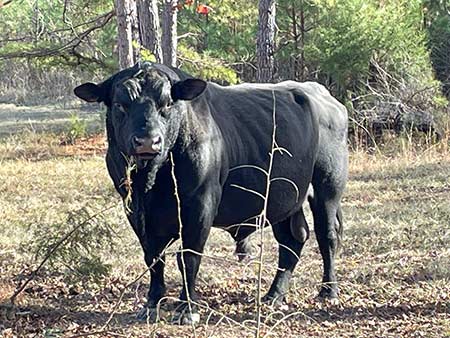
These big bulls are maintained and fed solely for their stud services.
They’re supposedly not much good to eat
A dear friend came up in the 1930s on a rural Mississippi farm. Growing up on a farm is a bit of a trope in the modern era. Back in the days before World War II, in the Deep South, however, it was a common way of life.
My wife is smart, assertive and capable. She is also of modest stature. Friends tell me the only substantive thing I contribute to our relationship is the capacity to reach tall things in the kitchen. So it sort of is with guys of other species as well.
In the bovine world, the women really do all the work. At a farm near where we live today, the cows and calves wander about freely in a massive expansive pasture. The cows keep busy gossiping about cow stuff while feeding and grooming the youngsters. There seems to be a social order to it all. Then there is a single massive bull maintained by all by his lonesome in his own separate space down the road.
I’m told those big bulls are too tough to make particularly good steaks. That big guy is kept around for one purpose and one purpose only. He’s there solely to make little cows. Outside of breeding season, the price he pays is a lifetime of solitude. On my buddy’s farm, their big breeder bull was an enormous docile creature named Ephraim.

There is a strange hierarchy among cows. The females of the
species seem to do all the real work.
The Villain
A fully grown bull can weigh more than 2,000 pounds. Even if they have a sweet disposition, an animal that large can yet still be incredibly dangerous. If they are by their nature grouchy, then things can get dicey quickly. So it was at another farm down the road from my friend’s place.
Their breeder bull made fine baby cows, but he hated everybody. One day a farm hand got sloppy, and the big animal crushed him to death. News travels fast in the rural Deep South, so word of this tragedy made the rounds in a hurry. Condolences were offered, and a plan contrived. The following day the big animal was to pay for his sins. His steaks might be tough, but somebody, somewhere would be willing to eat them. Now hold that thought.
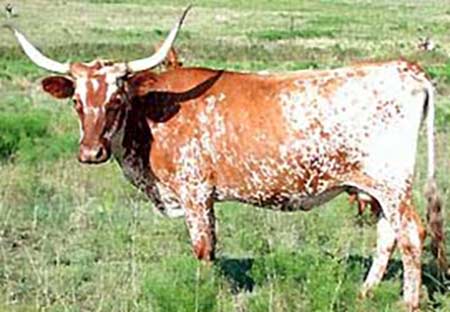
The Misunderstanding
It was getting late, and the light was growing dim. As my friend was cleaning up after supper, he looked out the window and saw Ephraim standing outside the pasture. Ephraim was indeed a docile creature, but he was still a big, dumb animal. Sometimes a good scratching against the fence was adequate to push it over. My buddy sighed and headed outside. He would return the bull to the pasture and then run the fence the following morning to mend the damage. By the time he got outside, the light was failing.
Ephraim was essentially a family pet and responded reliably when spoken to. Our hero patted the big animal on the flank and opened the nearby pasture gate. He directed the bull back into the enclosure and stepped aside to allow the beast to comply. Ephraim simply looked at him dumbly.
By now, it was getting late, and the man was getting tired. He gestured to the gaping gate and slapped the animal vigorously on its flank. The bull just stared at him. This time he let out a little snort. Now things were in danger of escalation.
My buddy retrieved a nearby discarded length of 2×4 lumber and used it to give Ephraim a decent prod. At that, the big animal turned to face his antagonist. He then glowered uncharacteristically and snorted like he meant it.
Such stuff seems cold and cruel to those who have not lived it, but farm animals exist in a harder world than do we modern civilized folk. Right, wrong, or otherwise, these creatures are raised for food. There is certainly no excuse for rank abuse, but there is little time or inclination for undue civility, either.
Ephraim pawed the ground and lowered his head. It was clear that the animal planned to make an issue of this. The beast had tasted the sweet elixir of freedom and apparently had little interest in returning to his place of incarceration. As Ephraim made to lunge at the man, my buddy swung the 2×4 and broke it squarely across the hulking animal’s skull.
The big bull was momentarily stunned. With a look of bewilderment in his eyes, he then turned and obediently marched into the pasture. My pal secured the gate and went to bed, both aggravated and confused by the evening’s atypical proceedings.
The following day broke bright and clear. My pal got up early, as was his custom, took breakfast, and prepared to start a new day. As he looked out the front window across the expansive pasture, he was shocked to see not one but two bulls munching happily. One was the expected Ephraim, while the other was the homicidal neighbor from down the road who had somehow escaped his enclosure on the day before his scheduled execution.
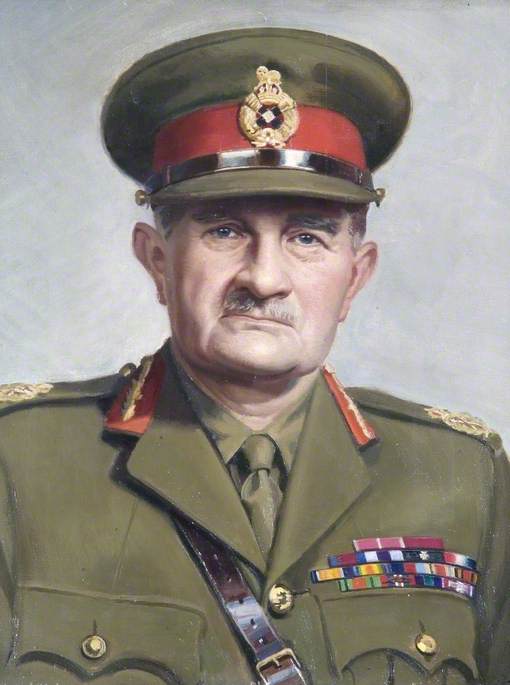
Slim should be remembered as the greatest British general of World War Two.
Even the most sketchily educated Briton today will nevertheless recognise in the murky depths of their consciousness the name of that great British general of World War Two, Montgomery of Alamein. To an older generation perhaps another name resonates equally and perhaps more strongly, the name of a man Montgomery airily dismissed as a mere ‘sepoy general’, and yet someone whose military legacy has arguably outlasted even that of the great ‘Monty’ himself.
That the name of Field Marshal William Slim is remembered by only a few old soldiers and interested military buffs today is a tragedy of enormous proportions, when one assesses in the great weighing scales of history his contribution to Britain’s success in the Second World War and his more longer lasting contribution to the art and science of war as a whole.
The war in the Far East is easy to forget, given that it took place far from home and in the shadow of the titanic struggle against Nazism in Europe. Yet the war against Japan in Burma, India and China was no less titanic, as two competing empires collided violently, with profound implications for the future of the post-war global order, not just in the Pacific but also for the whole of Britain’s creaking empire. Slim played a significant part in the whole story.
Slim was, first and foremost, a born leader of soldiers. It would be inconceivable to think of Monty as ‘Uncle Bernard’, but it was to ‘Uncle Bill’ that soldiers in Burma, from the dark days of 1942 and 1943, through to the great victories over the Japanese in 1944 and 1945, put their confidence and trust.
He inspired confidence because he instinctively knew that the strength of an army lies not in its equipment or its officers, but in the training and morale of its soldiers. Everything he did as a commander was designed to equip his men for the trials of battle, and their interests were always at the forefront of his plans.
He knew them because he was one of them, and had experienced their bitterest trials. Brigadier Bernard Fergusson (later Earl Ballantrae and Governor General of New Zealand), believed that Slim was unlike any other British higher commander to emerge in the Second World War, ‘the only one at the highest level in that war that… by his own example inspired and restored its self-respect and confidence to an army in whose defeat he had shared.’
Not for him the aristocratic or privileged middle class upbringing of some many of his peers, but an early life of industrial Birmingham, relieved only by the opportunities presented for advancement by the upheavals of the First World War. The 100 day 1000 mile retreat from Burma to India in 1942, the longest in the long history of the British Army was, whilst a bitter humiliation, nevertheless not a rout, in large part because Slim was put in command of the fighting troops.
He managed the withdrawal through dust bowl, jungle and mountain alike so deftly that the Japanese, though undoubtedly victorious, were utterly exhausted and unable to mount offensive operations into India for a further year. In time Slim was given the opportunity no British soldier has been given since the days of Wellington: the chance to train an army from scratch and single-handedly mould it into something of his own making, an army of extraordinary spirit and power against which nothing could stand.
By 1945 Slim’s 14th Army, at 500,000 men the largest ever assembled by Britain, had decisively and successively defeated two formidable Japanese armies, the first in Assam in India in 1944 and the second on the banks of the great Irrawaddy along the infamous ‘Road to Mandalay’ in Burma in 1945.
Slim’s victories in 1944 and 1945 were profound, and yet were quickly forgotten by a Britain focused principally on the defeat of Germany, and by a United States gradually pushing back the barriers of Japanese militaristic imperialism in the Pacific. In late 1943 the 14th Army had begun to call itself the ‘Forgotten Army’, because of the apparent lack of interest back home of their exertions. 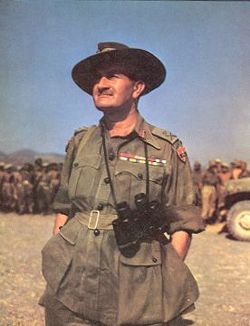
Sadly, from the time of the last climactic battles and the dash to seize Rangoon in May 1945 Slim’s achievements as the leader of this great army have equally been forgotten, although not of course by those who served under him who were all, as Mountbatten declared, ‘his devoted slaves’, nor indeed by their children and grandchildren who together make the Burma Star Association the only old soldiers’ association that actually continues to grow, rather than diminish.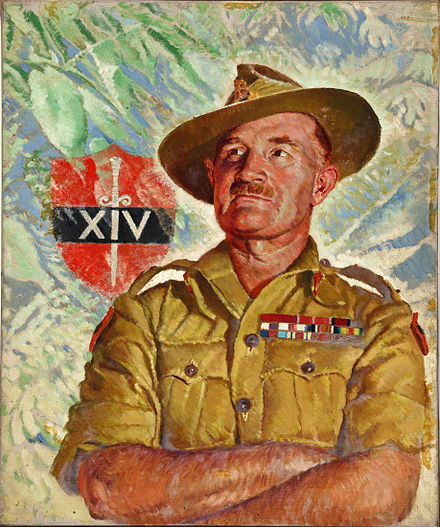
What were these achievements? In terms of his contribution to Allied strategy in Burma and India between 1942 and 1945 they were threefold. First, he prevented, by his dogged command of the withdrawal from Burma the invasion of India proper in 1942 by a Japanese Army exulting in its omnipotence after the collapse of the rest of East Asia and the Pacific rim.
Second, he removed forever any further Japanese ambitions to invade India proper by his destruction of Mutaguchi’s legions in the Naga Hills around Kohima and the Manipur Plain around Imphal in the spring and early summer of 1944, and in so doing he decisively shattered the myth of Japanese invincibility that had for so long crippled the Allied cause.
Third, despite the prognostications of many, and subtly influencing Mountbatten to conform to his own strategy, Slim drove his armoured, foot and mule-borne and air-transported troops deep into Burma in late 1944 and 1945, across two of the world’s mightiest rivers, to outwit and outfight the 250,000 strong Burma Area Army of General Kimura and in so doing engineer the complete collapse of Japanese hegemony in Burma.
Given the pattern of British misfortune in 1942 and in 1943 it is not fanciful to argue that without Slim neither the safety of India (in 1942 as well as in 1944), nor the recovery of Burma in 1945, would ever have been possible. Slim’s leadership and drive came to dominate the 14 Army to such a degree that it became, in Jack Master’s phrase, ‘an extension of his own personality.’
Slim’s achievements need also to be examined from a more personal, professional perspective. That he was able to defend India’s eastern borders from imminent doom, and crush both Mutaguchi and Kimura in the gigantic and decisive struggles of 1944 and 1945 was due to his qualities as a military thinker and as a leader of men.
Slim was a master of intelligent soldiering. That a man becomes one of the most senior officer of his generation is not always evidence per se that he has mastered this most fundamental of requirements: in Slim’s case it was.
His approach to the building up of the fighting power of an army – from a situation of profound defeat and in the face of crippling resource constraints – is a model that deserves far greater attention today than it has received in the past. It was an approach built on the twin platforms of rigorous training and development of each individual’s will to win, through a deeply thought-out programme of support designed to meet the physical, intellectual and spiritual needs of each fighting man.
Slim’s description of General Sir George Giffard, his superior for a time, can equally be applied to himself: Giffard’s great strength, Slim commented, lay in his grasp of ‘the fundamentals of war – that soldiers must be trained before they can fight, fed before they can march, and relieved before they are worn out.’
Second, Slim was a remarkable coalition commander. The Army that defeated the might of the Japanese in both India and Burma during 1944 and 1945 was a thoroughly imperial one, seventy-five percent Indian, Gurkha and African. Even in the British Empire of the time it was not self-evident that a British officer would secure the commitment of the various diverse nationalities he commanded: indeed, many did not. 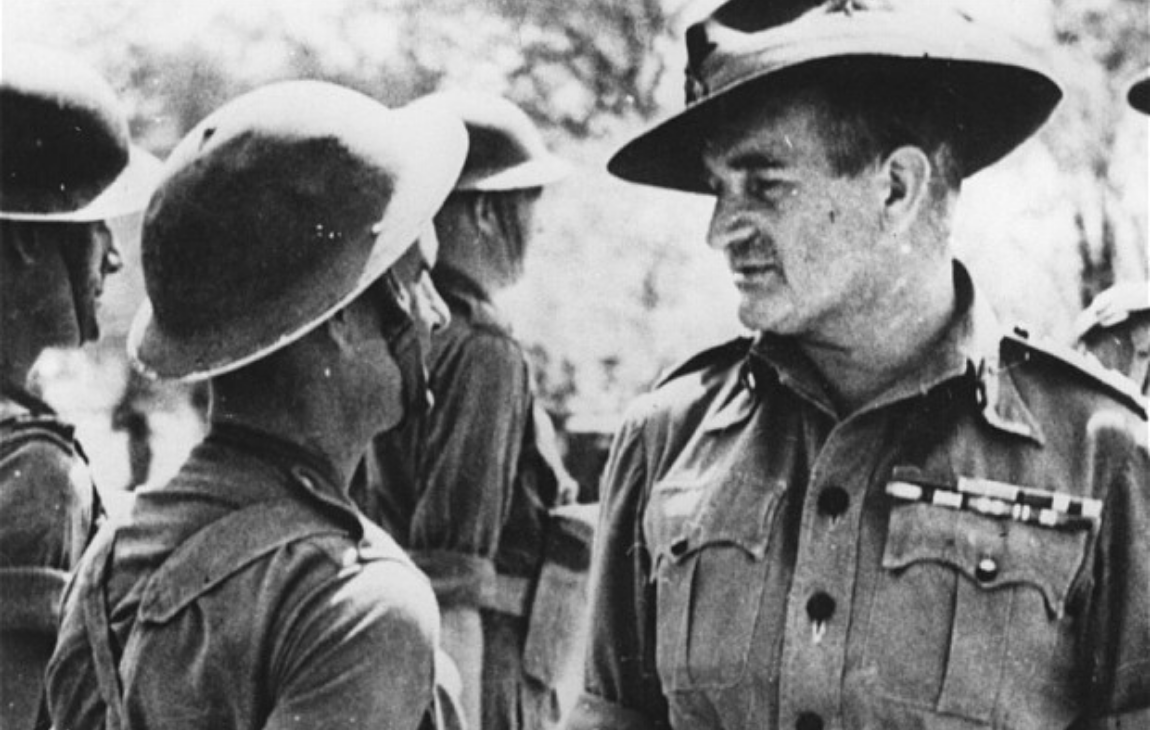
In his study of military command the psychiatrist Norman Dixon considered Slim’s quite obvious ability to join many of these diverse national groups to fight together in a single cause to be nothing less than remarkable, and the antithesis of the norm.
That he did so at a time of social and political unrest in India with the anti-colonial ‘Quit India’ campaign, and in the face of some early desertions to the Japanese-sponsored Indian National Army under Subhas Chandra Bose, makes his achievements even the more remarkable. The British soldier was also suspicious of officers of the Indian Army, but Slim succeeded effortlessly in winning them over, too. 
He ‘was the only Indian Army general of my acquaintance that ever got himself across to British troops’ recalled Fergusson. ‘Monosyllables do not usually carry a cadence; but to thousands of British troops, as well as to Indians and to his own beloved Gurkhas, there will always be a special magic in the words “Bill Slim.”
But in addition to his success in defeating the Japanese in 1944 and 1945, and in building up 14 Army to become a formidable fighting machine, Slim’s most abiding legacy was his approach to war, which at the time was singularly different to that adopted elsewhere during the war, either by Monty in Africa and North West Europe or Alexander in Italy.
Slim’s pre-eminent concern was to defeat the Japanese army facing him in Burma, not merely to recover territory, and he determined to do this through the complete dominance of the Japanese strategic plan. Training his troops relentlessly through monsoon, mountain and jungle, joining the command and operation of his land and air forces together, so that they served a single object, and delegating command to the lowest levels possible, Slim created an army of a power and fighting spirit rarely ever encountered in the history books.
In 1944 he allowed Mutaguchi’s 100,000 strong 15 Army to extend itself deep into India, there to be met by a ruthlessly determined 4 Corps, supplied by air and attacking at every opportunity the tenuous Japanese lines of communication back to the Chindwin. It was high risk, and more than one senior officer in Delhi and London despaired of success.
Slim, however, knew otherwise, and in the process of the climatic battles of Imphal and Kohima he succeeded in shattering the cohesion of a whole Japanese army and destroying its will to fight, a situation as yet unheard of for a fully formed Japanese army in the field. There were a number of close calls, and Slim was always the first to admit to his mistakes, but his steady nerve never failed. He moulded the Japanese offensive to suit his own plans, and step-by-step, he decisively broke it in the hills of eastern Assam and the Imphal plain.
Many commanders would then have sat on their laurels. Not so Slim. He was convinced that real victory against the Japanese required an aggressive pursuit, not just to the Chindwin but into the heart of Burma itself. Single-handedly he worked to put in place all the ingredients of a bold offensive to seize Mandalay at a time when every inclination in London and Washington was to seek an amphibious solution to the problem of Burma and thus avoid the entanglements of a land offensive.
Slim believed, however, that it could be done. Virtually alone he drove his plans forward, winning agreement and acceptance to his ideas as he went, particularly with Mountbatten, the Supreme Allied Commander in the Far East, and went on to execute in Burma in 1945 one of the most brilliant expositions of the strategic art that warfare has ever seen.
He did this in the face of difficulties of every sort and degree. Employing his abundant strategic initiative to the full, he succeeded in outwitting and destroying an even larger army under General Kimura along the Irrawaddy between Meiktila and Mandalay in the spring of 1945, Kimura himself describing Slim’s operation as the ‘masterstroke of allied strategy’. In both these operations Slim prefigured the doctrine of ‘manoeuvre warfare’.
Although Slim would not have recognised the term, his exercise of command in 14 Army indicates clearly that he espoused all of the fundamental characteristics. The modern British Army defines it as ‘the means of concentrating force to achieve surprise, psychological shock, physical momentum and moral dominance… At the operational level, manoeuvre involves more than just movement; it requires an attitude of mind which seeks to do nothing less than unhinge the entire basis of the enemy’s operational plan.’
It argues that the extreme military virtue does not lie, as Monty practised, in the direct confrontation of the enemy mass, in an attempt to erode his strength to the point where he no longer has the physical wherewithal to continue the contest, but rather in the subtlety of the “indirect approach”, where the enemy’s weaknesses rather than his strengths are exploited, and his mental strengths and, in particular his will to win are undermined without the necessity of a mass-on-mass confrontation of the type that characterised so much of Allied operations on both the Western and Eastern Fronts in Europe during the Second World War. Slim’s exercise of command in Burma makes him not merely a fine example of a ‘manoeuvrist’ commander but in actuality the template for modern manoeuvrist command.
‘Slim’s revitalisation of the Army had proved him to be a general of administrative genius’ argues the historian Duncan Anderson: ‘his conduct of the Burma retreat, the first and second Arakan, and Imphal-Kohima, had shown him to be a brilliant defensive general; and now, the Mandalay-Meiktila operation had placed him in the same class as Guderian, Manstein and Patton as an offensive commander.’
Mountbatten claimed that despite the reputation of others, such as the renowned self-publicist, Montgomery of Alamein, it was Slim who should rightly be regarded as the greatest British general of the Second World War. Slim’s failing was to deprecate any form of self-publicity believing, perhaps naively, that the sound of victory had a music all of its own. The ‘spin doctors’ of our own political generation have sadly taught us something Monty knew instinctively and exploited to his own advantage, namely that if you don’t blow your own trumpet no one else will.
The final word should be left to one who served under him. ‘“Bill” Slim was to us, averred Antony Brett-James, ‘a homely sort of general: on his jaw was carved the resolution of an army, in his stern eyes and tight mouth reside all the determination and unremitting courage of a great force.
His manner held much of the bulldog, gruff and to the point, believing in every one of us, and as proud of the “Forgotten Army” as we were. I believe that his name will descend into history as a badge of honour as great as that of the “Old Contemptibles.” Sadly, Slim’s name and achievements have not done what Brett-James hoped, and it is now the responsibility of a new generation to understand and appreciate his achievements.’
Robert Lyman’s A War of Empires will be published by Osprey in November 2021.
————————————————————————————– Lord William Slim in the House of Lords London UK

Compared to our rugged forebears who domesticated the continent, invented lots of cool stuff, won scads of wars and quite literally freed an enslaved world, we seem an awfully fragile lot these days.
Americans are not quite so durable as was once the case. As such, I thought it might be a fun exercise to see if I could offend every single person in the country in a single weekly column. All I’m really doing is packaging facts — here goes.
Men are Stupid
Testosterone is the primary sex hormone in males; an anabolic steroid from the androstane class. Testosterone begins life as cholesterol before being synthesized into its active form in the liver. This complex chemical combination of Carbon, Hydrogen, and Oxygen is arguably the most powerful force for chaos the universe has ever seen. Plutonium is mere baby formula compared to a proper surge of testosterone in a 13-year-old male.
As a physician, I have seen guys shot, set on fire, blown up and dismembered as a direct result of the deleterious effect of this mysterious toxin. In concert with alcohol, the synergy can be simply epic. By contrast, I have not once attended a woman professionally after she poured gasoline over a barbecue grill because she was, “Getting really hungry.”
By the numbers, 93.3% of the incarcerated population in America is male. Let the significance of that number sink in for a minute. Guys run the world and look at the shape it is in. Men are clearly idiots.
Women are Crazy
Ask any radical feminist to define a hysterectomy and they will rightly say it is the procedure wherein the female reproductive organs are surgically removed. However, I dare say very few radical feminists have dissected the etymological origins of the term. Hysterectomy is derived from the Latin hystericus meaning, “of the womb.”
Back in the day, hystericus was viewed as a neurotic condition unique to women involving emotional outbursts, unpredictability and outright madness. Medical practitioners in centuries past believed this condition somehow originated in the uterus. As a result, the term hysterectomy literally translates, “the surgical excision of the crazy from the woman.”
“Lunacy” is also an oblique antiquated reference to the woman’s monthly menstrual cycle.

It seems at some point in the distant past, the entire planet was tropical.
(Source: Mandy Choi, Unsplash)
Youth are Ignorant
Greta Tintin Eleonora Ernman Thunberg first embarked on a career in climate activism at the age of 15. Hers has since become a household name around the globe, thrice nominated for the Nobel Peace Prize — something for which I have yet to be considered a single time. She carries a diagnosis of Asperger’s Syndrome and refers to it as her “Superpower.” I think that’s legitimately awesome.
Greta inspired “Fridays for Future,” also known as the “School Strike for Climate.” This is an international movement wherein students skip Friday classes to participate in demonstrations demanding action on climate change. On March 15, 2019, one of these events attracted more than a million strikers worldwide.
When I was Greta’s age, I would have marched in support of invading space aliens if it got me out of school and into a crowd with girls. The argument could be made if you can’t be trusted with a handgun, you also shouldn’t be able to vote. Let Greta pay taxes for a few decades and then we’ll talk.
Climates Change
In February 2017, scientists retrieved a core sample drilled from the ocean floor in the Amundsen Sea off the coast of Western Antarctica. This sample, recovered a mere 560 miles from the South Pole, was fraught with fossilized plant spores, pollen and a mass of preserved fossilized plant roots. There have been ample fern and palm fossils discovered on all seven continents, as well as the North Pole. At some point in the past, long before men mucked with anything, the entire planet was actually tropical.
I don’t doubt the climate is changing, I’m just not convinced anything we do at this point is going to substantively change that fact. The upside is global warming should open up vast areas in places like Canada, Alaska and Russia to both habitation and agriculture.
When life gives you lemons, why not just grow some more lemons?
There are literally countless other examples of woke low-hanging fruit ripe for ridicule. For now, just send all your hate mail and parcel bombs to me in care of FMG Publications. We’ll be expecting them.

Louis Cukela earned the Medal of Honor—as well as a chestfull of other awards for heroism—on World War I’s Western Front. But the ethnic-Serbian Leatherneck is best remembered for his unconventional and humorous behavior, which included a knack for butchering the English language.
The smaller of the naval services enjoys a reputation for attracting eccentrics to its muster rolls. The historical literature of the early 20th-century Marine Corps is rich with names like Hikin’ Hiram (Hiram Bearss), Johnny the Hard (John Hughes), Diamond Lou (Lou Diamond), and Old Gimlet Eye (Smedley Butler). None of the sea stories surrounding these characters, however, matches the exploits of Louie Cukela during the World War I era and interwar years. Much of what has been written about him fails to survive the close scrutiny of official records, but enough remains to support the contention that he was one of the most unusual characters to wear forest green during those eras.
Official documents that record his birthplace remain confusing. Although always referring to his ethnicity as Serbian, Louis Cukela (pronounced coo-KAY-la) was born on 1 May 1888 in Split, or Spalato, in Croatia on the Adriatic Sea’s Dalmatian coast. Cukela’s ethnicity sometimes appeared on muster rolls and other official documents as Austrian or Croatian, but more often he was listed as Serbian. After completing two-year courses at both the Merchants Academy and the Royal Gymnasium, he immigrated to the United States in 1913 and settled in Minneapolis with his brother. Cukela’s mother had died in 1900, and he left his father and three sisters in Split. Claims that he studied for the priesthood and then served as a warrant officer in the Serbian Army before being cashiered as a result of a duel with a fellow officer cannot be supported by any records extant. Like so much of the Cukela legend, they are probably sea stories copied faithfully by a succession of journalists and historians.
From Soldier to Marine
On 21 September 1914, he enlisted in the U.S. Army and served with Company H, 13th Infantry at Camp McGrath near Batangas in the Philippines. Informed that his father had been taken prisoner by the Austrian Army and the rest of the family had fled to the hills, he obtained his discharge by purchase on 12 June 1916. Supposedly, Cukela intended to join the Canadian Army to get into the conflagration sweeping Europe. For some reason, however, he enlisted in the Marine Corps on 31 January 1917. He reportedly asked a bemused recruiting sergeant if the sign in the window, which trumpeted “First to Fight,” was true.
Cukela claimed the rank of corporal in the Army and told the recruiter that he spoke and read six languages; fortunately, he did not include English among them. The butchery of his adopted tongue grew increasingly worse as the years passed; he seemed to enjoy the befuddlement it produced among his following of admirers. Decades later, veterans could still recall Cukela’s unique version of the command “squads right about,” in the eight-man squads drill of the day: “Squads rightdo it two times, unt dunt foul it up. Ho-o-ooo!”
After recruit training, Cukela joined the 5th Marines at Quantico. In anticipation of a deployment to France, Major General Commandant George Barnett transferred eight companies of veteran Marines home from the Caribbean to provide backbone and grit to the regiment as it filled out rapidly with high-spirited volunteers possessing little or no military experience. Cukela took no back seat to his grizzled brothers-in-arms, and he sewed on the stripes of a corporal before the 5th Marines sailed to France in June 1917 to join the American Expeditionary Forces (AEF).
While the recruiting sergeant who signed up Cukela might have spoken the truth when assuring him that the Marine Corps was always the “first to fight,” General John J. Pershing, the commander in chief of the AEF, and other senior Army officers took steps to limit participation by the Leathernecks in the fighting in France. Shortly after reviewing the Marines for the first time, Pershing acknowledged their military smartness and lauded their appearance. Nonetheless, he fired off a secret cablegram to the adjutant general of the Army requesting that no more Marines be sent to France; just as forthrightly, he was informed that President Woodrow Wilson had directed the deployment of the remaining elements of an entire brigade of Leathernecks to the AEF. Furthermore, that brigade would be assigned to the 2d Division.
Heroism on French Battlefields
During their first year in France, Cukela and the 5th Marines performed duties behind the lines before deploying to the Verdun sector. Within a month in a combat zone, Cukela had earned a citation from the commanding general of the 2d Division and a Croix de Guerre from the French. On 27 May 1918, the Germans launched their third offensive of that spring. This time, it sent the French forces north of the Aisne River reeling back toward Paris, and by the 31st, the Germans had reached Chteau-Thierry. The 4th Brigade (Marine), AEF, took up a position on 1 June near the southern edge of Belleau Wood—an obscure forest just north of the Paris-Metz highway—with orders to dig in and hold at all costs. On the 5th, the Marines received orders to clear the wood of Germans. Between then and 26 June when commanders declared Belleau Wood secure, the Marines suffered a total of 4,710 killed or wounded—a casualty rate of almost 50 percent.
Cukela, newly promoted to gunnery sergeant of the 66th Company, 1st Battalion, 5th Marines led his platoon through the tangled underbrush as they used mostly bayonets, rifle butts, and grenades to wipe out machine-gun nests. Cukela was recommended for the Medal of Honor, but “Black Jack” Pershing and the staff of the AEF turned down the citation. Incredibly, they failed to award Cukela a lesser decoration, such as the Distinguished Service Cross or Silver Star.
Even as the Germans abandoned their offensive, the Allies planned to counterattack in hopes of cutting the main highway from Soissons to Chteau-Thierry. The Leathernecks moved into a pocket south of Soissons in preparation for clearing the Foret de Retz and the fields around Vierzy. In two days of bitter fighting the Marine brigade wiped out rifle pits and machine-gun nests to clear the contested terrain.
Louie Cukela was in the forefront of the fighting. Just as a friendly barrage of artillery fire lifted early on 18 July, murderous machine-gun fire tore into the ranks of the Leathernecks deployed in the Fort de Retz. Cukela struck out alone in front of his platoon, ignoring warnings from his comrades. Advancing from the flank, he used his bayonet to wipe out the crew of one machine-gun emplacement. Then, Cukela threw captured grenades to drive terrified Germans from a second strongpoint. Singlehandedly, he captured four Germans and two machine-gun nests. This time, AEF headquarters concurred in the recommendation for the award of the Medal of Honor, but inexplicably gave him both the Army Medal of Honor and the Navy Medal of Honor for the same act of heroism.
Cukela later fought in the St. Mihiel offensive, the epic assault on Blanc Mont, and the Meuse-Argonne offensive. He suffered wounds at St. Mihiel and Blanc Mont, but his regimental surgeon considered them so minor that they were never entered in either his medical record or officer’s qualification jacket.
The Marine Corps, meanwhile, offered the fearless Leatherneck a battlefield commission, effective 26 September 1918. The brigade surgeon noted at Cukela’s precommissioning physical that the intrepid Marine, continuing to march to his own drummer, was infected with gonorrhea. Somewhere he obtained a smartly tailored officer’s uniform, and he then trimmed his Central Europeanstyle mustache to a square brush cut that became a fixture for the rest of his life.
At about that time, he coined a phrase that became famous throughout the AEF. Upset with the performance of a subordinate, Cukela was apt to mutter, “When I vant to send a damn fool, I send myself.” The phrase caught fire with the American forces in France, and before long everyone was using it; supposedly, Pershing himself was overheard rebuking a subordinate with it.
Cukela continued to serve with the 5th Marines for the rest of the war and occupation duties in Germany. On 15 July 1920, he embarked on a troopship for home. Besides the Medal of Honor, he wore the Army’s Silver Star. France awarded him the Legion of Honor, two Croix de Guerre with Palms, another Croix de Guerre with Silver Star, and the Military Medal. Italy presented Cukela the War Merit Cross, and Yugoslavia awarded him the Commander’s Cross of the Royal Order of the Crown of Yugoslavia. Cukela would soon obtain unique and flashy ribbons for his medals. When asked, he coyly refused to divulge his source for the unauthorized materials, and no one demonstrated the temerity to question his blatant disregard for the uniform regulations.
From Demotion to Promotion in the Regular Marines
Back home, Cukela almost immediately fell victim to a draconian plan to trim the lineal list of officers from its wartime high of more than 2,400 (at the beginning of the war, the Corps counted only 341 commissioned officers). Named after its chairman, Colonel John Russell, the Russell Board recommended discharge for some reserve officers and a return to the enlisted ranks for others among the meritorious noncommissioned officers who had been elevated to officer rank during the war.
The results precipitated shock and outrage throughout the Marine Corps, especially when it was learned that Russell had advised the board to “bear in mind that they would be selecting the young officers that they would be inviting into their quarters and whom their daughters might marry.” Disappointed officers and outraged critics contended that the Russell Board had used its power to maintain the dominance of the Marine Corps by the effete intellectuals from Annapolis.
While recommending that Cukela retain his reserve commission, the Russell Board demoted him from first lieutenant to second lieutenant. A second board, convened in 1921 to address the controversy surrounding the Russell Board, restored the ranks of veteran tropical campaigners and those who had distinguished themselves under fire in France.
The panel recommended Cukela for promotion to first lieutenant in the regular Marine Corps, thus shielding him from further attempts to “pluck” the lineal list. Brigadier General Smedley D. Butler, the most vociferous critic of the Russell Board, cited the case of Louie Cukela to support his contention that veteran campaigners should lead the Marine Corps: “To be sure his table manners are not good, but it was my impression that we were not running a knitting society.”
Caribbean Adventures and Misadventures
Meanwhile, on 1 November 1919, Cukela joined the 1st Brigade in Haiti. Soon after arriving, he shared a pithy opinion with a promising second lieutenant. Cukela thought the custom of garrisoning the towns with Marines an utter waste of time; instead, they should take to the hills in a large force to aggressively pursue the Cacos, or Haitian insurgents. To the aggressive young officer, Cukela’s logic made sense; Lewis B. “Chesty” Puller never forgot the advice.
Shortly after arriving in Haiti, Cukela underwent his physical examination for promotion to first lieutenant, and the results indicated he was still marching to his own drummer. The brigade medical officer noted that while Cukela had been cured of gonorrhea he had meanwhile contracted syphilis.
While Cukela was deployed in the Caribbean, an incident far more serious than any lapses of judgment while in the quest for horizontal refreshment almost resulted in the end of his career. The lieutenant’s brigade commander charged that Cukela had personally executed three Haitian detainees. A medical officer, who examined Cukela just after the alleged incident, reported him highly agitated and smelling strongly of alcohol. Furthermore, he was well known for his predilection to personally execute captured Cacos. While the ensuing investigation cleared him of any wrongdoing, the Major General Commandant simply removed Cukela from the potentially damaging scene by transferring him to the 2d Brigade in the Dominican Republic.
The investigation did provide an amusing postscript, however. Cukela underwent two mental examinations during the inquiry, and the doctors who conducted them pronounced him sane. For the remainder of his career, he would respond to anyone who muttered, “Cukela, you’re crazy!” with “I’m crazy? I have proof that I’m sane; do you have such proof?” Then, the unabashed Cukela would produce the medical documents attesting to his sanity.
The Corps’ Eccentric Captain
In October 1923, Cukela left the Dominican Republic for duty at Quantico; he had earned a promotion to captain on 1 July 1921 on a lineal list that only moved when another officer senior to you was promoted, dismissed, retired, or died. Cukela took command of a company in the 5th Marines and quickly earned a reputation for his capable, if not bizarre, style of leadership. Marines of the era recalled with wry amusement Cukela’s unique response to a parade held in honor of the Secretary of the Navy.
Just as the troops assembled on the parade ground, the regiment’s fussy adjutant conducted a walk-by inspection. Spotting Cukela not wearing a single medal, he rebuked him for failing to comply with the order prescribing the parade uniform. Cukela turned the formation over to a lieutenant and returned to his quarters to appear in accordance with the adjutant’s instructions. Shortly thereafter, Cukela returned, and on-lookers that day at Quantico recalled with relish the scene for a generation. Cukela wore only one medal around his neck, the Commander’s Cross of the Royal Order of the Crown of Yugoslavia (supposedly the size of a salad plate). He had pinned the rest of his medals on the saddle blanket of the horse he was leading. Cukela took a position in front of his company and then, poker-faced, led it past the reviewing stand.
On the domestic front, Cukela finally met his match, marrying Minnie Myrtle Strayer after his return to Quantico. Reportedly, she was the only person capable of taming his wild impulses. Marines of the era recalled that the Cukelas would always be the last to leave the numerous parties or receptions, command performances for officers of the time. Then, Minnie and Louie would load all of the leftover party foods into their car. Stopping at the guard house, they would unload the booty for the pleasure of the Marines on duty. While Minnie arranged for the buffet, Louie would entertain the members of the guard with his endless number of sea stories.
Other legends survive from the long period Cukela commanded a company based at Quantico. During a field exercise with Army troops in Panama, he led his company behind the lines to infiltrate the local garrison of the opposition force. Once inside, he banged on the door of the commanding general’s quarters with the butt of his .45 pistol. Rousted from his slumber by the aggressive Leatherneck, the pajama-clad general was advised politely but firmly that he and his command were prisoners; Cukela wanted a breakfast of ham and eggs for his men.
Assigned to attend the Army Infantry Officers School at Fort Benning, Cukela was asked to provide a solution to a tactics problem. “Charge,” he roared. When the perplexed major teaching the class tried patiently to explain the “school solution” to the complicated maneuver, Cukela shouted: “I Cukela! Charge!” Pointing to his decorations, he added, “How do you think I get these?”
Even though the school emphasized infantry tactics, its instructors expected every student officer to know how to ride a horse. Reportedly, Cukela did not take well to riding. One day, his mount took off on a gallop toward Alabama and nothing Cukela attempted seemed to deter it. Shouts of “Stop horse!” accomplished nothing. Cukela resorted to force. Striking the horse on the head with a balled-up fist, it sank to its knees. Dismounting, Cukela eyed the dazed horse at eye-level: “I am Cukela; you are horse. I tell you to stop, you stop. You not stop, I give you hit break your head.”
During the period in which he deployed from San Diego to China with the 3d Brigade, he found himself in command of the rifle-range detail for a batch of recruits. Disappointed in their performance, Cukela instructed them to clear their weapons and turn in all of the unused ammunition. Then he ordered “fix bayonets.” The stunned drill instructors and confused recruits heard an angry Cukela shout, “So you can’t shoot straight; now we will do it another way.” He then led them in a wild charge straight for the targets.
During the Great Depression, Cukela commanded one of the Civilian Conservation Corps’ camps. His service record notes only an assignment to Fort Knox, so the posting must have been somewhere in Kentucky. After a two-year stint, he returned to the Marine Corps. During his final years on active duty, Cukela served at both the barracks at the Washington Navy Yard and Norfolk. By 1939, just as World War II erupted in Europe, he had advanced to number 3 on the list of captains. A year later, the Major General Commandant ordered him retired with the rank of major. By then, the indefatigable Cukela had served a total of 25 years, 1 month, and 25 days as a Marine.
Comical to the End
As the war threatened to draw in America, however, Cukela was brought back for active duty. Although the old warrior asked for field duty, his age precluded any such assignment; instead, he served as a quartermaster at the Navy yards in Norfolk and Philadelphia during the war and then accepted retirement again on 17 May 1945. He served just a few days shy of 32 years of combined service in the Army and Marine Corps.
Cukela’s eccentric behavior during World War II survived a telling and retelling. Encountering a pair of Marines as he mounted the stairs to his office, he asked one of them, “Do you know who I am?”
“No, sir,” came the reply.
“Dumb; don’t know nothin’,” Cukela growled.
Asking the second Marine the same question, Cukela received the correct answer: “Sir, you’re Major Cukela,” to which he replied, “Wise guy; think you know everythin’.”
Because of the rationing of gasoline, Cukela took to riding a bicycle around the post. But he never learned to ride it very well and could not manage to return a salute while controlling his bicycle with just one hand. Marines relished the result when they would walk blocks out of their way to watch Cukela tumble off his bicycle while returning their salutes. Thus he promulgated an order directing that no one was to salute him while he was on his bicycle.
After he suffered a stroke in 1955, one event occurred just as if the eccentric warrior had planned it himself. As he lay dying at the Naval Hospital in Bethesda, Maryland, no less an icon than Lieutenant General Chesty Puller paid him a visit. Even in his weakened condition, Cukela recognized Puller but addressed his distinguished visitor as “lieutenant.”
Cukela complained to Puller that he thought he was dying. Puller replied, “It’s all right, old man. You’re going to Valhalla, where all good Marines go.” Cukela lingered on before dying on 19 March 1956.
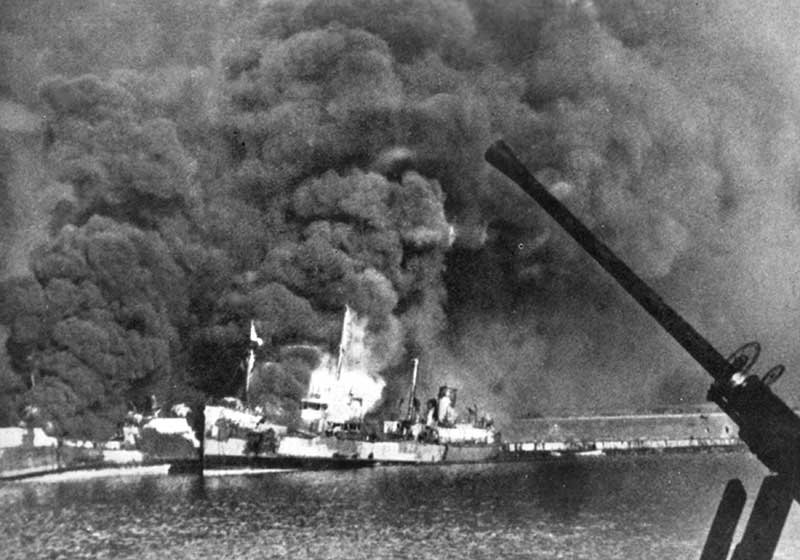
The attack on Bari harbor in Italy in 1943 was a debacle of epic proportions
for the Allies. However, great good was ultimately to come from this dark day.
December 2, 1943, was a Thursday. Allied troops worked feverishly in the freshly-liberated Italian port of Bari on the heel of Italy, offloading the ammunition and supplies required to support the ongoing fight against the Axis. Italy had capitulated three months before, but the Germans still fought like lions.
The port was fat with ships from America, England, Poland, Norway, and the Netherlands. On this very Thursday, British Air Marshal Sir Arthur Coningham, commander of the Allied Northwest African Tactical Air Force, stated, “I would consider it as a personal insult if the enemy should send so much as one plane over the city.” He would live to regret that.
The Germans attacked with 105 Ju-88 A-4 bombers from Luftflotte 2 and achieved complete surprise. The raid spanned about an hour. The attacking Luftwaffe raiders sank 27 cargo ships in the harbor. More than 1,000 allied troops, sailors, and merchant seamen perished alongside roughly the same number of civilians. The Germans lost but a single plane.
That would be bad enough, but survivors pulled from the oily water also began to manifest horrific skin burns. Massive blisters formed on their flesh. Six hundred twenty-eight military patients were hospitalized, suffering from these ghastly injuries. Eighty-three of them eventually died.
At first, there was a suspicion that the Germans had attacked the harbor with chemical weapons. However, the truth was something potentially far worse. The details were immediately suppressed, but we had just inadvertently exposed our own troops to mustard gas.
Among the 27 sunken vessels was a Liberty ship called the SS John Harvey. Its top secret cargo included 2,000 M47A1 mustard bombs to be used in the event Hitler first employed chemical warfare agents on the European battlefields.
During the Luftwaffe attack, these diabolical weapons had broken open, and the mustard agent had mixed with the fuel oil spilled into the harbor’s waters. The results were predictably horrifying.
Adolf Hitler was likely among the top five worst people who ever lived, and the experience he had with chemical agents during World War I kept him from using these dreadful things in World War II.
In the face of such an epic tragedy, Lieutenant Colonel Stewart Francis Alexander, a chemical warfare specialist on Eisenhower’s staff, was sent to Bari to investigate. He immediately identified mustard gas exposure. Alexander’s “Final Report of the Bari Mustard Casualties” was predictably classified.

Sometimes some of the most momentous discoveries come from some of the most unexpected places.
Lt. Col. Alexander’s superior officer at the Chemical Warfare Service (CWS) was Colonel Cornelius P. “Dusty” Rhoads. This was a citizen Army drawn up for the global conflict, and these guys came from all walks. In his previous life, Dr. Rhoads had served as head of the Treatment of Cancer and Allied Diseases Department at New York’s Memorial Hospital.
Col. Rhoads had an unprecedented opportunity to study hundreds of victims of mustard poisoning. He observed that the mustard agent suppressed cell division. Using his experience in oncology as a basis, it occurred to him that mustard agent might be used to inhibit the rapidly reproducing malignant cells that drive cancer.
Every day the human body creates around 330 billion new cells. Almost all of these cells demand that the entire genome be reproduced. Each of these packets of genetic information includes around 3.2 billion base pairs. Given that astronomical volume, mistakes are inevitable.
God designed us with proofreading mechanisms that catch most of these mistakes and destroy the aberrant cells before they can do any damage via a process called apoptosis. However, if one of these cells is almost but not quite normal, it can slip through that net and morph into cancer. These cancer cells typically multiply faster than normal cells and in an uncontrolled fashion.
Col. Rhoads became convinced that the active ingredient in mustard gas could be used, in very small doses, to attack rapidly-metabolizing cancer cells.
After the war, he approached Alfred Sloane and Charles Kettering to fund the Sloan Kettering Institute for Cancer Research (SKI). These two men had made fortunes off of war production through General Motors. The resulting cutting-edge research facility was manned by scientists no longer needed for the advancement of war goals. They proceeded to synthesize mustard derivatives into the first effective medications for cancer. Nowadays, we call this chemotherapy.
In 1949, the U.S. Food and Drug Administration approved Mustargen (mechlorethamine) as the first experimental chemotherapy drug in America. It was used to successfully treat non-Hodgkin’s lymphoma. This effort planted a seed that became the flourishing field of oncology today.
Thanks to this serendipitous discovery and a lot of hard work, cancer is no longer the death sentence it once was. Today, chemotherapy agents specifically target rapidly-metabolizing malignant cells while selectively sparing the healthy stuff, but there is still some overlap. That’s why many patients undergoing chemotherapy lose their hair because hair cells metabolize quickly as well.
The attack on the Bari harbor in 1942 cost some 2,000 lives. However, the American Cancer Society has since described the Bari attack as the beginning of “The Age of Cancer Chemotherapy.” Millions of people have had their lives saved or extended due to research that spawned from that terribly dark day.