By LAWRENCE J. SISKIND
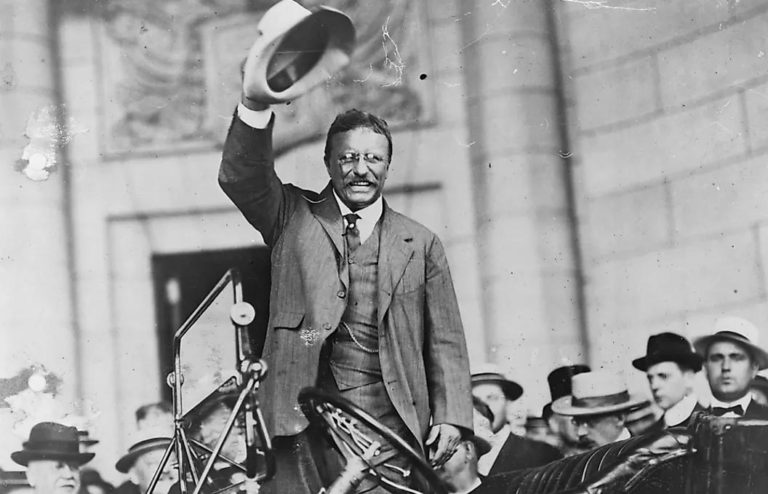
The lives of Theodore Roosevelt and Winston Churchill overlapped, but they met in person only once — at a dinner in the Governor’s Mansion in Albany, New York on December 10, 1900. The 42-year old Roosevelt was about to relocate to Washington DC to assume his duties as Vice President. The 26-year old Churchill, who was visiting America to shore up his finances by a lecture tour, was about to take his seat in Parliament.
What happened at their dinner is unknown. But to the extent historians have noticed the dinner (which isn’t a large extent[i]), they have accepted the view, first attributed to Roosevelt’s daughter Alice, that the two men did not get along because they were so much alike.[ii] As Robert Pilpel, in his Churchill in America 1895 – 1961, put it: “It was a case of likes repelling.”[iii]
But was it?
We will never know for certain because the witnesses are not available for deposition. But based on the evidence, the “likes repelling” theory is unpersuasive. Something else, something deeper, was afoot.
Let’s review the record, starting with Winston Churchill’s reaction to the dinner.
His reaction was a case of the dog not barking. If one examines Churchill’s papers, one might conclude that the event never took place. On December 21, 1900, eleven days after the dinner, he wrote a detailed letter to his mother, describing his American trip. The letter mentions his lectures, his earnings, and his many meetings with American luminaries. It mentions that he was “considerably impressed” by President McKinley. But as to Theodore Roosevelt, Churchill says nothing.[iv]
Subsequently, Churchill’s references to Roosevelt are very few and entirely benign. In December 1906, after an earthquake had destroyed Kingston, Jamaica, an American admiral landed armed soldiers to help clear the rubble.
Sir Alexander Swettenham, Governor of the island, issued a harsh letter condemning the move, and pointing out that the recent looting of a New York millionaire’s house would not have justified a British admiral landing armed soldiers to help the police. President Roosevelt complained to London about the ill-tempered letter, and Churchill, then the top assistant to the Colonial Secretary, supported Roosevelt, calling Swettenham “an ass … wrong on every point.”[v]
In December 1908, upon learning that the lame duck President was planning an African safari, Churchill sent Whitelaw Reid, the American ambassador in London, a copy of My African Journey, his account of his own 1907 hunting exploits on that continent, with a request to forward it on to Roosevelt.[vi]
In April 1918, Churchill suggested enlisting Roosevelt as a plenipotentiary in a rather far-fetched and never implemented mission to persuade the Bolsheviks to bring Russia back into the war on the side of the Allies.[vii]
That is all there is regarding the impression Roosevelt made on Churchill. There is nothing to show that Churchill was repelled by Roosevelt.
When we investigate Churchill’s impression on Roosevelt, a very different picture emerges.
To start, Roosevelt’s papers show that the dinner was actually his idea. Roosevelt was eager to meet the young Englishman in person. On December 4, 1900, Major James Burton Pond, the manager of Churchill’s American lecture tour, had invited then Governor Roosevelt to attend Churchill’s upcoming New York City lecture and had even offered him a box in the theater. Pond’s transparent aim in inviting Roosevelt was to use his famous name to promote the Churchill event.
Roosevelt reasonably might have ignored the invitation, or dismissed it with a curt letter of regret. Instead, in his December 6 response, he first declined the invitation due to a scheduling conflict, then lobbied for a meeting:
I am really sorry as I am a great admirer of Mr. Churchill’s books, and should very much like to have a chance of meeting him socially. Is he now in New York? I should greatly like to have him take lunch or dinner with me if he is in Albany on Monday; or lunch if he is here Tuesday, of next week. Where shall I write him?[viii]
Major Pond had merely invited Roosevelt to attend a lecture. He had not suggested a personal meeting. But here was Roosevelt inviting Churchill to break bread with him in Albany, and offering no fewer than three possible time slots, each one a meal rather than a perfunctory meet-and-greet office session. Roosevelt’s inquiry as to where he could write Churchill directly reveals his eagerness for a personal meeting.
But while Roosevelt very much wanted “a chance of meeting [Churchill] socially,” once he had that chance, he didn’t like what he saw.
After the dinner, on July 12, 1901, the now Vice President Roosevelt wrote to Hermann Speck von Sternburg, a family friend and German diplomat, who had spent time in India. The letter dealt mainly with military and international affairs. Roosevelt wrote: “I saw the Englishman, Winston Churchill here, and although he is not an attractive fellow, I was interested in some of the things he said.” [ix]
The “things” that interested Roosevelt were Churchill’s views on the fighting qualities of Gurka, Sikh, Punjabi, and Pathan regiments. The casual reference to Churchill’s unattractiveness was purely gratuitous and had nothing to do with the subject of the letter. But it set a tone. In subsequent letters, Roosevelt would miss no opportunity to denigrate Churchill, whether relevant to the correspondence or not.
On September 12, 1906, the now President Roosevelt wrote to Henry Cabot Lodge. Referencing Churchill’s recently published 2-volume biography of his father, Roosevelt commented: “I dislike the father and dislike the son, so I may be prejudiced.” He proceeded to describe both Churchills as “possess[ing] such levity, lack of sobriety, lack of permanent principle, and inordinate thirst for that cheap form of admiration which is given to notoriety, as to make them poor public servants.”[x] (Lodge responded a few days later, admitting he had not read the biography, but adding that he considered the son “clever but conceited to a degree which it is hard to express either in words or figures.”[xi])
On October 25, 1906, Roosevelt wrote to John St. Loe Strachey, a British journalist and newspaper proprietor. Strachey had asked Roosevelt for his opinion of William Randolph Hearst. Roosevelt replied: “[I]t is a little difficult for me to give you an exact historic judgment about a man whom I so thoroly [sic] dislike and despise as I do Hearst.” He called Hearst “a man without any real principle.” Then, reverting to his favored object of invective, Roosevelt added: “But when I have said this, after all, I am not at all sure that I am saying much more of Hearst than could probably be said … about both Winston Churchill and his father, Lord Randolph.”[xii] Although the subject was Hearst, Roosevelt could not resist bringing up Churchill.
For Roosevelt, it wasn’t enough to express his distaste for Churchill himself. He also expressed his distaste for those who admired Churchill. On November 14, 1906, Roosevelt wrote to Lodge again, this time attacking Archibald Primrose, the fifth Earl of Rosebery. The former Prime Minister’s sin was praising Winston Churchill’s biography of his father as “remarkable.” Roosevelt indignantly referenced Rosebery’s “lack of sense or proportion.”[xiii]
On May 23, 1908, Roosevelt wrote to his son Theodore Jr., then a student at Harvard. Young Theodore had just read Churchill’s biography of Lord Randolph and wanted to know his father’s opinion. Roosevelt answered: “Yes, that is an interesting book of Winston Churchill’s about his father, but I can’t help feeling about both of them that the older one was a rather cheap character, and the younger one is a rather cheap character.” (Underlining in original.)[xiv]
On November 6, 1908, the lame duck President Roosevelt wrote to British historian George Otto Trevelyan about the recent election of his then friend (and later opponent) William Howard Taft to succeed him. After discussing his post-White House plans, Roosevelt turned to history and once again attacked Rosebery, this time for the way “he speaks of Winston Churchill’s clever, forceful, rather cheap and vulgar life of that clever, forceful, rather cheap and vulgar egoist, his father.”[xv]
In January 1909, when Roosevelt received Churchill’s gift of his African Journey, he was taken aback. He admired the account but he didn’t like the author. So he dashed off a short thank you note to the donor (in which he expressed the hope that he “shall have as good luck as you had”),[xvi] and forwarded it to Ambassador Reid, with this cover: “I do not like Winston Churchill but I suppose I ought to write him. Will you send him the enclosed letter if it is all right?”[xvii]
Time did not moderate Roosevelt’s hostility.
September 10, 1909 found the former President at the foot of Mount Kenya, during the hunt in which he hoped to match Churchill’s luck. In a letter to Lodge and his wife, handwritten in pencil, Roosevelt described the American influence on British colonial reading habits. “Among the novels I see in the houses no English ones are more common than for instance, David Harum, or Winston Churchill’s – I mean, of course our Winston Churchill, Winston Churchill the gentleman.”[xviii] Roosevelt’s reference to “Winston Churchill the gentleman” was to the popular New Hampshire novelist, whose books were widely read and whose political career Roosevelt supported. The implication that the English Winston Churchill was not a gentleman is consistent with Roosevelt’s earlier references to Churchill as “unattractive” and “cheap.”
Following his African tour, Roosevelt traveled to Europe, where he met with a long parade of prominent royal, political, and intellectual figures. But the parade was not long enough to include Winston Churchill, who had been appointed Home Secretary in February 1910. On June 4, Roosevelt wrote to Lodge: “I have had a most amusing and interesting time here, but, literally there hasn’t been a five minutes free…. I have refused to meet Winston Churchill, being able to avoid causing any scandal by doing so.”[xix]
On October 1, 1911, Roosevelt reminisced about his African adventure in a long letter to Trevelyan. Discussing his visit to Khartoum, he described how the white settlers in British East Africa hoped that he would speak sympathetically about them when he traveled on to England. Then he added: “They had hoped much from Winston Churchill’s visit, but for various reasons most of them had disliked him ….”[xx] This of course was Roosevelt projecting his own enmity toward Churchill onto the local English community.
On October 5, 1911, in a letter to the playwright David Gray, Roosevelt described his experience as a special ambassador to the funeral of King Edward the previous year. “I dislike Winston Churchill and would not meet him,” he recounted, “but I was anxious to meet both Lloyd George and John Burns, and I took a real fancy to both of them.”[xxi]
On August 22, 1914, shortly after hostilities had erupted, Roosevelt wrote to Arthur Hamilton Lee, the British politician and soldier. Just as when he received Churchill’s African Journey, Roosevelt was in a bind. It was painful for Roosevelt to say anything positive about Churchill but the situation called for doing so.
Churchill, then First Lord of the Admiralty, had had the foresight to mobilize the fleet before war broke out, much as Roosevelt himself had ordered Admiral Dewey to prepare to attack the Spanish Fleet on the eve of the Spanish-American War. Roosevelt, perhaps gritting his teeth, wrote: “I have never liked Winston Churchill, but in view of what you tell me as to his admirable conduct and nerve in mobilizing the fleet, I do wish that if it comes in your way you would extend to him my congratulations on his action.” To assure that his rare compliment did not gain publicity, he added: “It must be strictly confidential, of course.”[xxii]
The evidence, taken as a whole, contradicts the verdict of Alice Roosevelt and some historians that this was a case of “likes repelling.”
First, the “repelling” was completely one-sided. Theodore Roosevelt was thoroughly repelled by Winston Churchill. After the dinner, he seems to have been determined to make sure that everyone knew how much he disliked Churchill. But nothing suggests that Winston Churchill was repelled by Roosevelt. After the dinner, Churchill simply didn’t think about Roosevelt very much, and when he did think about him, he seems to have just assumed that all was well between them.[xxiii]
Second, Roosevelt and Churchill were hardly “likes.” Granted both were sportsmen born into upper class families, and both pursued political careers. But they were markedly different in age, experience, and family ties. Roosevelt grew up in a warm, loving home, raised by parents who adored him. Churchill was largely ignored by his parents; any warmth he received growing up came from his nanny, Mrs. Everest. Roosevelt favored athletic endeavors that involved close physical contact, such as boxing and wrestling. Churchill stayed a polo mallet’s length away from his competitors.
If this were not a case of “likes repelling,” then what accounts for Roosevelt’s hostility?
As his correspondence with Major Pond shows, Roosevelt was anxious to meet Churchill. When the 26-year old Churchill showed up for dinner, Roosevelt doubtless expected a certain degree of deference from the younger man.
For all his progressive political inclinations. Roosevelt was deeply conservative in his views on social propriety and decorum. If one were a gentleman, one behaved in a certain way. Roosevelt rode, worked, and endured hardships as well as the lowliest ranch hand in the Badlands of the Dakota Territory.
But it was understood that when he slept in his cabin, the ranch hands were to move their mattresses up to the loft because the “boss” had to have the downstairs to himself. Similarly, the neighboring ranchers were expected to address him as “Mr. Roosevelt,” even if they were wealthy enough to consider themselves his equal. Nobody called him “Roosevelt” and certainly no one called him “Teddy.”[xxiv]
But the brash young visitor had no time for such niceties. If Roosevelt was ruled by his views of social etiquette, Churchill was constrained by his views of his mortality. He believed he had only a short time to live. His father had died at the age 45. His father’s sisters died at the ages of 45 and 51, and their brother died at 48. Churchill did not expect to live much beyond the 42 years of his dinner host.[xxv]
Churchill was not inclined to defer to Roosevelt’s seniority because he did not expect to live long enough to enjoy such seniority of his own.
So one diner appeared that evening expecting deference, and the other diner arrived demanding equality. We can imagine a dinner conversation marred by the incongruity. Roosevelt is accustomed to dominating the conversation. But young Churchill believes he has just as much wisdom to impart, and refuses to yield the floor. Roosevelt wants to talk about his charge up the San Juan Heights. Churchill tries to cut him short so that he can orate on Omdurman. They both consider themselves experts on Indian affairs – although they have in mind Indians of different continents.
For Churchill, the evening’s give-and-take must have been great fun. He probably drank and talked a good deal, as was his wont. More likely than not, he left Albany happy with his performance, and confident that his merry self-assurance had made a positive impression on his older and more accomplished host. In the future, he would just assume that Roosevelt would welcome the chance to read his book on hunting. Why wouldn’t he? After all, they had had such a good time that night at dinner!
But for Roosevelt, the evening must have been one long infuriating ordeal. The brash younger Englishman did not behave as he was supposed to. Rather than conducting himself like a gentleman, he behaved like a showman. He spoke when he should have listened. He interrupted when he should have deferred. How cheap! How conceited! How insufferable! He was not an attractive dinner guest and would never be welcome at his table again.
And so the two giants of history met for dinner and parted ways, each left with a different aftertaste.
Lawrence J. Siskind is of counsel at Coblenz Patch Duffy & Bass LLP in San Francisco, where he specializes in intellectual property law.
[i] Andrew Roberts, in Churchill: Walking with Destiny, devotes three sentences to the event and its aftermath. (p. 78) William Manchester gives it one half of one sentence in his Churchill biography The Last Lion. (p. 331) The dinner does not even merit a mention in Edmund Morris’s The Rise of Theodore Roosevelt.
[ii] Richard Langworth, Churchill and Theodore Roosevelt, Finest Hour 163, Summer 2015 (February 8, 2015).
[iii] Robert H. Pilpel, Churchill in America 1895 – 1961, p. 38.
[iv] The Churchill Archives, December 21, 1900 Letter from Winston Churchill to Jennie Churchill, CHAR 28/26/77-79.
[v] Richard Langworth, op. cit.
[vi] The Churchill Archives, December 8, 1908 Letter from Whitelaw Reid to Winston Churchill, CHAR 2/36/33.
[vii] Richard Langworth, op.cit.
[viii] The Letters of Theodore Roosevelt, Vol. II, The Years of Preparation 1898 – 1900, p. 1454.
[ix] The Letters of Theodore Roosevelt, Vol. III, The Square Deal 1901 – 1903, pp. 116 – 117.
[x] Selections from the Correspondence of Theodore Roosevelt and Henry Cabot Lodge 1884 – 1918, Vol. II, pp. 231 -232.
[xi] Id., at 232.
[xii] The Letters of Theodore Roosevelt, Vol. V, The Big Stick 1905 – 1907, p. 468.
[xiii] Selections from the Correspondence of Theodore Roosevelt and Henry Cabot Lodge 1884 – 1918, Vol. II, pp. 260 -261.
[xiv] The Letters of Theodore Roosevelt, Vol. VI, The Big Stick 1905 – 1907, p. 1034. A carbon copy of the letter is in the Theodore Roosevelt Collection in the Library of Congress in Washington DC. The staff kindly made the carbon copy available to the author. It shows the underlining.
[xv] Id., at p. 1329.
[xvi] The Letters of Theodore Roosevelt, Vol. VI, The Big Stick 1905 – 1907, p. 1467.
[xvii] Id., at p. 1465.
[xviii] Selections from the Correspondence of Theodore Roosevelt and Henry Cabot Lodge 1884 – 1918, Vol. II, p. 349.
[xix] The Letters of Theodore Roosevelt, Vol. VII, The Days of Armageddon 1909 – 1914, p. 87.
[xx] Id., at p. 350.
[xxi] Id., at p. 406.
[xxii] Id., at p. 810.
[xxiii] Churchill had a habit of forgetting people, and two of them were Roosevelts. On July 29, 1918, during World War I, Churchill met the Assistant Secretary of the US Navy, Franklin Roosevelt, at a dinner in London. Twenty-three years later, on August 9, 1941, during World War II, the two men met again in Placentia Bay near the shore of Newfoundland. Franklin Roosevelt noted that the two had met before during the Great War, and referred to it as one of his “treasured recollections.” Churchill admitted that the event “had slipped his memory.” Andrew Roberts, Churchill: Walking With Destiny, p. 673.Fortunately for the cause of Allied cooperation, this particular President Roosevelt was not as easily offended as the earlier one.
[xxiv] Edmund Morris, The Rise of Theodore Roosevelt, p. 331.
[xxv] Andrew Roberts, Churchill: Walking With Destiny, p. 31.