Category: Well I thought it was neat!

Above: Colt Model 1892 New Army Revolver. Photo by NRA Museums.
Pistols used in the National Matches started out in a pretty straightforward manner. Until 1911—actually until supplies of M1911 pistols became available—competitors in the National Individual Pistol Match used either of the two revolvers prescribed for U.S. Military service. Those were the several variations of Colt “New Army” and “New Navy” revolvers of 1892 (including the follow-on models of 1894, 1895, 1896, 1901, and 1903) and Smith & Wesson’s .38 Hand Ejector, Model of 1899—known from the outset of production as the “Military & Police” (M&P).
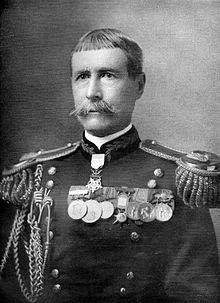
Gen. William P. Hall.
The only controversy came about in 1905, when Army Brig. Gen. William P. Hall declared that, “No Pistol with a barrel over six-inches in length will be allowed to used in the National Pistol Match …” Hall was the Military Secretary of the United States Army and the officer detailed to take charge of the 1905 Matches.
The decision was his to make, and he made it in response to a request from a National Guard State Adjutant General concerning the eligibility of revolvers of military pattern that had barrels over six-inches long. The gun in question was the M&P (a variant known to collectors as the Second Model, First Change, made from 1903-06) that was offered in 4-, 5-, and 6 1/2-inch barrel lengths.
Thus, states’ National Guards that purchased service pattern revolvers from Smith & Wesson in those years bought revolvers with 6 1/2-inch barrels. So too did members of both the regular and militia establishments who purchased Smith & Wesson revolvers for personal use.
Hall’s decision was reported in the appropriate journals—among them Shooting and Fishing magazine. Editor John Taylor Humphreys, who happened to have been the only civilian to compete in the 1904 National Pistol Match, pointed out that Gen. Halls decision did not take into account that 6 1/2-inch barrel revolvers had been permitted in 1904.
But Humphreys noted that, “The ruling of General Hall is in accordance with Government regulations, and being promulgated at this early date [Shooting and Fishing for June 22, 1905], should prevent any misunderstanding at the time of this year’s match.”
The early promulgation of Gen. Hall’s decision probably did not prevent misunderstanding, but it did not prevent the wails of potential competitors who wanted whatever advantage and extra one-half inch of barrel offered (presumably the familiarity with a particular revolver). In the August 10 edition of Shooting and Fishing there appeared the text of three sets of correspondence—two between Gen. Hall and procurers of military equipment and a letter to Humphreys.
Brig. Gen. William Crozier, Army Chief of Ordnance, responded to Hall’s query to the effect that barrels of revolvers issued to troops were of six-inch length. N.E. Mason of the Navy’s Bureau of Ordnance informed Hall that the Navy had purchased S&W revolvers, then in storage at the New York Navy Yard, and that those revolvers had six-inch barrels.
Finally, Hall responded to a letter from Humphreys dated July 26, 1905, citing correspondence with Crozier and Mason, and stating unequivocally that, “… only the model [revolver] as described in the Firing Regulations for Small Arms—1904, and issued to troops will be admissible.” To make his point clear, Hall noted that the newly introduced Colt small-frame .38 caliber revolver (the Police Positive) would not e allowed and neither would S&W revolvers with 6 1/2-inch barrels. And that was that, except …
Perhaps to pour oil on troubled waters, NRA Secretary Albert Jones ruled that in matches sponsored by the NRA and the New Jersey Rifle Association, revolvers with 6 1/2-inch barrels would be allowed. Smith & Wesson helped too, with a long run solution to the problem. The S&W Second Model, First Change became, in rather short order, the .38 Hand Ejector, Military & Police Model 1905, First Change, and the 6-inch barrel length was returned to the product line.
Not everything that goes on in a place like this orbits around fixing people.
Unsplash photo by the National Cancer Institute.
The young woman walked into the labor and delivery suite of the University hospital unannounced. She carried a big red biohazard bag with the top tied in a knot. I inquired what we could do for her.
She reported that she had undergone an abortion that morning at a local clinic. Afterwards the doctor had given her the bag and told her to come see us. He had not told her why. She reported a little abdominal pain but otherwise felt fine. She seemed confused by the whole affair.
We made her comfortable in a labor room while we tried to sort this all out. A fellow resident and I took the bag into another room, put on some gloves, and opened it up.
Inside we found a dismembered baby. Amongst a little extraneous goo were two perfectly formed arms, two similarly perfect legs, and a miniature torso. It was a little boy. There was no head.
We reported all of this to our attending physician, a highly experienced gynecologist. He just sighed. He suddenly seemed very old.
“If you’re not willing to go all the way you shouldn’t be doing the job,” he said with resignation.
I asked him what he meant by that.

Is this a human being? It’s an important question. Think it through. A lot is riding on the answer. Unsplash photo by Jill Sauve.
This man had been the city’s sole abortionist for many years before he came to work at the university. He explained that he had performed the procedure more than five thousand times. He said that not infrequently when you are extracting the fetus it comes into pieces. It must be accounted for on the outside to ensure nothing was left behind that could serve as a nidus for infection. In this case the doctor who had performed the procedure had recovered what was in the sack but had been unable to retrieve the baby’s head.
I asked what was to be done at this point. He dispassionately explained that you prep the patient in the OR, dilate the cervix, and crush the head so that it will pass through more readily. He likened it to an egg. He said there was a tool designed specifically for that purpose.
This isn’t some grandiose moral or political statement. It’s not Left or Right. This isn’t Sunday School or church. I’m just telling you what abortion looks like up close. Make your own value judgments. Most folks marching and screaming haven’t actually seen what they’re screaming for.
Unlike most of the activists in this debate, I have diagnosed pregnancy in a twelve-year-old. I’ve seen the fear in those eyes. I appreciate both points of view. I really do. However, the contents of that sack changed me. Nothing could ever justify that.

There is literally nothing more innocent and defenseless than a human child.
Unsplash photo by Filip Mroz.
I knew some hard men when I was a soldier. One proper warrior killed a man with a knife in Vietnam. I served with a Blackhawk door gunner who had unlimbered his M134 minigun, the electric-powered Gatling gun used as defensive armament on Special Operations helicopters, on a crowd in Somalia. I met quite a few soldiers who had done their share of killing. I never knew anybody who had taken life on the scale this physician had.
What most shocked me was that at some point some doctor did that and called it medicine. As I beheld those little arms and legs I just couldn’t comprehend how anyone could not think that was anything but a chopped up little baby. I still frankly don’t understand it.
Killing is meant to be viscerally objectionable. However, packaging is everything. The Air Force pilot commanding a Predator drone can sit in an air-conditioned building in Nevada and launch a hellfire missile over Afghanistan while readily distancing herself from the practical results of her actions. The Army Ranger who shoots a terrorist in the chest at bad breath range while clearing a building is a great deal more emotionally involved. Regardless, both of those people are comparably dead. There are parallels here.
It is easy to pontificate about rights and injustice over coffee late at night in a dorm room or on the street corner during a protest. It is another thing entirely when you are physically sifting through the remains of what is clearly a dismembered headless human child. Even that seasoned physician, the veteran of more than five thousand abortions, cannot completely convince himself that what he did was not somehow innately wrong. The emotional baggage was patently obvious.
“If you’re not willing to go all the way you shouldn’t be doing the job.” Indeed.
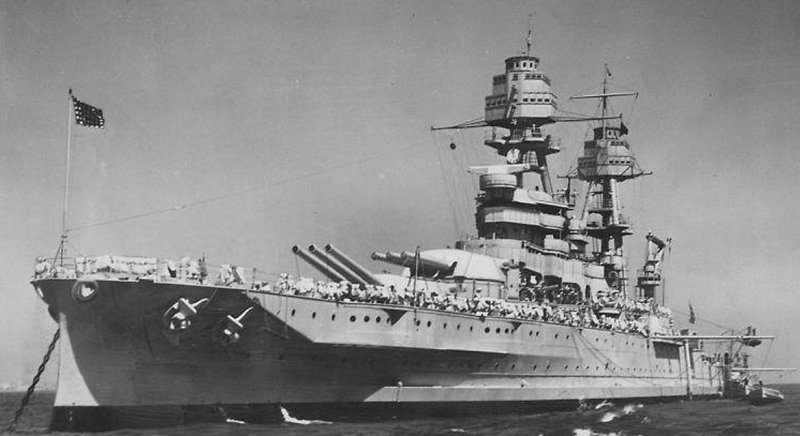
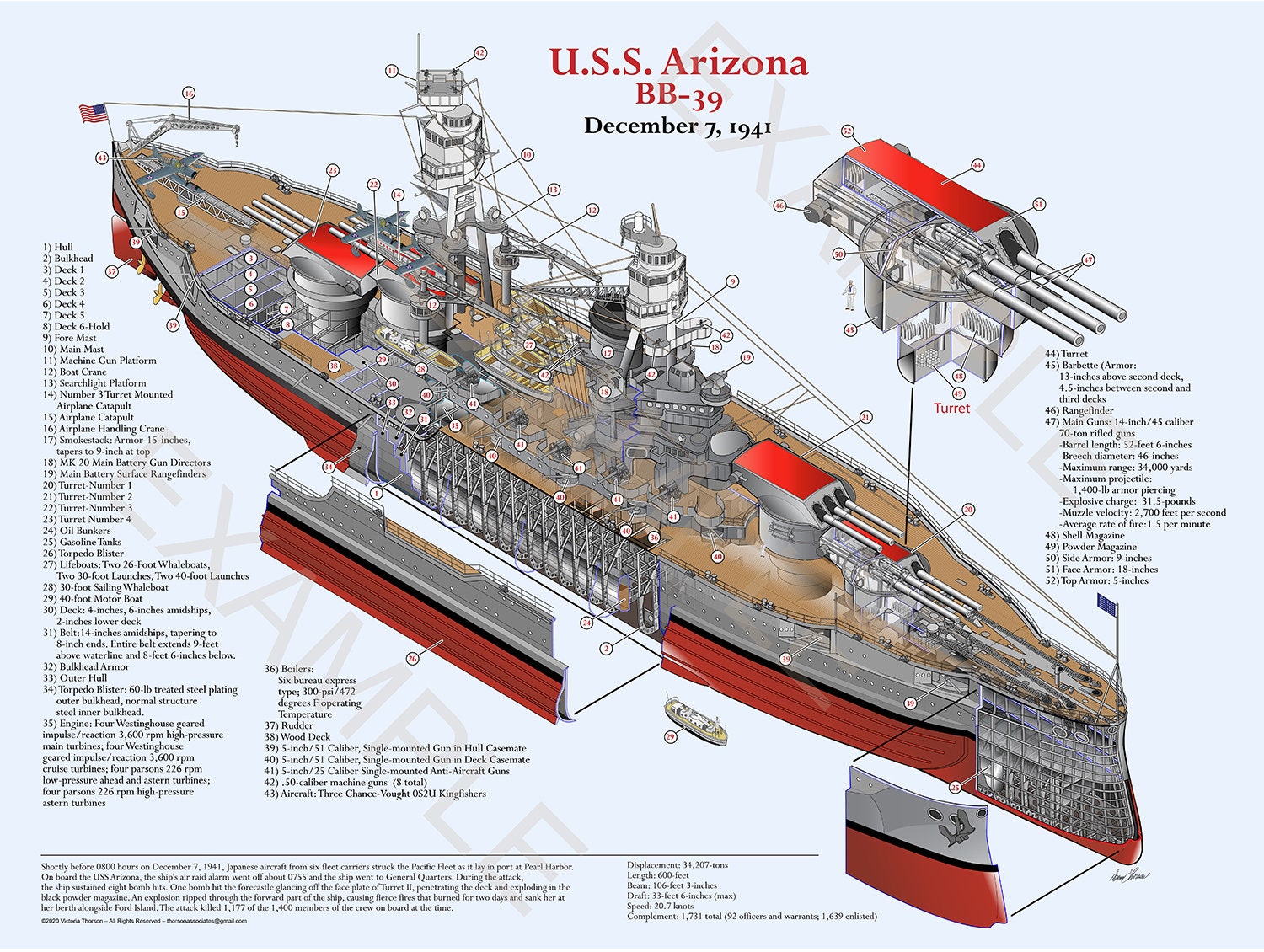

The last bomb to his Arizona, penetrated the deck in the vicinity of the forward magazine. Its possible the bomb actually went into the magazine itself. We don’t know for sure and never will. Know why? When the magazine exploded it obliterated the forward 3rd of the ship. It blew out the sides of the hull and destroyed all the supporting structure down to the keel. So much so that the deck just forward of the number 1 turret to just aft of the number 2 turret collapsed on the now missing decks underneath it.
The ship was in no condition to salvaged. It would have broken apart more in any attempt to raise it.
Logistically there were also problems. The bottom of this section of Pearl Harbor is very soft mud. As soon as Arizona sank to the bottom, and it didn’t take long as the water was maybe 6 feet deep under the keel, its mass sank several feet into the mud. If the water were deeper, raising portions of Arizona might have been possible.
In reality salvaged does not mean what you think it does. The correct term would be refloated, like USS Nevada and put back into service. As far as salvaging, Arizona did have considerable salvage work. Much of Arizona’s equipment and superstructure was removed and recycled even if only for the metal.
