Category: War
Categories
America’s ‘War’ Against Switzerland
PHOTOGRAPHS
1. Panjandrum – the ultimate invasion weapon
This ungainly device was intended to be used against the beach defences of Hitler’s Atlantic Wall. It consisted of two rocket-propelled wheels, ten feet in diameter, joined by a cylinder filled with explosives. The Panjandrum was designed by the British Admiralty’s Directorate of Miscellaneous Weapons Development, and named after a piece of 18th Century nonsense prose. It would be launched from a landing craft, accelerate up the beach and blow a hole in the sea wall or any other concrete obstacles in its path. Tests in 1943 and 1944 were a disaster. The rockets attached to the wheels often failed or detached themselves, and the Panjandrum went everywhere except in a straight line. It was never used in action.

PHOTOGRAPHS
2. Krummlauf – the gun that fired round corners
The Krummlauf was a curved barrel attachment for the German Sturmgewehr 44 (StG 44) assault rifle, which enabled the weapon to be fired around corners. Its shape meant it could also be used from within a tank to counter enemy infantry armed with mines or other anti-tank weapons. In use, it was found that the barrel attachment became distorted and quickly wore out from the pressure of the rounds being fired. Also, the bullets often shattered on exiting the krummlauf. Although a failure at the time, the concept has been revived with some modern weapons, allowing the user to engage the enemy without exposing themselves.

PHOTOGRAPHS
3. Maus – Hitler’s giant tank
The Panzerkampfwagen ‘Maus’ (Mouse), designed by Ferdinand Porsche, was the ultimate expression of Hitler’s desire to produce an indestructible super-heavy tank. It was first proposed in 1942, but few in the German High Command saw the need for this 200 ton monster. Trials began in 1943, but there were constant mechanical problems associated with the drivetrain. The tracks were driven by electric motors powered by a huge Daimler-Benz aircraft engine, but top speed was barely 12mph. The Maus had armour up to 240mm thick and a 12.8cm gun. Although there were plans to build 150 tanks, only two prototypes – two hulls and one turret – were ever completed.

PHOTOGRAPHS
4. Covenanter – Britain’s worst tank
At the outbreak of the Second World War the British army had three types of tank: light tanks for reconnaissance, heavily armoured ‘infantry tanks’ to support frontal attacks, and fast ‘cruiser tanks’ to exploit the gaps made in the enemy defences. One of the latter was the A13 Mk III (Cruiser Tank Mk V) Covenanter. It was designed in 1939, and looked good on the drawing board with its large wheels, low profile and rakishly sloped armour. Large numbers were ordered as Britain frantically re-armed. But its 2-pdr gun and 30mm armour were already outclassed when it was delivered in 1941, and worse defects lurked under the bonnet. The Covenanter suffered from major engine cooling problems which were never overcome. It was so unreliable that it never went to war, and the 1,771 tanks produced were used only for training.

PHOTOGRAPHS
5. TOG – a First World War tank revived
In 1939 the Ministry of Supply set up a committee of the principal tank designers from the First World War, with the object of looking into current British tank development. ‘The Old Gang’, as they were known, came up with their own concept for a heavy tank – known as TOG 1. It was a long, heavily armoured machine, able to cross trenches and terrain cratered by shells. Its armament was mounted in sponsons on either side of the hull. It was in effect a machine designed to re-fight the First World War, and showed just how remote the committee was from modern developments. Its transmission and steering system were also needlessly complex. A second prototype, TOG 2, featured a revolving turret and other improvements, but the tank was still too cumbersome and too complicated to be adopted by the War Office.

PHOTOGRAPHS
6. Maginot Line – failed French defences
The Maginot line was the French response to German rearmament in violation of the Treaty of Versailles. Built between 1929 and 1939, and named after a French defence minister, the line was a complex network of fortresses, bunkers, obstacles and artillery positions along France’s border with Switzerland, Germany and Luxembourg. The line was only partially extended north of this because it was assumed that any future German invasion attempt would be met and defeated in Belgium, hopefully with British assistance. The Maginot Line was seen as a sensible way to maximise the military potential of a limited number of troops, but it also reflected France’s static, defensive mentality which was exploited by Nazi Germany in May 1940. As expected, Hitler’s forces invaded neutral Belgium, but the focus of the attack was through the undefended Ardennes forest. The Maginot Line was quickly outflanked, and French forces caught off balance by the speed of the German advance. Within six weeks France had surrendered.

PHOTOGRAPHS
7. Smith Gun – firepower for the Home Guard
During the Second World War Britain’s Home Guard was famous for making do with outdated weapons as industry concentrated on supplying the regular army with modern equipment. In particular there were very few anti-tank guns, a shortage which retired British Army Major William H Smith intended to put right. His unusual design for a 3-inch smooth-bore gun was put into production in 1941, but only after many safety improvements had been imposed. The Smith Gun had to be tipped onto its side to fire – one of its wheels acting as a baseplate. It had a low muzzle velocity and was only accurate to about 200 yards, assuming ammunition was available to fire – which was rarely. 4,000 guns were made, but they only really had value as propaganda.

PHOTOGRAPHS
8. ‘White Rabbit’/’Nellie’ – the trench digging machine
‘White Rabbit’ or ‘Nellie’ were two of the nicknames given to a trench digging machine built by the Royal Navy and known officially as Cultivator No. 6. It was based on an idea first proposed by Winston Churchill during the First World War, which he revived in 1939, as First Lord Of the Admiralty. ‘Nellie’ was intended to burrow towards the enemy line, excavating a trench wide enough for troops to advance behind. The huge 130 ton machine combined a plough and cylindrical cutter but carried no weapons. The device may have had some merit on the Western Front during the First World War, but was utterly unnecessary on the Second World War battlefield and the idea was eventually dropped after a handful of machines had been constructed.

PHOTOGRAPHS
9. V-3 – Hitler’s ‘Supergun’
The Vergeltungswaffe (Retaliation Weapon) 3 was a German supergun designed to bombard London from an underground complex 100 miles away at Mimoyecques, near Calais in northern France. The V-3 was constructed on a multi-chamber principle whereby secondary charges firing in sequence along the main barrel accelerated a shell to the velocity required to reach its target. A battery of 25 gun tubes were sunk into inclined tunnels in the ground, further protected by a vast concrete slab. It was planned to bombard London at a rate of 600 shells an hour. The Allies assumed the site was part of the V-2 rocket programme and launched bombing attacks in late 1943. Despite intense work by the Germans to finish the project, it was finally put out of action by a raid on 6 July 1944 before a single shell had been fired.

PHOTOGRAPHS
10. Goliath – the robot demolition vehicle
Goliath, or the Leichte Ladungsträger, was a German expendable miniature tracked vehicle designed to deliver an explosive device by remote control. There were two types: battery-powered, with a 60kg charge, or a larger petrol engine version that could carry a 100kg device up to 650m from the controller. Goliath was to be used against buildings, bunkers or even enemy troops and vehicles if the opportunity arose. Some were used to clear minefields. Unfortunately for the Germans, the trailing control wires were vulnerable to being cut, and the vehicle itself was slow and had poor ground clearance. 2,650 were built between April 1942 and September 1944, but were rarely effective. The Germans also experimented with larger, radio-controlled vehicles that could drop a charge close to their intended target and then retire to a safe distance, but these too were a waste of resources.

PHOTOGRAPHS
11. Luftwaffe Heavy Bombers – a project abandoned
In 1936 the Chief of Staff of the new Luftwaffe, General Walther Wever, was killed in an air crash. He had been Germany’s principal advocate of strategic bombing – defeating an enemy country through the systematic attack on its economy and population. It was an idea which had gained ground in Britain, where new heavy bombers were being designed for RAF Bomber Command. In Germany however, Wever’s death – and a lack of resources – saw the abandonment of existing projects for a long-range bomber. Instead, priority was given to smaller aircraft, especially dive-bombers. The Luftwaffe’s prime function would be to support the army over the battlefield. Germany’s lack of a strategic bomber force to hit back at British and Soviet industry was keenly felt as the war progressed. Belated attempts to get a range of new four-engined aircraft into service failed, and only one – the Heinkel He 177 – saw action. There were even designs for an Amerika bomber that could reach New York, but that objective was also never realised.

PHOTOGRAPHS
12. Me 163 Komet – a firework fighter
The tiny Messerschmitt Me 163 Komet was the world’s only rocket-powered fighter. It was designed to intercept high-flying American bombers over Germany. It used a liquid propellant consisting of two volatile substances which ignited when mixed together. Enough thrust was produced to propel the tiny fighter to an altitude of 39,000 feet in 3.45 minutes, with a top speed of over 550mph. Operations began in May 1944 but the Komet was almost too fast and pilots struggled to engage the slow-moving bombers. Also, the rocket engine only had a ‘burn’ of 7 minutes, after which the pilot had to glide back to base. Accidents were common, and even small quantities of the highly unstable fuel could cause explosions if carelessly handled. 364 Komets were built but they shot down only 16 bombers for a loss of at least 13 of their own, which was a poor showing for such a major technological effort.

PHOTOGRAPHS
13. Schwerer Gustav – the German railway gun
A giant railway-mounted gun had been used by the Germans to bombard Paris, during The First World War. The concept of such a colossal weapon was revived in 1936, when Adolf Hitler asked the head of Krupp armaments what type of gun could destroy the fortifications of the Maginot Line. The gun was designated Schwerer Gustav. The 80cm gun, weighed 1,350 tonnes and could project a 7-tonne shell 29 miles. It was completed too late for the German Army’s attack on France, in May 1940. The artillery unit-to which it was allocated in January 1942, named the gun Dora. It fired 47 rounds, against the city of Sevastopol, in the Soviet Union-wearing out the barrel in the process. The second gun produced by Krupp, Schwerer Gustav 2, was never used in action. Schwerer Gustav 2 was placed in storage in March 1943, at Rügenwalde – an artillery firing range. The increased efficacy of aerial bombardment, in the Second World War, made these large guns obsolete.

PHOTOGRAPHS
14. V-2 – Hitler’s revenge weapon
The V-2 rocket was Germany’s most advanced weapon of the Second World War, and also the most wastefully expensive. It was the second of Hitler’s ‘revenge weapons’, a large ballistic missile carrying a one ton warhead, which reached the edge of space before descending at supersonic speed to its target. German rocket development began before the war, but the V-2 was not ready until the autumn of 1944. It was used mainly against London and Antwerp, and there was no defence against it. However, although technically brilliant, and of undoubted propaganda value to an embattled Nazi hierarchy, the weapon inflicted comparatively little damage in return for the vast sums spent on it. The total quantity of explosives delivered by the 3,000 or so V-2s fired was far less than could be dropped in a single raid by RAF Bomber Command. 9,000 people were killed in V-2 attacks. Tragically a far greater number of slave workers died building these weapons.

PHOTOGRAPHS
15. Boulton Paul Defiant – Britain’s flawed fighter
The unusual two-seat Boulton Paul Defiant entered RAF service in December 1939. Its only armament of four .303-inch machine guns was concentrated in a power-operated turret situated behind the pilot. The turret fighter concept was originally designed to combat mass formations of unescorted bombers, with pilots positioning their aircraft alongside or below, so that the gunners could pour fire into their targets. Unfortunately, the aircraft’s extra weight and lack of forward-firing weapons made it vulnerable to conventional enemy fighters. The two Defiant squadrons committed to the Battle of Britain suffered heavy losses and had to be withdrawn. The aircraft had some success later as a night fighter during the Blitz, but was then retired to training duties.

PHOTOGRAPHS
16. Wind Cannon – an experiment in air power
The Windkanone (Wind Cannon) was a bizarre German anti-aircraft weapon. It comprised a large barrel, bent upwards at one end, through which an explosive jet of compressed air was ejected upwards by the ignition of a mixture of hydrogen and oxygen. The aim was to knock down low-flying aircraft. Trials showed that a powerful ‘slug’ of high-velocity air could inflict damage on ground structures, but it was unclear if it would have the desired effect against a small, fast-moving aircraft. In 1945 a wind cannon was installed on a bridge over the River Elbe, but it failed to achieve any results.

PHOTOGRAPHS
17. Kamikaze – Japanese suicide weapons
The Japanese military regarded death in battle as the ultimate way to serve their Emperor. When the war started to turn against Japan, the use of suicide weapons became a natural extension of this ethos – and a symbol of their desperation. The most famous example were the Kamikaze – pilots who deliberately crashed their aircraft into American ships. The Ohka was a manned rocket-powered flying bomb which was carried beneath an aircraft and then released near its target. There were also Shinyo suicide motorboats and Kaiten manned torpedoes. Not all Kamikaze weapons were small. The giant battleship Yamato was sent on a one-way mission during the battle of the Philippines in 1944. It was sunk by US aircraft. Japanese suicide attacks caused heavy casualties on occasions but had no hope of stemming the huge American onslaught. Even some Japanese commanders opposed the tactics as wasteful and futile.

![Soviet troops with 'war dogs'. Wikimedia commons [public domain – no known author] via Wikimedia Commons.](/sites/default/files/styles/text_with_media_mobile_2x/public/2018-07/1_36.jpg?itok=j99eJKoq)
Soviet troops with ‘war dogs’. Wikimedia commons [public domain – no known author] via Wikimedia Commons.
18. War Dogs – an unconventional Soviet weapon
Dogs played an important role in the Second World War, mainly undertaking security and search duties. In the Soviet Union they were also used for mine detection, message and supply carrying and as weapons of war. The most extreme example were the dogs trained to destroy enemy tanks using explosives strapped to their backs. The animals were trained to run under the vehicles carrying mines which exploded when a protruding lever touched the hull and detonated the charge. Soviet anti-tank dogs were used in 1941 and 1942 but results were poor. The animals often got confused in the heat of battle and some blew up their own handlers. The Germans quickly learned to shoot all dogs on sight. The Soviets soon abandoned this unconventional form of warfare.
![This example of the war balloon was shot down by the United States and later re-inflated. US Army photograph A371800 [public domain] via Wikimedia Commons.](/sites/default/files/styles/text_with_media_mobile_2x/public/2018-07/2_7.jpg?itok=2WAo0IDg)
This example of the war balloon was shot down by the United States and later re-inflated. US Army photograph A371800 [public domain] via Wikimedia Commons.
Much has been made in the Western media and shared across the social platforms of the potentially thousands of Russian tanks and other armored vehicles that have been destroyed in Ukraine since the Kremlin launched its unprovoked invasion in February 2022. However, less attention has been paid to the nearly three dozen Ka-52 “Alligator” reconnaissance and attack helicopters that have been shot down in the fighting.


It was on May 24 that the General Staff of the Armed Forces of Ukraine (AFU) claimed its soldiers successfully downed one of these rotary aircraft. Though unconfirmed, it would be a significant setback for the Kremlin, which only produced about 170 of the Russian helicopters, with each costing roughly $16 million. The AFU didn’t specify which unit had downed the Ka-52.
In early April, the Ukrainian 10th Separate Mountain Assault Brigade “Edelweiss” had claimed on Facebook to have destroyed a Ka-52 helicopter with a Piorun portable air-defense system. That particular incident reportedly occurred near the fiercely contested city of Bakhmut.


There are reports that upwards of one-third of the 100 or so Russian Ka-52s that were in service at the start of the war have been destroyed.
The first Russian Ka-52 lost in Ukraine was confirmed destroyed in the opening weeks of the invasion when it was hit by a surface-to-air missile (SAM). Another had reportedly been damaged on the first day of the invasion on February 24, 2022, but it was able to land on its own. It remains unclear if it was returned to service.
The Washington-based think tank, the Institute for the Study of War (ISW), described the Ka-52 as being generally comparable to the U.S. Army’s AH-64 Apache.
Origins of the Ka-52 Attack Helicopter
Though aviation innovator Nikolai Ilyich Kamov died in November 1973, nearly a decade before the Soviet military adopted the Ka-52, his impact is seen with the rotary aircraft. The Soviet aerospace engineer was a pioneer of helicopter design, and he founded the Kamov Design Bureau.
[Note: Today, the Kamov Design Bureau is part of Russian Helicopters, a holding company owned by Rostec State Corporation. Rostec is a defense corporation owned by Russia.]

A characteristic of nearly all his designs, beginning with the Ka-8 Irkutyanin developed immediately after the Second World War, was the use of superimposed co-axial rotors to give a greater amount of lift to the vehicle. This was perfected with the Kamov Ka-15 (NATO reporting name “Hen”), a two-seat utility helicopter. It first flew in April 1952, and it went on to become the world’s first mass-produced coaxial rotary aircraft.
This eventually led to the development of the Kamov Ka-50 “Black Shark” (NATO reporting name “Hokum A) in the 1980s. Progress was slow, however, with operational testing being conducted from early 1985 through the middle of 1986. The advantage of its coaxial contra-rotating rotor system was that it removed the need for the entire tail rotor assembly and also improved the helicopter’s aerobatic capabilities. Though it reportedly requires a skilled (perhaps even daring) pilot, the Black Shark could perform loops, rolls, and “the funnel” (circle-strafing).
The Ka-50 was also noted for featuring a NPP Zvezda K-37-800 ejection seat to provide greater pilot survivability. The system actually blows away the rotor blades before an ejection seat deploys. How successful this is in practice isn’t entirely clear.

The single-seat attack helicopter only finally entered service with the Russian Army in 1995, although fewer than two dozen are believed to have been built. Even as the development of the Ka-50 continued, the Kamov design team opted to produce a helicopter that could be utilized to conduct battlefield reconnaissance, provide target designation, support and coordinate group attack helicopter operations.
That effort led to the development of a two-seat variant of the Black Shark, where the second crew member could operate the optronics/radar reconnaissance suite. Kamov’s designers also opted to employ a side-by-side seating arrangement, which was meant to improve cooperation between the pilot and co-pilot.
The Ka-52 “Alligator” in the Crosshairs
This twin-seat variant was subsequently designated the Ka-52 “Alligator” (NATO reporting name “Hokum B”). Today, the twin-seat, all-weather attack aircraft is considered among Russia’s best attack helicopters. It can be armed with anti-tank and air-to-air guided missiles, while it is also fitted with a 30 mm main gun.

According to Russian state media, the Ka-52 can provide target acquisition and designation while it is furnished with signature control devices, electronic warfare, and active anti-jamming systems. The rotary aircraft was also designated to destroy tanks, armored and non-armored vehicles, manpower, rotorcraft, and other enemy aircraft on the frontline and in the tactical depth, in any weather conditions, and at any time.
It is purported to be furnished with modern avionics and powerful armaments, while its coaxial rotor system and enhanced longitudinal control enable it to effectively maneuver and perform complex aerobatic operations. The Ka-52 is also noted for offering a high degree of protection for its crew, advanced automatic systems for easy piloting, and easy to service and maintain on the ground.
The Ka-52M
In January, Russian state media also reported that the first upgraded Ka-52M had been supplied to Russian troops, while deliveries of the helicopters would continue throughout this year. A total of ten had been supplied, and the aircraft is currently being produced at the Arsenyevsky aviation plant.

The modernized Alligator variant was unveiled in June 2019 at the Fifth International Military & Technical Forum Army-2019 arms show held at the Kubinka Airbase.
It was noted at the time that the new version was produced with more than 50 percent of its parts made of composite materials.
After a While, Crocodile
In addition to the Ka-52M, Russia produced the Ka-52 “Nile Crocodile” variant for export to Egypt. A total of 46 have been delivered to date, and unlike the model in service with the Russian military, the Nile Crocodiles were produced with anti-corrosion materials, a new cooling system to allow for operations in the hot climate, and a reinforced fuselage structure. The aircraft also feature updated avionics.

Numerous sources suggest that the name “Nile Crocodile” was apparently proposed by Dmitry Rogozin, then the Russian deputy prime minister in charge of the defense industry.
The Ka-52 Nile Crocodiles first entered service with the Egyptian Air Force in 2019 and are now operating with the 549 Air Wing, based at Wadi al Jandali air base in Cairo.
The Alligator at War
While the Ka-50 was first utilized in combat operations during the Second Chechen War, the Ka-52 Alligator first drew blood in support of the Russian military intervention in the Syrian Civil War in 2015. The first image of a Ka-52 in Syria was taken at the Hmeymim air force base (formerly Bassel al-Assad International Airport) in Latakia province and appeared on Russian television in March 2016.

It was in that conflict that one helicopter was lost due to technical failure in May 2018, and both pilots were killed in the resulting crash in Eastern Syria. None of the Ka-52s were reported to have been shot down by enemy fire in the Middle Eastern conflict.
The story is quite different in Ukraine, however.

Though the Ka-52 helicopter is a capable aircraft, Russia has been forced to respond to the high losses of the Alligator in the ongoing fighting. Earlier this year, the Russian Aerospace Forces (VKS) modified its combat tactics, including reducing the helicopters’ penetration distance into Ukrainian territory to avoid being shot down by surface-to-air and man-portable air defense systems (MANPADs). The Ka-52 helicopter now rarely operates behind the front lines, but even so, the losses continue to mount.
It would seem Ukraine’s Alligator hunters are determined to ensure what was once feared as an apex predator could become an endangered species.
Categories
Battle of Quebec 1759
Categories
‘LONGSTOP HILL 1943’
MAJOR J.T.M. ANDERSON VC DSO
8th (Argyllshire) Battalion The Argyll and Sutherland Highlanders.
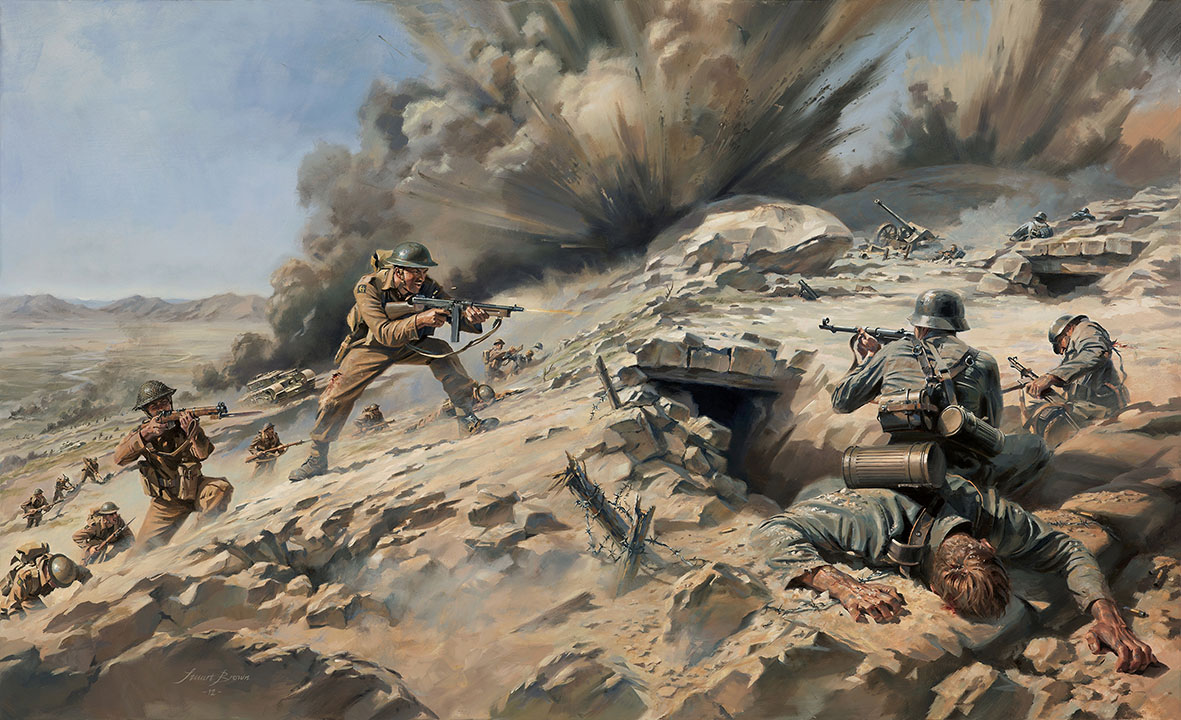
In Tunisia, strong resistance on Longstop Hill blocked the Allied advance on Tunis. On 23 April 1943 the 8th Battalion launched their attack supported by tanks of the North Irish Horse.
On approach, the Commanding Officer and his headquarters were killed. 25 year old Major ‘Jack’ Anderson assumed command. Despite a leg wound, he led the uphill assault, personally overcoming several enemy machine gun posts and mortar positions. The toll was heavy, reducing the Battalion to about 44 officers and men, but the objective was taken with 200 prisoners.
For his gallant leadership, Anderson was awarded the Victoria Cross. He was killed in action in Italy some months later.