Category: War
Categories
From the History Channel D Day Normandy 1944

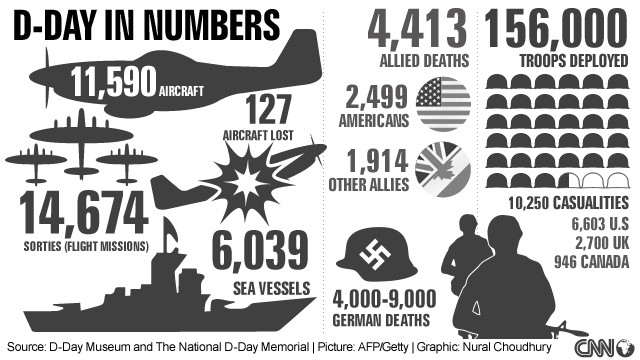

Seventy Three years ago today, America and her sturdy Allies began the Liberation of Western Europe from the Horrors of the Nazi. It was one of the great things that helped furthered the Life & Liberty of all mankind.

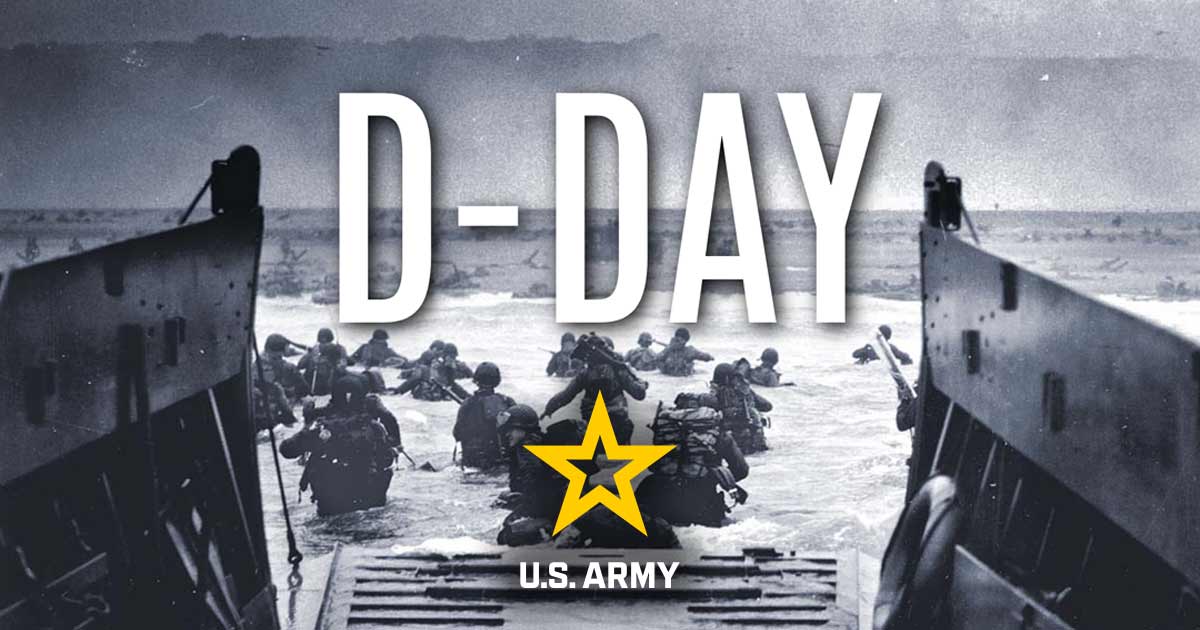
D-DAY
 Play video
During World War II (1939-1945), the Battle of Normandy, which lasted from June 1944 to August 1944, resulted in the Allied liberation of Western Europe from Nazi Germany’s control.
Codenamed Operation Overlord, the battle began on June 6, 1944, also known as D-Day, when some 156,000 American, British and Canadian forces landed on five beaches along a 50-mile stretch of the heavily fortified coast of France’s Normandy region.
The invasion was one of the largest amphibious military assaults in history and required extensive planning. Prior to D-Day, the Allies conducted a large-scale deception campaign designed to mislead the Germans about the intended invasion target.
By late August 1944, all of northern France had been liberated, and by the following spring the Allies had defeated the Germans. The Normandy landings have been called the beginning of the end of war in Europe.
Codenamed Operation Overlord, the battle began on June 6, 1944, also known as D-Day, when some 156,000 American, British and Canadian forces landed on five beaches along a 50-mile stretch of the heavily fortified coast of France’s Normandy region.
The invasion was one of the largest amphibious military assaults in history and required extensive planning. Prior to D-Day, the Allies conducted a large-scale deception campaign designed to mislead the Germans about the intended invasion target.
By late August 1944, all of northern France had been liberated, and by the following spring the Allies had defeated the Germans. The Normandy landings have been called the beginning of the end of war in Europe.
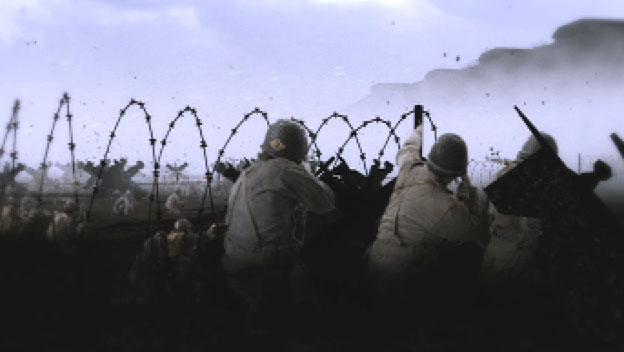
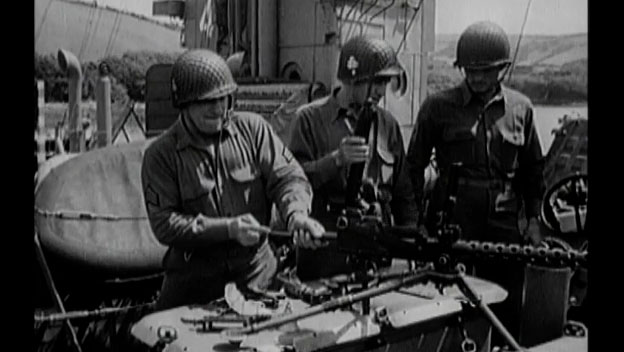
PREPARING FOR D-DAY
After World War II began, Germany invaded and occupied northwestern France beginning in May 1940.
The Americans entered the war in December 1941, and by 1942 they and the British (who had been evacuated from the beaches of Dunkirk in May 1940 after being cut off by the Germans in the Battle of France) were considering the possibility of a major Allied invasion across the English Channel.
The following year, Allied plans for a cross-Channel invasion began to ramp up. In November 1943, Adolf Hitler (1889-1945), who was aware of the threat of an invasion along France’s northern coast, put Erwin Rommel(1891-1944) in charge of spearheading defense operations in the region, even though the Germans did not know exactly where the Allies would strike.
Hitler charged Rommel with finishing the Atlantic Wall, a 2,400-mile fortification of bunkers, landmines and beach and water obstacles.
The Americans entered the war in December 1941, and by 1942 they and the British (who had been evacuated from the beaches of Dunkirk in May 1940 after being cut off by the Germans in the Battle of France) were considering the possibility of a major Allied invasion across the English Channel.
The following year, Allied plans for a cross-Channel invasion began to ramp up. In November 1943, Adolf Hitler (1889-1945), who was aware of the threat of an invasion along France’s northern coast, put Erwin Rommel(1891-1944) in charge of spearheading defense operations in the region, even though the Germans did not know exactly where the Allies would strike.
Hitler charged Rommel with finishing the Atlantic Wall, a 2,400-mile fortification of bunkers, landmines and beach and water obstacles.
In January 1944, General Dwight Eisenhower (1890-1969) was appointed commander of Operation Overlord. In the months and weeks before D-Day, the Allies carried out a massive deception operation intended to make the Germans think the main invasion target was Pas-de-Calais (the narrowest point between Britain and France) rather than Normandy.
In addition, they led the Germans to believe that Norway and other locations were also potential invasion targets. Many tactics was used to carry out the deception, including fake equipment; a phantom army commanded by George Patton and supposedly based in England, across from Pas-de-Calais; double agents; and fraudulent radio transmissions.
A WEATHER DELAY: JUNE 5, 1944
Eisenhower selected June 5, 1944, as the date for the invasion; however, bad weather on the days leading up to the operation caused it to be delayed for 24 hours.
On the morning of June 5, after his meteorologist predicted improved conditions for the following day, Eisenhower gave the go-ahead for Operation Overlord. He told the troops: “You are about to embark upon the Great Crusade, toward which we have striven these many months. The eyes of the world are upon you.”
Later that day, more than 5,000 ships and landing craft carrying troops and supplies left England for the trip across the Channel to France, while more than 11,000 aircraft were mobilized to provide air cover and support for the invasion.
On the morning of June 5, after his meteorologist predicted improved conditions for the following day, Eisenhower gave the go-ahead for Operation Overlord. He told the troops: “You are about to embark upon the Great Crusade, toward which we have striven these many months. The eyes of the world are upon you.”
Later that day, more than 5,000 ships and landing craft carrying troops and supplies left England for the trip across the Channel to France, while more than 11,000 aircraft were mobilized to provide air cover and support for the invasion.
D-DAY LANDINGS: JUNE 6, 1944
By dawn on June 6, thousands of paratroopers and glider troops were already on the ground behind enemy lines, securing bridges and exit roads. The amphibious invasions began at 6:30 a.m.
The British and Canadians overcame light opposition to capture beaches code named Gold, Juno and Sword, as did the Americans at Utah Beach. U.S. forces faced heavy resistance at Omaha Beach, where there were over 2,000 American casualties.
However, by day’s end, approximately 156,000 Allied troops had successfully stormed Normandy’s beaches.According to some estimates, more than 4,000 Allied troops lost their lives in the D-Day invasion, with thousands more wounded or missing.
Less than a week later, on June 11, the beaches were fully secured and over 326,000 troops, more than 50,000 vehicles and some 100,000 tons of equipment had landed at Normandy.
For their part, the Germans suffered from confusion in the ranks and the absence of celebrated commander Rommel, who was away on leave. At first, Hitler, believing the invasion was a feint designed to distract the Germans from a coming attack north of the Seine River, refused to release nearby divisions to join the counterattack.
Reinforcements had to be called from further afield, causing delays. He also hesitated in calling for armored divisions to help in the defense. Moreover, the Germans were hampered by effective Allied air support, which took out many key bridges and forced the Germans to take long detours, as well as efficient Allied naval support, which helped protect advancing Allied troops.
In the ensuing weeks, the Allies fought their way across the Normandy countryside in the face of determined German resistance, as well as a dense landscape of marshes and hedgerows.
By the end of June, the Allies had seized the vital port of Cherbourg, landed approximately 850,000 men and 150,000 vehicles in Normandy, and were poised to continue their march across France.
The British and Canadians overcame light opposition to capture beaches code named Gold, Juno and Sword, as did the Americans at Utah Beach. U.S. forces faced heavy resistance at Omaha Beach, where there were over 2,000 American casualties.
However, by day’s end, approximately 156,000 Allied troops had successfully stormed Normandy’s beaches.According to some estimates, more than 4,000 Allied troops lost their lives in the D-Day invasion, with thousands more wounded or missing.
Less than a week later, on June 11, the beaches were fully secured and over 326,000 troops, more than 50,000 vehicles and some 100,000 tons of equipment had landed at Normandy.
For their part, the Germans suffered from confusion in the ranks and the absence of celebrated commander Rommel, who was away on leave. At first, Hitler, believing the invasion was a feint designed to distract the Germans from a coming attack north of the Seine River, refused to release nearby divisions to join the counterattack.
Reinforcements had to be called from further afield, causing delays. He also hesitated in calling for armored divisions to help in the defense. Moreover, the Germans were hampered by effective Allied air support, which took out many key bridges and forced the Germans to take long detours, as well as efficient Allied naval support, which helped protect advancing Allied troops.
In the ensuing weeks, the Allies fought their way across the Normandy countryside in the face of determined German resistance, as well as a dense landscape of marshes and hedgerows.
By the end of June, the Allies had seized the vital port of Cherbourg, landed approximately 850,000 men and 150,000 vehicles in Normandy, and were poised to continue their march across France.
VICTORY IN NORMANDY
By the end of August 1944, the Allies had reached the Seine River, Paris was liberated and the Germans had been removed from northwestern France, effectively concluding the Battle of Normandy. The Allied forces then prepared to enter Germany, where they would meet up with Soviet troops moving in from the east.
The Normandy invasion began to turn the tide against the Nazis. A significant psychological blow, it also prevented Hitler from sending troops from France to build up his Eastern Front against the advancing Soviets. The following spring, on May 8, 1945, the Allies formally accepted the unconditional surrender of Nazi Germany. Hitler had committed suicide a week earlier, on April 30.
The Normandy invasion began to turn the tide against the Nazis. A significant psychological blow, it also prevented Hitler from sending troops from France to build up his Eastern Front against the advancing Soviets. The following spring, on May 8, 1945, the Allies formally accepted the unconditional surrender of Nazi Germany. Hitler had committed suicide a week earlier, on April 30.
Canada’s long-running and unlikely Sherman obsession
Today the Canadian Army rocks some gently used (mainly former Dutch Army) Leopard 2A4+/2A4M/2A6M main battle tanks but their armored tradition goes way back. In the 1930s, the branch trained with early US M1917 tanks and Vickers MKVI light tanks then by 1941 was using MkIV Churchills.
In World War II, Canada actually rolled their own tanks, producing 1420 locally-built Valentines at the Canadian Pacific Railway’s Angus Shop in Montreal. While most of the V’s went to the Soviet Union for use on the Eastern Front, the Montreal Locomotive Works built a modified version of the M3 Lee medium tank as the Ram to equip Canuck units in Northern Africa early in the war.
In 1943, MLW switched from the Lee/Ram to the Sherman (called “Grizzly” in Canadian service), which included British radio gear, a 2-inch smoke mortar mounted on the turret and a cast hull as opposed to the more common welded-hull version.
The 1st Canadian Armoured Brigade was equipped with Grizzlies in time for the invasion of Sicily in July 1943.
In all, MLW made 188 Canuck Grizzlies while others were acquired from allies.
The novice Canadian Armored Corps in Italy caught hell from both the terrain and German PzKpfw IV’s when 36 Shermans from the Three Rivers Regiment (Tank), CASF (now the 12e Régiment blindé du Canada) took on the brunt of the veteran German 16th Panzer Corps near Termoli in one of the most epic armored engagements of Canadian military history.
The 2nd Canadian Armoured Brigade, and the 4th Canadian Armoured Division, training in Britain for Operation Overlord, had their Ram tanks swapped out with the new tank just before D-Day.
They also caught hell in Northwestern Europe.


In World War II, Canada actually rolled their own tanks, producing 1420 locally-built Valentines at the Canadian Pacific Railway’s Angus Shop in Montreal. While most of the V’s went to the Soviet Union for use on the Eastern Front, the Montreal Locomotive Works built a modified version of the M3 Lee medium tank as the Ram to equip Canuck units in Northern Africa early in the war.
In 1943, MLW switched from the Lee/Ram to the Sherman (called “Grizzly” in Canadian service), which included British radio gear, a 2-inch smoke mortar mounted on the turret and a cast hull as opposed to the more common welded-hull version.
The 1st Canadian Armoured Brigade was equipped with Grizzlies in time for the invasion of Sicily in July 1943.
In all, MLW made 188 Canuck Grizzlies while others were acquired from allies.
The novice Canadian Armored Corps in Italy caught hell from both the terrain and German PzKpfw IV’s when 36 Shermans from the Three Rivers Regiment (Tank), CASF (now the 12e Régiment blindé du Canada) took on the brunt of the veteran German 16th Panzer Corps near Termoli in one of the most epic armored engagements of Canadian military history.
The 2nd Canadian Armoured Brigade, and the 4th Canadian Armoured Division, training in Britain for Operation Overlord, had their Ram tanks swapped out with the new tank just before D-Day.
They also caught hell in Northwestern Europe.
A rare colorchrome of a Sherman V of the Canadian 29th Reconnaissance regiment (The South Alberta Regiment). The Tank was commanded by Major David Currie (VC), and the tank was named ‘Clanky’. This photo was taken in Normandy around Arromanches in July of 1944. Photo via TheShermanTank.com
A pair of burnt-out Canadian M4A2 Shermans of the 10th Armored Regiment (The Fort Garry Horse) at the foot of the church at Rots – June 1944
Some Grizzlies were converted into the Skink anti-aircraft tank with a turret mounting four 20 mm Polsten guns– a very effective anti-personnel and AAA platform.
“Tank AA, 20 mm Quad,” better known as the Skink was Canadian self-propelled anti-aircraft gun, developed in 1943-44 fully enclosed mounting on the chassis of the Grizzly Canadian-built M4A1 Sherman
Other variants included the Badger flame tank and Kangaroo APC, both made from Sherman hulls.
When Hitler was vanquished, the Canadians left their Grizzlies/Shermans in Europe while in 1946 they picked up 294 “Easy Eight” M4A2(76)W HVSS Shermans cheap– just $1,460 each (Late model Shermans cost $200,000 to make in 1945). They were left overs from Lend Lease production meant for Uncle Joe in Moscow but by that stage of the 1940s, the U.S. would rather sell them at scrap prices that give them to the Soviets.
The batch of M4A2(76)W’s (M4A3E8’s) were kept in Canada proper for training purposes, even though they were different from the Shermans forward deployed along the Rhine.
When Korea came, the Canadians borrowed 20 Shermans from the U.S. Army and Marines in-country and, after using them in often very heavy combat and tense DMZ patrol from 1951 to November 1954, returned all 20 back to the U.S.
Trooper Andy Parenteau of the Lord Strathcona’s Horse (Royal Canadians) sleeps on the back of a Canadian Sherman M4A3(76)W HVSS tank, Korea. Note the American ration box and United Nations/Canada crest on the tail
British forces used Centurions in the conflict– speaking of which…
In 1952, the Canadian Army bought the first of what would be 274 Centurion Mk 3 Tanks and split these MBTs between the active units in Germany (with their Grizzles being passed on to Portugal) and at home, later adding 120 Mk 5’s to the arsenal– while transferring the Easy Eight Shermans to reserve units.
They remained in service until 1978 when Canada replaced their aging Centurions with 127 new German-built Leopard C1 (equivalent to Leopard 1A3 with laser rangefinder) MBTs and, as the buy was limited and 114 were based in West Germany, just a handful were sent home to Canadian Forces Base Gagetown, New Brunswick for training.
The days of large tank lots in Canada had come to an end.
This led to the retirement of the last Canadian reserve force Shermans in the 1970s, one of the last Western countries to do so.
Canadian Easy Eight Shermans in reserve units 1970s out for a Sunday drive
You have to admit, the camo scheme looks good on these tanks…and they were an instant WWII veterans parade every time they left the armory
After retirement, many Canadian Shermans remained in use well into the 1980s– as targets.
Ex-Canadian M4 Sherman used for target practice with anti-tank weapons, 1986
It should be noted that as late as 1989, the Finning Tank Drill, a rock drill used in logging road construction, was produced in British Columbia from Sherman hulls while BC’s Morpac Industries, Inc., still produces heavy-duty, off-road load crawlers based on Sherman components. It is very likely these civilian mods will be in the wilds of Canada’s western forests for decades to come.
Here is a Finning caught in its natural state:
Today some 60~ intact models are thought to still exist in the country as gate guards and museum pieces and they pop up from time to time in both their Grizzly and later Easy Eight variants for sale at reasonable prices.
The Ontario Regiment (RCAC) Museum in Oshawa, Ontario has a pair of great working Shermans, (“Bart” #78-904 and “Billy #78-856).
Overall, not a bad track record for the often derided Sherman.

The Battle of Château-Thierry was fought on July 18, 1918 and was one of the first actions of the American Expeditionary Forces (AEF) under General John J. “Black Jack” Pershing.

It was a battle in World War I as part of the Second Battle of the Marne, initially prompted by a German offensive launched on 15 July against the AEF, an expeditionary force consisting of troops from both the Army and Marine Corps, and the newest troops on the front.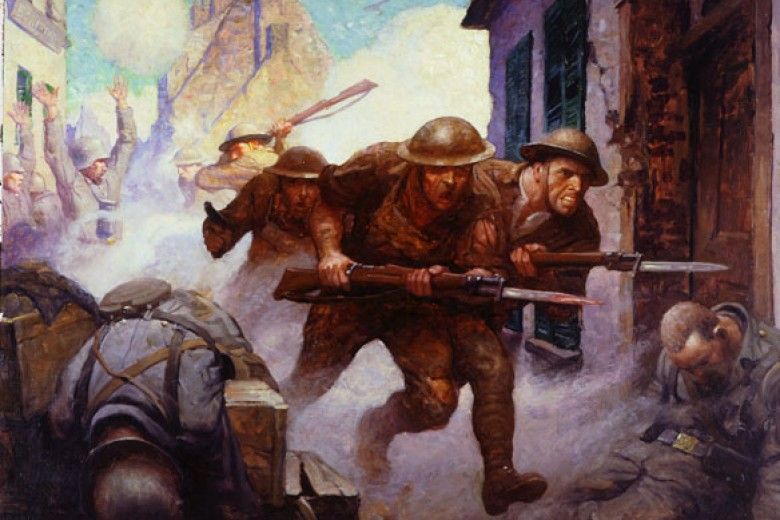
On the morning of 18 July 1918, the French (some of them colonial) and American forces between Fontenoy and Château-Thierry launched a counter-assault under the overall direction of Allied généralissime Ferdinand Foch against the German positions.
This assault on a 40 km (25 mi) wide front was the first in over a year. The American army played a role fighting for the regions around Soissons and Château-Thierry, in collaboration with predominantly French forces.
The allied forces had managed to keep their plans a secret, and their attack at 04:45 took the Germans by surprise when the troops went “Over the Top” without a preparatory artillery bombardment, but instead followed closely behind a rolling barrage which began with great synchronized precision.
Eventually, the two opposing assaults (lines) inter-penetrated and individual American units exercised initiative and continued fighting despite being nominally behind enemy lines.[2]
Contents
[hide]
Background
Despite the revolution in Russia, fortune seemed to favor the Allies with the arrival of the Americans to France. However, these troops needed time to train before they could be combat effective.
Recognizing the window of opportunity, Ludendorff consolidated the manpower freed up from the Eastern Front to conduct Operation Michael in order to split the Allies’ lines. The successes of the German Stormtroopers infiltration tactics earned Germany approximately 40 miles of territory. But the offensive lost momentum when it surpassed its supply lines.
Up to this point, American General Pershing refused to hand over American divisions to either the British or French armies, insisting on keeping them together as one army. But in the face of the German onslaught, Pershing relented and sent a portion of his army to assist the French in blocking the German advance.[3]:7–10
Prelude[edit]
Looking to defeat the British occupied in Flanders, Ludendorff sought to divert the Allies’ French reserves away from the region. In his Operation Blucher, Ludendorff aimed some of his forces at the Chemin des Dames and took the French Sixth Army by surprise.
Driving on, the Germans were soon at the Marne River, situated under 50 miles from Paris. With Marshal Ferdinand Foch unable to acquire British assistance, General Pershing’s chief of operation, Colonel Fox Conner, recognized the gravity of the situation and ordered the 3rd Division to block them.[3]:39–41[4]
Battle
The 3rd Division occupied the main bridge on the south bank of the Marne that led in Chateau Thierry on May 31 as the French 10th Colonial Division rendezvoused with them from the north bank. The Americans positioned their machine guns to cover the French retreat, and had a unit led by Lt John Bissell situated north of the second bridge. The French spent the night adding explosives to the bridges to destroy them. Early the following morning, on June 1, the Germans advanced into Chateau Thierry from the north, forcing the French to the main bridge, which they defended with the support of American machine-gun fire. The French succeeded in destroying the bridge as the Americans kept up their fire on the Germans. Lt. Bissell’s group was still on the north side of the Marne. They worked their way back to the secondary bridge in-between American machine-gun fire and made it across, along with a group of Germans that were captured shortly afterwards. From the north of the Marne on June 2, the Germans engaged in heavy artillery and sniper fire against the Allies. They made an attempt to take the remaining bridge but were forced to end the assault as the casualties rose.[3]:41–42
Memorials[edit]
After World War I, a memorial was built on Hill 204, 2 miles (3 km.) west of the town for which it is named. The Château-Thierry Monument, designed by Paul P. Cret of Philadelphia, was constructed by the American Battle Monuments Commission “to commemorate the sacrifices and achievements of American and French fighting men in the region, and the friendship and cooperation of French and American forces during World War I.”[5]
There is also a monument in front of the Bronx County Courthouse in New York City that was presented by the American Legion on November 11, 1940. The monument consists of the “Keystone from an arch of the old bridge at Chateau Thierry,” which the monument notes was “Gloriously and successfully defended by American troops.”[6]
The first Filipino to die in World War I was Private Tomas Mateo Claudio who served with the U.S. Army as part of the American Expeditionary Forces to Europe. He died in the Battle of Chateau Thierry in France on June 29, 1918.[7][8] The Tomas Claudio Memorial College in Morong Rizal, Philippines, which was founded in 1950, was named in his honor.[9]
References[edit]
- Jump up^ http://www.kumc.edu/wwi/index-of-essays/american-military-operations-and-casualties.html
- Jump up^ Edwin L. James (1918). “A Description of the Battle of Chateau-Thierry”. New York Times Current History. New York Times. Archived from the original on 6 June 2009. Retrieved 2009-06-22.
- ^ Jump up to:a b c David Bonk (2007). Chateau Thierry and Belleau Wood 1918: America’s baptism of fire on the Marne. Great Britain: Osprey Publishing. ISBN 978-1-84603-034-5. Retrieved 31 October 2016.
- Jump up^ Eisenhower, John S.D. (2001). Yanks: The Epic Story of the American Army in World War I. New York: The Free Press. pp. 136–137. ISBN 0-684-86304-9.
- Jump up^ “Aisne-Marne American Cemetery and Memorial” (PDF). American Battle Monuments Commission, U.S. Government. Archived from the original (PDF) on 2009-07-04. Retrieved 2009-06-22.
- Jump up^ “An overlooked memorial”. Matt at I’m Just Walkin’. Retrieved 2014-11-15.
- Jump up^ Zena Sultana-Babao, America’s Thanksgiving and the Philippines’ National Heroes Day: Two Holidays Rooted in History and Tradition, Asian Journal, retrieved 2008-01-12
- Jump up^ Source: Philippine Military Academy
- Jump up^ “Schools, colleges and Universities: Tomas Claudio Memorial College”. Manila Bulletin Online. Archived from the original on 2007-07-07. Retrieved 2007-07-04.
– “Tomas Claudio Memorial College”. www.tcmc.edu.ph. Retrieved 2007-07-04.
The Story of the American Expeditionary Forces |
CHATEAU – THIERRY
| U.S. Marine Corps |
THE BATTLEFOR |
At Belleau Wood
| | Quick Facts | Background | Chronology | | A First Hand Account | Quick FactsWhere: The Aisne-Marne Sector, 5 miles immediately northwest of the town of Chateau-Thierry on the River Marne. BackgroundThe Hunting Lodge within Belleau Wood
|
| Sources and thanks: A half dozen works were consulted for this page including E.M. Coffman’s War to End All Wars, Stalling’s The Doughboys, Friedel’s Over There, SLA Marshall text in the American Heritage History of World War I and American Armies and Battlefields in Europe. The most valuable resource for the chronology was the Official 2nd Division History which is now available on CD from our friends at the Digital Bookshelf. A forgotten Marine contributor sent the Frederick Wise comments which are from the memoir, A MARINE TELLS IT TO YOU. The top illustration is a detail from a Leatherneck Magazine cover. Regular contributors Herb Stickel and Ray Mentzer helped with the other photos.All of the above are recommended for deeper study of the battle as well as two interesting websites: Bradley Omanson’s Scuttlebutt & Small Chow: A Salty Old Harbor of Marine Corps History Great War Society Member Edward Swaim’s Belleau Wood Today Photo Essay Last, a special thanks for Col. Bill Anderson, USMC, a Great War Society Member and student of the battle who caught some serious errors of omission in my original draft. MH |
| To find other Doughboy Features visit ourDirectory Page | For Great War Society Membership InformationClick on Icon |
| For further information on the events of 1914-1918 visit the homepage of The Great War Society |
Additions and comments on these pages may be directed to:
Michael E. Hanlon (medwardh@hotmail.com)
Hitler definitely died in 1945, according to new study of his teeth

By
French researchers claim to have put an end to conspiracy theories surrounding the death of Adolf Hitler, after a study of his teeth proved he definitely died after taking cyanide and shooting himself in the head in Berlin in 1945.
The researchers reached their conclusion after they were given rare access to fragments of Hitler’s teeth which have been held in Moscow since the end of World War II.
“The teeth are authentic, there is no possible doubt. Our study proves that Hitler died in 1945,” said professor Philippe Charlier.
“We can stop all the conspiracy theories about Hitler. He did not flee to Argentina in a submarine, he is not in a hidden base in Antarctica or on the dark side of the moon,” he told AFP news agency.
The teeth were put on display in 2000 in Moscow as part of an exhibition to mark the 55th anniversary of the end of the war.
They were back in the news again last month when the memoirs of a Russian interpreter who worked in Berlin in 1945 were published in English for the first time.
She recounted how she had been tasked with proving Hitler’s death by tracking down his dental records in the ruined German capital and seeing if they matched a set of teeth she had been entrusted with – which they did.
In March and July 2017, Russia’s FSB secret service and the Russian state archives authorised a team of French researchers to examine Hitler’s bones for the first time since 1946, said Professor Charlier, who was one of the scientists chosen.
They were able to look at a skull fragment presented as being from the Fuhrer, which showed a hole on the left side which was in all probability caused by the passage of a bullet.
The scientists were not authorised to take samples from this fragment, they noted in their study published on Friday in the scientific magazine European Journal of Internal Medicine.
The skull fragment’s morphology was “totally comparable” to radiographies of Hitler’s skull taken a year before his death, the research found.
The analysis of the Nazi leader’s bad teeth and numerous dentures found white tartar deposits and no traces of meat fibre – the dictator was vegetarian.
The examination of the teeth did not find any traces of powder, which indicates there was not a revolver shot to the mouth, more likely the neck or the forehead.
Equally, bluish deposits seen on his false teeth could indicate a “chemical reaction between the cyanide and the metal of the dentures,” the researcher said.
If this study confirms the generally accepted view that Hitler died on the 30 April, 1945, in his Berlin bunker with his companion Eva Braun as the Soviets were capturing the city, it also sheds new light on the exact causes of death, said Mr Charlier.
“We didn’t know if he had used an ampule of cyanide to kill himself or whether it was a bullet in the head. It’s in all probability both,” he said.
Charlier, a specialist in medical and legal anthropology, was also involved in the analysis of the mummified heart of Richard the Lionheart.


John Jefferson Williams (1843 – May 13, 1865) was a Union soldier and private in Company B the 34th Regiment Indiana Infantry.
He was killed at the Battle of Palmito Ranch, the last land battle of the Civil War, and is generally recognized as the last soldier killed in the American Civil War.
Every Soldier does not want to be either the 1st or last to die in a war for obvious reason.

The Mossad@TheMossadIL
We just smuggled a half ton of smoking gun evidence of Iran’s nuclear program in a daring mission to save the world and you’re all talking about the PowerPoint font. Just for that next time we’re using comic sans.
