M
ilitary spending can amount to hundreds of billions of dollars annually as new technologies are sought, and systems are updated to ensure the world’s best fighting forces stay one step ahead of their competition. However, those countries that lack spending power often resort to tried and true technology from previous generations. In some cases, this means using relatively antiquated vehicles that, in some instances, call[ back to the Cold War or even World War II.
While, on the face of it, this may sound desperate or even downright dangerous, military technology is by its nature highly robust, and some examples, such as the Tupolev TU-95 long-range bomber or the Boeing CH-47 Chinook helicopter, have not as yet required replacing. Some older designs, such as the Lockheed C-130 Hercules transport plane and the Type 209 submarine, have received regular updates to keep them consistent with modern military requirements.
For this article, we have chosen vehicles that remain in fighting forces today. For example, some individual ships and submarines are still used as training vessels or for reconnaissance purposes. These include the USS Constitution, a square-rigger sailing frigate from 1797, and the last remaining Hai Shi Class submarine from 1944, which are still technically in service with the United States and Taiwanese navies, respectively, but pose no significant military threat. The following are the oldest war vehicles that are still in active service today.
Read more: 10 Most Impressive Supersonic Bombers Of All Time
SIKORSKY BLACK HAWK

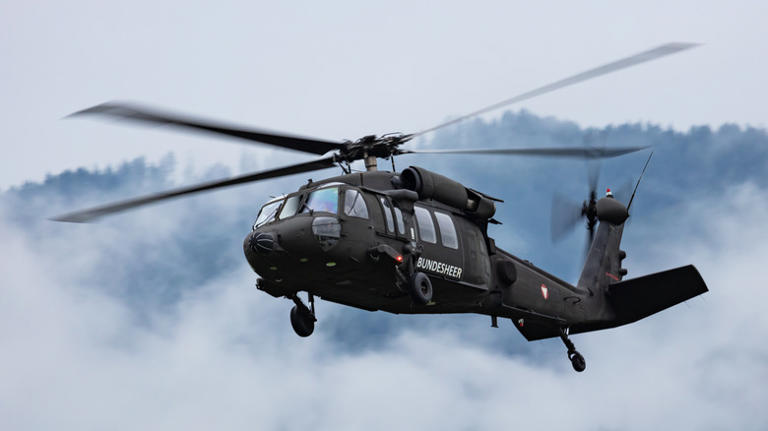
Many of us remember the Black Hawk helicopter as the subject of Ridley Scott’s 2001 film “Black Hawk Down,” based on a novel of the same name. However, that near-disastrous mission into Somalia in 1993 is just one episode in the long and storied history of this multipurpose helicopter, which has been in service since 1979.
The Black Hawk is a medium-lift helicopter crewed by four, usually consisting of a pilot, co-pilot, and crew chiefs. It can also carry 11 troops or six stretcher patients plus medical attendants, as well as various combinations of personnel and cargo, making it a highly versatile and valuable vehicle. It cruises at an average speed of 174 miles per hour, with a top speed of 222 mph, making it one of the world’s fastest helicopters. It also has a range of more than 350 miles, but it can go longer thanks to external fuel tanks.
In over 40 years since the Black Hawk first entered service, it has been used for casualty evacuation, combat assault, aerial firefighting, search and rescue, and special operations. It can be armed with rockets, guns, and missiles. There are currently over 4,000 units in operation worldwide, of which more than 2,000 are used by the United States, and the Black Hawk shows no sign of retiring any time soon.
TYPE 209
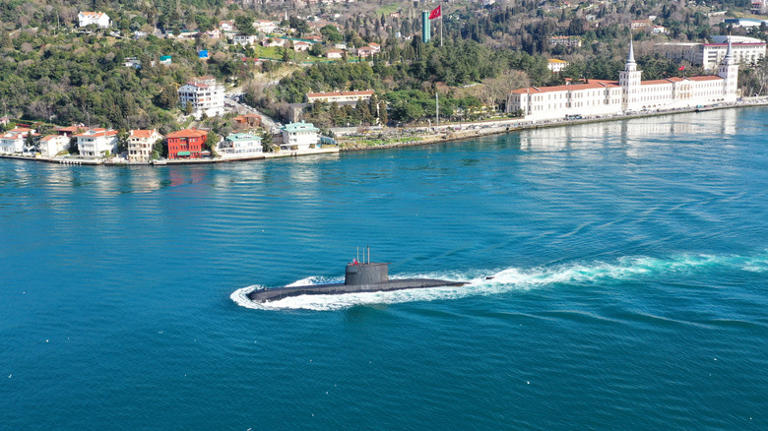
Germany is known for many exports, including pharmaceuticals, consumer electronics, luxury automobiles, and … Albert Einstein. Diesel-electric attack submarines are not usually included in this list, yet the Type 209 is success story of a military vehicle created exclusively for sale to other countries.These vessels have been sold to 12 navies, as aging World War II and Cold War-era submarines have gradually required replacing. Germany, spotting this looming gap in the market, was quick to respond with this robust and versatile submarine, although, curiously, it doesn’t operate any itself.
While specifications vary due to the adaptable nature of the Type 209, it is crewed by roughly 40 people and has a submerged displacement of between 1,200 tons. All use diesel-electric propulsion, which provides a surfaced speed of around 11 knots and a submerged speed of around 22 knots. It can dive to a maximum of 500 meters and has a range of about 430 miles when submerged.
Five variants of Type 209 exist in various militaries, from South America to the Mediterranean, to South Africa, to Asia, as evidence of the versatility and adaptability of the original vessel. Modifications can include an increased air supply, escape hatches, taller masts, overhauled engines and systems, and even an increase in length. While each country assigns its own class names to the submarine, they are all unmistakably the Type 209, based on the original German design and incorporating the European nation’s renowned technological prowess and build quality.
VICTOR CLASS
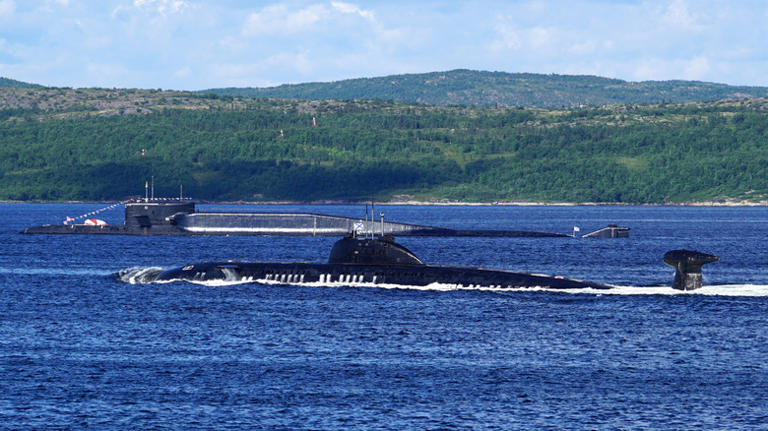
Predating the Type 209 is the Victor Class submarine, which is still operational in its native Russia, where it was first commissioned in 1967. Codenamed “Project 671”, it is one of the earliest nuclear-powered attack submarines, which produced two quieter versions, the Victor II and Victor III, in later years, the latter of which is still in service today. This remnant of the Cold War was the Soviets’ answer to the U.S. Sturgeon Class sub, and it is characterized by its teardrop-shaped hull and the large sonar pod on its stern plane.
The Victor Class submarine is a worrying reminder of just how dangerous the post-World War II global situation had become, as nations equipped their aircraft and submarines with nuclear warheads in preparation for the outbreak of all-out war. The Victor Class was one such vessel that carried two 200-kiloton Novator torpedoes or two S-10 Granat cruise missiles, each capable of devastating an entire city. They were also powered by a nuclear reactor, which drove a steam turbine, providing 22.7 megawatts of power to a single propeller shaft as a highly efficient, albeit risky, energy source.
Thankfully no boats ever suffered any severe damage during their long tenure, and the Victor Class has gradually been retired, with the first Victor III subs being taken out of service in 1998. Just two, the “Tambov” and “Obinsk,” remain operational and are used by the Russian Navy as testing vehicles for new weapons and other technology.
BOEING CH-47 CHINOOK
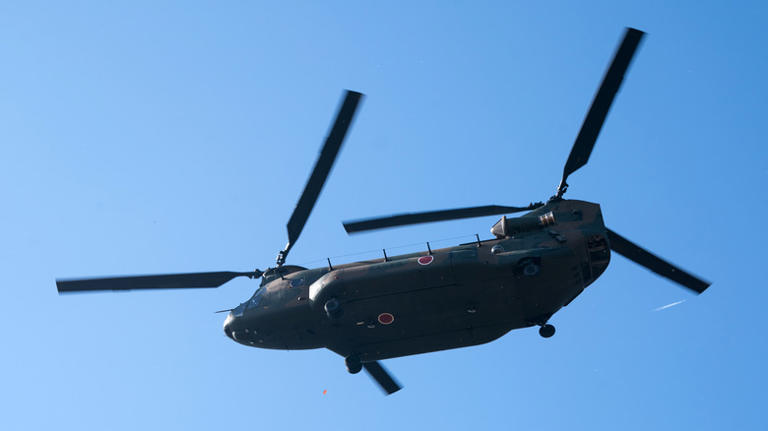
The Boeing CH-47 Chinook is one of the most recognizable helicopters in history, with its dual rotors and bulbous profile. Its versatility as a medium to heavy-lift vehicle and consistent updates have ensured that the design will remain in service until at least 2060, and the latest CH-47 boasts advanced technological features to rival any of its modern equivalents.
This versatility is evidenced by the fact that the Chinook is operational with many militaries across the globe, as diverse as Great Britain, Australia, Canada, Egypt, and the Netherlands, as well as its native United States. Having first entered service in 1962, it has been used in Vietnam, the Iran-Iraq conflict, the Falklands War, and Afghanistan. It features two powerful gas turbine engines, capable of lifting up to 24,000 pounds, and has many new advanced capabilities that maintain its usefulness in modern military practice.
These include a digital cockpit management system, autopilot functionality, a digital flight control system with hover and landing assists, and advanced cargo capabilities. The CH-47 Chinook embodies the term, “If it ain’t broke, don’t fix it.” However, the modern machine is highly sophisticated compared to the original vehicle from over 60 years ago.
LOCKHEED C-130 HERCULES
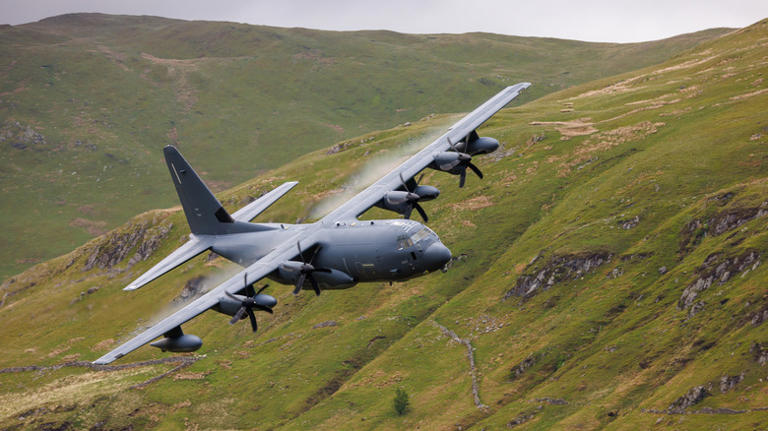
The Lockheed C-130 Hercules could be called the fixed-wing transport plane’s answer to the Chinook helicopter, as a tried-and-true design that hasn’t needed replacing since entering military service in 1956. This reliable, versatile workhorse is capable of transporting large payloads from runways that are high in altitude and poorly surfaced. The latest C-130J iteration is used by 21 countries, with other variants employed by tens more nations worldwide.
Built by Lockheed-Martin, the modern Hercules is impressive for a plane with such a long service history. It has four Rolls-Royce turboprop engines producing 4,700 hp each. It will fly at a top speed of 417 miles per hour at an altitude of 22,000 feet, but it can climb to a ceiling of 28,000 feet while carrying its maximum 42,000-pound payload. It is large at almost 98 feet in length and 39 feet tall, with a wingspan of 133 feet.
The Hercules is as powerful as its name suggests, but it is also versatile and used for many different roles, including meteorological services, medical operations, disaster relief, and firefighting duties, as well as airlift support. It is also large and can carry all sorts of cargo, including other helicopters, armored vehicles, palleted goods, and personnel. Given that a larger version, the C-130J-30 “Super Hercules,” is also in production, it looks likely that the Hercules will be flying for many years to come.
TUPOLEV TU-95
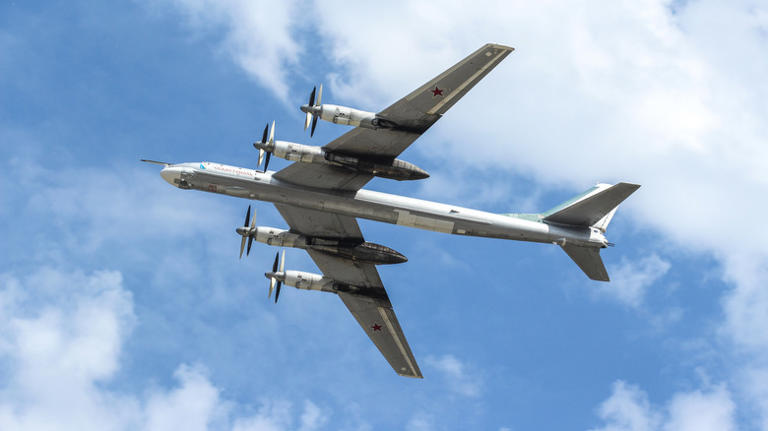
During World War II, three Boeing B-29 Superfortresses were forced to land on Soviet territory and duly appropriated by the Russians. From these, they created their own almost-carbon-copy prototypes, the Tupolev TU-80 and TU-85, which evolved into the Tupolev TU-95. Codenamed “The Bear” by NATO, this long-range bomber was Russia’s answer to the B-52, and it entered service in 1956.
Like the B-52, the TU-95 is a formidable and sizable machine capable of carrying a nuclear payload. It underwent several different redesigns for various military applications, including flight training, reconnaissance, and transport duties, as a launcher for hypersonic aircraft, and for recovering space modules for Russia’s cosmonaut program. Few aircraft can claim to have had such a storied career as the TU-95.
A lot has happened since 1956. The Cold War that created a requirement for the TU-95 has long passed, and Russia has been involved in many other conflicts. Despite still being in use, this aircraft may be showing its wear. After two accidents, they were briefly grounded in 2015.
BOEING B-52 STRATOFORTRESS
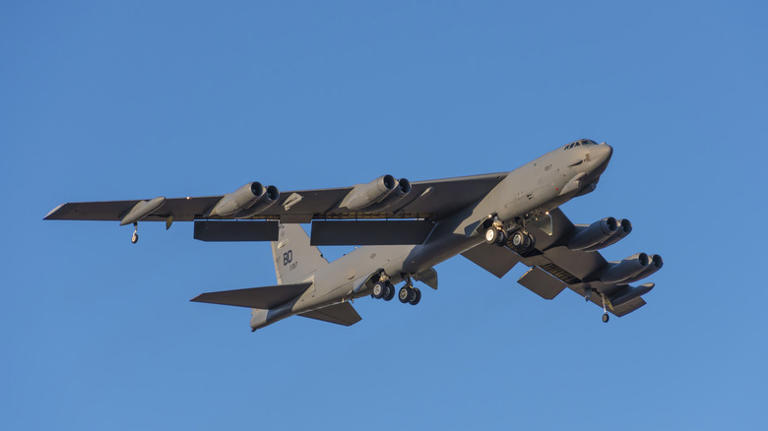
Boeing and the U.S. military have enjoyed a successful partnership dating back to World War I when the company first trained flight instructors for the Army. Since then, it has won many contracts to produce military aircraft for various purposes. These include tactical fighter aircraft, helicopters, transport planes, reconnaissance planes, uncrewed combat planes, and long-range bombers, such as the B-17 Flying Fortress, the B-29 Superfortress, and the B-52 Stratofortress.
The specifications of the B-52 are impressive, to say the least. It is so large that it requires a unique set of skills and specially designed landing gear to attempt a takeoff and landing. It has eight Pratt and Whitney turbofan engines, each providing around 17,000 pounds of thrust. It has a colossal 185-foot wingspan, is 159 feet long, can fly at a maximum speed of 650 miles per hour, and has a range of 8,800 miles. Despite its vastness, the modern B-52 requires a crew of just five to operate, including its commander, pilot, navigator, electronic warfare officer, and radar operator.
This now-legendary bomber is still operational in its native United States, having been in service since 1952. It is yet another testament to the enduring design qualities of some post-war military aircraft that finds them still eminently usable over a half-century later. Originally intended as a high-altitude bomber, its new primary function is to provide the United States with an immediate global strike capability for nuclear and non-nuclear precision weapons. Modern machines offer a maximum payload of 70,000 pounds, which will soon be upgraded by approximately 50%, making this aircraft unrivaled within its segment. As such, the B-52 is expected to remain in service until well after 2040.
MIKOYAN-GUREVICH MIG-17
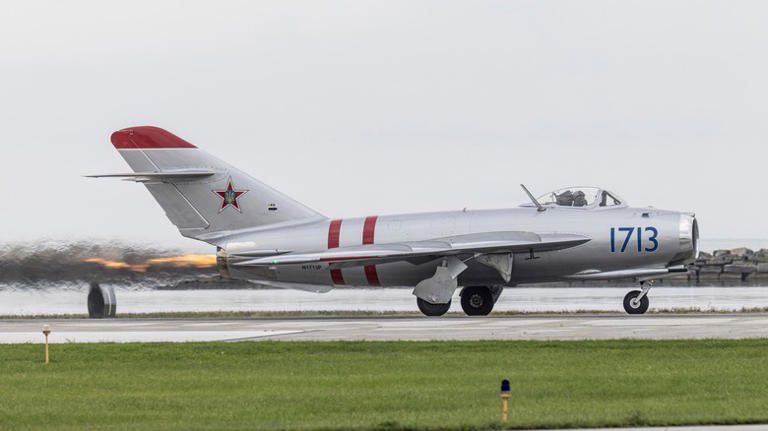
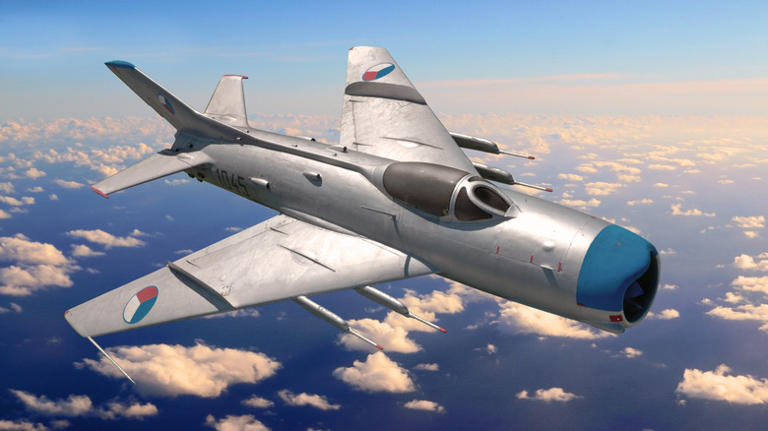
Codenamed “Fresco” by NATO, the Mikoyan-Gurevich MiG-17 has had an eventful history, having served in more than 20 military forces since production began in 1951. It is notable for its snub-nosed profile, with its tapered afterburner to the rear that gives it a cigar-shaped silhouette.
Its predecessor, the MiG-15, served successfully in the Korean War, and this updated jet was more agile, with an extended fuselage and more acutely-angled wings. Its armament includes three cannons and 16 rockets, and it can reach speeds of up to 711 miles per hour.
The MiG-17’s first major conflic t was the Vietnam War, as flown by the North Vietnamese Air Force, where it was dubbed the “Silver Swallow” and pitted against the F-105s and F-4s of the United States. While not as maneuverable, these had the speed advantage over the MiG, ultimately downing 105 of the aircraft throughout the conflict.
Having been built in its native Russia, as well as Poland, China, and Czechoslovakia, more than 9,000 units were produced in the short time before discontinuation in 1958. While it is something of a relic today, this aging high-subsonic fighter jet is still operational with the military of Tanzania.
M47 PATTON
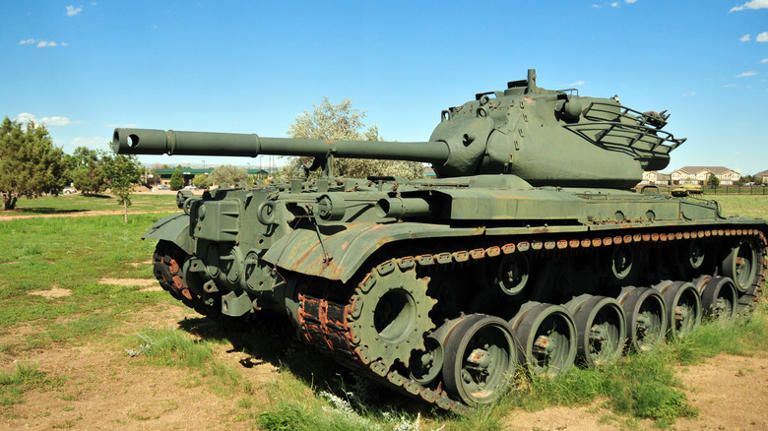
After World War II, the U.S. military saw a requirement to update the Patton, Pershing, and Sherman tanks used throughout the conflict. The result was the M47 Patton unit, which was commissioned in 1950 and named after the legendary General George S. Patton, who had died five years previously.
The M47 Patton was expectedly robust, with four-inch armor plating, and powerful with its twin-turbo V12 engine that produced 810 horsepower. With a top speed of 37 miles per hour, it was a whole seven miles per hour faster than its predecessor, the M46 Patton, and it was well-armed, with its 90-millimeter cannon and dual 30 and 50-caliber machine guns with anti-aircraft capabilities.
While the M47 Patton tank was still in its early years of production, the United States was already working on its successor, the M48, which was far superior in many ways and entered service in 1953. Having only been active with its native U.S. military for around a decade, the unit was later adopted by various countries, including South Korea, Turkey, Yugoslavia, Spain, and Pakistan, and a modernized version is currently operational with the Iranian army.
T-54/T-55
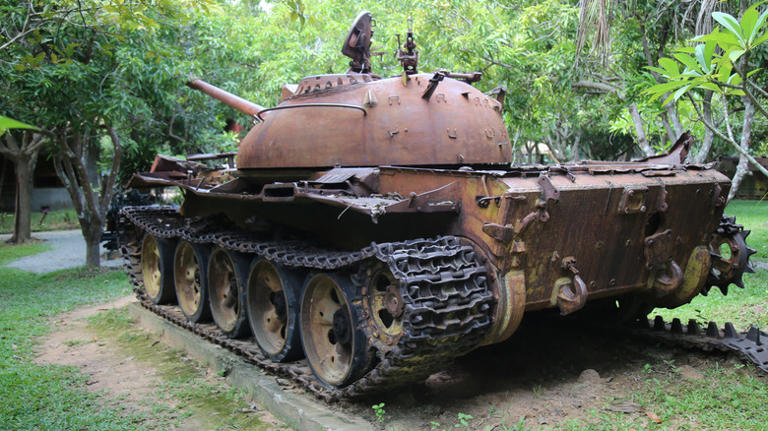
As the successor to the legendary World War II-era T-34 tank, the T-54 had some big shoes to fill. Its prototype was developed in 1946, immediately after the war, and it entered production in 1947. Along with its sibling, the modified T-55, they are among the most widely-used tanks in history, having been manufactured until 1981. they went on to serve in the Arab-Israeli War and the Vietnam War and saw action in Eastern Europe, the Middle East, and Africa.
The T-54 has a 100-millimeter main cannon, a 7.62-millimeter turret-mounted machine gun, and a 520-horsepower V12 engine. Notable additions on the T-55 include a snorkel that allows it to ford depths of over five meters, additional armor, engine upgrades, an anti-radiation lining, and radiation detection equipment, the latter a reflection of the looming threat of the Cold War at the time of production.
Given its vintage status, you’d be forgiven for thinking that the T-54 would have been retired by now. However, it is still operational with multiple militaries, including those of Afghanistan, Cuba, Ethiopia, Iraq, and Nigeria. Lately, Russia has also had to put many units back into service as artillery on the Ukrainian front line, as its tank force has been depleted by as many as 150 units per month.
M3 STUART
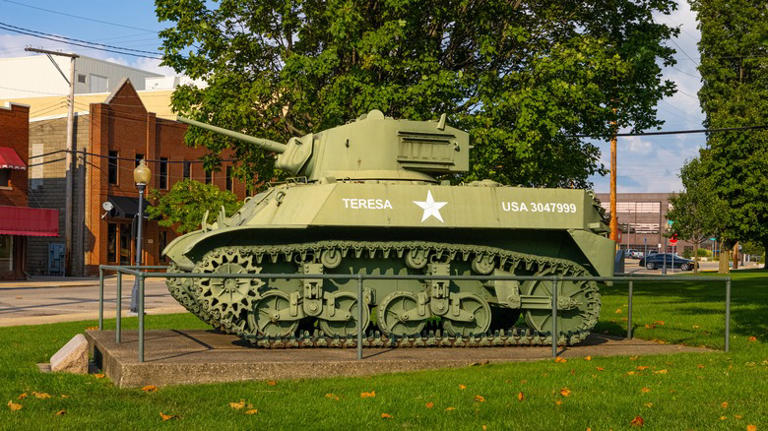
Before entering World War II, the U.S. offered the Allies a helping hand by way of lend-lease equipment, which included the M3 Stuart tank. The British debuted these in the North Africa Campaign under Gen. Bernard “Monty” Montgomery and were admired for their reliability, speed, and robust build.
While the M3 Stuart tanks were hardy little units, they were no match for the German Panzer tanks, and their high turrets stood out, making them vulnerable to attack. They featured armor of up to 1 1/2 inches thick and up to four machine guns in addition to the main 37-millimeter anti-tank gun.
The M3 Stuart tank was manufactured in large numbers by the American Car and Foundry Company, and many variants were produced, including turretless configurations that were used as personnel carriers and the ominously-named “Satan” that incorporated a flame thrower. It is still operational as a training vehicle with the Paraguay military, having been in service since 1941.
T-34
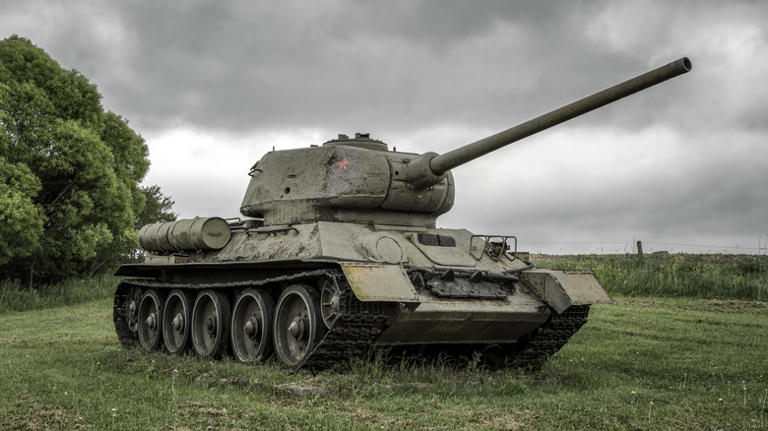
Developed in the late 1930s, the T-34 was instrumental in Russia’s success on the Eastern Front, ultimately helping to turn the tide of World War II in the Allies’ favor. The combination of its mobility, rugged build, and firepower made it a formidable opponent for German tanks like the notorious Panzer units. It was produced in factories in Kharkiv and Stalingrad, the latter becoming the main theater where it would prove its value as a formidable fighting machine.
Throughout the war, the T-34 underwent various modifications and improvements to its design, resulting in different models and variants. There were changes to its armor thickness, engine upgrades, and turret design, but its principal features remained the same. These included the powerful 7.62-millimeter main gun, wide tracks that allowed for improved weight distribution and off-road mobility, and its sloped armor, which proved effective in deflecting enemy shells.
The T-34 is still in service today, a testament to the legacy and robust nature of this World War II relic, which was highly influential in modern tank development. It remains a valuable asset to the armies of North Korea, Laos, Vietnam, Yemen, and Guinea, among others.