Category: War

Santa Claus, wearing red shorts on a 90 degree day, visited a field hospital during the Guadalcanal campaign, 1942. He toured hospitals around the island in a Chevrolet captured from Japanese forces and gave out presents supplied by the Red Cross.
Ralph Morse/Life Picture Collection/Shutterstock
The Allies’ first land campaign in the Pacific during World War II took place at Guadalcanal. The siege, led by U.S. Marines but involving every branch of the military, began on Aug. 7, 1942 and continued for about six months, until Japanese forces abandoned the island on Feb. 3, 1943.
Guadalcanal was an important early win for the Allies in World War II, but victory came at a high cost; 1,592 Americans were killed in action, another 4,183 were wounded and many more suffered from tropical diseases. On the Japanese side the toll was even greater, with 14,800 killed in action.
In Guadancanal, war was indeed hell. It’s something to keep in mind when viewing these photos of the joyful Christmas celebrations that the troops were able to muster on that remote and battle-torn island.
The pictures shot by LIFE staff photographer Ralph Morse ran in LIFE’s issue of March 1, 1943, when the campaign was over. The photos were part of a much larger story that was built around an excerpt from a book that would become a classic of war reporting, Guadalcanal Diary.
The Guadalcanal Christmas featured touches that American soldiers would have found familiar. A chaplain led midnight mass, a choir performed songs, and the troops were served a holiday meal that included turkey and pie.
Of course there were differences too. Santa was walking around in shorts because they were in the tropics and it was 90 degrees out. He wore a military helmet instead of a red stocking cap. The presents he distributed were provided by the Red Cross. The only family these soldiers could be with was the found family they had made with each other.
And if the energy in the photos is any indication, they were grateful for all of it.
American soldiers celebrating Christmas in Guadalcanal, 1942; one soldier held a sign with a message for Japanese prime minister Hideki Tojo.
Ralph Morse/Life Picture Collection/Shutterstock
Santa Claus, wearing red shorts on a 90 degree day, visited a field hospital during the Guadalcanal campaign, 1942. He toured hospitals around the island in a Chevrolet captured from Japanese forces and gave out presents supplied by the Red Cross.
Ralph Morse/Life Picture Collection/Shutterstock
Soldiers prepared turkeys to be cooked for a Christmas meal during the Guadalcanal campaign, 1942.
Ralph Morse/Life Picture Collection/Shutterstock
U.S. soldiers cut up mince pies in preparation for a Christmas celebration in Guadalcanal, 1942.
Ralph Morse/Life Picture Collection/Shutterstock
A church flag flew above the stars and stripes during Christmas celebrations for the American forces in Guadalcanal, 1942.
Ralph Morse/Life Picture Collection/Shutterstock
American soldiers celebrated midnight mass on Christmas eve in Guadalcanal, 1942.
Ralph Morse/Life Picture Collection/Shutterstock
A choir sang on Christmas eve in Guadalcanal, 1942; this group toured the island with Santa to perform for soldiers during the holiday.
Ralph Morse/Life Picture Collection Shutterstock

“Neither the Huns nor their hornbows make us afraid!”
The Geatish king Gizur challenges the invading Huns to a pitched battle on behalf of the Goths, from the
Scandinavian epic poem Battle of the Goths and the Huns, which preserves place names from the Gothic rule in South-Eastern Europe.
 IRON MEN FOR IRON TIMES!!
Grumpy
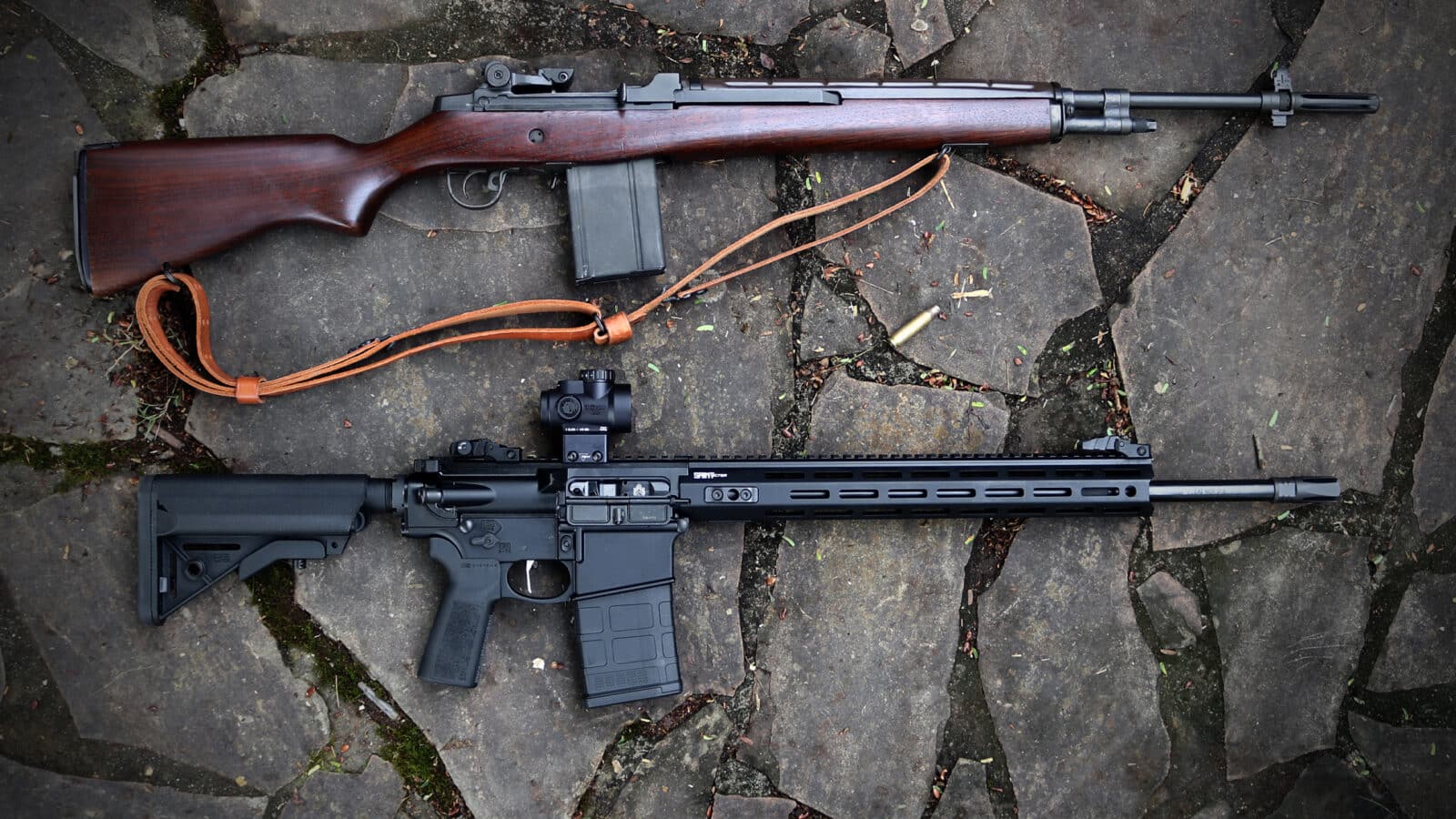 How does the M1A stack up against the AR-10? That’s the question veteran gun writer Dr. Will Dabbs set out to explore in today’s article. He looks at the Springfield Armory M1A and the SAINT Victor AR-10 to find the strengths of each, and if one is better suited for specific situations. The rifles in this article were provided by the company to the author for use in this article.
Fords and Chevys, blondes versus brunettes, paper or plastic…life is all about choices. These decisions are what define us — make us who we are. This manifests in countless little ways.

In 2023, we Americans spent half a trillion dollars on clothing and footwear. That’s about $1,500 for every man, woman, and child in the United States. Were we being totally honest, all we really need is a generous burlap sack with a few strategically placed holes. However, the nuanced details of fabric, cut, and hue are what make us distinctive. Americans are legitimately addicted to stuff like that.
This same curious drive to define ourselves uniquely suffuses our tactical firearms as well. If the mission is to turn .308 ammunition into noise, there are multiple good ways to do that. Springfield Armory has built a thriving business around just such stuff.
The Players
Both the AR-10 and the M14 are about the same age. The M14 arose from the T44 prototypes that competed in 1953 against the Belgian FN FAL in the U.S. Army Infantry Board rifle trials. The T44 was type-classified as the M14 in 1957. The M14 was an evolutionary development of the esteemed M1 Garand.

The M1 rifle was indeed a great gun, but it wasn’t all that it could be. A groundbreaking design back in 1936 when it was introduced, the M1 took U.S. forces all the way through the Second World War. Ours was the only major military armed almost exclusively with autoloading rifles. However, the rugged action was fed by an eight-round en bloc clip that was both cumbersome and awkward. The M14 fixed that.

The M14 rifle was chambered for the 7.62x51mm NATO round, itself some 12 mm shorter than the .30-06 it replaced. It was also fed by a detachable 20-round steel box magazine. The action was tweaked here and there, but the beating heart of the M14 was the same vital organ that drove the M1 Garand. The M14 subsequently captured the hearts of American shooters.
By contrast, the AR-10 was an entirely fresh new design. Developed by gun-designing visionary Eugene Stoner and a few others back around the same time the M14 was spooling up, the AR-10 reflected the radical application of WWII-era aviation materials science. The receivers were aircraft-grade aluminum, and the furniture was formed from phenolic polymer. The end result drove a revolution in modern small arms.

That first AR-10 was almost ready in time to compete in those 1950s-era Infantry rifle trials. However, the technology was in its infancy, and these early guns were not quite ready for prime time. The 7.62 NATO AR-10 morphed into the AR-15 that eventually begat the superlative Springfield Armory SAINT rifles that can be found in abundance in American gun shops today.
M1A Particulars
The Springfield Armory M1A was first introduced in 1974. Over more than half a century, Springfield Armory M1A rifles have dominated matches, provided countless hours of recreation on the range, bagged game, and effectively secured American homes and farms. Springfield Armory now offers the M1A in everything from a straight service rifle configuration up through a compact CQB (Close Quarters Battle) beast.

I bought my M1A back in 1988. It was and is rugged, accurate, and elegant all in equal measure. Modern versions are, if anything, even better. The bolt handle reciprocates with the action so you can manhandle it in the unlikely event of a stoppage. Magazines need to be hooked in front and rocked into place. The safety is a handy midline steel tab located in the front part of the trigger guard. The bolt locks back on the last round fired.
The mechanical sights on the M1A are arguably the finest mankind can contrive. The rear sight is readily adjustable for both windage and elevation without tools. A trained marksman can easily make range adjustments on the fly. The forward sight is a rugged post generously protected by steel wings. Fitting an optical sight involves screwing a detachable mount into the left side of the receiver. Naturally, Springfield Armory can hook you up with that.

The M1A fits the human form like a broken-in pair of combat boots. The stock drop perfectly interfaces with the human animal and provides a tangible connection to military riflemen that spans centuries. The trigger is both positive and predictable, lending itself to precision riflery. Despite being the better part of four feet long, the M1A nonetheless maneuvers quickly and reliably brings the pain out to great distances. The mystical combination of Parkerized steel and dark stained walnut reliably stirs the soul.
SAINT 7.62 Details
It’s tough to get your mind around just how prescient Gene Stoner and his buddies were when they first bodged the AR-10 up. Try as we may, the flower of modern engineering prowess cannot seem to come up with anything better even having had seven decades to work on it. The synergistic melding of pistol grip, safety, magazine release, and bolt catch appear to be legitimately perfect.
The Springfield Armory SAINT Victor 7.62 brings all of that incomparable human engineering into the Information Age.

The SAINT Victor 7.62 comes standard with a nickel boron-coated flat trigger, either a 16” or 20” lightweight barrel, and a set of superb detachable flip-up iron sights.

B5 Systems provides the furniture, and the 9310 steel bolt is Magnetic Particle Inspected. The critical steel bits are Melonite-coated for insanely long life and exceptional wear resistance.
There is ample room up top for any conceivable optic, and accessories are a drop-in fit thanks to scads of M-Lok real estate. A Radian Raptor-LT ambidextrous charging handle is as good as mankind can contrive. The bilateral safety rotates through 45 degrees rather than 90. If you haven’t tasted that yet, you’ll like it.

There is a reason every decent modern semi-auto rifle in the world apes the basic layout of the AR-10. Nothing is more efficient, faster, or easier to use. The bolt locks to the rear on the last round fired, and empty mags drop away cleanly. Magazine changes set the standard for everything else.
Ruminations
So, which rifle design is best? Well, for me, they both are. If the basic mission is throwing .308 bullets downrange, both the M1A and the SAINT Victor 7.62 are two different routes to a common destination. It’s easier to mount accessories and a suppressor on an AR-10, but the M1A looks like it stepped out of a classic war movie. Modern versus retro is a serious thing these days. Pick your poison.

I have had the privilege of serving as temporary custodian of both a beautifully restored 1972 Fastback Mustang and a late-model Corvette Stingray. Both cars would get you to Kroger and back to pick up a gallon of milk. They would each turn heads for entirely different reasons. I loved both cars for what they were. I lament having had to pass them on to some other deserving souls. These two magnificent rifles are analogous.
The M1A just drips with retro cred. The action is unkillable, and the gun works as efficiently and effectively now as it did 70 years ago when they thought it up. Running the M1A is the nostalgia play.
The SAINT Victor 7.62 benefits from decades of mechanical evolution in materials science. As a result, this gun is somewhat lighter and, I suppose, technically more environmentally resistant. It looks a bit like a Star Wars blaster.
If you’re in the market for a serious big bore shooter, you won’t go wrong with either option. Nothing we might ever experience as civilian riflemen will stress these weapons, and they will still be running hard and true when your grandkids’ kids come of age. At the end of the day, it all boils down to personal reference — retro versus cutting edge. Pure range power awaits at the end of either path.
As World War II progressed, Germany struggled to keep up in the battle against the growing numbers of Allied tanks.
While the Wehrmacht’s anti-tank guns were the most formidable weapons of their type on the battlefields of Europe, the cost to manufacture the guns and their ammunition became an unbearable strain for the Reich’s economy.
Consequently, the Germans sought lower-cost options, and these new weapons focused on the use of powerful hollow charge warheads in a rocket projectile. Range and accuracy were sacrificed for economical mass production.

Most famous among these developments were the 8.8cm Raketenpanzerbüchse 54 “Panzerschreck”, and the various sizes of the Panzerfaust anti-tank grenade launcher. Combined, these short-range but highly effective AT weapons accounted for the largest percentage of Allied tanks destroyed in the last year of the war.
Both could penetrate the armor of any Allied tank, provided they achieved a solid hit. The Panzerschreck (with shield) weighed a hefty 24 pounds unloaded but could engage targets out to 150 meters. The Panzerfaust weighed less than 14 pounds but had an effective range of just 60 meters.

Neither was an optimal solution, but by late 1944 these short-range weapons had become the new normal for German anti-tank units.
A US intelligence report from late 1944 noted: “Although the German bazooka and the Panzerfaust have a very definite military value, they and the larger rocket weapons are now employed on such a large scale because shortages of materials, labor, and industrial facilities prevent the Germans from producing the requisite number of conventional artillery and antitank weapons.
For instance, the average anti-tank company, which formerly was armed with from 9 to 12 anti-tank guns, now has either about 3 guns and 36 bazookas, or no guns and about 54 bazookas. Probably the Panzerfaust is the most useful of these weapons, enabling the infantry squad and comparable units to stop Allied tanks.”
The Püppchen
At first glance, the 8.8 cm Raketenwerfer 43 Püppchen (“Dolly”) appears to be a tiny artillery piece. In fact, it is a development of the Panzerschreck — intended to give the anti-tank rocket launcher greater range and accuracy. The 315-pound carriage-mounted weapon used a new rocket, the RPGr4312, which replaced the Panzerschreck electrical ignition system with a percussion cap igniter.

The Püppchen was loaded through a sliding breechblock, and on firing the exhaust gases were contained within like a normal artillery piece. The barrel pivoted on a pintle which allowed for simple aiming and easy target acquisition. The carriage wheels could be removed to lower the profile, and skis could be added for transport across snow. Firing instructions were printed directly onto the gun shield.

The Püppchen offered more stability as a firing platform than the Panzerschreck, increasing accuracy and providing an effective range of approximately 500 meters (and a max range of 750 meters). However, there was nothing that could be done about the dramatic firing signature of the rocket launcher. It was unlikely that a Püppchen crew could get off more than a couple of shots before they were observed, and targeted or overrun.

Recently, The Armory Life managing editor Richard Johnson and I were reviewing some film of Volkssturm defenders in Konigsberg during early 1945. In scenes of the Püppchen firing, we noticed considerable jump each time a rocket was launched. These weapons are normally described as “recoilless”, which seems a bit generous. The gunner would still need to re-lay the gun on target after each shot.

The Püppchen‘s small carriage was not suited to be towed by normal vehicles, but rather by horse teams or an ultra-light tractor like the Kettenkrad. The US “Intelligence Bulletin” reported on the Püppchen in the November 1944 issue:

“The Püppchen, a carriage-mounted rocket launcher with breechblock also fires the 88-mm rocket. Although the Püppchen has wheels, the gun can be fired from little sleighs to achieve a very low silhouette. While the Püppchen has a range of 770 yards, it is very lightly built and is likely to smash up when towed by motor vehicles.”
Other than the wheeled carriage, the Püppchen could be equipped with skis for use in the snow. A US Ordnance report from March 1945 described the use of skis: “Ski mounts, instead of the conventional wheels, have been found mounted on the 8.8cm Raketenwerfer 43, which bears the nickname “Püppchen”.
Due to the fact that the Püppchen is designed for rapid wheel disassembly, the changeover from wheels to skis can be accomplished in approximately thirty seconds. An iron ring is attached at each end of the skis for the attachment of towing ropes.”

The report also notes that the skis were 54 inches long and 7.5 inches wide. A significant advantage of operating the Püppchen without its wheels was the extremely low profile of the weapon — just 2 feet 11 inches high.
As the Püppchen’s barrel pivoted on a pintle, much like a machine gun on a tripod, this gave a gunner with steely nerves a good opportunity to get a first shot-kill from a well-sited ambush position.
US Ordnance Description
“This weapon is a closed breech rocket launcher which fires a rocket projectile. It is transported on a two-wheeled carriage and may be fired from the carriage or from firing segments to lower the silhouette. If necessary, it may be readily disassembled into seven loads for transport. A cone-shaped gas deflector is fitted over but does not protrude beyond the muzzle.
The piece is aimed by grasping two handles fitted to the left rear of the cradle and aligning the open sights on the target. The rear sight is adjustable from 180 to 700 meters. The launcher fires from a closed breech which is operated by a handle on top of the breech ring.
Opening of the breech cocks the hammer which is held in firing position by a sear. When the projectile has been inserted and the breech closed, a squeeze of the right handle depresses the sear, releasing the hammer.
A safety device fitted to the left of the firing pin in the center of the breechblock must be turned to “F” position before the launcher can be fired. An additional safety feature prevents the hammer from striking the firing pin unless the breech is fully closed.
The small shock of recoil developed by the rocket gases against the closed breech is transmitted directly to the spade. Ammunition used with the rocket launcher is a modified version of the 8.8 cm rocket projectile, having a percussion primer instead of the electric type.
The rocket is fitted with a base plate with a protruding rim to seat the round in the tube. The base plate and primer are the only parts of the round which are extracted after firing.”

A March 1945 “Intelligence Bulletin” report on German rocket weapons included the following details on the use of the Püppchen:
The Püppchen (“Dolly”), a carriage-mounted rocket launcher with breechblock, fires the same 88-mm rocket that is used with the Ofenrohr. The breech prevents any flash to the rear while firing is in progress. To lower the Püppchen silhouette, the wheels may be removed and the piece left standing on two sled like rests.
In preliminary positions the ground is dug out so that the horizontal section of the lower carriage and trail will lie below the surface. For an all-around prepared position, circular trenches with an inner radius of about 2 feet are prepared.
The barrel is left just clear of cover, as is done in the case of the preliminary positions. The lower carriage is dug in and the trail wedged, so that the piece can be fired at an angle of 180 degrees. Positions are prepared in defilade or on reverse slopes and are well camouflaged.
In general, enemy doctrine governing the preparation of positions and the conduct of fire is similar to that for the Ofenrohr, except that only two projectors of the Püppchen type are considered necessary for satisfactory interlocking fire.
The maximum effective range of the Püppchen is considered to be 220 yards, although badly dispersed fire up to 275 yards is possible. For this reason, the Püppchen, like the Ofenrohr, is employed in the foremost infantry positions.
For added protection from artillery fire, the launcher may be detached from its carriage and removed to a shelter some distance away from the prepared position.
Alternate positions are prepared only when the terrain restricts the field of fire and provides good cover for the maneuvering piece. In such terrain each position is constructed so that the Püppchen can be run in and out on wheels.
Since the Püppchen is harder to conceal than the Ofenrohr, the Germans believe that it is necessary to furnish the larger weapon with antitank protection in the form of obstacles, natural or artificial, supplemented by mines.
Because the Püppchen’s carriage is not strong enough to stand up under motor towing at high speed, and since horse-draft sacrifices valuable time and involves the problem of replacing animal casualties, the Püppchen generally is transported on trucks and is used only in positional warfare.
The 88-mm rocket used in both the Ofenrohr and the Püppchen is heavy enough to cause ammunition-supply difficulties in battle. (A box of three rounds weighs 24 pounds.) This is why the Germans try to build up supplies in all main and alternate positions.”

Conclusion
At this stage of the war, the die was cast for Nazi Germany — it was unfortunately a matter of how many lives would have to be spent for them to realize it. Was the 8.8 cm Raketenwerfer 43 Püppchen a sound design? By the standards and situation the Germans faced that time, most certainly.
Could it stem the tide of Allied armor bearing down on the Reich? Clearly, no.