Categories
Category: War
On July 7, 1944, Sergeant Thomas Baker was gravely wounded while fighting fanatical Japanese defenders during the Battle for Saipan. His primary weapon had been ruined during vicious hand to hand fighting. Not wanting to endanger his comrades, Sergeant Baker asked for a 1911 pistol containing eight rounds of ammunition. When last seen alive he was resting with his back against a tree in a jungle clearing.
When American forces later assaulted through the area they discovered Thomas Baker’s lifeless corpse. The slide was locked back on his empty pistol, and there were eight dead Japanese soldiers scattered about the clearing. Sergeant Baker’s posthumous Medal of Honor stands in profound testimony to unimaginable personal courage. The G.I. pistol he carried is an American icon.
The M1911 pistol earned its place in Sergeant Baker’s hand that fateful day as a result of a grueling head to head trial between John Moses Browning’s design and one from Savage. The competition came down to a two-day torture test, winner take all. A single example of each gun fired six thousand rounds. When the guns got hot they were simply immersed in water to cool them off. The other had thirty-seven stoppages. John Moses Browning’s 1911 had none.
After more than 2.7 million GI-issue pistols later, the M1911 has formed the foundation of modern pistol craft. Even more than a century after its introduction the 1911 still has more than its share of rabid acolytes. I am one of them.
Modern Treatment
The sundry details of memory bumps, skeletonized triggers, checkering, and customized controls are the places where pistolero dreams go to thrive or die. An entire industry orbits around customizing John Browning’s timeless hogleg. However, like Coke Classic, Lady Liberty, the Beatles, and Marilyn Monroe, sometimes there are salient attributes to be found solely in the original. In addition to the fancier sort, Springfield Armory also fills that need.
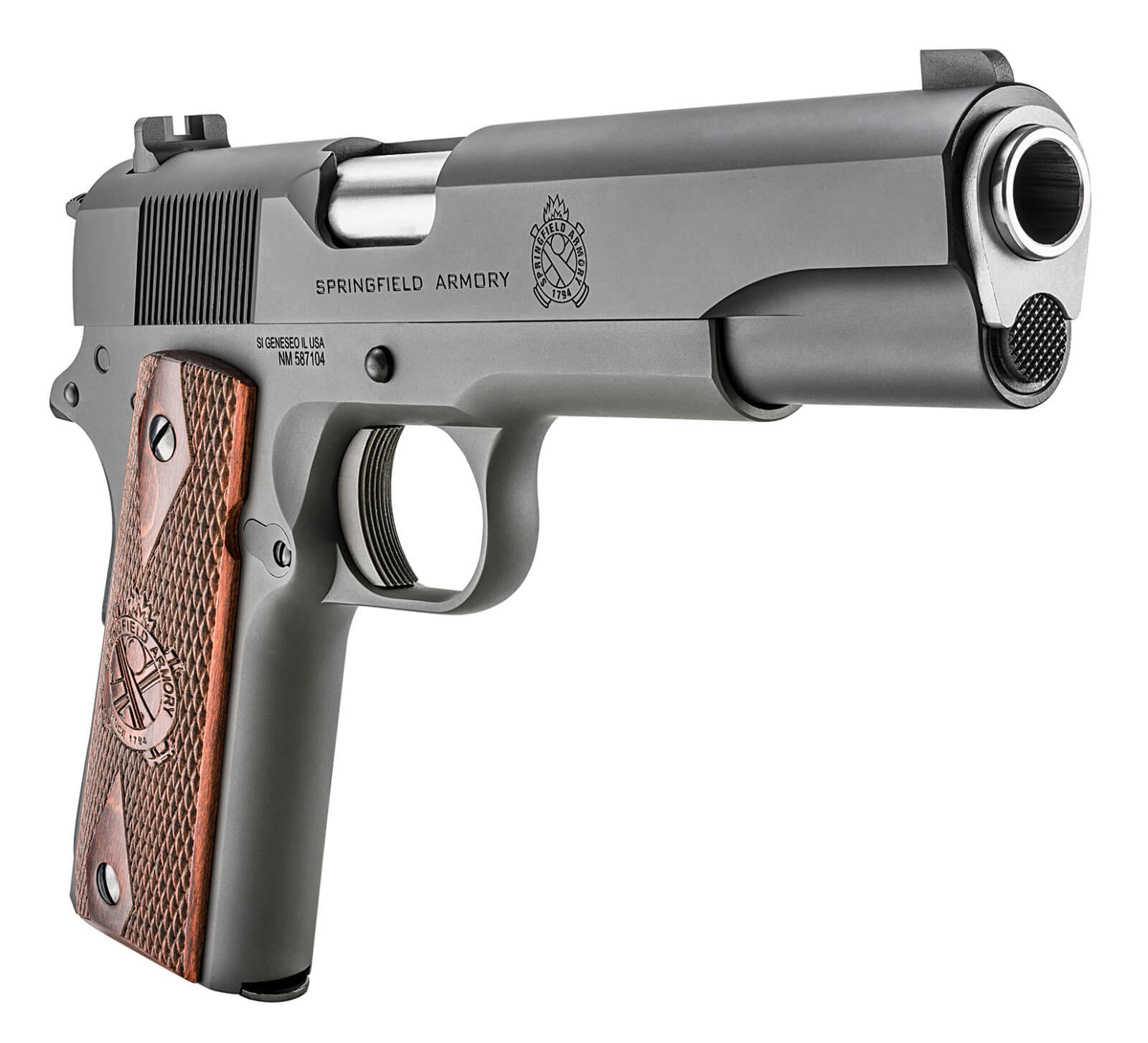
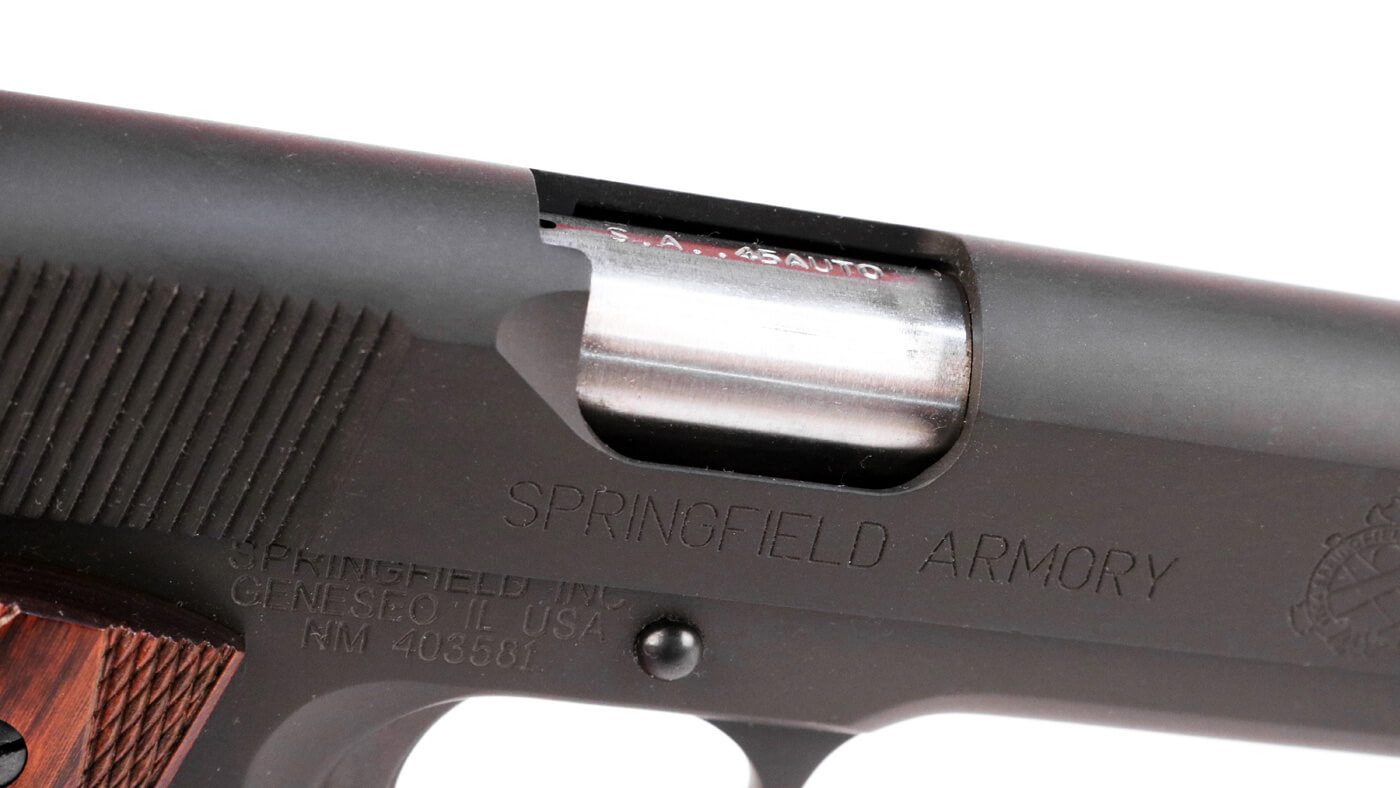
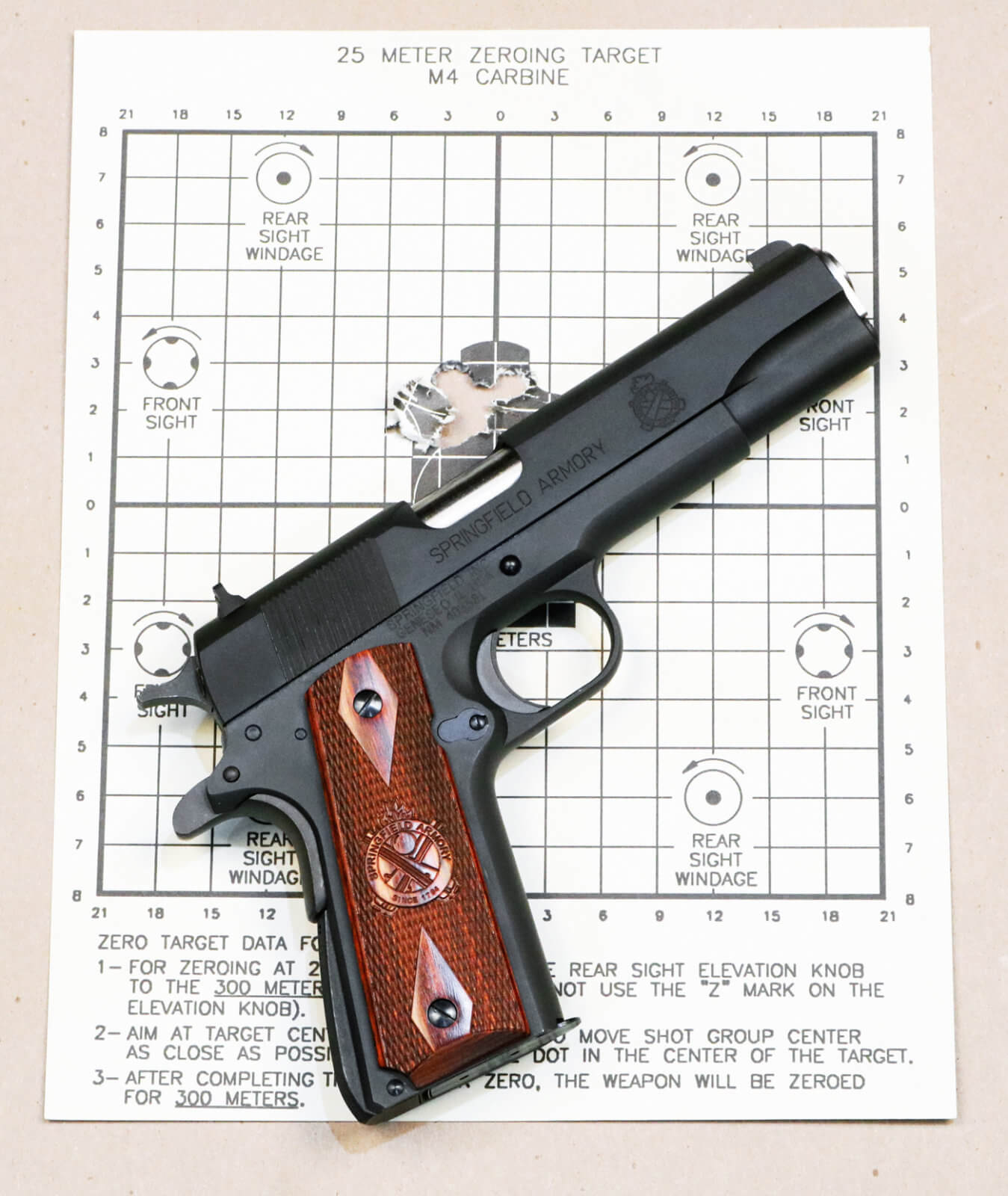
Overall the Springfield Armory 1911 Mil-Spec is typical 1943. The front bit of the frame is smooth, the mainspring housing is arched, and the trigger is small and unremarkable. There are no extraneous grooves on the slide, and the hammer is a classic spur. The gun weighs 39 ounces, just like Browning’s original, and the barrel is a full 5″ long. The gun is finished in a pleasing dull Parkerizing.
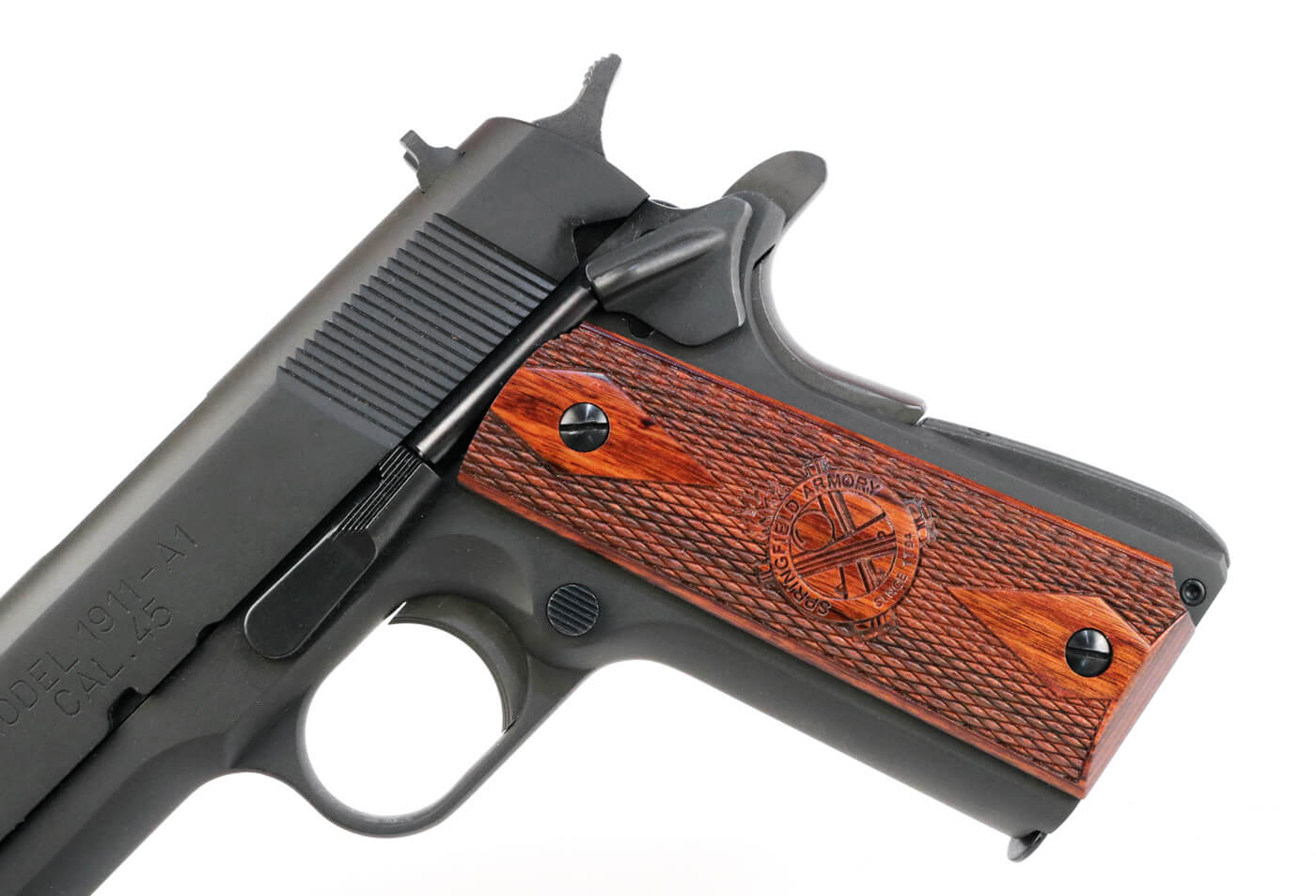
There are indeed a few nods to modern technological evolution. The sights are about the same size as the originals, but they now feature three white dots. The grips are a beautiful walnut with the Springfield Armory crossed cannons logo. The biggest departure, however, is to be found in the ejection port.
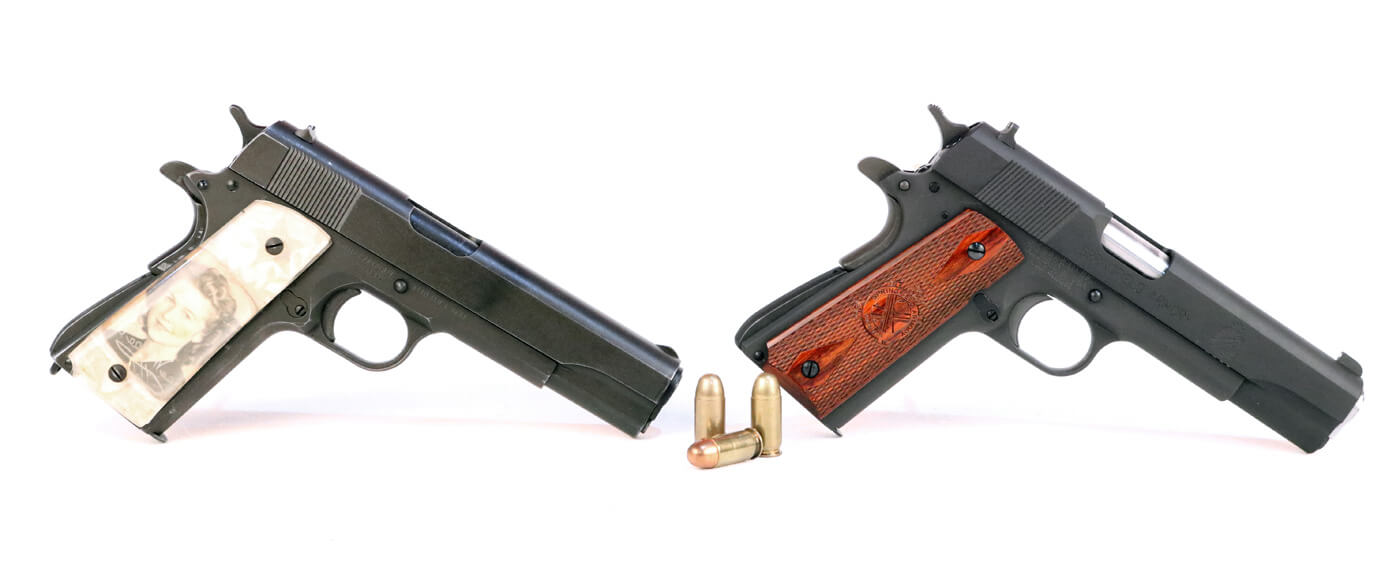
I have an original 1944-production M1911A1 that is a jewel in my personal collection. The gun runs like a sewing machine, but it drops its empties on the top of my head with monotonous regularity. The lowered and flared ejection port of the Springfield Armory 1911 Mil-Spec spits the hot brass out to the side without bouncing the cases off your face. The difference is obvious at a glance, but most normal folks won’t care. This does make the gun perform much better on the range while enhancing reliability.
How Does She Run?
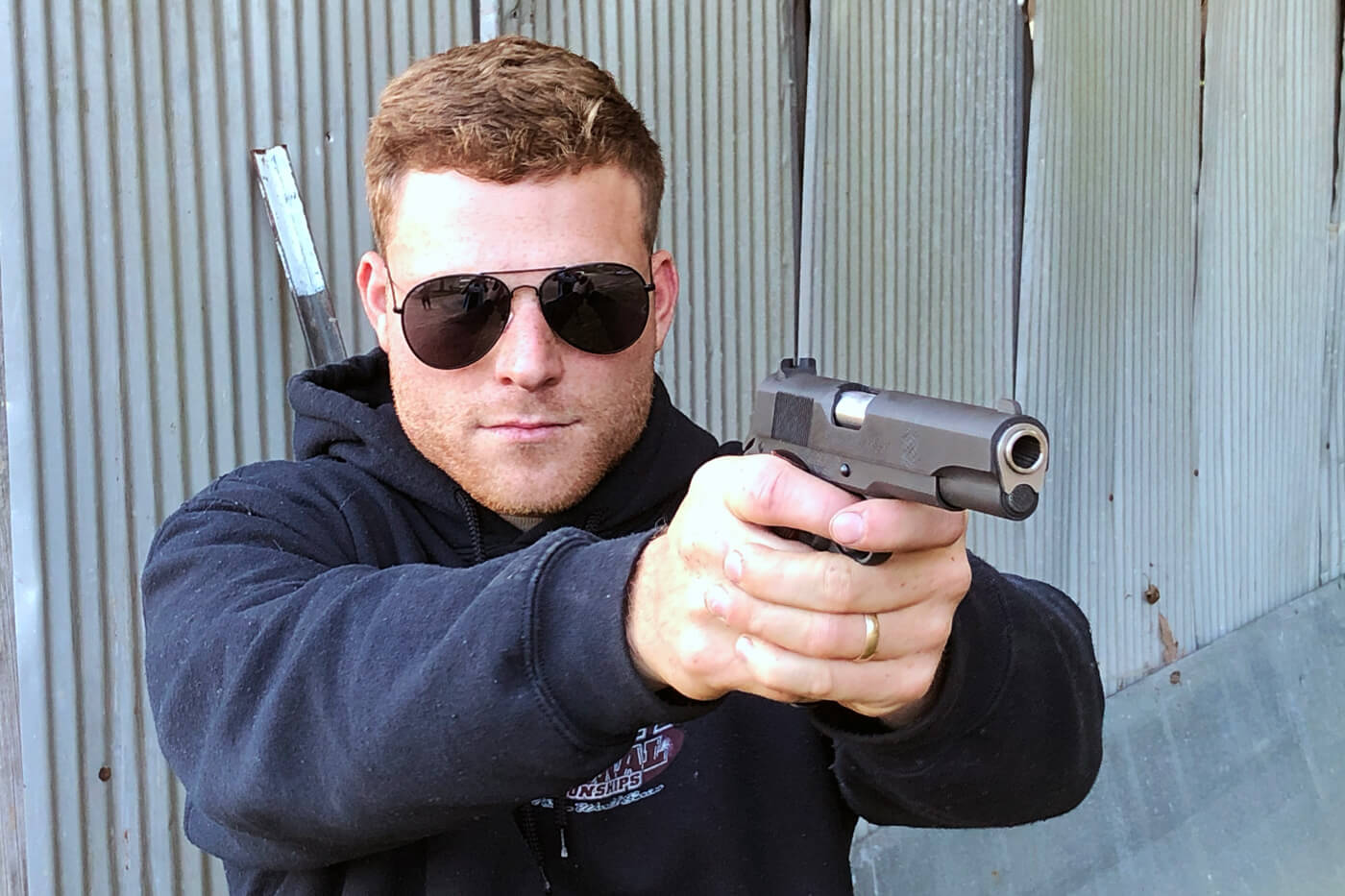
A little trigger time behind the Springfield Armory 1911 Mil-Spec reminds you what all the fuss was about back before the First World War. The single-stack, seven-round magazine keeps the grip comfortable for most American shooters with normal-sized mitts. The slide-to-frame interface slides like greased glass. The trigger is indeed shorter than those on custom guns, yet it nonetheless feels familiar and tight. The three-dot sights are much easier to acquire than the tiny unadorned G.I. versions.
Recoil is manly without being uncomfortable, and the controls fit me like my favorite pair of broken-in boxers. The slide locks back with authority on the last round fired, and empty magazines shoot out of the gun like a liberal fleeing responsibility. Combat reloads will channel your inner Audie Murphy.
Ruminations
John Dillinger carried a gun like this. So did my wife’s grandfather. That young stud fought all the way across North Africa, Sicily, and Italy, slogging through places like Anzio and Monte Cassino to ensure that his children grew up in a world free from the Nazis and their ilk. Countless brave American warriors have wielded John Browning’s martial marvel to crush the forces of oppression and tyranny for three quarters of a century. Armed professionals continue to slay dragons with theirs even today.
Springfield Armory makes reliably awesome guns. Their 1911 Mil-Spec takes an American classic and sprinkles it with just enough modern technology to make a tactical player in the Information Age. The overall effect is retro gold.

Photos courtesy of FN Herstal, Ars Mechanica Foundation
What are the odds of finding an-all original M1 Garand or M1 carbine actually used on the battlefront to liberate Europe? Not as good as you might think. And you have Fabrique Nationale to thank for that. Collectors of World War II U.S. military arms usually know little about FN’s history. And that’s a mistake.
Didn’t think there was a connection between the M1 Garand and carbine and the renowned Belgian gunmaker? M1 Garand and M1 Carbine collectors have seen the evolution of a cottage industry of dealers selling and assembling components for the purpose of recreating factory configurations by matching, pairing, and marrying parts by the markings. But a collectable is only original once. The question should be asked if factory original guns really survived the war.
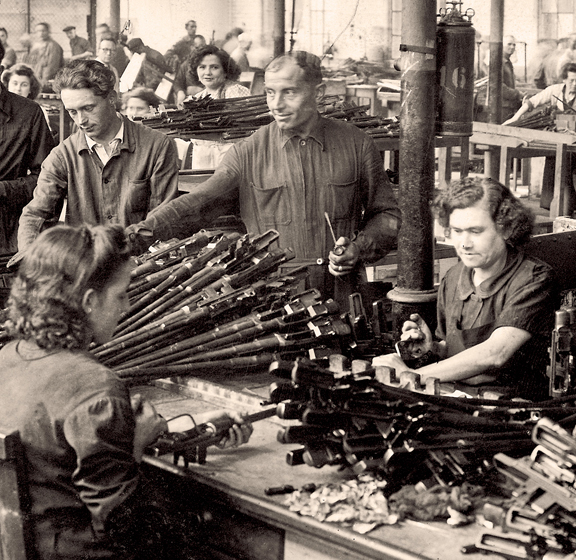
FN workers assemble or disassemble M1 Garand rifles.
One rather inconvenient truth for some of the M1 rifle and carbine parts assemblers of today is that FN was actually contracted by the U.S. government to rebuild all of U.S. small arms utilized in the European theatre at war’s end. And FN did it while leaving only photographic evidence but not a trail for collectors to follow.
The Fabrique Nationale factory at Herstal, near Liege, Belgium, was liberated by Allied troops in September 1944, and despite losses in manpower and equipment—as well as later ”buzz bomb” attacks—FN went back to work. The U.S. Army first contracted with FN during the Battle of the Bulge, and 400,000 mud-grips for Sherman tanks were cast in FN’s foundry. Other orders included manufacturing 5,000 sheet-metal gas cans, which were in short supply and urgently needed.
The U.S. military recognized FN’s capability to rebuild most of its small arms, with the possible exception of the U.S. Model 1911A1 pistols. This may have been a legal restriction as FN and Colt shared worldwide production rights.
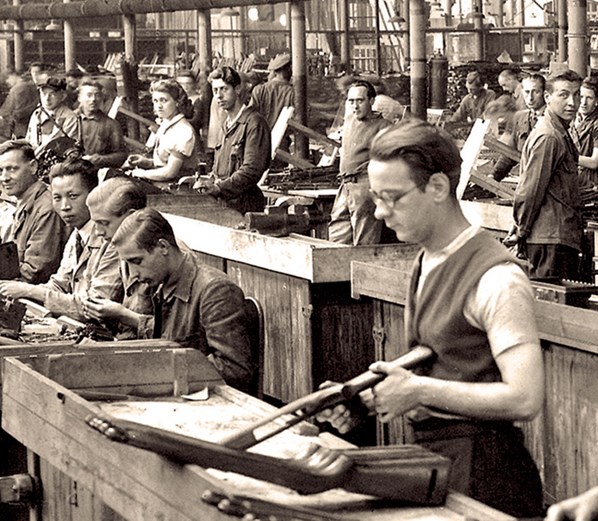
A newly made FN M1 Carbine stock is visually inspected by a worker.
After the fall of Berlin and Japan’s surrender, the U.S. military contracted with FN to repair, refurbish and package all the small arms used in the European theatre. More than 2.1 million American military arms made their way to FN, including M1 Garands, M1 Carbines, Thompson submachine guns, M3 “grease guns,” Browning .30-cal. and .50-cal. machine guns, as well as others.
Fabrique Nationale’s s task was to strip all components, inspect parts, check for wear and re-assemble the arms with new replacement parts (when needed) before packing and crating. The spare parts were supplied by the U.S. military or made at FN. Countless new walnut stocks were made for M1 Garands and carbines—including M1A1 paratrooper stocks.
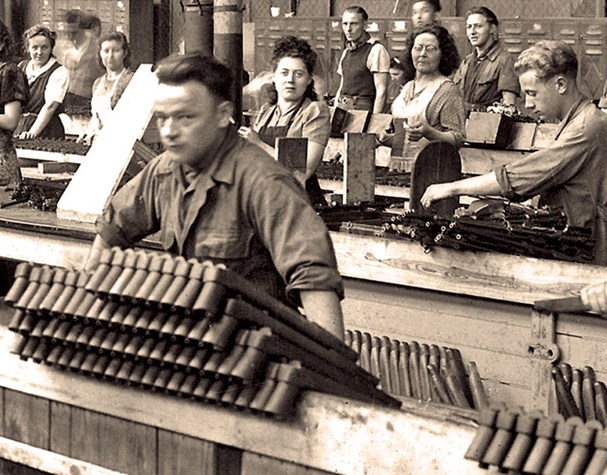
FN-made M1 Carbine paratrooper stocks are ready for assembly.
Guns were not disassembled and reassembled one at the time, instead parts were stripped and piled into large wicker baskets. No attention was paid to parts markings—only to functionality. Fabrique Nationale did not add any known markings, even some markings found on postwar M1 carbine magazines and generally attributed to FN manufacture are questionable at best. It is likely that the U.S. military specified that no markings be applied, as FN historically marked parts for quality control in its own production.
The FN program was called the “redeployment” program and lasted from June 1945 through June 1946. It was a tremendous economic boon for a company struggling to restart production of new goods in the immediate post-war economy. Period photos indicate that most of the work was done by hand, even the shaping of walnut stocks. This is logical as FN would not have invested in mechanization for a single contract, especially in those difficult times when labor was readily available but machinery was expensive to acquire.
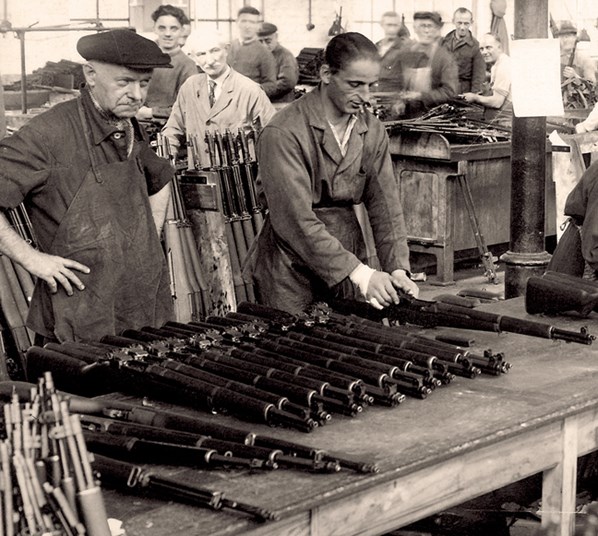
An FN worker checks the actions of newly assembled M1 Garand rifles.
The FN workers and locals were always grateful to the U.S. Army, not only for liberating the entire region but also for creating jobs and restarting the economy. The 1945 contracts were the first of a long standing relationship between FN and the U.S. military. Today FN America supplies small arms to the U.S. military, including the FN-designed M240 and M249 machine guns.
For collectors seeking to buy an all original World War II M1 Garand or Carbine, FN’s redeployment program is something to keep in mind when considering originality. There are, however, many ways of interpreting originality. For some collectors, a piece is collectable if it is period correct, that includes arsenal reworks and even field modifications. Others are more selective, seeking out only factory original guns, those that have never been arsenal refurbished or upgraded.
Categories