I’ve always wanted a Single Action Army revolver in .45 Long Colt, but I’d lose my appetite whenever I looked at the prices of SAA clones online. Now, thanks to Taurus’ new Deputy line of very budget-friendly SAA revolvers, I might just get that itch scratched at last.
Quick Summary: Taurus’ Deputy is a value win for those looking to add a Single Action Army revolver to their collection at a fraction of the cost. It’s reliable, balanced, and the transfer-bar safety even makes it carriable.
The Deputy has classic Old West vibes with some modern safety features. (Photo: Paul Peterson/Guns.com)
This was one of the few guns I was truly excited to grab from my local FFL when it arrived. Despite all the semi-auto pistols and tactical rifles I get to test every year, I’ve always had my eye on a classic Single Action Army. The platform is outdated, but it’s also classy and fun.
Alas, the cost for most full-power SAAs has remained well out of my budget.
I’ve had to satisfy my cravings for cowboy-style, single-action shooting with rimfire options like the extra-budget Rough Rider revolvers in .22 LR from Heritage, itself a subsidiary of Taurus. Yet, plinking calibers don’t quite capture the cool factor and fun that come with a “big iron” Single Action Army in .45 Long Colt.
Here’s the Deputy in .45 LC next to a plinking Heritage Rough Rider in .22 LR. (Photo: Paul Peterson/Guns.com)
The name “Deputy” and the caliber are carved right onto the barrel. (Photo: Paul Peterson/Guns.com)
When I took this Deputy out of the box, I was pleasantly surprised by the well-balanced weight and overall looks. The grips are checkered polymer and easy to replace, but the rest of the gun has a nice, deep satin black finish. The hammer and trigger felt crisp, and the cylinder had a rock-solid lockup.
Sure, I would prefer some of the gorgeous color-case-hardened affairs from the likes of Colt, but not at more than six times the cost. I wanted a gun I could shoot without worry and happily share with others at the range. At a glance, this seemed like it might be exactly that.
Features
Normally, you would only carry an SAA revolver like this with five rounds in the cylinder and the hammer down on an empty chamber, for safety. But Taurus solved that with a transfer-bar safety that lets you safely carry all six. (Photo: Paul Peterson/Guns.com)
Taurus is one of the kings of affordable firearms, but don’t let the company’s low-cost guns fool you. We’ve toured one of Taurus’ new factories in Southwest Georgia, and they have made some big moves to provide quality guns at budget-friendly prices.
The Deputy is a single-action-only clone of the classic Single Action Army with a medium-sized frame and a four-click hammer. That four-click hammer is a nice touch that mirrors the original, but Taurus didn’t make the Deputy as a pure clone. It upgraded it for modern safety considerations.
Pulling the trigger raises the transfer bar up so the hammer can strike the bar and firing pin. (Photo: Paul Peterson/Guns.com)
This is a four-click hammer, which is a nice touch. (Photo: Paul Peterson/Guns.com)
Perhaps the most significant change from the original SAA is the addition of a transfer-bar safety, which moves a metal arm up when the trigger is pulled. This places the bar in just the right spot to transfer the hammer’s energy to the firing pin. The hammer simply can’t reach the firing pin without it.
Normally, Single Action Army revolvers have no such safety, and the hammer can strike the firing pin to discharge a round without a trigger pull. That is why it was common to carry these six-shot revolvers with one empty chamber under the hammer.
Taurus solved this issue with the transfer bar, making it safe to carry the Deputy with all six chambers loaded.
Here’s a clear look at the right side… (Photo: Paul Peterson/Guns.com)
…and the left. (Photo: Paul Peterson/Guns.com)
Here are the very basic, fixed iron sights. They work best, in my experience, if you shoot with a bit more feeling instead of chasing a pure sight picture. (Photo: Paul Peterson/Guns.com)
I opted for a model sporting a 4.75-inch barrel, though we’ve recently had the 5.5-inch version out on the range for testing, too. I’m partial to the shorty. I also picked a model chambered for .45 Long Colt (or just .45 Colt), since it’s a classic caliber that matches the gun’s history.
Those looking to pair the Deputy with a preferred .357 Mag hunting rifle will be happy to know Taurus makes a version for that chambering as well.
The loading gate is easy to use, and the plunger on the top right spits out used shells well. The cylinder can be removed by pulling the cylinder pin on the bottom right forward. (Photo: Paul Peterson/Guns.com)
The trigger is short and crisp, essentially starting at the wall just before the break. The plunger handle is also metal, which is a step up over some other budget options out there. The checkered polymer grip panel works well, but it isn’t terribly sexy. You can pick up aftermarket replacements easily enough. (Photo: Paul Peterson/Guns.com)
Loading is done through the loading gate on the right side. There’s a spring-loaded plunger under the barrel for manually ejecting spent shells. The process is slick and enjoyable, but it is not fast.
The plowshare grips are polymer. The checking is nice and positive in my hand, but the polymer grips are my biggest complaint overall. They just lack that… class. You can replace these with Cocobolo wood or any number of options as desired. Several grip makers offer aftermarket options for the Deputy.
The finish is deep satin black, and it is shiny enough to check your teeth. It survived my testing without any notable wear.
Specifications
The cylinder pops out for cleaning. The small piece on top of the cylinder is the cylinder spacer. This is all you really need to remove for cleaning and general maintenance. (Photo: Paul Peterson/Guns.com)
Here’s a quick breakdown of the basic specs for the Taurus Deputy with a 4.75-inch barrel.
Weight: 2.27 pounds Frame Size: Medium Length: 10.25 inches Barrel Length: 4.75 inches Sight Radius: 5.62 inches Height: 5.11 inches Width (Cylinder): 1.65 inches Caliber: .45 Long Colt/.45 Colt (also available in .357 Mag) Capacity: 6 rounds Safety: Transfer bar Grooves: 6 Twist Rate: 1:16.5 RH Finish: Polished, satin black Frame Material: Steel Cylinder Material: Alloy steel Barrel Material: Alloy steel Trigger Pull: 5.29 pounds
Reliability & Accuracy
Loading and unloading are done via the loading gate. (Photo: Paul Peterson/Guns.com)
I can’t say that I shot this gun remarkably well right out of the gate. Single-action-only revolvers take some practice. There’s almost more of a feeling to shooting it well than a sense of aiming.
The plowshare grip shape locks the gun into your hand while still allowing it to rock back with the recoil. It’s also well designed for quickly shifting the gun in your hand when cocking the hammer for your next shot.
The plowshare grip shape locks the gun into your hand while still allowing it to rock with recoil and tilt back for cocking. (Photo: Paul Peterson/Guns.com)
Even in .45 Long Colt, the recoil on this Deputy is quite controllable. In fact, I’d call it enjoyable. There is something about ripping off shots of .45 Long Colt with an Old West shooter like this. The recoil is part of the joy.
As for accuracy, the sights are basic, but the gun can handle itself at moderate ranges even in my relatively inexperienced hands.
Here’s what I got at 7 yards with my first shots after picking up the gun.
Here are my first three targets, all shot at 7 yards. I don’t have a lot of trigger time on SAA revolvers, and it shows a bit here. Still, the groups are more than adequate for self-defense needs. (Photo: Paul Peterson/Guns.com)
After some practice, here’s what I got for my slow and rapid-fire shooting at the same distance.
The target on the left was my slow-fire shooting at 7 yards on my second range trip. The target on the right shows what I was able to do when shooting as fast as I could cock, point, aim, and pull the trigger. (Photo: Paul Peterson/Guns.com)
My test ammo all proved to be reliable in this gun, with no hang-ups on the range. That included 150 rounds of round-nose 250-grain Remington Express, 150 rounds of 250-grain flat-nosed HSM Cowboy Action, and 60 rounds of round-nosed 255-grain Winchester Super X. (Photo: Paul Peterson/Guns.com)
Reliability proved to be 100 percent solid for my 360 rounds of various types of ammo. The gun remains nice and tight.
There is something very relaxing about loading and unloading an SAA revolver on the range. Most of my range trips feel pressed for time, and I tend to plow through several semi-auto guns with preloaded magazines just to get my work done.
The single-action Deputy really slowed me down, and it made my range trips all the more enjoyable for it.
Pros & Cons
Here’s my short list of the pros and cons for the 4.75-inch Taurus Deputy:
Pros:
Very reliable
Great looks and feel for the money
Well-made
Accurate, if you do your part
Four-click hammer
Transfer-bar safety makes it safe to carry
Can safely carry six (instead of five) rounds
Classic, historic design
Loads of fun on the range
Affordably priced
Cons:
SAA revolvers take practice
Very simple iron sights
Polymer grips, which are replaceable
Final Thoughts
I have always wanted one of these Single Action Army revolvers for my collection. Mostly, I wanted a shooter that was also affordable and rugged, and the Deputy checks those boxes. (Photo: Paul Peterson/Guns.com)
It’s hard to grow up in America without letting the lore of the Old West and cowboys color your childhood on some level. This Deputy has me feeling a bit nostalgic. If only the younger version of me could have had some time with this revolver.
At a price that is below even other budget makers of Single Action Army revolvers, the Taurus Deputy offers quality, reliability, accuracy, and good looks. The addition of a transfer-bar safety makes this a tool you could carry into the hunting fields for self-defense as well.
All in all, the Deputy is a value win that will scratch the cowboy itch for budget-minded buyers.
On August 7, 1942, Pfc. Robert “Lucky” Leckie and the 1st Marine Division stormed ashore at Guadalcanal only to find that the Japanese had abandoned the beaches and holed up inland. But their relief was to be short-lived. Within days, Leckie—a machine gunner and later an intelligence scout—and the rest of the 1st Marines would get their first bitter taste of battle and death.
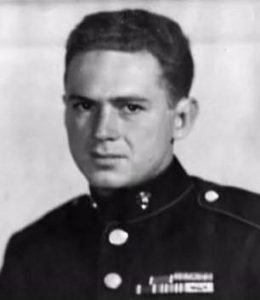
Robert Leckie (USMC)
Leckie’s recollection of that battle is part of his 1957 memoir, Helmet for My Pillow, which is excerpted here. The book, along with E. B. Sledge’s With the Old Breed and the story of Medal of Honor recipient Sgt. John Basilone, are the basis for the HBO miniseries, The Pacific.
In his narrative, Leckie replaced the names of his fellow marines with their nicknames. We have identified as many as we could.
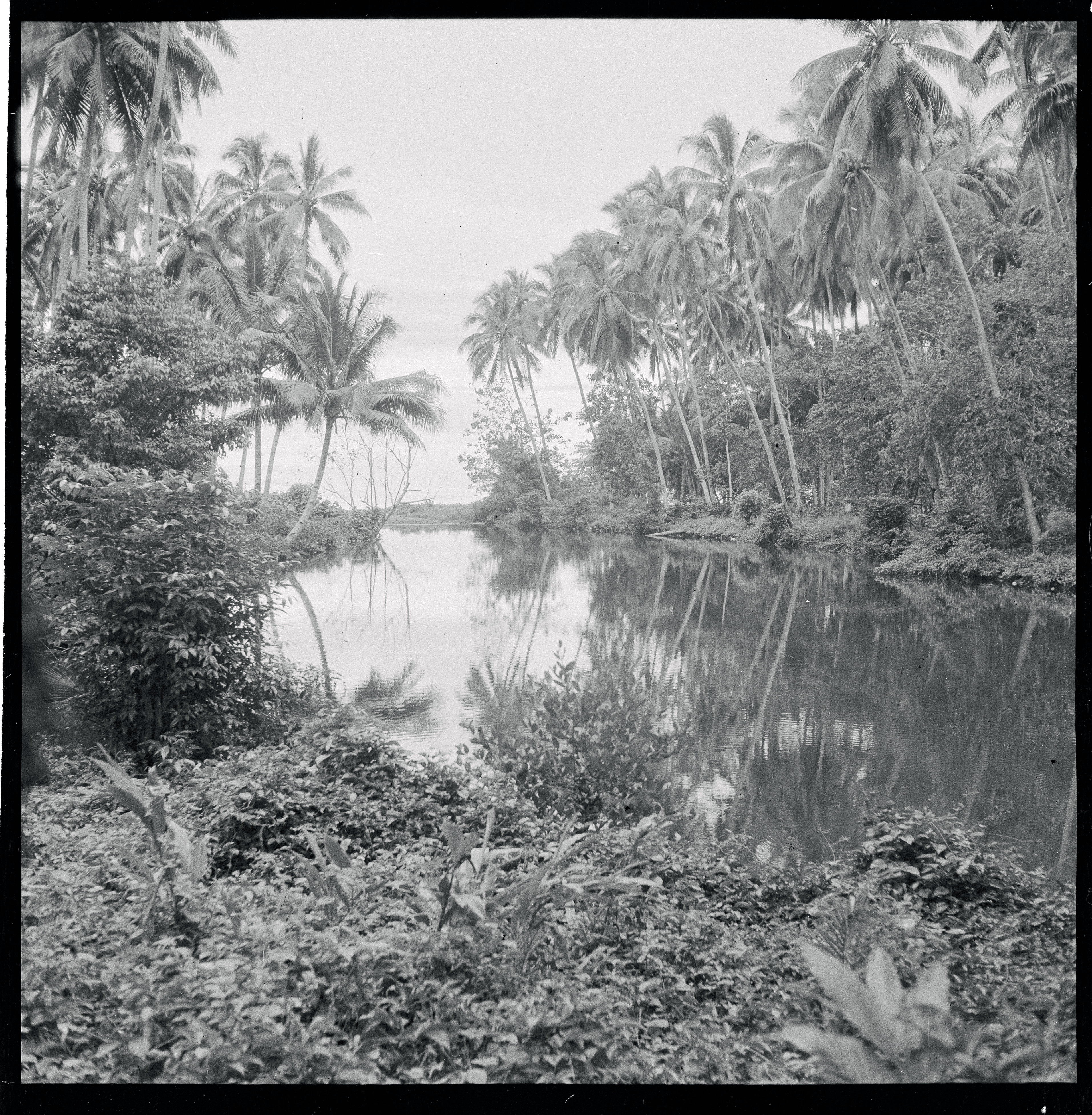
The Tenaru River lay green and evil, like a serpent, across the palmy coastal plain. It was called a river, but it was not a river; like most of the streams of Oceania, it was a creek—not 30 yards wide. even a creek, for it did not always
Perhaps it was not flow and it seldom reached its destination, the sea. Where it might have emptied into Iron Bottom Bay, a spit of sand, some 40 feet wide, penned it up. The width of the sand spit varied with the tides, and sometimes the tide or the wind might cause the Tenaru to rise, when, slipping over the spit, it would fall into the bosom of the sea, its mother.
Normally, the Tenaru stood stagnant, its surface crested with scum and fungus; evil, I said, and green. If there are river gods, the Tenaru was inhabited by a baleful spirit.
Our section—two squads, one with “the Gentleman” as gunner, the other with Lou “Chuckler” Juergens as gunner and me as assistant—took up position approximately 300 yards upstream from the sand spit.
As we dug, we had it partially in view; that is, what would be called the enemy side of the sand spit. For the Tenaru marked our lines. On our side, the west bank, was the extremity of the marine position; on the other, a no man’s land of coconuts through which an attack against us would have to pass.
The Japanese would have to force the river to our front; or come over the narrow sand spit to our left, which was well defended by riflemen and a number of machine gun posts and barbed wire; or else try our right flank, which extended only about a hundred yards south of us, before curving back north to the Tenaru’s narrowest point, spanned by a wooden bridge.
The emplacement for the Gentleman’s gun was excellently located to rake the coconut grove opposite. We dug it first, leaving Chuckler’s and my gun standing some 20 yards downstream, above the ground, protected by a single strand of barbed wire strung midway down the steeply sloping riverbank. We would emplace it next day.
We dug the Gentleman’s gun pit wide and deep—some 10 feet square and 5 feet down—for we wanted the gunner to be able to stand while firing, and we wanted the pit to serve as a bomb shelter as well, for the bombs were falling fiercer.
But furiously as we worked, naked to the waist, sweat streaming so steadily our belts were turned sodden, we were unable to finish the pit on the first day. When night fell, only the excavation was done, plus a dirt shelf where the gun was placed. We would have to wait for the next day to roof it over with coconut logs.
We felt exposed in our half-finished fortifications, unsure. The dark made sinister humpbacks of the piles of soft red earth we had excavated, and on which we sat.
But because we did not know real battle— its squallish trick of suddenness—we could not feel foreboding as we sat atop the soft mounds, concealing the telltale coals of our bitter Japanese cigarettes in cupped hands, softly smoking, softly talking. We were uneasy only in that shiftiness that came each night and disappeared each dawn.
No one went to bed. The stars were out, and this was enough to keep everyone up, unwilling to waste a bright night.
Suddenly in the river, upstream to our right, there appeared a widening, rippling V. It seemed to be moving steadily downstream. At the point of the V were two greenish lights, small, round, close together.
“Jawgia” whooped and fired his rifle at it.
To our right came a fusillade of shots. It was from G Company riflemen, shooting also at the V. More bullets hit the water. The V disappeared.
The stars vanished. The night darkened. Like our voices, the men began to trail off to bed, wrapping themselves in their ponchos and lying on the ground a few yards behind the pit. Only the Chuckler and I were left to stand watch.
Lights—swinging, bumping lights, like lanterns or headlights—glittered across the river in the grove. It was fantastic, a truck there, as though we might awake next morning and find a railroad station confronting us across that stagnant stream. The coconut grove was no man’s land. The enemy had a right to be there, but, by all the experience of jungle warfare, he was inviting death to mark himself with lights, to let his truck wheels shout, “Here we are!”
“Who goes there?” the Chuckler bellowed.
The lights bumped and swung serenely on.
“Who goes there? Answer, or I’ll let you have it!”
The lights went out.
This was too much. Everyone was awake. The mysterious V in the river and now these ghostly lights—it was too much! We jabbered excitedly, and once again warmed our souls in the heat of our voices.
Shattering machine gun fire broke out far to the left. As far down as the sand spit, perhaps. There came another burst. Again. Another. The sharply individual report of the rifle punctuated the uproar. There followed the “plop” of heavy mortars being launched behind us, then the crunching roar of their detonation across the Tenaru. The conflagration was sweeping toward us up the river, like a train of powder.
It was upon us in an instant, and then we were firing. We were so disorganized we had not the sense to disperse, clustering around that open pit as though we were born of it.
Falsetto screeching rose directly opposite us and we were blasting away at it, sure that human intruders had provoked the cry of the birds. I helped the Gentleman fire his gun, although I was not his assistant. He concentrated on the riverbank, firing burst after burst there, convinced that the Japs were preparing to swim the river. The screeching stopped.
The Gentleman spoke softly. “Tell those clucks to quit firing. Tell them to wait until they hear the birds making a clatter, ’cause a smart man’d try to move under cover of it. That’s when they’ll be moving.”
I was glad he gave me this little order to execute. I was having no fun standing in the pit, watching the Gentleman fire. I crawled out and told everyone what he had said. They ignored it and kept banging away. There came a lull, and in that silent space, I, who had had no chance to fire my own weapon, blasted away with my pistol. I leaned over the mound and shoved my pistol-clenching hand into the dark and emptied the clip. There came a roar of anger from Bill Smith, “the Hoosier.”
I laughed at him, and the Chuckler crawled back from the bank and whispered, “C’mon, let’s get our gun.”
We snaked up the bank on our bellies, for the night was alive with the angry hum of bullets. The Chuckler took the gunner’s spot and I crouched alongside in the position to keep the gun fed. We had plenty of ammunition, the long 250-round belts coiled wickedly in the light green boxes, those same sturdy boxes you now see slung on the shoulders of shoeshine boys.
The Chuckler fired and the gun slumped forward out of his hands, digging its snout into the dirt, knocking off the flash hider with a disturbing clatter, spraying our own area with bullets.
“That yellow-belly!” the Chuckler cursed.
He cursed a certain corporal who was not then distinguishing himself for bravery, and who had set up the gun and done it so sloppily that the tripod had collapsed at the first recoil.
I crawled down the slope and straightened it. I leaned hard on the clamps.
“She’s tight,” I told the Chuckler.
His answer was a searing burst that streaked past my nose.
A man says of the eruption of battle: “All hell broke loose.” The first time he says it, it is true—wonderfully descriptive. The millionth time it is said, it has been worn into meaninglessness: It has gone the way of all good phrasing; it has become cliché.
But within five minutes of that first machine gun burst, of the appearance of that first enemy flare that suffused the battlefield in unearthly greenish light—accentuating the reenveloping night as it died—within five minutes of this, all hell broke loose.
Everyone was firing, every weapon was sounding voice; but this was no orchestration, no terribly beautiful symphony of death, as decadent rear-echelon observers write. Here was cacophony; here was dissonance; here was wildness; here was the absence of rhythm, the loss of limit; for everyone fires what, when, and where he chooses; here was booming, sounding, shrieking, wailing, hissing, crashing, shaking, gibbering noise. Here was hell.
Yet each weapon has its own sound, and it is odd with what clarity the trained ear distinguishes each one and catalogs it, plucks it out of the general din, even though it be intermingled or coincidental with the voice of a dozen others, even though one’s own machine gun spits and coughs and dances and shakes in choleric fury.
The plop of the outgoing mortar with the crunch of its fall; the clatter of the machine guns and the lighter, faster rasp of the Browning automatic rifles; the hammering of .50-caliber machine guns; the crash of 75mm howitzer shells; the crackling of rifle fire; the wham of 37mm antitank guns firing point-blank canister at the charging enemy—each of these conveys a definite message, and sometimes meaning, to the understanding ear, even though that ear be filled with the total wail of battle.
So it was that our ears prickled at strange new sounds: the lighter, shingle-snapping crack of the Japanese rifle; the gargle of their extremely fast machine guns; the hiccup of their light mortars.
To our left, a stream of red tracers arched over to the enemy bank. Distance and the cacophony being raised around us seemed to invest them with silence, as though they were bullets fired in a deaf man’s world.
“It’s the Indian’s gun,” I whispered, referring to the gun of Johnny Rivers.
“Yeah. But those tracers are bad stuff. I’m glad we took ’em out of our belts. He keeps up that tracer stuff, and they’ll spot him, sure.”
They did.
They set up heavy machine guns in an abandoned amtrac on their side of the river and they killed the Indian.
Their slugs slammed through the sandbags. They ate their way up the water jacket of his gun and they ate their way into his heart. They killed him, killed the Indian kid, the flat-faced, anonymous prizefighter from Pittsburgh. He froze on the trigger with their lead in his heart; he was dead, but he had killed more of them. He wasn’t anonymous then; he wasn’t a prelim boy then.
They wounded his assistant. They blinded him. But he fought on. The marines gave him the Navy Cross and Hollywood made a picture about him and the Tenaru Battle. I guess America wanted a hero fast, a live one; and the Indian was dead.
The other guy was a hero, make no mistake about it; but some of us felt sad that the poor Indian got nothing.
It was the first organized Japanese attack on Guadalcanal, the American fighting man’s first challenge to the Japanese “superman.” The “supermen” put bullets into the breast of the Indian, but he fired 200 more rounds at them.
How could the marines forget the Indian?
Now we had tracer trouble of a different kind. We had begun to take turns firing, and I was on the gun. The tracers came toward me, alongside me. Out of the river dark they came. You do not see them coming. They are not there; then, there they are, dancing around you on tiptoe; sparkles gay with the mirth of hell.
They came toward me, and time stretched out. There were but a few bursts, I am sure, but time was frozen while I leaned away from them.
“Chuckler,” I whispered. “We’d better move. It looks like they’ve got the range. Maybe we ought to keep moving. They won’t be able to get the range that way. And maybe they’ll think we’ve got more guns than we really have.”
Chuckler nodded. He unclamped the gun and I slipped it free of its socket in the tripod. Chuckler lay back and pulled the tripod over him. I lay back and supported the gun on my chest.
We moved backward, like backstroke swimmers, almost as we had moved when we stole the case of beer out of the North Carolina shanty, trying, meanwhile, to avoid making noise that might occur during one of those odd and suspenseful times of silence that befalls battles—noise that might attract fire from the opposite bank—if anyone was there.
For, you see, we never knew if there really was anyone there. We heard noises; we fired at them. We felt shells explode on our side and heard enemy bullets, but we could not be sure of their point of origin.
But now there was no enemy fire while we squirmed to our new position. We set up the gun once more and resumed firing, tripping our bursts at sounds of activity as before. We remained here 15 minutes, then sought a new position. Thus we passed the remainder of the battle; moving and firing, moving and firing.
Dawn seemed to burst from a mortar tube. The two coincided; the rising bombardment of our mortars and the arrival of light. We could see now that the coconut grove directly opposite us had no life in it. There were bodies, but no living enemy.
But to the left, toward the ocean and across the Tenaru, the remnant of this defeated Japanese attacking force was being annihilated.
We could see them, running. Our mortars had got behind them. We were walking our fire in; that is, dropping shells to the enemy’s rear, then lobbing the projectiles steadily closer to our own lines, so that the unfortunate foe was forced to abandon cover after cover, drawn inexorably toward our front, where he was at last flushed and destroyed.
We could see them flitting from tree to tree. The Gentleman’s gun was in excellent position to enfilade. He did. He fired long bursts at them. Some of us fired our rifles. But we were out of the fight now; way off on the extreme right flank. We could add nothing to a situation so obviously under control.
“Hold your fire!” someone from G Company shouted at the Gentleman. “First Battalion coming through.”
Infantry had crossed the Tenaru at the bridge to our right and were fanning out in the coconut grove. They would sweep toward the ocean.
Light tanks were crossing the sand spit far to the left, leading a counterattack. The Japanese were being nailed into a coffin.
Everyone had forgotten the fight and was watching the carnage, when shouting swept up the line. A group of Japanese dashed along the opposite river edge, racing in our direction. Their appearance so surprised everyone that there were no shots.
We dived for our holes and gun positions. I jumped to the gun, which the Chuckler and I had left standing on the bank. I unclamped the gun and fired, spraying my shots as though I were handling a hose.
All but one fell. The first fell as though his underpart had been cut from him by a scythe, and the others fell tumbling, screaming.
Once again our gun collapsed and I grabbed a rifle—I remember it had no sling—which had been left near the gun. The Jap who had survived was deep into the coconuts by the time I found him in the rifle sights. There was his back, bobbing large, and he seemed to be throwing his pack away. Then I fired and he wasn’t there anymore.
Perhaps it was not I who shot him, for everyone had found his senses and his weapon by then. But I boasted that I had. Perhaps, too, it was a merciful bullet that pounded him between the shoulder blades; for he was fleeing to a certain and horrible end: black nights, hunger, and slow dissolution in the rain forest. But I had not thought of mercy then.
Modern war went forward in the jungle.
Men of the 1st Battalion were cleaning up. Sometimes they drove a Japanese toward us. He would cower on the riverbank, hiding; unaware that opposite him were we, already the victors, numerous, heavily armed, lusting for more blood. We killed a few more this way. The Fever was on us.
Down on the sand spit the last nail was being driven into the coffin. Some of the Japanese threw themselves into the channel and swam away from that grove of horror. They were like lemmings. They could not come back. Their heads bobbed like corks on the horizon. The marines killed them from the prone position; the marines lay on their bellies in the sand and shot them through the head.
The battle was over.
Beneath a bright moon that night, the V reappeared in the river. The green lights gleamed malevolently. Someone shot at it. Rifle fire crackled along the line. The V vanished. We waited, tense. No one came.
Lt. Hugh “Ivy-League” Corrigan strode up to our pits in the morning. He sat on a coconut log and told us what had happened. He smoked desperately and stared into the river as he talked. The skin around his eyes was drawn tight with strain and with shock. His eyes had already taken on that aspect peculiar to Guadalcanal, that constant stare of pupils that seemed darker, larger, rounder, more absolute. It was particularly noticeable in the brown-eyed men. Their eyes seemed to get auburn, like the color of an Irish setter.
“They tried to come over the sand spit,” the lieutenant said. “There must have been a thousand of them. We had only that one strand of wire and the guns. You should see them stacked up in front of Bitenail’s gun. Must be three deep. They were crazy. They didn’t even fire their rifles.” He looked at us. “We heard firing up here. What happened?”
We told him. He nodded, but he was not listening; he was still intent on that yelling horde sweeping over the sand spit. When he spoke again it was to tell us who had been killed. There were more than a dozen from H Company, besides more than a score of wounded. Four or five of the dead were from our platoon. Two of them had been hacked to death. A Japanese scouting party had found them asleep in their hole on the riverbank and sliced them into pieces.
It is not always or immediately saddening to hear “who got it.” Except for one’s close buddies, it is difficult to feel deep, racking grief for the dead, and now, hearing the lieutenant tolling off the names, I had to force my face into a mask of mourning, deliberately adorn my heart with black, as it were, for I was shocked to gaze inward and see no sorrow there. Rather than permit myself to know myself a monster (as I seemed then) I deliberately deluded myself by feigning bereavement. So did we all.
Only when I heard the name of the doctor who I remembered joking about the wormy rice did a real pang pierce my heart.
Lieutenant Ivy-League arose, still staring into the river, and said, “I’ve got to get going. I’ve got to write those letters.” He turned and left.
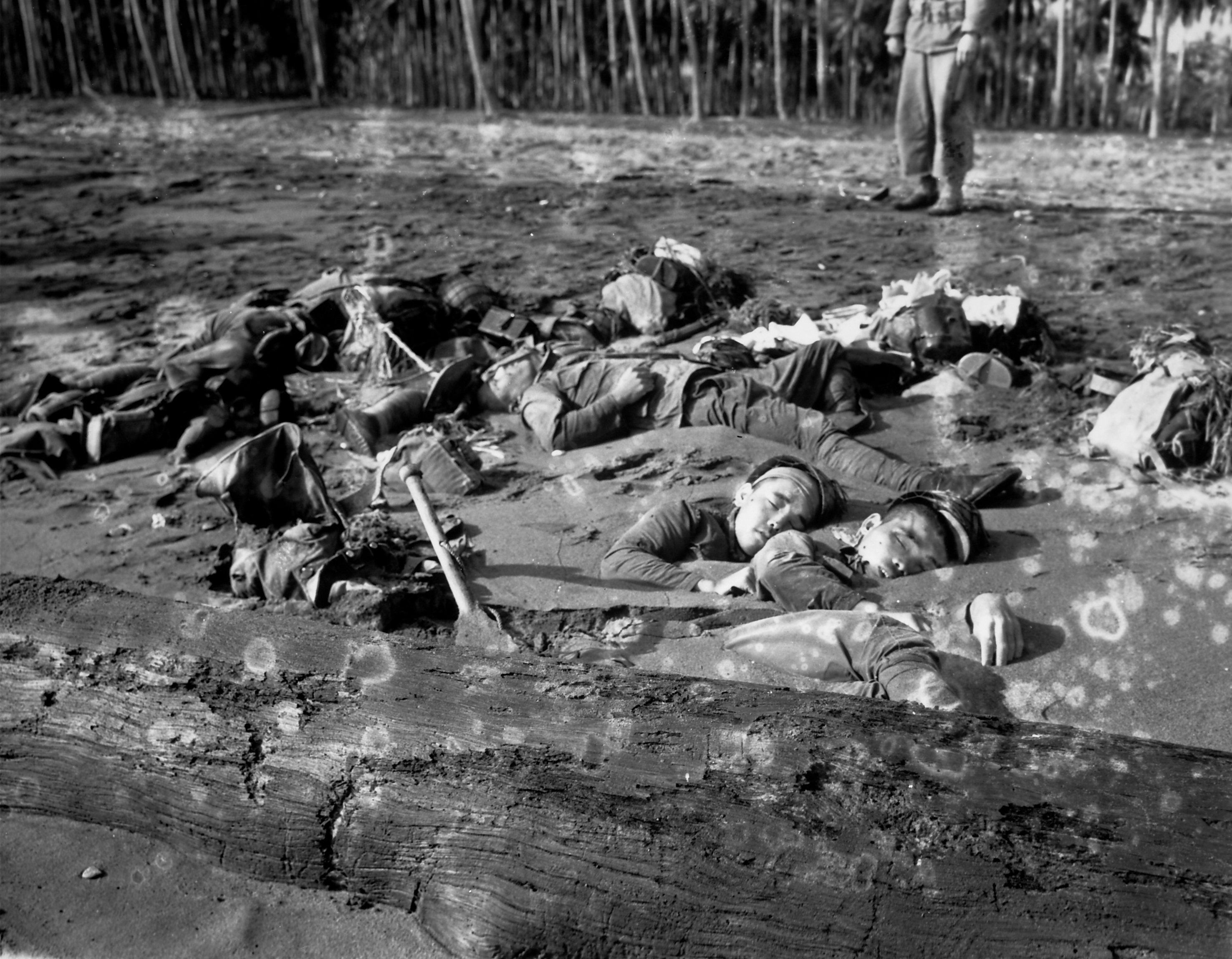
We got the second gun emplaced that morning. Then, the Hoosier and I sneaked off to the beach. Our regiment had killed something like 900 of them. Most of them lay in clusters or heaps before the gun pits commanding the sand spit, as though they had not died singly but in groups. Moving among them were the souvenir hunters, picking their way delicately as though fearful of booby traps, while stripping the bodies of their possessions.
Only the trappings of war change. Only these distinguish the marine souvenir hunter, bending over the fallen Jap, from Hector denuding slain Patroclus of the borrowed armor of Achilles.
One of the marines went methodically among the dead armed with a pair of pliers. He had observed that the Japanese have a penchant for gold fillings in their teeth, often for solid gold teeth. He was looting their very mouths. He would kick their jaws agape, peer into the mouth with all the solicitude of a Park Avenue dentist—careful, always careful not to contaminate himself by touch—and yank out all that glittered. He kept the gold teeth in an empty Bull Durham tobacco sack, which he wore around his neck in the manner of an amulet. “Souvenirs,” we called him.
The thought of him and of the other trophy-takers suggested to me, as I returned from the pits, that across the river lay an unworked mine of souvenirs to which I might rightfully stake a claim. When I had shot the Japanese fleeing down the riverbank, something silver had flashed when the first one fell. I imagined it to be the sun’s reflection off an officer’s insignia. If he had been an officer, he must have been armed with a saber. This most precious prize of all the war I was determined to get.
I slipped through the barbed wire and clambered down the bank. I left my clothes at the water’s edge, like a schoolboy on a summer’s day, and slipped into the water. I had a bayonet between my teeth; still the schoolboy, fancying myself a bristling pirate…. I paddled carefully around the body of a big Japanese soldier, lying in the water with one foot caught in the underbrush. He swayed gently, like a beached rowboat. He seemed unusually bloated, until I perceived that his blouse was stuffed with cooked rice and that his pants were likewise loaded to the knees, where he had tied leather thongs to keep the rice from falling out. “Chowhound,” I thought, and felt an odd affection for him. Dead bodies were strewn about the grove. The tropics had got at them already, and they were beginning to spill open. I was horrified at the swarms of flies; black, circling funnels that seemed to emerge from every orifice: from the mouth, the eyes, the ears…. All of my elation at the victory, all of my fanciful cockiness fled before the horror of what my eyes beheld. It could be my corrupting body the white maggots were moving over; perhaps one day it might be.
Holding myself stiffly, as though fending off panic with a straight arm, I returned to the riverbank and slipped into the water. But not before I had stripped one of my victims of his bayonet and field glasses, both of which I slung across my chest, crisscross like a grenadier. I had found no saber. None of the dead men was an officer.
I swam back, eager to be away from that horrid grove. My comrades, who had covered my excursion with our guns, mistook my grimace of loathing for a grin of triumph, when, streaked with slime, I emerged from the Tenaru. They crowded around to examine my loot. Then I went to chow.