I wrote this article while sitting in a hotel room in Madrid contemplating how I got here. I was visiting the Spanish and Portuguese militaries as part of my experience in the Army’s Schools of Other Nations (SON) Program. I have spent the last nine months studying at the Colombian Superior School of War, and I sometimes pinch myself to make sure I am not dreaming.
In 2007, if you told 2LT Player, a “CHEMO” for 3-7 Field Artillery, what the next decade would look like, he would have told you to stop teasing him because he had to finish the USR.
I am confident about what he would have said, because I am him, just ten years later. However, in the next ten years, I served in multiple leadership positions at the platoon and company level. I also served in a joint special operations unit, taught ROTC, and was selected to attend a foreign service’s ILE.
I arrived at my first assignment at Schofield Barracks with doom and gloom ringing in my ears. During my Basic Officer Leader Course, my small group leader told me that as a 74A headed to the 25thInfantry Division, I most likely would not have a chance to lead and it would be a constant struggle to be viewed as a serious professional.
Fortunately, the battalion operations officer changed my outlook during our initial counseling session. He listened intently as I told him my concerns of being “stuck on staff” and my desire to lead a platoon. He said: “There is no such thing as a bad branch, only bad officers.”
He went on to say that if I wanted to lead Soldiers, I needed to demonstrate my leadership potential by performing well. He had a good point. In the Army, we do not always have control over duty assignments, but we have complete control over our performance. I committed myself to earning the right to lead Soldiers and developing the skills and attributes required for success.
As a result, I discovered what I consider the “Eight Essential Characteristics of Officership.” LEAD
Leadership is more than knowing where you are, where you want to go, and how you are going to get there. Leading includes inspiring others to take the journey with you.
All officers are leaders, regardless of duty position. You must be ready to make decisions, move the mission forward, and lead by example.
Great leaders never ask a subordinate to make a sacrifice that he or she is not willing to make. If we hold ourselves to the same standard that we hold our Soldiers, they will strive to meet or exceed that standard. LISTEN
Keep an open mind and seek advice. Every team has experienced members that are an extremely valuable resource.
These team members can provide historical examples of past issues and help guide your decisions. But first, you must be approachable and willing to listen. SUPPORT YOUR COMMANDER
An officer who understands mission command and commander’s intent is worth 10 officers who don’t. When you are given a legal and lawful order, execute and stay within your limits.
When a commander decides on a course of action, it is not your place to second guess. We advise and make recommendations, commanders make decisions and assume the risks. LEARN AND IMPROVE
Superior leaders are acutely aware of their strengths and weaknesses. They actively build on their strengths and improve upon their weaknesses.
Complacency is a fatal leadership flaw and we should never find comfort in remaining stagnant. This goes for every aspect of the profession of arms. Make realistic and achievable goals and then work to achieve them. REQUIRE MINIMUM SUPERVISION
Officers who require constant oversight are detrimental to high op tempo organizations that operate in complex environments.
Valuable members of the team understand their responsibilities and execute with little supervision. Asking for the occasional azimuth check is important, but don’t inundate your boss with questions you should be able to answer yourself. COUNSEL SUBORDINATES
Counseling is the most important tool that leaders have at their disposal. Clearly communicating expectations and standards provides a baseline for measuring performance and ensures that both the rater and rated officer understand expectations.
This is especially important when managing your rater profile and justifying the contents of evaluation reports for both officers and NCOs. ENSURE THE SUCCESS OF YOUR SUBORDINATES
Leaders who take a genuine interest in their subordinates will see their teams achieve amazing feats. This goes hand in hand with counseling.
You must get to know your Soldiers and help them personally and professionally. Find out their goals and help develop a plan to achieve them. If you take care of your Soldiers, they will always take care of the mission. BE A STUDENT OF HISTORY
As a professional, you must immerse yourself in your profession. Military history is full of lessons and examples that you can compare to your situation.
“Top block” officers read history and apply it regularly in their work. Taking the time to learn from the past will increase your ability to answer the tough questions when they arise.
While the above list is by no means comprehensive, Officers who adhere to these principals will be given the opportunity for increased responsibility.
The Army needs and rewards good leaders. If you strive to be a true professional, take care of your Soldiers, and solve problems within the commander’s intent, your branch won’t matter. You will have an amazing Army Story, even as a “CHEMO.” Major Nathan Player is currently a student at the Superior School of War in Bogota Colombia. He is assigned to 3rd Special Forces Group at Fort Bragg following graduation. He has 13 years of combined enlisted and officer service, has commanded at the O3 Level, and has served in various Joint Staff and professional education assignments.
Just so you know what the Weasels record really is & not what they say! Grumpy
2018 CANDIDATE RATING SCORECARD
Candidates who have established a voting record, either in the office for which they are running or in another elected office, are evaluated primarily based on that voting record. However, sponsorship of pro or antigun legislation and other such factors can affect their grade.
If an incumbent or challenger has not established a voting record or demonstrated his or her position in some other way, that candidate is evaluated on his or her responses to the GOA 2018 Federal Candidate Questionnaire or public statements.
Every candidate, whether an incumbent or challenger, begins with an “A” and is then downgraded for each antigun position or vote.
A+ Pro-Gun Leader: introduces pro-gun legislation. A – A- Pro-Gun Voter: philosophically sound. B – B- Pro-Gun Compromiser: generally leans our way. C – C- Leans Our Way: occasionally.
D – D- Leans Anti-Gun: usually against us. F Anti-Gun Voter: a philosophically committed anti-gunner. F- Anti-Gun Leader: outspoken anti-gun advocate who carries anti-gun legislation. NR Not rated: Refused to answer his or her questionnaire; no track record.
Now I had been very lucky in my time in Mr Reagan’s Army. As I had for the most part had some pretty good Leadership. But this guy if half the stuff about him is true. Was leagues ahead of them.
It just goes to show, that when the shit hits the fan. Usually Folks like him show up and lead the way.
RIP Sir, as you really earned your pay! Grumpy
When the United States Army Went to War Armed with French Weapons
France. What a silly place, am I right? They eat frogs, they’re on their, like, millionth government since the Revolution, and they keep needing us ‘Muricans to save them during world wars. Well, that is one way of viewing the Franco-American narrative, I suppose, if one were to overlook the incredibly vital French aid during the American Revolution (thousands of troops, a Navy, and literally tons of weapons) and all the French thinkers that influenced the Founding Fathers.
And then there’s that little problem of the U.S. Army using mainly French weapons when it entered World War I.
“But ASO, surely it was only a few weapons, right?” the interlocutor might ask. Sure, gentle reader, just a few weapons: just several hundred thousand automatic rifles, machine guns, grenades, artillery pieces, and tanks. That’s all.
“But how could this happen?” the astonished reader asks.
Simple. It’s what happens when you build a small Army – less than 200,000 men – meant for fighting small wars on small islands and entirely neglect modernization.
On April 6, 1917, when the U.S. declared war on Imperial Germany, the U.S. Army had about 200,000 Soldiers on active service, approximately 80,000 of which were National Guardsmen called up for the 1916 Mexican Border Expedition. Getting the Army up to size wasn’t the problem; with authority of the National Defense Act of 1916, the President and Congress could call up the approximately 350,000 Soldiers in the National Guard and institute the draft. No, the problem was how to arm these Soldiers.
Once upon a time – back in the Spanish-American and Civil Wars – this wasn’t too big of an issue. Regular troops were augmented by units of U.S. Volunteers, most of whom were armed by their states or from stores of small arms kept by the Federal government in arsenals across the country. But that was back when war was relatively simple and you could equip infantry units with weapons like the muzzle-loading 1861 Springfield or the 1873 Springfield trapdoor rifle. With 1,000 men to a regiment, it was pretty simple to do the math: 1,000 rifles, some tents, a small wagon train, a blacksmith forge, and travelling kitchens would get you what you needed. Not so in 1917.
The first problem was force structure. The National Defense Act of 1916 had changed the organization of infantry regiments to reflect the changing nature of war: they now had machine guns and automatic rifles. Further, General John Pershing – Commander of the American Expeditionary Forces – added even more weapons to the list in 1917 to increase a regiment’s lethality: Stokes mortars, 37mm light field guns, and grenade launchers affixed to rifles. He also flexed infantry regiments up to a wopping 3,200 men, arranged in three battalions. The infantry regiment formed the core of Pershing’s main functional maneuver element: the division. Each division contained four infantry regiments, three field artillery regiments, three machine gun battalions, one regiment of engineers, and battalions of support troops. Each of these divisions contained 28,000 men. That was a lot of men to equip. Indeed, the first four divisions to arrive in France in the fall of 1917 -the 1st, 26th, 2nd, and 42nd – numbered over 112,000 men; this was over half the size of the Regular Army when war had been declared. There were simply too many men who needed arms and equipment.
The other problem was modernization. The Army was just not ready for the modern age. Their machine-gun was still the 1895 Browning, nicknamed the “potato digger” because its recoil drove it into the ground. The Army’s field guns were still of Spanish-American War vintage. The 1903 Field Gun was actually quite good, but had been stuck in the development stage for nearly two decades. The Browning Company had manufactured a new machine gun and automatic rifle, but there were barely any models of these excellent weapons on hand when war was declared, and it would take over a year for them to actually get pushed to France in any numbers that would matter. The service’s main rifle, the M1903 Springfield, was excellent, but was also lacking in numbers. Facing the daunting task of equipping the first four divisions to head to France, the War Department turned to its allies for help.
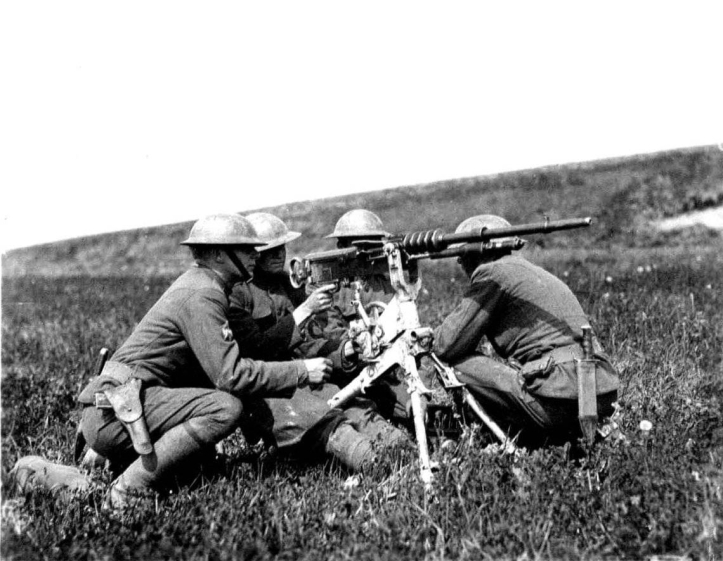
Thus it was that the French opened their stores of weaponry and began arming the Doughboys that were arriving in France by the thousands in the fall of 1917. To the regimental machine gun companies and the machine gun battalions went the M1914 Hotchkiss machine gun. The Hotchkiss was gas-actuated and air-cooled, firing an 8mm Lebel round and had to be crewed by three men, due to its weight and the need to incessantly feed 24-round strips of ammo into the gun. Its weight – 110 pounds with the tripod – caused it to usually be carried around on carts, adding to the difficulty of getting it into battle. However, U.S. machine gun battalions racked up excellent records using the Hotchkiss and even learned how to use them for laying down machine gun barrages.
U.S. troops with the Hotchkiss, 1918. (Library of Congress)
Far less popular than the Hotchkiss was the M1915 Chauchat automatic rifle. Now, the concept of automatic rifles was that there would be one auto rifle squad in each infantry platoon, giving that platoon the ability to lay down some serious suppressive fire. And it was a good concept. The problem lay in the Chauchat. It was slow, heavy, and seemed to jam at the worst possible times. The jams were not usually caused by the weapon itself, but by the magazine’s idiotic design that left half of the side open – open to the ubiquitous mud of the Western Front. Small wonder then that it jammed. However, in the hands of well-trained and meticulous soldiers, the Chauchat could be a force multiplier.
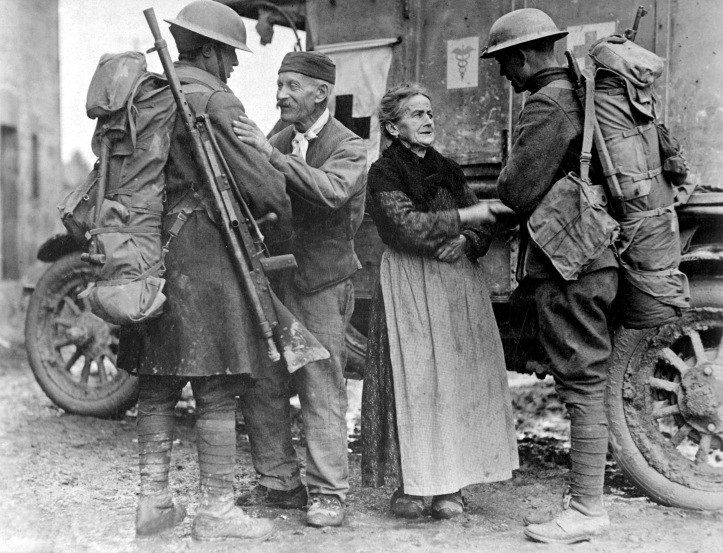
An old French couple, M. and Mme. Baloux of Brieulles-sur-Bar, France, under German occupation for four years, greeting soldiers of the 308th and 166th Infantries upon their arrival during the American advance. (Library of Congress)
Another infantry weapon adopted from the French was the Vivien and Bessières – or V-B in Doughboy parlance – rifle grenade. Fitting to the barrel of a rifle, the grenade was projected by the pressure from the bullet going off in the rifle’s chamber. V-B squads could deliver a barrage of deadly grenades on top of attackers or right before entering an enemy trench. There were, however, issues. The V-B was tooled for the French 8mm round, while the American rifles were 7.62mm. This difference sometimes caused the V-B not to go off because the 7.62mm rounds did not carry enough force. Still, the U.S. didn’t have any rifle grenades at the outbreak of war, so it was better than nothing.
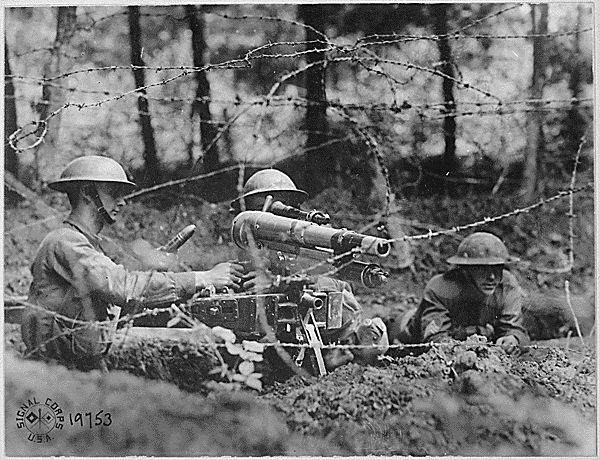
While the Americans would get their primary field mortar from the British with the Stokes Mortar (a few lucky units got the British Lewis machine gun as well, which was very effective), they got their infantry support gun from the French: the Canon d’Infanterie de 37 modèle 1916 TRP, or simply, the 37mm gun. Doughboys, not quick to be wordy, called them “one pounders.” These small guns were crewed by two men and could be quickly moved around the battlefield to knock out machine gun nests or other medium targets. Some men used them as “sniping guns,” rolling them out into No-Man’s Land, firing off thirty-five rounds in a minute, then limbering up and getting the hell out before the Germans could respond with a murderous barrage. But the 37mm was still not a field gun.
U.S. troops using a 37mm gun near Chateau-Thierry in 1918. (U.S. Army Signal Corps Photo)
Moving from the 37mm to field artillery, the two most striking French gifts to the Americans were the 75mm field piece and the 155mm field piece. The French 75 was possibly one of the most successful field guns of all time. It was deadly accurate and could keep up a high rate of fire due to the pneumatic firing device that absorbed the recoil of the gun and left the barrel sited after every shot. This alleviated the need to re-site the gun after a round was fired. U.S. troops got so proficient with the 75 that they could fire on the recoil, leading to such a high volume of fire that French advisers pulled out their hair in worry and German prisoners demanded to know where the American 75mm machine gun was. The gun even led to its own mixed drink being named for it, the French 75.
Less popular in alcoholic memory, but well-liked by the infantry who followed behind its powerful explosives was the 155mm Schneider howitzer. It provided the heavy type of barrage that Doughboys would need to break a German attack or take apart enemy entrenchments. It was a mix of old and new – pneumatic firing like the 75, but on a rickety gun carriage with wooden wheels that shook and rattled when the gun was fired. The U.S. purchased more than 1,300 of these for the American Expeditionary Force.
Along with the guns came the tanks. One tank in particular: the Renault FT-17. Since at the beginning of the war the U.S. wasn’t even thinking about tanks, they had to borrow the Renault from the French when it came time to think about a Tank Corps. The Renault was small – it could only fit two men: a driver and a commander/gunner. The commander communicated with the driver by kicking him in the head or shoulders, since the tank was so loud that the men couldn’t hear each other. And since the driver couldn’t see anything at all, this type of communication was vital. The U.S. would work on their own tank variant, with supervision by George Patton, but the war would end before it saw action. For more on the Renault, check out this War Stories Podcast.
During the war, the massive U.S. industrial machine would roll into action, turning out millions of small arms, thousands of field guns, and hundreds of tanks. But the fact remains that the first battles fought by U.S. troops in the fall of 1917 and the spring of 1918 were done so with mainly French weaponry, with some from the British. For the most part the equipment was good; but there is no doubt that fewer lives would have been lost had the U.S. fielded the Browning .30 caliber machine gun and Browning Automatic Rifle earlier in the conflict (although loss of life was more to do with poor American strategy and tactics than armaments). This shocking lack of readiness would be seen twenty-four years later, as the U.S. faced the Second World War. While the Army had a massive amount of equipment available, most of it was from the stocks of World War I – and therefore out-of-date. It would take another year and a half before the U.S. Army could begin to bring their weapons on the battlefield in parity against their enemy.
Both of these examples stand as a warning to the current U.S. Army: ignore modernization at your peril, and at the peril of thousands of lives of American service members. Because France can’t always be around to bail us out of trouble.
Enjoy what you just read? Please share on social media or email utilizing the buttons below.
About the Author: Angry Staff Officer is an Army engineer officer who is adrift in a sea of doctrine and staff operations and uses writing as a means to retain his sanity. He also collaborates on a podcast with Adin Dobkin entitled War Stories, which examines key moments in the history of warfare.
Ordinary Americans are much less hysterical than America’s elites.
Recent articles here and here by Victor Davis Hanson—my colleague at the Hoover Institution–paint a frightening picture of the United States as a country teetering on the edge of civil war. In addition to being an exceptional prose stylist, Hanson is an active combatant in today’s political wars, so his impressions are understandable. As a data guy and a noncombatant, however, I am happy to report that the available data provide grounds for feeling much more sanguine about the state of our country. Although they are noisy and harmful to our politics, the kinds of people Hanson criticizes are many fewer in number than generally believed. They are what political scientists call the political class, a small minority of self-appointed activists, demonstrators, donors, partisan media commentators and office-seekers. Given that such people are the public face of politics, many Americans understandably take them as representative, but they are statistically abnormal—what we call “outliers.”
To understand contemporary American political life, you should begin with the realization that most of the people blabbering on cable television, venting on Facebook, and/or fulminating on Twitter are abnormal. They are abnormally interested and involved in politics, they tend to occupy the policy extremes, and they are abnormally opinionated (yes, many readers of Hanson’s article and this one are probably abnormal). Consider some numbers. As of today, there are about 235 million eligible voters in the United States. About one percent of them subscribe to either The New York Times or The Wall Street Journal. Liberals rail against Fox News and conservatives against MSNBC; they should take consolation in the fact that the Fox viewing audience is about one percent of the eligible electorate while news shows on MSNBC fall short of that. Sean Hannity’s is the highest-rated political show on cable television with an audience of about 1.5 percent of the eligible electorate. On the other end of the spectrum Rachel Maddow gets a bit over one percent. Anderson Cooper 360 draws in a paltry 0.4 of one percent. Granted, these small audiences may spread the word to some non-subscribers and non-viewers, but even taking such second-order effects into account, the simple fact is that the ranks of the politically interested are surprisingly thin.
Some suggest that the internet and social media have replaced the older print and electronic media, but the available research does not support that suggestion. If “hundreds of millions of people” really were doing politics on social media, I would share Hanson’s worries, but such a claim overstates the number of social media activists by several orders of magnitude. A 2013 Facebook study that tracked Bing toolbar searches found that 96 percent of the users clicked on zero or one opinion column in a three-month period. In 2017 the Pew Research Center reported that less than four percent of adults consider Twitter an important source of news. (Twitter audiences are exaggerated, but for what it’s worth, President Trump reportedly has 53 million followers; Katie Perry has about twice that many.) Studies of fake news conclude that its impact is minimal.
Researchers have studied the concept of “filter bubbles” or “ideological silos.” This is the fear that the availability of politically slanted media outlets on the internet allows people to isolate themselves and consume only news and opinion consistent with their ideological preferences. Research like the Facebook study noted above fails to find much reason for concern, mainly because most Americans don’t search out any political news, let along limit themselves to ideologically congenial news. Other research finds that internet audiences are, in fact, less politically homogeneous than people’s face-to-face networks. In my personal experience I’ve concluded that the two kinds of people most likely to exist in ideological silos are academics and journalists.
In many respects the American electorate has changed surprisingly little in more than six decades. In 2016 about 10 percent of the eligible electorate made a campaign contribution—to any campaign at any level, the same figure as in the 1950s. Despite media hype about Obamamania in 2008 and Trump rallies in 2016, less than 10 percent of the eligible electorate attended any kind of campaign meeting or rally in those years, the same figure as six decades ago. As for people who knock on doors or make phone calls for campaigns, we are talking about two to three percent of the eligible electorate, the same small proportion as in the Eisenhower era.
Turning from interest and activity to beliefs and preferences, an examination of the ideological distribution of the American public finds that roughly 40 percent consider themselves moderates, 35 percent conservatives and 25 percent liberals. These figures are virtually the same as those from 1976, when the Democrats nominated an Evangelical Christian from Georgia and the Republicans a country club moderate from Michigan. On issue after issue the American public chooses centrist positions. The 2016 Republican platform position on abortion was “never, no exceptions. Twenty percent of the public holds that position. The Democratic platform was “anytime, for any reason.” Thirty percent of the public holds that position. The other fifty percent of the public says “sometimes, for some reasons,” a position not offered by either party.
The big change in our politics is that the parties have sorted. Historically they have been “big tents,” including disparate viewpoints and different kinds of people. But beginning in the 1960s the Democrats began shedding their conservative wing and during the Reagan era the Republicans followed suit as liberals left the party. Our parties today look like the British Labour and Conservative Parties in their heydays, except in a much larger, more heterogeneous country where two ideological parties cannot begin to represent the diversity of American public opinion.
In recent years there has been a great deal of commentary about Americans becoming tribal, adopting partisanship as an identity and attributing nothing but good to their own party and nothing but bad to the other party. One widely cited study reported that more people now even say that they would be unhappy if their child married someone from the other party. Well, in the 1950s, 75 percent of Americans claimed affiliation with either the Democratic or Republican parties; today that figure stands at only 60 percent. Numerous studies find that normal Americans are unhappy with both parties: Americans now rate the other party and their own party more negatively than they used to. Support for a third party is at an all-time high (although there is little agreement on what kind of third party). The proportion of people unhappy if their child married someone from the other party is about the same as the proportion of Red Sox fans who would be unhappy if their child married a Yankee fan or vice versa. And Democrats and Republicans agree that they would unhappy if their child married someone from their own party if that person talked about politics a lot. Partisanship has become more tribal within the political class, but considerable evidence suggests that most normal people are unhappy with that development.
How do the preceding observations square with the facts that party lines in voting seemingly have hardened? Split-ticket voting has dropped significantly, and those who have a party affiliation vote that affiliation 90 percent of the time. These developments are consistent with a hardening of partisanship but also are natural consequences of party sorting. If voters face a choice between a liberal Democrat and a conservative Republican for every office, one important reason to split your ticket or support a particular candidate from the other party has disappeared. Consider West Virginia in 2012. Republican Mitt Romney overwhelmed President Obama by almost 27 percentage points. At the same time Democratic Senator Joe Manchin thumped his Republican opponent by 24 percentage points. Did this display of massive ticket-splitting indicate that West Virginia voters were unusual, or was their opportunity to vote for a pro-gun, pro-life Democrat what was unusual today? If there were more conservative Democrats and more liberal Republicans in our states and congressional districts, party lines in voting would be less distinct.
Finally, some words about immigration, a major bone of contention between Republicans and Democrats in the political class, although surprisingly, less important than commonly believed among normal Americans. Although the U.S. is an immigrant nation, today’s emphasis on ethnic identity politics understandably leads many people to conclude that today’s immigration differs from that of previous eras, with more negative implications. But the kinds of controversies the United States now is experiencing are strikingly similar to those that accompanied earlier large waves of immigration. Hanson certainly is correct in asserting that political pressures to assimilate are much lower today, but societal pressures remain strong. The evidence indicates that despite the rhetoric of ethnic identity group activists and today’s celebration of diversity, the American melting pot continues to boil. Ongoing studies report, for example, that English language acquisition is proceeding at a rate comparable to, if not faster than, that in the early 20th Century; in particular, by the third generation Latinos are English-dominant or fully bilingual.
According to some eminent demographers, the U.S. Census Bureau has inadvertently stoked the fires of nativism with questionable projections about the United States becoming a majority-minority country by mid-century. Richard Alba strongly criticizes Census Bureau practices, noting that a child with one non-white grandparent goes into the non-white box, as will his or her children. For example, Senator Ted Cruz is half-Cuban married to an anglo white, so his daughters are one-quarter Hispanic. Under current practices in 2045 the Census Bureau will record the children of Senator Ted Cruz’ daughters as Hispanic even if they are only one-eighth Hispanic by that point. Inter-ethnic and inter-racial marriages have dramatically risen, producing increasing numbers of children of mixed-race or ethnicity. Many of them will come to identify as white, not minority. In addition, history shows that whiteness is an ever-evolving concept. In the 1840s native-born Americans did not view Irish immigrants as white; nor did they consider my Italian grand-parents to be white in 1910. Today, all the myriad ethnic groups from earlier migrations are simply “Euro-whites.”
Our country is experiencing rapid social changes that naturally create social problems and political controversies. The American citizenry has worked through these kinds of problems in the past (most recently in the 1960s) and I am optimistic that they will continue to do so, despite the efforts of members of the political class to keep political controversies alive and allow societal problems to fester. Whenever you are feel discouraged about America, turn off CNN, log off your computer, and go walk the aisles of Walmart.
Morris P. Fiorina is a senior fellow at the Hoover Institution and the Wendt Family Professor of Political Science at Stanford University.
WASHINGTON —
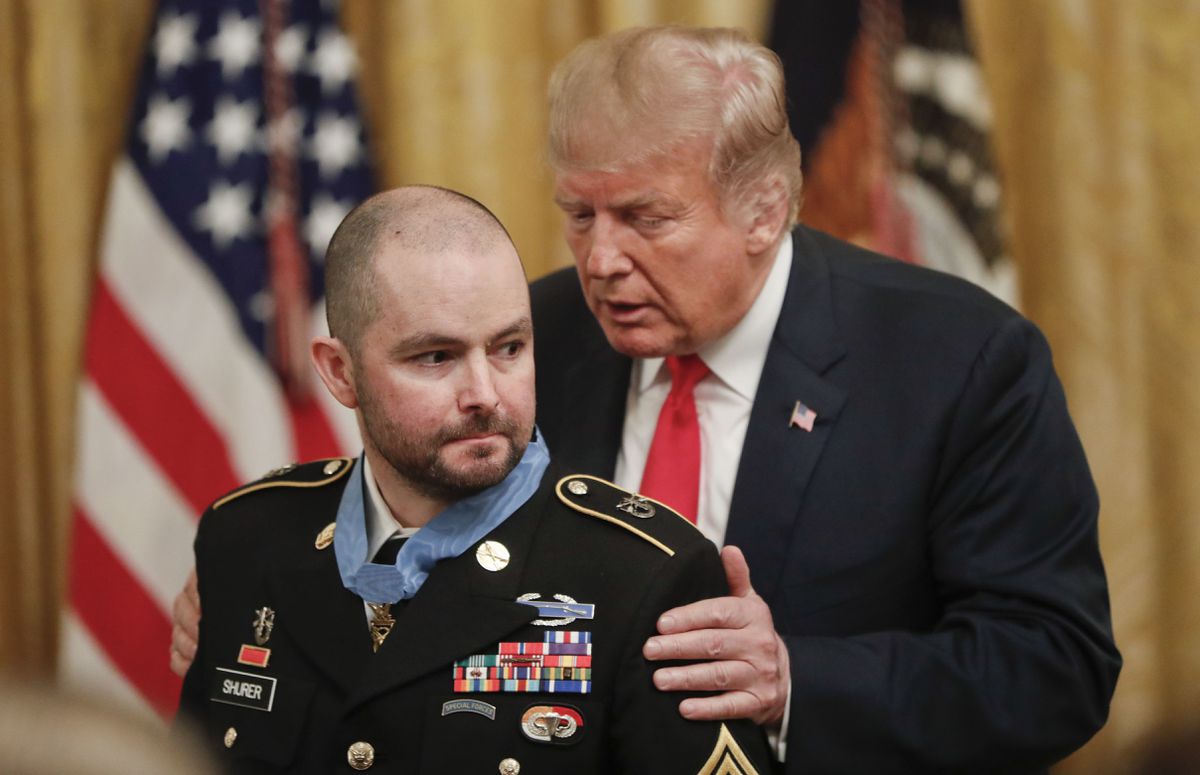
A former medic with the 3rd Special Forces Group (Airborne) who heroically fought his way up a mountain to render aid to his Special Forces teammates and their Afghan commando counterparts will receive the Medal of Honor.
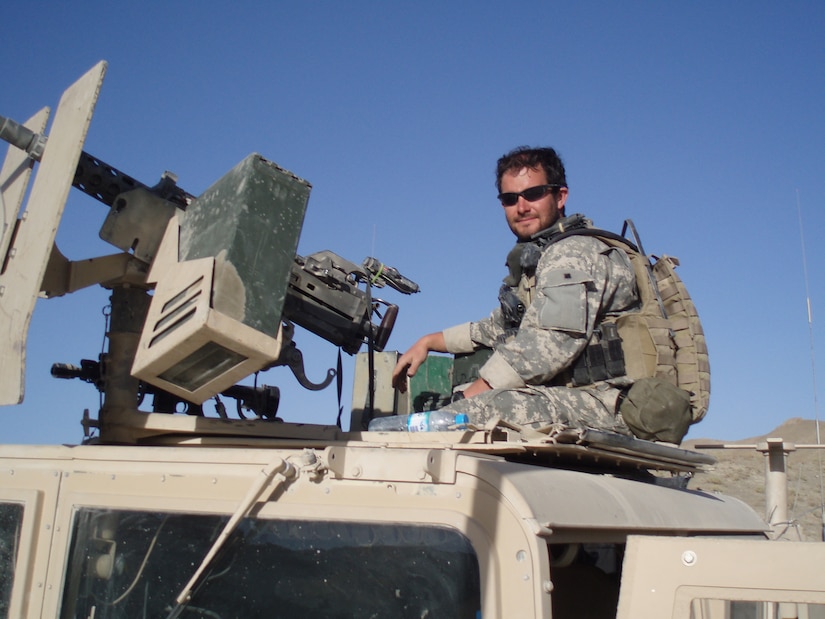
Former Army Staff Sgt. Ronald J. Shurer II will receive the Medal of Honor at an Oct. 1, 2018, White House ceremony for going above and beyond the call of duty April 6, 2008, while assigned to Special Operations Task Force 33 in Afghanistan during Operation Enduring Freedom. Photo courtesy of Ronald J. Shurer II
White House officials announced that former Army Staff Sgt. Ronald J. Shurer II went above and beyond the call of duty April 6, 2008, while assigned to Special Operations Task Force 33 in Afghanistan during Operation Enduring Freedom. He will receive the highest military award for valor at a White House ceremony Oct. 1.
In April 2008, Shurer was assigned to support Special Forces operators working to take out high-value targets of the Hezeb Islami al Gulbadin in Shok Valley.
As the team navigated through the valley, a firefight quickly erupted, and a series of insurgent sniper fire, rocket-propelled grenades, and small arms and machine gun fire forced the unit into a defensive fighting position.
Around that time, Shurer received word that their forward assault element was also pinned down at another location, and the forward team had suffered multiple casualties.
With disregard for his safety, Shurer moved quickly through a hail of bullets toward the base of the mountain to reach the pinned-down forward element.
While on the move, Shurer stopped to treat a wounded teammate’s neck injury caused by shrapnel from a recent RPG blast. Rendering Aid
After providing aid, Shurer spent the next hour fighting across several hundred meters and killing multiple insurgents.
Eventually, Shurer arrived to support the pinned down element and immediately rendered aid to four critically wounded U.S. units and 10 injured commandos until teammates arrived.
Soon after their arrival, Shurer and his team sergeant were shot at the same time. The medic ran 15 meters through a barrage of gunfire to help his sergeant.
Despite a bullet hitting his helmet and a gunshot wound to his arm, Shurer pulled his teammate to cover and rendered care.
Moments later, Shurer moved back through heavy gunfire to help sustain another teammate who had suffered a traumatic amputation of his right leg. Keeping Enemy at Bay
For the next several hours, Shurer helped keep the large insurgent force at bay while simultaneously providing care to his wounded teammates. Shurer’s actions helped save the lives of all wounded casualties under his care.
Shurer also helped evacuate three critically wounded, teammates down a nearly vertical 60-foot cliff, all while avoiding rounds of enemy gunfire and falling debris caused by numerous airstrikes.
Further, Shurer found a run of nylon webbing and used it to lower casualties while he physically shielded them from falling debris.
Shurer’s Medal of Honor was upgraded from a Silver Star upon review
____________________________________Thank God, that we can still grow such MEN! Grumpy
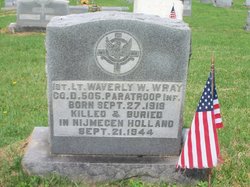
The M1 rifle was used in all theaters of combat during World War II. 1LT Waverly Wray, the airborne officer referenced at the beginning of this article, could be counted among the greatest warriors these United States could produce.
1LT Waverly Wray was born in 1919 and raised in the wooded hills around Batesville, Mississippi, perhaps a forty-five minute drive from where I sit typing these words. An expert woodsman steeped in fieldcraft from his youth, Wray was described by his commander, LTC Ben Vandervoort, thusly, “As experienced and skilled as an Infantry soldier can get and still be alive.” At 250 pounds Wray was an intimidating specimen, yet he was also a committed Christian man of character. He fastidiously eschewed profanity and sent half of his Army paycheck home each month to help build a church in his hometown.
Immediately after jumping into Normandy with the 82d Airborne, 1LT Wray set out on a one-man reconnaissance at the behest of his Battalion Commander. Wray’s mission was to assess the state of German forces planning a counterattack against the weakly held American positions outside Ste.-Mere-Eglise. Wray struck out armed with his M1 rifle, a Colt 1911A1 .45, half a dozen grenades, and a silver-plated .38 revolver tucked into his jump boot. Hearing German voices on the other side of a French hedgerow, Wray burst through the brush and shouted, “Hande Hoch!” Confronting him were eight German officers huddled around a radio.
For a pregnant moment, nobody moved. Then seven pairs of hands went up. The eighth German officer reached for his sidearm. 1LT Wray shot the man between the eyes with his M1.
A pair of German soldiers about 100 meters away opened up on Wray with MP40 submachine guns. 9mm bullets cut through his combat jacket and shot away one of his earlobes. All the while Wray methodically engaged each of the seven remaining Germans as they struggled to escape, reloading his M1 when it ran dry. Once he had killed all eight German officers he dropped into a nearby ditch, took careful aim, and killed the two distant Wehrmacht soldiers with the MP40’s.
Wray fought his way back to his company area to report what he had found, blood soaking his ventilated jump jacket. His first question was to ask where he could replenish his supply of grenades. When American forces eventually took the field where Wray had waged his one-man war against the leadership of the 1st Battalion, 158thGrenadier Regiment, they found all ten German soldiers dead with a single round each to the head. Wray had completely decapitated the enemy battalion’s leadership singlehandedly. Wray stopped what he was doing and saw to it that all ten German soldiers were properly buried. He had killed these men, and he felt a responsibility to bury them properly.
Waverly Wray survived the savage fighting in Normandy only to give his life for his country at Nijmegen, Holland, during Operation Market Garden later in the year. He has a granite marker in Shiloh Cemetery in Batesville, Mississippi, near the church he helped build. 1LT Wray was, by all accounts, an exceptionally good man who died six days before his twenty-fifth birthday. Wray died to ensure the blessings of liberty for further generations of Americans.
John Garand’s Rifle
Those who lived it have told me that there was only one M1 rifle and that it wasn’t called the Garand. The .30-06 rifle we call the Garand was the M1, the M1 Carbine was the Carbine, and the M1A1 Thompson was the Thompson. There was always only one M1.
John Cantius Garand was a Canadian-born gun designer who developed the M1 rifle in the early 1930’s. Those who knew him say that old John Cantius pronounced his name differently from the way we do. In his Canadian dialect, Garand rhymed with “Errand.”
Early versions of the M1 were gas trap designs based upon the flawed presumption that ported barrels would wear appreciably faster than the non-ported sort. This same misconception is what drove the Germans to attempt the ill-fated G41 gas trap rifle before settling on the much more reliable piston-driven G43 design. In short order, the M1 was standardized with the familiar gas piston action.
The M1 rifle soldiered on everywhere during World War II from European plains to fetid South Pacific jungles.
5.4 million of the rifles ultimately rolled out of four wartime factories. The M1 served with distinction in all services and in all theaters throughout World War II as well as the war in Korea. The weapon saw fairly widespread issue among ARVN forces early during the conflict in Vietnam as well. An M1 rifle cost the government about $85 during the Second World War. This equates out to around $1,200 today.
If properly maintained the M1 rifle offered a quantum advance in firepower over the bolt-action designs of the day.
Morphology
For all its justifiable accolades, the M1 was a flawed design. The thing weighs about ten pounds and remains exceptionally bulky, even by the standards of the day. The eight-round en-bloc clip is extremely difficult to fill by hand, and the gun is nearly 44 inches long. Ammunition typically came issued in these disposable spring steel clips. However, early in the war troops frequently had to fill their clips manually from ammo that was packed on single stack five-round Springfield clips, something that was all but impossible to do under pressure.
Despite its few warts, the M1 represented a quantum advance in firepower when compared to the bolt-action repeaters in common service at the time. Interestingly, there are anecdotal accounts of some old school soldiers trading their M1s for bolt-action 1903 Springfields early in the war in the Philippines out of distrust of the autoloading action. However, it did not take long for troops on both sides of the line to come to respect the prodigious firepower of the M1.
Practical Tactical
The M1 rifle was a big, heavy, bulky beast, but it was also reliable, accurate, and rugged. Generations of GIs came to adore the gun.
The M1 sports a unique manual of arms. The safety is a pivoting tab in the front of the trigger guard that soldiers on in modern Springfield Armory M1A rifles today. This design is comparably accessible with either hand. The rigid charging handle reciprocates with the bolt and can be manhandled or even kicked if the action gets gummy.
To put the gun into action you retract the bolt until it locks to the rear automatically. Place a loaded 8-round clip in place in the action and press it down with the thumb until it locks. The bolt will then snap shut of its own accord. One must be fairly quick to snatch the thumb out of the way lest it gets badly pinched. Troops of the day described the resulting painful injury as “M1 Thumb.”
The M1 rifle fed from an 8-round en bloc clip. This means the clip becomes part of the action when loaded into the rifle.
The M1 will fire eight rounds as fast as the trigger can be cycled. On the last round fired the action locks open and the empty clip ejects out the top making a distinctive metallic springing sound in the process. Much hay has been made that this sound might signal to the enemy that the weapon is dry. The World War II combat veterans with whom I have visited discounted this concern. They said this sound was typically lost in the bedlam of battle.
The safety on the M1 is a pivoting tab located in the front of the trigger guard. It is comparably accessible with either hand. The rigid charging handle reciprocates with the bolt.
Denouement
When I was a young buck you could get beautiful M1 rifles through the mail for $165 from the DCM delivered straight to your door. Alas, I didn’t have $165, and the paperwork requirements seemed unduly onerous. I did ultimately land a high-mileage DCM M1 some years later for a good bit more than that. My M1 sports a meticulously repaired crack to the upper handguard and the stigmata of hard use. I love the gun and would not trade it for a specimen that was new in the box. Like Waverly Wray and the other hard men who wielded these old guns to defeat tyranny around the globe, my M1 rifle has character.
A friend who landed on Omaha Beach on June 6, 1944, summed up an Infantryman’s relationship to his primary weapon better than I ever could. He once told me that for nearly a year some part of his anatomy was touching that rifle. Whether he was patrolling, sleeping, shaving, or crapping, he kept that M1 rifle close at hand no matter what.
The M1 is an innately accurate and imminently reliable battle arm. It is not unstoppable, nor does it shoot divinely straight. However, the design certainly earned the respect and legendary status it has gained over the decades. Big, fat, heavy, and mean, the M1 was a gun that quite literally saved the world.
Special thanks towww.worldwarsupply.com for the replica gear used to outfit our period paratrooper.
Technical Specifications
M-1 Garand Rifle
Caliber 7.62 x 63 mm/.30-06 in
Weight 9.5 lbs
System of Operation Gas—Semiautomatic
Length 43.6 in
Barrel Length 24 in
Feed 8 round en bloc steel clips
Sights Protected Front Blade and Adjustable Rear Aperture
____________________________________ Some more stuff I found out about this Stud of a man!
*DISTINGUISHED SERVICE CROSS Citation:
The President of the United States takes pride in presenting the Distinguished Service Cross (Posthumously) to Waverly W. Wray (0-1030110), First Lieutenant (Infantry), U.S. Army, for extraordinary heroism in connection with military operations against an armed enemy while serving with Company D, 2d Battalion, 505th Parachute Infantry Regiment, 82d Airborne Division, in action against enemy forces on 7 June 1944, in France. While his platoon was engaged in a heavy fight with the enemy, First Lieutenant Wray, completely disregarding his own safety, crawled under devastating machine gun fire and although wounded, fought on until he had destroyed two enemy machine gun positions. Returning to his platoon he reorganized it and, securing a re-supply of ammunition, led it in a successful attack upon the enemy. Only after he had driven the enemy from his platoon sector did he accept first aid for his wounds. First Lieutenant Wray’s valiant leadership, personal bravery and zealous devotion to duty at the cost of his life, exemplify the highest traditions of the military forces of the United States and reflect great credit upon himself, the 82d Airborne Division, and the United States Army.
Headquarters, First U.S. Army, General Orders No. 51 (1944)
*SILVER STAR
Rank: 1st Lieutenant (Lieutenant)
Unit: Executive Officer Company D, 505th Parachute Infantry Regiment, 82nd Airborne Division “All-American”, U.S. Army
Details: Citation unavailable.
*PURPLE HEART
Rank: 1st Lieutenant (Lieutenant)
Unit: Executive Officer Company D, 505th Parachute Infantry Regiment, 82nd Airborne Division “All-American”, U.S. Army
RIDDER VIERDE KLASSE DER MILITAIRE WILLEMS ORDE (MWO.4)
Rank: 1st Lieutenant (Lieutenant)
Unit: Executive Officer Company D, 505th Parachute Infantry Regiment, 82nd Airborne Division “All-American”, U.S. Army
Awarded on: October 8th, 1945
Action: For having distinguished himself during the fighting by the 82nd Airborne Division in the area around Nijmegen between September 17th and October 4th 1944 by having performed outstanding deeds of courage, tact and loyalty and having repeatedly displayed outstanding devotion to duty and great perseverance and in all respects having set a praiseworthy example to all in those illustrious days during which he lost his life.
Details: Royal decree no.31 Awarded posthumously.
God how I miss that old Man. While Jimmy Carter was POTUS, I never did sleep very well. (Carter was & is a good man. But he was way out of his league in the White House)
But the night Reagan was elected. I slept like a babe for the next 8 years usually! I still say that he was the last of the Adults in this country.
I just hope God has taken good cafe of him. That and Thanks Sir! Grumpy




 1LT Waverly Wray was born in 1919 and raised in the wooded hills around Batesville, Mississippi, perhaps a forty-five minute drive from where I sit typing these words. An expert woodsman steeped in fieldcraft from his youth, Wray was described by his commander, LTC Ben Vandervoort, thusly, “As experienced and skilled as an Infantry soldier can get and still be alive.” At 250 pounds Wray was an intimidating specimen, yet he was also a committed Christian man of character. He fastidiously eschewed profanity and sent half of his Army paycheck home each month to help build a church in his hometown.
 John Garand’s Rifle


 5.4 million of the rifles ultimately rolled out of four wartime factories. The M1 served with distinction in all services and in all theaters throughout World War II as well as the war in Korea. The weapon saw fairly widespread issue among ARVN forces early during the conflict in Vietnam as well. An M1 rifle cost the government about $85 during the Second World War. This equates out to around $1,200 today.


 The M1 sports a unique manual of arms. The safety is a pivoting tab in the front of the trigger guard that soldiers on in modern Springfield Armory M1A rifles today. This design is comparably accessible with either hand. The rigid charging handle reciprocates with the bolt and can be manhandled or even kicked if the action gets gummy.


 Denouement