Life expectancy is now dropping in America thanks to a culture that has created an epidemic of suicides and overdoses
Life expectancy only rose during the 20th century in America and the rest of the world, as did the material quality of life. As Americans ushered in a new century, there was optimism that life expectancy would only continue to rise in the 21st century.
That optimism was misplaced. AP reports people are offing themselves at a record pace, driving down the life expectancy in this declining nation:
The suicide death rate last year was the highest it’s been in at least 50 years, according to U.S. government records. There were more than 47,000 suicides, up from a little under 45,000 the year before.
The AFP news agency also chimed in with their own doleful statistics:
The drug overdose rate rose 9.6 percent compared to 2016, while suicides climbed 3.7 percent, said the US Centers for Disease Control and Prevention’s (CDC) National Center for Health Statistics.
The drug overdose rate is so high, more Americans die every single year than died during the totality of the 20-year long Vietnam War. Much of the problem comes from prescription opioids, and not the oft-villainized street drugs America has waged an all-out (and unsuccessful) holy war against since the 1970s.
Put these two sets of statistics together, and one can glean America’s native Anglo culture is so miserable major impacts on the population are occurring. AFP fills us in on how dire the situation is:
As a result, the average life span in America dropped to “78.6 years, a decrease of 0.1 year from 2016,” said the report.
As life expectancy has now started to decline, the geniuses at the CDC and in the mainstream media are miffed. They can’t seem to figure out why people are now killing themselves in droves and overdosing on drugs trying to escape reality.
A decrease of 0.1 years in life expectancy might not seem like much. But, it usually takes plagues or wars to bring about such a dip.
“We’ve never really seen anything like this,” said Robert Anderson, who oversees CDC death statistics. Anderson said declines like this haven’t been seen since the great flu pandemic of 1918 and World War I.
Watching the carefully polished public relations imagery America broadcasts of itself to the world, one couldn’t imagine people would be desperately grasping at something – anything – to escape the reality of living in this supposed paradise on earth.
Why would people be trying to escape by taking massive quantities of drugs and/or putting their head in a noose?
I’ll tell you why. Anglo culture, quite simply is a living hell. The America the world sees on TV is nothing but a lie. The reality: People are overworked, undersexed, bombarded with divisive politics around the clock, micromanaged by not only a Nanny State but overbearing corporate policy, fed a steady diet of trashy food, brainwashed into chasing illusions they can never make into reality, buried under a mountain of debt they can never pay off, suffering a sustained decline in their standard of living, witnessing a breakdown of the family and local communities the likes of which the world has never seen, and are now being told male and female genders are a thing of the past.
This, on top of having their entertainments limited to shopping, eating out, porn, and Netflix. Oh, and living in a police state morphing into a panopticon surveillance state in which everything has been made illegal except going to work, paying taxes, and doing exactly what you’re told when you’re told to do it. A nation where Big Brother is increasingly always watching.
Like those who commit suicide or overdose on drugs, all I can think about is a way out of this place when I’m here. When I’m back in what many of us call “The Matrix” scraping out some money to leave for happier destinations abroad, I frequently find myself murmuring, “I hate this fucking place.” Perhaps because I know there are better places. Most Americans don’t. They’re brainwashed into believing this dystopia is the best the world has to offer. It ain’t, folks. You really need to fucking get out more.
Meantime, those of us who know something is very, very wrong with this culture are being proven right by such statistics. Rather than saying this nation might need to ease up on people and let them reclaim some of their lives and freedom, we instead are treated to more boilerplate from the CDC. Boilerplate that offers no viable solutions:
“We are losing too many Americans, too early and too often, to conditions that are preventable,” Dr. Robert Redfield, the CDC’s director, said in a statement.
Redfield laments the problem but points no fingers. The CDC is located at the intersection of the corporate-government complex, so don’t expect them to say slave-driving corporations and a tyrannical government are the root causes of such widespread misery.
Unfortunately, statistics painting such a grim picture aren’t blips on the radar, either. A long-term downward trend in life expectancy is beginning. Continuing from AFP:
Overall, the statistics show a “downward trend in life expectancy since 2014,” a time period in which Americans have lost 0.3 years of life, he told AFP, describing the trend as “very concerning.”
At least one so-called “expert” echoes our claims about how miserable America has become:
CDC officials did not speculate about what’s behind declining life expectancy, but Dr. William Dietz, a disease prevention expert at George Washington University, sees a sense of hopelessness.
Financial struggles, a widening income gap and divisive politics are all casting a pall over many Americans, he suggested. “I really do believe that people are increasingly hopeless, and that that leads to drug use, it leads potentially to suicide,” he said.
Did you notice Dietz equates money with happiness, like a true ‘Murican who can’t see past the economy. He, like so many lost souls equates getting and spending money on worthless junk and poorly made restaurant meals as the be all, end all of existence. Indoctrination works.
Happiness is deeper than dollars and cents, bro. And doesn’t come from voting the right candidates into office, either. But, Dietz is right about one thing. I feel hopeless when I’m here. Do you?
All it took for me to feel happy and whole again was a recent 10-day trip out of Anglo America to my oasis of humanity in the Old World culture of Latin America. The year I spent living abroad and the months I’ve spent in South America and Asia are the happiest memories of my adult life. I’ve often wondered, if I didn’t have that release in my life – the female attention in particular – would I have ended up one of the statistics in this report?
I wrote this article while sitting in a hotel room in Madrid contemplating how I got here. I was visiting the Spanish and Portuguese militaries as part of my experience in the Army’s Schools of Other Nations (SON) Program. I have spent the last nine months studying at the Colombian Superior School of War, and I sometimes pinch myself to make sure I am not dreaming.
In 2007, if you told 2LT Player, a “CHEMO” for 3-7 Field Artillery, what the next decade would look like, he would have told you to stop teasing him because he had to finish the USR.
I am confident about what he would have said, because I am him, just ten years later. However, in the next ten years, I served in multiple leadership positions at the platoon and company level. I also served in a joint special operations unit, taught ROTC, and was selected to attend a foreign service’s ILE.
I arrived at my first assignment at Schofield Barracks with doom and gloom ringing in my ears. During my Basic Officer Leader Course, my small group leader told me that as a 74A headed to the 25thInfantry Division, I most likely would not have a chance to lead and it would be a constant struggle to be viewed as a serious professional.
Fortunately, the battalion operations officer changed my outlook during our initial counseling session. He listened intently as I told him my concerns of being “stuck on staff” and my desire to lead a platoon. He said: “There is no such thing as a bad branch, only bad officers.”
He went on to say that if I wanted to lead Soldiers, I needed to demonstrate my leadership potential by performing well. He had a good point. In the Army, we do not always have control over duty assignments, but we have complete control over our performance. I committed myself to earning the right to lead Soldiers and developing the skills and attributes required for success.
As a result, I discovered what I consider the “Eight Essential Characteristics of Officership.” LEAD
Leadership is more than knowing where you are, where you want to go, and how you are going to get there. Leading includes inspiring others to take the journey with you.
All officers are leaders, regardless of duty position. You must be ready to make decisions, move the mission forward, and lead by example.
Great leaders never ask a subordinate to make a sacrifice that he or she is not willing to make. If we hold ourselves to the same standard that we hold our Soldiers, they will strive to meet or exceed that standard. LISTEN
Keep an open mind and seek advice. Every team has experienced members that are an extremely valuable resource.
These team members can provide historical examples of past issues and help guide your decisions. But first, you must be approachable and willing to listen. SUPPORT YOUR COMMANDER
An officer who understands mission command and commander’s intent is worth 10 officers who don’t. When you are given a legal and lawful order, execute and stay within your limits.
When a commander decides on a course of action, it is not your place to second guess. We advise and make recommendations, commanders make decisions and assume the risks. LEARN AND IMPROVE
Superior leaders are acutely aware of their strengths and weaknesses. They actively build on their strengths and improve upon their weaknesses.
Complacency is a fatal leadership flaw and we should never find comfort in remaining stagnant. This goes for every aspect of the profession of arms. Make realistic and achievable goals and then work to achieve them. REQUIRE MINIMUM SUPERVISION
Officers who require constant oversight are detrimental to high op tempo organizations that operate in complex environments.
Valuable members of the team understand their responsibilities and execute with little supervision. Asking for the occasional azimuth check is important, but don’t inundate your boss with questions you should be able to answer yourself. COUNSEL SUBORDINATES
Counseling is the most important tool that leaders have at their disposal. Clearly communicating expectations and standards provides a baseline for measuring performance and ensures that both the rater and rated officer understand expectations.
This is especially important when managing your rater profile and justifying the contents of evaluation reports for both officers and NCOs. ENSURE THE SUCCESS OF YOUR SUBORDINATES
Leaders who take a genuine interest in their subordinates will see their teams achieve amazing feats. This goes hand in hand with counseling.
You must get to know your Soldiers and help them personally and professionally. Find out their goals and help develop a plan to achieve them. If you take care of your Soldiers, they will always take care of the mission. BE A STUDENT OF HISTORY
As a professional, you must immerse yourself in your profession. Military history is full of lessons and examples that you can compare to your situation.
“Top block” officers read history and apply it regularly in their work. Taking the time to learn from the past will increase your ability to answer the tough questions when they arise.
While the above list is by no means comprehensive, Officers who adhere to these principals will be given the opportunity for increased responsibility.
The Army needs and rewards good leaders. If you strive to be a true professional, take care of your Soldiers, and solve problems within the commander’s intent, your branch won’t matter. You will have an amazing Army Story, even as a “CHEMO.” Major Nathan Player is currently a student at the Superior School of War in Bogota Colombia. He is assigned to 3rd Special Forces Group at Fort Bragg following graduation. He has 13 years of combined enlisted and officer service, has commanded at the O3 Level, and has served in various Joint Staff and professional education assignments.
Just so you know what the Weasels record really is & not what they say! Grumpy
2018 CANDIDATE RATING SCORECARD
Candidates who have established a voting record, either in the office for which they are running or in another elected office, are evaluated primarily based on that voting record. However, sponsorship of pro or antigun legislation and other such factors can affect their grade.
If an incumbent or challenger has not established a voting record or demonstrated his or her position in some other way, that candidate is evaluated on his or her responses to the GOA 2018 Federal Candidate Questionnaire or public statements.
Every candidate, whether an incumbent or challenger, begins with an “A” and is then downgraded for each antigun position or vote.
A+ Pro-Gun Leader: introduces pro-gun legislation. A – A- Pro-Gun Voter: philosophically sound. B – B- Pro-Gun Compromiser: generally leans our way. C – C- Leans Our Way: occasionally.
D – D- Leans Anti-Gun: usually against us. F Anti-Gun Voter: a philosophically committed anti-gunner. F- Anti-Gun Leader: outspoken anti-gun advocate who carries anti-gun legislation. NR Not rated: Refused to answer his or her questionnaire; no track record.
Now I had been very lucky in my time in Mr Reagan’s Army. As I had for the most part had some pretty good Leadership. But this guy if half the stuff about him is true. Was leagues ahead of them.
It just goes to show, that when the shit hits the fan. Usually Folks like him show up and lead the way.
RIP Sir, as you really earned your pay! Grumpy
When the United States Army Went to War Armed with French Weapons
France. What a silly place, am I right? They eat frogs, they’re on their, like, millionth government since the Revolution, and they keep needing us ‘Muricans to save them during world wars. Well, that is one way of viewing the Franco-American narrative, I suppose, if one were to overlook the incredibly vital French aid during the American Revolution (thousands of troops, a Navy, and literally tons of weapons) and all the French thinkers that influenced the Founding Fathers.
And then there’s that little problem of the U.S. Army using mainly French weapons when it entered World War I.
“But ASO, surely it was only a few weapons, right?” the interlocutor might ask. Sure, gentle reader, just a few weapons: just several hundred thousand automatic rifles, machine guns, grenades, artillery pieces, and tanks. That’s all.
“But how could this happen?” the astonished reader asks.
Simple. It’s what happens when you build a small Army – less than 200,000 men – meant for fighting small wars on small islands and entirely neglect modernization.
On April 6, 1917, when the U.S. declared war on Imperial Germany, the U.S. Army had about 200,000 Soldiers on active service, approximately 80,000 of which were National Guardsmen called up for the 1916 Mexican Border Expedition. Getting the Army up to size wasn’t the problem; with authority of the National Defense Act of 1916, the President and Congress could call up the approximately 350,000 Soldiers in the National Guard and institute the draft. No, the problem was how to arm these Soldiers.
Once upon a time – back in the Spanish-American and Civil Wars – this wasn’t too big of an issue. Regular troops were augmented by units of U.S. Volunteers, most of whom were armed by their states or from stores of small arms kept by the Federal government in arsenals across the country. But that was back when war was relatively simple and you could equip infantry units with weapons like the muzzle-loading 1861 Springfield or the 1873 Springfield trapdoor rifle. With 1,000 men to a regiment, it was pretty simple to do the math: 1,000 rifles, some tents, a small wagon train, a blacksmith forge, and travelling kitchens would get you what you needed. Not so in 1917.
The first problem was force structure. The National Defense Act of 1916 had changed the organization of infantry regiments to reflect the changing nature of war: they now had machine guns and automatic rifles. Further, General John Pershing – Commander of the American Expeditionary Forces – added even more weapons to the list in 1917 to increase a regiment’s lethality: Stokes mortars, 37mm light field guns, and grenade launchers affixed to rifles. He also flexed infantry regiments up to a wopping 3,200 men, arranged in three battalions. The infantry regiment formed the core of Pershing’s main functional maneuver element: the division. Each division contained four infantry regiments, three field artillery regiments, three machine gun battalions, one regiment of engineers, and battalions of support troops. Each of these divisions contained 28,000 men. That was a lot of men to equip. Indeed, the first four divisions to arrive in France in the fall of 1917 -the 1st, 26th, 2nd, and 42nd – numbered over 112,000 men; this was over half the size of the Regular Army when war had been declared. There were simply too many men who needed arms and equipment.
The other problem was modernization. The Army was just not ready for the modern age. Their machine-gun was still the 1895 Browning, nicknamed the “potato digger” because its recoil drove it into the ground. The Army’s field guns were still of Spanish-American War vintage. The 1903 Field Gun was actually quite good, but had been stuck in the development stage for nearly two decades. The Browning Company had manufactured a new machine gun and automatic rifle, but there were barely any models of these excellent weapons on hand when war was declared, and it would take over a year for them to actually get pushed to France in any numbers that would matter. The service’s main rifle, the M1903 Springfield, was excellent, but was also lacking in numbers. Facing the daunting task of equipping the first four divisions to head to France, the War Department turned to its allies for help.
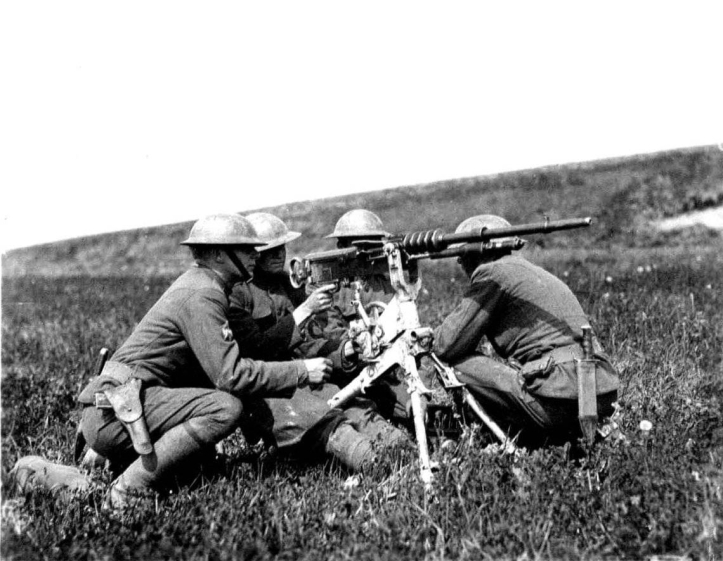
Thus it was that the French opened their stores of weaponry and began arming the Doughboys that were arriving in France by the thousands in the fall of 1917. To the regimental machine gun companies and the machine gun battalions went the M1914 Hotchkiss machine gun. The Hotchkiss was gas-actuated and air-cooled, firing an 8mm Lebel round and had to be crewed by three men, due to its weight and the need to incessantly feed 24-round strips of ammo into the gun. Its weight – 110 pounds with the tripod – caused it to usually be carried around on carts, adding to the difficulty of getting it into battle. However, U.S. machine gun battalions racked up excellent records using the Hotchkiss and even learned how to use them for laying down machine gun barrages.
U.S. troops with the Hotchkiss, 1918. (Library of Congress)
Far less popular than the Hotchkiss was the M1915 Chauchat automatic rifle. Now, the concept of automatic rifles was that there would be one auto rifle squad in each infantry platoon, giving that platoon the ability to lay down some serious suppressive fire. And it was a good concept. The problem lay in the Chauchat. It was slow, heavy, and seemed to jam at the worst possible times. The jams were not usually caused by the weapon itself, but by the magazine’s idiotic design that left half of the side open – open to the ubiquitous mud of the Western Front. Small wonder then that it jammed. However, in the hands of well-trained and meticulous soldiers, the Chauchat could be a force multiplier.
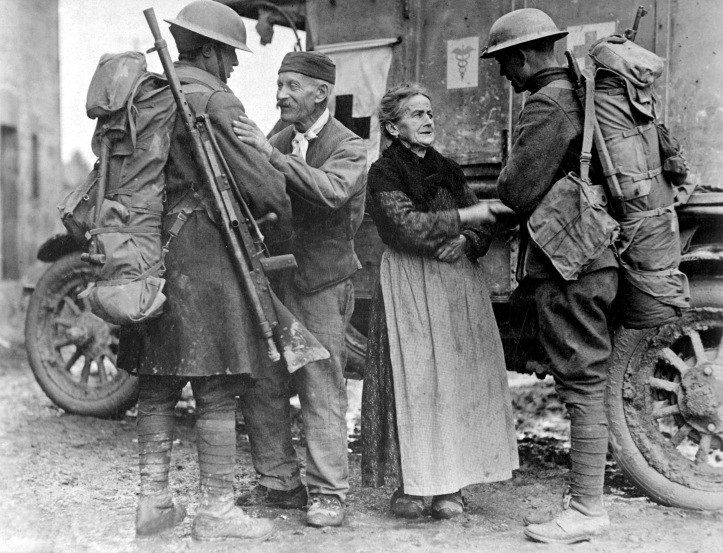
An old French couple, M. and Mme. Baloux of Brieulles-sur-Bar, France, under German occupation for four years, greeting soldiers of the 308th and 166th Infantries upon their arrival during the American advance. (Library of Congress)
Another infantry weapon adopted from the French was the Vivien and Bessières – or V-B in Doughboy parlance – rifle grenade. Fitting to the barrel of a rifle, the grenade was projected by the pressure from the bullet going off in the rifle’s chamber. V-B squads could deliver a barrage of deadly grenades on top of attackers or right before entering an enemy trench. There were, however, issues. The V-B was tooled for the French 8mm round, while the American rifles were 7.62mm. This difference sometimes caused the V-B not to go off because the 7.62mm rounds did not carry enough force. Still, the U.S. didn’t have any rifle grenades at the outbreak of war, so it was better than nothing.
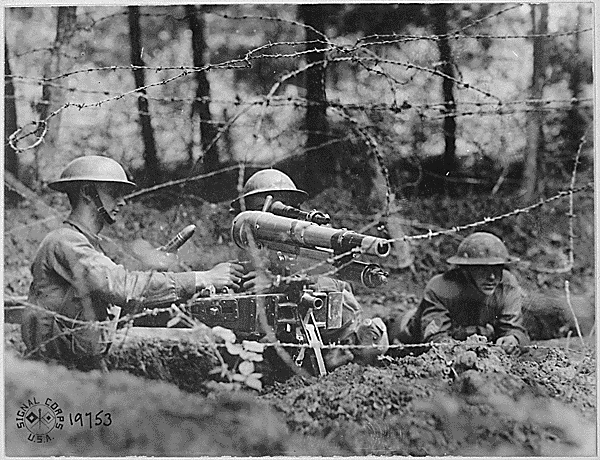
While the Americans would get their primary field mortar from the British with the Stokes Mortar (a few lucky units got the British Lewis machine gun as well, which was very effective), they got their infantry support gun from the French: the Canon d’Infanterie de 37 modèle 1916 TRP, or simply, the 37mm gun. Doughboys, not quick to be wordy, called them “one pounders.” These small guns were crewed by two men and could be quickly moved around the battlefield to knock out machine gun nests or other medium targets. Some men used them as “sniping guns,” rolling them out into No-Man’s Land, firing off thirty-five rounds in a minute, then limbering up and getting the hell out before the Germans could respond with a murderous barrage. But the 37mm was still not a field gun.
U.S. troops using a 37mm gun near Chateau-Thierry in 1918. (U.S. Army Signal Corps Photo)
Moving from the 37mm to field artillery, the two most striking French gifts to the Americans were the 75mm field piece and the 155mm field piece. The French 75 was possibly one of the most successful field guns of all time. It was deadly accurate and could keep up a high rate of fire due to the pneumatic firing device that absorbed the recoil of the gun and left the barrel sited after every shot. This alleviated the need to re-site the gun after a round was fired. U.S. troops got so proficient with the 75 that they could fire on the recoil, leading to such a high volume of fire that French advisers pulled out their hair in worry and German prisoners demanded to know where the American 75mm machine gun was. The gun even led to its own mixed drink being named for it, the French 75.
Less popular in alcoholic memory, but well-liked by the infantry who followed behind its powerful explosives was the 155mm Schneider howitzer. It provided the heavy type of barrage that Doughboys would need to break a German attack or take apart enemy entrenchments. It was a mix of old and new – pneumatic firing like the 75, but on a rickety gun carriage with wooden wheels that shook and rattled when the gun was fired. The U.S. purchased more than 1,300 of these for the American Expeditionary Force.
Along with the guns came the tanks. One tank in particular: the Renault FT-17. Since at the beginning of the war the U.S. wasn’t even thinking about tanks, they had to borrow the Renault from the French when it came time to think about a Tank Corps. The Renault was small – it could only fit two men: a driver and a commander/gunner. The commander communicated with the driver by kicking him in the head or shoulders, since the tank was so loud that the men couldn’t hear each other. And since the driver couldn’t see anything at all, this type of communication was vital. The U.S. would work on their own tank variant, with supervision by George Patton, but the war would end before it saw action. For more on the Renault, check out this War Stories Podcast.
During the war, the massive U.S. industrial machine would roll into action, turning out millions of small arms, thousands of field guns, and hundreds of tanks. But the fact remains that the first battles fought by U.S. troops in the fall of 1917 and the spring of 1918 were done so with mainly French weaponry, with some from the British. For the most part the equipment was good; but there is no doubt that fewer lives would have been lost had the U.S. fielded the Browning .30 caliber machine gun and Browning Automatic Rifle earlier in the conflict (although loss of life was more to do with poor American strategy and tactics than armaments). This shocking lack of readiness would be seen twenty-four years later, as the U.S. faced the Second World War. While the Army had a massive amount of equipment available, most of it was from the stocks of World War I – and therefore out-of-date. It would take another year and a half before the U.S. Army could begin to bring their weapons on the battlefield in parity against their enemy.
Both of these examples stand as a warning to the current U.S. Army: ignore modernization at your peril, and at the peril of thousands of lives of American service members. Because France can’t always be around to bail us out of trouble.
Enjoy what you just read? Please share on social media or email utilizing the buttons below.
About the Author: Angry Staff Officer is an Army engineer officer who is adrift in a sea of doctrine and staff operations and uses writing as a means to retain his sanity. He also collaborates on a podcast with Adin Dobkin entitled War Stories, which examines key moments in the history of warfare.


 Words fail me on how to express my admiration for this guys guts and courage! Grumpy